


 by Tom Gurney
Tom Gurney BSc (Hons) is an art history expert with over 20 years experience
Published on June 19, 2020 / Updated on November 29, 2026
Email: tomgurney1@gmail.com / Phone: +44 7429 011000
Overview
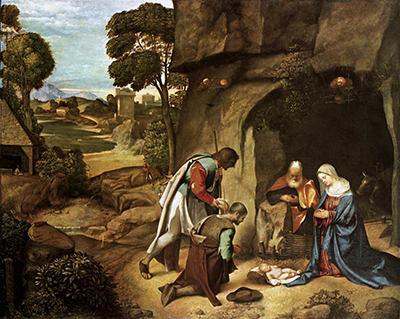
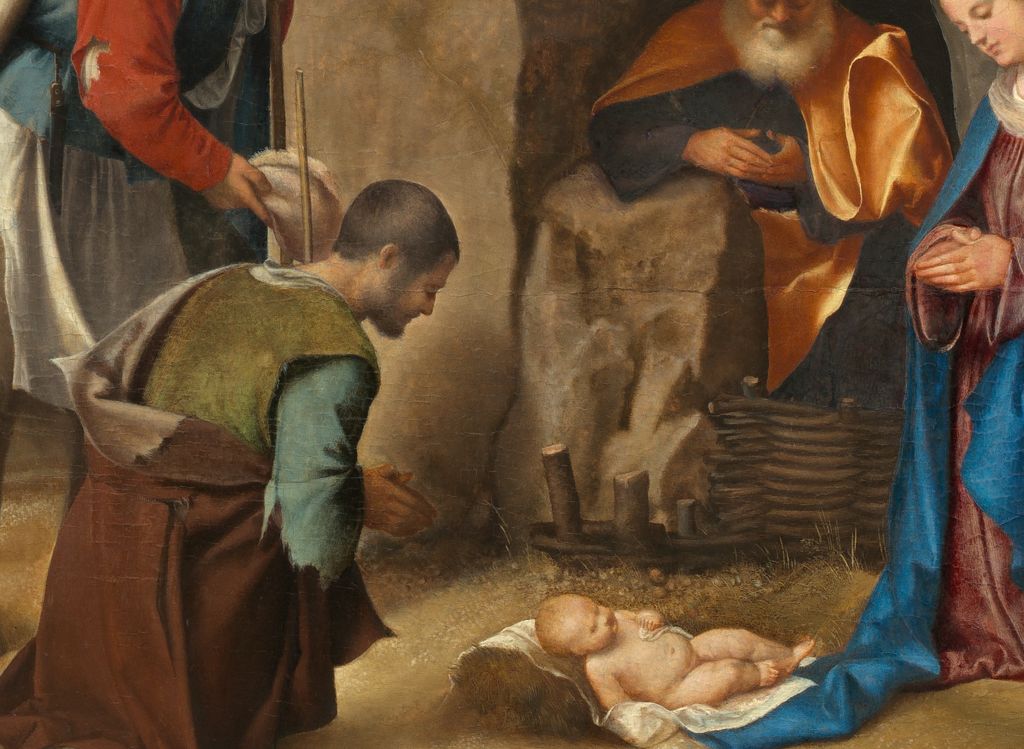
A bent shepherd brings his clasped hands down almost to the level of the infant. The other man is still lowering himself. Neither has reached the little patch of white cloth on which the child lies. In Giorgione's Adoration of the Shepherds, their arrival takes place at the edge of a dark, rocky shelter above a valley. The National Gallery of Art in Washington dates the oil on panel to around 1505–10. Just over a metre wide, it is sometimes called the Allendale Nativity after the British family that owned it for several generations. [1]
At a Glance
- Datec.1505–10
- CollectionNational Gallery of Art, Washington
- AttributionGiorgione
- Inventory1939.1.289
Four adults at the cave
The people occupy a relatively shallow piece of ground. A shepherd kneels almost in profile with his worn clothing pulled close at the shoulder. Behind him a second shepherd bends, keeping his back high while lowering his head. Their staffs belong to the working life they have stepped out of for this moment. Mary's blue mantle makes a broad, heavy shape beside the child. Joseph, who sits farther back with softened eyes, wears a golden robe that remains visible against the deep shadow. The adults' eyes converge on the infant, but the folds of their clothes, the different heights of their heads and the uneven bank keep the group from falling into a symmetrical arrangement. [1]
The meeting depends on a difference in height that is easy to forget in a reproduction. A standing spectator can take in the heads right away. To see what the figures see, one must look down past their clothed forms to a small nude body. The child lies uncovered in a place where we would expect to find a little bedding. The white beneath him is just enough to keep him distinct from the earth. His exposure makes the painted gestures feel protective, even though nobody has yet reached out to pick him up. The shepherds' hands are occupied with prayer and the adults beside him share their concentration. [1]
The composition has the dramatic scale of an encounter without much spectacle. Its lit fabrics are restrained enough that they never draw the eye entirely away from the faces. A very small winged figure appears at the upper left, well outside the gathering. That change of scale allows the supernatural presence to enter almost as an incident in the sky. The people below find the child as they would find a person in need of shelter. Their bodily responses allow the viewer time to consider what recognition might have meant to them. [1]
A valley that continues beyond the story
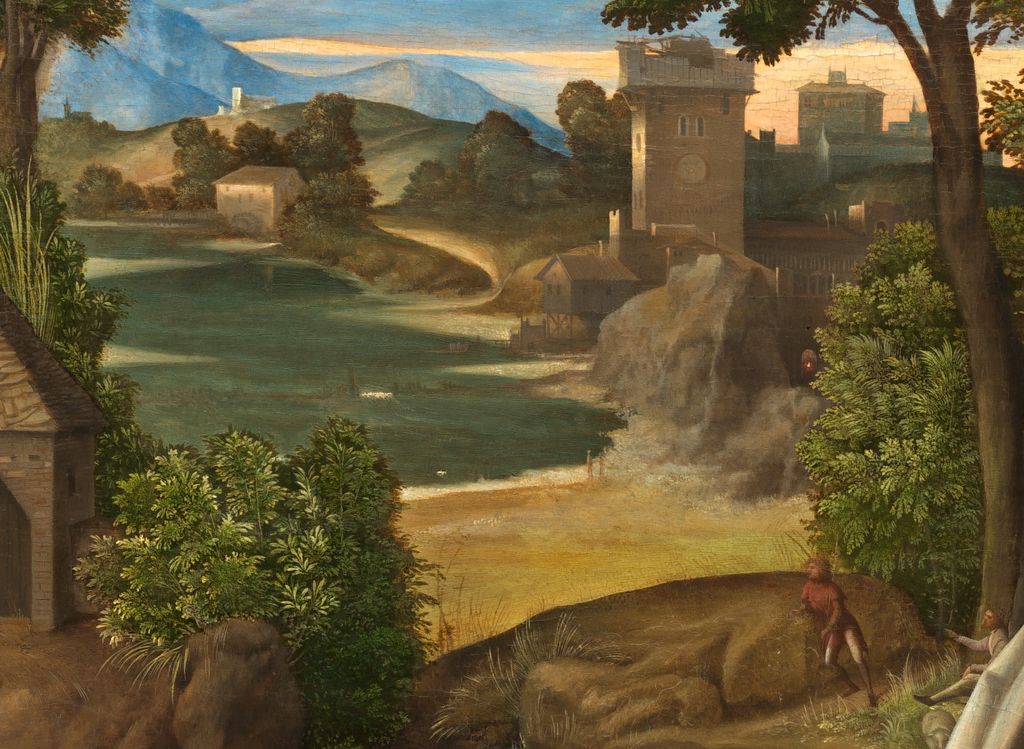
The cavern presses close to the figures and almost closes off the sky on the right. At the left the land opens into a deep view with water, buildings, a rise of green ground and distant mountains. The recession is particularly palpable near the water and the smaller buildings. You can move from the small stones in the foreground to the buildings and then to the cooler forms near the horizon. In the cave the same eye comes up against a vertical wall of darkness, a surface against which Mary and Joseph appear almost as brightly lit as the land across the picture. [1]
The exposed ground at the visitors' feet is less dramatic than the horizon, but it helps to make the transition work. Conservator Jill Dunkerton noticed that the pebbled foreground of Giorgione's Sunset has parallels here, in The Tempest and in The Adoration of the Kings. The observations were part of a larger investigation into which passages of The Sunset could be associated with the early painting and which had been altered during later treatment. Here they give us a detail to look for in an area a viewer might usually pass over. Small touches can bring the nearest ground into focus without a hard border where it passes into deeper space. A resemblance between details is one strand of comparison among the many needed to assess these pictures. [1] [2]
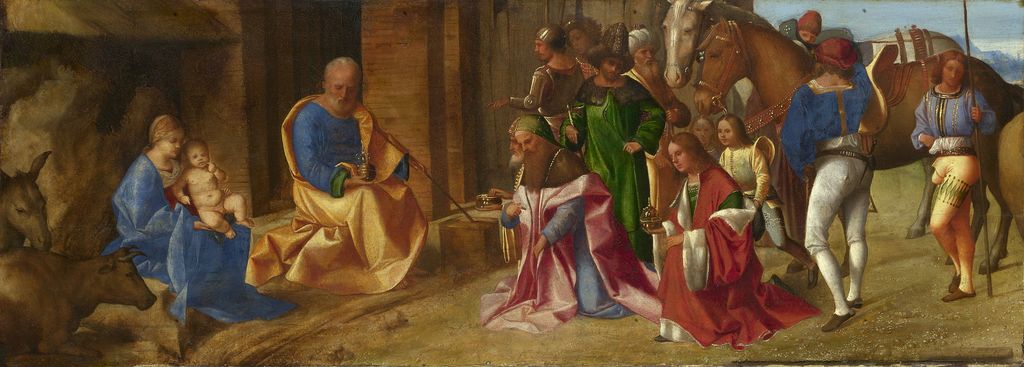
The places across the valley could feel familiar to an early viewer from the Veneto. No original commission identifies them as an exact landscape. The city and cultivated country matter for the action even viewed simply as a lived-in world. Someone could approach along a path from a field and find this family on their way. The effect differs from the London Adoration of the Kings, where layers of clothing, horses and assistants occupy the route toward the child. At Washington the far-off signs of ordinary activity remain distant. A pair of strangers with staffs has come forward from the world to which the valley belongs. [1] [3]
A second Adoration in Vienna
The Kunsthistorisches Museum keeps another Adoration of the Shepherds, inventory GG 1835, on a poplar panel measuring 91 by 115 centimetres. Its German entry presents it as an unfinished repetition of the Washington composition and identifies Giorgione in the workshop field. It dates the panel to around 1510. These are separate surviving objects of similar scale. The Washington dimensions, 90.8 by 110.5 centimetres, are worth keeping in view when comparing one with the other. A photograph cropped to its picture edges can make the two seem the same size or mask the difference in proportions. [1] [4]
An early document increases the stakes of the comparison. After Giorgione died, Isabella d'Este tried to get a night scene she believed he had painted. Her Venetian correspondent Taddeo Albano reported more than one picture and associated one with the collector Taddeo Contarini. Vienna gives a possible Contarini ownership in 1510, with an explicit question mark. Scholarship has explored the Washington and Vienna pictures in relation to the correspondence, including the reference to an unfinished work. The identity of the pictures in the letter remains a historical question. The dark shelter at Washington and the glow on the land make the association intelligible without settling which work Isabella heard about. [4] [5]
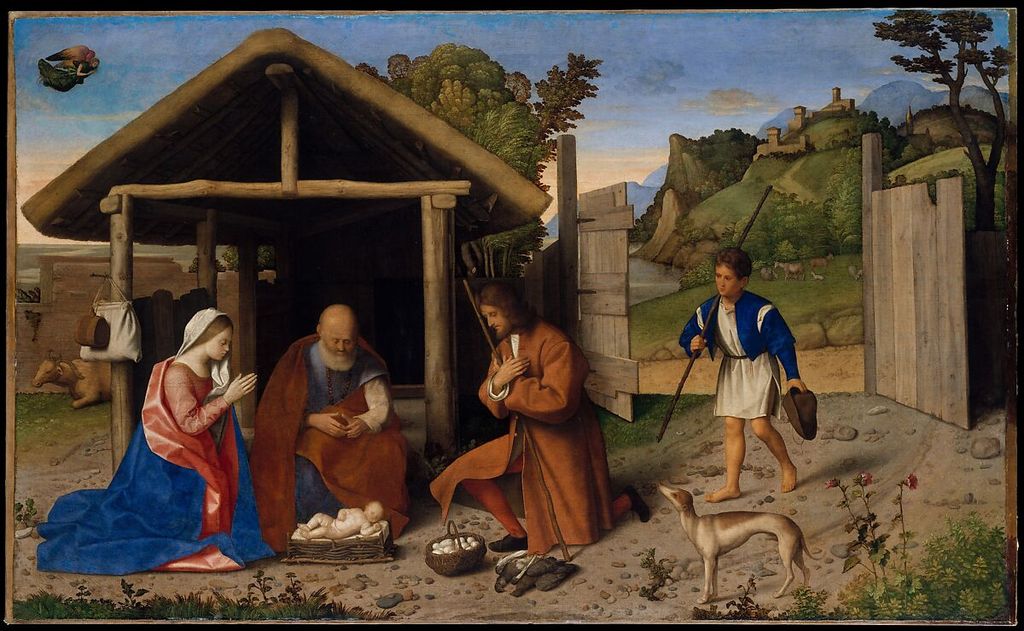
Around a generation later, Vincenzo Catena treated the subject in the panel now in the Metropolitan Museum of Art. The Met dates it probably after 1520. Keeping both works in sight helps to distinguish the familiar devotional act of kneeling to greet the child from Giorgione's unusually forceful pairing of a close cave and a valley opening into immense distance. The visible similarities belong to a shared subject and to Venetian ways of placing a holy encounter in a landscape. Catena's picture is a separate work with its own arrangement and should be read on those terms. [1] [6]
From Rome to the Kress Collection
The Washington painting can be followed securely through a much later history. It belonged to Cardinal Joseph Fesch in Rome and figured in his posthumous sale in 1845. After a sale in London in 1847 it passed to Thomas Wentworth Beaumont and then to successive generations of the Beaumont family, including its titled Allendale owners. The name by which the work is known therefore tells us where it spent part of its modern life. The naming convention has also spread to a group of pictures that scholars compare with it, including the small Holy Family in Washington. Neither the family name nor the group label establishes a common original patron. [1] [3] [7]
The Duveen firm bought the painting in 1937. The NGA dates its sale to the Samuel H. Kress Foundation to 1938 and the Foundation's gift to 1939. At the time the attribution carried particular consequences. Bernard Berenson thought the picture early Titian, and the dealer Joseph Duveen backed Giorgione. Nicholas Penny's National Gallery catalogue research records preliminary doubt on the part of Kenneth Clark in London and his subsequent support for Giorgione. The National Gallery of Art today gives the picture to Giorgione and notes the wide acceptance of that judgement. The disagreement is part of the object's history, especially the conditions under which it crossed the Atlantic. [1] [5] [7] [8]
Return to the spot between the kneeling man and the white cloth. It leaves barely enough room for the shepherd to lean farther forward. The view to the left lets us imagine a much longer journey. Between those two very different measures of space lies one of the picture's quietest achievements. The people have gone as far as they need to go. The terrain beyond them still seems wide enough to walk into. [1]
Annotated Details from Adoration Of The Shepherds
Select a point to see its detail.
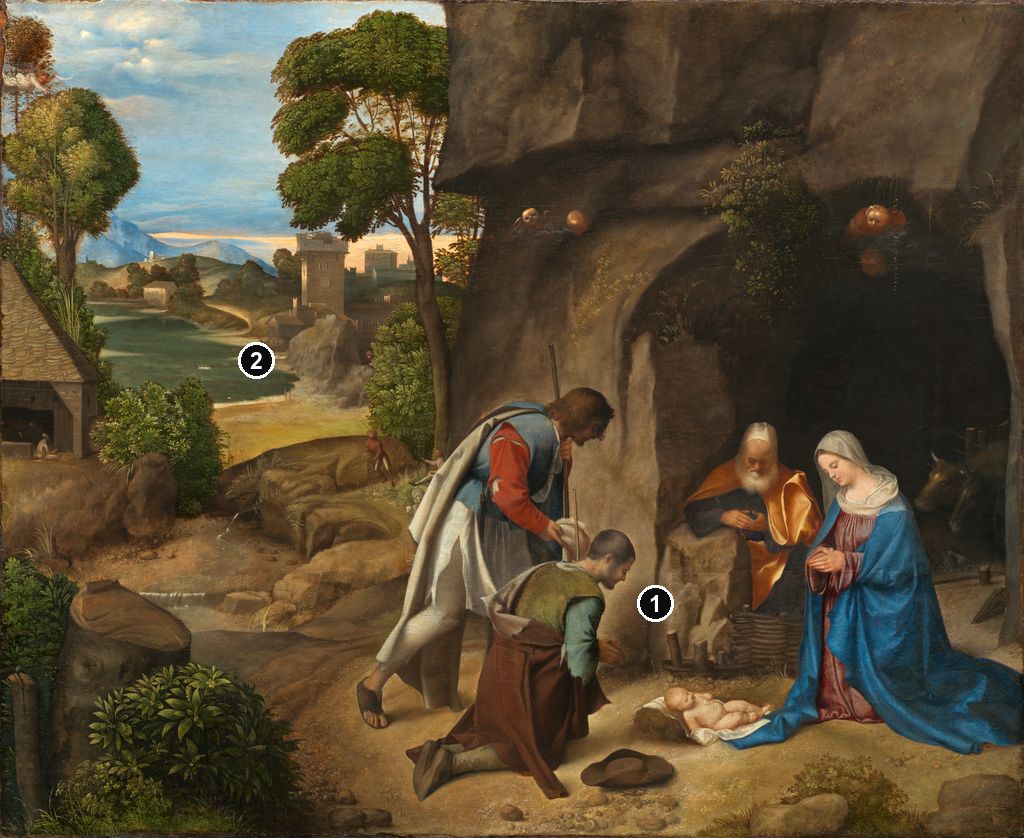
1. The kneeling shepherd · 2. The open valley
Details from ADORATION OF THE SHEPHERDS
Detail crops from the same image.
The kneeling shepherd
The figure leans toward the child as his companion begins to lower himself.
The open valley
Cooler and smaller forms lead toward a river and a distant settlement.
Giorgione’s career
Castelfranco Madonna
Early 1500sFondaco dei Tedeschi
1507–08Three Philosophers
1508–09Death in Venice
1510Discussion
Share what you noticed and how you arrived at your reading.
Reader Insights
Which detail would you point out to somebody seeing The Adoration of the Shepherds for the first time?
How does from Rome to the Kress Collection change how you read the work?
Join the Conversation
Share a detail, comparison or question about The Adoration of the Shepherds below.
References
- National Gallery of Art, Washington, The Adoration of the Shepherds, 1939.1.289. View source.
- Jill Dunkerton, National Gallery Technical Bulletin, Giorgione and not Giorgione: The Conservation History and Technical Examination of Il Tramonto. View source.
- National Gallery, London, The Adoration of the Kings, NG1160. View source.
- Kunsthistorisches Museum, Anbetung der Hirten, Gemäldegalerie 1835. View source.
- Acta Historiae Artium, Giorgione in America. View source.
- Metropolitan Museum of Art, Vincenzo Catena, The Adoration of the Shepherds. View source.
- Kress Collection Digital Archive, The Adoration of the Shepherds. View source.
- National Gallery, London, Scenes from Tebaldeo's Eclogues, catalogue entry. View source.