


 by Tom Gurney
Tom Gurney BSc (Hons) is an art history expert with over 20 years experience
Published on June 19, 2020 / Updated on November 29, 2026
Email: tomgurney1@gmail.com / Phone: +44 7429 011000
Overview
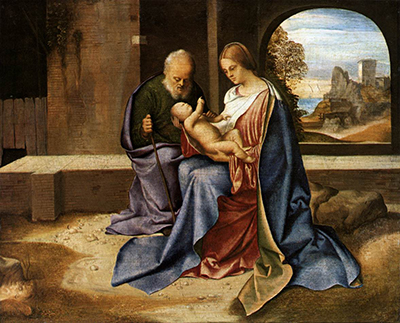
There is an arch in the brick wall behind Giorgione's Holy Family. Through it a tower catches the light, trees rise toward the curve of the masonry and a town lies in pale blue at the horizon. In front of the wall, a child turns his head toward his mother as she holds him in her lap. The room for these two kinds of attention is remarkably small. The painting, dated probably around 1500 by the National Gallery of Art in Washington, is less than forty-six centimetres wide. At that scale the pale town is easy to miss until the eye has taken in Mary's hands. [1]
At a Glance
- Datec.1500
- CollectionNational Gallery of Art, Washington
- AttributionGiorgione
- Inventory1952.2.8
The infant and the shawl
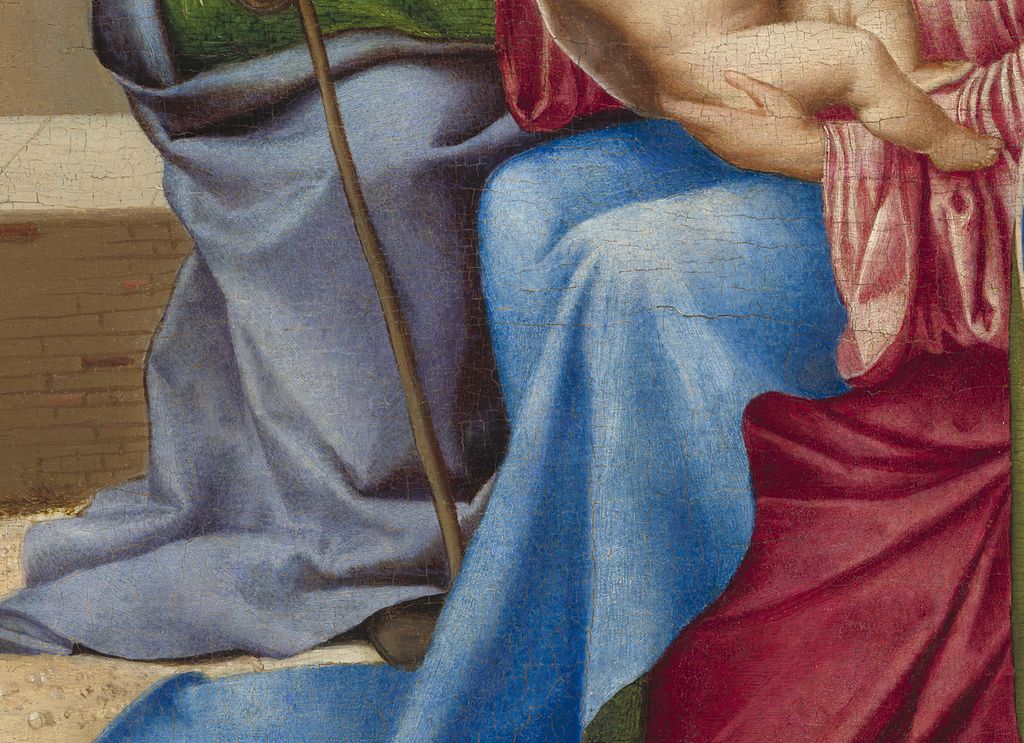
The child lies lengthwise across the picture, held at the back of his head and beneath his body. He is supported partly by a length of white cloth that runs from the neck of Mary's dress, across her shoulders and beneath him. This is one piece of material with several jobs. It guides our eye from her face to her arms and gives the child a secure place without removing the sense that he can wriggle. He extends one arm toward Mary while turning his face up toward hers. Joseph is so close that he can watch the exchange without either of them having to look up. A scene with three people feels unusually full because small changes in their position are so consequential. [1]
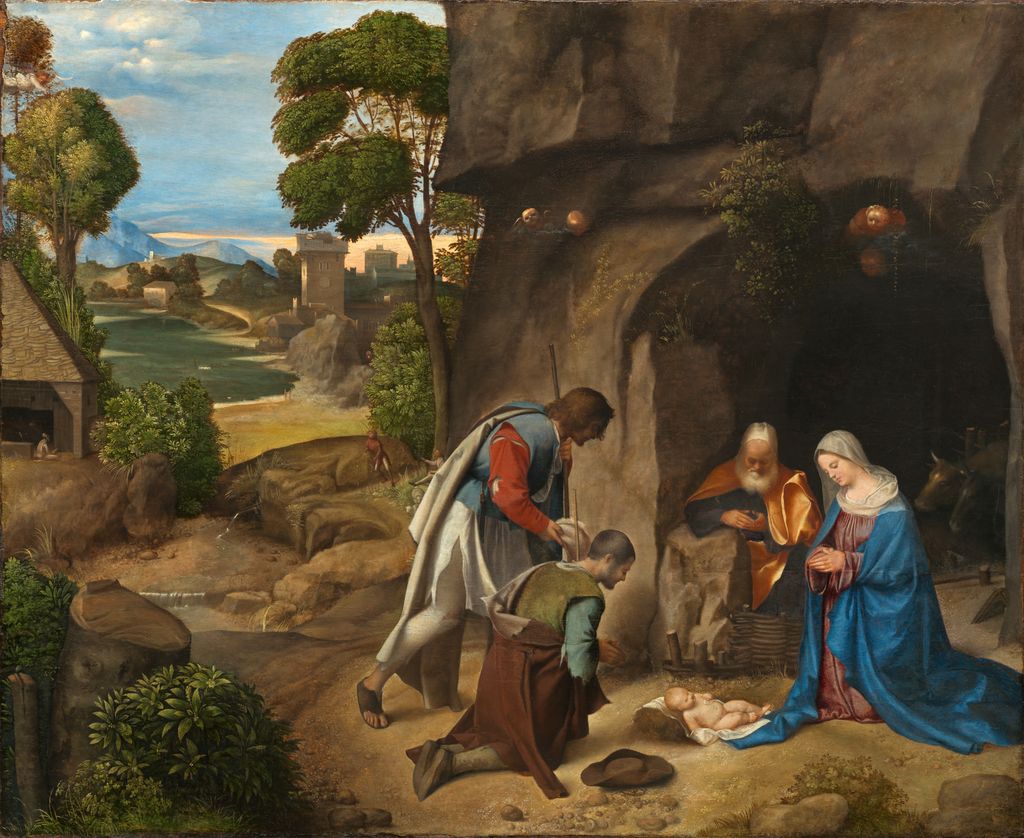
The child in the Washington Adoration of the Shepherds also lies on white cloth, but on the ground where visitors can gather round him. In the Holy Family it is part of the mother's dress and defines the space immediately around them. That practical difference is more revealing than the recurrence of white against earth tones. Attention in the Adoration passes between separate people who have come together outside a shelter. Here the adults can almost touch shoulders. There is no room in that circuit for a new arrival. [1] [2]
At their feet, little stones mark the ground beneath the figures. The irregular line is easy to pass over at a distance, where it has the appearance of a few pale touches scattered on brown. In close view, it shows how little of this scene is staged on furniture or a formal platform. The companions are gathered low, beside a wall, with earth and moss around them. That placement gives the architecture above their heads an unexpectedly imposing scale. A short distance behind them, the same painter who has attended to the child's fingers asks us to imagine a country beyond the building. [1]
How the arch contains a distance
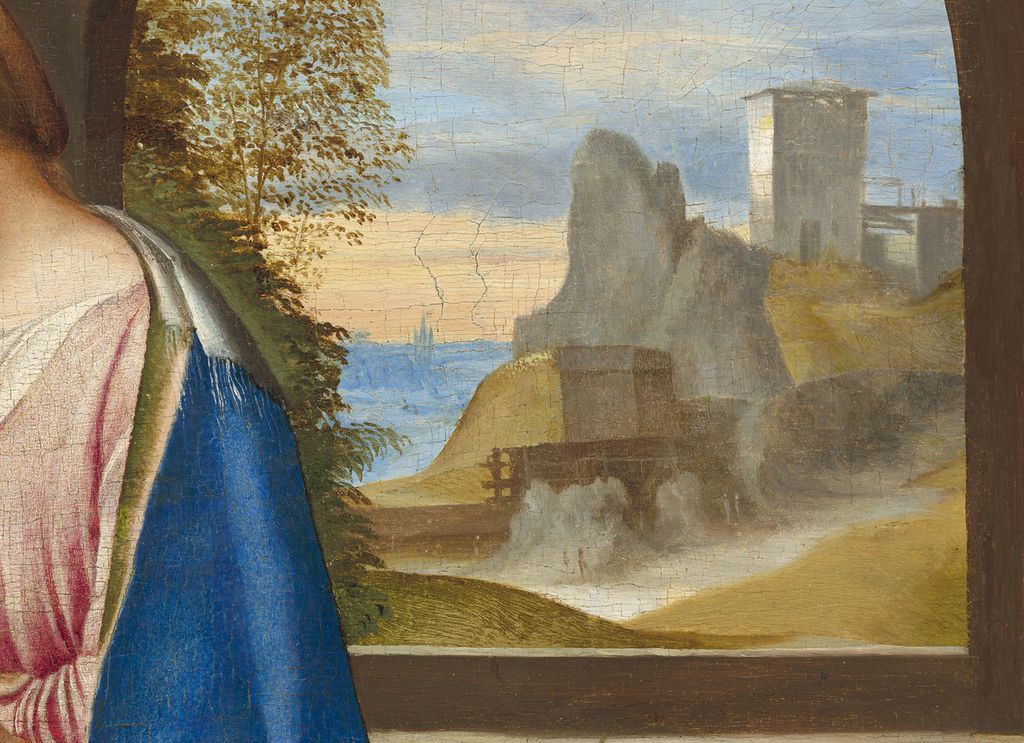
The brick wall makes it possible to hold two views in one painting. Its courses run across most of the upper field. The uninterrupted part behind the adults puts their profiles and clothing in front of a relatively even colour. At the opening, on Mary's right, cooler and more finely divided forms appear almost immediately. The visual change has the effect of stepping from an enclosed place into the light. Follow the small tree upward beside the opening and then look across to the white tower. At that distance the tower can be legible as a vertical landmark with little ornament. Behind it the buildings of the far town merge into a silhouette. [1]
The opening makes a picture within the picture, rather like setting a small landscape inside the more immediate scene of the people. It also keeps the two in a particular relation. You can look through the arch without tracing a path through the people, since it opens to the side of the adult figures. But you have to move your attention several times between the two views if you want to take in the whole work. Look at the reflected light in the baby's skin and then the line of pale peach beyond the town. One passage concerns the nearest flesh and the other concerns an almost unmeasurable stretch of air. Bringing those scales together is one of the things a small painting can do especially well. [1]
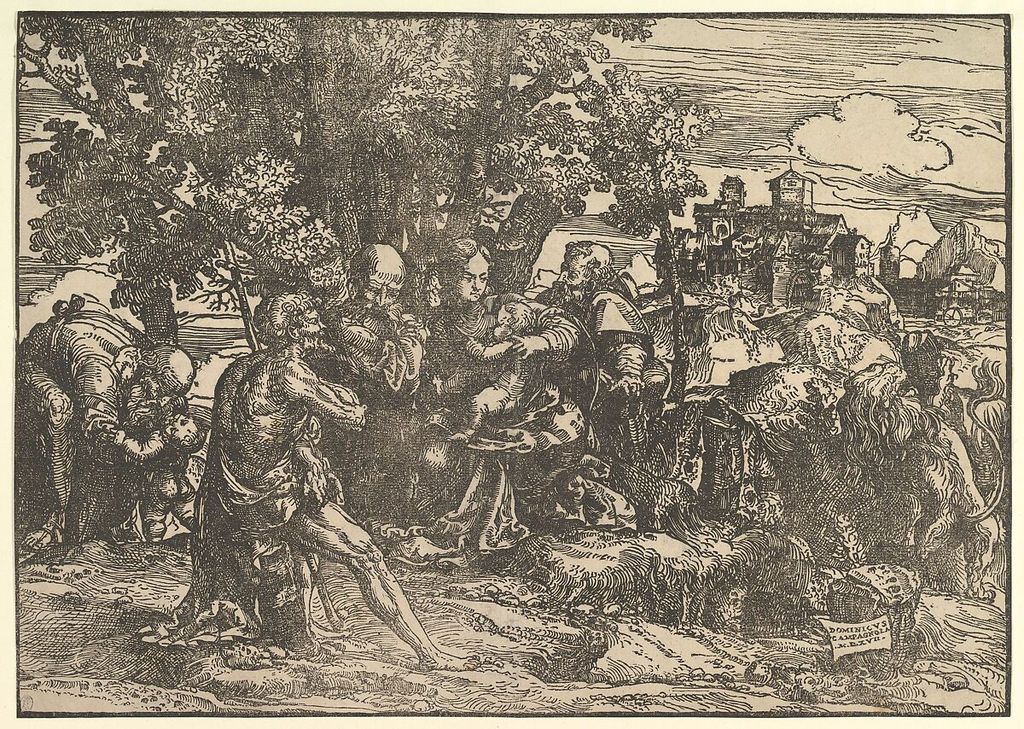
Domenico Campagnola's 1517 woodcut showing Mary and the infant with Joseph, Jerome and the young John the Baptist offers a comparison from a slightly later moment. The Holy Family is part of a much larger gathering under trees, with the signs of a town opening beyond them. The print's sheet, trimmed to a little over forty-five centimetres wide, is surprisingly close to the painting's width. Yet its space is more continuous. Printed lines can carry the eye across grass, people and town, where Giorgione uses the masonry to set one scale of looking apart from another. Campagnola supplies a Venetian comparison in another medium, with other figures and a different account of closeness. [1] [3]
The support and the name
The Washington work measures 37.3 by 45.6 centimetres and is catalogued as oil on panel transferred to hardboard. That line records two stages in the object's physical life. Oil paint was applied to a wooden picture support. A later intervention removed the original support and attached the surviving painted layers to a manufactured board. Statements about the painted surface and statements about the structure that now carries it therefore answer different questions. The public object record does not specify a date or full procedure for the transfer. The visible bricks continue to tell us about the design, but one cannot use the present back as an untouched piece of original panel evidence. [1]
The attribution underwent its own changes. The NGA bibliography includes a 1933 publication giving the work to Giovanni Bellini and a 1951 catalogue placing it in the Venetian school with Giorgione as a possibility. Today the Gallery displays it under Giorgione's name with an approximate early date. Bellini's name remains pertinent to the history of looking at this out-of-the-way domestic group, especially in debates about an early Giorgione and the overlap of the artists' approaches to devotional painting. The London National Gallery places it in the Allendale group. The group's utility lies in making such comparisons possible within a restricted body of pictures. [1] [4] [5]
A copy on the back of a cello
The secure modern trail runs through Henry Willett, the Bensons and the Duveen firm. Henry Willett bought the work in 1887. In 1894 it passed by exchange to Robert Henry and Evelyn Holford Benson, hence the name Benson Holy Family. The Bensons' collection went to Duveen in 1927. The Kress Foundation bought the painting in 1949 and gave it to the NGA in 1952. The Gallery lists Charles I, James II and the Dutch painter Allart van Everdingen as possible earlier owners. Art historian Jaynie Anderson has questioned the royal link in particular because the relevant early royal and Mantuan inventories do not yield the trace a secure identification would require. [1] [6] [7]
A striking piece of evidence comes from a different sort of wooden object. Anderson published a partial copy painted on the back of a violoncello attributed to the maker Luigi Amici and dated Rome 1778. The copy had to fit a small oval. Its painter retained the family group, adapted the outlines to the shape of the medallion and gave up most of the original setting. Anderson found the fit of figures and colours close enough to suggest that the copyist might have seen the painting in Rome. This is a clue to an earlier location, with no identified eighteenth-century owner to connect it conclusively to the later Bensons. [7]
The position of the copy on the back of a cello gives it a very different audience from a framed picture. Its owner could see it when setting up or putting away the instrument. The side facing an audience at a performance would have been the other one. The detailed view through the arch would have been difficult to keep in an oval already occupied by three people. A copyist resolved that problem by keeping the gestures that hold the family together. The sacrifice makes the original's other decision all the more striking. Giorgione found space for the fingers of a reclining child and an entire sky in a panel only modestly wider than the front of a cello. [1] [7]
Annotated Details from Holy Family
Select a point to see its detail.
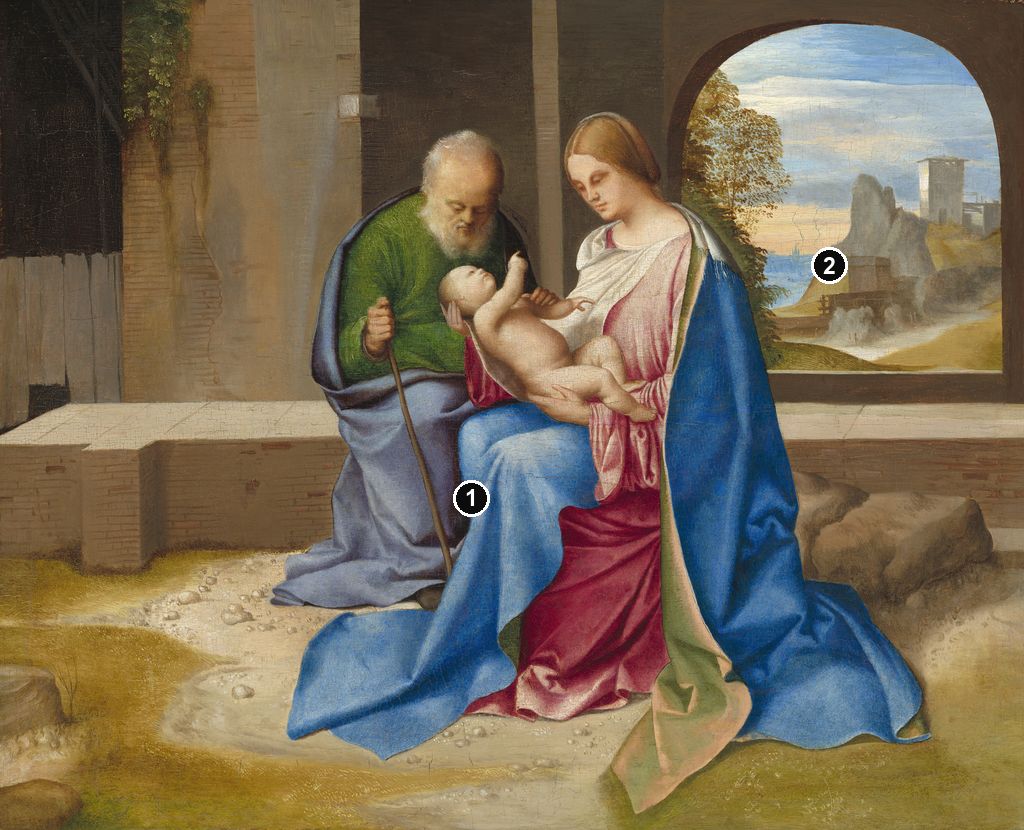
1. Mary supports the child · 2. The arch
Details from HOLY FAMILY
Detail crops from the same image.
Mary supports the child
Her long cloth passes behind him and helps to cradle his body.
The arch
The opening in the brick wall gives the small group a second scale of looking.
Giorgione’s career
Castelfranco Madonna
Early 1500sFondaco dei Tedeschi
1507–08Three Philosophers
1508–09Death in Venice
1510Discussion
Share what you noticed and how you arrived at your reading.
Reader Insights
Which detail would you point out to somebody seeing The Holy Family for the first time?
How does a copy on the back of a cello change how you read the work?
Join the Conversation
Share a detail, comparison or question about The Holy Family below.
References
- National Gallery of Art, Washington, The Holy Family, 1952.2.8. View source.
- National Gallery of Art, Washington, The Adoration of the Shepherds, 1939.1.289. View source.
- Metropolitan Museum of Art, Domenico Campagnola, Mary seated beneath trees with baby, 44.1.23. View source.
- National Gallery, London, The Adoration of the Kings and the Allendale group. View source.
- Klára Garas, The History of Collecting Giorgione in America. View source.
- Kress Collection Digital Archive, The Holy Family. View source.
- Jaynie Anderson, Copies of Venetian Renaissance paintings on stringed instruments and the provenance of Giorgione's Benson Holy Family in Washington. View source.