


 by Tom Gurney
Tom Gurney BSc (Hons) is an art history expert with over 20 years experience
Published on June 19, 2020 / Updated on November 29, 2026
Email: tomgurney1@gmail.com / Phone: +44 7429 011000
Overview
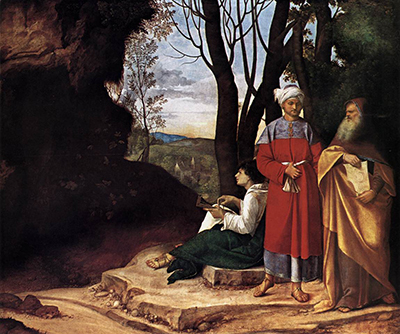
Two men stand on rocky ground while a third sits near the face of a dark rock. The youngest bends his attention forward, towards the edge of the rock and the light that falls across it. One of the other men carries a sheet. Between the figures and the overhanging stone, the country opens far back into a pale band of light. The eye goes from the men to the rock and through that gap into a distance too far away for their instruments to touch. A Venetian observer in 1525 called the three philosophers. The title has lasted, while the particular identities and purposes of the group have remained matters of interpretation. [1] [2]
The Kunsthistorisches Museum in Vienna dates the canvas to 1508–09. Its Gemäldegalerie inventory number is 111. The current picture measures 125.5 by 146.2 centimetres and has been substantially trimmed at the left. Both the act of painting and the changes of ownership and format have helped produce the object that can be seen today. The work has an unusually rich chain of early evidence for Giorgione, including an account of how it was brought to completion and a history of collections in which at least one picture was long associated with it. [1] [2]
At a Glance
- Datec.1508–09
- CollectionKunsthistorisches Museum, Vienna
- AttributionGiorgione, with Sebastiano named as finisher by Michiel
- InventoryGG 111
The group near the rock
The seated man is lowest in the picture and nearest the rock. His leftward gaze leads into a region of deep tone and clearly edged planes. He has instruments associated with observing angles and reckoning space. The curve of one tool can be seen against his torso and the bent position of his body lets it sit naturally within the setting. The darkness towards which he turns makes the pale accent on his face particularly noticeable. It is a small point of light for so large a picture. The artist’s attention to it encourages the viewer to think about the act of observation going on within the landscape. [1] [3]
The older man stands at the far right and brings a much larger area of bright cloth into the painting. The sheet he holds contains visible signs and lines that have prompted astronomical readings. From the viewer’s position it is possible to see both its distinct shape and some of its marks. A man between these two occupies another interval of age, dress and attention. Across the three figures run a seated angle, a comparatively easy standing posture and the firmer upright of the oldest man. Their grouping gives each person a role in the act of looking even before a viewer can put a name to any of them. [1] [3]
The landscape gives those differences room. The rocky face covers a large part of the area beside the young man, and the broken irregularity of its edge makes the gap towards the distance quite narrow. Within that opening there are trees, buildings and far light which extend the space dramatically. Some trees are nearly bare while others hold foliage. The KHM has asked whether changes of season, the different ages of the men and the passage from near ground to distance might be felt together. A possible thematic relation between the ages and the surroundings rests on things genuinely visible in the picture. It need not account for every instrument or turn of the head. [1] [3]
The outline of the man on the left can be read in relation to the instruments he uses. His upper body leans into the direction of his observation. Below him the hard ledge is straight in some places and crumbles away in others. The man holding the sheet at the opposite edge of the scene presents a different kind of attention. What can be grasped directly from a rock or from light is set beside what can be held on paper and consulted again. The arrangement makes thought visible through the way different people occupy the same ground. That relation has force whether we imagine an encounter among teachers and a student or among people with separate knowledge of the world. [1] [3]
Michiel’s entry in the Contarini collection
Marcantonio Michiel recorded the canvas in 1525 among pictures in the Venetian house of Taddeo Contarini. He described two standing figures, one sitting and studying the rays of the sun, and a finely painted rock. He also said the painting was begun by Zorzi from Castelfranco and finished by Sebastiano Veneziano, the painter now better known as Sebastiano del Piombo. The description brings object and ownership together. It would be difficult to associate those particulars with the surviving canvas by accident. [1] [2] [4]
What the entry handed down was a way of identifying the picture. Its expression for the figures became the familiar title. It also offered a piece of early testimony unusually valuable to anyone studying the interaction of two painters. It is impossible to apportion complete bodies, garments and landscapes between them on the basis of Michiel’s sentence. One way of approaching the evidence is to ask how much of a picture a young painter might complete after another had established the arrangement. Technical study might bring the order of some layers into focus. Individual brush marks need much more specific evidence before they can carry the names of Giorgione or Sebastiano. The Sleeping Venus poses a related question about completion by Titian, with its own documentary problems. [2] [4]
The KHM records the painting with Taddeo in 1525, with Dario Contarini in 1545, and in Bartolomeo della Nave’s collection in 1636. The Frick’s account of the household adds a later Contarini inventory. In 1556 the Giorgione is recorded in the main hall and Giovanni Bellini’s St Francis in the Desert in an adjacent room. Both works give unusually extensive space to rock, light and landscape, so the association in an early household has helped modern viewers recover a relationship of looking that a museum’s arrangement by artist can obscure. The age and ownership of the two pictures give this comparison a solid ground. The Frick leaves open whether Taddeo had originally commissioned the Giorgione. [1] [4] [5]
Pythagoras, Magi and the work of attention
The museum’s current object note favours an identification of the seated figure as Pythagoras, with Pherecydes and Thales as the teachers. On this reading the rocky setting may be the site of Apollo’s oracle at Didyma. The instruments and the earnest direction of the young man’s gaze help make a reading centred on ancient philosophy compelling. The object history still leaves room to ask how such names were meant to be recognised. An investigator can combine a historical text, a plausible attribute and the position occupied by a figure. Such a reading grows stronger when those strands can be connected to what a first owner or painter knew about the subject. [1] [3]
The interpretation as Magi has a long history. It gives the three men a role for which study of the sky is relevant and allows a story about different ages, dress and origins to be read through the picture. Rudolf Schier traces the catalogue interpretation to Christian von Mechel in 1783 and follows its scholarly revival. The uncertain hour, the lack of a clearly identified child or destination and the difference between a light effect and a guiding star all complicate the proposal. Underlying changes in the painting have also mattered to this debate. Published radiographs have been read as evidence for earlier attributes, such as a crown or headdress. Jaynie Anderson cautions against inferring the colour of painted skin from an X-ray. Such details are informative about revision and scholarship, with limited power by themselves to settle the present subject. [3] [6] [7]
Other readings take the picture less as an illustration of named figures and more as a scene about forms of knowledge. The ages and apparently different places of origin of the men have made interpretations involving periods of life or traditions of thought attractive. Schier instead proposes a historical reading in terms of the encounter of Sultan Mehmed II and Patriarch Gennadios Scholarios in Constantinople. His case involves comparison with a drawing by Gentile Bellini and later versions of the meeting, as well as links between the Contarini family and Constantinople. It has a different evidentiary burden from a reading based on ancient philosophers or the Magi. Similar clothing or pose can make an image a useful comparison. It takes more to show that a particular historic meeting was envisaged. [3] [6]
A lost line of verse and a room of scientific things
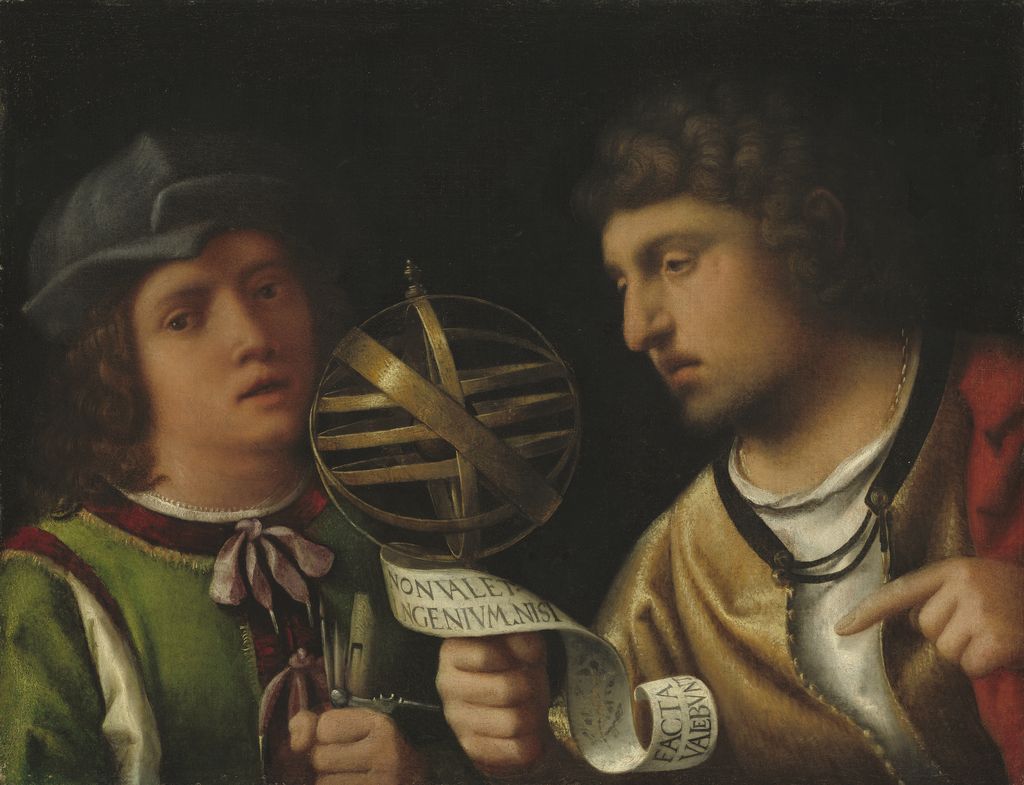
The KHM has presented Giulia Zaccariotto’s discovery that a Latin verse was recorded in relation to the picture in a manuscript now in the Biblioteca Marciana. The line, from the Elegy of Maecenas, was associated with the painting by around 1520. It commends life through achievements of the mind in the face of death. Anyone who has spent time with the quiet middle of the picture can see how a historical visitor might have connected such words to the three men. The line is now absent from the visible painting. Its wording and placement belong to the history of how the work could be read. It is neither a surviving signature nor a record of the exact names of all the figures. [3] [8]
The note belongs to a collection of Latin texts written by the Venetian diarist Marin Sanudo. Texts like these preserve part of the intellectual experience of visiting a collection. A visitor who read the verse while looking at the painting would have met it with a focus on the worth of intellectual labour, a focus suggested by an early reader’s environment. The KHM public presentation of Zaccariotto’s research considers Taddeo very likely to have commissioned the work. The Frick’s published exhibition leaves that question open. The verse adds unusually direct evidence to the history of reading and ownership. The dispute over whether Taddeo ordered the first painting still depends on how the evidence of patronage is connected to ownership and display. [4] [8] [9]
That discovery helps explain why the museum displayed the picture in the context of scientific objects. Angles, instruments and the repeated observation of nature were matters of considerable intellectual and practical importance in Renaissance Venice. The museum’s Nature’s Time exhibition compares this painting with surviving instruments and objects used to orient a viewer in a changing world. Such a pairing has its own limits. An exhibited astrolabe or instrument of a later date illuminates the culture of measurement without proving there is the same implement in a specific hand. Paint can evoke thought by showing concentration, observation and the play of light over the things put under examination. One of the exhibition’s examples, an astronomical instrument associated with Erasmus Habermel, belongs to the late sixteenth century and therefore shows later workmanship. It also gives a tangible account of what a small, precisely divided device could do in the hands of a skilled user. A paper or simple implement in the Giorgione begins to look like part of a practice rather than a purely emblematic accessory. [1] [3]
From a private house to an archducal gallery
The later ownership of The Three Philosophers lets us follow another part of its story. Bartolomeo della Nave’s collection helped carry Venetian paintings into an international market. The Hamilton inventories preserve the picture’s association there, before its eventual passage to Archduke Leopold Wilhelm. One of those records mentions another work of equivalent size depicting Amazons, named in connection with the same painter. That historical pairing deserves attention as an inventory comparison. The record’s use of a related work gives little basis for taking the Bellini in the Contarini household as an originally intended pendant. Different owners could see a picture’s relation to other pictures differently. [1] [5] [10]
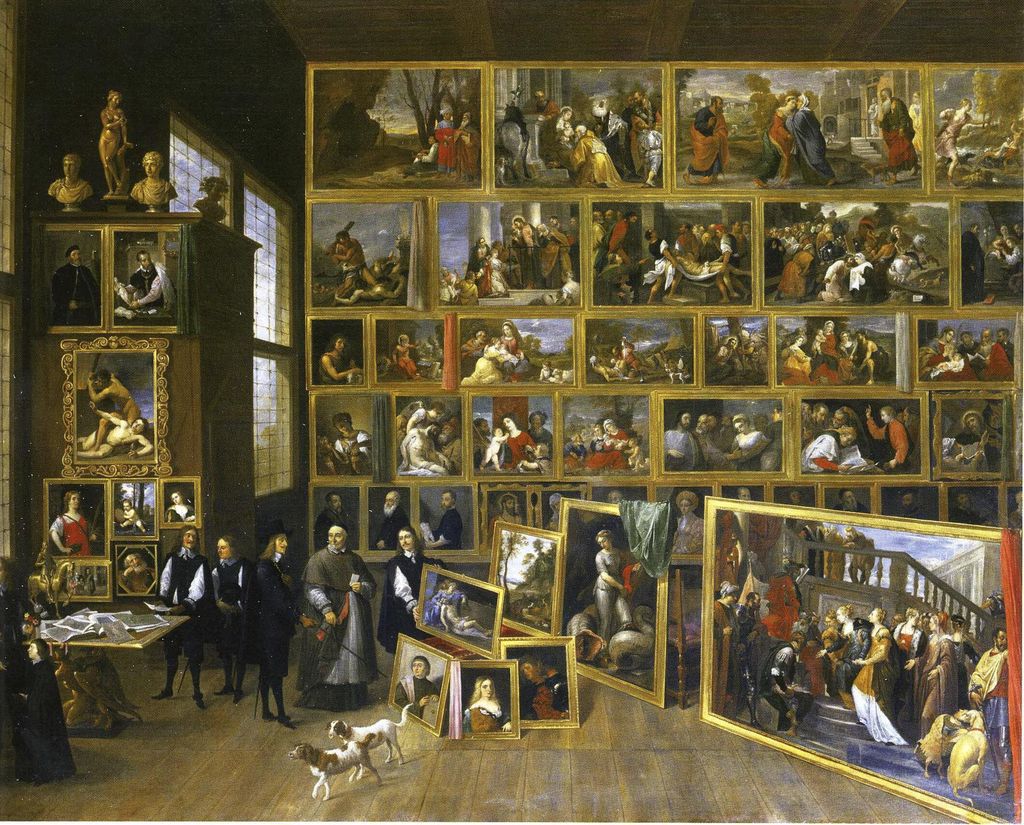
David Teniers the Younger made the archducal holdings familiar in paintings of the collection’s display. His gallery picture at Petworth places the philosopher group among other prominent objects on the walls. These representations are views of a collector’s abundance, and each object enters a new arrangement of size and status when it is reproduced within a gallery interior. The KHM’s collection booklet compares Teniers’s view with the present canvas and records a loss on the left. A tiny painting of a large painting can help identify an earlier arrangement, even though its brushwork can never serve as a precise template for all the missing ground. [10] [11]
A reproductive print extends the chain farther. The Art Gallery of South Australia holds a sheet by Jan van Troyen, after Giorgione, with Teniers identified as intermediary. It is plate 20 of the Theatrum Pictorium and shows the composition in the different medium of etching and engraving. The print helped someone away from the archduke’s collection encounter the subject, even while its new forms of line and shading changed details of the experience. The sheet can help trace how the name and image were transmitted. Its existence also makes clear that an old reproduction can have two or three authors and more than one object behind it. The Courtauld’s account of the Theatre of Painting describes the process through Teniers’s smaller painted copies, the published sheets and his views of the entire collection. Set beside one another they show how an image could turn from an individual possession into a pictured item in a room and then into a recognisable page in a book. That passage also made it easier for viewers to compare details across versions. It survives as a record of how works could look before alterations made during the later installation of the Vienna collections. [12] [13]
The early owner’s description, the possible inscription and the reproductions have given The Three Philosophers several ways of being remembered. On the Vienna canvas the slow act of looking is still present in the young man’s body. The painting allows us to watch him measuring or contemplating something that cannot be brought wholly into view. The stillness of his companions and the far light have their own rhythms. The different approaches to the subject begin with this shared physical experience, even when they arrive at different conclusions about what the men are called or what they hope to see. [1] [3]
Annotated Details from Three Philosophers
Select a point to see its detail.
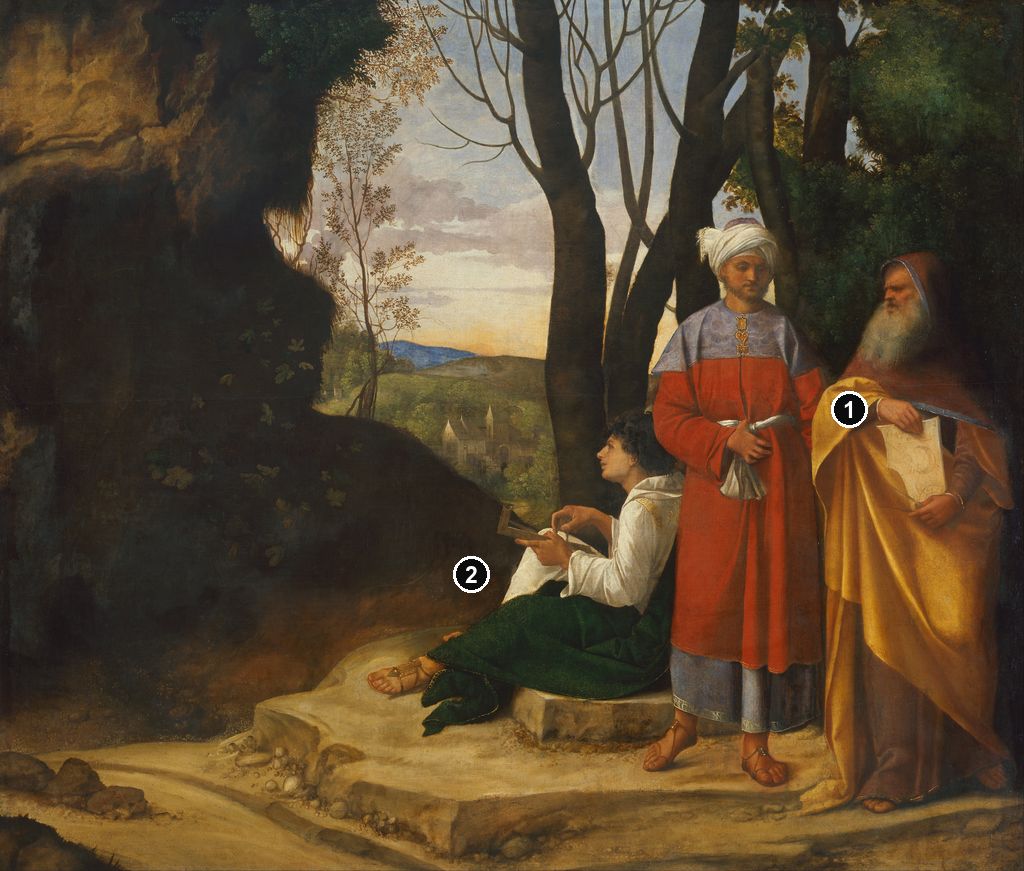
1. The older figure · 2. The rock opening
Details from THREE PHILOSOPHERS
Detail crops from the same image.
The older figure
Paper and instruments invite attention to observation without settling the three identities.
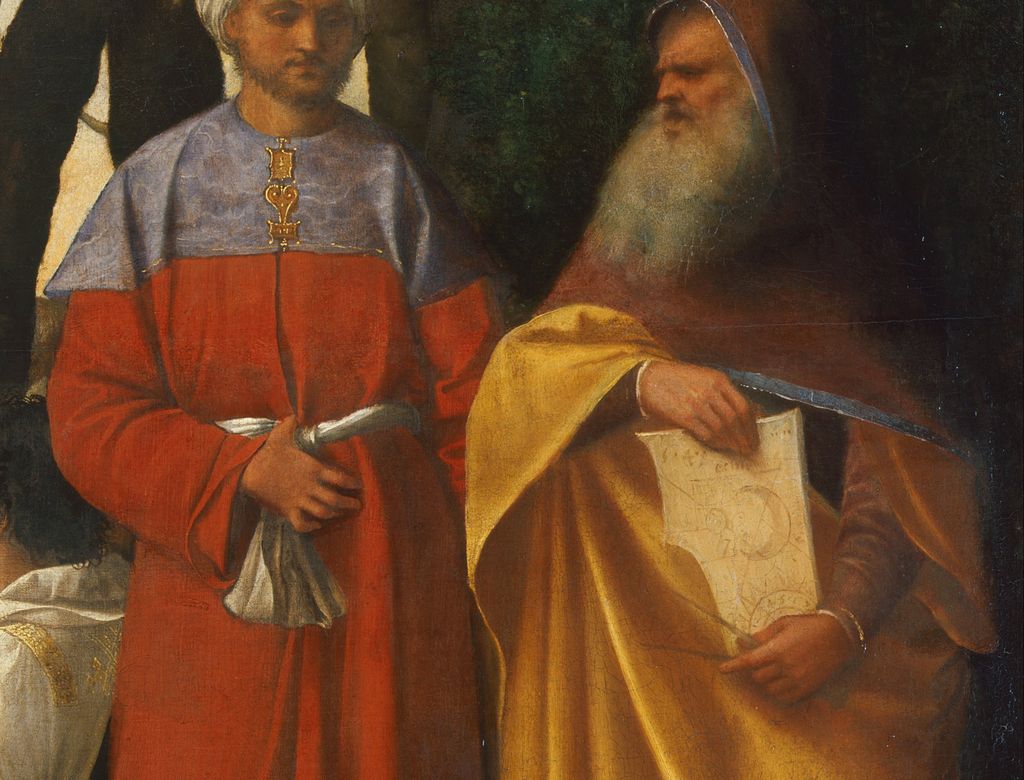
The rock opening
The young man faces a substantial dark mass rather than the people standing above him.
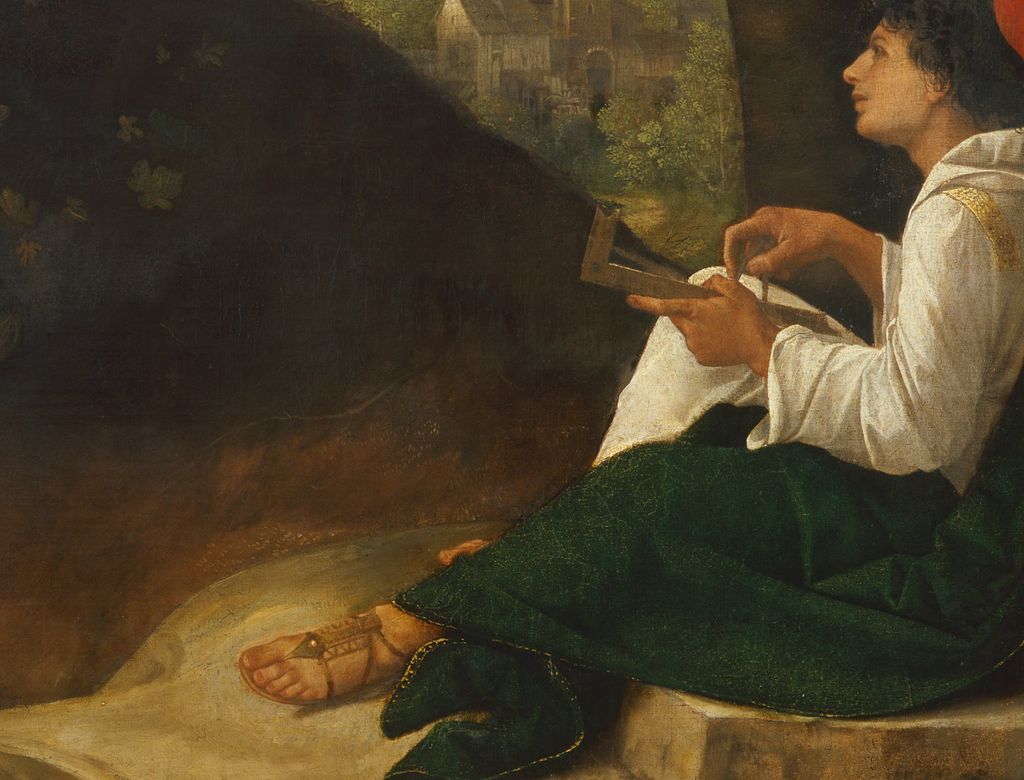
Giorgione’s career
Castelfranco Madonna
Early 1500sFondaco dei Tedeschi
1507–08Three Philosophers
1508–09Death in Venice
1510Discussion
Share what you noticed and how you arrived at your reading.
Reader Insights
Which detail would you point out to somebody seeing The Three Philosophers by Giorgione for the first time?
How does from a private house to an archducal gallery change how you read the work?
Join the Conversation
Share a detail, comparison or question about The Three Philosophers by Giorgione below.
References
- Kunsthistorisches Museum Wien, Die drei Philosophen, GG 111. View source.
- Marcantonio Michiel, Notizia d’opere di disegno, Opere in Venezia, Taddeo Contarini entry, Morelli edition, 1800. View source.
- Kunsthistorisches Museum Wien, A new way of looking at the world, Nature’s Time exhibition. View source.
- The Frick Collection, The Three Philosophers, Bellini and Giorgione in the House of Taddeo Contarini. View source.
- Xavier F. Salomon, The Frick Collection, Exhibition tour transcript. View source.
- Rudolf Schier, Sailing to Byzantium: Giorgione’s Three Philosophers, Predella 41–42, 2017. View source.
- Jaynie Anderson, Giorgione, technical examination section, Oxford Bibliographies in Art History. View source.
- Kunsthistorisches Museum Wien, Giulia Zaccariotto on Vivitur ingenio and Taddeo Contarini. View source.
- Giulia Zaccariotto, Vivitur ingenio: I Tre filosofi di Giorgione e Taddeo Contarini, library catalogue, Officina Libraria. View source.
- Hamilton Palace Inventories, The Three Philosophers, links to inventory entries M4/10 and M4/40. View source.
- Kunsthistorisches Museum Wien, Sammellust exhibition booklet, entry for GG 111. View source.
- Art Gallery of South Australia, Jan van Troyen, The Three Philosophers, plate 20 of Theatrum Pictorium. View source.
- The Courtauld, David Teniers and the Theatre of Painting. View source.