


 by Tom Gurney
Tom Gurney BSc (Hons) is an art history expert with over 20 years experience
Published on June 19, 2020 / Updated on November 29, 2026
Email: tomgurney1@gmail.com / Phone: +44 7429 011000
Overview
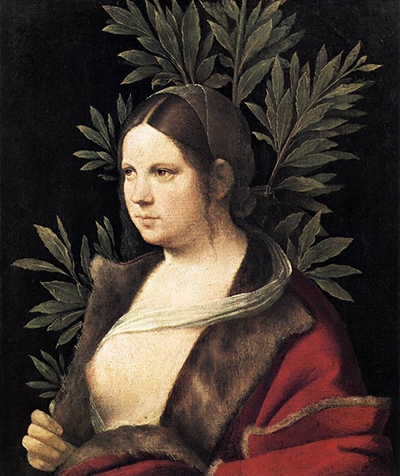
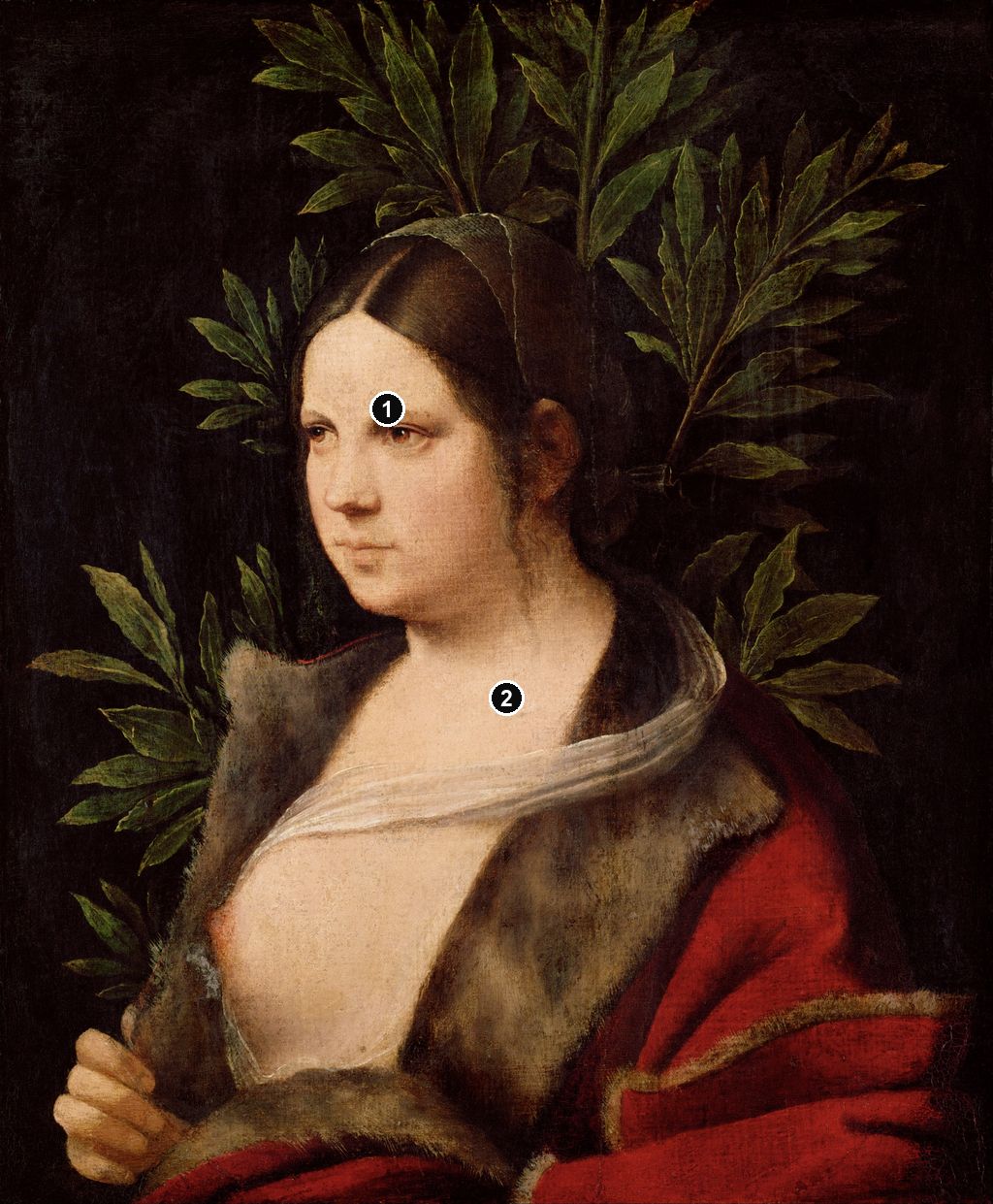
A woman stands close enough for us to notice the fur at the edge of a red mantle and the thin white fabric at her neck. Broad leaves spread behind her head. She has turned slightly, and her gaze continues away from the place where we stand. Her hand pulls at the opening of the garment. Its movement changes the shape of the cloth and brings a patch of bare skin into the light. There is a great deal of quiet between these few elements. In the portrait known as Laura, Giorgione gives the face a presence that has outlasted attempts to name the woman, explain her clothing or make her branch of laurel into an unambiguous sign. [1] [2]
The work is in the Kunsthistorisches Museum in Vienna, inventory number GG 31. It is only about 41 centimetres high. The museum describes oil on canvas mounted to an older spruce panel. Its date belongs to one of the most important parts of the object, on the reverse. A person looking at the face without the catalogue would miss the writing that makes this work such a fixed point in the study of Giorgione. In front of the picture, attention falls on fabric, pose and held-back expression. Turning to its documented back brings in a painter, a colleague, someone who asked for the work and a day in June 1506. [1] [2] [3]
At a Glance
- Date1506
- CollectionKunsthistorisches Museum, Vienna
- AttributionGiorgione
Edges in cloth, fur and leaf
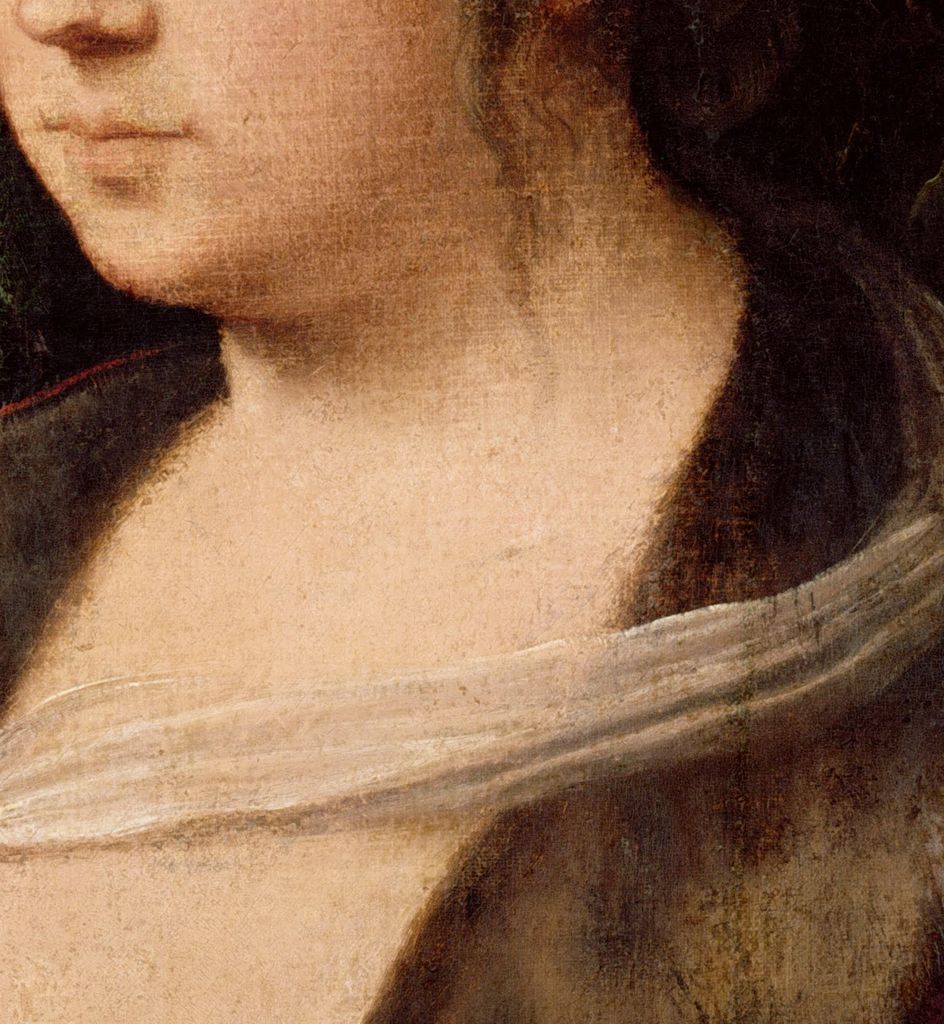
The arrangement of the clothing remains easy to follow even though many edges are soft. The white material is light and fine. It passes through recognisable changes in tone where it crosses the neck or comes close to another surface. In the opened mantle the fur has smaller fluctuations of light, gathering into points around the border. The red farther from the face has a weight that helps hold the more brilliant white in place. Differences in material are closely tied to differences in colour. The skin seems to take some warmth from what surrounds it while remaining perceptibly unlike either the red cloth or the grey-brown fur. [1] [2]
The direction of the head introduces another set of edges. Much of the face is given a gentle light. The boundary at the cheeks and the attentiveness of the eyes make its turn legible. Behind it the leaves rise fairly close to the hair. Some catch a brighter strip and others retreat into a much darker region. The branch gives the portrait air and depth without requiring a second scene outside. The tilt of leaves, head and shoulder helps make a picture of very small dimensions seem to have room around the person. [1] [2]
The position of the hand matters to the tone of the encounter. The woman holds the mantle where its edge becomes visible and brings its fur into contact with skin. The movement is specific, and the paint rewards attention to the weight and fall of the clothing. In interpreting the exposed breast it is tempting to begin with one of the historical explanations, then read the gesture to match it. A direct account of what the figure is doing leaves more room for what viewers at different dates could have understood. Her garment remains a set of skilfully described surfaces even as it becomes evidence in a debate about the portrait’s purpose. [1] [2]
The date and the names on the reverse
The inscription gives the first day of June 1506 and names the maker as master Giorgio of Castelfranco. It calls him a colleague of master Vincenzo Catena. The words indicate that the picture was made at the request of a man named Giacomo. What remains legible tells us much about the circumstances of an individual commission, even though Giacomo’s further identity is unresolved. The inscription uses the third person, and the surviving evidence does not require us to call it Giorgione’s autograph. It gives the date and the painter’s name in a different way from a signature painted visibly at the bottom of the image. [1] [3] [4]
Anik Waldeck’s research examines the ties between the two painters in the context of Catena’s business and social connections in Venice. The National Gallery interprets the language as evidence of a partnership, something that also occurred between other painters. It is a much stronger basis for connecting the two men than a loose resemblance between works attributed to them. Questions about how the partnership was organised and whether either painter had the contractual role of master or assistant take more evidence. The word is especially useful because it describes the relation as one seen at the time, before later biographers grouped painters around famous teachers. [4] [5]
The Städel also points to an inscription on the reverse of a separate portrait in San Diego. Its date is read with greater uncertainty, and the relation of that painting to Giorgione is independently worth evaluating. The Vienna date has a special value to researchers of the artist’s career because no collection comparison needs to supply its year. A useful lesson follows for the rest of the paintings. Dating one by its own dated inscription gives a fixed point. Dating another because it seems to share an approach to shoulder, contour or shadow is an argument that starts from that point and still has to be made for the second painting. [2] [6] [7]
Why the woman is called Laura
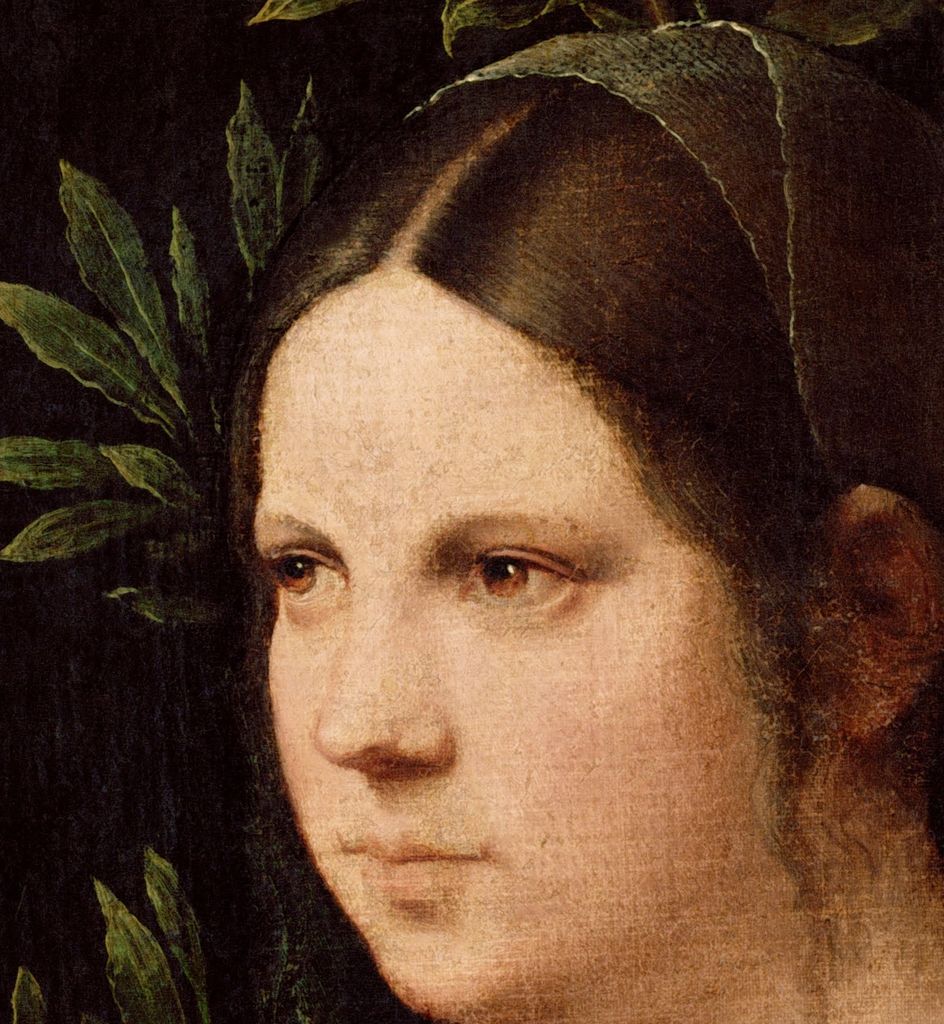
The leaves are conventionally identified as laurel. They gave generations of viewers a reason to think of Laura, the woman addressed by the fourteenth-century poet Petrarch. The name also ties the painting to an old way of describing the union of poetry and a woman’s image. None of this makes the picture a record of Petrarch’s contemporary. At issue is what a Venetian painting from 1506 might have signalled to viewers familiar with his poetry, his account of desire and the culture of laurels and names. The association is valuable even when the figure remains anonymous. [1] [2]
In its exhibition on Venetian representations of women, the KHM considered the picture in relation to bride imagery, women seen as beauties, and pictures associated with courtesans. The fur-lined mantle and the exposure of the breast can carry social or erotic meanings. They have also been read in relation to marriage. There is a difference between explaining a convention and establishing the sitter’s status. The name of a requester on the back and the style of a piece of clothing cannot independently supply an identity. Giorgione’s painting allows facial presence, attractive fabric and an inviting or withheld gaze to appear in one compact field. It is easy to understand why those qualities were available to different kinds of interpretation. [1] [2] [8]
The Vienna exhibition’s accompanying catalogue also asks us to look at the mantle as a garment. It identifies it as a man’s fur coat around the sitter. That observation can change a viewer’s sense of the painting. The hands and skin then belong to a person occupying a particular item of clothing, with its weight, scale and possible social associations. The garment frame remains much larger than the opening it creates. The contrast is one reason the gesture can be read as vulnerable, performative or contractual depending on the surrounding evidence. In the exhibition, a later painting by Bernardino Licinio offers a visual comparison for the reading of the bared breast as consent to marriage. Its date and different identity make the comparison evidence for an interpretive tradition. They leave the younger woman's actual situation open. [2] [8]
In the KHM's Boy with an Arrow, a different kind of emblem sits close to a face with similarly guarded attention. The arrow naturally encourages viewers to ask about love, martyrdom or other subjects. Looking at the hint of green laurel behind the woman is an equivalent moment of interpretation, although the object, pose and artistic purpose differ. Both pictures reward the movement between an individually seen figure and a particular thing carrying associations beyond the picture. [1] [9]
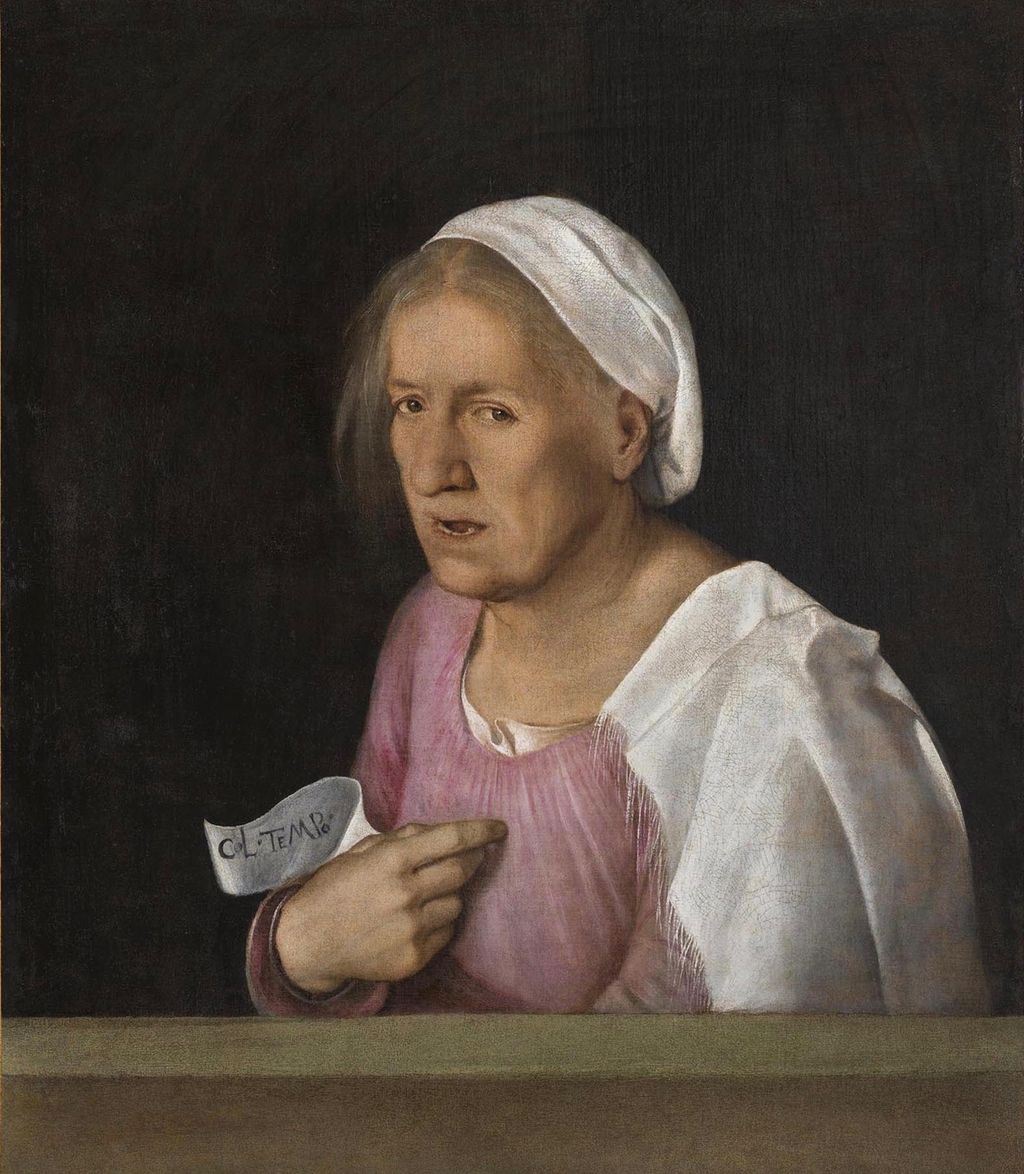
A comparison with La Vecchia makes the nature of the naming problem more precise. In Venice the older woman presents a slip of writing within the painted scene. In Vienna the leaves receive the interpretive work that words on the front might otherwise have done. The more documentary words are behind the work, out of sight while someone looks at it. The two paintings make two sorts of attention possible. One puts the reader’s eye on a fragment of text at the same time as the painted body. The other lets a viewer dwell in the uncertainty of the expression and then seek the object’s documentary story separately. [1] [10]
A name that travelled into prints
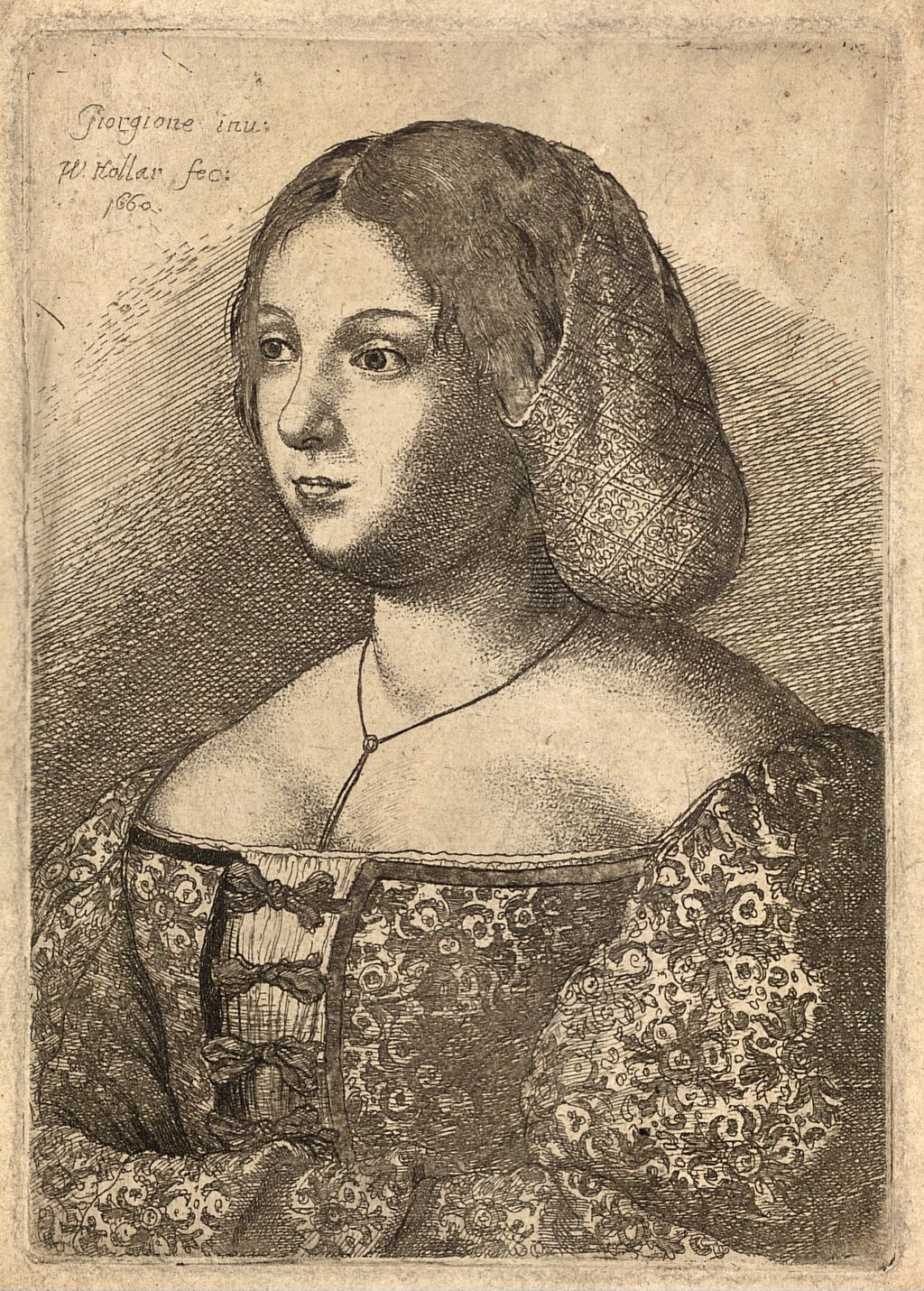
A seventeenth-century etching by Wenceslaus Hollar in the Royal Collection is catalogued as Petrarch’s Laura, after Giorgione. The figure in that sheet has a patterned bodice and a hair covering. These and the pose make it quite distinct from the Vienna arrangement with fur, exposed skin and a branch. The fact that the two images have circulated under a related name is positive evidence of the name’s reach and of the appetite for pictures connected with Petrarch. It is a reason to inspect the object rather than to take the words Laura and after Giorgione as proof that the print records every part of the Vienna panel. The Dutch catalogue also documents Hollar’s related portrait title and separate impression. [11] [12]
The KHM's account opens a related question about a painting’s ability to do the work of a poem. A poet can let a woman’s name recur beside an image or a form of speech until the two acquire a life together. A painter can hold a branch and a face in a fixed relation while leaving a viewer to move between the immediate portrait and the more remote poetic name. This is part of what the KHM exhibition suggests by bringing Petrarch into the discussion. It also explains why it is possible to retain the title Laura and still leave its relation to the sitter unanswered. [1] [2]
The print and the painting therefore invite two legitimate kinds of comparison. One concerns laurel, costume and the uses of desirable or idealised women's images in Venetian art. The other considers how an identifiable literary name travels through later circulating objects. Putting them together highlights the considerable difference between recognising a subject through a catalogue and seeing the ways in which clothing, skin and the paint's changes of light establish a person in front of the viewer. The latter is what Giorgione’s small field of painting can convey with unusual precision. [1] [2] [11]
Annotated Details from Laura
Select a point to see its detail.
1. The laurel · 2. The edge of the fur
Details from LAURA
Detail crops from the same image.
The laurel
The leaves helped to establish the conventional title, which does not identify the sitter securely.
The edge of the fur
The painter uses interrupted light to distinguish flesh, fur and cloth.
Giorgione’s career
Castelfranco Madonna
Early 1500sFondaco dei Tedeschi
1507–08Three Philosophers
1508–09Death in Venice
1510Discussion
Share what you noticed and how you arrived at your reading.
Reader Insights
Which detail would you point out to somebody seeing Laura by Giorgione for the first time?
How does a name that travelled into prints change how you read the work?
Join the Conversation
Share a detail, comparison or question about Laura by Giorgione below.
References
- Kunsthistorisches Museum Wien, Young Woman (“Laura”), GG 31, museum account via Google Arts & Culture. View source.
- Kunsthistorisches Museum Wien, Titian’s Vision of Women, Bildnis einer jungen Frau (Laura). View source.
- Augusto Gentili, Giorgio da Castelfranco, detto Giorgione, Dizionario Biografico degli Italiani. View source.
- Anik Waldeck, Vincenzo Catena and Giorgione, Reconsidered, Artibus et Historiae 74, 2016, pp. 59–71. View source.
- National Gallery, London, Vincenzo Catena. View source.
- Städel Museum, Giorgione, Digital Collection. View source.
- National Gallery, London, Technical Bulletin vol. 34, comparative discussion of early Titian and Giorgione. View source.
- Kunsthistorisches Museum Wien, Tizians Frauenbild, exhibition. View source.
- Kunsthistorisches Museum Wien, Knabe mit Pfeil, GG 323. View source.
- Gallerie dell’Accademia di Venezia, La vecchia, inv. 272. View source.
- Royal Collection Trust, Wenceslaus Hollar, Petrarch’s Laura, after Giorgione, RCIN 803867. View source.
- Rijksmuseum, Wenceslaus Hollar, Portret van een jonge vrouw. View source.