


 by Tom Gurney
Tom Gurney BSc (Hons) is an art history expert with over 20 years experience
Published on June 19, 2020 / Updated on November 29, 2026
Email: tomgurney1@gmail.com / Phone: +44 7429 011000
Overview
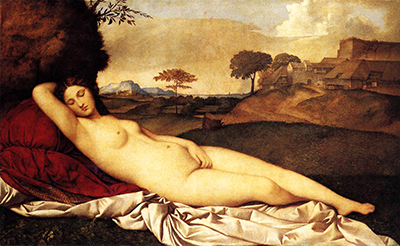
A woman sleeps outside, her right arm bent around her head and her other hand brought to rest over her lower body. Behind her shoulder, a rise in the land picks up the direction of her arm. The line of her flank and legs draws the gaze across a long opening in the landscape. Red cloth gathers closely below her head and a much larger spread of pale fabric lies under her body. Above it, the eye can travel from a near, dark slope towards houses, trees and much lighter country. In the Dresden Sleeping Venus, the world around the sleeping figure seems to possess a life independent of her even as it follows the movement of her body. [1] [2]
The large oil painting, in the Gemäldegalerie Alte Meister, is known as the Dresden Venus. The Städel identifies the original for one of its related works as Dresden inventory 185, measuring 108.5 × 175 cm, and dates it about 1508–10. It credits Giorgione and Titian. That pair of names reflects both an early description and a long effort to establish which painting that description concerns. The present appearance of the canvas gives a strong sense of what the image became. It has a more complicated relationship to the words of the earliest known witness. [1] [2] [3]
At a Glance
- Datec.1508–10
- CollectionGemäldegalerie Alte Meister, Dresden
- AttributionGiorgione, with Titian associated with completion
Looking from the raised arm to the distant buildings
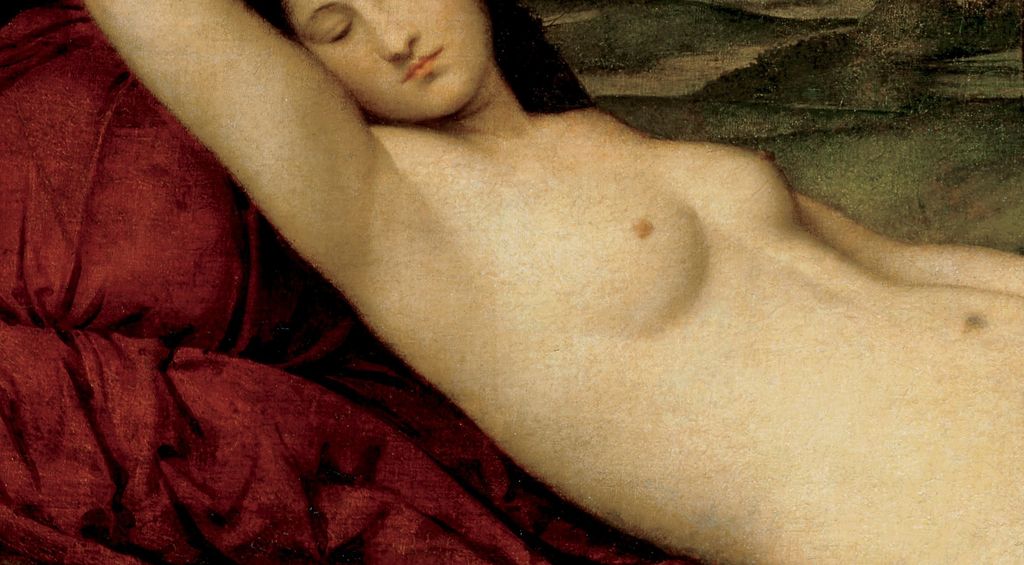
The figure stretches across almost the whole width. Her right elbow makes a high, compact turn at one end. The line beneath her arm carries the eye towards her head, then down along the quieter diagonal of her torso. At the opposite end the leg and foot lead into a darkening patch of ground. The effect depends on very small adjustments to her silhouette. The limbs have enough weight to seem to lie on the fabric. The head rests where it is held, quiet against the dark red bend of cloth. Large parts of the background work in the same broad horizontal direction without flattening into a single band. [1] [2]
The fabric beneath her gives that direction a particular energy. It is bunched where her weight bears on it and breaks into complex folds around the body. In the centre, its more open areas sustain long changes of light. The sheets and cushions set off the warmth of the skin against a landscape that contains cooler distances. Attention can pass through several forms of softness, from the skin to folds, soil and vegetation, with the differences of material preserved by the distinct way each reflects light. [1]
The distant settlement is especially useful for finding the actual scale of the foreground. Human construction occupies a small interval, while the reclining figure takes up the near ground on a very different scale. There is no obvious architectural frame around her, yet the land fulfils some of the jobs that a room might, marking the edges of her resting place and creating passages between the body and its surroundings. Her closed eyes keep the encounter one-sided. The viewer may follow several directions within the landscape. The figure remains at rest. [1] [2]
These visual features help explain why the painting has so often been compared with the Venus of Urbino. There too the extended length of a female figure gives the painting its main direction. In the later Uffizi canvas the woman is awake and looks towards the viewer, while the planes of an interior take the place of the open landscape. To compare their limbs or the disposition of white linen is to notice what can persist from one composition to the next. To compare where the figures look and where they are placed is to see how much can change while the basic type remains recognisable. [1] [4]
The two pictures also give fabric different jobs. In Dresden the strong red is gathered beneath the sleeper’s head, and the light cloth extends under her from a space immediately beside the low ground. In the Uffizi picture, a deep green hanging divides the area where the woman rests from the rest of the room. The room opens towards figures by a chest, with daily activity visible behind the comparatively still body. The Uffizi describes a domestic and marital context for Titian's picture. For the Dresden painting we can place an early description in a private house, while leaving its original location and social occasion open. Readers can compare uses of the body across the pictures without transferring a documented setting from one object to the other. [1] [3] [4]
Michiel, Marcello and a second painter
In 1525, in the house of Girolamo Marcello, Marcantonio Michiel described a sleeping Venus on canvas with Cupid. He credited the main figure to Giorgione and assigned the completion of the landscape and Cupid to Titian. The compact entry attests to collaboration in a way unusual for sixteenth-century paintings. It also identifies a particular house, a particular subject and a figure who is now absent from the painting in Dresden. Taken together, these parts made the identification of the museum picture with the Marcello canvas a compelling historical argument. The argument still has to accommodate the different dates of the record and of the later holdings to which the picture can be securely traced. [2] [3] [5]
What might completion have meant to the people who discussed the contents of the Marcello collection? The entry makes it easy to imagine the main figure being advanced and other parts awaiting substantial work. It cannot tell us whether the completing painter followed an agreed layout, made new decisions over existing paint or adjusted nearby passages to tie the result together. Nor does the entry provide an exact measurement, support examination or illustration. Its value lies in registering the individual roles reported to Michiel, with enough visual description that they can be compared with a canvas still in existence. [3] [5]
The Three Philosophers offers an independent occasion on which Michiel reports a second artist bringing one of Giorgione’s works to completion. There the painter named is Sebastiano del Piombo. The Vienna painting gives us a reason to take the possibility of incomplete works and later work seriously across early Venetian collections. The Dresden question still needs its own evidence. One report concerns the continuation of a painted nude and landscape. The other concerns a picture with quite different figures and purpose. Both bear on the working habits of painters in the same city. Each leaves unresolved the boundary of what another hand actually did. [3] [5] [6]
The Cupid we can no longer see
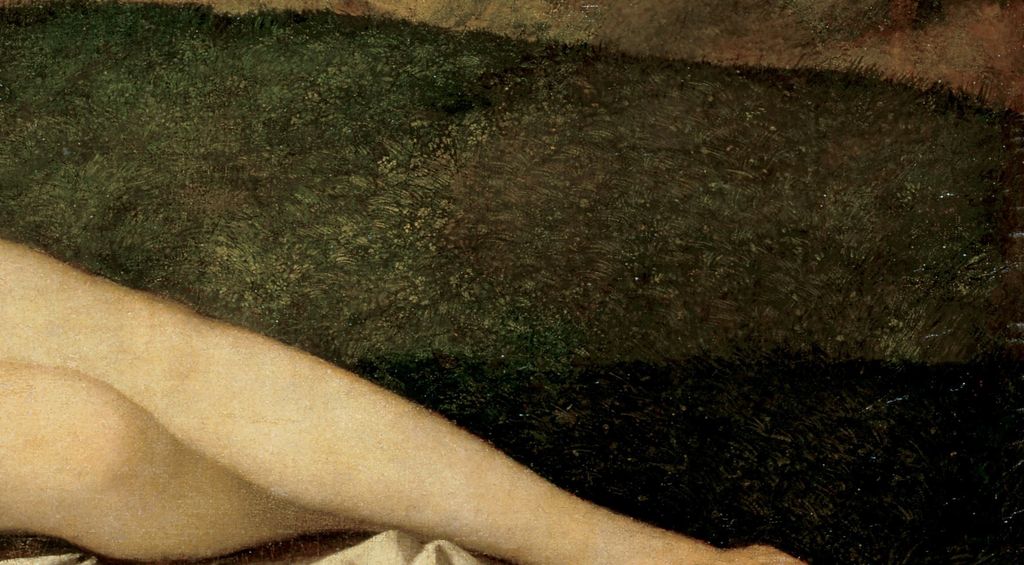
The most consequential difference between the current image and Michiel’s description is near the figure’s feet. Cupid is missing from the visible surface. A Dresden catalogue transcribed an earlier inventory that described him. Valentina Locatelli’s study of the museum’s nineteenth-century attributions reviews the history of the condition and the details that led Giovanni Morelli to bring the wording and the canvas together. Earlier inventories, different descriptions of the subject and correspondence around works in the gallery supply several independent kinds of evidence. A missing figure in a current reproduction does not erase them. [3] [7] [8]
Research cited by Locatelli traces the covering of the remains of Cupid to 1837. Martin Schirmer uncovered them in 1843, and the area was covered again because of the state of the underlying image. That sequence matters for the impression the painting makes. It now has one large, still body facing the spread of landscape. The presence of a second, smaller figure would have introduced a point of attention and helped identify the subject. Viewers now experience a visual change produced by the painting’s life in a collection. The later intervention contributes to the solitary appearance of the sleeper without demonstrating that solitude was the original purpose of the design. [7] [8]
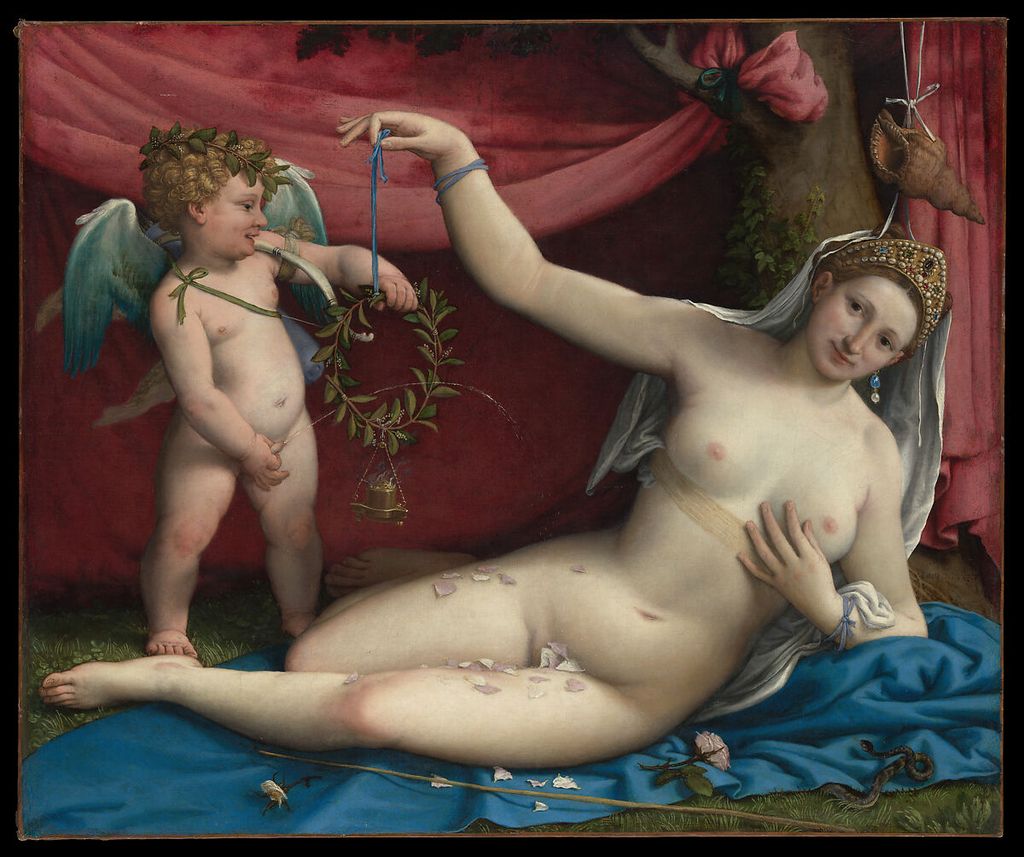
A related object makes the consequence of such changes easier to grasp. In Lorenzo Lotto’s Venus and Cupid, the boy contributes action, scale and a different line of attention. The Metropolitan Museum interprets the picture in relation to marriage. Different bodies and gestures distribute the story across the canvas, and the goddess’s position by itself carries only part of the meaning. The Lotto can illustrate the visual work that a Cupid does in a Venetian picture of Venus. It gives no exact model for reconstructing what the little figure in Dresden once looked like. [9]
A lost detail can be more important in a picture of sleep than its size suggests. Here the woman's face offers no overt acknowledgement of a viewer. A waking companion, if one were present, could provide a response the sleeper withholds. A Cupid can also shift a viewer’s first impression of the figure, from a beautiful woman resting outside to a mythological subject. The written catalogue preserves the relation of the two bodies even at a date when the ground near her feet had become difficult to read. The history of the image then depends partly on which generation of viewers described it and what the restorers allowed them to see. [3] [7] [8]
How the Dresden label changed
Locatelli shows that in 1876 the Dresden catalogue associated the canvas with Sassoferrato as a work after a lost Titian. The attribution that seems natural today was therefore far from inevitable. An illustrated Venus could be judged a copy, associated with an influential Venetian prototype or identified as the work that an early collector had described. Those are very different ways of recovering the history of a picture. In the earlier Dresden account the familiar type could carry a Titian connection while the artist actually responsible for the object on view was given another name. [7]
Morelli’s recognition made the historical possibility immediate again. The Dresden commission’s minutes from June 1882 preserve the discussion provoked by his new attribution. By connecting the picture to Michiel, it became possible to explain why the nude resembled known Venetian work, why Titian entered its attribution and why an identification involving Cupid depended on documentary clues as well as the visible canvas. The restoration history matters particularly because the little boy cited in the early descriptions had become hard to check with an ordinary view of the original. [3] [7] [8]
It helps to distinguish the steps in Morelli’s conclusion. One was that the picture belonged in the discussion of Venetian art rather than among later imitations. Another was that this particular picture fitted Michiel’s description in all of its important parts. A third was that the division of work could be expressed using the old names. The nineteenth-century discussion recovered those questions for the Dresden canvas. It also opened possibilities for disagreement in which a critic might accept a Venetian date, yet arrive at a different conclusion about either the Marcello identification or the work of two painters. [3] [7]
There is a substantial modern objection to the identification. In a National Gallery technical bulletin, Paul Joannides argues that the provenance link to Marcello is insecure and that what is known of the painting’s radiographs and surface is compatible with Titian throughout. He concludes that the Dresden painting cannot be the one Michiel described. The Städel related-work metadata and the Royal Academy exhibition presentation reflect the accepted joint reading, and conservation historian Marlies Giebe has made a case for the stages that support that identification. Reading the objection alongside the holding attribution gives a clearer sense of the evidence in dispute. Everyone can point to the beautifully shaped body and the long landscape. Establishing which painter began it, or precisely how two hands should be assigned, asks a different sort of question. [2] [5] [10] [11]
What later images retained
At the Städel, Christian Siedentopf’s version is recorded as a drawing in black chalk. It is a work after the Dresden painting, naming Giorgione and Titian as its sources. Studied on its own terms, the copy shows what can persist when the colour and paint are exchanged for paper and chalk. It is possible to follow the curve of the body and recover the broad divisions of landscape from the printlike economy of the drawing. The surface of the original, the sharpness of a colour transition and the historical state of Cupid at an earlier date belong to other sources. The existence of such a version shows what the composition offered an artist working in a new medium. [2]
The Venetian painter Padovanino knew how to make a recognisable image speak in more than one historical voice. Maria H. Loh’s study of his work identifies a sleeping Venus of around 1625 that recalls the Dresden picture and borrows selectively from the Uffizi Venus as well. His choice of the outdoor setting and the closing of the eyes recall Dresden. The broad hanging at the left recalls the different stage on which the awake woman lies in the Uffizi. Loh draws attention to its colour too. Padovanino uses red where the hanging in Titian’s Florentine painting is green. The result preserves the mood of an outdoor sleep and borrows the emphatic framing of a room. The body and the setting invite a reader to go between works that we now place in separate collections. In the early seventeenth century, the combination could also have invited a spectator to recognise how an artist played with memory and painterly precedent. The relation is historical evidence of reception. It supplies no independent answer to the uncertainty over the making of the original. [4] [12]
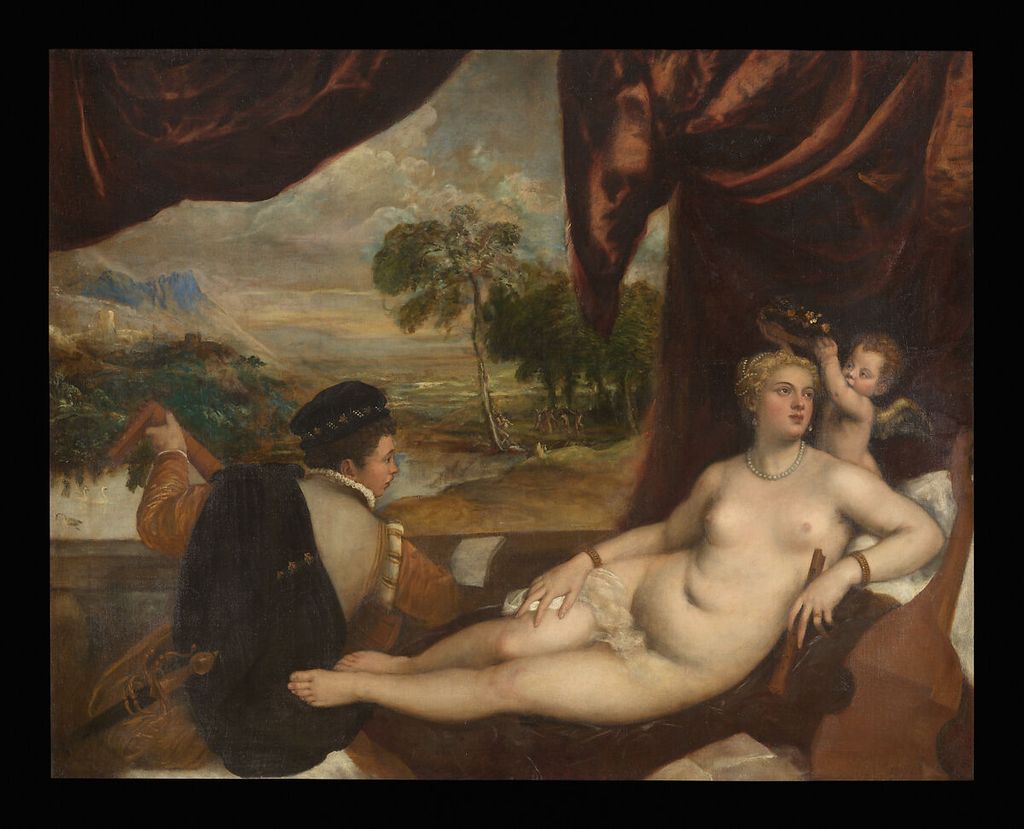
Another descendant of the Venetian reclining type can show how far the setting might go in distributing attention. Titian’s Venus and the Lute Player brings a musician into the reclining figure’s company, with gesture and outward attention taking on the work that silence does in Dresden. Its music and its busier exchange of looks make the pose adaptable to another situation. The comparison brings one element of the Dresden painting into sharper focus. The spectator has enough time to register the land and the wrinkles of the cloth because the composition supplies few competing actions. [1] [13]
The picture’s descendants reveal the difference that a posture can make. A long body can establish the scale of an entire composition even before a viewer identifies a story. In Dresden, the sleeping face keeps that large form inward and still, and the changing distances behind it give the land its own pace. The darker shapes at the foot and the open light by the houses matter in themselves. They matter also as the place where a changing surface, two painters’ names and several historical accounts touch the act of looking. [1] [2] [7]
Annotated Details from Sleeping Venus
Select a point to see its detail.
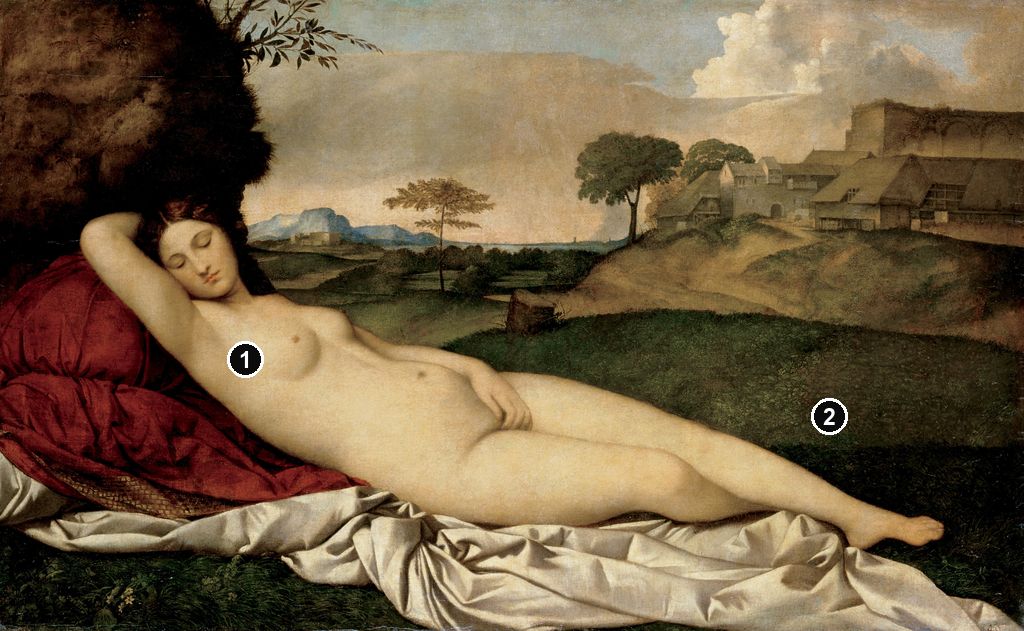
1. The resting figure · 2. Where Cupid once appeared
Details from SLEEPING VENUS
Detail crops from the same image.
The resting figure
The lifted arm carries the contour of the sleeping figure back toward the dark foliage.
Where Cupid once appeared
Early testimony and technical imaging support the presence of a Cupid near the feet before later treatment concealed him.
Giorgione’s career
Castelfranco Madonna
Early 1500sFondaco dei Tedeschi
1507–08Three Philosophers
1508–09Death in Venice
1510Discussion
Share what you noticed and how you arrived at your reading.
Reader Insights
Which detail would you point out to somebody seeing Sleeping Venus by Giorgione and Titian for the first time?
How does what later images retained change how you read the work?
Join the Conversation
Share a detail, comparison or question about Sleeping Venus by Giorgione and Titian below.
References
- Staatliche Kunstsammlungen Dresden, Sleeping Venus, museum account via Google Arts & Culture. View source.
- Städel Museum, Christian Siedentopf, Giorgiones schlummernde Venus in Dresden, with metadata for the original. View source.
- Marcantonio Michiel, Notizia d’opere di disegno, Opere in Venezia, Girolamo Marcello entry, Morelli edition, 1800. View source.
- Gallerie degli Uffizi, Titian, Venus of Urbino. View source.
- Simone Facchinetti and Arturo Galansino, eds., In the Age of Giorgione, Royal Academy of Arts, 2016, fig. 6. View source.
- Kunsthistorisches Museum Wien, Die drei Philosophen, GG 111. View source.
- Valentina Locatelli, Italian Painters: Critical Studies of their Works. The Gemäldegalerie Alte Meister in Dresden, an Overview of Giovanni Morelli’s Attributions, pp. 13–14. View source.
- Königliche Gemäldegalerie zu Dresden, Catalogue, no. 185 (262), and transcription of earlier inventory. View source.
- Metropolitan Museum of Art, Lorenzo Lotto, Venus and Cupid. View source.
- Paul Joannides and Jill Dunkerton, “A Boy with a Bird” in the National Gallery: Two Responses to a Titian Question, National Gallery Technical Bulletin 28, argument following the discussion of Michiel and note 22. View source.
- Jaynie Anderson, Giorgione, technical examination bibliography and summary of Marlies Giebe’s findings, Oxford Bibliographies in Art History. View source.
- Maria H. Loh, Titian Remade: Repetition and the Transformation of Early Modern Italian Art, Getty, 2007, discussion of Padovanino’s Sleeping Venus. View source.
- Metropolitan Museum of Art, Titian, Venus and the Lute Player. View source.