


 by Tom Gurney
Tom Gurney BSc (Hons) is an art history expert with over 20 years experience
Published on June 19, 2020 / Updated on November 29, 2026
Email: tomgurney1@gmail.com / Phone: +44 7429 011000
Overview
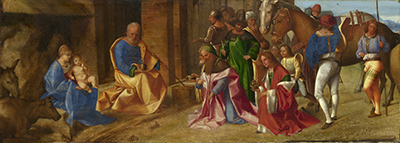
Christ is the smallest person in Giorgione's Adoration of the Kings, and he is the one who meets our eyes. From the Virgin's lap he looks out with a finger in his mouth while the first visitors kneel and a richly dressed company waits behind them. The National Gallery in London dates its painting to 1506–7. The oil-painted wooden panel is just 29.8 centimetres high and more than eighty centimetres wide. Its proportions make the journey to the stable take time. By the time we have followed the gifts, gestures and horses from one end of the picture to the other, the stillness around the child has acquired a very particular force. [1]
At a Glance
- Date1506–07
- CollectionNational Gallery, London
- AttributionGiorgione
- InventoryNG1160
The company at the stable
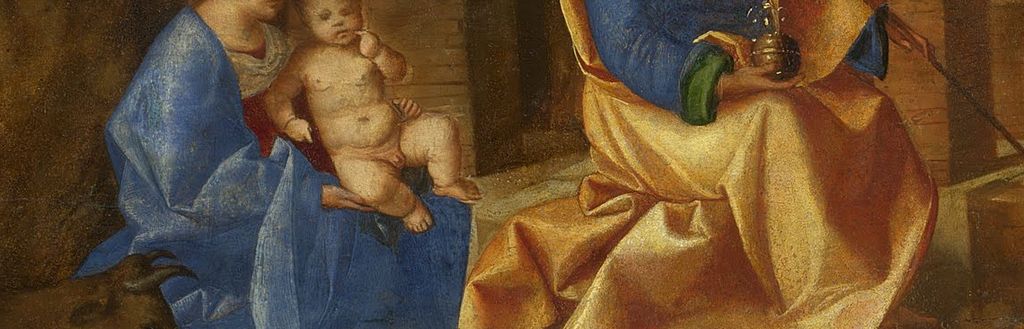
The Holy Family sits on the steps at the left. Mary supports the unclothed child in her lap. Joseph has taken charge of a gift from the visitors. An ox looks on from the shelter. The angular steps and the upright posts hold this part of the picture together, and the two adults keep their eyes lowered. The child, presented with no grand costume and with both hands close to his body, seems to notice somebody just outside the scene. Giorgione makes that outward glance available to the viewer at the same time that people elsewhere in the panel struggle to see him for themselves. [1]
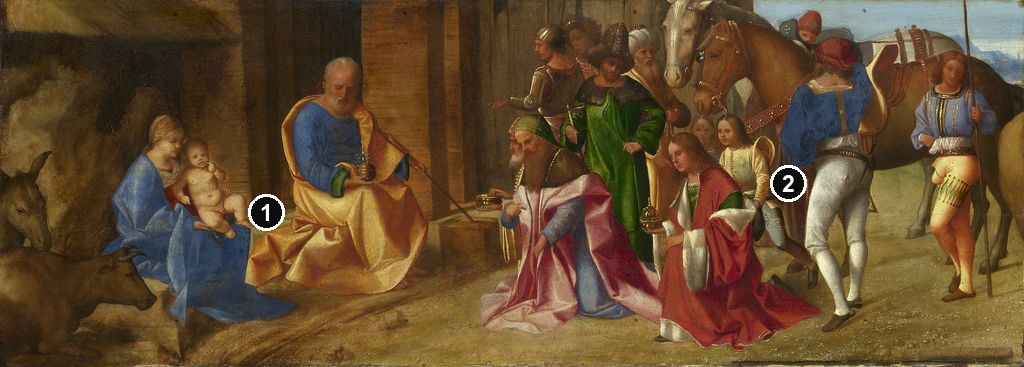
The visitors have caught up with one another at different stages of the ceremony. In the Gallery's reading, Caspar has already given Joseph the glass container of myrrh. Melchior, the eldest, is about to hand over a golden bowl. Balthasar waits farther back with a glass orb interpreted as containing frankincense. The succession of objects lets us infer a past action and anticipate two others. Even if one were unable to distinguish the kings by name at this tiny scale, the different positions of their gifts would make the order of events legible. An object held securely by a seated man speaks of a transfer already made. The bowl about to be offered still belongs to the moment of approach. [1]
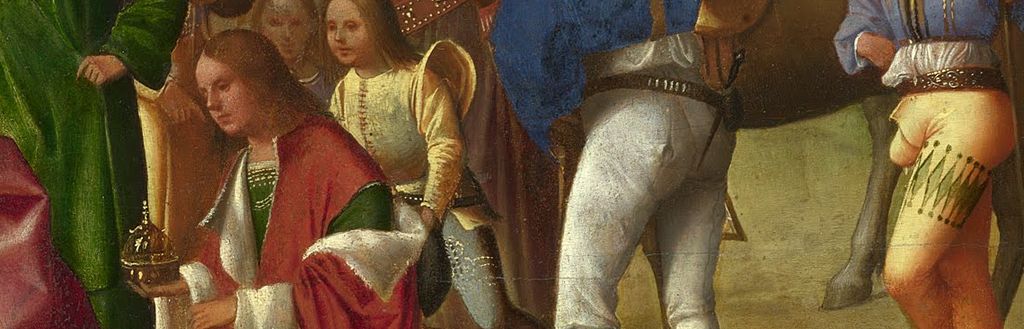
The kings have left a conspicuous strip of space between themselves and the family. Their distance from the child gives each gesture room, even though one king's head partly overlaps another's. Compare that spacing with the mass of people to the right. A helmeted man directs the attention of his companion toward the steps. Pages wait behind Balthasar and grooms have horses to manage. Hands and faces point across one another. The company may have arrived for the same purpose, but the painting gives each attendant a different immediate concern. Many of the figures are busy with the arrangements that allow the kings to kneel undisturbed. [1]
What the eye finds on a second pass
The National Gallery draws attention to a groom whose back faces us, a turned standard bearer with crossed legs and a coat trimmed in fur near the middle of the company. Seen whole, the panel barely gives each person elbow room. Magnify it and the painter's attention to seams, belts and harness becomes unmistakable. The back of the groom's clothing has split at a seam. Nearby, the delicate decoration of a hat registers the sort of attention that a viewer would normally reserve for a king's cloak. Studs on the harness catch the light in little intervals and take the eye into the group of horses. [1]
Look for a few repeated colours as you move across the panel. Reds punctuate the company at intervals. Light tones break through the darker mass of bodies and tack. A bright sleeve or a strip of illuminated cloth makes you pause among people who would otherwise recede into a single crowd. The effect depends on the slim format. In a taller picture there would be space to let the procession climb or wind away in depth. Here the most immediate route is across the surface, with occasional turns into the small pockets of space around a figure or between two animals. The eye can move in either direction, following the procession toward the stable or beginning with the child and travelling out to the men who are still looking for a view. [1]
The groom also gives us a rare point of comparison with another painter. The Gallery notes the appearance of a similar rear-facing figure in a later Adoration of the Kings by Dosso Dossi. A motif as specific as this is worth distinguishing from the shared scriptural subject. Mary, the child and the three visitors recur across many Adorations. A groom turning away from the spectator supplies a much narrower visual clue. The echo suggests that Dosso had seen Giorgione's panel. It gives us a way to think about the painting's circulation even though its first destination remains uncertain. [1]
Was it made for an altarpiece?
A low strip of painted stories can form the base of an altarpiece. Known as a predella, the strip might have related episodes to the large figures enshrined above it. At only 29.8 centimetres high, with a gathering extending sideways, the London picture has the dimensions and the kind of subject that would suit such a position. The Gallery suggests a Virgin and Child as one possible subject for a hypothetical upper panel. A visitor would then have met the familiar figures at two different scales. The Virgin and Child above would dominate the ensemble while the scene below invited a worshipper to follow the company into the presence of the infant. [1]
That reconstruction remains hypothetical. The Gallery also points out that Venetian painters were already increasingly making altarpieces as single unified scenes, a development that made the separate narrative tier less usual. Giorgione's surviving Castelfranco Madonna shows just how powerfully a unified field could work. Its vertical format lifts the Madonna and Child high above the foot of the throne. In London the same figures occupy a corner of a low rectangle. The two designs show the different demands of displaying a sacred figure at the centre of an altarpiece and telling a story through the successive arrivals of visitors. There is no documentary link joining these two objects. [1] [2]
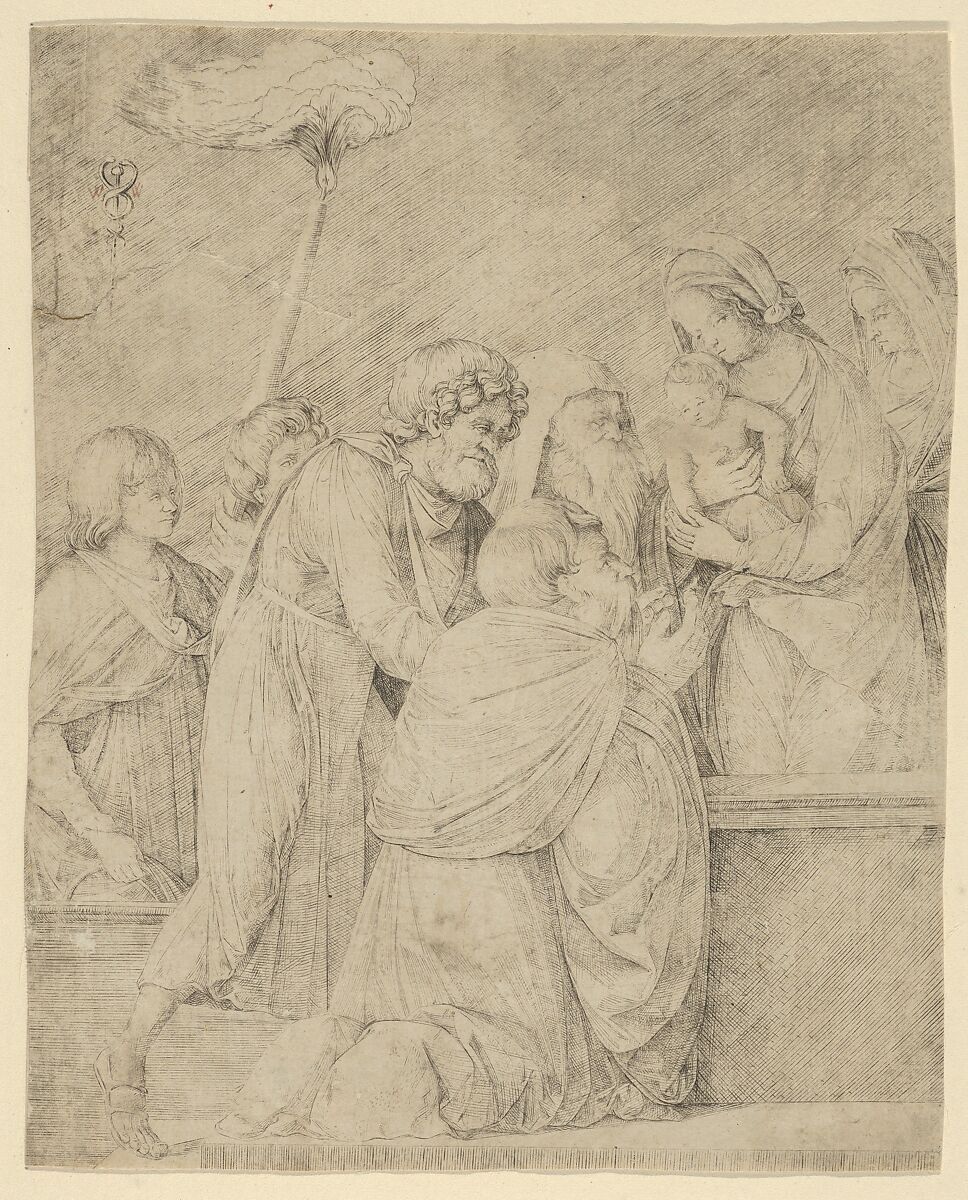
Around 1500 Jacopo de' Barbari also tackled the Adoration in an engraving. The Metropolitan Museum of Art's example measures about twenty by sixteen centimetres, a compact upright in which the eye can rise from the encounter toward the architecture above. Their shared subject makes the contrast in proportions especially clear. In a print the size of de' Barbari's, the company must fit around or behind the principal figures. Giorgione can let the figures and the gaps between them occupy a long path from the open ground to the steps. The print supplies a near-contemporary example of another solution to the same problem. It does not establish a source for the panel. [3]
The Allendale group and the Bellini name
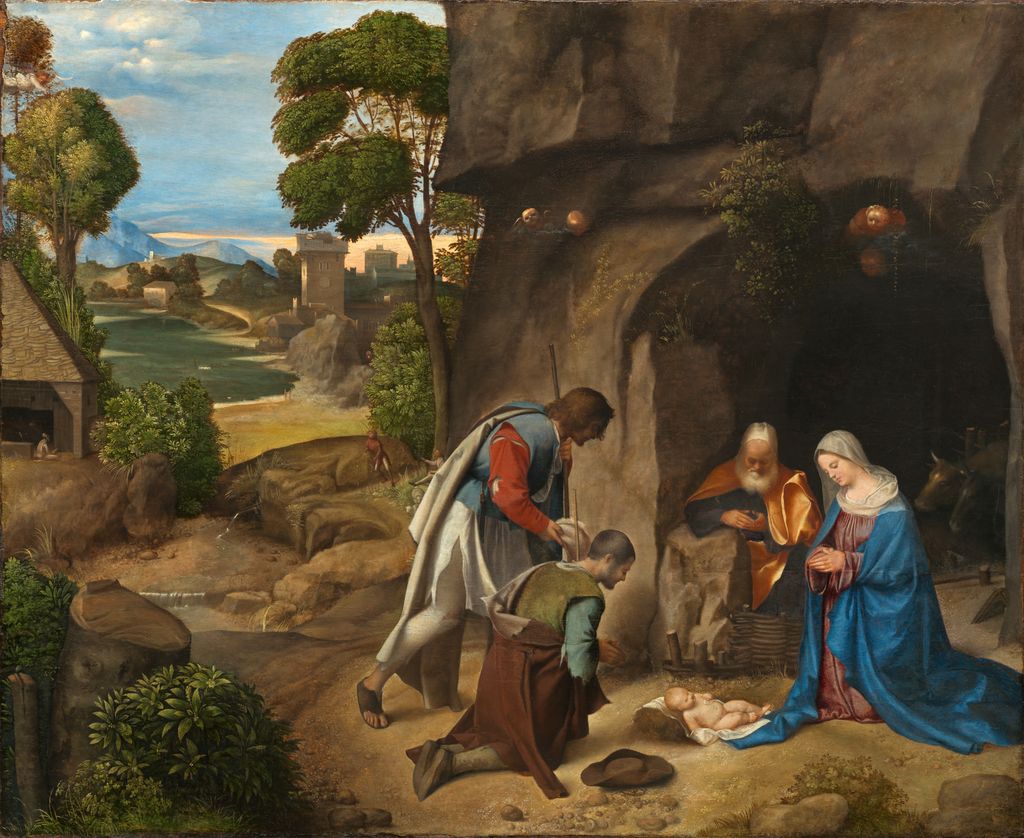
The National Gallery places its panel in the Allendale group, named for the Washington Adoration of the Shepherds. It also puts Washington's Holy Family and an Adoration of the Shepherds in Vienna in this company. The grouping gives us a set of religious works through which questions of visual style and authorship can be tested across collections. In the London scene, costly fabrics and horses announce the visitors well before they approach the child. At Washington, two shepherds come to the mouth of the cave. Comparing the encounters draws attention to something that the different social registers share, the painter's feeling for how a spectator approaches a small sacred group from across a much larger piece of ground. [1] [4] [5]
The name Giorgione came relatively late in the panel's documented British history. An 1822 catalogue lists it as Giovanni Bellini at Leigh Court, near Bristol, in the collection of Philip John Miles. It appeared under Bellini's name at the Royal Academy in 1870 and again at the Miles sale in 1884, when the National Gallery bought it. The Gallery's photographic archive adds a further turn. An entry identifies the work as formerly given to Bonifazio and records a photograph made after cleaning under the attribution to Giorgione. The archival entry is evidence of an attribution history. It leaves the details of the treatment and the reasoning behind the change to fuller documentation. [1] [6]
Herbert Cook's early monograph captures a point in the debate when the panel already had champions as a Giorgione. Open the book beside the modern catalogue and the change in emphasis is instructive. Early writers sought to establish a list of works for a painter with a short life and no conveniently complete record of commissions. The present London entry can give the picture a date, object number, dimensions and long history of references while leaving its original use open. The proposed predella and the Allendale comparison answer different questions. The first concerns where the panel may have been seen. The second concerns which other pictures help explain the way it was made. [1] [7]
Come back finally to the gesture of the armoured attendant. He points toward a child who has already looked past the kings and across the panel's edge. It is a tiny loop of attention, easy to miss next to the horses and their harness. The attendant helps somebody else see the event while the child seems to have seen us first. A picture just under thirty centimetres high can accommodate a great deal of activity. Giorgione uses that space to let a glance travel farther than any of the people in the procession. [1]
Annotated Details from Adoration Of The Kings
Select a point to see its detail.
1. The kings and their gifts · 2. Retinue and horses
Details from ADORATION OF THE KINGS
Detail crops from the same image.
The kings and their gifts
Two gestures and the different placements of the gifts separate successive stages of the same encounter.
Retinue and horses
The party overlaps, turns and changes direction at a very small scale.
Giorgione’s career
Castelfranco Madonna
Early 1500sFondaco dei Tedeschi
1507–08Three Philosophers
1508–09Death in Venice
1510Discussion
Share what you noticed and how you arrived at your reading.
Reader Insights
Which detail would you point out to somebody seeing The Adoration of the Kings for the first time?
How does the Allendale group and the Bellini name change how you read the work?
Join the Conversation
Share a detail, comparison or question about The Adoration of the Kings below.
References
- National Gallery, London, The Adoration of the Kings, NG1160. View source.
- Museo Casa Giorgione, The Castelfranco Altarpiece. View source.
- Metropolitan Museum of Art, Jacopo de' Barbari, The Adoration of the Magi, 17.50.77. View source.
- National Gallery of Art, Washington, The Adoration of the Shepherds. View source.
- National Gallery of Art, Washington, The Holy Family. View source.
- National Gallery Archive, London, The National Gallery, NG29/4/4. View source.
- Herbert Cook, Giorgione, catalogue of works. View source.