


 by Tom Gurney
Tom Gurney BSc (Hons) is an art history expert with over 20 years experience
Published on June 19, 2020 / Updated on November 29, 2026
Email: tomgurney1@gmail.com / Phone: +44 7429 011000
Overview
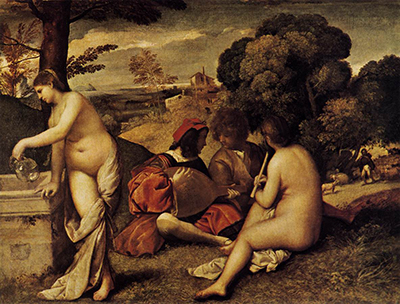
A woman pours water into a stone basin at the side of a gathering. A second woman holds a pipe. Two clothed men sit close together on the grass, one with a lute. Nobody's attention visibly converges on all the others, even though they lie within easy reach of one another. The Louvre calls the painting Le Concert champêtre, the Pastoral Concert, and catalogues it as an early work of Titian. For centuries it was known as a Giorgione. That history makes the picture a particularly good place to see how a kind of Venetian painting could survive a change of artist's name while keeping the imaginative world with which that name was associated. [1] [2]
At a Glance
- Datec.1509
- CollectionMusée du Louvre, Paris
- AttributionTitian; formerly attributed to Giorgione
- InventoryINV 71
The space between water and music
The standing woman is set far enough to the side that she could almost be at another gathering. One arm takes the vessel toward the basin and the other helps balance her body as she turns. The low stone structure provides a conspicuous piece of geometry where most of the rest of the encounter happens on shifting terrain. From her feet, the eye can follow the hem and turn of the drapery to the pale body at the edge of the dark mass of trees. The pouring water offers one trace of movement that a spectator can follow without knowing why anyone has come to this clearing. Her own line of sight stays with what is close to the basin. [1] [2]
The woman seated farther to the right holds a wind instrument away from her mouth. Her back helps make a barrier of the circle just where its nearest figures seem to invite us in. The lute player wears bright clothes and turns toward his companion. Their position suggests a conversation that is not shared equally with the other figures. Look from his fingers and the instrument to the standing woman's vessel. Both figures are absorbed in activities associated with sound, but the painting lets the imagined splash of water and the imagined note of a lute have places and durations of their own. One of the reasons the scene feels unusually unhurried is that these actions have been given room without being synchronised. [1] [2]
The Louvre's educational catalogue reads the scene as a possible allegory of poetry in which the two women serve as ideal figures who inspire the men. Under that interpretation, the way the men attend to one another without plainly seeing the women becomes part of the conception. The pipe and the poured water can serve different aspects of inspiration. As the catalogue presents it, Venetian viewers could be accustomed to the coexistence of an observed world with one imagined or called up through poetry. The image gives us enough evidence to make a connection without revealing a text that the painter meant to illustrate exactly. The women have a substantial presence of their own. Taken as the figures' muses, they still carry the weight of bodies sitting and standing on a painted stretch of land. [1] [2]
Hills behind a public gathering
The foreground keeps us busy with closeness, fabrics and gestures. Beyond it the terrain rises and falls, with a tree standing out against the sky and a settlement spread over a faintly lit distance. At the right a shepherd and sheep draw the eye beyond the central players into a piece of land that continues to have people and work in it. In a different picture the shepherd could be the principal figure. Here he gives the word pastoral another dimension. The concert suggests the country retreat of people with the leisure to play. The animals and the man attending to them suggest something of the regular work of that same landscape. [1] [2]
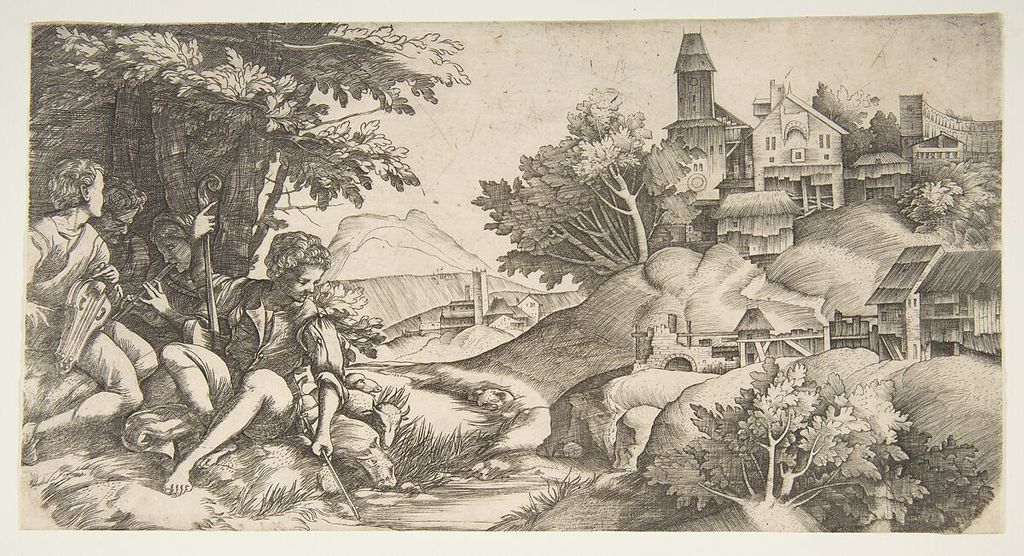
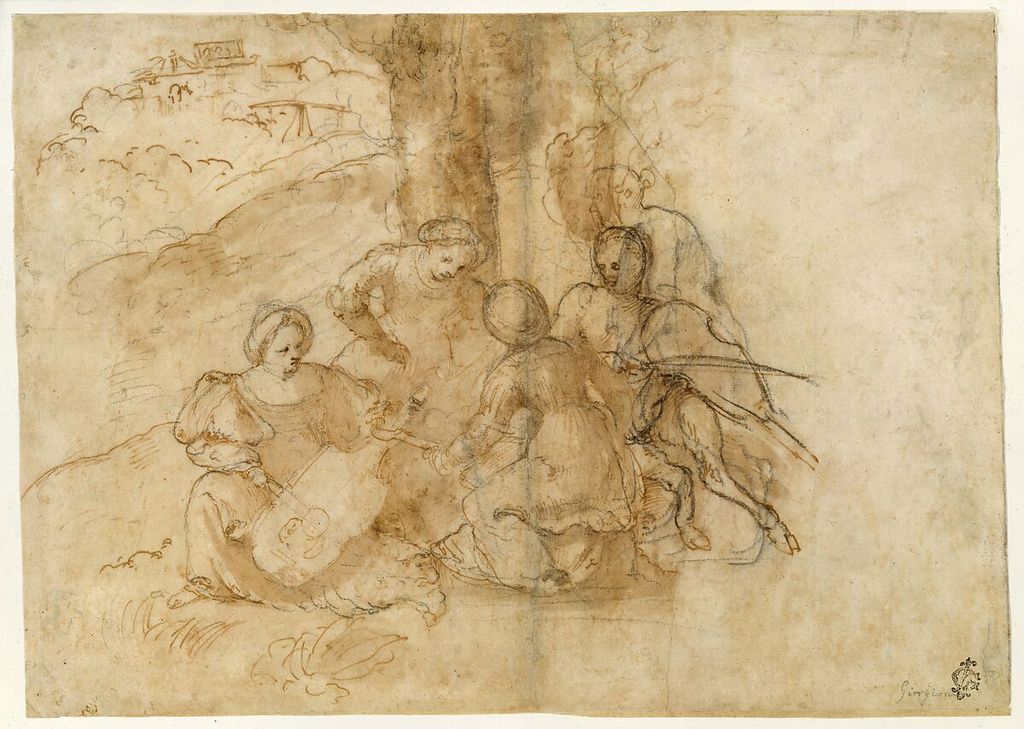
An engraving in the Met credited to Giulio and Domenico Campagnola, from around 1517, gathers shepherds and their instruments beneath trees at the left and lets a hilly country open out to the right. The museum discusses how a print with more than one plausible contributing hand acquired its name and composition. On paper, short changes in the pattern of engraved lines can separate a musician from a piece of grass and give light to the distance. The thick growth and the reclining or seated figures share a world with the painting without supplying direct evidence of its author. Girolamo Romanino's separate Concert champêtre, also in the Met, similarly gives companions a rural space to make and listen to music, but with washes and written lines of pen. Together the works establish how broad a range of scenes an early sixteenth-century pastoral subject could encompass. [3] [4]
There is a further comparison to make in Castelfranco's Frieze of the Liberal and Mechanical Arts. The painted instruments there seem to have been set down. Without bodies to move them, such tools help a learned householder think through the relation of musical harmony to other habits of observation. Here the lute and the pipe occupy the space around a musician or an imagined presence. What the spectators of either work could hear in their thoughts depended on what was going on around the instrument. [1] [2] [5]
From Giorgione to Titian in the catalogue
The present Louvre entry identifies Titian and places the painting in the first quarter of the sixteenth century. The museum's interpretive publication places it more specifically around 1509. Its large format, 105 by 137 centimetres, gives the painter sufficient room to set the three nearer figures across a field of cloth, skin and grass while retaining a great amount of country beyond them. The combination of tone and mood has long been associated with Giorgione's innovations. Discussions of early Titian's way of giving volume to bodies within a continuous landscape have also helped move the attribution toward him. No signed label in the painting tells us how to divide the technical and imaginative work between two painters. Collaboration has been proposed, along with attributions to other Venetians. [1] [2]
The Louvre records possible earlier ownership by the Earl and Countess of Arundel. Its qualification applies to part of that chain, including a possible Venetian purchase in 1622 and the identification with a Giorgione in a 1655 posthumous inventory. Later evidence is much more definite. The picture passed through Everhard Jabach, from whom Louis XIV bought it in 1671. The French royal inventory of 1683 assigned it to Giorgione. That label travelled a long way beyond one collector's papers. For generations it shaped how the picture in Paris was read and how its invention was understood in relation to Giorgione's reputation. The Louvre's modern credit changes the account of authorship without making the history of the earlier name irrelevant. [1] [2]
Afterlives in photographs and other paintings
One object at the Musée d'Orsay makes the persistence of the older credit unusually tangible. It is a carbon print on card associated with Adolphe Braun's photographic enterprise, showing the canvas as it was known in the Louvre in 1891. The historic description names Giorgione. The Orsay identifies the original as the picture now attributed to Titian. A photograph of an artwork can carry valuable evidence about its appearance and about what the photograph's original public was told. In the reduction from coloured canvas to carbon print, the light around the women and the dark shape of the trees remain more readily identifiable than the specific relation between the clothing, grass and distant hills. A label and a technique together give us a different object with its own history. [1] [6] [7]
A small copy by Paul Cézanne in pencil, watercolour and touches of white also preserves its own way of reading the painting. The Louvre's drawings database describes the source under the old Giorgione name. Here the old wording belongs to the catalogue description of a nineteenth-century study, even as the painting department credits the large canvas to Titian. The scale of the Cézanne, only about eighteen centimetres wide, makes the grouping of the foreground peculiarly portable. The copy tells us what a painter could study in an older work once its original dimensions had been set aside. [1] [8]
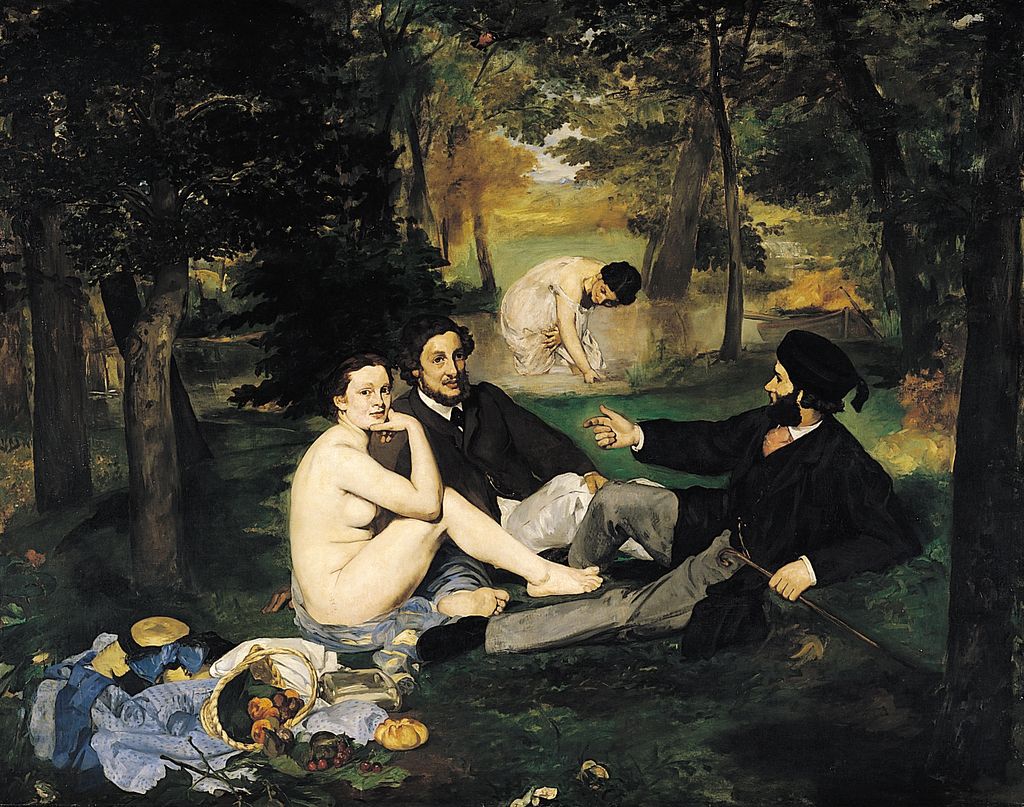
Édouard Manet's Le Déjeuner sur l'herbe drew on the Louvre painting for the encounter of a nude woman and clothed men in a landscape. For the disposition of the central group, the Musée d'Orsay also points to Marcantonio Raimondi's engraving after Raphael's Judgement of Paris. Manet kept the freedom to make visible people who seem to belong to his own time. At the Salon des Refusés in 1863 many viewers objected in part because he set aside the established literary or mythological conditions that might allow a nude to sit among clothed men. Looking back from Manet, the play of visibility and attention in the Louvre painting assumes a different importance. There the water, the pipe at rest and the men's lack of outward response sustain the chance that they are having an encounter with music and its sources as much as with anybody in the room. [1] [2] [9]
Annotated Details from Pastoral Concert
Select a point to see its detail.
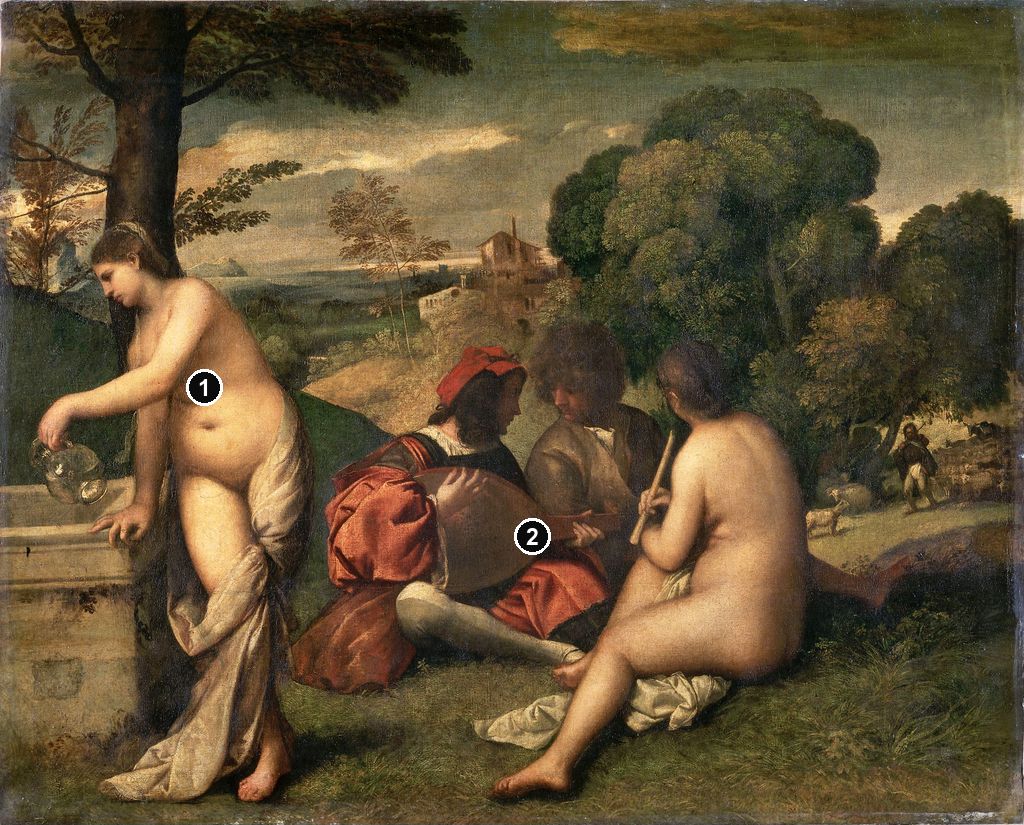
1. Vessel and basin · 2. The lute player
Details from PASTORAL CONCERT
Detail crops from the same image.
Vessel and basin
The standing woman pours water separately from the group with the lute.
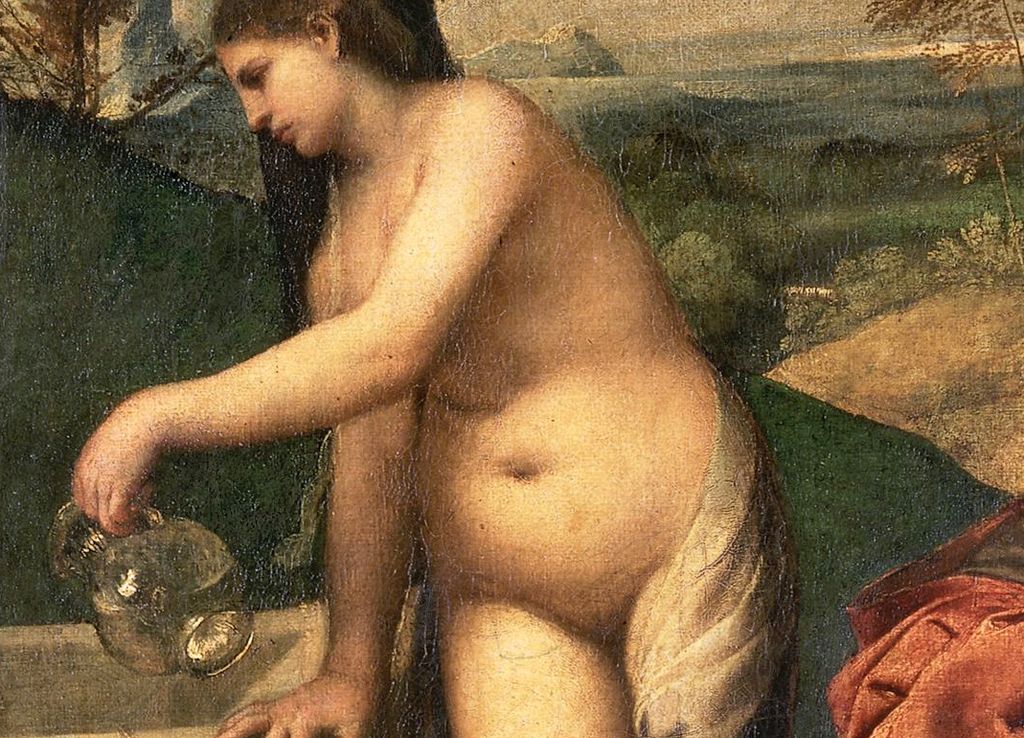
The lute player
The musician turns toward his dressed companion while the woman at the right holds a separate instrument.
Giorgione’s career
Castelfranco Madonna
Early 1500sFondaco dei Tedeschi
1507–08Three Philosophers
1508–09Death in Venice
1510Discussion
Share what you noticed and how you arrived at your reading.
Reader Insights
Which detail would you point out to somebody seeing Pastoral Concert for the first time?
How does afterlives in photographs and other paintings change how you read the work?
Join the Conversation
Share a detail, comparison or question about Pastoral Concert below.
References
- Musée du Louvre, Le Concert champêtre, INV 71. View source.
- Musée du Louvre, Premiers feux au musée, Le Concert champêtre. View source.
- Metropolitan Museum of Art, Giulio and Domenico Campagnola, Shepherds with musical instruments. View source.
- Metropolitan Museum of Art, Girolamo Romanino, Concert champêtre. View source.
- Museo Casa Giorgione, Il Fregio delle Arti Liberali e Meccaniche. View source.
- Musée d'Orsay, Adolphe Braun, Concert champêtre, photograph record. View source.
- Musée d'Orsay, Parcours Zola et les peintres. View source.
- Musée du Louvre, Département des Arts graphiques, Paul Cézanne, Le Concert champêtre, RF 31173. View source.
- Musée d'Orsay, Édouard Manet, Le Déjeuner sur l'herbe. View source.