


 by Tom Gurney
Tom Gurney BSc (Hons) is an art history expert with over 20 years experience
Published on June 19, 2020 / Updated on November 29, 2026
Email: tomgurney1@gmail.com / Phone: +44 7429 011000
Overview
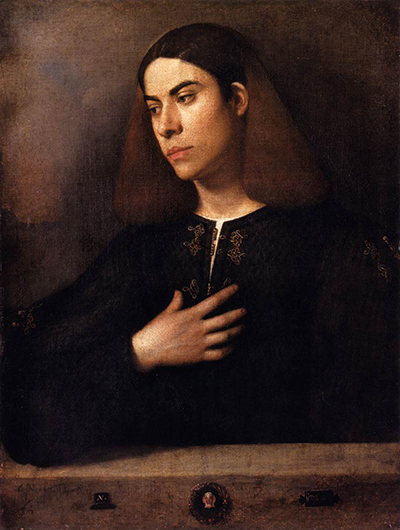
The young man holds a hand across his chest and looks out to one side. He wears a dark garment that takes up most of the canvas. There is little ornament between his throat and the edge of the stone in front of him, so that the pale hand commands almost as much attention as his face. The Museum of Fine Arts in Budapest, which dates the portrait to about 1503 and gives it to Giorgione, uses the secondary name Broccardo Portrait. A later fragment of writing helps to explain that name. The sitter's identity remains open. The painting is oil on canvas, 72.5 by 54 centimetres, and has the Budapest inventory number 94. [1] [2]
At a Glance
- Datec.1503
- CollectionMuseum of Fine Arts, Budapest
- AttributionGiorgione; named identity uncertain
- Inventory94
A shoulder, a hand and a glance
The head is turned far enough toward the light for us to see a pale cheek against the warmer fall of hair. We can follow the line from the brow to the nose and mouth with unusual clarity, even though the edge of the hair is harder to locate as it darkens into the background. The gaze continues toward the left, a little down from the level of our eyes. Nothing in the field tells us what has drawn it. If we place ourselves directly in front of the picture, we can see the distance between what the young man appears to attend to and what is given for us to see. [1] [2]
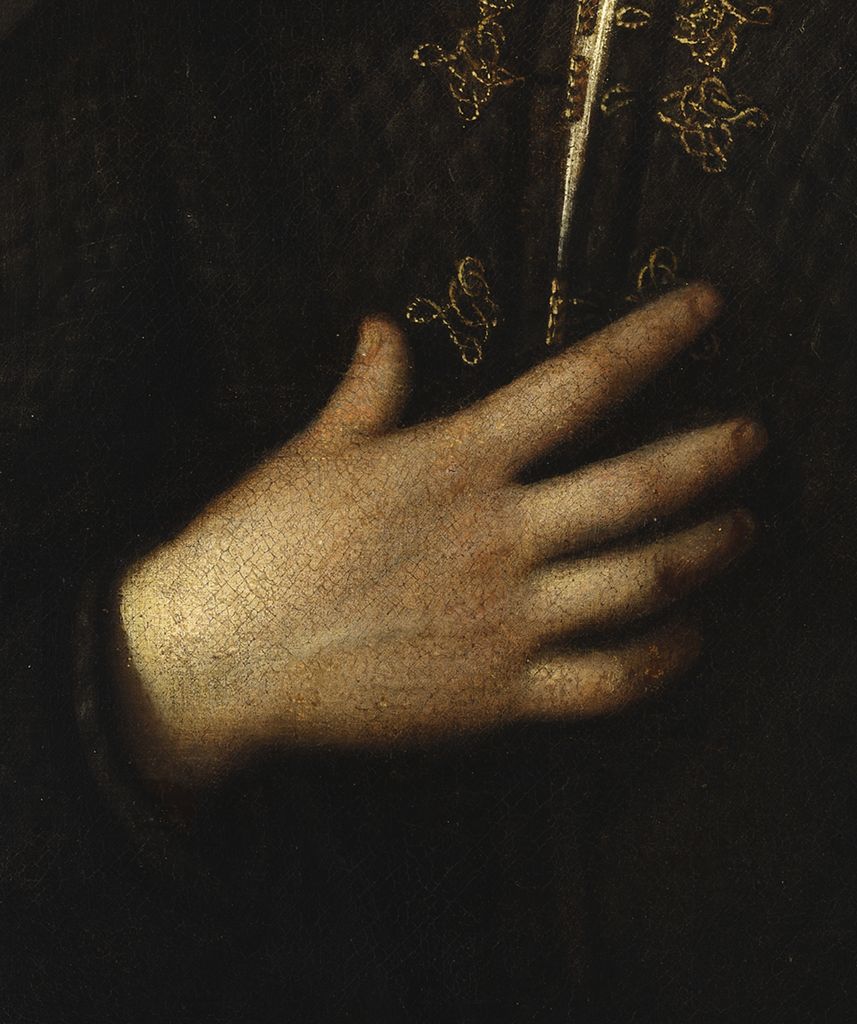
The hand has its own different direction. One forearm comes up on a broad diagonal and the fingers open across the chest. There is a little distance between them, and their shape is clear against the clothing. The gesture may feel like a sign of inward attention, an acknowledgement of feeling or a response to somebody out of sight. The choice to give the hand that much light keeps such possibilities close to the face itself. It also places a lived movement inside a formal likeness. Any occasion that required the young man to compose himself for a painter still leaves room for him to have made this small gesture in the course of being observed. [1] [2]
At the collar, the embroidery and the edge of a pale shirt take up remarkably little space. Look at the narrow opening at the top of the garment and then move outward to the shoulders. By remaining almost all dark, the material can give the youth some physical breadth without announcing a particular occupation. The collar also gives the hand something to approach. One of the fingers reaches farther across the body than the others and almost carries the line of the sleeve up to the face. Colour and position have done much of what a visible attribute in a more elaborate portrait could have done for our attention. [1] [2]
The edge of the stone
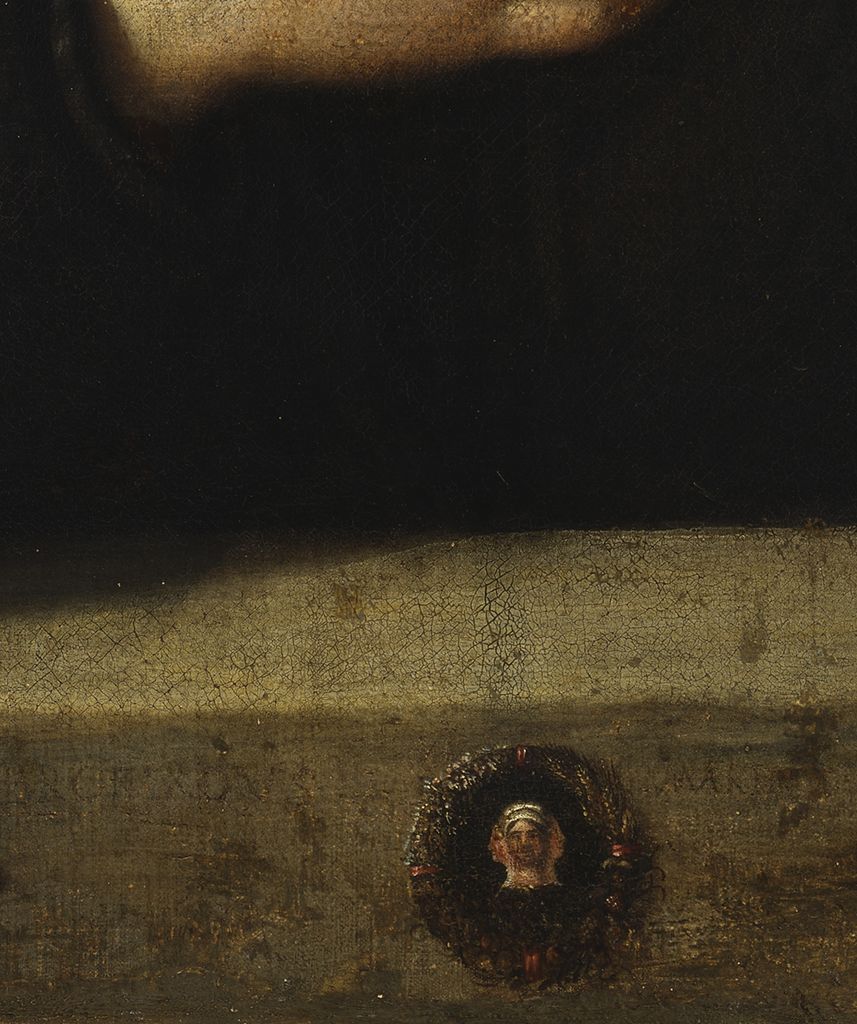
The parapet separates the painter's space from the person looking at it. The upper ledge seems capable of receiving a hand or elbow. The youth's arm instead carries the hand just above it towards his own chest. Against the vertical form of the body the stone keeps the bottom of the work level. The effect is to hold the sitter near us while making it difficult to imagine stepping into his space. Part of the portrait's quiet sense of address depends on that physical division before any emblem is considered. [1] [2]
Marks on the face of the parapet create another kind of distance. The Museum of Fine Arts records a later fragment reading Antonivs Brokardvs Mari[…]. It joins several puzzling motifs on the stone, the identification and meaning of which also remain debated. The easiest mistake in looking at such a panel of signs is to assume that everything was put there at the same moment. The museum explicitly distinguishes the surviving writing from the first phase of the painting. The conventional Broccardo name can therefore lead us to the correct object and to a piece of its history without proving how the person was originally known. [1] [2]
The museum's Budapest account discusses several possible emotional registers. A reader might recognise the inwardness of love, a sort of still grief or religious or poetic contemplation. These possibilities matter where conventional signs have the power to direct an interpretation. Without knowing what the sitter had in mind or when each painted mark acquired its current form, the best evidence lies in the distribution of attention. The face refuses a fixed point of contact with the spectator. The hand keeps returning the eye toward his body. The expressiveness remains accessible even when a specific reason for it cannot be recovered. [1] [2]
Budapest, Berlin and Rome
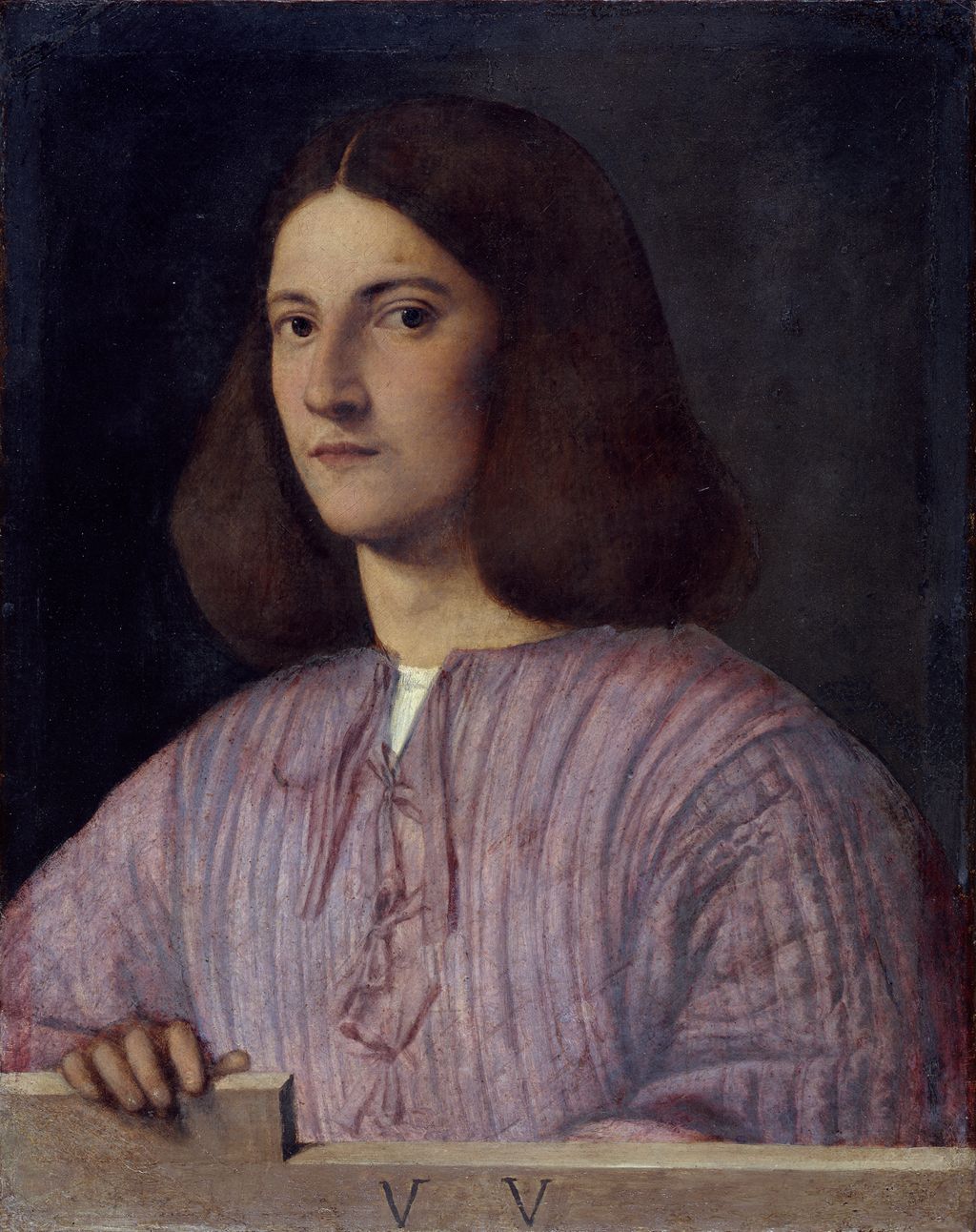
The Berlin Gemäldegalerie owns another Portrait of a Young Man, inventory 12A, which it catalogues as Giorgione and dates to the early sixteenth century. Its secondary title, the Giustiniani Portrait, derives from the collection in Padua where it remained until 1884. Jean Paul Richter acquired it and gave it to Giorgione before Wilhelm von Bode bought it for Berlin. The painting is on canvas like the Budapest portrait but smaller, 59.2 by 47 centimetres. The Berlin figure is seen against a dark ground in a violet-striped garment and glances in the other direction. The two collection names give us ways of distinguishing objects that the ordinary title would otherwise leave ambiguous. [3]
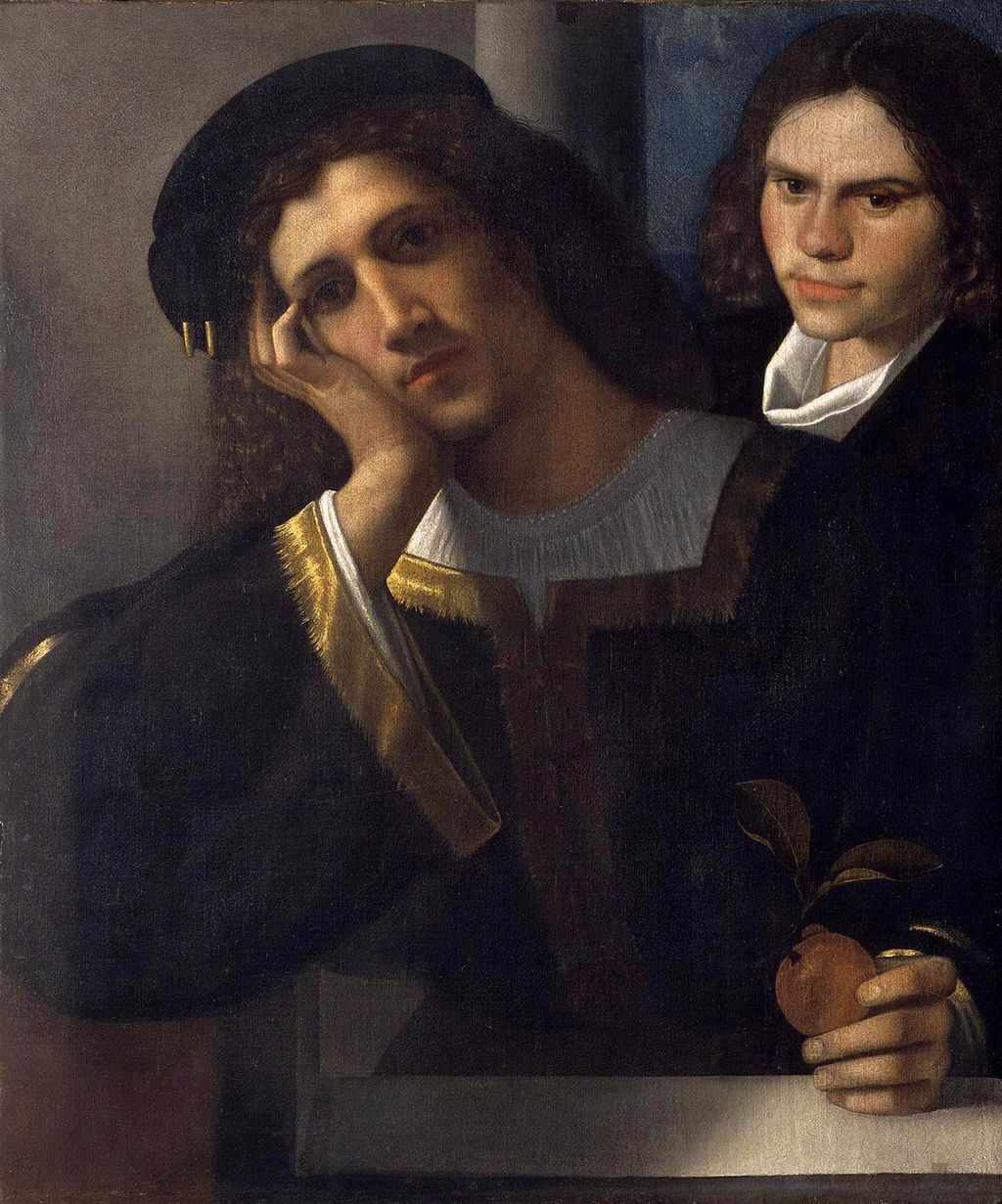
The Hungary–Italy exhibition at Palazzo Barberini gave the Budapest canvas a different partner. From November 2025 to March 2026 it was shown beside the Palazzo Venezia Double Portrait. Both pictures make the amount of space a sitter has near the frame part of the encounter. The Roman figure supports his face on his hand while holding a bitter orange in the other. Seeing someone else behind him makes a difference to our interpretation of his withdrawal. In the Budapest picture the place of that second observer is partly taken up by the viewer, who has a chance to study a face absorbed by something else. [1] [4] [5]
The Vienna Youth Holding an Arrow makes another useful point of reference. Its youth brings an unmistakeably slender object into the foreground even though its significance remains difficult to settle. Here the clearest thing in front of the body is a bare hand placed against dark cloth. The painted and impressed signs at the margin of the Budapest picture may still offer lines of enquiry. On the scale of the whole canvas, it is the light across that hand that continually brings us back from the parapet to the person. [1] [6]
Annotated Details from Portrait Of A Youth
Select a point to see its detail.
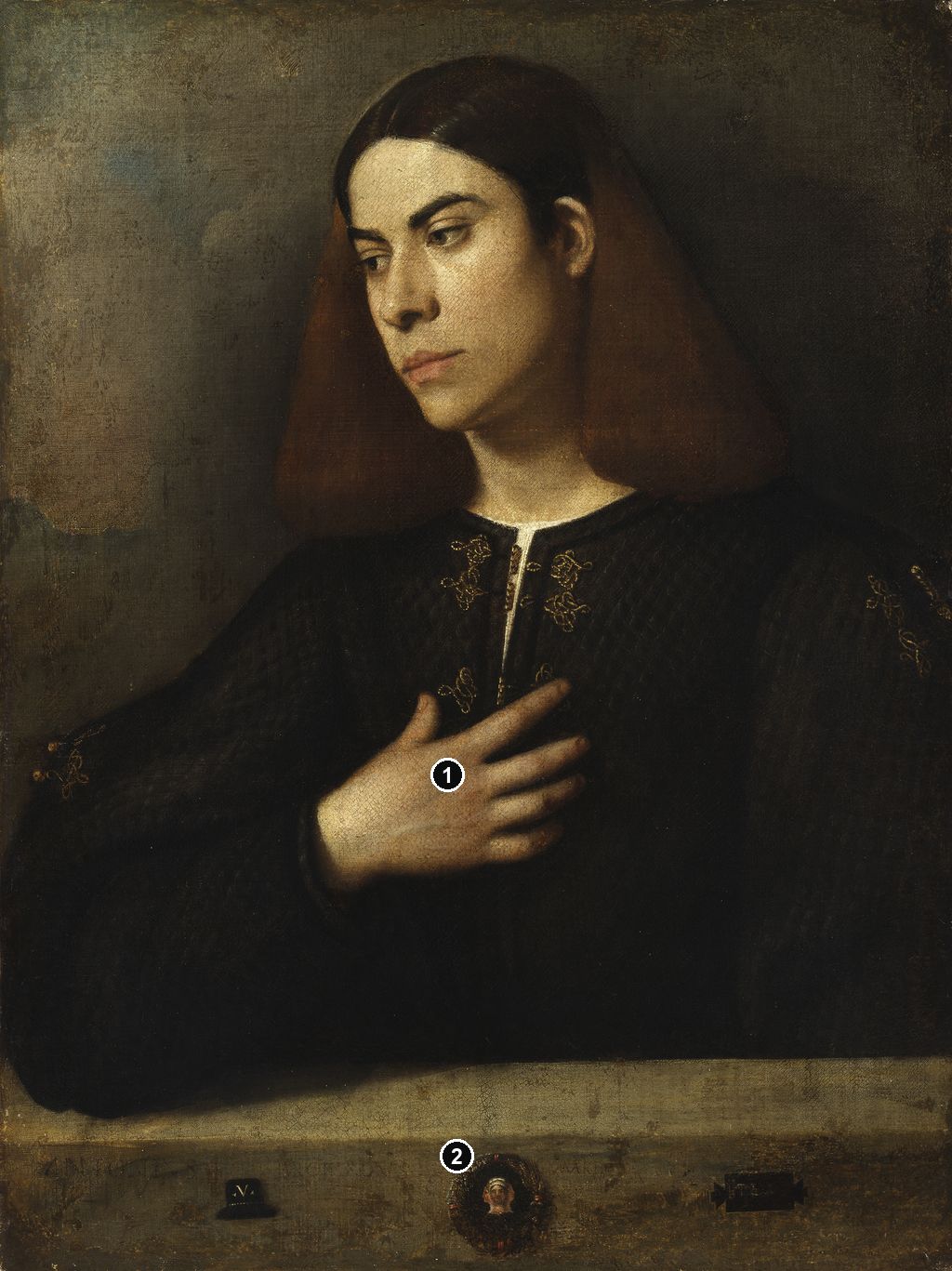
1. The hand · 2. Parapet and marks
Details from PORTRAIT OF A YOUTH
Detail crops from the same image.
The hand
The arm crosses the dark garment and gives the quiet portrait a direction opposite the gaze.
Parapet and marks
The visible signs belong to the history of the object and do not securely settle the sitter’s name.
Giorgione’s career
Castelfranco Madonna
Early 1500sFondaco dei Tedeschi
1507–08Three Philosophers
1508–09Death in Venice
1510Discussion
Share what you noticed and how you arrived at your reading.
Reader Insights
Which detail would you point out to somebody seeing Portrait of a Youth for the first time?
How does budapest, Berlin and Rome change how you read the work?
Join the Conversation
Share a detail, comparison or question about Portrait of a Youth below.
References
- Szépművészeti Múzeum, Ifjú képmása (Broccardo-portré), inventory 94. View source.
- Museum of Fine Arts, Budapest, Portrait of a Young Man (the Broccardo Portrait). View source.
- Staatliche Museen zu Berlin, Bildnis eines jungen Mannes, inventory 12A. View source.
- VIVE and Gallerie Nazionali di Arte Antica, Giorgione: From Budapest to Rome. View source.
- VIVE, Palazzo Venezia, Double portrait, inventory 902. View source.
- Kunsthistorisches Museum, Knabe mit Pfeil. View source.