


 by Tom Gurney
Tom Gurney BSc (Hons) is an art history expert with over 20 years experience
Published on June 19, 2020 / Updated on November 29, 2026
Email: tomgurney1@gmail.com / Phone: +44 7429 011000
Overview
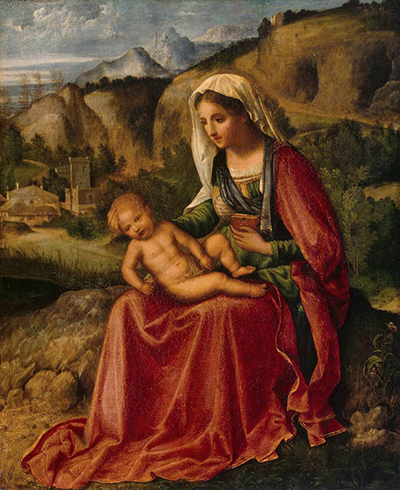
The infant in the Hermitage Virgin and Child in a Landscape has turned so far that Mary must support his head. She does it with one hand while holding a book close to her chest with the other. The movement would be at home in a room where somebody has set aside their reading to hold a child. Instead the figures sit on a rock above a descending landscape. The Hermitage dates its small painting to about 1503 and gives it to Giorgione. It is forty-four centimetres high and now on canvas after a transfer from its original wooden panel. [1] [2]
At a Glance
- Datec.1503
- CollectionState Hermitage Museum, St Petersburg
- AttributionGiorgione, attribution debated historically
- InventoryGE 185
How Mary holds him
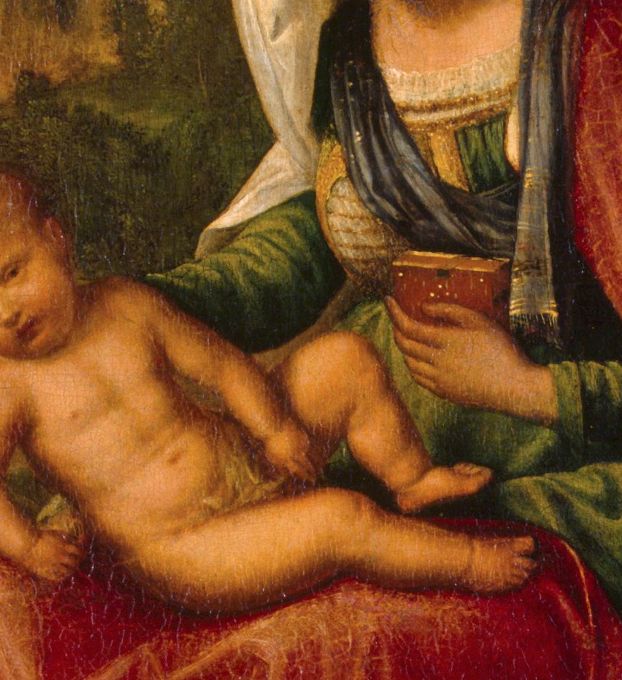
Mary looks down intently while the child directs his eyes out of the picture. His near arm braces him as he turns on her lap. Her hand receives the movement almost at the point where his head would otherwise tip back. Study the design at that point before looking at the whole. Mary's neck, the rounded back of the child's head and the reach of her fingers meet at different angles. The support she gives him looks temporary, a hold that would change as soon as he moved again. The Royal Academy's catalogue suggests that the opening in her dress might indicate that she has finished nursing. The moment remains recognisable without settling exactly why the child came to be lying in that position. [1] [3]
The book survives as a compact shape in the middle of this small drama. Since its pages are unavailable to us, the painting does very little to suggest a particular text. It shows what has happened to her attention. Her hand has gathered the book in against her body while her gaze and her other hand go with the child. There are powerful devotional associations with reading in pictures of the Virgin, but one of the pleasures of this treatment is simply seeing what it looks like to have both hands full. The painter arranges the figure so that a familiar kind of interruption can carry weight in a picture meant to be contemplated. [1] [3]
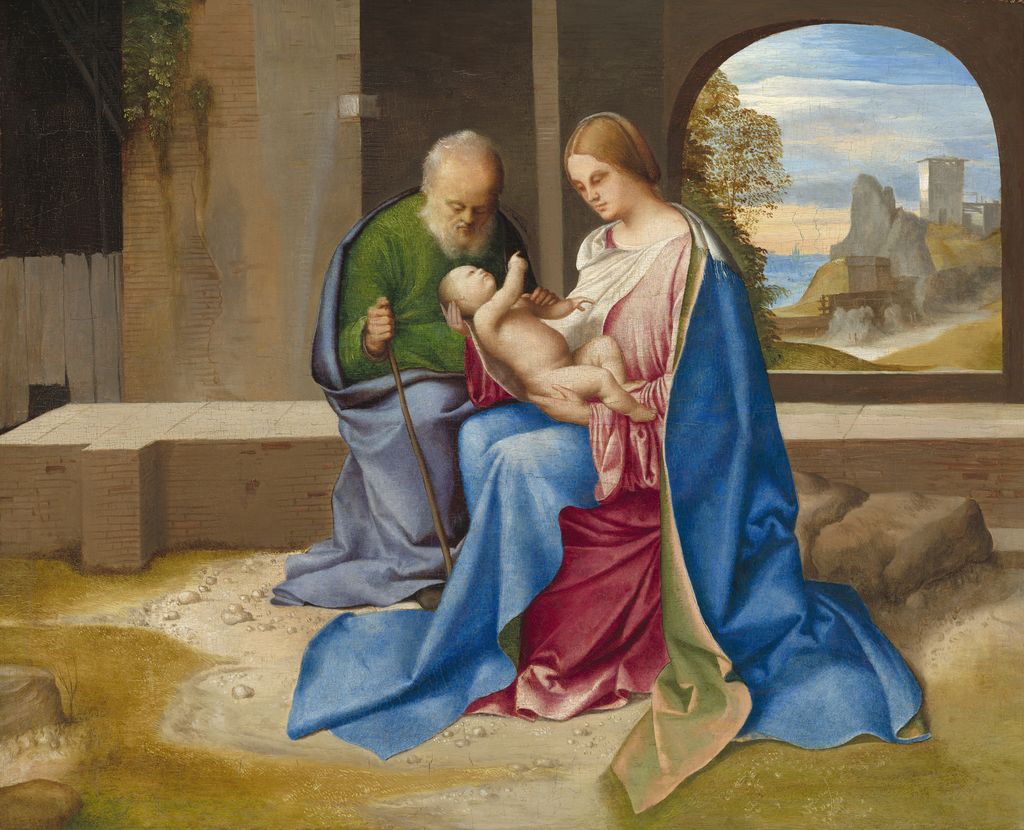
Compare the hand with the one in Washington's Holy Family. There, too, the Virgin supports the infant's head while he lies across her lap. The German connoisseur Jean Paul Richter made that resemblance part of his case for Giorgione in 1937, as the Royal Academy catalogue recounts. Washington shows a longer stretch of white cloth supporting the body and also gives Joseph a place beside them. In St Petersburg the tilt of the head, the book and the angle of the mother's shoulders hold the picture together with two figures. The likeness helps specify the character of the gesture. Here, as elsewhere in the debate over small Venetian devotional paintings, even a good comparison leaves room for a shared compositional tradition. [3] [4]
A hillside close to the figures
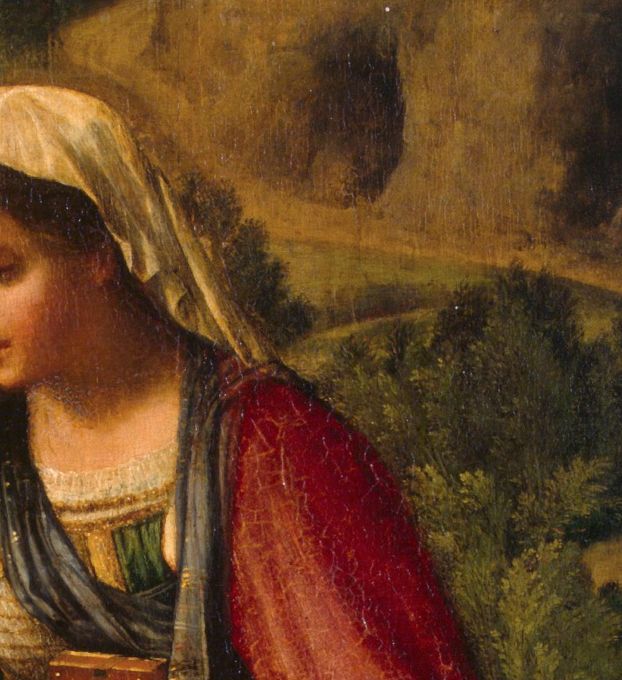
The loose sweeps of land have a different rhythm from the turning infant. From the rock on which Mary sits the ground falls toward a village. Rises at the edge and folds of the slope make it difficult to trace a single straight line to the horizon. Two dark mouths in the hillside, described in the Royal Academy catalogue as possibly quarries, pull the eye back to nearer ground. At first they can be mistaken for mere shadows in a reproduction. Once you see them as openings, the hill seems to have more volume, and the movement from the foreground to the buildings becomes less direct. [1] [3]
Golden earth colours return through different parts of the scene. The Hermitage describes a warmth that seems to permeate each colour and temper the separations between people and terrain. The drapery still has sharp folds in places. A little distance away the landscape is put together through much softer turns and changes in intensity. One can follow the contour of the figures clearly while still feeling that the air and the light that reach them belong to the same space as the hillside. The painting is high enough in relation to its width to give Mary and the child a substantial presence without reducing the landscape to a narrow strip over their shoulders. [1] [2]
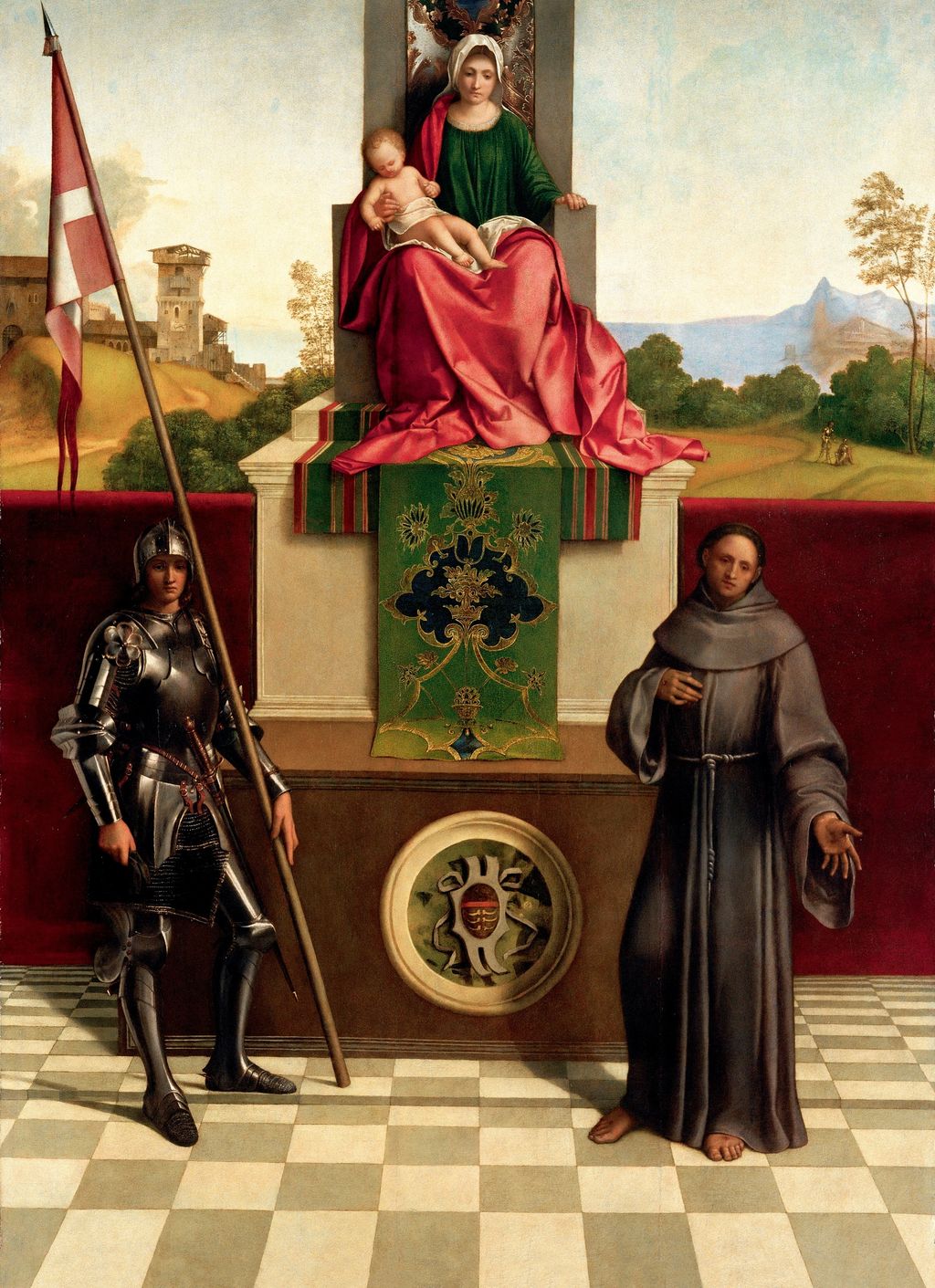
A work of this scale could suit a domestic chapel or another privately viewed setting. The Hermitage places it in the tradition of small devotional images, although the original buyer and exact setting remain unknown. Its scale helps explain the closeness possible in that kind of encounter. There is space to pay attention to a finger or the opening of a cave without stepping back across the room. The Castelfranco Madonna asks for a different movement of the eye. The enthroned mother and child stand above saints in a large public altarpiece. Here, the ground slopes beside the figures and the infant rests lower, on his mother's body. [1] [3] [5]
One title, two different settings
The Tallard Madonna at the Ashmolean Museum in Oxford is often mentioned beside the St Petersburg picture. Bernard Berenson connected both with another Virgin and Child composition in Venice and suggested an association with Giovanni Cariani. The 2016 Royal Academy exhibition catalogued the Hermitage work as Giorgione and the Tallard as attributed to him. The two were separate catalogue entries, with visibly distinct landscapes. The Oxford painting contains a distant view of Venice, with buildings around Saint Mark's that can be picked out from across the water. The mountainsides and village of the Hermitage picture belong to a different design. You can read the two together as exercises in finding space for a devotional pair and a deep view without making their landscapes or attribution evidence interchangeable. [3] [6]
The name on the label
The Hermitage acquired the painting in 1817 from a St Petersburg collection, identified in its English catalogue as that of A. A. Creyton. It entered under the name of the Ferrarese painter Garofalo. Gustav Waagen placed it closer to Giovanni Bellini's school in 1864, and later proposals included Andrea Previtali and Francesco Bissolo. Claude Phillips suggested Giorgione in 1895 and subsequently described the work as a copy of a lost original. Ludwig Justi moved from supporting an early Giorgione to questioning the authenticity of the painting. The sequence matters because a bare list of names can make different stages of the same scholar's judgement sound like an accumulating consensus. [1] [2] [3]
The 1955 Venice exhibition Giorgione e i Giorgioneschi helped build support for Giorgione, a position maintained by the Hermitage and the Royal Academy catalogue. Proponents have proposed dates ranging from the mid-1490s to well into the first decade of the sixteenth century. The museum's present date, about 1503, is a useful guide to the early context and retains the necessary margin of uncertainty. The transfer of the picture from panel to canvas explains why the Royal Academy speaks of an original panel while the Hermitage's web label lists oil on canvas. An apparent conflict between descriptions in this case records a change in the object, not the existence of a second version. [1] [2] [3]
Those changing labels have their own interest, but the gesture that attracted Richter remains remarkably quick to see. The child's weight moves down into Mary's lap as his face moves round toward the light. Her fingers adjust to him while her other hand still has the book. The landscape is in constant motion of a slower kind. Every rise and opening leads somewhere else, even as the brush stays with two people who for a moment have nowhere to go. [1] [3]
Annotated Details from Virgin And Child In A Landscape
Select a point to see its detail.
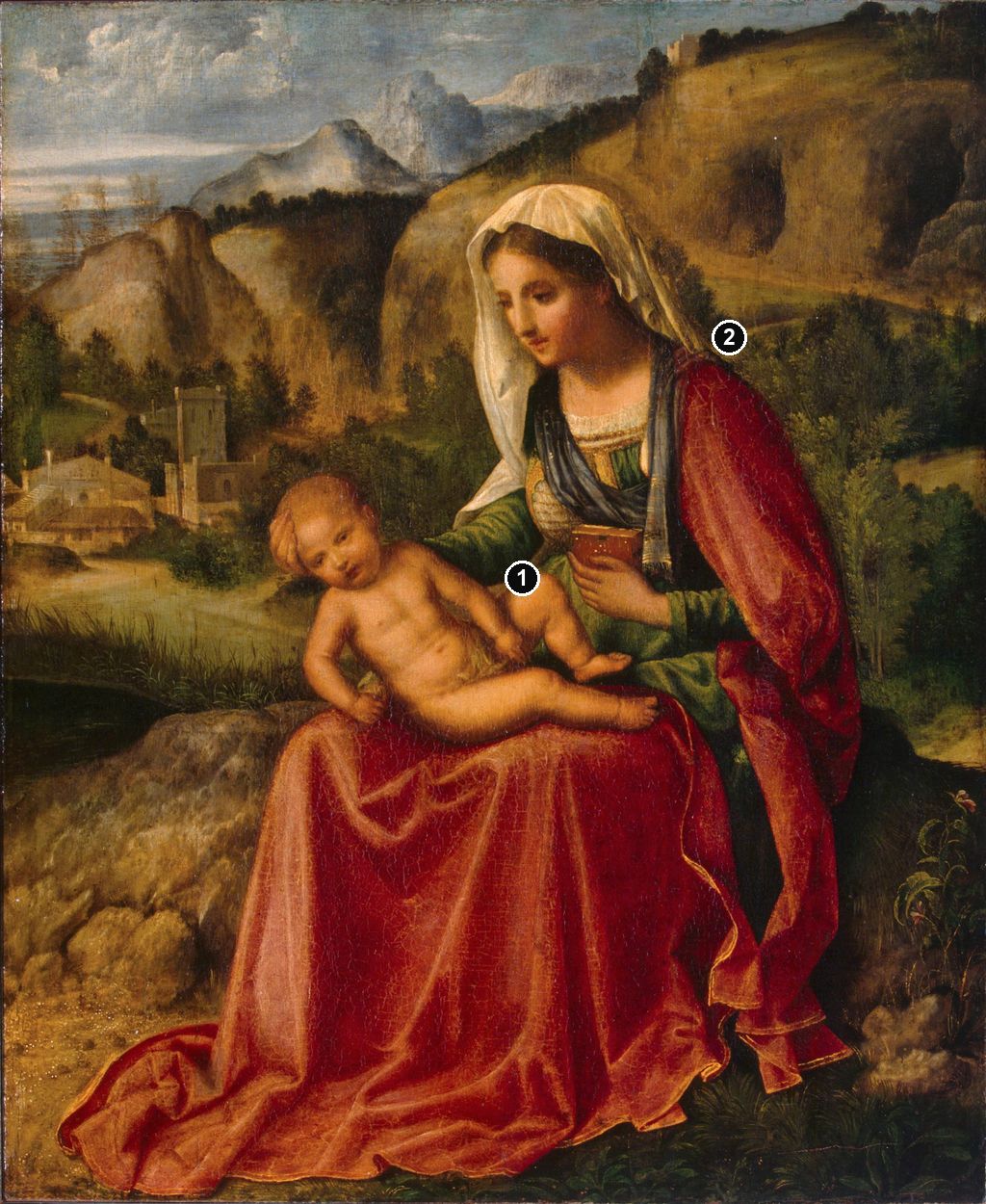
1. The mother's supporting hand · 2. The hillside
Details from VIRGIN AND CHILD IN A LANDSCAPE
Detail crops from the same image.
The mother's supporting hand
Mary adjusts her hold as the infant turns on her lap.
The hillside
Openings in the slope make the painted land feel close to the figures.
Giorgione’s career
Castelfranco Madonna
Early 1500sFondaco dei Tedeschi
1507–08Three Philosophers
1508–09Death in Venice
1510Discussion
Share what you noticed and how you arrived at your reading.
Reader Insights
Which detail would you point out to somebody seeing Virgin and Child in a Landscape for the first time?
How does the name on the label change how you read the work?
Join the Conversation
Share a detail, comparison or question about Virgin and Child in a Landscape below.
References
- State Hermitage Museum, Мадонна с Младенцем в пейзаже, ГЭ-185. View source.
- State Hermitage Museum, Western European Art: Paintings 13th to 18th Century, Madonna and Child in a Landscape. View source.
- Simone Facchinetti and Arturo Galansino, eds., In the Age of Giorgione, Royal Academy of Arts, catalogue nos. 27–28. View source.
- National Gallery of Art, Washington, The Holy Family, 1952.2.8. View source.
- Museo Casa Giorgione, The Castelfranco Altarpiece. View source.
- Ashmolean Museum, The Virgin and Child with a view of Venice. View source.