


 by Tom Gurney
Tom Gurney BSc (Hons) is an art history expert with over 20 years experience
Published on June 19, 2020 / Updated on November 29, 2026
Email: tomgurney1@gmail.com / Phone: +44 7429 011000
Overview
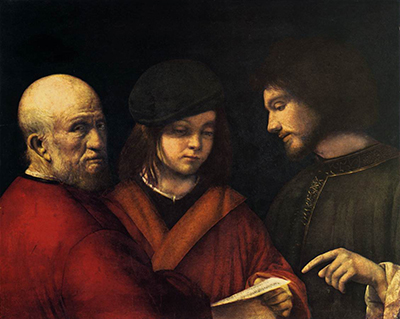
A boy in a dark cap lowers his eyes toward a sheet of paper. A man beside him brings a finger close to it, and an older man at the left turns his face outward as though we too had come close to hear what is happening. The painting in the Galleria Palatina at Palazzo Pitti is commonly called The Three Ages of Man. It has also been called The Singing Lesson. The Italian state catalogue dates it to about 1505–10 and records Giovanni Morelli's attribution to Giorgione in 1880. An oil on wood panel some 62 by 77.5 centimetres, it contains surprisingly little apart from the three heads, their clothing, the sheet and the hands around it. [1] [2]
At a Glance
- Datec.1505–10
- CollectionGalleria Palatina, Florence
- AttributionGiorgione
- InventoryPalatina 110
Reading over the boy's shoulder
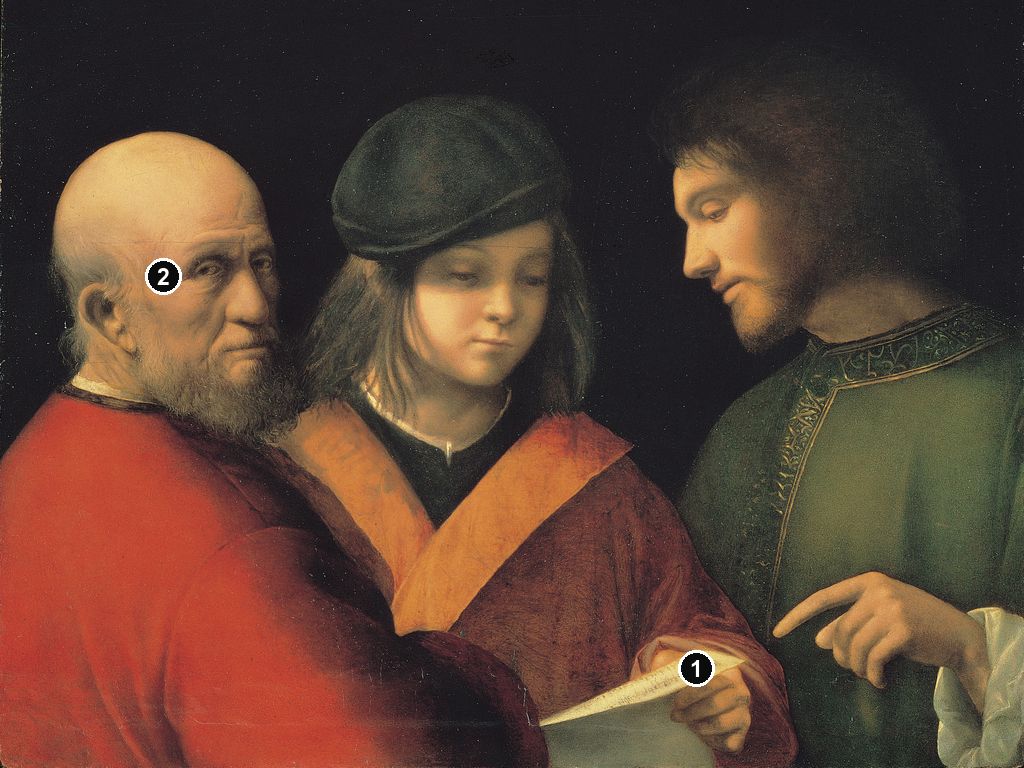
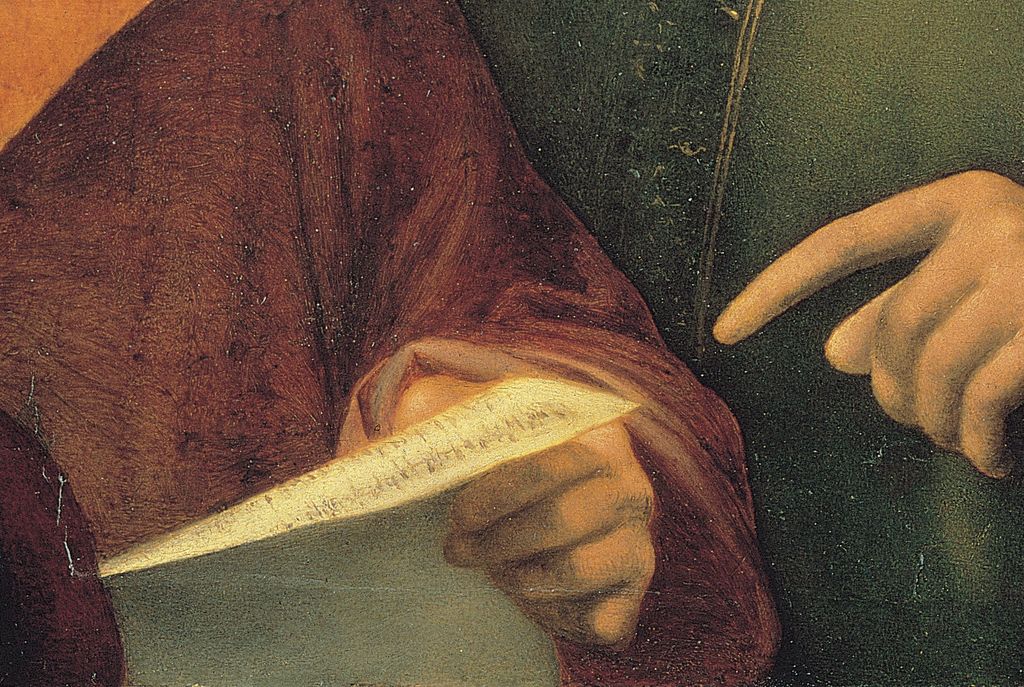
It is tempting to begin with the men at either end, because their faces are more independent of the shadow. The boy's head occupies the middle but inclines so far that the cap almost carries him out of the light. His attention is given to the paper. The adult on the right reaches in with a finger and looks down with him. His gesture supplies enough direction for the eye to follow, even as the visible marks on the sheet provide little information about the exact nature of the lesson. A musical reading can take the finger as a way of keeping time or showing a place, while the slight distance between hand and page leaves the manner of instruction open. [1] [2] [3]
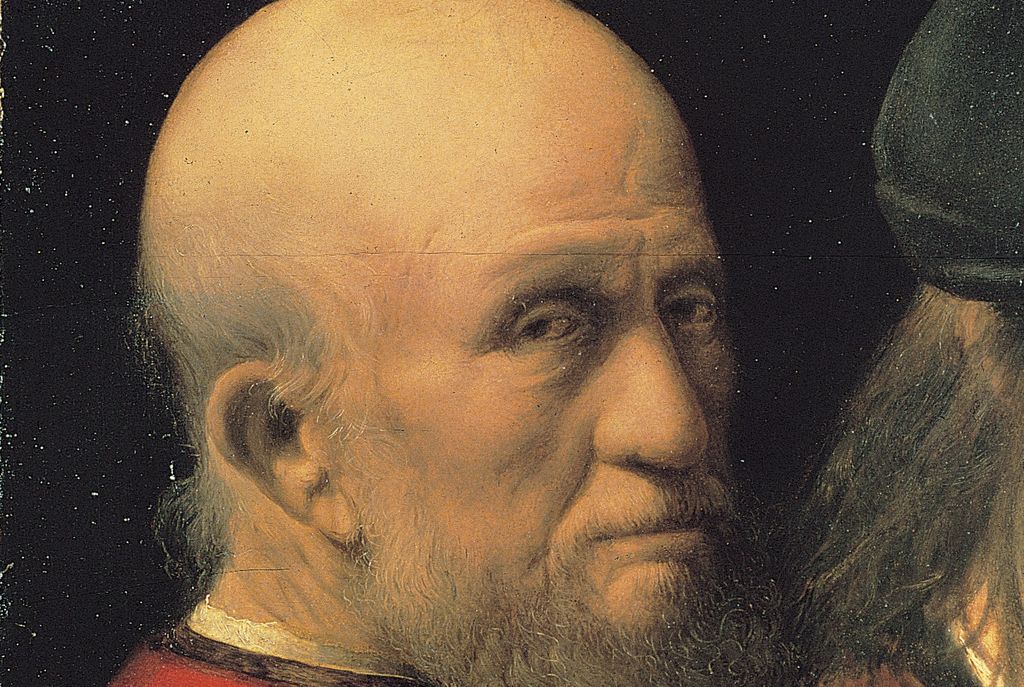
The older figure is very close to them in depth. The turn of his upper body keeps his face available to us while the others look away. Notice how effectively that movement closes off the left side of the picture. We can imagine a room, but the light reveals virtually nothing beyond them. What would otherwise be a narrow view of someone reading becomes a social encounter, because the man on the left has acknowledged the space on our side of the panel. The boy, by comparison, enjoys a moment of concentration undisturbed by any awareness of a fourth person. [2] [3]
Morelli found the shadowed head of the boy and the music paper especially persuasive even though he thought the surface suffered from retouching. His account offers a record of looking before the modern restoration. He found a characteristic passage in a small part of a picture labelled Lorenzo Lotto in Florence. At the time he also distinguished his reading from that of Crowe and Cavalcaselle, who had proposed Andrea Schiavone. Attributions of this kind were often argued out passage by passage. Morelli's attention to the boy and his paper is a reason to notice how much personality can survive in a head with very little of its surface plainly lit. [1] [4]
The ages, the singers and the emperor
The familiar title takes as its starting point something apparent in the faces. There is a youth, a mature adult and an older adult. The effect of a continuous sequence is enhanced by the shared object. The person who has least experience appears to have the most to learn, while the other men offer very different kinds of attention. This reading can make the painting a meditation on the way knowledge, including musical knowledge, passes from one age to another. The effort of reading a sheet or following a finger gives the meditation a particular action. [1] [3]
Singing also has a historical foothold as a subject of its own. An inventory of the Venetian Vendramin collection from the sixteenth century records works associated with Giorgione and described in terms of three people singing. Writing about the Pitti picture, Klára Garas discusses connections with such descriptions. The resemblance is striking, but words that could describe more than one small group picture do not settle which one was inventoried. The current encounter still makes sense as a music lesson. With no instrument clearly visible, singing or learned reading can be conveyed through a hand near the sheet and the gathered attention of the people around it. [2] [3]
A very different old title is also worth preserving. Garas traces the panel's likely appearance in the collection of Nicolò Renieri as a depiction of Marcus Aurelius studying between two philosophers, then listed as Palma Vecchio. The young emperor was one way to explain an evidently shared act of study. That title has the advantage of taking the two older people seriously as companions in intellectual activity. It has the drawback of depending on a personal identification the figures' attributes cannot confirm. The early wording is more useful as evidence of a collector's interpretation than as proof of an original commission about the Roman emperor. [1] [2]
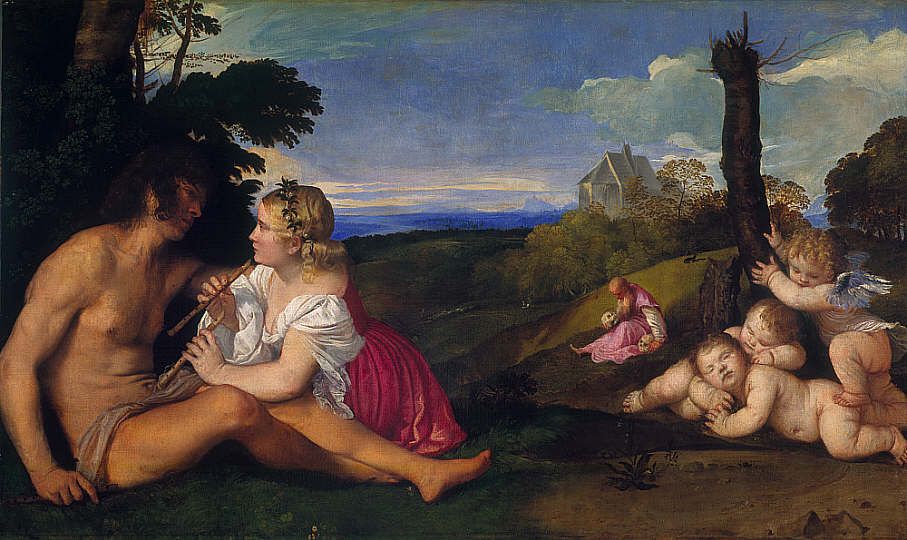
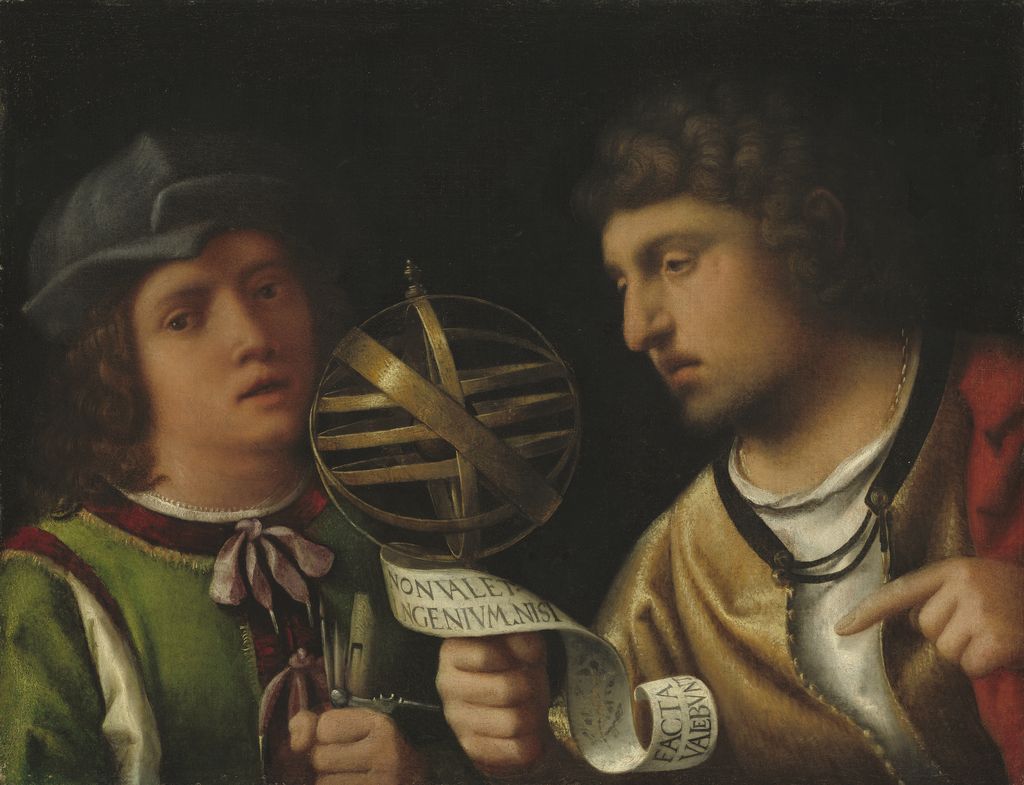
Giorgione's Three Philosophers at the Kunsthistorisches Museum also brings together people of differing ages, but it gives them room to stand or sit independently in a landscape. One holds papers and the seated figure studies the rugged ground. Those documents and poses belong to a larger drama of observing the surroundings. The reading of the paper at Pitti is a close exchange between people. Titian's Three Ages of Man in the National Galleries of Scotland handles the analogy at a still more expansive scale, with children, young lovers and an old man spread across a pastoral setting. Looking at all three pictures makes the smaller Florence scene's concentration on instruction much more apparent. [3] [5] [6]
Beneath the figures
According to Garas, Alfio del Serra restored the Pitti panel in 1989. Infrared examination later revealed traces of a preparatory design with a kneeling Virgin and Child in a landscape, suggestive of an Adoration. A ghost of another arrangement on a painted panel is evidence of work abandoned or radically redirected before we reach the picture we know. It cannot tell us how long the earlier idea was pursued, whether the same hand was responsible for every stage, or when the next customer first saw it. It does give the finished absence of scenery an additional significance. At some point land and a kneeling figure were imagined in the same area where we now find an enclosed encounter. [2]
By 1713 the panel was recorded at Pitti under a title identifying the three ages. Garas's account also notes a description associating it with a Lombard manner. The Italian catalogue places the possible acquisition among material that passed from Renieri's collection to the Medici. The shifting descriptions of authorship and subject were not simply two independent strands of cataloguing. What an observer thought was happening between the people could affect the set of works to which they compared it. Likewise an attribution to a particular painter could make a reader more willing to see an allegory, a Roman episode or a lesson. [1] [2]
Perhaps the most helpful way to experience the panel is to follow the mature man's finger, then take the other direction out toward the older man's eyes. What begins as a matter of life stages becomes a question about who is watching whom. The teacher and his young companion keep their attention together. The older figure makes a little room for ours. [1] [3]
Annotated Details from Three Ages Of Man
Select a point to see its detail.
1. Paper and fingers · 2. The older man
Details from THREE AGES OF MAN
Detail crops from the same image.
Paper and fingers
A pointing hand and a downward glance give the interpretive question its most concrete evidence.
The older man
The face on the left turns outward while the lesson or song continues beside him.
Giorgione’s career
Castelfranco Madonna
Early 1500sFondaco dei Tedeschi
1507–08Three Philosophers
1508–09Death in Venice
1510Discussion
Share what you noticed and how you arrived at your reading.
Reader Insights
Which detail would you point out to somebody seeing The Three Ages of Man for the first time?
How does beneath the figures change how you read the work?
Join the Conversation
Share a detail, comparison or question about The Three Ages of Man below.
References
- Catalogo generale dei beni culturali, Tre età dell'uomo, 0900297809. View source.
- Klára Garas, The History of Collecting Giorgione in America, pp. 48–49. View source.
- Royal Collection Trust, The Art of Italy in the Royal Collection, figure 83 and related discussion. View source.
- Giovanni Morelli, Le opere dei maestri italiani nelle gallerie di Monaco, Dresda e Berlino, p. 162. View source.
- Kunsthistorisches Museum, Die drei Philosophen. View source.
- National Galleries of Scotland, Titian, The Three Ages of Man. View source.