


 by Tom Gurney
Tom Gurney BSc (Hons) is an art history expert with over 20 years experience
Published on June 19, 2020 / Updated on November 29, 2026
Email: tomgurney1@gmail.com / Phone: +44 7429 011000
Overview
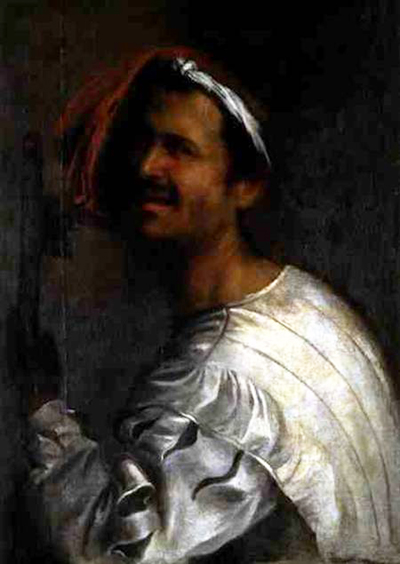
The figure turns back toward us while keeping his flute in his left hand. The cap puts part of his face into shade. His white sleeve has openings along it that catch light as his shoulder turns. In the Galleria Borghese he is known as the Flute Player, or Cantore con flauto, inventory 130. The painting is oil on canvas, 102.5 by 73 centimetres. The Gallery places it in the Venetian school, attributes it to Giorgione with qualification and dates it to around 1507. His companion, the Passionate Singer, is another canvas in the same collection with a related history and quite a different expression. [1] [2]
At a Glance
- Datec.1507
- CollectionGalleria Borghese, Rome
- AttributionVenetian school, attributed to Giorgione
- Inventory130
Turning toward the spectator
To see how the figure is made, begin with the broad part of the shirt. It is set at an angle to the plane of the picture, and its slashed sleeve helps emphasise the turn. The man's head comes round toward us more sharply than the body. That double movement accounts for much of the disconcerting sense of contact. He has the air of someone deliberately making himself visible at a performance. His expression, described by the museum as nearly a grimace, could also be the continuation of something that has just happened out of sight. As with the instrument, we can recognise the means of performing while having to imagine the occasion. [1]
The red hat matters as a piece of design as well as costume. It sets a boundary to the light around the upper face. The Galleria Borghese reports that technical examination revealed a larger shape was planned for it. This is not merely a comment on how an old cap may have worn or on how a particular photograph has been cropped. It records a change in the form chosen during painting. That adjustment would affect how much of the face appears in shade and how directly we can see the turn. The work's several restorations and examinations are recorded as separate events, with diagnostic campaigns in 1953, 2000, 2001 and 2023 among the relevant entries. The Gallery reports the larger hat as an observation from examination, without requiring us to guess why the painter altered it. [1]
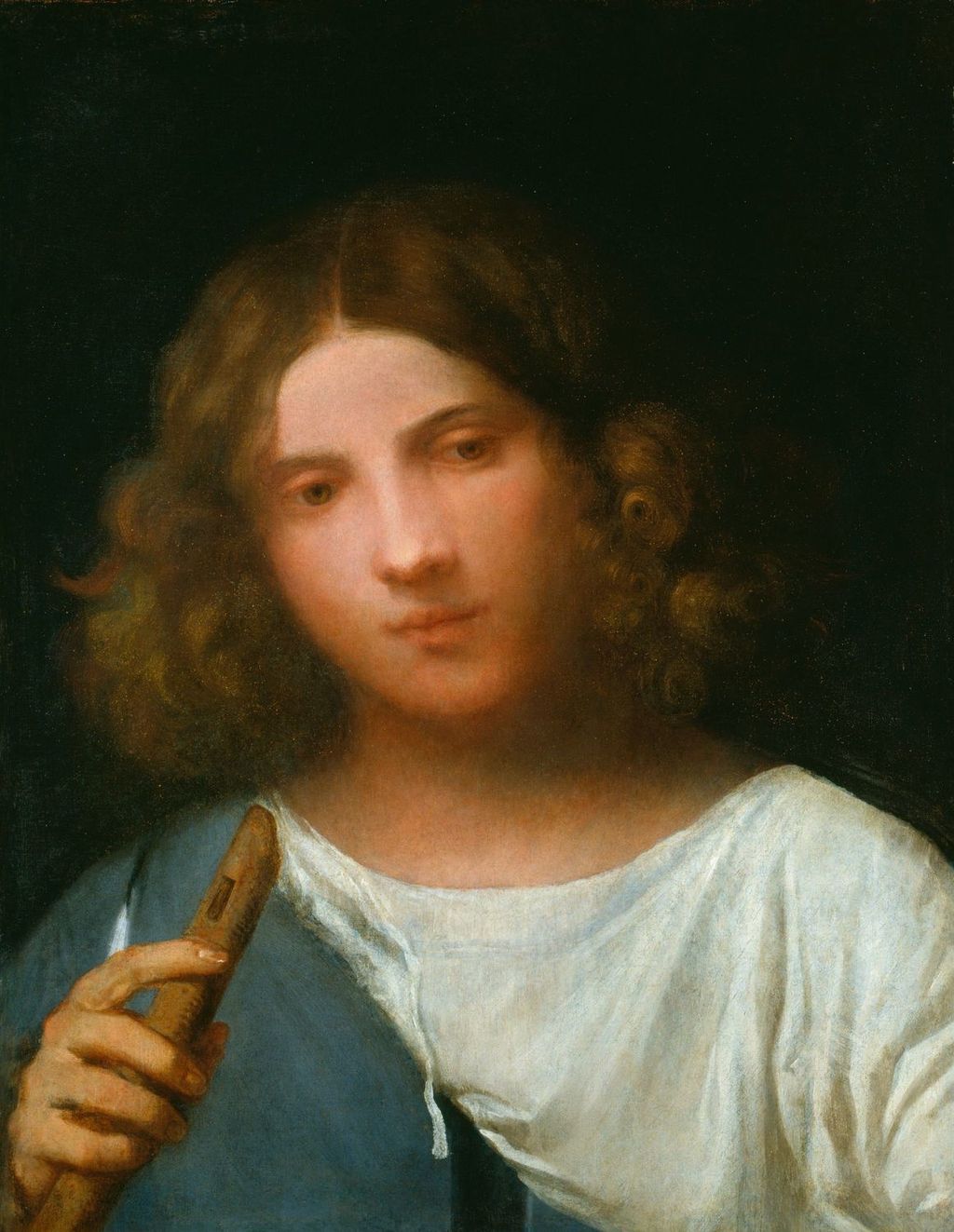
Look also at the division of the red and white. The bright shirt offers a broad surface below the face. The red is more compressed and has the force of an accent. Between them the head can read as almost caricatural because lines and changes of shade are gathered around a rather small number of features. In the Royal Collection Shepherd with a Flute, the interruption of playing makes the turn appear inward. The Borghese flautist presents a more forceful profile and twist. Both images are silent at the moment of depiction, but one can easily imagine different immediate consequences. One player may return to his music after a thought. The other seems to be making an audience aware of his reaction. [1] [3]
The place of the second singer
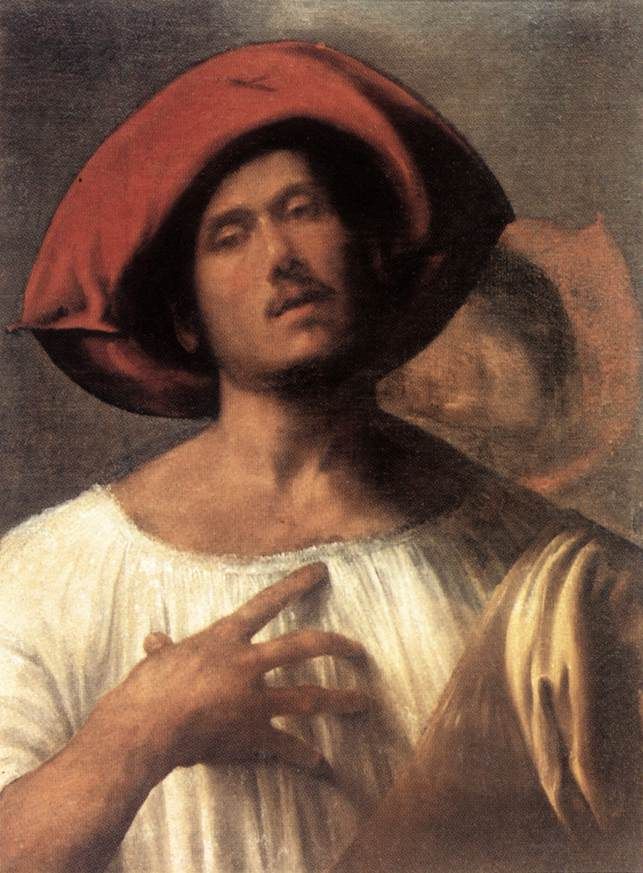
The approximate 1633 inventory of Scipione Borghese describes two jesters on canvas. One was in a shirt and red cap, and the other carried a pipe in a slashed garment. The same grouping occurs in Jacopo Manilli's description of the villa in 1650, under the name Giorgione. The old description identifies characteristics that still show very plainly on the canvases. Because the collection numbers are distinct, a viewer can find and compare the works on their own material terms. The instrument belongs to 130. The stronger impression of someone actively voicing a note belongs to Passionate Singer, inventory 132. Their canvases are roughly similar in size, with the second measuring 104 by 77 centimetres. [1] [2]
For a time scholars tried to link them to an early record of three singing heads in the Vendramin collection. That idea suggested the two paintings could be fragments cut from a single larger composition. The Borghese account describes the reconstruction as subsequently rejected. It retains the comparison with the Concert from the Mattioli collection, with which the works were shown in Venice in 1955 and in Paris in 1993. That painting's conservators have found revisions beneath its visible group. The technical observations belong to a separate object, and the comparison can help explain why people were drawn to the lost-group hypothesis even after its particular claims came into doubt. [1] [2] [4]
The attitude of the figure also belongs in an early sixteenth-century conversation about expressive faces. The Borghese notes the timing of Albrecht Dürer's stay in Venice when explaining why scholars have thought about that encounter in relation to this group of pictures. Dürer's close examination of physiognomy can be studied in works with intense bodily pressure near the frame. Their existence does not show that a particular image supplied the model for this face. The proximity in time allows comparison with a kind of bold address that makes a spectator feel gathered into the painted space rather than placed at a formal distance. [1] [5]
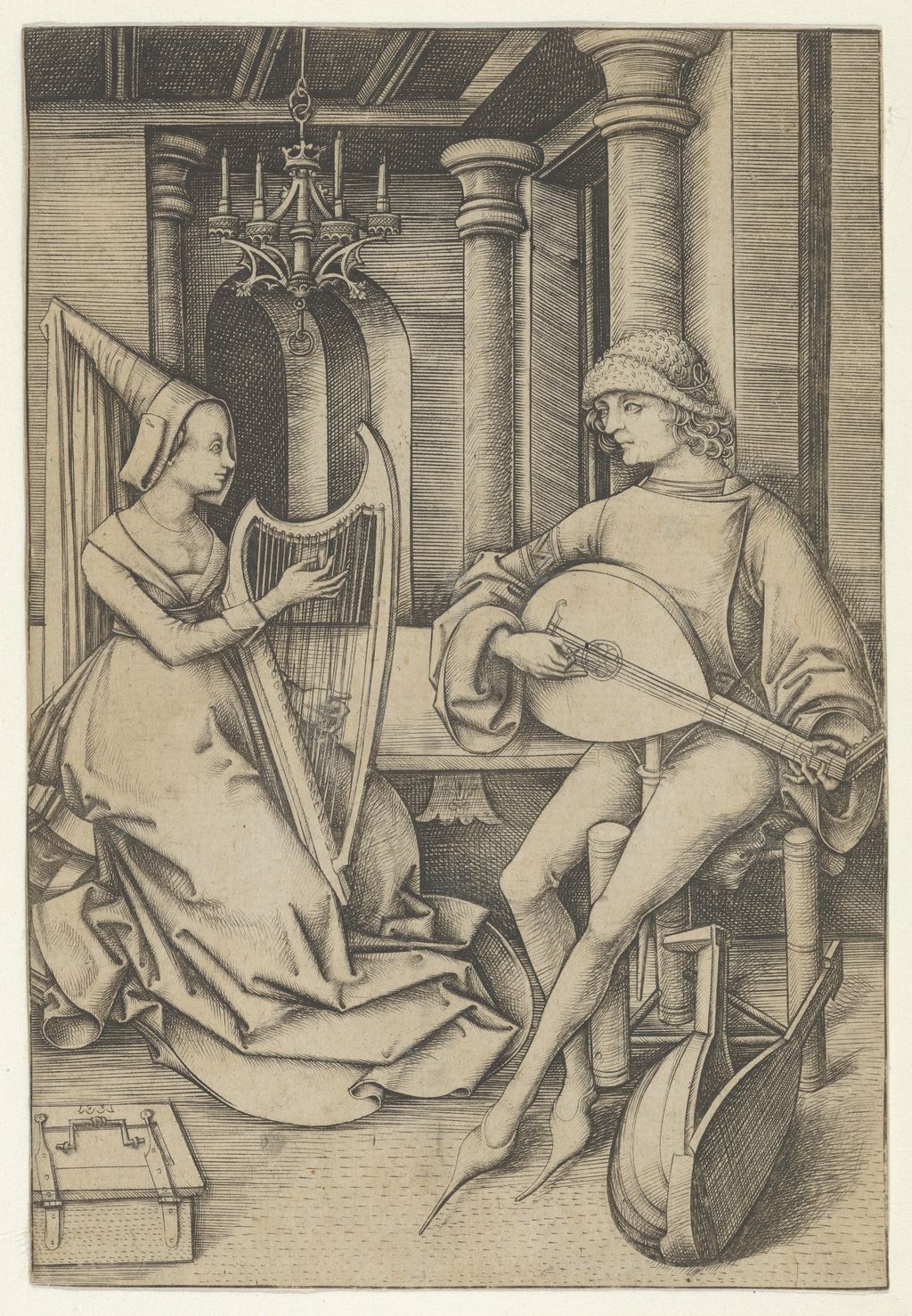
Dürer's Jesus Among the Doctors, now in Madrid, gives the comparison a concrete object. It was painted in Venice in 1506 and packs the heads, books and hands in so closely that the figures have little room to perform their argumentative gestures. Its contrasting faces also emerge through quite different kinds of shadow. The Borghese painter chose to give a single very direct face that sort of space and intensity. There are other ways to produce a musical encounter. Israhel van Meckenem's engraving Lute Player and Harpist, made a little earlier, lets two people in courtly dress accompany one another, with room for instrument cases and furnishings at their feet. At the Borghese there is no such account of a room or of an audience's status. The slashed sleeve, instrument and look carry almost the entire description of performance. [6] [7]
The artist's name in the Borghese inventories
Names changed even while the pictures stayed together. The 1833 Borghese inventory used Giovanni Bellini. Later scholars including Venturi and Berenson proposed Domenico Capriolo. Roberto Longhi renewed the case for a Giorgione connection, and other authors have considered painters deliberately working in Giorgione's manner well after his death. The Gallery retains a qualified attribution to Giorgione. The twofold wording, Venetian school and attribution, is important to distinguish from the reports of the old family guide, where Giorgione's name was written without such a reservation. The works passed to the Italian state in 1902 with the collection in which the debate had taken shape. [1] [2]
The recent display of works from the Borghese at Palazzo Barberini provides another marker in its travel history. Exhibition language there retained the link to Giorgione's Venetian sphere while presenting a sixteenth-century object. For close looking in Rome today, the most helpful approach still begins with the parts making the movement legible. A figure in a slashed sleeve has paused with his hand on an instrument and his head turned to the room. The company he had at the hands of a painter is still debated. The quickness of the turn makes it quite easy to imagine he has found some here. [1] [8]
Giorgione’s career
Castelfranco Madonna
Early 1500sFondaco dei Tedeschi
1507–08Three Philosophers
1508–09Death in Venice
1510Discussion
Share what you noticed and how you arrived at your reading.
Reader Insights
Which detail would you point out to somebody seeing Singer with a Flute for the first time?
How does the artist's name in the Borghese inventories change how you read the work?
Join the Conversation
Share a detail, comparison or question about Singer with a Flute below.
References
- Galleria Borghese, Cantore con flauto, inventory 130. View source.
- Galleria Borghese, Passionate Singer, inventory 132. View source.
- Royal Collection Trust, A Boy with a Pipe (The Shepherd), RCIN 405767. View source.
- Gallerie dell'Accademia di Venezia, Il Concerto, Mattioli collection. View source.
- National Gallery of Art, Washington, German Paintings of the Fifteenth through Seventeenth Centuries. View source.
- Museo Nacional Thyssen-Bornemisza, Albrecht Dürer, Jesus Among the Doctors, 134. View source.
- Metropolitan Museum of Art, Israhel van Meckenem, Lute Player and Harpist, 27.5.2. View source.
- Gallerie Nazionali di Arte Antica and Galleria Borghese, Capolavori dalla Galleria Borghese a Palazzo Barberini, exhibition press material. View source.