


 by Tom Gurney
Tom Gurney BSc (Hons) is an art history expert with over 20 years experience
Published on June 19, 2020 / Updated on November 29, 2026
Email: tomgurney1@gmail.com / Phone: +44 7429 011000
Overview
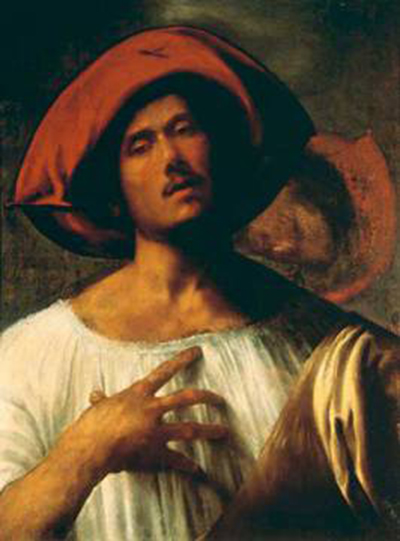
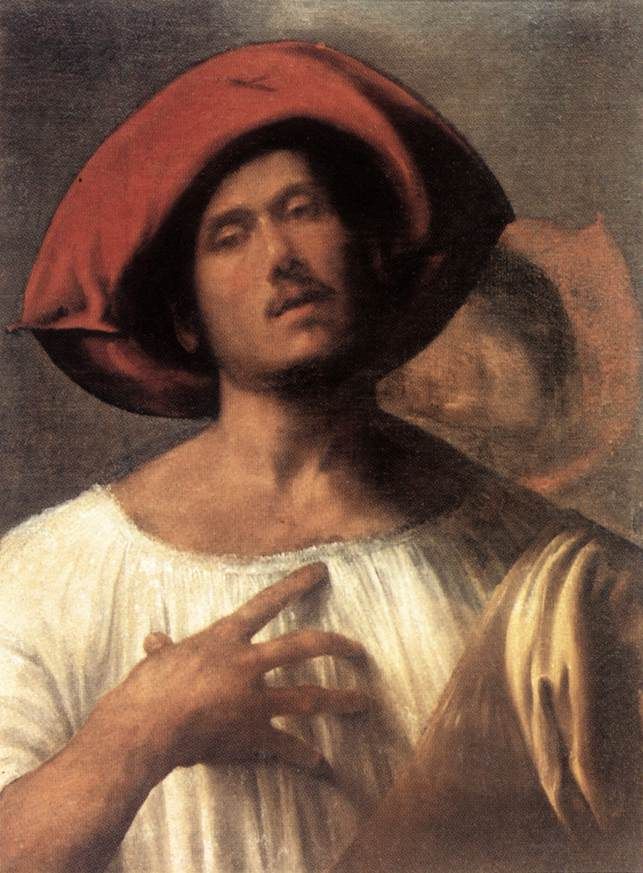
The singer sets his right hand at his chest. His eyes are turned toward the viewer and his head tips back, so his slightly parted lips seem to belong to a voice already in motion. His costume is broad and informal, a white shirt with a rounded neckline, a flaring red hat and a yellow garment, probably a cloak, at his left shoulder. The Passionate Singer at the Galleria Borghese is an oil painting on canvas measuring 104 by 77 centimetres. It carries the inventory number 132. The Gallery dates it to around 1507 and attributes it to Giorgione within the Venetian school, preserving an open question about exactly who painted it. [1] [2]
At a Glance
- Datec.1507
- CollectionGalleria Borghese, Rome
- AttributionVenetian school, attributed to Giorgione
- Inventory132
What a painter can make us hear
There is no way to tell what the singer is singing. We can make a guess about something much closer to us, the physical effort implied by his hand and head. The movement at the chest makes us aware of breath. The tilt of the head and the parted mouth make it reasonable to imagine a sustained note. The direction of his eyes presents a different question. He seems aware of a person outside the painting, but his face is absorbed in what he is doing. It is easy to feel his audience could be very near even though nothing of a performance space is visible. [1]
The shoulder and the various shapes of the hat let the body complete the impression that starts at the mouth. The wide band of red is decisive. Beneath it, the head appears to be rising away from our own eye level. The fabric at the neck is more open and mobile than a tight, fastened collar would have been. Together with the hand and the tipped face it keeps the pose at some distance from dignified portraiture. The Gallery finds those clothes close to clothing worn by herdsmen or soldiers, and the early inventory describes a pair of jesters. The figure's bearing and occupation in the picture can be discussed with more confidence than his profession or social position outside it. [1] [2]
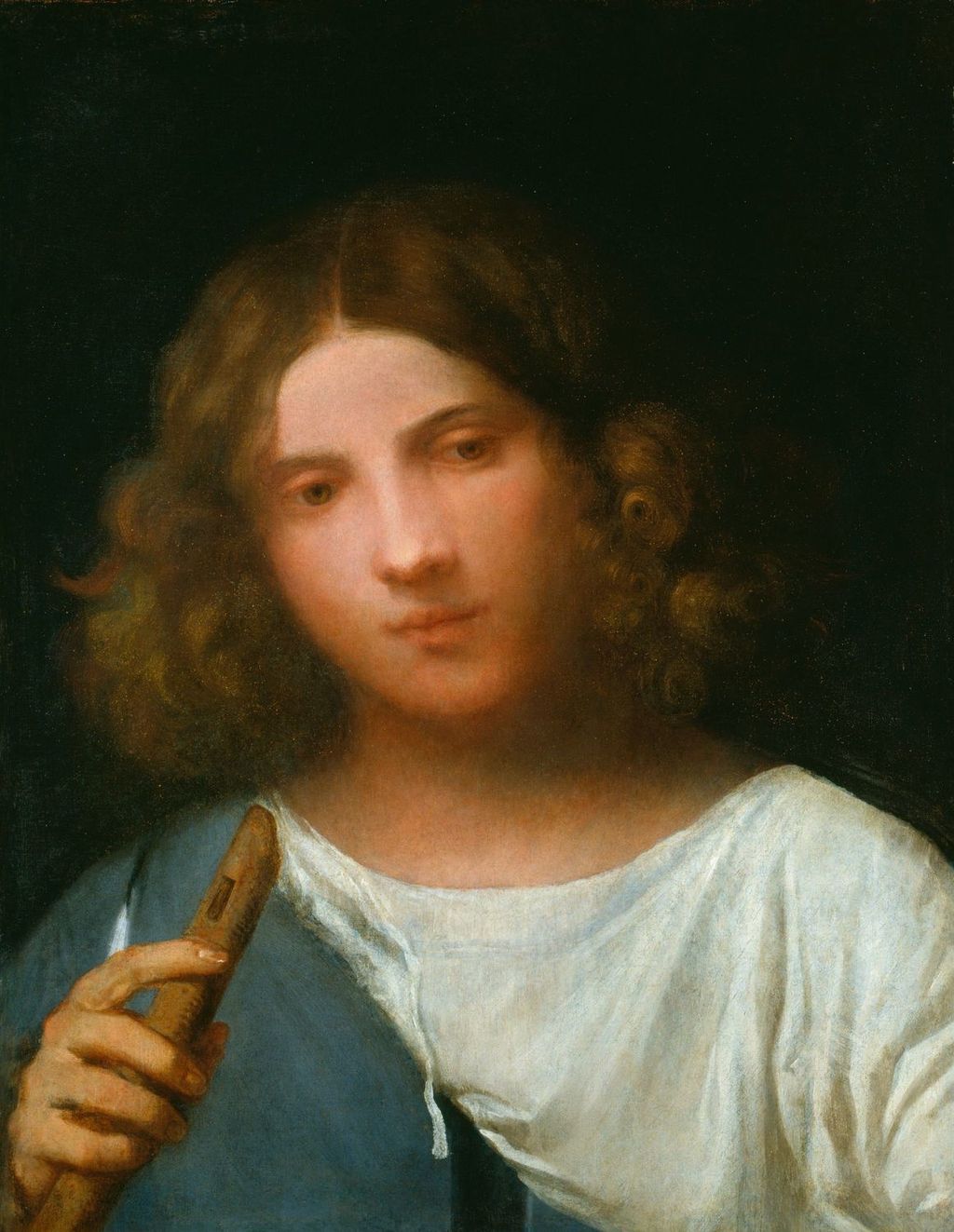
Compare Singer with a Flute, the companion canvas. Our attention there runs from the profile of a turning shoulder up to a sharp glance. The instrument gives the role away while the man's mouth remains relatively closed. Here the form of a singer is distributed over the face and chest, and the hand that reaches across the shirt has no instrument to exhibit. The two pictures let a painter tell two different things about a sound that cannot actually cross their surfaces. Light on the white shirts links them. The turn of the body in one and the lift of the neck in the other let very different presences emerge. [1] [2]
The other head recorded during restoration
In the catalogue's account of the 1953 treatment, a head oriented horizontally appeared in the background. It was considered to be of comparable quality and attributed to the same hand as the principal figure, but it was covered again during later restoration. The published description establishes a distinct conservation observation. We cannot see that head clearly in the present state and identify its expression or purpose. The interruption is significant in part because we might otherwise assume a dark painted ground had been conceived as a simple blank area from the beginning. [1]
The researchers who examined the Mattioli Concert, a group painting associated with Giorgione, recovered evidence of an earlier composition beneath its visible figures. The Borghese's report of a second head and the other picture's evidence of reworking tell us that apparently settled surfaces can retain traces of materially different ideas. Their specific findings are separate. The background head in the Singer has no established identity. It does not prove that the present singer turned toward it, that the two Borghese canvases began as one object, or that a larger composition can now be put together from surviving parts. A former hypothesis linking them as cut-down fragments of a lost Vendramin trio is now described by the museum as discredited. [1] [2] [3]
Rooms, inventories and attributions
The two paintings have a strong connection as objects collected together. The Borghese catalogue singles out an inventory made around 1633, where the two jesters were placed together as a pair of canvases under Giorgione's name. In 1650 Giacomo Manilli repeated the grouping in his guide to the Villa Pinciana. A large red hat was one of the things by which a visitor could recognise the singer. That brief outline is surprisingly apt when set beside the plain shape of the garment and the shape made by his right hand. The more fully a canvas endorses the inventory description on visible grounds, the easier it is to distinguish the early collector's chosen title from the unresolved question of authorship. [1] [2] [4]
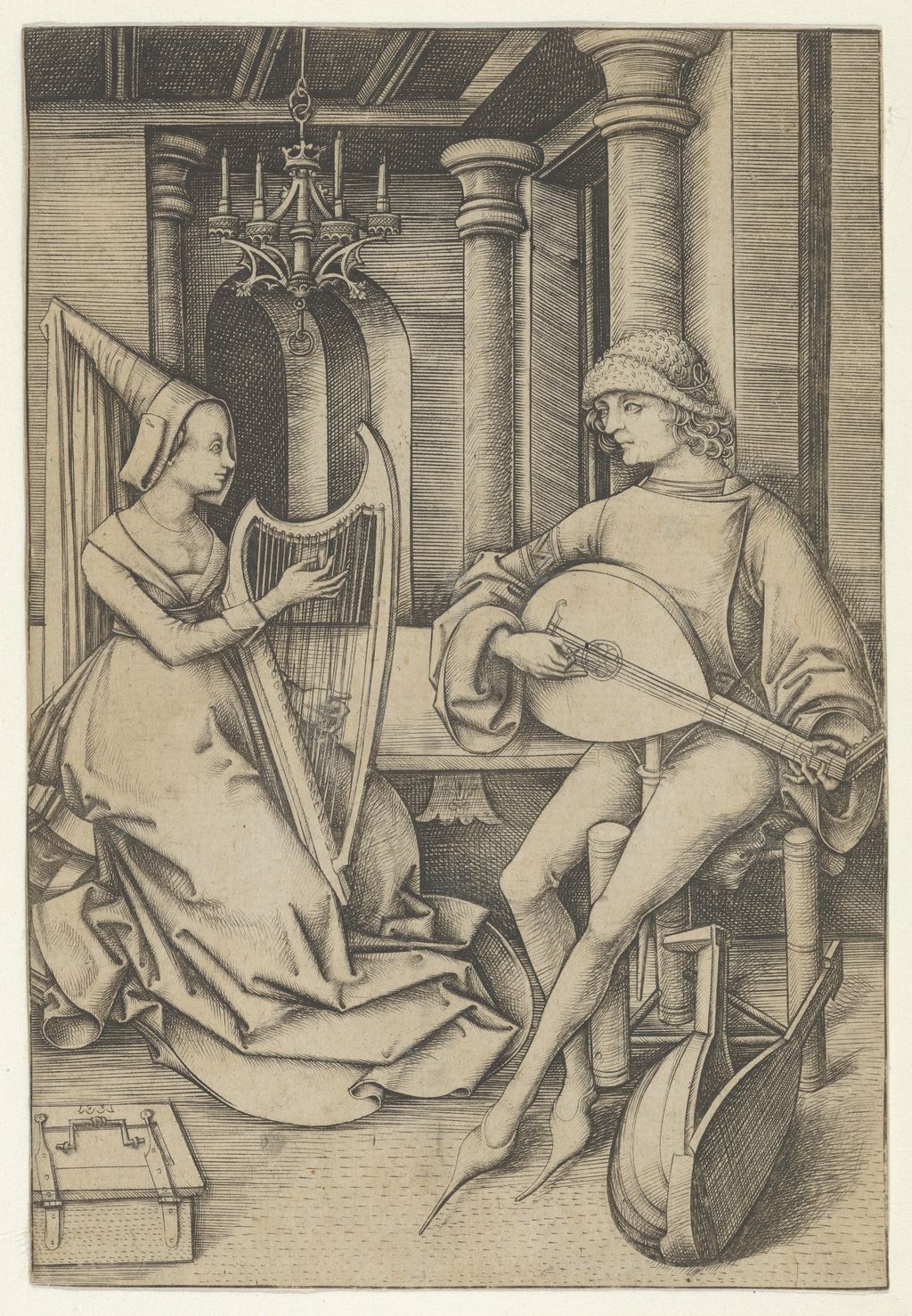
For a reader of Manilli's guide, moving from one work in the villa to the next was part of the visit. His book describes the rooms and pictures alongside gardens and sculpture. The dressed performers look especially specific against that varied company. In an engraving such as Israhel van Meckenem's Lute Player and Harpist, the courtly clothes and furnishings create a setting around a performance and help decide who might be in the room. The Borghese Singer gives us neither those visual signs of private domestic music nor signs of membership of an organised choir. The activity can seem immediate, because the figure attends to an unseen listener, even while the setting remains difficult to reconstruct. [1] [4] [5]
The paintings passed to the Italian state in 1902. In between, the 1833 inventory gave the pair to Bellini. Domenico Capriolo was proposed by several scholars. The Borghese account also cites writers who considered a later imitation of the manner of Giorgione, among them scholars who discussed Pietro della Vecchia. Those suggestions help explain the difference between pictorial style and pictorial date. The face and particular relation to a supposed audience can belong to an early Venetian invention and still recur in the work of later artists. The Gallery's current attribution keeps the pair's relation to Giorgione visible while acknowledging why the paint handling has caused disagreement. [1] [2] [4]
Cariani's A Concert, dated about 1518–20 by the National Gallery of Art, lets the idea of a dramatic performer take shape in another way. The lute player has an audience on both sides and the action of his fingers is supported by a careful painting of the instrument. The NGA's David Alan Brown relates it to Venetian paintings of learning and musical performance as well as Cariani's interest in comic and individualised expression. In the Passionate Singer the body alone projects the performance. The notional audience begins at our side of the canvas. As the eyes come round to find us, the simple raised hand lets us imagine what it would take to stand before a room and sing. [1] [6]
Giorgione’s career
Castelfranco Madonna
Early 1500sFondaco dei Tedeschi
1507–08Three Philosophers
1508–09Death in Venice
1510Discussion
Share what you noticed and how you arrived at your reading.
Reader Insights
Which detail would you point out to somebody seeing Passionate Singer for the first time?
How does rooms, inventories and attributions change how you read the work?
Join the Conversation
Share a detail, comparison or question about Passionate Singer below.
References
- Galleria Borghese, Cantore appassionato, inventory 132. View source.
- Galleria Borghese, Flute Player, inventory 130. View source.
- Gallerie dell'Accademia di Venezia, Il Concerto, Mattioli collection. View source.
- Galleria Borghese, The collection of Scipione Borghese. View source.
- Metropolitan Museum of Art, Israhel van Meckenem, Lute Player and Harpist, 27.5.2. View source.
- National Gallery of Art, Washington, Giovanni Cariani, A Concert. View source.