


 by Tom Gurney
Tom Gurney BSc (Hons) is an art history expert with over 20 years experience
Published on June 19, 2020 / Updated on November 29, 2026
Email: tomgurney1@gmail.com / Phone: +44 7429 011000
Overview
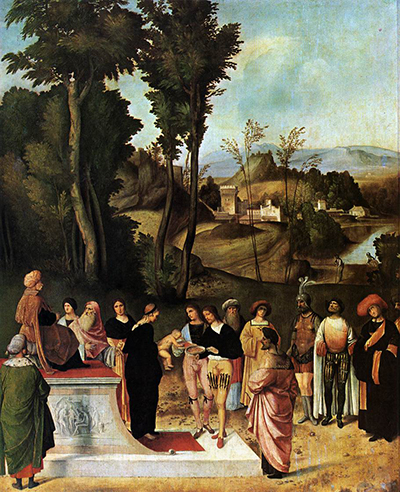
Pharaoh is sitting high enough to look down on everyone in the clearing. The person whose fate concerns him most is the smallest, the naked infant Moses, held across a woman's arms. Two shallow trays have been brought near enough for him to choose between them. In this early oil painting associated with Giorgione, a moment of apparent play is being used to decide whether a child can be trusted to live. The panel belongs to the Uffizi in Florence and measures 89 by 72 centimetres. It has a companion in the same collection, The Judgement of Solomon, in which another ancient king makes an infant the centre of a test. [1] [2] [3]
At a Glance
- DateEarly 1500s; dates debated
- CollectionUffizi Galleries, Florence
- AttributionGiorgione; collaboration debated
- Inventory1890 no. 945
A crown and two dishes
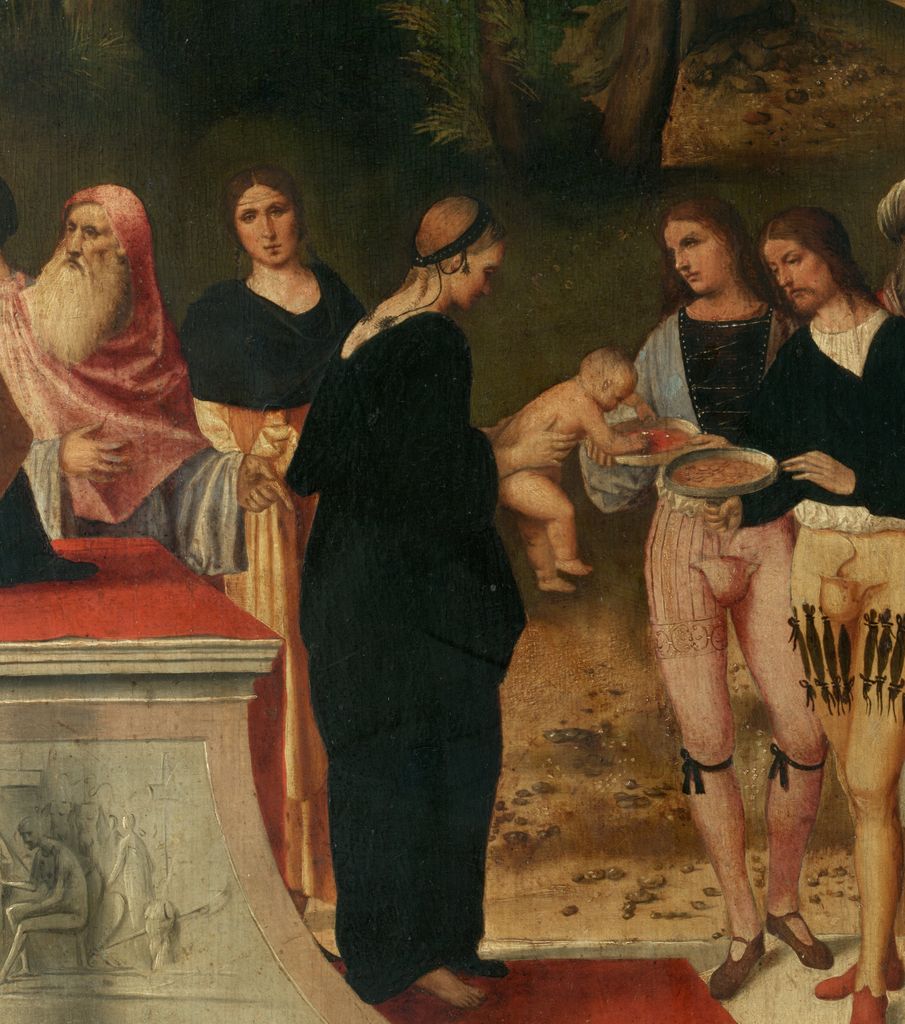
Moses has been adopted by Pharaoh's daughter. In the legend the child knocks the crown down, and the adults take the incident as a possible sign that he intends to overthrow the ruler. The threat could be real or a child's interest in something bright. In this version of the story the court presents dishes containing gold and burning coals. Moses chooses the hot material and brings it to his mouth. The choice saves him because the adults treat it as proof of his innocence. His wound explains the difficulty with speech that the grown Moses mentions when he is called to return to Egypt. [1] [2] [4]
The trial itself comes from legends about Moses's infancy rather than the text of Exodus. The Italian catalogue cites medieval French verse associated with Geoffroy de Paris and Herman de Valenciennes. The Royal Academy catalogue also looks back to Josephus, whose account links the infant to the threatened crown. The dish test circulated in medieval literature and appeared in the Speculum Humanae Salvationis, where a Christian reader could relate the deliverance of Moses to the Flight into Egypt. Versions put different attractive objects beside the coals. The precise contrast could vary as long as the test still asked a very young child to make an impossible decision in front of a suspicious ruler. [1] [2] [4]
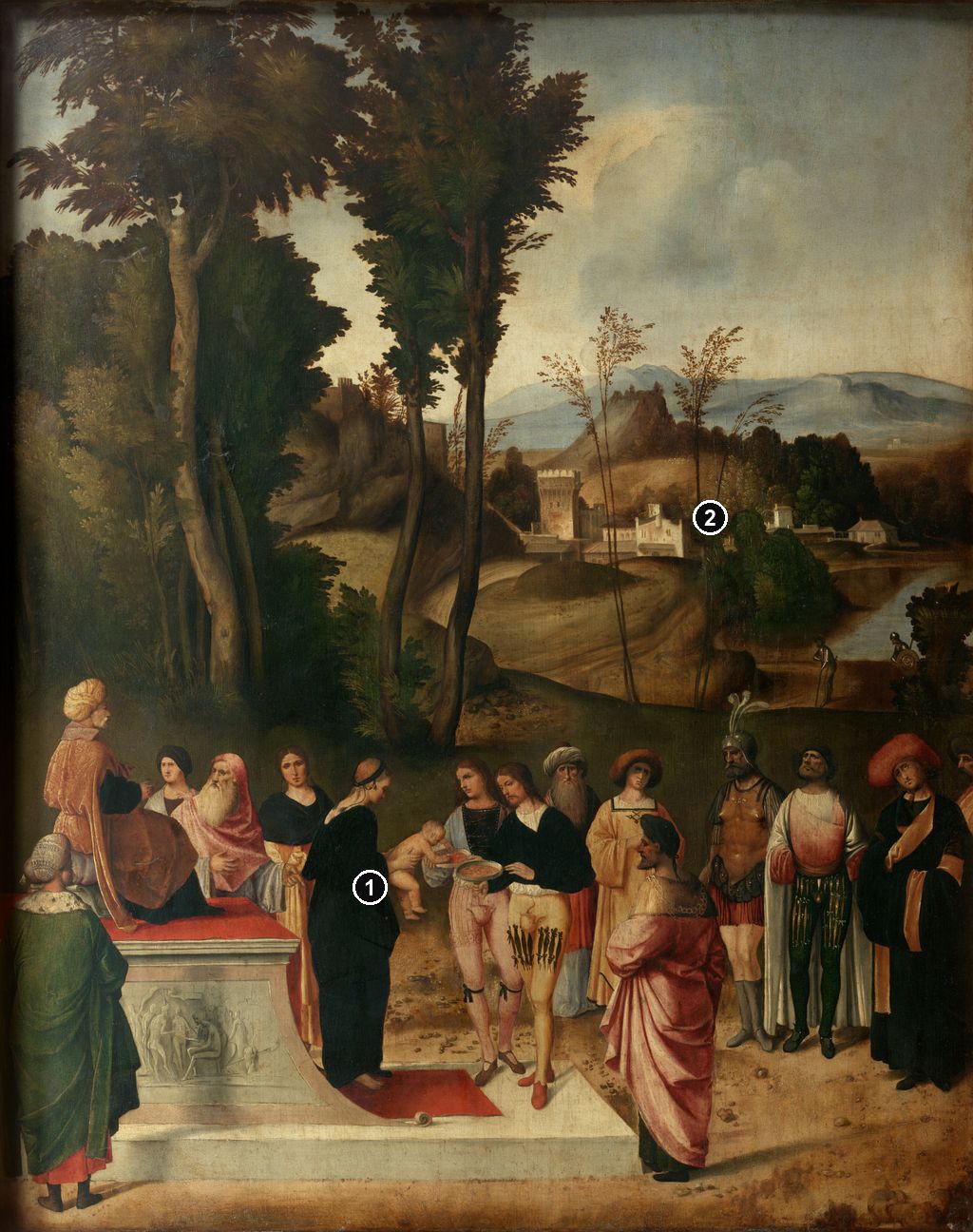
In the picture two pages present the bowls. Since we already know what lies in them from the title and the story, we have time to notice the gentleness with which Moses is held. The woman in dark clothing supports him sideways, at a moment when one small movement toward either tray has consequences far beyond his understanding. His position is a visual answer to the scale of the throne. Pharaoh can remain seated because other people give the test physical form. The child has almost no control over where he is held, yet the test puts the appearance of a free choice at its centre. [1] [2]
Pharaoh's court in the open air
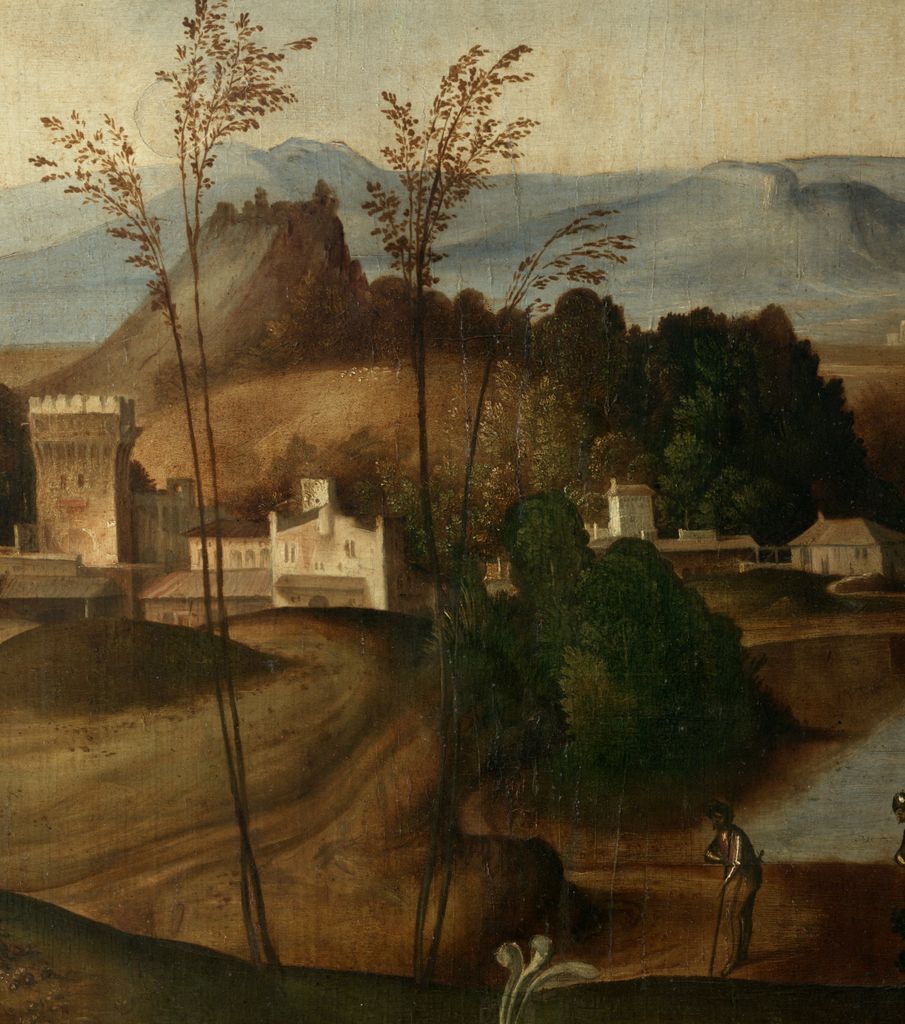
This court meets far from the walled buildings in the distance. The throne and its base are on the left. The space beyond the company opens toward a village, hills, water and changing ground. The map of the painting differs from the map of the episode. The royal entourage can invest almost the whole of the foreground in a single incident, while on the slope outside its circle people go about other business. A worker with a spade is among the figures listed in the Italian record. The presence of such labour helps locate the court in a world painted from the countryside of northern Italy, even though the story belongs to ancient Egypt. [1] [2]
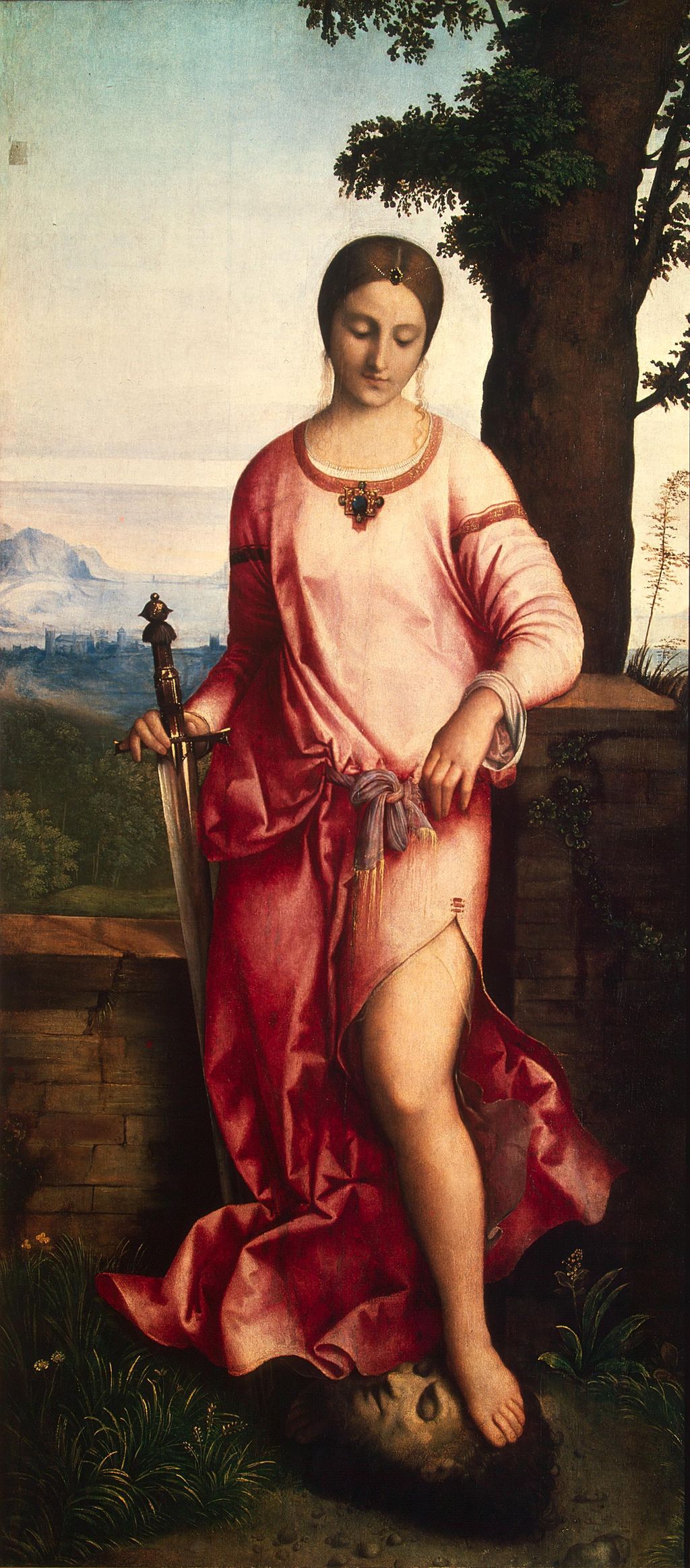
The costumes likewise range across place and time. Turbans and more familiar contemporary clothes put people of different rank and roles into one gathering. Pharaoh's height and his raised seat give him immediate authority before a viewer can identify every member of the crowd. Other figures, including the woman traditionally identified as Pharaoh's daughter, help turn attention toward the child. At least one face looks outward. The catalogue compares that regard with the composure of the Hermitage Judith. It is a useful resemblance to test on the surface. Judith commands a whole tall panel on her own, while the face here interrupts a group in which most attention passes sideways. [1] [2]
There is also another tiny scene in relief on the throne base, interpreted by the Royal Academy as possibly Prometheus forming a human being out of clay. That identification remains open. The relief calls attention to the furniture even before a subject is assigned to it. Near the child held above the ground, a sculpted figure appears in a much flatter material. The artist has given the viewer a model of one story inside the space occupied by another. The arid stone and the fresh colours of the clothing make almost opposite demands on paint. [2]
The other panel and its painted back
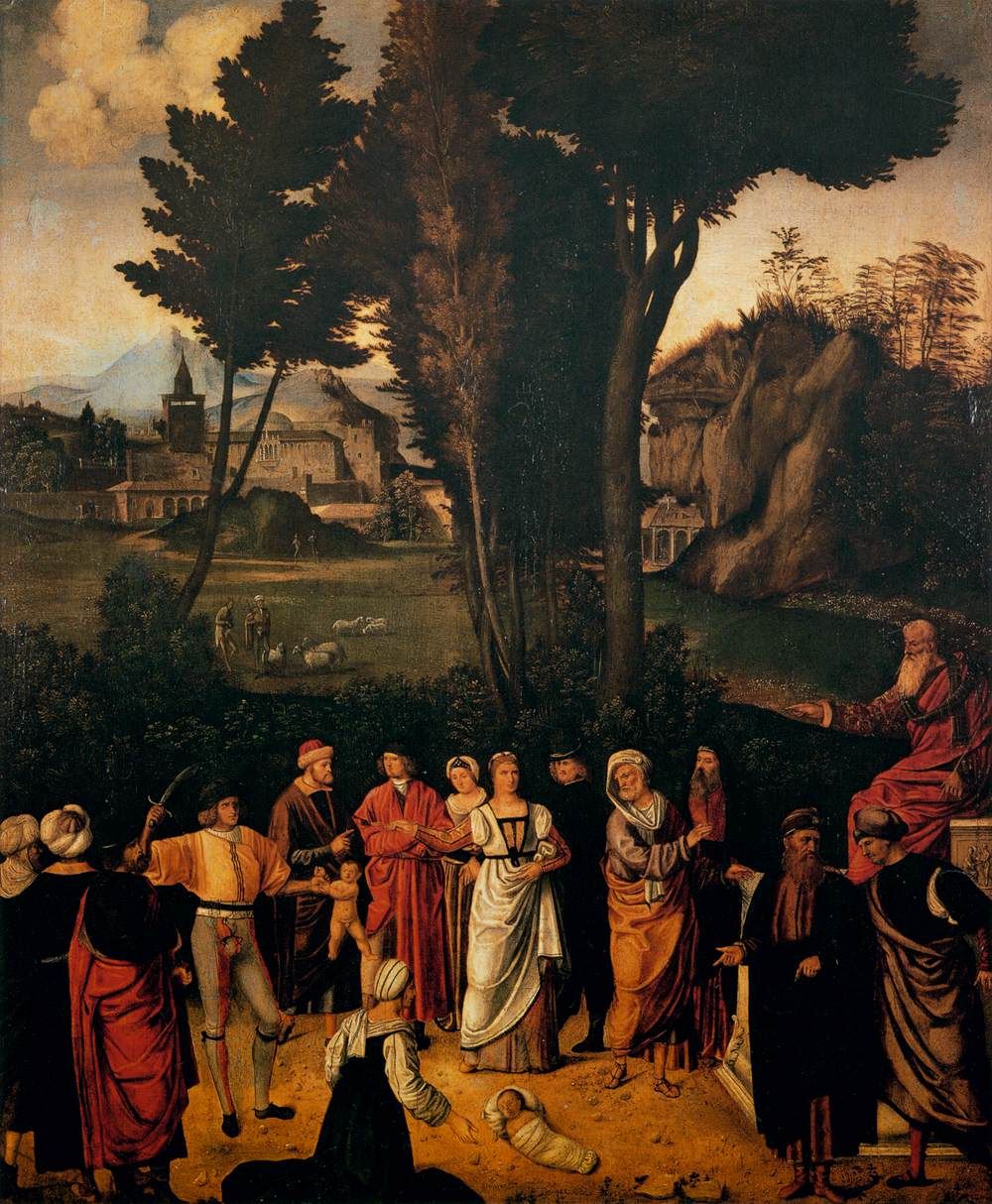
The Judgement of Solomon gives another ruler the task of deciding what an infant's peril can reveal. In that story Solomon threatens to divide a living child in order to discover which of two claimants is his mother. The test depends on the response of the women. Here it asks an infant to act and adults to interpret what he does. Set together, the scenes bring different ways of exercising judgement into view. Their oil-painted wooden supports, similar dimensions and coordinated treatment make the comparison something the objects themselves invite. [1] [2] [3]
The backs matter as well as the fronts. An Italian exhibition catalogue describes decorative interlacing branches over an imitation marble surface on both reverses. It also notes worn recesses along the edges. The authors suggest that the two might have been made as furniture, possibly as cupboard doors, with decoration from roughly the same period on both sides. A pair of fronts for a piece of furniture would have brought the two judgements into the same domestic setting and given their backs a visible role when opened. The decorative and physical evidence permits the suggestion without revealing the design of the original object or the identity of its owner. [3]
Giorgione and the other hands
The Royal Academy records an unassigned small panel in the Orsetti collection in Venice in 1680, described recognisably through the seated ruler, woman and infant. The 1692 inventory of the Grand Duchess of Tuscany at the villa of Poggio Imperiale puts the painting in the orbit of its Florentine companion. It passed to the Uffizi in 1795. Accounts differ over its attribution at that point. The national catalogue records Bellini on entry and Cavalcaselle assigning the two works to Giorgione in 1861. The Royal Academy finds a Giorgione attribution at the end of the eighteenth century, an attribution in the 1825 inventory and an etching under his name by Carlo Lasinio in 1828. The disagreement concerns the earliest status of the name in the inventories. The present association with Giorgione runs through a substantial history of comparison and debate. [1] [2] [3]
Giuseppe Fiocco proposed that Giorgione devised the scheme and painted parts of it while Giulio Campagnola also contributed. Antonio Morassi proposed Vincenzo Catena, whose name appears beside Giorgione's on the back of Laura, and Roberto Longhi argued for a contribution from a Ferrarese painter. Others have defended the essential unity of the painting, sometimes explaining unevenness through restoration. Proposed dates include the mid-1490s and the early 1500s. Closer to the end of the decade, the composition of The Tempest gives landscape an even larger role. The extent to which dress and terrain in the Test bear comparisons with other pictures helps explain why arguments about the landscape have persisted alongside arguments about the bodies and faces. [1] [2] [3] [5]
The crowd can hold our attention for as long as we wish to spend with the debate. The picture ultimately brings us back to two shallow vessels. One holds the means to expose a supposed criminal. The other holds an innocent child's apparent escape from that judgement. The court waits for a meaning it can attach to an ordinary movement of the hand. Only the people looking back on Moses's life know just how much was being decided. [1] [2] [4]
Annotated Details from Test Of Fire Of Moses
Select a point to see its detail.
1. The test · 2. Land beyond the court
Details from TEST OF FIRE OF MOSES
Detail crops from the same image.
The test
Two dishes bring the adults’ proposal within reach of a child too young to understand it.
Land beyond the court
The terrain provides an independent space behind the group attending Pharaoh.
Giorgione’s career
Castelfranco Madonna
Early 1500sFondaco dei Tedeschi
1507–08Three Philosophers
1508–09Death in Venice
1510Discussion
Share what you noticed and how you arrived at your reading.
Reader Insights
Which detail would you point out to somebody seeing The Test of Fire of Moses for the first time?
How does giorgione and the other hands change how you read the work?
Join the Conversation
Share a detail, comparison or question about The Test of Fire of Moses below.
References
- Catalogo generale dei beni culturali, Mosè sottoposto alla prova del fuoco, 0900286684. View source.
- Simone Facchinetti and Arturo Galansino, eds., In the Age of Giorgione, Royal Academy of Arts, catalogue no. 16. View source.
- Exhibition catalogue, Université de Liège repository, Mosè alla prova del fuoco, catalogue V.1. View source.
- Metropolitan Museum Journal, The Twelve Ages of Man: A Further Study of a Set of Early Sixteenth-Century French Tapestries. View source.
- Fondazione Federico Zeri, Mosè sottoposto alla prova del fuoco, photo and work catalogue. View source.