


 by Tom Gurney
Tom Gurney BSc (Hons) is an art history expert with over 20 years experience
Published on June 19, 2020 / Updated on November 29, 2026
Email: tomgurney1@gmail.com / Phone: +44 7429 011000
Overview
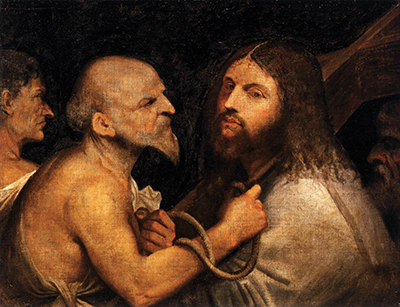
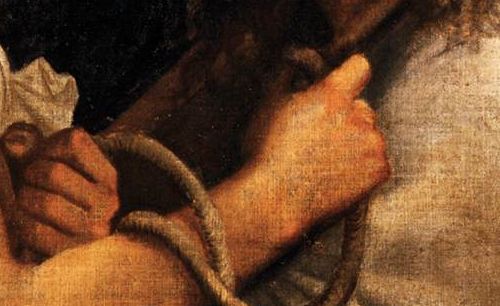
The rope runs tight beside Christ's neck. The cross lies across his shoulder, and the man closest to him is about to pull again. Christ turns his face to the viewer in the short interval when there seems time for a look. This is the Venetian Christ Carrying the Cross preserved by the Scuola Grande di San Rocco, where it is presented under Giorgione's name. Its authorship has been disputed since Giorgio Vasari changed his mind between editions of the Lives. The 2016 Royal Academy catalogue gives it to Titian with qualification and dates it around 1508–10. It is an oil painting on canvas, 68.2 by 88.3 centimetres. [1] [2]
At a Glance
- Datec.1508–10
- CollectionScuola Grande di San Rocco, Venice
- AttributionGiorgione at San Rocco; also attributed to Titian
Two faces and a rope
The canvas gives very little space to the route along which Christ is being led. The timber's sloping edge can make us feel his load from almost within the distance of the people carrying it. Faces emerge around him in the shallow space, and the closely placed hand of the man with the rope makes the threat of the next movement plain. Look at the difference between their expressions and Christ's. His eyes remain turned outward while his body bears the pressure from the side. The scene does not need to show the climb to Calvary in full to communicate how difficult it is for him to go on. [1] [2] [3]
The crop also changes what a beholder can do. A painting with several episodes on a wide stage might put us in a position to follow the story past many other witnesses. This canvas brings our attention directly to a person who appears to have noticed us. To look hard enough to see his eyes is already to meet them. Elsje van Kessel argues that features of this kind belong in the history of its devotional power alongside the way the image was placed and used. For a worshipper the effect of the face also depended on how near one could get to it, what surrounded it and whether others were already there. [2] [3]
Early descriptions sometimes identify the men pulling Christ in explicitly anti-Jewish language. The wording belongs to a long history of Christian Passion imagery that cast Jewish people as collective antagonists. Documents from San Rocco record how the image was described in its own period. They do not establish the identity of the pictured men or make a historical account of responsibility for the Crucifixion. In looking at the painting today, the firmest description begins with the people, instruments and gestures that can actually be seen. The pull on the rope makes the confrontation intelligible well before a viewer reaches any inventory note. [1] [2] [3] [4]
From a church altar to the Scuola
On 20 December 1520 the Venetian diarist Marin Sanudo recorded the crowd coming to the church at San Rocco because of an image of Christ. He describes it on an altar and reports a reputation for performing miracles. He also identifies an immediate consequence of that reputation. The crowds brought alms, which could help finance a splendid new building for the confraternity. The Scuola's own history likewise associates income from the painting with the work of constructing its seat. We have an unusually early report of the connection between an encounter with a small picture and the resources needed for an imposing Venetian building. [1] [3] [4]
Researchers have proposed different accounts of how the picture first came to the church. The earliest clear evidence of its use on the altar comes later than its proposed painting date. There are hints from the building's earlier chapel arrangements, but they allow for the possibility that the canvas was placed there after it had been made. The movement from church to confraternity buildings represents a much more visible change in presentation. In the Scuola it can be viewed alongside Tintoretto's large canvases, with a separate lunette of God the Father and angels above it, attributed by the Scuola to Titian and assistants. The neighbouring image and large room reframe an encounter originally reported in connection with an altar. [1] [2] [3] [5]
A woodcut in the Fondazione Giorgio Cini archive preserves the design's reputation in another form. The archive records a shop associated with the image that offered wax objects, votive gifts and prints. A devotional print could carry a recognisable face and gesture out of the church by very different means from a visit to the canvas. In printing the design, an artist had to translate the dark, close grouping into marks capable of being impressed on paper. That is both a technical change and a change in use. One could take away the composition and see it again without standing in the crowd. The archival print also helps keep the Venice design recognisable among the many other pictures with almost the same title. [3] [6]
What changed between Vasari's editions
In 1550 Vasari placed the picture in Giorgione's biography. He stressed the devotion that had grown up around it and the miracles people believed they could witness. In 1568 the image was also described in the life of Titian, with Titian taking credit for the painting and Giorgione's name reported as a view others held. The lines come from two editions by a single writer who was willing to revise his account of early Venetian painting. Their disagreement is evidence that competing accounts circulated close to the period. It cannot be resolved by counting each reference as a witness with independent access to a commission record. [1] [2] [4]
The Scuola discusses why some scholars still support Giorgione. On its stylistic reading, the power of the face resides in a late manner comparable to La Vecchia, where age and expression acquire extraordinary presence from small variations in light. Others place the San Rocco picture close to early Titian. The Treccani biography of Titian takes seriously documentary hints of a date around 1508–09 and acknowledges the prior Giorgione attribution. The 2016 catalogue's qualified Titian credit sets out one defensible judgement. An encounter with the picture can make the competing positions comprehensible. The dark transitions in Christ's face and the force given to a working hand and rope can each bring significant but different comparisons into view. [1] [2] [7]
A different Christ in Boston
The Isabella Stewart Gardner Museum has another Christ Carrying the Cross, a small wooden panel bought as a Giorgione in 1896. The museum now associates it with the circle of Giovanni Bellini, possibly Vincenzo Catena. Its Christ also turns outward, though the figure occupies the panel without the San Rocco canvas's tightly gathered attendants. Conservation in Boston has been documented by the Gardner. Those findings belong to that museum's own object and support. They are helpful in considering how a smaller private devotional picture presents the same subject at close range. The Boston panel has a different provenance and material history from the canvas singled out by the crowded Venetian church. [1] [8] [9]
With the Scuola picture, go back to the end of the visible rope and follow it to the face rather than to the cross. The great wooden shape conveys a burden that Christ will continue to carry. The rope brings the movement of the next second into the space near his eyes. A brief chance to meet his look has remained available long after the first crowds of visitors and their candles have gone. [1] [3]
Annotated Details from the San Rocco Christ Carrying the Cross
Select a point to see its detail.
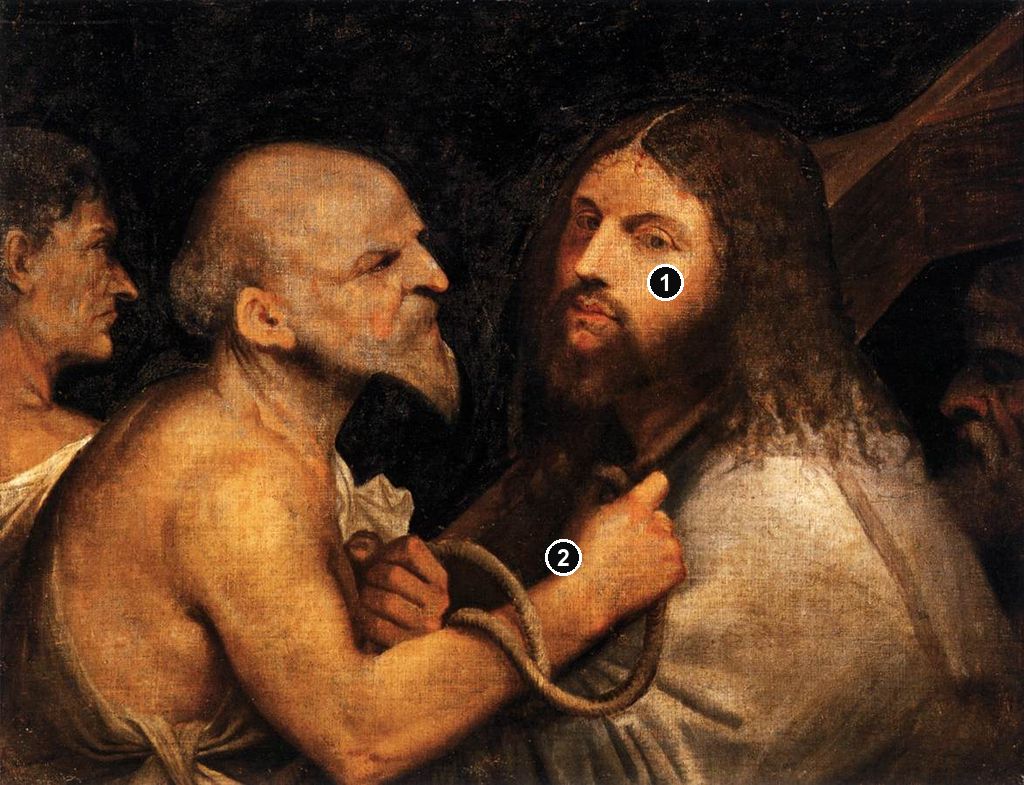
1. Christ’s gaze · 2. The rope
Details from THE SAN ROCCO CHRIST CARRYING THE CROSS
Detail crops from the same image.
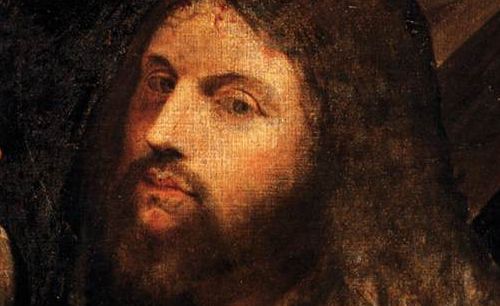
Christ’s gaze
The close-up makes a brief outward glance possible under extreme physical pressure.
The rope
The hand and cord carry the action from the man pulling it to Christ’s throat.
Giorgione’s career
Castelfranco Madonna
Early 1500sFondaco dei Tedeschi
1507–08Three Philosophers
1508–09Death in Venice
1510Discussion
Share what you noticed and how you arrived at your reading.
Reader Insights
Which detail would you point out to somebody seeing Christ Carrying the Cross for the first time?
How does a different Christ in Boston change how you read the work?
Join the Conversation
Share a detail, comparison or question about Christ Carrying the Cross below.
References
- Scuola Grande di San Rocco, Giorgione, Cristo portacroce. View source.
- Simone Facchinetti and Arturo Galansino, eds., In the Age of Giorgione, Royal Academy of Arts, figure 4 and discussion. View source.
- Elsje van Kessel, How to Make an Image Work? The Presentation of the Miraculous Christ Carrying the Cross at San Rocco in Venice. View source.
- Fondazione Giorgio Cini, Il Cristo portacroce della Scuola di S. Rocco a Venezia. View source.
- Scuola Grande di San Rocco, Chiesa. View source.
- Fondazione Giorgio Cini, Archivio digitale, Cristo portacroce woodcut, stampa 16429. View source.
- Treccani, Dizionario Biografico degli Italiani, Vecellio, Tiziano. View source.
- Isabella Stewart Gardner Museum, Christ Carrying the Cross, circle of Giovanni Bellini. View source.
- Isabella Stewart Gardner Museum, Conservation of a Panel Painting: Circle of Giovanni Bellini, Christ Carrying the Cross. View source.