


 by Tom Gurney
Tom Gurney BSc (Hons) is an art history expert with over 20 years experience
Published on June 19, 2020 / Updated on November 29, 2026
Email: tomgurney1@gmail.com / Phone: +44 7429 011000
Overview
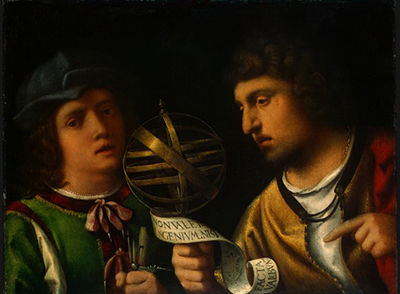
The tutor has lifted an armillary sphere, a model of concentric rings representing the heavens. He looks down and points to it. The boy grips a cluster of implements and looks directly at us. They have gathered so close to the picture's surface that the space between their bodies is just wide enough to contain the instrument and the curling strip of paper around it. The National Gallery of Art in Washington calls this Giovanni Borgherini and His Tutor and gives it to Giorgione. The oil painting, 47 by 60.7 centimetres, has been in the collection since Michael Straight gave it in 1974. Its suggested identity has to be considered alongside a related work in Munich, which that museum connects to the same early description by Vasari. [1] [2]
At a Glance
- DateEarly 1500s
- CollectionNational Gallery of Art, Washington
- AttributionGiorgione; identity disputed
- Inventory1974.87.1
What each person holds
Look first where the tutor brings his hand toward the brass-coloured rings. An armillary sphere is an object one can turn and point to while explaining the routes imagined through the sky. The visible bands carry the model's idea more immediately than an inscription could. As the tutor demonstrates something specific, the viewer can see that the whole instrument has a structure defined by intervals between its rings. Its position also leaves an important opening in the composition. Frame the man's pointing hand between the two faces and it is easy to see how the lesson has become part of the portrait. His direction of sight runs inside the picture while the boy's goes out across its surface. [1] [3]
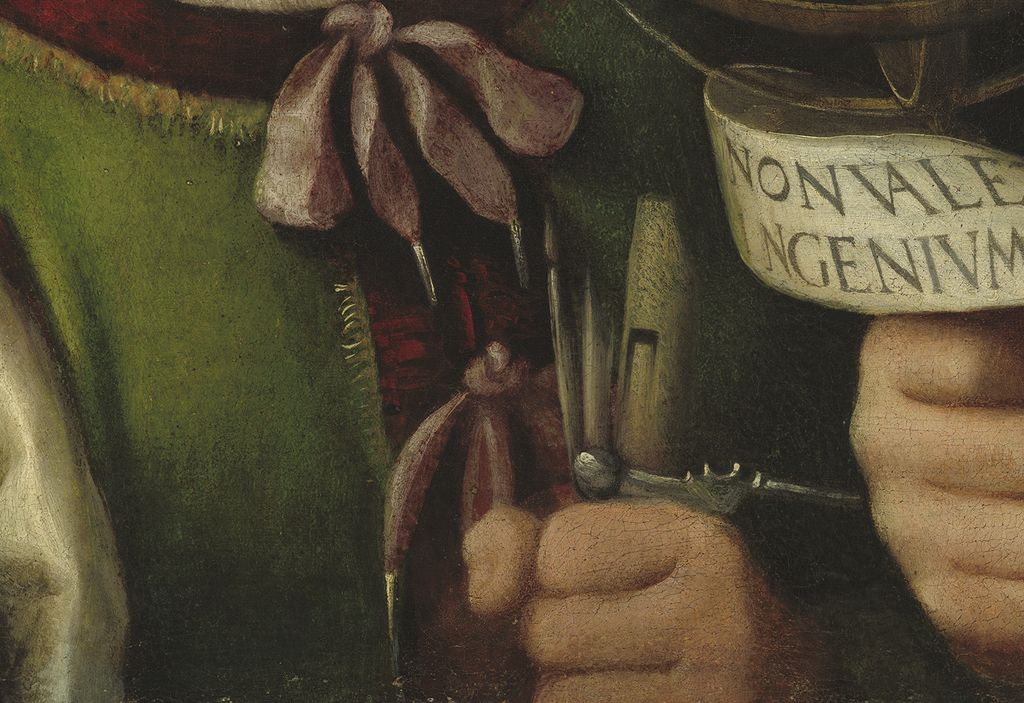
The boy has an instrument of his own, but it is one of several things held together in his left hand. The Washington catalogue identifies a flute, a quill, a brush and a compass. Together they suggest music, writing, visual art and measured drawing. They also turn the lower edge into a place where a reader has to look carefully. All those shafts could be mistaken for a single tool on a small reproduction. In front of the original the differences in shape give each its own length and handling. The boy can display the things he has acquired or learned to use without presenting any one of them as his sole profession. [1] [4]
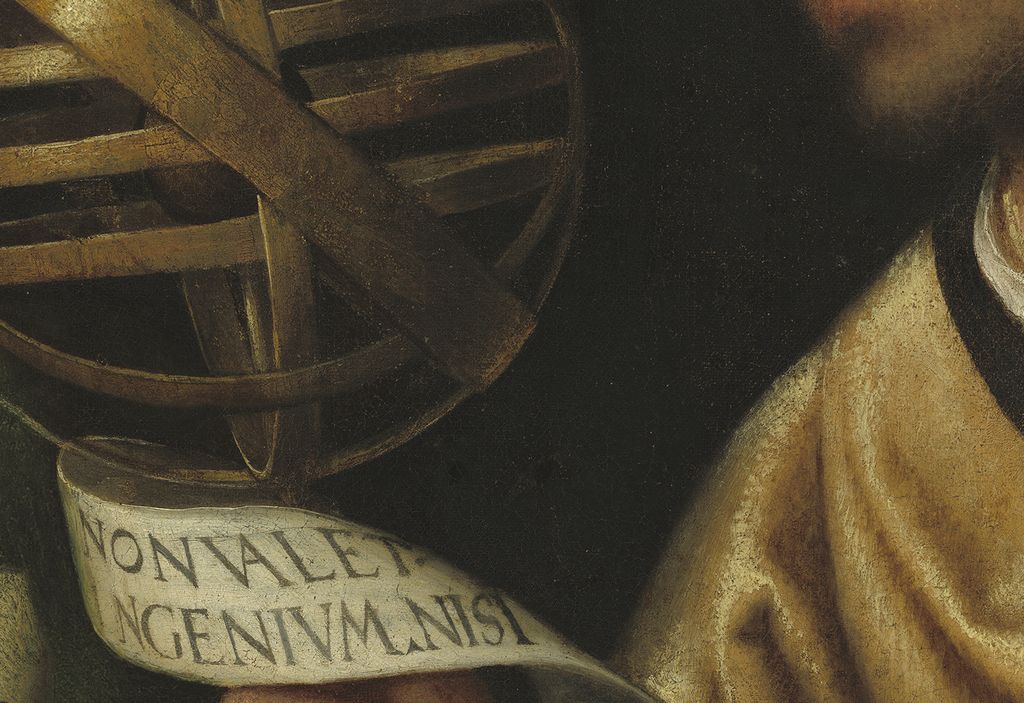
A scroll curls over the handle and around the tutor's hand. Its words, Non valet ingenium nisi facta valebunt, can be rendered roughly as “Talent is of no avail unless deeds count.” The thought concerns how abilities become meaningful through acts. It is present in the painted object, and the tutor's demonstration gives it a visual context. No record establishes that Giorgione composed the line or that the teacher uttered it when the picture was made. The connection between the saying and practical knowledge comes from how the painter has set the objects and gestures together. [1]
What Vasari saw in Florence
In the 1568 edition of the Lives, Giorgio Vasari describes a picture by Giorgione in the home of Giovanni Borgherini's sons in Florence. It showed Giovanni when he was young in Venice, alongside the teacher who guided him. Vasari admired the graded shadows and the effect of the faces. For the Washington painting the correspondence is real. There are two men of different ages, the older of whom has undertaken a demonstration. The National Gallery of Art uses the entry to support a probable lineage beginning with the family. Vasari's passage does not specify measurements, illustrated objects or an inscription. It therefore leaves room for an alternative identification. [1] [2]
The Munich picture, inventory 7452, is much taller than the Washington one and also on canvas. In it the older man, whom the museum identifies as the Venetian humanist and astronomer Trifone Gabriele, turns to the spectator as if our arrival has broken into his explanation. The pupil appears to have been listening. Gabriele holds a compass and an astrolabe in the Munich catalogue's description. The museum notes evidence that Giovanni Borgherini studied with the humanist while in Venice and cites resemblance between the teacher and other likenesses of Gabriele. The place of the viewer, the shape of the canvas and the instruments of instruction all differ from Washington. These are two separate pictures and two claims on Vasari's description, even though both men may have been linked with the same Venetian intellectual milieu. [1] [2] [3]
Gabriele's reputation extended from the study of the sky to literature and language. Works published or transmitted through his circle include a dialogue on the sphere and on the rising and setting of stars. That intellectual range makes the choice of measuring instruments understandable within a portrait of Gabriele. It also helps us read scientific instruction as a social activity in Washington. A model between two people can support a discussion in much the same way as a drawing or a text, because both can see the parts being explained. The connections are historically suggestive without providing a firm name for the speaker in the Washington canvas. [1] [2] [3] [4]
Two separate histories of paint and ownership
The technical account of the Munich work increases the need for precision. Its researchers identified multiple stages beneath the existing portrait, including a figure drawing, a landscape with human figures and a single portrait before the current two-person composition. Infrared imaging, X-radiography and mapping of elements in the paint helped distinguish their traces. In places the stages are embedded one above another, and some marks cannot confidently be assigned. The report gives art historians a way to compare Munich's working method with other works associated with Giorgione. Its results belong to that canvas. The brush and quill painted into the boy's hand in Washington answer a different question about the appearance of the finished scene. [1] [5] [6]
The Washington provenance is firmer toward the present. The NGA records a sale to Sir Herbert Frederick Cook in 1923 and a purchase by Michael Straight through Agnew in 1960. Records connected with the earlier sale give differing accounts of how the canvas passed out of Borgherini ownership or came to Milan. The NGA qualifies that part of the chain. Straight gave the object to the Gallery in 1974, where it has the accession number 1974.87.1. The existence of that clear modern identifier is useful when many early pictures with uncertain subjects have accumulated multiple names. [1]
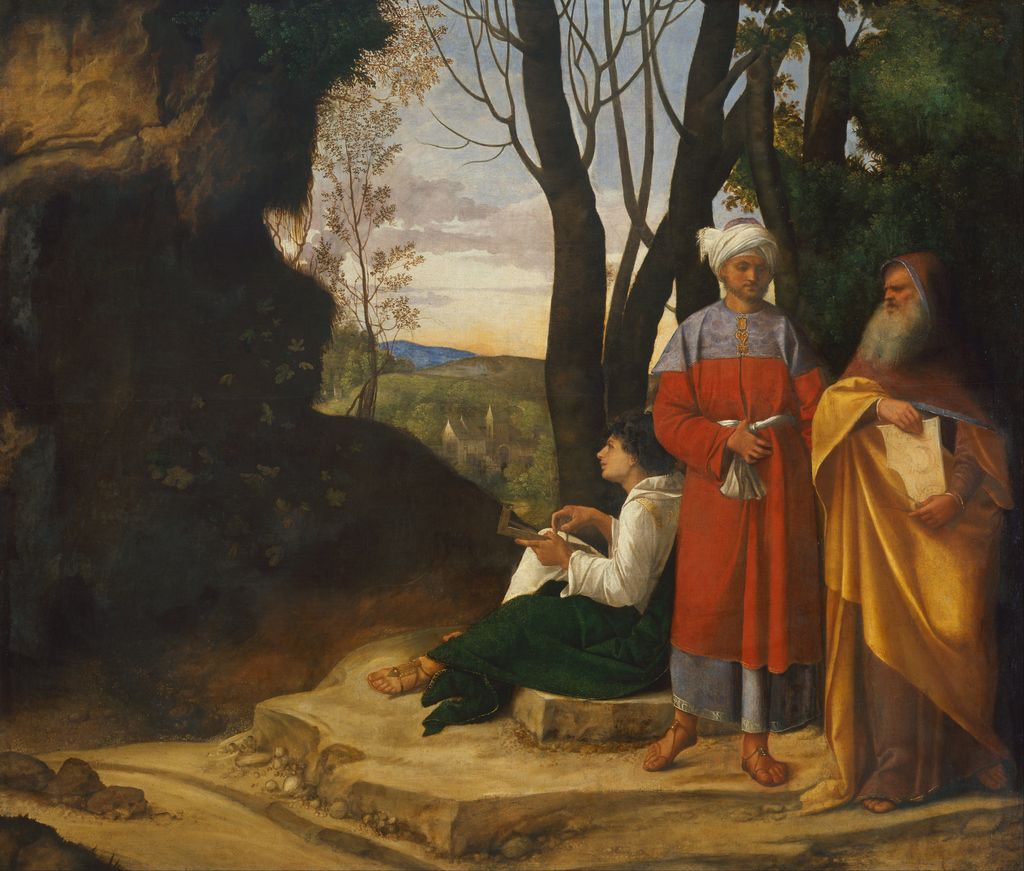
The Three Philosophers can enrich a final comparison. There too it matters who actually observes the sky or ground, who reads from a page and who turns elsewhere. The Washington double portrait opens those roles to us with just a few hands. One man has a tool to explain how the heavens are measured. A student has grabbed several means of putting his own talent to use. He is the one who notices us first. [1] [7]
Annotated Details from Giovanni Borgherini And His Tutor
Select a point to see its detail.
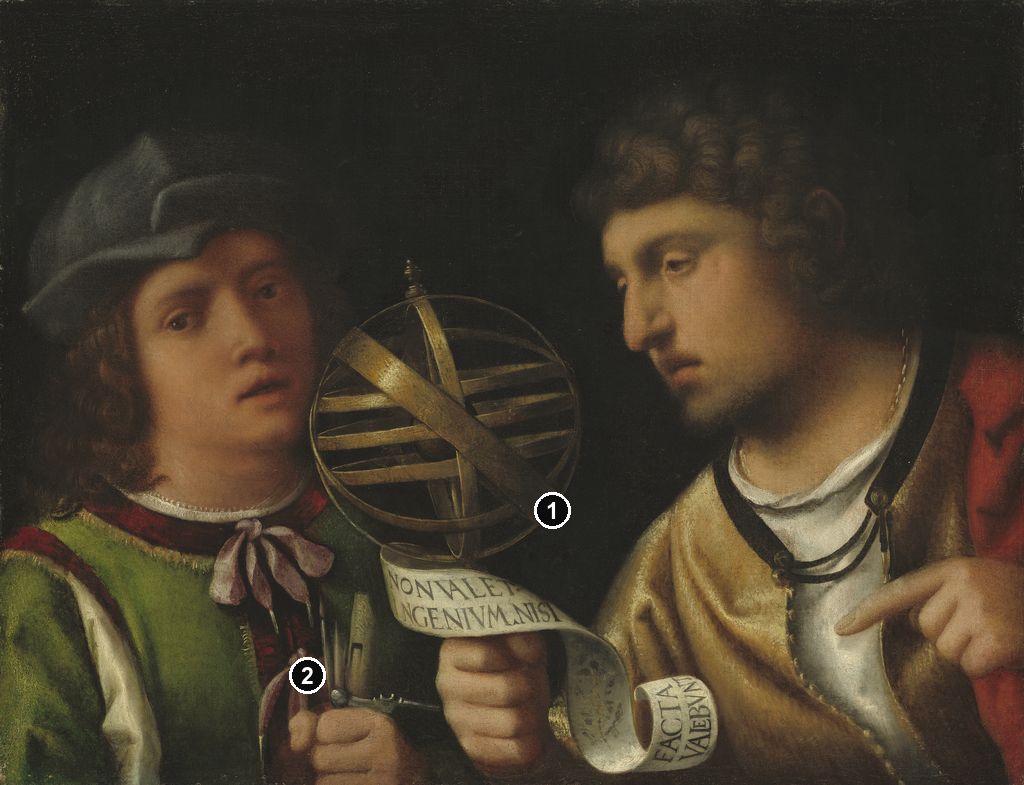
1. Armillary and inscription · 2. The student's tools
Details from GIOVANNI BORGHERINI AND HIS TUTOR
Detail crops from the same image.
Armillary and inscription
The tutor shows the model in the narrow space between the figures.
The student's tools
The quill, flute, compass and brush bring several streams of education together.
Giorgione’s career
Castelfranco Madonna
Early 1500sFondaco dei Tedeschi
1507–08Three Philosophers
1508–09Death in Venice
1510Discussion
Share what you noticed and how you arrived at your reading.
Reader Insights
Which detail would you point out to somebody seeing Giovanni Borgherini and His Tutor for the first time?
How does two separate histories of paint and ownership change how you read the work?
Join the Conversation
Share a detail, comparison or question about Giovanni Borgherini and His Tutor below.
References
- National Gallery of Art, Washington, Giovanni Borgherini and His Tutor, 1974.87.1. View source.
- Bayerische Staatsgemäldesammlungen, Portrait of Giovanni Borgherini and Trifone Gabriele, 7452. View source.
- Bayerische Staatsgemäldesammlungen, Bildnis des Giovanni Borgherini und des Trifone Gabriele, German collection record. View source.
- Treccani, Dizionario Biografico degli Italiani, Gabriel, Trifone. View source.
- Alte Pinakothek, One Painting, Four Ideas. View source.
- Anneliese Földes et al., One Canvas, Four Ideas: A Double Portrait Attributed to Giorgione. View source.
- Kunsthistorisches Museum, Die drei Philosophen. View source.