


 by Tom Gurney
Tom Gurney BSc (Hons) is an art history expert with over 20 years experience
Published on June 19, 2020 / Updated on November 29, 2026
Email: tomgurney1@gmail.com / Phone: +44 7429 011000
Overview
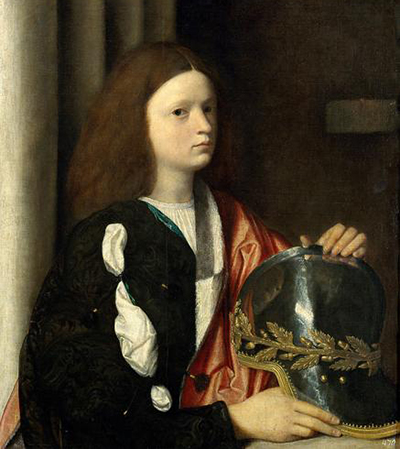
The boy holds a helmet so large that it almost competes with his head for space. Its hard surface reflects the light, and oak leaves near it offer a possible clue to his name. At the Kunsthistorisches Museum in Vienna the work is catalogued as Giorgione's Portrait of Francesco Maria I della Rovere. The museum regards the future Duke of Urbino as the most likely sitter. Both the identification and the artist have been disputed. The 2016 Royal Academy exhibition catalogued the work as attributed to Sebastiano del Piombo, around 1505. The picture measures 73 by 64 centimetres and survives on canvas after transfer from its wooden panel. [1] [2]
At a Glance
- DateEarly 1500s
- CollectionKunsthistorisches Museum, Vienna
- AttributionGiorgione at KHM; also attributed to Sebastiano
- InventoryGG 10
A boy carrying the weight of an emblem
The young sitter has been given a dark wall and a view into a passage of receding columns. The wall makes the quiet expression in his face easier to register. The columns let some space in at the side without opening the whole picture to a landscape. Around his shoulders, the robe falls in well-defined angles. The painting holds the stillness of his posture and a certain sense of formality at the same time. The boy is equipped with something that would look very different in his hands if he had picked it up casually. Its size and the closeness with which he holds it make the impression of an expected role particularly strong. [1] [2]
The metal catches forms and gleams from around it. The Vienna entry singles out the helmet reflections as the most remarkable evidence of the painter's hand, along with the angular drapery, the expression and the tiny piece of paper attached to the wall. Such a piece of paper, often called a cartellino, can occupy an important place in a portrait. Here it helps set a visible plane into the dark area even where the viewer cannot rely on it for a legible name. Compare its flatness to the curving metal surface. The painter uses different kinds of small detail to show us where things sit in the room and how they receive the light. [1] [2]
Oak is rovere in Italian. Oak leaves are in keeping with the Della Rovere name, and the family's arms include an oak tree. That association is more convincing at the level of lineage than at the level of an individual's identity. The Royal Academy discusses an Urbino inventory in which a medium-sized picture of a boy holding a helmet was described with oak branches as an emblem of Duke Guidobaldo. The colour, pose and equipment in the Vienna picture make it tempting to join that description to this object. The records do not amount to a commission specifying both painter and sitter. The picture still asks to be understood through the relation between its unusually young face and its emphatic signs of family and rank. [1] [2]
What the name rests on
Wilhelm Suida made the case for Giorgione in 1935 and argued that the young sitter was likely Francesco Maria, born in 1490. At the age implied by the portrait he had a public future before him, eventually succeeding as Duke of Urbino in 1508. Alessandro Ballarin connected the work to Francesco Maria's appointment as prefect of Rome in 1502, and later proposed an earlier date around 1500 on stylistic grounds. Each change in the proposed date changes what could have occasioned the picture. The Royal Academy points out a difficulty with the sitter argument. The face is hard to match with the better identified likeness on a gold ducat. An oak branch and approximate age are meaningful clues, with limits to how much they can settle. [1] [2]
The identity was already unstable in old collections. According to the Royal Academy, the work is mentioned with the Venetian paintings of Bartolomeo della Nave and acquired by the Marquess of Hamilton in the 1630s. One entry calls it a duke of Urbino by Raphael. Another records a young man with a helmet and calls it Correggio. It then passed into the collection of Archduke Leopold Wilhelm, whose cabinet of pictures was documented by David Teniers the Younger. A print from the Theatrum Pictorium associated the young man with Palma Vecchio. The Rijksmuseum records a print after the composition, with a Teniers model likely to have mediated between painting and print. Thus a nineteenth-century attribution debate inherited several much older names and a reproducible design. [2] [3]
The Royal Academy's authors consider the proposal of Sebastiano del Piombo to have real force. They trace it to Rodolfo Pallucchini and to comparisons with pictures in Venice. The current Vienna catalogue sees the folds, the little paper and the play of reflection more in keeping with Giorgione after restoration. Suida also paid close attention to the luminous helmet and the colour of the sitter's clothing. There is wide agreement that the work belongs in an ambitious moment of Venetian painting. Some of the same details remain central to the case for two painters whose early styles overlap. [1] [2]
The adult duke and another young knight
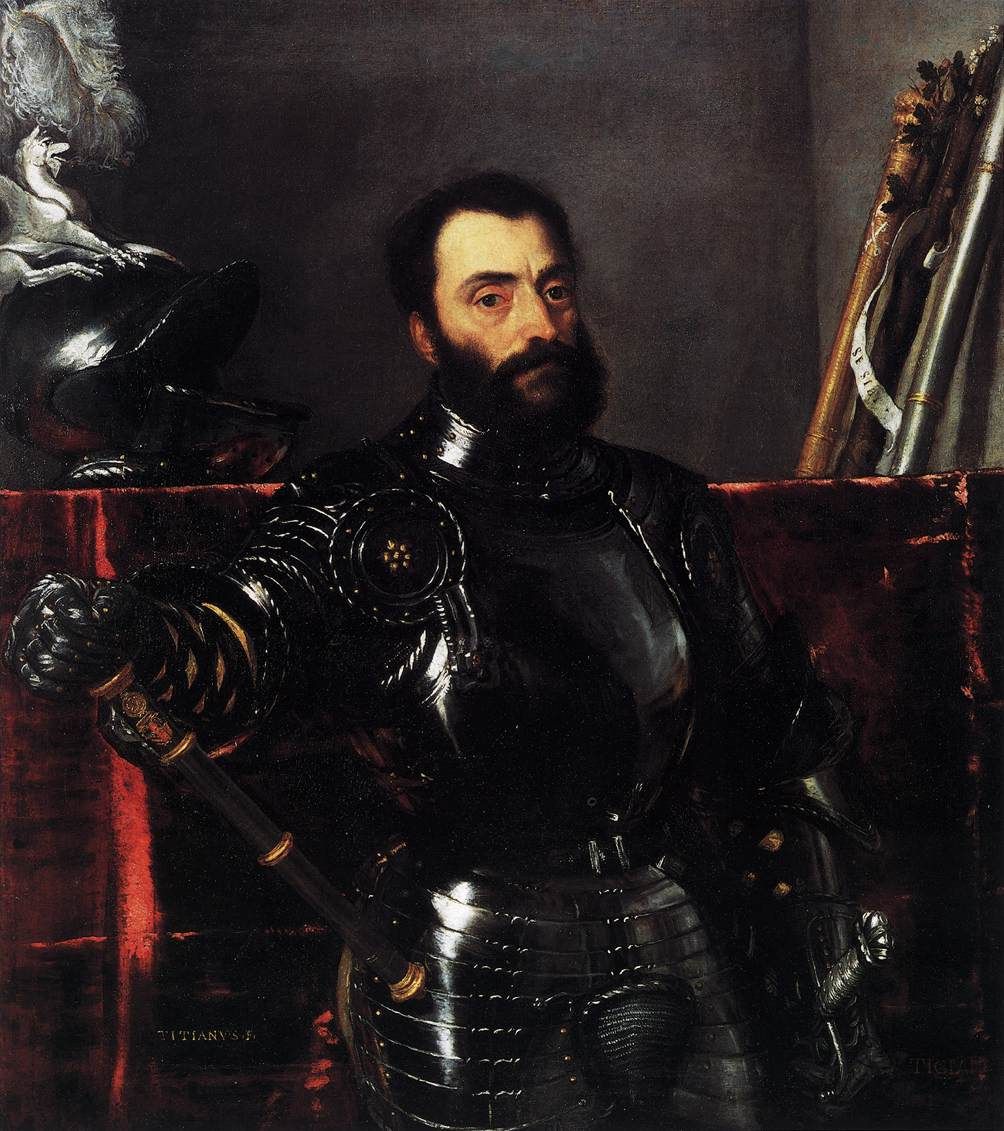
Titian's adult likeness in the Uffizi shows Francesco Maria after a public career. Its military batons, polished armour and rich velvet declare offices and affiliations, and an oak branch reinforces the Della Rovere lineage. The adult wears armour with the resolution of a man whose right to command has already been established. The boy in Vienna has the helmet to carry and the uncertain authority of youth. The distinction in age and audience makes the Uffizi painting useful for thinking about the function of the Vienna picture, though a shared name in catalogue titles cannot prove an earlier sitter's identity. [1] [2] [4]
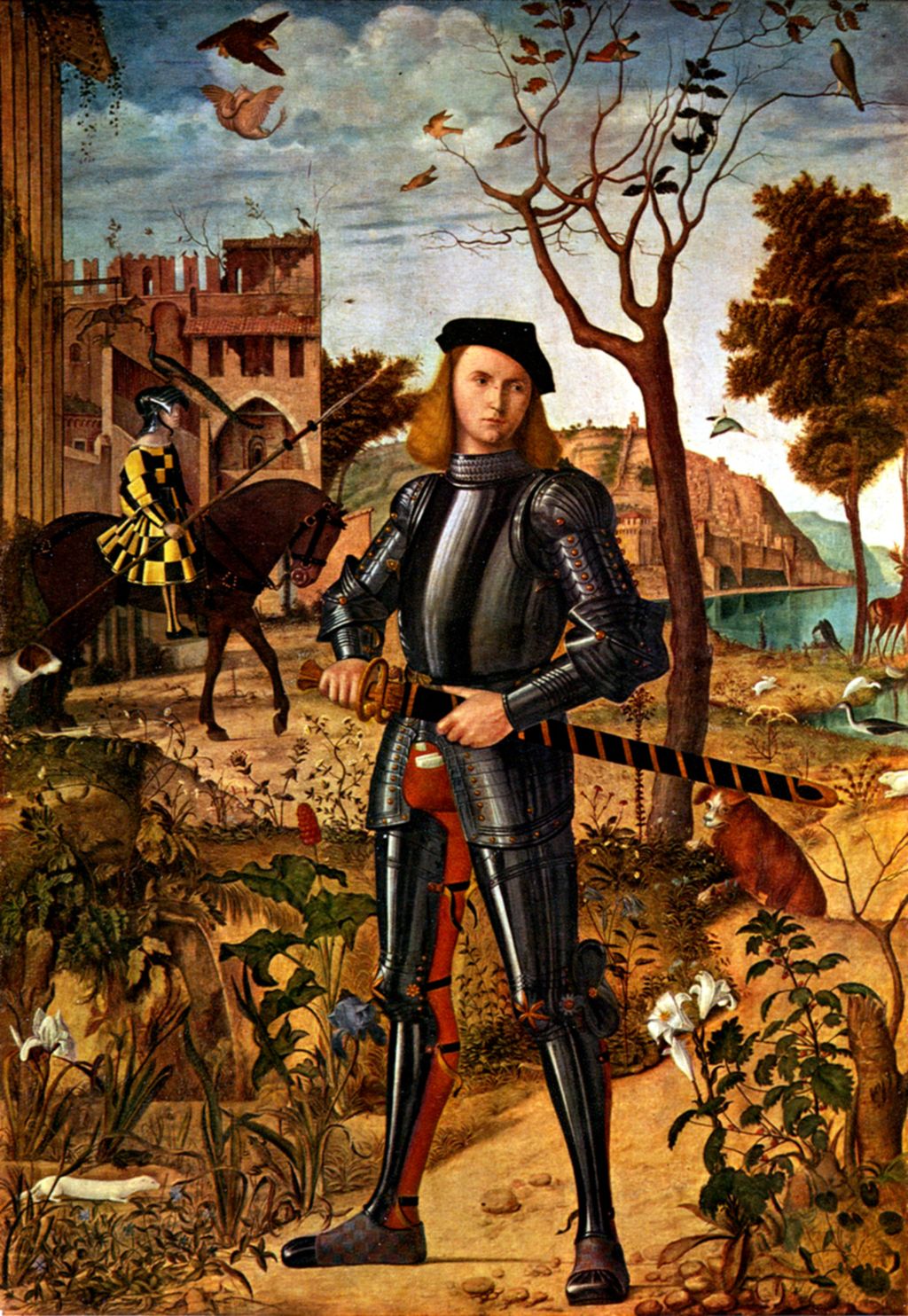
A different claimant to the young duke's name is Vittore Carpaccio's Young Knight in a Landscape, now in Madrid. That work shows the figure at full length amid vegetation and animals, with a signed and dated cartellino. The Thyssen's catalogue describes the proposal that the knight is Francesco Maria and discusses several alternatives. Its restoration clarified the timing of different motifs, including the addition of an oak to an earlier stage of the design. The Madrid example is a particularly instructive comparison with Vienna. An emblem can be deliberate and historically significant without giving a name that everyone agrees on. [2] [5] [6]
Return to the reflections on the helmet and the soft light in the young face. For all the possible heraldry, the painting has given the boy an expression quieter than the outward signs of rank would need. What a viewer can recognise in that moment is a young person holding something ponderous and highly charged, as though he has been asked to pose with a future he is still growing into. [1] [2]
Giorgione’s career
Castelfranco Madonna
Early 1500sFondaco dei Tedeschi
1507–08Three Philosophers
1508–09Death in Venice
1510Discussion
Share what you noticed and how you arrived at your reading.
Reader Insights
Which detail would you point out to somebody seeing Portrait of Francesco Maria della Rovere for the first time?
How does the adult duke and another young knight change how you read the work?
Join the Conversation
Share a detail, comparison or question about Portrait of Francesco Maria della Rovere below.
References
- Kunsthistorisches Museum, Bildnis des Francesco Maria I. della Rovere. View source.
- Simone Facchinetti and Arturo Galansino, eds., In the Age of Giorgione, Royal Academy of Arts, catalogue no. 8. View source.
- Rijksmuseum, Portret van Francesco Maria I della Rovere. View source.
- Gallerie degli Uffizi, Titian, Portrait of Francesco Maria della Rovere. View source.
- Museo Nacional Thyssen-Bornemisza, Vittore Carpaccio, Young Knight in a Landscape. View source.
- Museo Nacional Thyssen-Bornemisza, Carpaccio's Knight, restoration and technical study. View source.