

 John William Waterhouse.jpg)
 by Tom Gurney
Tom Gurney BSc (Hons) is an art history expert with over 20 years experience
Published on August 14, 2026 / Updated on August 14, 2026
Email: tomgurney1@gmail.com / Phone: +44 7429 011000
The Bouquet (Study): Introduction
A red-haired woman in a green dress holds a mass of pink flowers against dark foliage. In John William Waterhouse’s The Bouquet, face and upper body are developed with luminous colour while hands, bouquet and lower background remain visibly open. Falmouth Art Gallery preserves the oil as a public collection object; its unequal finish makes the act of painting unusually legible. [1]
The canvas is generally dated 1908 and is often titled The Bouquet (Study) or Portrait of a Lady in a Green Dress. It measures 59 × 42 cm and was presented to Falmouth by Alfred A. de Pass. [1] [2] The word “study” is useful, but the exact relation to another final composition should not be overstated without a documented sequence.
At a Glance
- ArtistJohn William Waterhouse (1849–1917)
- Collection titleThe Bouquet [1]
- Common extended titlesThe Bouquet (Study); Portrait of a Lady in a Green Dress [2]
- Datec.1908 [2]
- MediumOil on canvas [1]
- Dimensions59 × 42 cm [1]
- CollectionFalmouth Art Gallery, Cornwall [1]
- AccessionFAMAG 1000.18 [1]
- CreditPresented by Alfred A. de Pass [1]
- SubjectUnnamed red-haired woman holding pink flowers
Contents
- Introduction
- What Kind of Study Is This?
- The Unnamed Woman in Profile
- Green Dress and Pink Bouquet
- A Hierarchy of Finish
- Flowers Without a Literary Source
- Waterhouse’s Flower-Women Around 1908
- From Private Studio to Falmouth
- Frame, Scale and Public Encounter
- A Bouquet as a Model of Painting
What Kind of Study Is This?
Falmouth Art Gallery records the object as The Bouquet, without a parenthetical qualification. [1] Other modern sources add “Study” and the alternative descriptive title Portrait of a Lady in a Green Dress. [2]
The visual evidence supports the study label. Some passages approach completion, while others preserve exposed strokes and loosely indicated forms.
That does not automatically prove the canvas was a preparatory stage for one larger painting. An artist may produce an oil study to test colour, model and motif without later translating it directly.
The object’s selective finish places it within Waterhouse’s movement from studies towards more developed pictures and within the bouquet theme.
The word “study” can therefore refer to function, appearance or later catalogue category. Those meanings should remain distinct.
As function, it may have helped Waterhouse investigate a figure carrying flowers. As appearance, it is visibly less resolved than an exhibition picture. As catalogue category, it distinguishes the work from other canvases with related titles.
The painting is nevertheless an independent physical object. It entered Falmouth’s collection, received an accession number and can be viewed without a hypothetical final canvas beside it. [1]
Calling it unfinished should not imply failure. Selective finish may be exactly what Waterhouse required from the exercise.
The correct balance is to recognise process without reducing the picture to a disposable step.
The Unnamed Woman in Profile
The model turns towards the right. Her face is shown in near profile, with eye, nose, lips and chin clearly defined against the darker garden.
Profile gives Waterhouse a strong contour. The face can remain pale and luminous while the surrounding hair and foliage carry greater tonal weight.
Her red-brown hair is gathered low, with small pale flowers or ornaments placed near the back of the head. Loose strands soften neck and cheek.
No secure sitter name accompanies the Falmouth record. [1] She should not be identified as Muriel Foster or another Waterhouse model on appearance alone.
Nor is the work necessarily a portrait commission. The alternative title Portrait of a Lady in a Green Dress describes format and clothing but does not supply a biographical sitter. [2]
The model’s gaze extends beyond the right edge. This direction creates attention without showing its object.
Viewers may read expectancy, distraction or contemplation, yet those remain responses to pose rather than evidence of emotion.
Waterhouse often made women appear absorbed in a world adjacent to the viewer. Here the bouquet gives her an activity or possession, but she is not looking at it.
The separation between gaze and flowers prevents the work from becoming a simple image of smelling.
Her face is the most finished zone. That hierarchy preserves the model’s presence even where the rest of the picture exposes its construction.
Green Dress and Pink Bouquet
The dress is a deep green, enriched by warmer, cooler and translucent-looking passages. Its neckline frames shoulders and neck, while patterned or embroidered areas are only partly resolved. [2]
Green makes a natural link with the foliage behind the figure. Dress and garden belong to one broad colour family.
The pink bouquet interrupts that continuity. Flowers gather as a warm, pale mass near the lower right, opposite the sitter’s head.
Their forms are suggestive rather than botanically exact in reproduction. Roses are likely, but the page need not identify every bloom or assign a coded message.
The bouquet has both visual and thematic weight. It balances the head, explains the title and turns the woman into a carrier of gathered nature.
Her hands are less complete than her face. Strokes indicate grip and placement without hiding the drawing and revisions beneath.
That openness allows viewers to see the bouquet being solved. Petals, fingers and stems have not yet been separated with uniform certainty.
The green-and-pink relation is central to the work’s appeal. Complementary warmth and coolness create vitality without the broader palette of a multi-figure narrative.
Dress and flowers also represent different kinds of surface. Cloth hangs and folds; petals cluster and overlap.
Waterhouse tests both against skin. The study becomes an exercise in coordinating materials around a human profile.
A Hierarchy of Finish
Waterhouse concentrates modelling in the face, hair and upper shoulder. The bouquet, hands and parts of the lower field remain more visibly abbreviated.
This hierarchy may reflect working sequence. Identity and expression had to be secured first; secondary forms could be adjusted later.
It also directs modern looking. The eye meets the face, travels through dress to flowers and then notices the incomplete passages.
Dark foliage is built with broad marks. Some branches and leaves emerge; others remain a general mass that makes the head luminous.
The lower background includes light ground or table-like horizontals but does not establish a complete interior or garden architecture.
Visible drips and long strokes in the bouquet region remind viewers that the image is liquid colour fixed over time.
Such marks differ from the polished surface often associated with Victorian academic painting. They reveal that Waterhouse’s finished effects could grow from energetic initial placement.
The study does not prove that Waterhouse never drew; drawings in pencil and chalk remain part of his practice.
Nor can reproduction reveal whether he drew directly on this canvas. Infrared examination would be needed for concealed underdrawing.
What the visible surface proves is selective investment. He allowed different parts to reach different stages.
That variation is not simply “loose versus detailed.” It is a system in which each zone contributes only what the composition currently needs.
Flowers Without a Literary Source
The collection title names an object, not a poem or myth. [1] No source text identifies the woman as Flora, Persephone, Ophelia or a Tennysonian heroine.
That absence should be respected. Waterhouse’s flower paintings can create mood without narrative identification.
A bouquet already carries rich ordinary associations: gift, courtship, celebration, mourning, decoration and the movement of plants from garden to interior.
None can be selected as the work’s exact story without evidence.
The flowers’ cut state is visible in principle. They have been gathered and held, separating their beauty from continued growth.
This condition can support reflection on impermanence. Petals will fade while paint preserves their appearance.
Yet even that familiar symbolism should remain interpretive rather than an encoded message Waterhouse is known to have specified.
The woman’s averted gaze keeps the bouquet from becoming a direct emblem she contemplates. Flowers and consciousness occupy adjacent but separate centres.
The picture therefore balances sensual immediacy with narrative openness. Pink against green is concrete; what occasion produced the bouquet is unknown.
This openness places responsibility on the viewer. Interpretation begins, but the painting does not force one inherited plot.
Waterhouse’s Flower-Women Around 1908
The proposed date of 1908 places The Bouquet at the beginning of Waterhouse’s sustained late sequence of non-narrative or lightly narrative women with flowers. [2] [3]
In that year he completed The Soul of the Rose and one version of Gather Ye Rosebuds While Ye May. Christie’s describes the wider sequence as an exploration lasting roughly six years. [3]
The works share motifs but not identities. One woman inhales a rose beside a wall; another carries flowers in an interior; later figures stand within bowers, arrange blossoms or gather them outdoors.
The Bouquet is especially useful because its open surface reveals the process behind that polished late world.
Its woman is clothed in deep green rather than the pale dresses of several companion works. The bouquet is carried at chest height rather than cut directly from a visible plant.
The near-profile pose concentrates her relation to something outside the frame. In The Soul of the Rose, by contrast, scent and wall create a self-contained sensory act.
These differences prevent “flower-women” from becoming a single generic subject.
The date also marks a period when Waterhouse was moving away from explicit literary crises without abandoning the expressive female figure.
Flowers supplied event at a smaller scale. Holding, arranging, inhaling and gathering became sufficient actions.
The series can be read through beauty and mortality, but also through labour and selection. Someone has cut, assembled and carried the bouquet.
The Falmouth study records that material process alongside the painter’s own act of assembly.
From Private Studio to Falmouth
Falmouth Art Gallery credits the painting as a gift from Alfred A. de Pass. [1] The accession number FAMAG 1000.18 places it within the gallery’s permanent collection.
De Pass was an important benefactor whose gifts helped shape public collections in Cornwall and elsewhere. The object page preserves his role even where the work’s earlier provenance is not detailed. [1]
Gift history matters because it changes access. A study that might have remained privately owned became part of a municipal collection.
Public ownership also supplies a stable title, measurement and physical identifier. Those facts protect the work from confusion with commercially reproduced variants.
The Falmouth record does not give the 1908 date in its brief online entry, so that date is drawn from wider cataloguing rather than presented as a collection inscription. [1] [2]
Similarly, the gift credit does not establish how or when de Pass acquired the canvas. A complete provenance would require additional archive research.
These limits should be stated rather than bridged with assumptions about Waterhouse selling or gifting it directly.
The surviving record is still strong enough for a public page: physical object, medium, dimensions, accession, collection and donor are secure.
Unlike many private late studies, The Bouquet can therefore anchor discussion in an institutional object.
Frame, Scale and Public Encounter
The gallery records a rare late nineteenth-century French artist’s frame with a reverse profile, gilded mouldings and applied bay-leaf-and-berry ornament. [1]
That frame is not incidental. It shapes how the loose study is presented as a finished museum object.
Its gilded precision contrasts with open brushwork. A working-looking surface receives an elaborate historical boundary.
The frame’s date may precede the commonly proposed 1908 canvas date. It should not automatically be called the original frame without documentary proof.
At 59 by 42 centimetres, the painting is intimate but not miniature. [1] Its head and bouquet can sustain close examination in a gallery.
Scale also clarifies handling. Strokes that look coarse in enlarged digital detail may appear finely calibrated before the actual object.
Public display lets viewers move between distances. From afar, figure and flowers cohere; nearby, their stages separate.
That movement is essential to understanding the study. Reproduction usually fixes one distance and flattens paint.
The Falmouth setting therefore adds interpretive value beyond ownership. It allows process to be experienced physically.
The frame and accession history also show how later custodians participate in meaning. Waterhouse made the canvas; donors and curators determined its public afterlife.
A Bouquet as a Model of Painting
A bouquet is an arrangement made from separate living forms. Painting similarly selects and brings elements together inside a boundary.
The analogy is visible without needing to be a hidden allegory. The model holds one arrangement while Waterhouse constructs another.
Flowers overlap, and painted marks overlap. Both depend upon colour distribution, rhythm and the balance between abundance and order.
The unfinished bouquet makes this relation especially clear. We watch Waterhouse decide how much separation each bloom requires before the cluster becomes convincing.
The woman is another part of the arrangement, but she is not merely decorative. Her gaze, profile and grip give the flowers human scale and purpose.
Her anonymous status raises the ethical limit of the analogy. A model is not a flower to be arranged; she is a worker whose participation helped make the image.
Recognising that distinction prevents aesthetic language from erasing collaboration.
The study thus joins three acts of selection: someone gathers flowers, the model presents them and Waterhouse selects marks from the posed scene.
Its visible incompletion keeps those acts from appearing effortless.
The Red-Haired Model and Repeated Appearance
Waterhouse’s red-haired women create strong continuity across his paintings, but continuity of appearance is not the same as a secure personal identity.
The model in The Bouquet resembles figures from his mature and late work. Hair colour, pale skin and a long profile conform to an ideal that he returned to repeatedly.
That recurrence can arise in several ways. He may reuse a trusted professional model, select different sitters with similar features or alter observed faces towards a preferred type.
Reproduction comparison cannot decide among them. A profile suppresses half the facial information, while lighting and painted adjustment change the rest.
The woman should therefore remain unnamed. The manuscript can still acknowledge that her body and held pose were necessary to the work.
Carrying a bouquet at chest height while maintaining a turned head requires coordination. Even if flowers were added separately, the pose had to be observed or constructed.
The hands’ unfinished state does not make their labour irrelevant. It may show that Waterhouse had not yet resolved the most physically complex junction in the study.
This perspective also challenges the phrase “flower-woman” when it becomes too totalising. The category describes a repeated painted motif, not the model’s identity in life.
She may have posed as a bouquet carrier in one session and as a literary figure in another. Her professional contribution exceeded any single fictional or symbolic name.
Waterhouse’s ideal type is an artistic outcome; the sitter behind it was a person.
Holding those statements together gives the painting greater historical depth than either romantic muse mythology or purely formal analysis alone.
Conservation Questions Raised by an Open Surface
An incompletely resolved painting poses particular conservation questions. Thin or exposed passages can be mistaken for abrasion, while later varnish may make original tonal differences appear more extreme.
The Falmouth object record confirms the medium and canvas but does not publish a technical report. [1]
Viewers should therefore avoid deciding from reproduction which pale areas are bare ground, rubbed paint or intentional light strokes.
The same caution applies to drips and long marks. They appear consistent with a working surface, but direct inspection is needed to establish whether every visible line is original.
Conservation could potentially clarify sequence. Microscopy might distinguish initial blocking from later accents, and imaging could reveal changes beneath the face or bouquet.
Such examination might also show whether Waterhouse stopped permanently at this stage or returned after the first campaign. Surface appearance alone does not provide a calendar.
The historical frame adds another layer. Its gilding and ornament require different care from the oil, and the gallery specifically records it as a notable object. [1]
Frame and canvas may have joined after Waterhouse’s work was complete. Their conservation histories can therefore diverge.
These questions are not necessary for ordinary enjoyment, but they matter for precise claims about technique. The manuscript describes what can be seen and identifies what would require material evidence.
That boundary is especially valuable for studies, whose appeal often encourages viewers to narrate every exposed stroke as if they had watched the painter make it.
Public Ownership and Local Value
Falmouth’s possession gives the study a place within a Cornish municipal collection rather than leaving it as a detached image in Waterhouse’s online catalogue. [1]
Local galleries make nationally significant artists accessible outside London. A work of modest scale can support teaching about portraiture, process, colour and Victorian collecting.
Alfred de Pass’s gift also belongs to the history of civic philanthropy. The painting’s current value is not only financial or reputational; it lies in repeated public use.
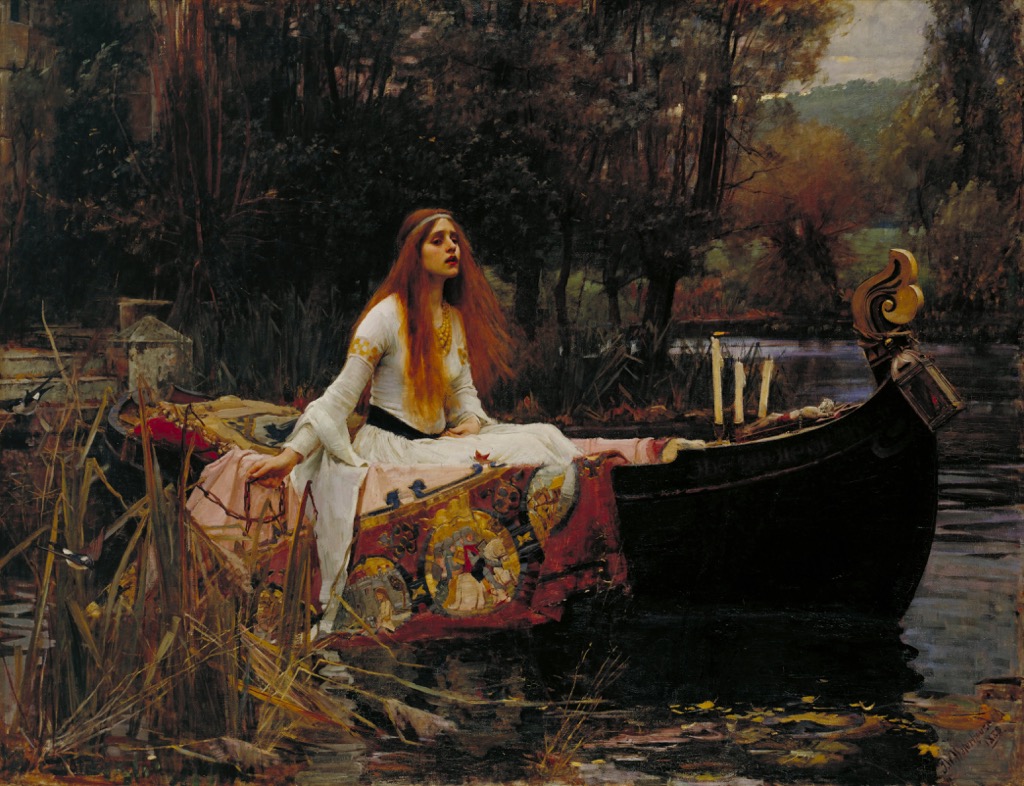
Students can compare the resolved face with the open bouquet at actual scale. Artists can examine how little information a background needs. General visitors can encounter a Waterhouse that differs from the highly polished Lady of Shalott known through reproduction.
Display rotations and loans may limit availability at any given moment, which is why visitors should check ahead. Ownership nevertheless creates the possibility of continuing public encounter.
This afterlife completes a transformation. A studio investigation becomes a teaching object, and the traces of private making become shared evidence.
Related Pages
- The Lady of Shalott: Compare Waterhouse's best-known literary composition.
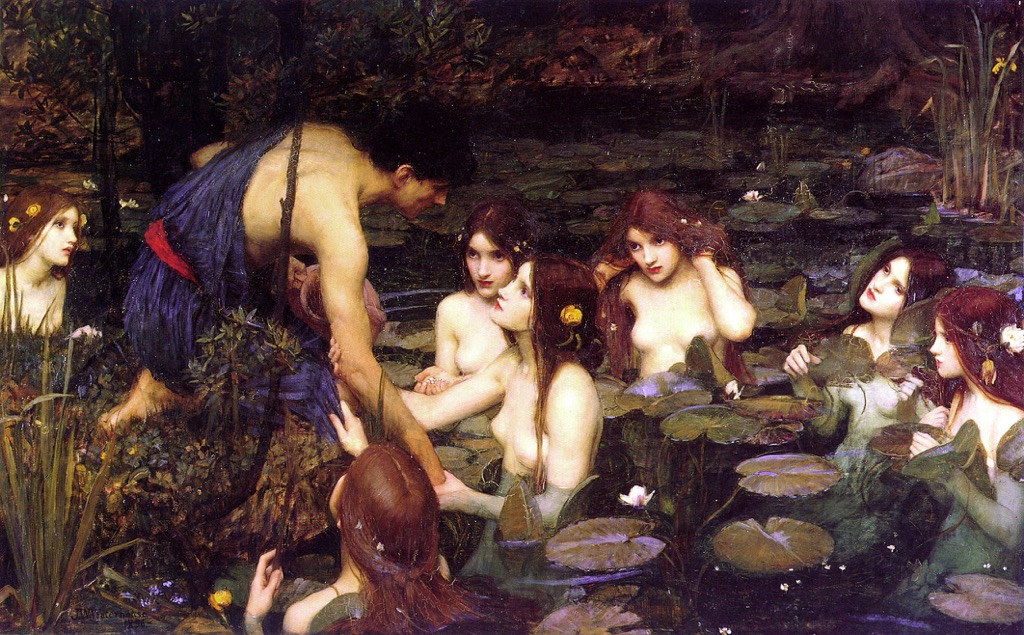
- Hylas and the Nymphs: Compare another major mythological scene.
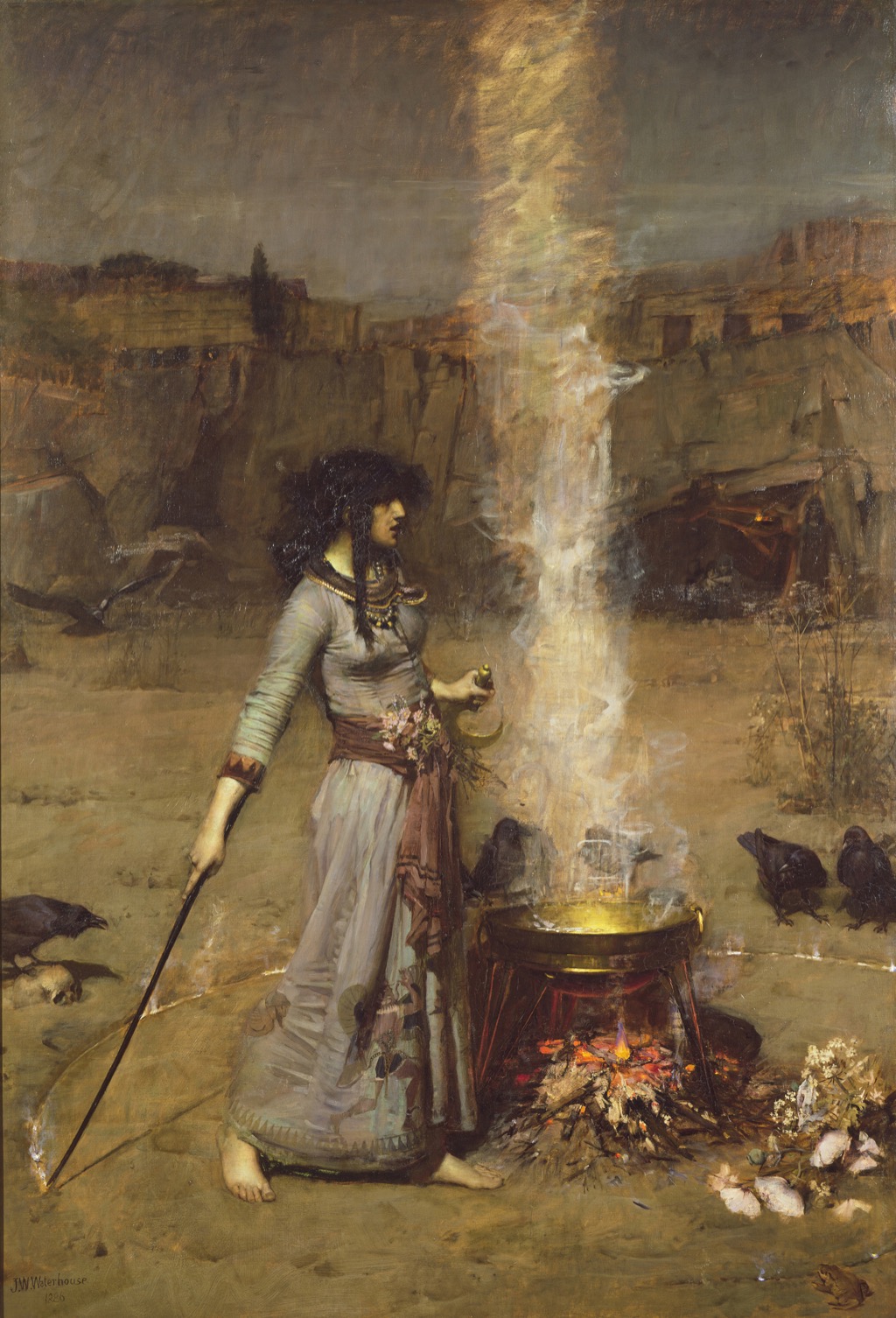
- The Magic Circle: Compare Waterhouse's treatment of ritual and symbolism.
Frequently Asked Questions
Falmouth Art Gallery uses The Bouquet. “Study” is a common modern qualification reflecting the work’s open finish. [1] [2]
It is generally dated about 1908. [2]
Oil on canvas, 59 × 42 cm. [1]
No secure sitter identity is published by the gallery. [1]
No specific literary source is documented. It belongs to Waterhouse’s broader late flower-woman practice.
It belongs to Falmouth Art Gallery, although display should be checked with the gallery before visiting. [1]
Discussion
The Bouquet occupies a productive middle ground. It is sufficiently developed to sustain profile, colour and floral presence, yet open enough to show Waterhouse distributing effort across face, dress, hands and background.
Its public collection record provides unusually firm material control: 59 × 42 centimetres, oil on canvas, Falmouth accession FAMAG 1000.18 and the gift of Alfred de Pass. Its interpretive uncertainties are different. The model is unnamed, and no exact final composition or literary source should be forced upon her.
Reader Insights
Which visible detail most changes the way you read this page?
Which source or comparison helps the work feel less familiar and more specific?
What question would you bring back to the painting after reading?
Join the Conversation
Share your reading of this page below.
References
- Falmouth Art Gallery, “FAMAG 1000.18: John William Waterhouse, The Bouquet,” collection record including medium, dimensions, donor and frame. View source.
- Art UK, “John William Waterhouse, The Bouquet,” object record, c.1908 date, Falmouth location and dimensions. View source.
- Christie’s, “John William Waterhouse, The Rose Bower,” catalogue essay discussing the late flower-women sequence beginning in 1908. View source.