

 Buy Art Prints Now
from Amazon
* As an Amazon Associate I earn from qualifying purchases.
Image reference [image]
 by Tom Gurney
Tom Gurney BSc (Hons) is an art history expert with over 20 years experience
Published on August 14, 2026 / Updated on August 14, 2026
Email: tomgurney1@gmail.com / Phone: +44 7429 011000
Cleopatra: Introduction
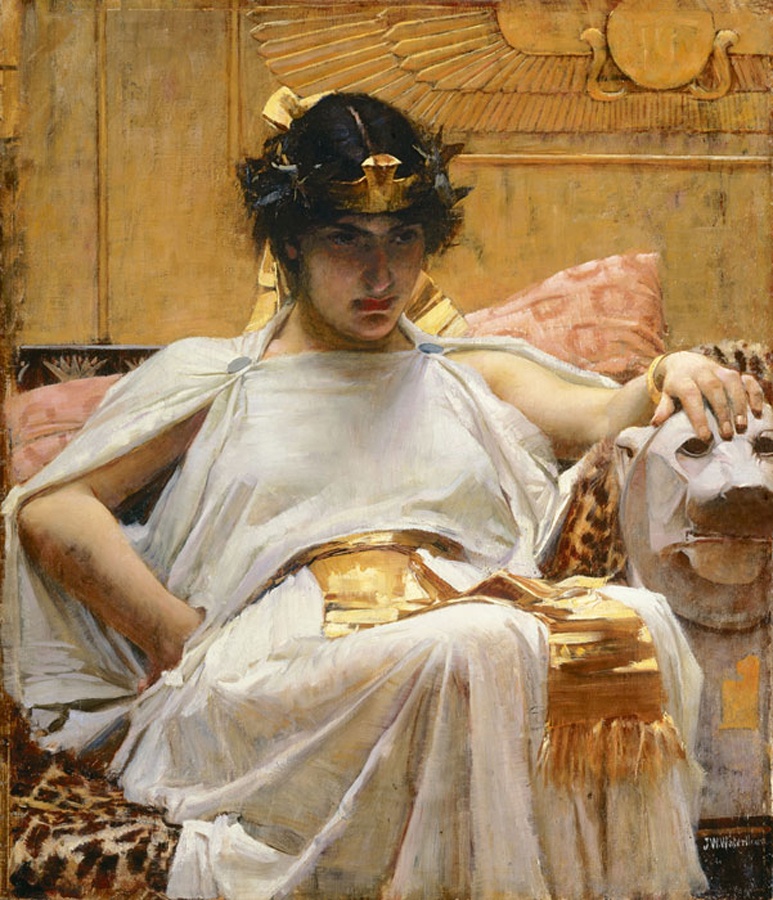
John William Waterhouse's Cleopatra does not show the Egyptian queen dying, meeting Antony or arriving on her famous barge. She sits alone, leaning forward from a leopard skin and looking out beneath dark, level brows. Gold, patterned surfaces and loosely draped white fabric establish luxury; her gaze establishes command.
Painted in 1888 for The Graphic Gallery of Shakespeare's Heroines, the work represents Shakespeare's Cleopatra in Antony and Cleopatra. That commission is essential. Waterhouse was not attempting a documentary likeness of the historical Cleopatra VII. He was inventing a compelling late-Victorian body for a theatrical and literary character whose attraction, political power and refusal to be contained drive Shakespeare's tragedy. [1] [2] [3]
At a Glance
- ArtistJohn William Waterhouse
- Date1888 [1] [6]
- MediumOil on canvas [6]
- DimensionsApproximately 56 × 64 cm; published secondary records vary slightly [6]
- CollectionPrivate collection [6]
- SubjectCleopatra as a character in William Shakespeare's Antony and Cleopatra [1]
- CommissionOne of 21 paintings made for The Graphic Gallery of Shakespeare's Heroines [2] [3]
- Published reproductionPhotogravure issued by Sampson Low in 1888; later colour portfolio edition in 1896 [1] [3]
- Contemporary responsePraised for its “Oriental splendour” in The Graphic in 1889 [2]
- Key visual deviceCleopatra's direct, challenging gaze from a reclining pose
Contents
- Introduction
- What the painting shows
- Shakespeare's Cleopatra, not a documentary portrait
- The Graphic Gallery commission
- Gaze, pose and authority
- Gold, white cloth and leopard skin
- Sensuality and the late-Victorian viewer
- Cleopatra VII and the limits of historicism
- From oil painting to photogravure
- Waterhouse in 1888
What the painting shows
Cleopatra occupies a shallow, richly appointed space. She reclines or sits low upon a leopard skin, one arm extended along the support beside her. Her torso inclines forward, and her face turns towards the spectator. A loose white garment falls across her body beneath gold ornaments and a decorative girdle.
The pose combines ease with pressure. Reclining can signify leisure or erotic availability, but Cleopatra's forward movement and fixed gaze prevent her from becoming a passive display. She seems to assess the person looking at her.
The queen is presented without narrative companions. Antony is absent; so are Charmian, Iras, Caesar and the messengers whose entrances drive Shakespeare's play. Waterhouse concentrates a many-voiced drama into one encounter between character and spectator.
The setting offers compressed signs of Egypt and royalty rather than a mapped palace. Gold surfaces, ornament, animal skin and architectural pattern produce an atmosphere of abundance. Their function is theatrical and associative.
No asp appears as the painting's organising motif. Waterhouse therefore refuses the most familiar terminal image of Cleopatra. She is alive, self-possessed and dangerous before the tragedy has fixed her as a beautiful corpse.
Her hands do not perform an obvious task. Action moves instead through head, shoulders and eyes. The absence of anecdotal gesture makes expression carry unusual force.
This is why the work often feels more like a confrontation than an illustration. It gives no single episode to decode. The title supplies the character; the body supplies her presence.
Shakespeare's Cleopatra, not a documentary portrait
The Folger Shakespeare Library catalogues Waterhouse's image explicitly as Cleopatra, character in Shakespeare's Antony and Cleopatra. [1] Its place in a gallery of Shakespeare's heroines confirms that literary identity. [2] [3]
Shakespeare's play presents a romance between two rulers, Cleopatra of Egypt and Mark Antony, within the struggle that ends with Octavius Caesar's victory. Its queen can mock, command, perform, rage, negotiate and reinvent herself. When defeat leaves her facing display in Caesar's Roman triumph, she chooses death. [4]
Waterhouse does not illustrate that entire trajectory. He constructs a character capable of it. The level gaze can suggest intelligence, impatience, desire, suspicion or calculation because the play never reduces Cleopatra to one stable mood.
The picture's isolation is therefore selective rather than literal. Shakespeare's Cleopatra is surrounded by a court and defined through exchange. Waterhouse extracts her from dialogue so that the viewer temporarily occupies the place of interlocutor.
The accompanying quotation for the published image identified her through Antony's phrase “my serpent of old Nile,” according to the Folger's account. [2] The words join attraction to danger and person to river. Waterhouse's queen needs no painted snake for that metaphor to operate.
It would be misleading to present the painting simply as “Cleopatra, Queen of Ancient Egypt.” That description is not wholly false, but it loses the commission's decisive layer. This is the nineteenth century imagining Shakespeare imagining the first century BCE.
Literary framing also explains why strict archaeological accuracy was not the principal test. The picture had to condense a famous role into an image memorable among twenty other heroines. Character, atmosphere and reproducibility mattered as much as antiquarian detail.
The Graphic Gallery commission
The Graphic was a widely circulated illustrated London periodical. It commissioned 21 paintings of Shakespearean heroines by leading artists and displayed them in a gallery. The images were distributed as magazine centrepieces and in large portfolio editions, accompanied by commentary or plot material associated with William Ernest Henley. [2] [3]
Waterhouse's Cleopatra was one component of this deliberately collective enterprise. Its neighbours included familiar women from comedy, romance and tragedy. Each artist had to make a single female character legible and desirable as an independent image.
The Folger holds an 1888 portfolio titled Graphic Gallery of Shakespeare's Heroines, with 21 plates and letterpress around each plate. [3] It also catalogues an individual 1888 photogravure after Waterhouse, published in London by Sampson Low. [1]
These records distinguish the oil painting from its reproductive afterlife. Waterhouse made the design; printed versions carried it into homes, portfolios and libraries. The image's historical audience was therefore much larger than the audience that could see the privately owned canvas.
The commission sits between fine art and mass visual culture. Original paintings were exhibited and valued as unique objects, but their subjects and compositions were chosen with reproduction in mind. Strong silhouette, concentrated expression and decorative contrast survived translation into print.
Cleopatra's direct look works especially well in this system. On a gallery wall it challenges a visitor; on a portfolio sheet it addresses the reader leaning over the page. The encounter travels.
The 1896 colour portfolio held by the Folger shows that the project continued to be packaged and circulated after its initial appearance. [3] Its date belongs to a later publication context, not to every surviving print or to the oil painting itself.
Gaze, pose and authority
The painting's emotional centre is Cleopatra's gaze. She looks outward without smiling or softening her expression. Her lowered head makes the eyes appear to rise beneath the brows, intensifying scrutiny.
Waterhouse uses an asymmetry of knowledge. The spectator can inspect costume and setting but cannot determine what Cleopatra thinks of being inspected. She retains the stronger psychological position.
Her recline complicates that authority. A conventional odalisque might be arranged for unresisted visual possession. Cleopatra occupies comparable materials of luxury, yet her forward lean and watchfulness interrupt the convention. Comfort becomes readiness.
One arm extends across the animal skin and support, increasing her territorial span. The gesture is not a royal command in the formal sense, but it gives her body control of the horizontal field around it.
The face does not depend on a crown alone to communicate rank. Expression makes sovereignty personal. She looks like someone accustomed to measuring others and to being measured herself.
This reciprocity fits Shakespeare's queen. In the play, Cleopatra is repeatedly described by men, but she also tests messengers, stages appearances and controls the terms of attention. Waterhouse converts verbal volatility into concentrated visual resistance. [4]
No single adjective resolves the result. “Seductive” is relevant but insufficient; “angry” is too fixed; “melancholy” ignores challenge. The image holds attraction and refusal together.
That doubleness is the source of its modern immediacy. Cleopatra is available to view because painting makes her so, but she does not behave as though the viewer owns the encounter.
Gold, white cloth and leopard skin
The palette builds a royal environment around three dominant materials: gold, white drapery and spotted animal skin. Each contributes meaning as well as surface variety.
Gold suggests wealth, sacred splendour and the crafted brightness expected of an Egyptian queen in Victorian visual culture. It creates a field in which flesh and white fabric stand out.
The drapery is loose rather than rigidly corseted. Its folds expose and conceal, making the body seem less constrained by contemporary dress. The Folger contrasts Waterhouse's figure with earlier nineteenth-century Cleopatras whose bodies remained contained by Victorian conventions. [2]
The leopard skin introduces an animal texture beneath the human figure. Its spots break the smooth surfaces and associate the queen with luxury, hunting, danger or exotic display. Because she rests directly upon it, the skin becomes both throne-like support and sensual material.
These signs should not be treated as a reliable inventory of Ptolemaic court furnishing. They are visual rhetoric. Waterhouse assembles a late-Victorian idea of “Oriental splendour,” the phrase used by a contemporary reviewer. [2]
That phrase now requires historical distance. “Oriental” belonged to a European framework that grouped diverse eastern cultures into an imagined realm of luxury, sensuality and difference. It describes the reception of the picture, not a neutral account of Egypt.
The work can therefore be admired for its colour and surface while also being read critically. Its Cleopatra derives power through an exoticising visual language created for British viewers.
Material contrast keeps that language active. Hard gold, soft cloth, fur, skin and dark hair create a sequence of sensations that the painted surface invites the eye to imagine touching. Cleopatra's gaze checks that tactile fantasy.
Sensuality and the late-Victorian viewer
The Folger's study of Shakespeare's illustrated heroines identifies Waterhouse's Cleopatra as a break from more restrained Victorian types. It describes her as uncorseted, direct and poised between invitation and repulsion, looking towards changing representations of women near the end of the century. [2]
This interpretation is persuasive because the body is neither fully exposed nor conventionally armoured. Loose fabric makes sensuality visible, while facial expression prevents softness from governing the image.
Cleopatra posed a particular difficulty for moralised galleries of female beauty. Her sexuality could not easily be separated from political influence, theatrical self-fashioning and the destruction associated with Antony's career. To make her merely decorous would erase the character.
Waterhouse responds by shifting moral pressure into the spectator's experience. The queen does not enact a sinful episode. She looks back. Any judgement must operate under her apparent scrutiny.
The image still participates in a commercial culture that turned famous women into collectable beauties. Its commission, exhibition and portfolio reproduction all depended on visual appeal. The painting's resistance exists inside that economy, not outside it.
This tension helps explain the contemporary praise for splendour. Reviewers could celebrate costume, colour and artistic richness while encountering a female character whose autonomy exceeded the gentler ideal represented by many Shakespearean heroines. [2]
It is tempting to label her straightforwardly a “New Woman.” The Folger uses that comparison to illuminate the picture's later significance, but Waterhouse's ancient queen is not a literal 1880s campaigner. The phrase works as a critical analogy about female self-possession.
The strongest reading holds commerce, sensuality and power together. Cleopatra attracts attention, but her expression denies the fantasy that attraction makes her controllable.
Cleopatra VII and the limits of historicism
The historical Cleopatra VII was the last ruler of Egypt's Ptolemaic dynasty. That dynasty emerged from the Macedonian Greek conquest associated with Alexander and ended in 30 BCE after Cleopatra's defeat and Rome's takeover of Egypt. [5]
These facts are important because popular images often detach Cleopatra from political history. She was not simply an exotic beauty. She ruled within a Hellenistic monarchy navigating Roman power.
Waterhouse's painting does not explain that statecraft. Nor does it show a securely reconstructed Ptolemaic crown, palace or facial likeness. Its source is Shakespearean character and nineteenth-century visual convention.
The difference should not be framed as artistic failure. Historical painting often reveals the period that produced it as strongly as the period represented. Waterhouse's Cleopatra offers evidence about Victorian Shakespeare, gender and Egyptomania even where it offers little archaeological information.
The Met notes that Roman takeover followed Cleopatra VII's defeat and death in 30 BCE. [5] Shakespeare turns that transition into tragedy through Antony and Cleopatra's relationship, their military failures and Caesar's projected triumph. [4]
Waterhouse stops before defeat. There are no emblems of Roman capture and no death-bearing basket. This restores to Cleopatra the contingency that familiar biography can remove. She appears as a ruler who has not yet become an ending.
Viewers should therefore move between three Cleopatras without confusing them: the historical Ptolemaic queen, Shakespeare's dramatic protagonist and Waterhouse's painted interpretation. Each is connected, but each is produced by different evidence.
That layered approach gives the picture more depth than either literalism or dismissal. It is not Cleopatra VII “as she really looked,” but it is a powerful document of how her afterlife kept changing.
From oil painting to photogravure
The original oil is privately held, yet the composition became public through reproduction. The Folger's individual record describes a photogravure published by Sampson Low in London in 1888, with an image area of approximately 23.2 by 20 centimetres. [1]
Photogravure translated tonal painting into an inked print capable of fine gradation. Although colour and texture changed, Cleopatra's eyes, pose and major contrasts remained legible.
The portfolio format encouraged close, sequential viewing. A reader could compare Waterhouse's queen with other Shakespearean women and with the accompanying text. Meaning arose partly from that sequence.
Reproduction also altered scale. The oil's physical presence gave way to a sheet that could be handled, stored and framed. This made the image culturally mobile while separating many viewers from Waterhouse's actual brushwork.
Later digital images repeat the process in another medium. They can bring the painting to vast audiences but introduce new problems: uncertain colour, reversed images, invented titles, unreliable dimensions and cropped composition.
The Folger print is therefore more than a substitute illustration. It is evidence of the work's intended publication history, connecting the painting to commissioned reproduction rather than accidental online circulation.
The distinction between object and image is especially valuable for a private work. Present collection details may be sparse, but the commissioned photogravure remains catalogued in a public research library. [1]
Cleopatra's challenge to the viewer has survived every translation. Paint, ink and pixels change; the directed gaze remains the composition's most transferable fact.
Waterhouse in 1888
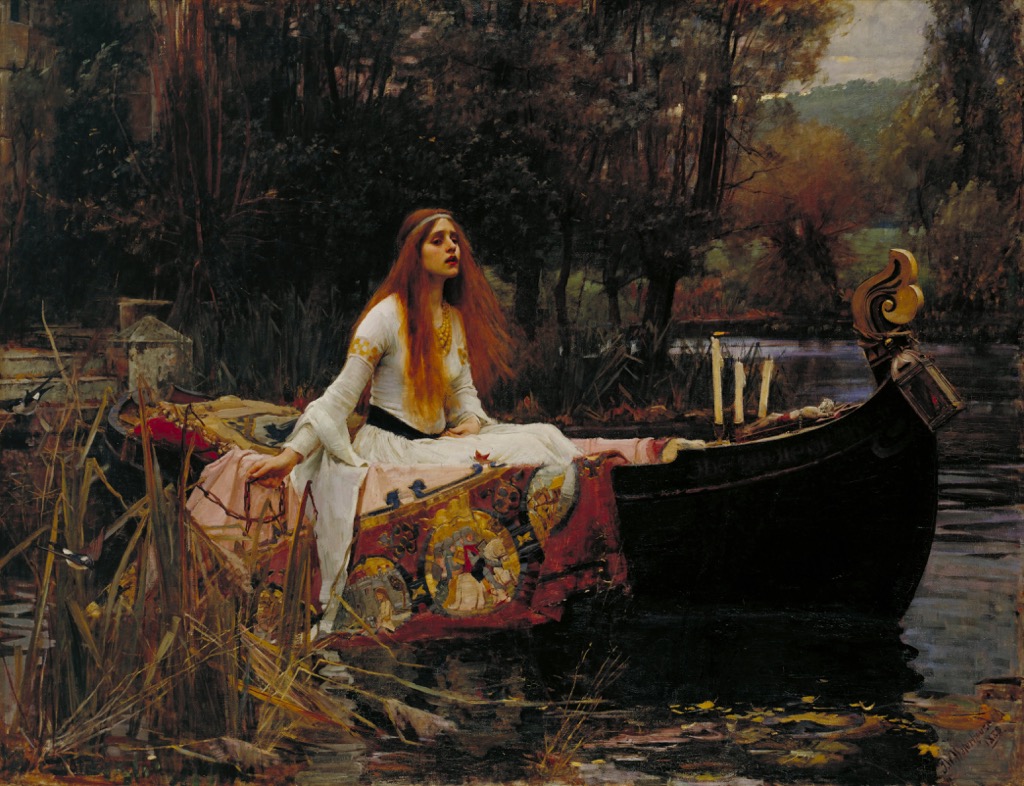
The year 1888 also produced Waterhouse's first Lady of Shalott, now among his most famous paintings. The juxtaposition reveals his range: one heroine drifts towards death within a broad English landscape, while another confronts the viewer from a compressed, luxurious interior.
Both works depend on literary recognition but choose different narrative strategies. The Lady of Shalott depicts an episode shaped by Tennyson's poem. Cleopatra functions more like a character portrait detached from one scene.
Waterhouse had been elected an Associate of the Royal Academy in 1885. [7] Cleopatra therefore belongs to a phase of increasing professional standing, not to an unknown apprentice period.
His earlier classical subjects had often used archaeological detail, anecdote and larger groups. Here the single female figure becomes sufficient to carry a historical world. That concentration anticipates many works of the 1890s and 1900s.
Yet it would be too neat to call 1888 a sudden conversion from classical to Pre-Raphaelite or literary art. Cleopatra is at once classical, Shakespearean, decorative and commercially commissioned. Waterhouse's development involved overlap.
The painting also shows his ability to answer an external brief without disappearing into it. Twenty-one artists could produce twenty-one heroines, but this queen remains recognisably Waterhouse's: richly surfaced, psychologically guarded and suspended before decisive action.
Her importance within his career lies partly in this economy. A few materials, one body and one look carry the drama that a more conventional history painting might distribute across an entire court.
Evidence, dating and responsible interpretation
The Folger dates the 1888 photogravure and identifies Waterhouse as the artist of the source painting. [1] Its portfolio records document the commission and publication context. [3] These are stronger foundations than unsourced online claims about multiple versions or present ownership.
The painting is often dated 1888, though some scholarly discussions describe it as painted about 1887. The safest wording is “painted in or by 1888 for the Graphic project,” with 1888 used as the standard display date.
Published dimensions vary by a centimetre or more. A Commons record gives 55.9 by 63.5 centimetres, while other secondary reproductions reverse or slightly alter values. [6] “Approximately 56 by 64 centimetres” communicates scale without false precision.
Current location should remain “private collection” unless a current authoritative owner record becomes available. Repeated internet assertions about a named collection are not enough.
The model is likewise unidentified in the sources used here. Facial resemblance does not document a sitter.
Interpretive claims should be signposted. Leopard skin, direct gaze and loose dress are observable. “Seductive,” “New Woman” and “resistant” are critical readings supported by composition and reception, not facts recorded on the canvas.
Finally, the work must be labelled as Shakespearean. Removing The Graphic Gallery from its story turns a purpose-built literary image into a generic portrait and loses the public of readers for whom it was designed.
Related Pages
- Juliet: Compare another late-Victorian literary woman built around gaze and dramatic context.
- The Missal: Compare Waterhouse’s close focus on reading, text and inward attention.
- A Roman Offering: Compare a compact classical subject with private-collection source limits.
Frequently Asked Questions
It represents Cleopatra as a character in Shakespeare's Antony and Cleopatra, ultimately derived from the historical Cleopatra VII. [1] [4] [5]
It is recorded as privately owned. [6]
Approximately 56 by 64 centimetres, though published secondary measurements vary slightly. [6]
The skin contributes luxury, animal energy and exoticising splendour. No source used here identifies it as one exact Shakespearean prop.
No. There is no asp-centred suicide scene. Waterhouse presents the living queen as a concentrated character image.
A reviewer in The Graphic praised the painting's “Oriental splendour,” a historically revealing phrase that should be read within Victorian attitudes towards Egypt and the East. [2]
Discussion
Waterhouse's Cleopatra succeeds because it refuses to settle into one category. It is an illustration commissioned for reproduction, yet it has the concentration of a formidable independent painting. It uses sensual display, yet makes being looked at uncomfortable. It evokes ancient Egypt, yet speaks most clearly about Shakespeare and late-Victorian visual culture.
The queen's direct gaze holds these tensions together. Gold, cloth and leopard skin may invite sensory pleasure, but her expression converts pleasure into encounter. She is not simply the object of the page. She seems to judge its reader.
Reader Insights
Which visible detail most changes the way you read this page?
Which source or comparison helps the work feel less familiar and more specific?
What question would you bring back to the painting after reading?
Join the Conversation
Share your reading of this page below.
References
- Image reference
- Folger Shakespeare Library, “Cleopatra, character in Shakespeare's play, Antony and Cleopatra,” catalogue record for the 1888 photogravure after Waterhouse. View source
- Georgianna Ziegler, Folger Shakespeare Library, “Shakespeare's Heroines Illustrated,” history and interpretation of The Graphic Gallery, including contemporary reception of Waterhouse's Cleopatra. View source
- Folger Shakespeare Library, Graphic Gallery of Shakespeare's Heroines, 1888 portfolio catalogue record, documenting 21 plates, publisher and accompanying letterpress. View source
- Folger Shakespeare Library, William Shakespeare, Antony and Cleopatra, complete text and scene summaries. View source
- The Metropolitan Museum of Art, “Egypt in the Ptolemaic Period,” historical overview of the dynasty through Cleopatra VII and the Roman takeover of 30 BCE. View source
- Wikimedia Commons, “Cleopatra — John William Waterhouse,” public-domain image record, standard date, medium, approximate dimensions and private-collection status. View source
- Royal Academy of Arts, “John William Waterhouse RA,” artist record and institutional chronology. View source