

 Buy Art Prints Now
from Amazon
* As an Amazon Associate I earn from qualifying purchases.
Image reference [image]
 by Tom Gurney
Tom Gurney BSc (Hons) is an art history expert with over 20 years experience
Published on August 14, 2026 / Updated on August 14, 2026
Email: tomgurney1@gmail.com / Phone: +44 7429 011000
A Roman Offering: Introduction
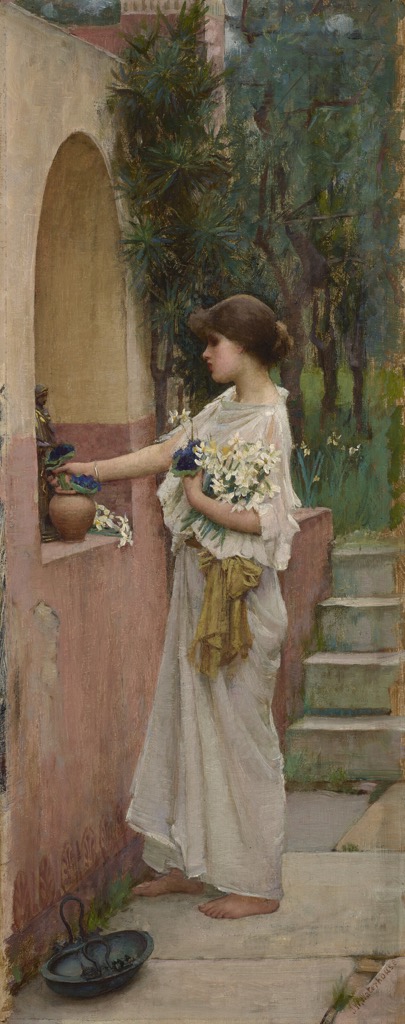
John William Waterhouse's A Roman Offering compresses a complete act of devotion into an exceptionally narrow canvas. A young woman in classical dress stands before a small shrine, raising flowers towards it with both hands. Nothing spectacular occurs. There is no public procession, no priest and no visible deity answering her gift. The painting's drama lies in the concentration required to make an ordinary object into an offering.
Painted about 1891, the work belongs to Waterhouse's Capri-inspired classical pictures and to a period when naturalist observation was changing his handling of antiquity. The Roman setting matters, but so do the model's physical balance, the weight of the flowers and the close vertical space. The result is neither an archaeological reconstruction nor a vague “classical maiden.” It is a carefully staged image of private ritual, poised between ancient subject matter and modern painting. [1]
At a Glance
- ArtistJohn William Waterhouse
- DateAbout 1891 [1]
- MediumOil on canvas [1]
- Dimensions49.9 × 20.3 cm (19 5/8 × 8 in.) [1]
- SignatureSigned “J.W.Waterhouse” at lower right [1]
- CollectionPrivate collection
- SubjectA young woman in Roman dress placing or presenting flowers at a small household shrine [1]
- Earlier sale titleArranging Flowers in 1965 [1]
- Related Waterhouse paintingThe Shrine, also known as At the Shrine, 1895 [1] [2]
- Recorded museum displayLong-term loan to the Legion of Honor, Fine Arts Museums of San Francisco, August 2008–January 2011 [1]
Contents
- Introduction
- What the painting shows
- Why the canvas is so narrow
- Flowers as an offering
- The Roman household shrine
- Capri, Italy and imagined antiquity
- Naturalism within a classical subject
- The model and the limits of identification
- Relation to The Shrine
- Title, provenance and changing interpretation
What the painting shows
A young woman stands in profile within a shallow architectural space. She faces a small shrine or niche and holds flowers upwards, as if placing them before a sacred image. Her long dress falls in a column, while the raised forearms, bowed head and projecting flowers gather the action near the upper part of the canvas.
The figure's pose is quiet but not passive. Her body must hold itself within the confined setting while her hands complete a precise task. The flowers are light, yet the offering has ceremonial weight. Waterhouse lets posture communicate that difference.
Architecture encloses the act. Uprights, ledges and the narrow edge of the picture turn the space into something between a corridor, a courtyard corner and a private devotional station. The viewer does not survey a grand Roman interior. We stand close enough to feel that the ritual belongs to one person.
The shrine is deliberately modest. It does not compete with the woman in scale or colour, and the deity is not developed as an independent character. Attention remains on the human action by which sacred presence is acknowledged.
Flowers provide the visible exchange between woman and shrine. They have been gathered elsewhere, carried into this space and lifted from everyday possession towards dedication. Their colour and irregular outlines interrupt the controlled vertical geometry around them.
Nothing proves that the scene records one identifiable ancient ceremony. Waterhouse's title gives the broad cultural setting and the nature of the act, not a date, household or named goddess. Responsible interpretation begins with what the canvas establishes: Roman dress, a domestic-scale shrine and a floral gift.
Why the canvas is so narrow
At just over twenty centimetres wide, A Roman Offering has a notably slender format. [1] Its proportions are not a minor catalogue fact. They determine how the subject works.
The standing body almost becomes the picture's central axis. There is little room for lateral movement, so the figure's turn towards the shrine reads as a decisive use of scarce space. Her gesture does not spread across a broad narrative field; it rises.
This vertical pressure encourages comparison between figure and architecture. The dress resembles a column, the body fits the architectural bay, and the uplifted flowers mark the point where those parallel structures become action. Waterhouse makes enclosure intensify concentration.
A wider canvas might have invited anecdote: other worshippers, a view of the house, a landscape or more decorative antiquities. The narrow one excludes these possibilities. It keeps the ritual singular.
The format also affects viewing distance. From afar, the composition can register as a tall harmony of warm and pale tones. Close inspection reveals the offering, face, hands and shrine. The viewer repeats the painting's movement from general setting to focused act.
Waterhouse often used spatial thresholds—doors, windows, garden walls and pools—to place a woman between zones. Here the picture itself becomes a threshold-like strip. The woman occupies the passage between human space and a sacred image without crossing into illusionistic depth.
The small scale should therefore not be mistaken for slight ambition. Its discipline is part of the idea. A private act requires neither panoramic history painting nor monumental rhetoric; it can gain force through compression.
Flowers as an offering
Flowers in Waterhouse's art can be gathered, worn, smelled, exchanged or allowed to drift on water. In A Roman Offering they are dedicated. That change of function transforms botanical beauty into ritual action.
The offering is valuable partly because it is perishable. Stone architecture may endure; cut flowers will not. Presenting them acknowledges a time beyond ordinary possession, even though the gift itself will fade. The picture does not need to state a theology for that contrast to register.
The woman's two-handed gesture implies care. She does not toss the flowers or hold them casually at her side. Their elevation separates the instant of giving from the practical acts of gathering and carrying that preceded it.
Waterhouse avoids the spectacular imagery of animal sacrifice or public festival. His choice makes Roman religion intimate and aesthetically gentle for a late-Victorian audience. Yet gentleness should not erase seriousness. Domestic ritual helped structure ancient household life, and offerings were modes of relationship, obligation and protection rather than decoration alone. [3] [4]
The floral subject may also have attracted collectors accustomed to pictures of women arranging blossoms. Indeed, the work appeared at auction in 1965 under the title Arranging Flowers. [1] That title describes visible activity but removes its destination. “Offering” makes the shrine essential; “arranging” could turn the same raised hands into domestic decoration.
This title history demonstrates how interpretation can pivot on one word. The painting itself supports the ritual reading through the shrine, costume and directed gesture. Flowers remain beautiful objects, but their beauty has been given a purpose.
The Roman household shrine
The shrine gives the painting its historical framework. In Roman domestic religion, household deities and protective spirits could be honoured at a lararium, a shrine located within the home. The Metropolitan Museum of Art describes the lar familiaris as a household deity concerned with the family's health and prosperity, and notes that such shrines could contain paired figures of Lares bearing vessels used in offerings. [3]
That background clarifies Waterhouse's choice without turning his painted structure into a diagram of one excavated lararium. The work does not provide enough detail to identify every sacred figure or implement. It offers a nineteenth-century evocation of domestic devotion.
The distinction between household ritual and temple spectacle is central. A small shrine lets religious action occur within everyday architecture. The woman need not become a public priestess. She can be a member of a household performing an ordinary observance.
Waterhouse's antiquity is often approached through beauty, costume and surface. Here the devotional act makes the imagined past behavioural. The woman does something that belongs to a pattern of obligation. Architecture, flowers and bodily discipline combine to suggest habit.
The museum record for a Roman Lar also explains why vessels and offerings matter: the figure carries a drinking horn and an offering dish, material signs of ritual exchange. [3] Waterhouse simplifies such apparatus and gives the flowers visual priority. This is artistic selection, not evidence that Romans worshipped only through floral gifts.
Nor should the woman be labelled a Vestal Virgin. Vestals served Vesta in a formal public priesthood; a female figure at a household shrine is not automatically one of them. Waterhouse's title remains deliberately general.
The most accurate description is therefore also the most useful: a young woman makes a floral offering at a small Roman household shrine. It respects both the catalogue evidence and the painting's restraint.
Capri, Italy and imagined antiquity
Christie's connects A Roman Offering with visits Waterhouse began making to Capri in 1888. [1] The island offered light, architecture, landscape and models through which British artists could approach an Italianate or classical world.
Capri should be understood as stimulus rather than certified location. The title says “Roman,” not “Capri,” and no surviving evidence makes this an exact portrait of an island building. Travel supplied visual experience that could be reorganised in the studio.
This matters because Waterhouse's classical paintings occupy several temporal layers. Ancient dress and ritual evoke Rome; Italian travel gives the architecture and light a modern observed basis; the finished canvas addresses British exhibition and collecting culture. None of those layers cancels the others.
The work's warmth would have offered northern viewers an imagined climate of stone, flowers and outdoor or semi-outdoor life. Christie's notes that such Italianate subjects appealed to British collectors living under less temperate skies. [1] That market context helps explain the picture's charm, but it does not exhaust its content.
Waterhouse was born in Rome to artist parents, although the family returned to Britain while he was young. It is tempting to read every Roman subject autobiographically, yet no cited statement makes A Roman Offering a memory of childhood. His later training, travel and competitive artistic environment provide firmer explanations.
The Capri connection also places this work before his most famous Arthurian and literary heroines. It shows that his interest in concentrated female figures did not begin with medieval legend. Classical genre, travel observation and intimate action helped form the visual language he would later develop.
Institutionally, this experiment belonged to an established Royal Academy career rather than a student's exercise: Waterhouse had been elected an Associate Royal Academician in 1885 and would become a full Academician in 1895. [5] The small canvas is exploratory in handling and focus, not marginal to his professional development.
Naturalism within a classical subject
Christie's describes A Roman Offering as a fusion of classical subject matter with the naturalist influence associated with Jules Bastien-Lepage and the English painter George Clausen. It points particularly to Waterhouse's use of a square brush and to a model who appears more English than Italian. [1]
That combination prevents the painting from behaving like a polished archaeological tableau. The setting and dress evoke antiquity, but the figure retains observed physical presence. Her action has balance, reach and weight.
Naturalism here does not mean documentary neutrality. Waterhouse still selects an attractive model, elegant costume, harmonious palette and legible ritual. The term is most useful for describing how close observation and painterly touch animate a constructed historical subject.
The brushwork matters because edges need not be equally finished. Flowers can flicker, fabric can break into planes and masonry can remain suggestive rather than mechanically described. Such variation directs the eye towards the act while preserving atmosphere.
The model's English appearance, noted in the catalogue essay, complicates a simplistic equation between physical type and historical setting. [1] Waterhouse did not need an ethnographic “Roman” face. He built the past from contemporary studio resources.
This is common to much historical painting: a modern sitter inhabits old costume and an invented environment. What makes the transformation persuasive is not racial or national authenticity but coherence among pose, light, objects and story.
The classical and naturalist elements therefore work together. Antiquity supplies distance and ritual meaning. Naturalism supplies immediacy. The viewer can recognise the scene as “Roman” while feeling that a real body is carefully lifting real flowers.
The model and the limits of identification
The identity of the sitter is not established by the principal catalogue record. [1] She should not be assigned a name merely because her features resemble figures elsewhere in Waterhouse's art.
Artists regularly reused models, and resemblance can be meaningful when discussing studio practice. It is not the same as documented identity. Hair, profile and expression may also change through costume, pose and the artist's preferred type.
The model's function in this painting is more than decorative. Her profile avoids direct eye contact, concentrating attention on the shrine. The viewer watches her focus instead of being addressed by her gaze.
Her dress creates the principal continuous shape. Its fall stabilises the composition, while exposed face and hands articulate intention. The body is both structural and expressive.
Calling her simply a “maiden” can make the scene sound generically poetic. “Young woman in Roman dress” is more exact. It distinguishes the living model, painted costume and ancient fiction without pretending that one can be separated entirely from the others.
It is also unwise to invent a personal crisis or prayer for her. The flowers and shrine demonstrate an offering; they do not reveal whether she asks for health, gives thanks, marks a festival or fulfils routine custom. Waterhouse creates psychological inwardness without supplying a transcript.
That uncertainty is productive. Because the purpose remains unstated, the gesture can represent devotion itself: attention directed beyond the self, made visible through a gift.
Relation to The Shrine
Christie's identifies the subject as one Waterhouse later repeated in a composition called At the Shrine. [1] The related painting is more commonly catalogued as The Shrine and dated 1895. [2]
The two works should not be merged. A Roman Offering is the narrow painting of about 1891 measuring 49.9 by 20.3 centimetres. The Shrine is a later, larger and differently organised composition. Shared subject does not mean shared object.
Comparison shows Waterhouse revisiting a visual problem rather than copying a finished answer. In each case a female figure approaches a sacred structure with flowers, but scale, setting, pose and spatial emphasis change.
The later work expands the relation between figure and architectural environment. A Roman Offering remains compressed, almost like a single upright panel extracted from a larger decorative scheme. Its intimacy is distinctive.
Waterhouse frequently returned to themes across years: the Lady of Shalott, Ophelia, flower gathering, mirrors, music and enchantment. Repetition allowed him to shift narrative emphasis while retaining recognisable motifs.
Here the recurring elements are raised flowers, profile attention and sacred architecture. They form a small vocabulary of devotion. In the earlier canvas, the vocabulary is reduced to its essentials.
Readers moving between the two pages should therefore be told exactly which painting is under discussion. The safest identifiers are date, dimensions and composition, not the fluctuating use of At the Shrine as an alternate title.
Title, provenance and changing interpretation
The recorded provenance begins publicly with a Christie's sale in London on 22 October 1965, where the picture appeared as Arranging Flowers. It was acquired there by Canston, returned to Christie's in 1995 and was then acquired by Ann and Gordon Getty. [1]
The 1965 title is historically relevant but descriptively incomplete. It demonstrates that titles can be lost, altered or modernised as works pass through collections and sale rooms.
The restored title A Roman Offering reconnects the flowers with ritual. It also differentiates the painting from countless genre scenes of floral arrangement. The shrine changes the verb from ordering to giving.
From August 2008 until January 2011 the painting was on long-term loan to the Legion of Honor, part of the Fine Arts Museums of San Francisco. [1] That display history gave a privately owned work a period of public visibility.
Private ownership means current location wording should remain cautious. A past owner's collection and a past museum loan are not automatically the present location. “Private collection” is safer unless a current authoritative record states more.
The provenance published by Christie's is also not a complete ownership history back to Waterhouse's studio. Absence of earlier entries should not be filled with imagined patrons. A transparent page distinguishes recorded chain from unknown interval.
This object history reinforces the painting's larger lesson: context changes visibility. Under one title, it is a woman arranging flowers; under another, a Roman devotional act. Careful cataloguing does not replace looking, but it helps the viewer see what the composition directs those flowers towards.
Why this small painting matters
A Roman Offering captures a transitional strength in Waterhouse's art. Classical setting remains important, yet the grand anecdote of early works has contracted into one absorbed figure. Naturalist handling and bodily observation make the ancient subject immediate.
The picture also demonstrates how scale can intensify meaning. Its narrow format excludes spectacle and makes the viewer attend to alignment: body, shrine, flowers and upward gesture.
Unlike Waterhouse's enchantresses, the woman does not direct power outward. Unlike his doomed literary heroines, she is not caught in a climactic narrative. Her significance comes from chosen attention.
That modesty suits the domestic shrine. Household worship belongs to repeated life rather than exceptional public drama. The painting's stillness can imply ritual habit without showing more than one instance.
Flowers unify sensory pleasure and ethical action. Their colour attracts the viewer, but their destination prevents them from becoming mere ornament. Beauty is something the figure gives away.
The work deserves to be read beside the later Shrine, Capri subjects and larger classical compositions, but it should retain its own identity. Its particular achievement is compression: a history painting reduced to the width of a standing body without losing cultural or emotional depth.
Related Pages
- The Shrine: Compare the later, larger shrine composition without confusing the two works.
- Saint Cecilia: Compare a quiet ritual figure in another Waterhouse devotional setting.
- The Charmer: Compare a compact late subject built around action, concentration and ambiguity.
Frequently Asked Questions
It is dated about 1891 in the Christie's catalogue. [1]
A young woman in Roman dress lifts flowers towards a small household shrine, presenting them as an offering. [1]
The oil on canvas measures 49.9 by 20.3 centimetres, making it unusually narrow. [1]
No secure source identifies her as a Vestal. The painting is better described as a woman making a domestic Roman offering.
No. A Roman Offering dates from about 1891; Waterhouse revisited a related subject in The Shrine of 1895. [1] [2]
That title was used when the painting was sold at Christie's in 1965. Later cataloguing identifies the sacred context and the work's established title. [1]
It is privately owned. It was displayed on long-term loan at the Legion of Honor in San Francisco from August 2008 to January 2011. [1]
The work is associated with Waterhouse's Capri-inspired subjects, and his visits began in 1888, but the catalogue does not identify the depicted architecture as one exact Capri location. [1]
Discussion
The enduring appeal of A Roman Offering comes from the balance between accessibility and uncertainty. The action is instantly legible: a woman gives flowers at a shrine. Yet the name of the deity, the purpose of the gift and the woman's identity remain unstated.
Waterhouse uses that gap intelligently. Instead of illustrating a famous myth, he makes ritual attention the subject. The narrow canvas, profile pose and uplifted flowers remove distractions until an ordinary gesture acquires gravity.
Reader Insights
Which visible detail most changes the way you read this page?
Which source or comparison helps the work feel less familiar and more specific?
What question would you bring back to the painting after reading?
Join the Conversation
Share your reading of this page below.
References
- Image reference
- Christie's, “John William Waterhouse, A Roman Offering,” object record, catalogue essay, provenance, literature and exhibition history. View source
- Wikimedia Commons, “John William Waterhouse — The Shrine,” public-domain image record for the related 1895 composition. View source
- The Metropolitan Museum of Art, “Bronze statuette of a Lar,” collection entry explaining the lar familiaris, lararium and offering vessels. View source
- The Metropolitan Museum of Art, Roman Art: A Resource for Educators, discussion of household guardian spirits, domestic shrines and offerings. View source
- Royal Academy of Arts, “John William Waterhouse RA,” artist record and institutional career. View source