

 by Tom Gurney
Tom Gurney BSc (Hons) is an art history expert with over 20 years experience
Published on August 14, 2026 / Updated on August 14, 2026
Email: tomgurney1@gmail.com / Phone: +44 7429 011000
The Danaïdes: Introduction
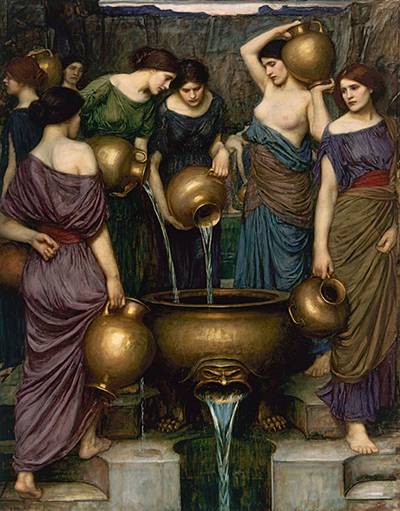
John William Waterhouse's earlier Danaïdes shows five women carrying water towards a vessel that can never be filled. Painted in 1903 or about 1904 and now privately owned, it is a finished composition in its own right, not merely a sketch for the larger seven-figure canvas in Aberdeen. [1] [2]
Some modern lists call this image The Danaïdes II, while others use “II” for the later painting. Numbering is therefore unsafe. This manuscript identifies the work by its five figures, private ownership and earlier date, keeping it separate from the 1906 Aberdeen Danaïdes already covered in manuscript 32. [2] [3]
At a Glance
- ArtistJohn William Waterhouse
- TitleThe Danaïdes / The Danaides [1]
- DateCommonly 1903; also catalogued as 1904 [1] [2]
- MediumOil on canvas [1]
- DimensionsApproximately 154.3 × 111 cm; another record gives 152.4 × 111.9 cm [1]
- CollectionPrivate collection [1]
- SubjectThe daughters of Danaus endlessly carrying water into a leaking vessel
- FiguresFive principal women, rather than seven in the 1906 Aberdeen version [2]
- Version controlDate, figure count and ownership are safer than the inconsistent label “II”
- StatusAn independent finished painting, not simply a preparatory study
Contents
- Introduction
- What the painting shows
- The Danaids' crime and coercion
- Water that cannot be retained
- Five women and a compact design
- Vessels, colour and repeated labour
- The earlier and later versions
- Why “Danaïdes II” is unreliable
- Beauty, guilt and punishment
- Date, dimensions and private ownership
What the painting shows
Five women descend or gather around a great vessel in a dark underworld setting. Each carries a jar or urn filled with water.
One or more figures pour while others approach, wait or prepare to empty their containers. Their different stages make a cycle visible within one still image.
The receiving vessel cannot retain what they pour. Water escapes, making every journey useless.
No god, judge or guard appears. The punishment operates automatically through impossible work.
Rock and shadow enclose the group. There is no open landscape or route towards ordinary life.
Waterhouse differentiates the women through posture and coloured drapery while joining them through repeated vessels, bent bodies and downward movement.
The five-figure group is more compact than the seven-woman procession painted later. Bodies overlap closely, making the labour feel concentrated.
The women do not appeal directly to the viewer. Their attention remains with the task, suggesting repetition so long established that protest has become futile.
Falling water is the composition's clearest movement. It briefly connects jar and basin, then proves the failure of connection.
The image begins after marriage, murder, judgement and death. Waterhouse selects the eternal consequence rather than the dramatic crime.
The Danaids' crime and coercion
The Danaids are the fifty daughters of Danaus. Apollodorus tells how the fifty sons of Danaus's brother Aegyptus pursued marriages with them after dynastic conflict and flight to Argos. [4]
Danaus agreed to the matches but secretly armed his daughters and ordered them to kill their husbands in bed. Forty-nine obeyed. [4]
The murders explain their later punishment, but the story is not a simple moral tale about violent wives.
Aeschylus's Suppliant Women centres the daughters' earlier terror and resistance to unwanted marriage. [5] They arrive at Argos as refugees asking protection from the sons of Aegyptus.
The myth therefore holds coercion at several levels: pursuit by cousins, forced marriage and a father's lethal command.
Hypermnestra, the one daughter who refuses to kill, spares Lynceus because he respects her wish to remain a virgin. [4]
Her exception shows that obedience to Danaus is not presented as moral innocence. Disobedience preserves life.
Waterhouse does not identify Hypermnestra among the punished group. Because she avoids the crime, she normally stands outside the water-carrying sentence.
The five painted women represent the guilty sisters collectively rather than literally accounting for all forty-nine.
Their beauty can encourage sympathy, but interpretation should retain both their victimisation and their violence.
The painting omits the men who shaped the crisis. That absence makes punishment visually absolute while concealing the network of paternal and marital power behind it.
Water that cannot be retained
The Danaids' familiar sentence is endless water-carrying into a pierced, leaking or bottomless container.
The motif became attached to them over time rather than appearing identically in every early Greek source. [6]
Plato's Gorgias, for example, describes uninitiated souls attempting to fill a leaking jar with sieves; it does not name those workers as Danaids. [6]
Roman poetry makes the association explicit. Horace describes the daughters' crime and water escaping through the bottom of their vessel. [7]
Waterhouse inherits the mature proverbial form. His audience could understand futility without knowing the myth's entire transmission history.
The punishment attacks purpose more than flesh. The women remain capable of effort, but effort cannot accumulate into completion.
Each successful pour is also a failure. Water reaches its destination and immediately leaves it.
This makes the Danaids comparable with Sisyphus, whose stone returns down the slope after every ascent.
The vessel can also suggest impossible purification. Water might wash away guilt, but no quantity is sufficient and no final cleansing occurs.
Waterhouse gives the water beauty—bright streams against dark rock—which makes the sentence visually seductive.
The viewer can enjoy a pattern that the women must endure. That ethical mismatch is part of the painting's power.
Five women and a compact design
The earlier version contains five principal figures, compared with seven in Aberdeen's 1906 canvas. [2] [3]
Five is not a literal fraction of the myth's forty-nine guilty daughters. It is a compositional number.
The group is arranged tightly enough for bodies, jars and streams to form one interlocking mechanism.
One figure's curve continues into another's vessel; a bent shoulder answers a tipped urn; lines of water lead sight downward.
The compactness gives the earlier painting a unity that Anthony Hobson and later commentary have contrasted with the imposing procession of the second version. [2]
That judgement should remain attributed. “More harmonious” and “more imposing” describe critical preferences, not objective ranks.
The five women allow closer attention to individual poses. The seven-figure work places greater emphasis on number, procession and collective burden.
No figure becomes a single heroine. Even the most prominent woman remains one stage in a repeated action.
Waterhouse therefore balances individuality and system. Faces and garments differ, but every body is governed by the same impossible task.
The tall canvas reinforces descent. Viewers follow jars and figures from upper space towards the receiving vessel.
Confinement increases because the group nearly fills the available width. There is motion but no escape route.
Vessels, colour and repeated labour
The jars are more than archaeological props. They are extensions of the women's bodies and instruments of punishment.
Rounded forms repeat shoulders, heads and the great basin. Handles create loops that the eye follows from one figure to another.
Metallic or earthen surfaces catch light differently from skin and cloth, enriching the scene while emphasising weight.
Draperies in muted blues, reds, greens and mauves separate the women within the dark setting.
Water supplies the palest moving accents. Each stream is momentary in life but permanently suspended by paint.
This paradox suits the myth: temporary actions repeat eternally.
The figures bend under physical weight, yet Waterhouse avoids grotesque strain. Their controlled movements suggest long habituation.
Beauty does not relieve the sentence. It makes viewers return visually to a cycle from which the subjects cannot depart.
The vessels may look ceremonial, recalling offerings or ritual purification. In the underworld they have lost any sacred completion.
Labour is feminised through water-carrying, an activity historically associated with domestic necessity. Myth turns ordinary service into cosmic penalty.
The painting can therefore be read beside Waterhouse's Penelope: both subjects repeat gendered work, but Penelope uses repetition strategically while the Danaids are denied purpose.
The earlier and later versions
Waterhouse returned to the Danaid subject in the 1906 canvas now owned by Aberdeen Art Gallery & Museums. [3]
The Aberdeen work measures 162.5 × 127.4 cm and presents seven figures. It was exhibited at the Royal Academy in 1906 and acquired by Aberdeen in 1927. [3]
The earlier private canvas is slightly smaller and contains five figures. [1] [2]
It should not be called a mere study. Its scale, finish and independent ownership support its status as a completed painting.
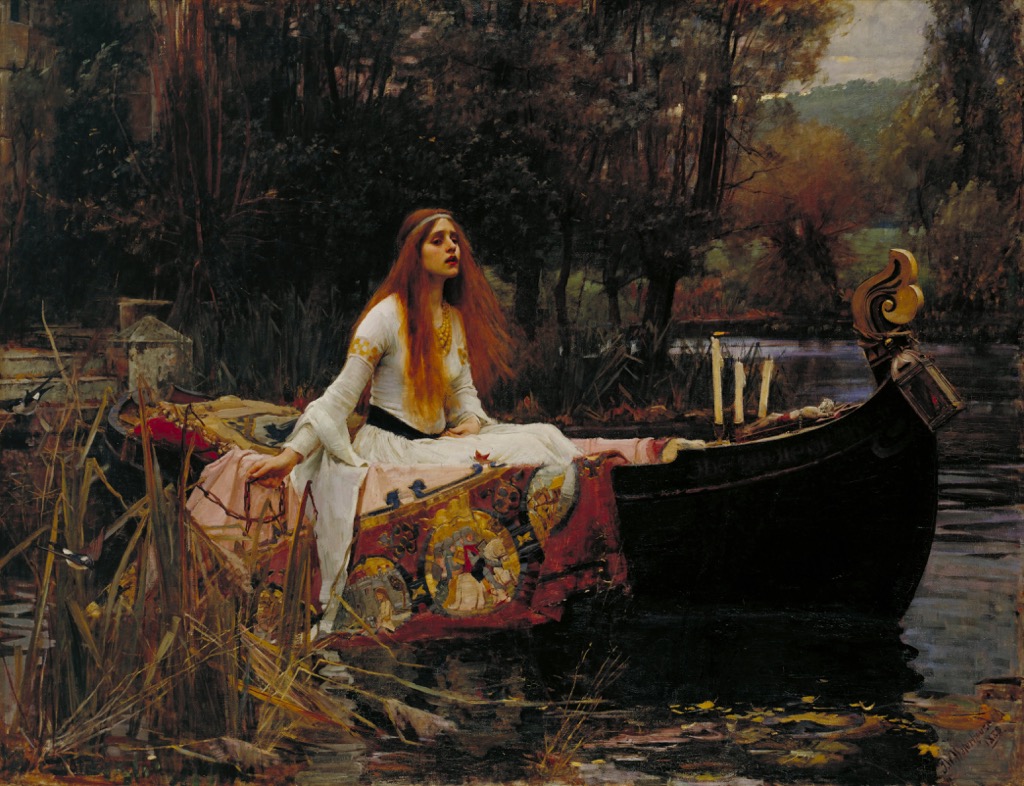
Waterhouse often revised subjects through new compositions: Lady of Shalott, Ophelia, Lamia and Circe all received multiple treatments.
Repetition did not mean copying. In the Danaid pair, he changes the number and spatial rhythm while retaining the central action.
The later work makes endlessness visible through a larger procession. The earlier one concentrates the cycle within a denser group.
Both deserve individual pages because their visual arguments differ.
The earlier manuscript should link to the 1906 Aberdeen manuscript rather than reproduce its museum facts as if they belonged here.
Conversely, images of the five-figure painting should not carry Aberdeen's accession number, dimensions or acquisition history.
Version control is therefore an editorial requirement, not a minor caption issue.
Why “Danaïdes II” is unreliable
Websites and image lists use Roman numerals inconsistently. Some call the later 1906 painting Danaïdes II because it follows the earlier version chronologically.
Others attach “II” to the private image as a navigation label or distinguish files without explaining the sequence.
The artist's documented title for either work does not require a numeral in the current sources.
Using “II” alone can therefore send readers to the wrong composition.
The safest identifiers are:
- earlier five-figure version, 1903 or 1904, private collection;
- later seven-figure version, 1906, Aberdeen Art Gallery & Museums.
This manuscript uses the first formula. The requested “Danaïdes II” phrase can appear in search metadata as an alternate online label, but not as the only public identity.
The date itself needs qualification. Wikimedia records 1903, while scholarly and museum-adjacent comparison often calls the earlier version 1904. [1] [2]
Rather than silently choosing, the page should publish “1903 (also catalogued 1904).”
Small dimensional discrepancies—154.3 × 111 cm versus 152.4 × 111.9 cm—should likewise be disclosed as source variation. [1]
Transparent uncertainty prevents false precision and lets future catalogue research update the object cleanly.
Beauty, guilt and punishment
Waterhouse's Danaids are beautiful, richly draped and absorbed. Their punishment is not represented through bodily disfigurement.
This can humanise the condemned women, but it can also aestheticise suffering.
Viewers are invited to linger over colour, skin, vessels and flowing water while the title explains that the action is torment.
The contradiction is ethically productive. Pleasure in the painting echoes the mechanism of punishment: the eye begins the pattern again.
The women's guilt is real within the myth, but it is complicated by coercive marriage and paternal orders.
Ancient and modern readers can disagree about responsibility without making the image morally empty.
Waterhouse removes knives, husbands and severed heads. The result is less sensational but also less explanatory.
Punishment appears as a self-contained natural order rather than a verdict that might be questioned.
Modern interpretation should restore the preceding violence while refusing to romanticise murder.
Hypermnestra's absence remains important. The woman who chose differently is not trapped within the painted system.
The group consequently represents both collective responsibility and the erasure of individual circumstances by punishment.
Date, dimensions and private ownership
The painting is privately owned, limiting access to current conservation, provenance and exhibition information. [1]
Wikimedia's object record dates it 1903 and gives dimensions of 154.3 × 111 cm, while its caption notes an alternative 1904 date and 152.4 × 111.9 cm. [1]
These discrepancies may reflect rounding, catalogue transmission or competing source traditions.
Without a current owner catalogue, the manuscript should not invent an exact location or continuous provenance.
Private status does not mean the work was never exhibited, but no firm first exhibition should be claimed from the sources used here.
High-resolution reproduction establishes the five-figure composition but cannot replace direct technical examination.
Colour, cropping and apparent finish can vary online.
The object should also not inherit the 1906 painting's Royal Academy record. That documented exhibition belongs to Aberdeen's version. [3]
The earlier work's importance rests on the image and its chronological relation to the later canvas even where its market history remains incomplete.
Place in Waterhouse's mythological art
The earlier Danaïdes belongs to Waterhouse's mature return to Greek and Roman myth around the turn of the century.
Near it chronologically are Echo and Narcissus, Psyche Opening the Golden Box and the first Lamia.
These works focus on psychologically charged actions rather than panoramic epic.
The Danaids are unusual because no single protagonist dominates. Group rhythm carries meaning.
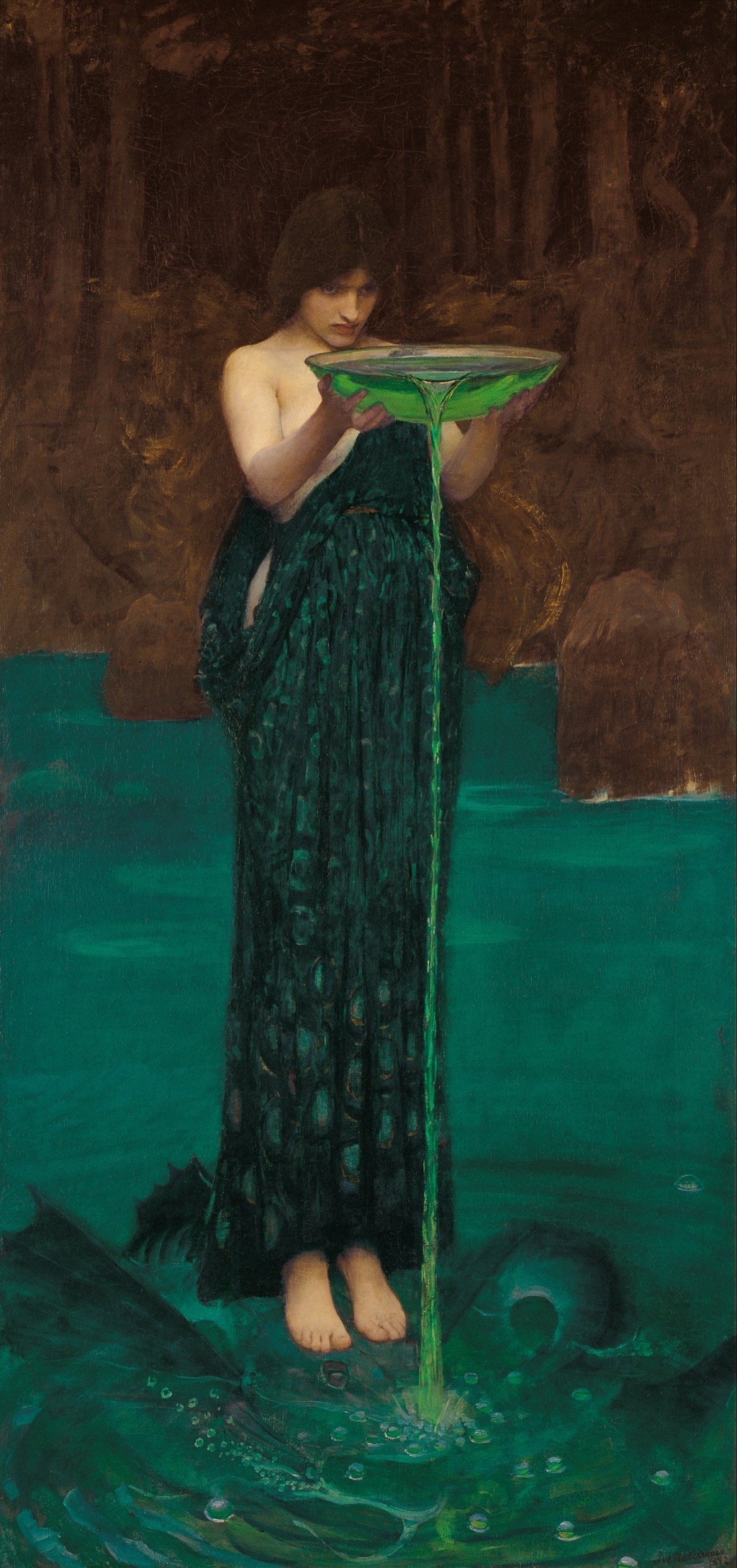
They also differ from Waterhouse's enchantresses. Circe and Medea exercise specialised power; the Danaids have lost agency within punishment.
Yet the story behind them contains decisive female violence and resistance to marriage, preventing simple victimhood.
Waterhouse turns that moral complexity into a visual system of work without outcome.
The later revision confirms that he considered the solution important enough to enlarge and rethink.
The five-figure canvas therefore belongs in the catalogue as an independent mature painting and as the first half of a revealing compositional dialogue.
Underworld space and the absence of time
Waterhouse does not map Hades through named rivers, judges or regions. Rock, darkness and the receiving vessel are sufficient to remove the women from ordinary geography.
This economy universalises the punishment. A viewer need not identify Tartarus to understand bodies confined to labour whose product disappears.
The lack of sky is especially important. Day cannot pass into night, and weather cannot mark a new season. Light belongs to bodies, vessels and water rather than a visible sun.
Time is represented only through stages of work. One woman arrives, another tips a jar and another has nearly completed a pour. The composition supplies sequence but denies historical progress.
That distinction separates repetition from stillness. The Danaids are not frozen; they are intensely active. Their tragedy is that movement never becomes change.
Rock also makes the water strange. In ordinary landscape, flowing water joins a larger cycle of rain, river and sea. Here it escapes the vessel without nourishing anything.
The underworld converts a life-giving substance into proof of waste.
No visible authority needs to renew the sentence. The environment and equipment embody judgement, making punishment appear natural even though it originates in moral tradition.
Modern viewers can question that naturalisation. Once coercive marriages and Danaus's order are restored to the story, the absence of judges prevents the picture from showing who decided the sisters deserve eternity.
The elegant enclosure is therefore politically as well as formally effective: it hides the institution that makes labour compulsory.
Comparing individual figures
Close looking should resist treating the five women as identical. Their relation to the vessel gives each a different temporal position.
A figure still carrying a full jar bears expectation without any rational hope. A pouring figure witnesses immediate loss. A woman with an emptied vessel confronts the need to begin again.
These differences let one cycle appear simultaneously. The painting works almost like consecutive frames compressed into a single group.
Posture also distributes emotion. A lowered head can suggest concentration, shame or exhaustion; an upright figure may look newly arrived but not newly condemned.
Because expressions are restrained, the manuscript should avoid assigning a precise feeling to each sister. Body angle and task stage are more secure than psychological labels.
Colour preserves distinction without liberating anyone. One drapery may be blue and another warm red, but all colours feed the same downward rhythm.
The women are thus individual enough to command empathy and similar enough to represent a collective sentence.
That balance would shift in the seven-figure canvas. Added bodies lengthen the procession and make the system more visible than any one participant.
In the earlier composition, the spectator can still move between five separate experiences of the same futility.
Why the subject remains modern
The Danaids have become an enduring image for work that cannot be completed: administrative repetition, domestic tasks undone as soon as performed and systems that consume effort without improvement.
Such analogies should not erase the myth's specific violence. They explain why its structure remains recognisable.
Waterhouse avoids comic absurdity. The women and their labour retain gravity, making futility tragic rather than merely inefficient.
The subject also asks whether punishment can become disproportionate. Forty-nine murders are grave, but eternity removes any possibility of repentance, learning or release.
Hypermnestra's exception keeps moral choice visible outside the image. She interrupts both paternal command and collective pattern.
The painted sisters cannot make another such choice. Their work contains no decision, only recurrence.
For a modern page, this is the strongest reason to keep the early version distinct. Its five bodies make the conversion from persons into mechanism especially close and legible.
The canvas is not simply a preliminary step towards Aberdeen. It is a different meditation on how a group loses time, purpose and individuality.
Related Pages
- The Lady of Shalott: Compare Waterhouse's best-known literary composition.
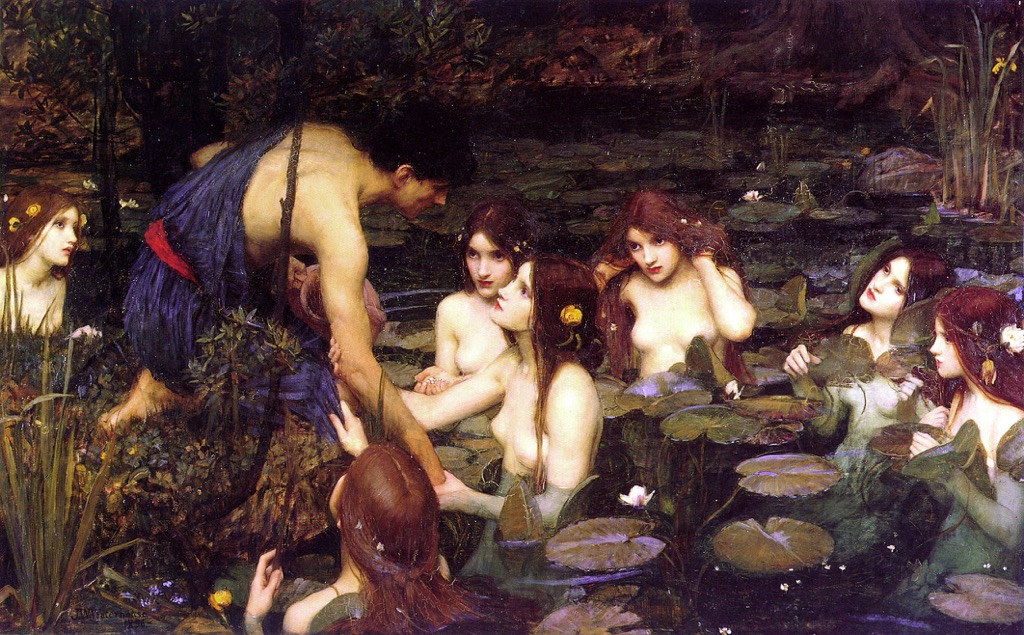
- Hylas and the Nymphs: Compare another major mythological scene.
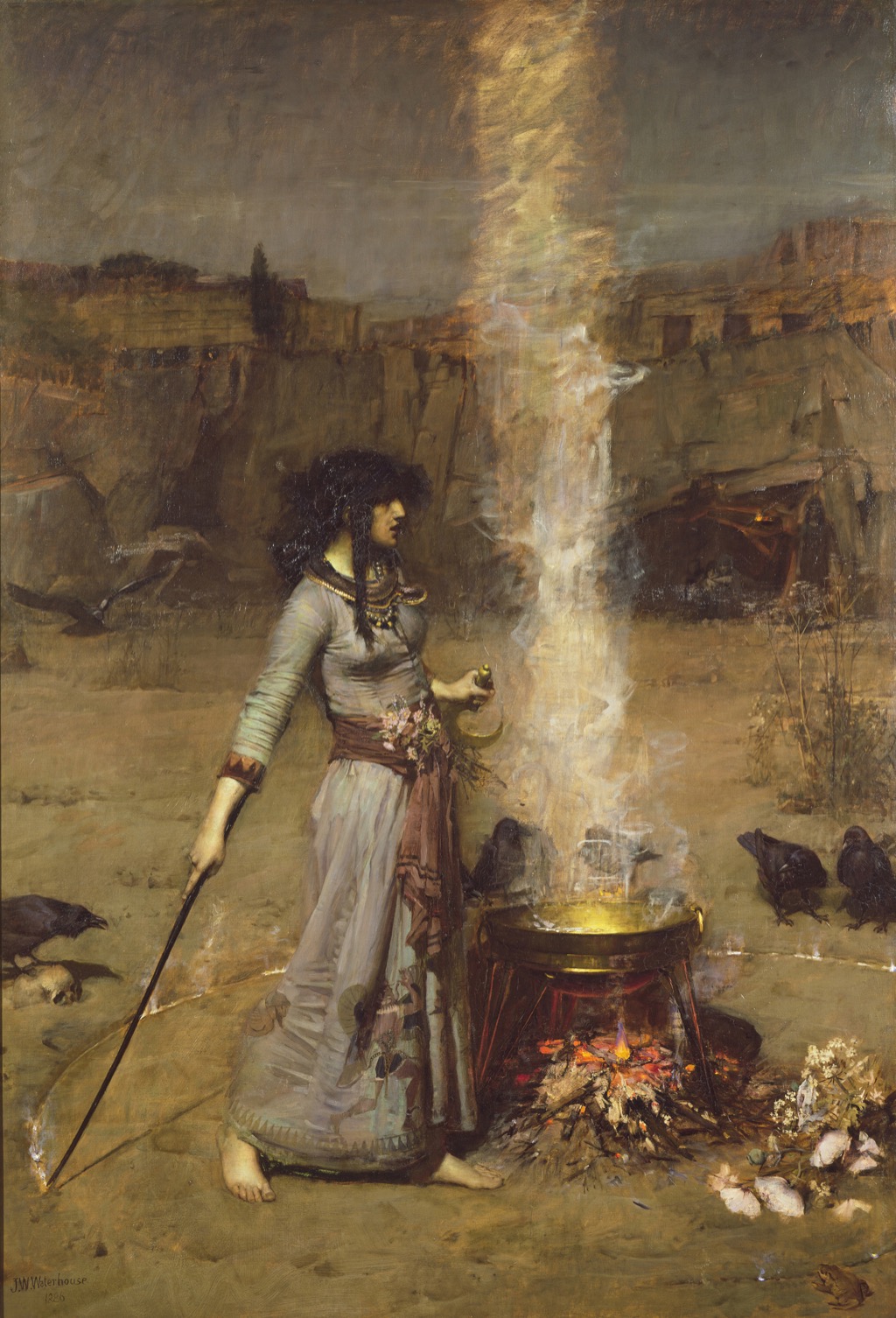
- The Magic Circle: Compare Waterhouse's treatment of ritual and symbolism.
Frequently Asked Questions
No. This is the earlier five-figure painting in private ownership. Aberdeen owns the seven-figure version dated 1906. [3]
Modern sites use numerals inconsistently. Date, figure count and ownership are more reliable identifiers than “II.”
No. It is a large finished oil and should be treated as an independent composition, even though Waterhouse later revised the subject.
They perform an endless underworld punishment: carrying water into a vessel that leaks or cannot be filled. [6] [7]
Forty-nine. Hypermnestra spared her husband Lynceus and escaped the collective guilt. [4]
Discussion
The five-figure Danaïdes makes futility intimate. A smaller group lets viewers track individual bodies, yet overlapping jars and streams absorb each woman into the sentence.
Comparison with Aberdeen's later canvas shows how number changes meaning. Seven women imply a longer procession; five create a tighter mechanism. Neither can literally represent forty-nine, so each solves myth through rhythm rather than census.
Reader Insights
Which visible detail most changes the way you read this page?
Which source or comparison helps the work feel less familiar and more specific?
What question would you bring back to the painting after reading?
Join the Conversation
Share your reading of this page below.
References
- Wikimedia Commons, “John William Waterhouse: The Danaides,” record for the earlier private version, including competing 1903/1904 dates and dimensions. View source.
- Jacqueline Banerjee, “The Danaïdes,” The Victorian Web, comparison of Waterhouse's earlier five-figure and later seven-figure paintings. View source.
- Aberdeen Art Gallery & Museums, “The Danaides,” object ABDAG003402, record for the separate 1906 seven-figure canvas. View source.
- Apollodorus, Library, Book 2, chapter 1, section 5, translated by James George Frazer, Perseus Digital Library. View source.
- Aeschylus, Suppliant Women, translated by Herbert Weir Smyth, Perseus Digital Library. View source.
- Alan H. Sommerstein, ed., Aeschylus: Suppliants, Cambridge Greek and Latin Classics, introduction on the development of the water-carrying punishment. View source.
- Horace, Odes, Book 3, Ode 11, translated by C. Smart, Wikisource. View source.