

 by Tom Gurney
Tom Gurney BSc (Hons) is an art history expert with over 20 years experience
Published on August 14, 2026 / Updated on August 14, 2026
Email: tomgurney1@gmail.com / Phone: +44 7429 011000
Miranda – The Tempest: Introduction
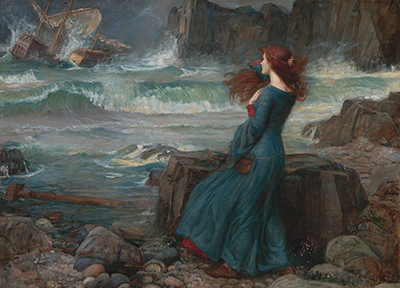
A young woman stands on a rock above a sea that seems to be breaking apart. Wind drives her dress and hair across her body; waves rise against black rocks; a ship heels so sharply in the distance that survival appears impossible. John William Waterhouse's Miranda – The Tempest makes the opening disaster of Shakespeare's play immediate, but its true subject is compassion. Miranda cannot yet know who is aboard. She responds to suffering before identity, love or political history can tell her what to feel.
Painted and exhibited in 1916, the canvas belongs to the final year in which Waterhouse showed work at the Royal Academy during his lifetime. It also returns to a Shakespearean heroine he had first painted more than forty years earlier. Between the calm early Miranda and this storm-driven late version lies almost the whole of Waterhouse's career.
At a Glance
- ArtistJohn William Waterhouse (1849–1917)
- TitleMiranda – The Tempest
- Date1916 [1] [2]
- MediumOil on canvas [1] [2]
- Dimensions100.4 × 137.8 cm [1] [2]
- CollectionPrivate collection; documented through its auction and exhibition history [1] [2]
- Signed and dated“J.W. Waterhouse / 1916” [1]
- First exhibitedRoyal Academy, London, 1916, no. 52 [1] [2]
- Also exhibitedWalker Art Gallery Autumn Exhibition, Liverpool, 1916, no. 258 [1] [2]
- Literary sourceWilliam Shakespeare's The Tempest, Act 1, Scene 2 [1] [3]
- Narrative momentMiranda watches the storm raised by Prospero and believes that the ship and its people are being destroyed [1] [3]
- Important distinctionProspero and Ariel have arranged the apparent wreck, but no one aboard is killed; Miranda does not yet know this when she reacts [3] [4]
Contents
- Introduction
- The Storm Seen through Miranda
- The Opening of Shakespeare's Tempest
- Compassion before Recognition
- Wind, Water and the Listing Ship
- Miranda's Body and Hidden Expression
- A Shipwreck That Repeats Miranda's History
- From the Early Miranda to the Late Painting
- The Royal Academy in 1916
- How to Look at the Painting
The Storm Seen through Miranda
The ship is distant, but its danger governs every part of the painting. Its masts and hull tilt against the horizon while the sea between vessel and shore becomes a field of broken movement. Waterhouse does not give viewers the deck-level confusion with which Shakespeare opens The Tempest. He positions us on the island beside the person who watches from safety and cannot bear what she sees.
Miranda stands close to the foreground, yet she is not turned towards us. Her attention travels across the water, and ours follows it. The body provides the nearest and largest form; the ship supplies the narrative cause. This long diagonal exchange lets Waterhouse bind human sympathy to an event that remains physically remote.
The composition depends upon unequal knowledge. Miranda believes that a “brave vessel” has been dashed to pieces and that the people aboard are perishing. Prospero knows that his magic has protected them. The audience of Shakespeare's play quickly receives the same assurance, but the painting preserves the interval before reassurance. [3]
Waterhouse therefore illustrates an appearance rather than an actual fatal shipwreck. The danger is staged within the story, yet Miranda's distress is real. This difference matters. Calling the scene merely an illusion would diminish the moral force of her response; calling it an actual massacre would misstate the play.
Her father is absent from the canvas. So is Ariel, the spirit who carries out the storm. Waterhouse removes the agents and shows the witness. Magic becomes visible through its effects—wind, water, wreck and fear—rather than through a wand or supernatural body.
The choice makes Miranda the painting's moral centre. Prospero begins the action because the ship carries people connected with his exile. Miranda has no wish for revenge. She sees only vulnerable lives.
The Opening of Shakespeare's Tempest
Shakespeare probably wrote The Tempest in late 1610 or early 1611. Its first recorded court performance took place on 1 November 1611, and the play was first printed in the 1623 First Folio. [5]
The drama opens aboard a ship caught in a violent storm. Sailors struggle to save the vessel while nobles obstruct them and ordinary hierarchies begin to collapse. The ship appears to split, leaving the audience uncertain about its passengers as the setting changes to Prospero's island. [3]
In Act 1, Scene 2, Miranda asks her father to stop the storm if his art has caused it. She says that she has suffered with the people she watched suffer and imagines the noble creatures aboard the vessel destroyed. Prospero tells her that no harm has been done. [3]
He then explains the history she cannot remember. Twelve years earlier, Prospero was Duke of Milan. Absorbed in study, he entrusted government to his brother Antonio, who usurped the dukedom with the support of Alonso, King of Naples. Prospero and the infant Miranda were put to sea in an inadequate boat but reached the island alive. [4]
The new ship carries Antonio, Alonso, Alonso's son Ferdinand and others. Prospero has caused the tempest to bring his enemies within his control. Ariel later reports that every person is safe and that the passengers have been dispersed around the island. [3] [4]
Ferdinand is led towards Miranda, and the two fall in love. Prospero tests the young man before accepting their union. By the end of the comedy, Ferdinand and Miranda's marriage helps reconcile Naples and Milan, Prospero forgives his enemies, renounces his magic and prepares to return home. [4]
Waterhouse selects the moment before any of those outcomes can soften the spectacle. The distant ship contains Miranda's future husband, her father's betrayers and the route by which she will leave the island. To the Miranda shown here, it contains only unknown people in mortal danger.
Compassion before Recognition
Miranda's first response establishes her character. She does not ask whether the ship carries friends or enemies. She has lived apart from ordinary society and cannot identify its passengers, yet distance has not reduced her capacity to imagine their pain.
This is compassion in its strictest sense: she suffers with those she sees suffering. Shakespeare's language makes that shared feeling explicit, and Waterhouse gives it a bodily form. [3]
Her hand rises towards her chest, where alarm seems to press inward. Her body leans into the weather rather than retreating from it. Although the storm cannot physically reach the ship through her, posture makes sympathy an effort.
Waterhouse does not paint the later meeting with Ferdinand, which would allow romance to explain her concern. The ship carries him, but she has not seen him. Her distress comes first.
That sequence protects Miranda from becoming simply a prize in Prospero's political restoration. She possesses an ethical imagination before she enters the marriage plot. The painting concentrates on the moment when her judgement differs from her father's: his storm is strategic; to her, suffering cannot be a tool.
Prospero's assurance that no harm has been done resolves the immediate factual fear but not the moral question. He has still made terror part of his design. Miranda's protest tests the human cost of power even when that power stops short of killing.
Waterhouse's absence of Prospero sharpens the difference. No magician appears to explain, control or reassure. We share Miranda's restricted viewpoint and must look at apparent destruction before the comedy supplies its safety net.
It is tempting to treat the painting as a portrait of helplessness, but Miranda's response is not useless. Within the play, her plea forces Prospero to account for what he has done and begins the long narration through which she learns her history. Emotion becomes an insistence upon knowledge.
The picture can consequently be read as an image of moral sight. Miranda cannot change the sea, but she refuses the emotional distance between shore and ship.
Wind, Water and the Listing Ship
Waterhouse constructs the storm from opposing forces. The shore rises in hard, jagged forms while water breaks into foam. The ship tilts across the more stable line of the horizon. Miranda stands upright enough to resist collapse, but fabric and hair reveal the pressure acting upon her.
The vessel is small in scale yet emphatic in angle. A level ship could be absorbed into the seascape; this one appears to be losing its proper relation to the world. Its listing form converts distance into emergency.
Rocks make the water dangerous twice over. The sea is violent in itself, and the coastline threatens impact. Christie's describes the late composition through its listing ship, thundering waves and threatening rocks, in contrast to Waterhouse's much calmer early treatment of Miranda. [1]
Foam interrupts the darker water, creating repeated flashes that lead the eye outward. The waves do not form a single wall. They arrive as broken, competing surfaces, so the viewer cannot find a visually secure route between Miranda and the ship.
Her blue and violet clothing belongs to the storm's colour world. Rather than isolating the heroine in a bright, untouched costume, Waterhouse lets sea, sky, fabric and shadow circulate through related tones. She is distinct from the tempest but not decoratively protected from it.
The hair provides warmer colour and freer movement. Wind lifts and draws it away from the head, making air visible where paint cannot literally represent it. The same force acts upon the heavy folds of her dress, but the two materials respond differently: hair streams; fabric twists and weighs.
This attention to bodily weather links Miranda with several of Waterhouse's solitary women. Yet the storm is not merely a decorative setting for beauty. It explains pose, conceals the face and creates the distance Miranda's sympathy tries to cross.
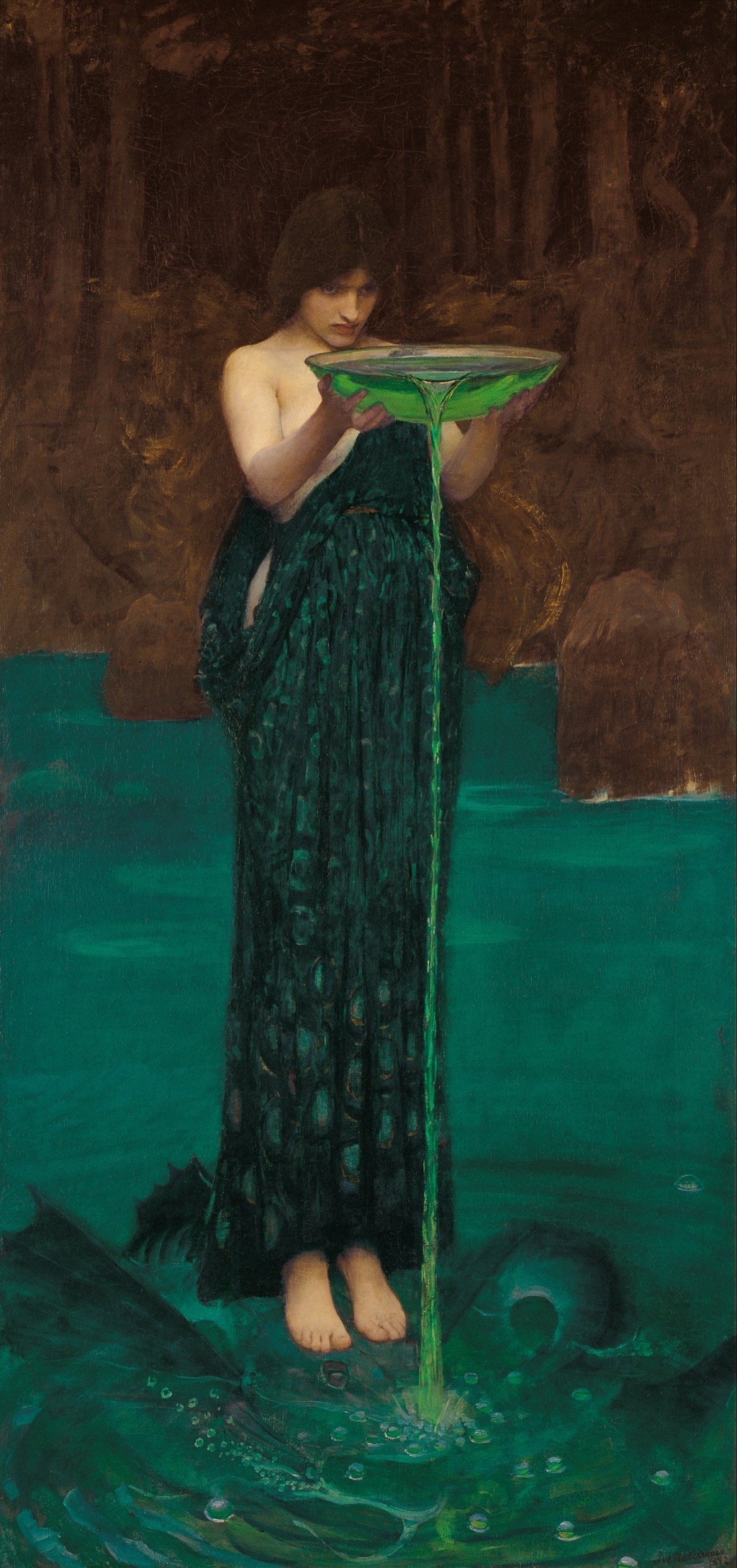
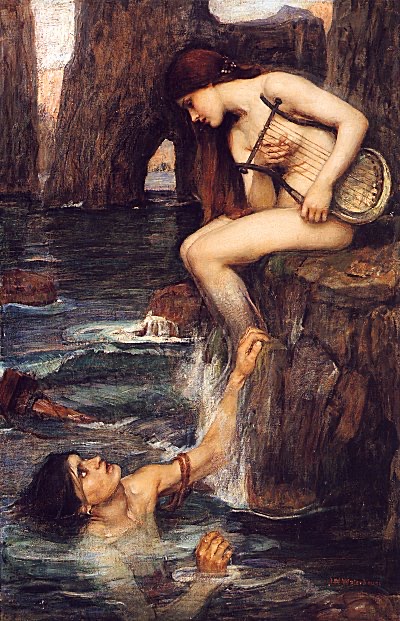
The seascape also recalls Waterhouse's long interest in dangerous water. Christie's connects its visual vocabulary with A Mermaid and The Siren, works developed around 1900. [1] Here, however, the supernatural female figure does not inhabit or cause the danger. Miranda stands against the violence and wishes it undone.
Miranda's Body and Hidden Expression
Miranda is shown from behind and in partial profile. We see enough of her face to recognise concentration but not enough to fix a theatrical expression.
This withholding has practical and psychological effects. Wind drives hair across the head, and the body faces the event that matters. At the same time, the hidden expression asks viewers to infer emotion from shoulder, hand and stance.
One hand is pressed or lifted towards her breast. The gesture answers Shakespeare's language of the heart and makes the ship's distant danger feel physically lodged in her. [2] [3]
Her other arm hangs lower within the mass of fabric. The asymmetry prevents the pose from becoming a balanced emblem. She looks caught in a transition between watching, recoiling and moving forward.
The back is not passive. Its curve and the turn of the shoulders record effort against wind. Her weight appears directed towards the shore's edge while the dress pulls in other directions.
Waterhouse places her close enough that viewers almost share the rock, yet the turned figure blocks easy intimacy. We cannot exchange glances with Miranda. We must look with her.
The decision also resists a conventional display of the beautiful heroine's face. Although the auburn hair and sweeping dress retain Waterhouse's familiar sensuousness, narrative attention remains attached to an unseen object of concern.
Her clothing does not establish a precise historical period. The flowing dress supports the imagined island setting and makes the wind legible, but it should not be treated as an archaeological reconstruction of Mediterranean or Jacobean costume.
The body functions as the painting's most sensitive instrument. Sea and sky show weather at large; Miranda shows what it feels like.
A Shipwreck That Repeats Miranda's History
The storm has a personal structure that Miranda does not initially understand. Before she could remember, she and Prospero were also placed in a vessel and exposed to the sea. [3] [4]
Prospero's enemies did not openly execute them. They set father and child adrift in what the play presents as an act of political removal, leaving chance and water to complete the violence. Gonzalo secretly supplied food, clothing and books, allowing them to survive. [3]
Now Prospero brings those enemies to his island by making their ship appear doomed. The apparent wreck reverses the direction of power. The former castaways stand on land; the people who expelled them become helpless at sea.
Miranda's compassion interrupts this symmetry. She cannot remember the original voyage as experience, and she does not yet know that the current passengers include those responsible. Her response refuses inherited vengeance before she even learns its cause.
Waterhouse does not narrate the earlier boat, but it deepens the image. The shore is more than a safe viewing platform. It is the end point of Miranda's first involuntary voyage and the beginning of the events that will carry her home.
Ferdinand makes the reversal more complex. He appears to be swallowed by the sea but will become the means of political and emotional renewal. The ship is simultaneously an instrument of Prospero's revenge and the vehicle of Miranda's future.
This knowledge belongs to readers and audiences, not to the painted woman. The picture becomes poignant because so much of her life is contained in the object she sees only as catastrophe.
Waterhouse preserves that dramatic irony. He does not add a visible Ferdinand or a sign that guarantees rescue. Hope exists outside the image, in the continuing play.
From the Early Miranda to the Late Painting
Waterhouse first exhibited a painting of Miranda at the Royal Academy in 1875, near the beginning of his career. Christie's records another small, classically dressed Miranda related in style and composition to this early phase. [6]
The early conception is quiet. The heroine sits on a rocky shore while a ship appears distant and calm, or—in the small related painting—the narrative action has not yet begun. Gathering clouds provide warning without the physical violence of the 1916 sea. [1] [6]
The difference is not simply that Waterhouse learned to paint larger waves. The two conceptions choose different states of knowledge. The early Miranda waits near the edge of a story. The late Miranda is overtaken by its first crisis.
In 1916, rock, ship and figure no longer sit in stable horizontal layers. The vessel lists, surf breaks and clothing whips across the body. Waterhouse returns to the subject by dismantling the calm that had once contained it.
The interval of more than forty years makes Miranda a rare frame around his career. The subject precedes the Roman paintings through which he first became widely recognised and returns after decades of mythological, Arthurian and poetic heroines.
It would be speculative to turn this return into a private autobiographical statement. What can be documented is a broader late-career pattern: Waterhouse revisited early subjects and created a more dramatic Miranda. [1]
He returned once more in a smaller painting exhibited posthumously at the Royal Academy in 1917. Christie's records that version as about half the size of the 1916 canvas and last documented at auction in 1930. [1]
These works should not be treated as one painting with uncertain dates. The 1916 canvas is the large signed work measuring approximately 100 × 138 cm and exhibited as Royal Academy no. 52. [1] [2]
The Royal Academy in 1916
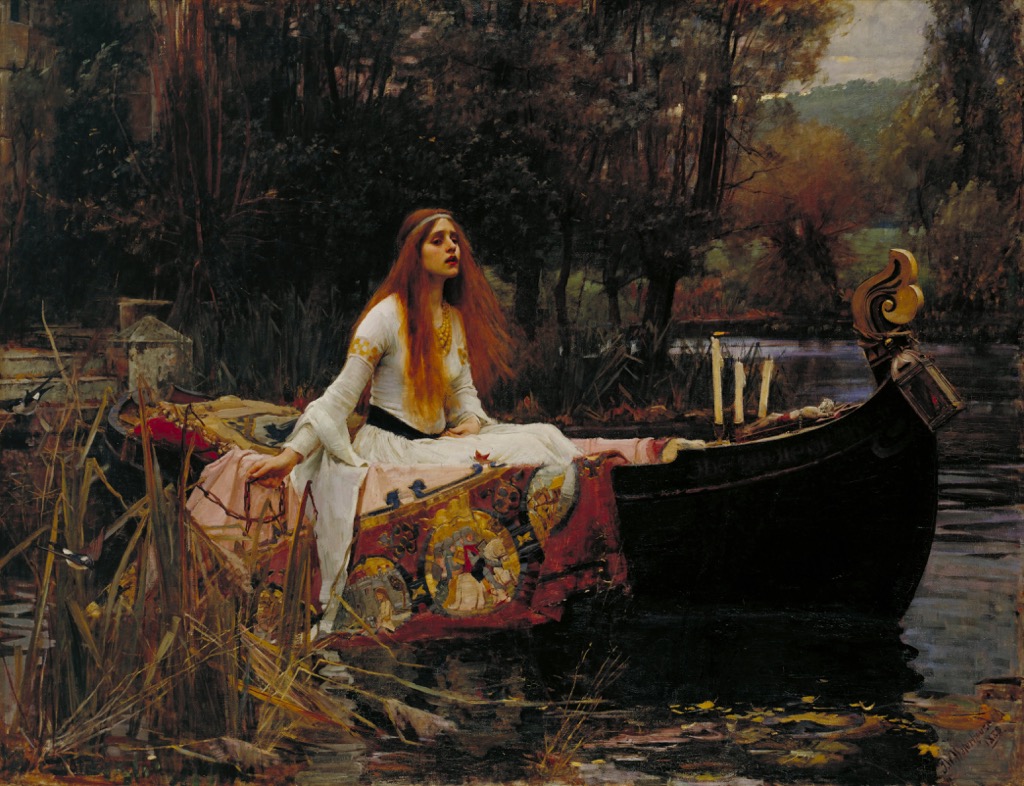
Miranda – The Tempest was one of three Waterhouse paintings at the Royal Academy in 1916. The others were “I Am Half-Sick of Shadows,” Said the Lady of Shalott and the group composition A Tale from the Decameron. [1] [2]
Together they draw upon Shakespeare, Tennyson and Boccaccio. The selection demonstrates that literary narrative remained central to Waterhouse's public work at the end of his career.
The 1916 exhibition was the last Royal Academy summer exhibition to which he contributed during his lifetime. Waterhouse died in February 1917, and four works appeared at the Academy later that year. [1]
The historical setting was the third year of the First World War. Christie's notes that Miranda received little press attention, both because such subjects were considered out of fashion and because wartime conditions curtailed coverage. [1]
Sotheby's reports a scholarly proposal that renewed interest in English literary narratives could connect with wartime patriotism. [2] This should remain an attributed interpretation, not a documented statement of Waterhouse's intention.
The picture does not depict modern warfare, and Miranda's ship should not be converted into a coded image of a particular naval event without evidence. Yet a 1916 audience encountered the spectacle of people apparently perishing at sea under conditions very different from those of 1875.
That context may alter reception without determining meaning. Miranda's sympathy for anonymous people aboard a distant vessel could acquire contemporary force even though the subject belongs to a play written three centuries earlier.
The painting was also shown in Liverpool at the Walker Art Gallery's Autumn Exhibition of 1916 as no. 258. [1] [2] Its documented public life therefore extended beyond the London summer exhibition within the year it was painted.
Later auction records place it in private ownership. Christie's offered it in London in October 1991, and Sotheby's catalogued it in New York in 2009. [1] [2] Those records provide dimensions, signature, exhibition history and provenance without supporting a claim that the canvas now belongs to a named public museum.
How to Look at the Painting
Begin with the ship. Notice how small it is and how decisively its angle disturbs the horizon.
Then follow the bands of water back towards the rocks. The distance is not empty; it is built from repeated obstacles of wave, foam and stone.
Move to Miranda's hand at her chest. It turns an event far away into a pressure close to the body.
Notice that her face is not offered frontally. Waterhouse makes viewers share her direction of sight rather than inspect her expression from outside.
Compare the movement of hair, dress and sea. Each responds to the storm, but each has a different weight and rhythm.
Finally remember what Miranda does not know: the people are safe, Ferdinand is aboard, and the storm will begin the journey that takes her from the island. The painting stops before reassurance, recognition and love.
Related Pages
- The Lady of Shalott: Compare Waterhouse's best-known literary composition.
- Hylas and the Nymphs: Compare another major mythological scene.
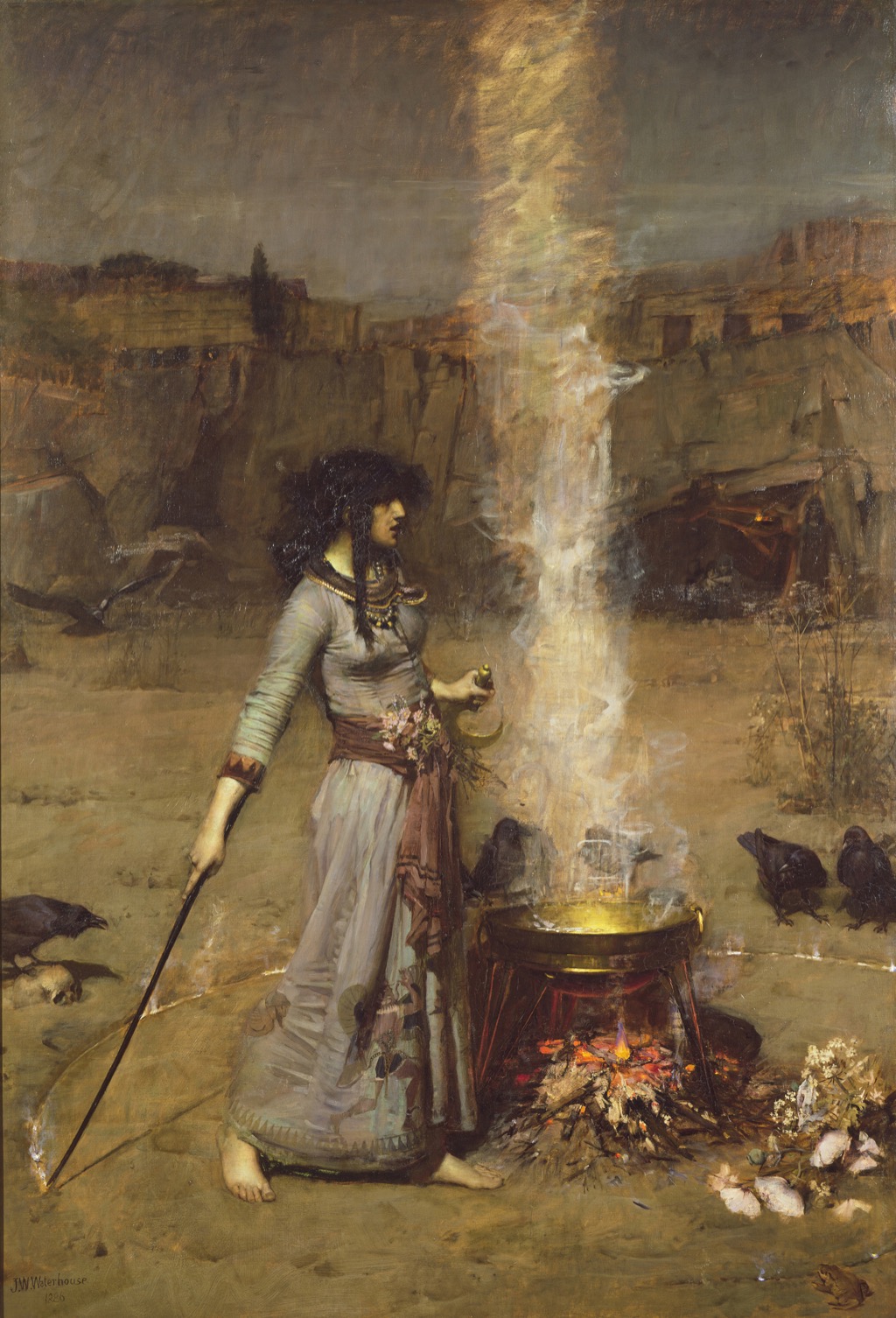
- The Magic Circle: Compare Waterhouse's treatment of ritual and symbolism.
Frequently Asked Questions
It shows Miranda watching the ship in the storm at the beginning of Shakespeare's play. She believes the vessel and its passengers are being destroyed and begs Prospero to stop the tempest. [1] [3]
No one aboard is killed. Prospero and Ariel stage the storm, preserve the passengers and disperse them around the island. [3] [4]
Yes. Ferdinand, son of Alonso, King of Naples, is among the passengers. He later meets Miranda, and they fall in love. [4]
He is not shown. Waterhouse isolates Miranda and the apparent wreck, leaving her compassionate response at the centre.
Yes. He exhibited an early treatment in 1875, painted the major late version in 1916 and had a smaller version exhibited posthumously in 1917. A small related early Miranda is also documented. [1] [6]
It is documented in private ownership through modern auction records. It should not be assigned to a public museum without newer evidence. [1] [2]
No. It was among his final Royal Academy exhibits during his lifetime, but works were shown posthumously in 1917, including a smaller Miranda. [1]
The pose directs viewers towards the ship and makes wind, tension and bodily response more important than a fully displayed facial expression. That is visual analysis rather than a recorded explanation by Waterhouse.
Discussion
Waterhouse's late Miranda is an image of power seen from the side of the person who did not choose it. Prospero commands the storm, Ariel performs it and the men aboard struggle within it. Miranda alone stands outside its mechanisms. Her role is to feel what strategy tries to make acceptable.
The fact that no one dies does not cancel her response. She reacts to the evidence available to her, and her first impulse is to protect people she cannot name. The painting holds this ethical clarity by excluding the later explanations that make the shipwreck safe.
Reader Insights
Which visible detail most changes the way you read this page?
Which source or comparison helps the work feel less familiar and more specific?
What question would you bring back to the painting after reading?
Join the Conversation
Share your reading of this page below.
References
- Christie's. “John William Waterhouse, Miranda – The Tempest,” lot record and catalogue essay documenting the 1916 canvas, its exhibitions, comparison with the 1875 treatment and the smaller 1917 version. View source
- Sotheby's. “John William Waterhouse, Miranda – The Tempest,” 2009 catalogue record, with dimensions, provenance, exhibition history and late-career discussion. View source
- Folger Shakespeare Library. William Shakespeare, The Tempest, Act 1, Scene 2, including Miranda's response to the storm and Prospero's account of their exile. View source
- Royal Shakespeare Company. “The Plot: The Tempest,” synopsis of Prospero's exile, the staged shipwreck, Ferdinand and Miranda, and the play's reconciliation. View source
- Royal Shakespeare Company. “Dates and Sources: The Tempest,” evidence for composition, early performance, first publication and Shakespeare's influences. View source
- Christie's. “John William Waterhouse, Miranda,” record for a small early treatment and discussion of its relationship to the 1875 composition. View source