

 by Tom Gurney
Tom Gurney BSc (Hons) is an art history expert with over 20 years experience
Published on August 14, 2026 / Updated on August 14, 2026
Email: tomgurney1@gmail.com / Phone: +44 7429 011000
Narcissus: Introduction
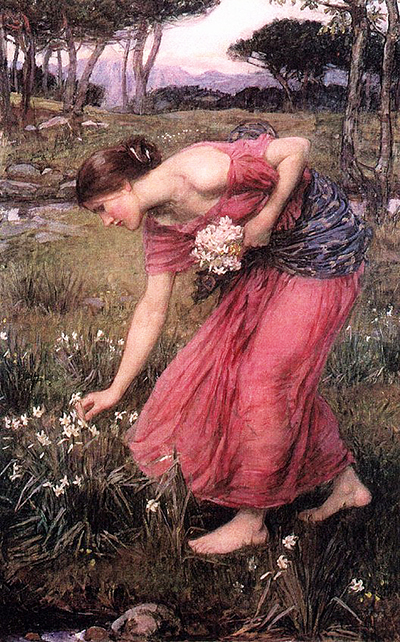
John William Waterhouse's Narcissus is not another painting of the beautiful youth staring into a pool. It shows a young woman stooping among flowers, her pink drapery and pale skin set against a steep, densely planted bank. The title names the narcissus blooms she gathers and may also invite the classical associations carried by their name.
Painted in 1912 and exhibited at the Royal Academy in 1913, the canvas belongs to Waterhouse's late sequence of women gathering flowers. [1] [2] It must be distinguished from his much better-known Echo and Narcissus of 1903, in which Ovid's rejected nymph and self-enamoured hunter appear together beside water. [3]
At a Glance
- ArtistJohn William Waterhouse
- TitleNarcissus
- Date1912 [1]
- MediumOil on canvas [1]
- Dimensions94 × 62 cm [1]
- CollectionPrivate collection [1]
- ExhibitedRoyal Academy, London, 1913 [2]
- SubjectA young woman stooping among narcissus flowers
- Related drawingA pencil study for the stooping figure survives on the reverse of a study for Listening to My Sweet Pipings [2]
- Important distinctionNot Echo and Narcissus (1903), Walker Art Gallery, Liverpool [3]
Contents
- Introduction
- What the painting shows
- Why the title is easily misunderstood
- Narcissus as flower and myth
- The stooping figure
- Colour, space and the garden bank
- Waterhouse's flower-gathering sequence
- From drawing to canvas
- The 1913 Royal Academy context
- How to interpret the painting
What the painting shows
A young woman bends sharply from the waist near the centre of a tall canvas. Her body makes a long descending curve, bringing her face and hands close to the flowers at the lower edge.
She wears soft pink or rose-coloured drapery. The garment has slipped from one shoulder, exposing the upper back and arm, while its folds gather around the hips and legs.
Her dark or auburn hair is loosely arranged. She does not meet the spectator's eyes. Every part of her pose directs attention downward towards the plants.
The bank rises behind her rather than opening into a distant view. Leaves, stems and shadows create a close natural enclosure. Small pale flowers punctuate the green and brown ground.
This compressed setting matters. Waterhouse does not stage a mythological encounter between several actors. He isolates one absorbed action: bending to inspect or pick a bloom.
The figure is monumental relative to the canvas. Although she performs a modest task, her diagonal pose fills the narrow format and gives the action physical urgency.
The flowers are not arranged as a botanical specimen. They are scattered through living vegetation, and the woman's hands enter the same intricate zone of leaves and stems.
No pool is prominent, no reflected face appears, and no male hunter is shown. Those absences are the clearest warning against importing the entire story of Ovid's Narcissus into the picture.
The scene is sensuous without becoming theatrical. Bare skin, bent body, soft cloth and dense growth create intimacy, yet the woman's attention remains her own.
Why the title is easily misunderstood
For modern audiences, “Narcissus” most often means the mythological youth who fell in love with his reflection. Waterhouse had already painted that story in Echo and Narcissus in 1903. [3]
The 1912 painting is visually different. Its protagonist is a woman among flowers, and its title can be read first as the singular or collective name of the narcissus plant.
Older catalogues and image records sometimes reproduce the title without explaining this distinction. Search results then place the flower-gathering woman beside retellings of the male youth's punishment.
Waterhouse may have welcomed the resonance. A narcissus flower carries the myth within its name, and viewers educated in classical literature would have recognised the connection.
Recognition is not the same as narrative illustration. Nothing securely identifies the woman as Echo, Persephone or another named heroine.
The safest description is therefore literal: a woman gathers or attends to narcissi. A secondary interpretation may consider how those flowers evoke beauty, looking, transformation and death.
This two-level reading suits Waterhouse's late work. A simple outdoor action supplies immediate visual pleasure, while title and floral tradition leave a classical undertone available without requiring a complete story.
The singular title also concentrates attention. It can name a species, an exemplary blossom or the mythic memory attached to the flowers as a group.
It should not be changed to Narcissa or treated as evidence that the bending figure is male. The body, clothing and pictorial type belong to Waterhouse's sequence of female flower gatherers.
Narcissus as flower and myth
In Ovid's Metamorphoses, Narcissus rejects those who love him, including Echo, and is made to desire an image he cannot possess. He wastes away beside the water; when mourners seek his body, they find a flower in its place. [4]
The myth joins sight, desire and transformation. Its final flower turns a fatal act of looking into a natural form that returns seasonally.
Ancient versions and later botanical identifications are not completely uniform, so it is unnecessary to assign every painted bloom a precise modern cultivar. Waterhouse's title supplies the relevant identification.
In the 1912 canvas, the reflective water central to Ovid's plot disappears. Touch replaces sight as the dominant action: the woman bends and reaches into the vegetation.
That reversal is suggestive. The legendary Narcissus cannot detach himself from an image; Waterhouse's unnamed woman engages with tangible flowers and earth.
Yet beauty remains potentially dangerous or transient. A picked flower will fade, and the exposed figure herself is presented in the language of youthful bloom.
The myth's transformation allows Waterhouse to move from narrative history painting towards a quieter symbolist scene. The flower can carry the story in compressed form.
It would be excessive to claim that the woman witnesses Narcissus's metamorphosis. There is no visible body becoming plant and no documentary evidence for that precise moment.
Nor should she automatically be called Persephone. Narcissi appear in the Homeric Hymn to Demeter as part of the meadow where Persephone gathers flowers before her abduction, but Waterhouse did not supply that title here. [5]
The Persephone parallel helps explain why flower gathering could sound mythic to an educated audience. It remains contextual rather than an identification.
The painting's power lies in this controlled uncertainty: a flower is fully present, while several classical memories hover around it.
The stooping figure
Waterhouse makes bending the painting's central event. The pose is not a neutral means of placing a hand near the ground; it organises the whole composition.
Head, spine and drapery descend in a continuous sweep. The arms form shorter diagonals that focus the action around the flowers.
The pose makes the body vulnerable because the woman turns away from any surrounding audience. At the same time, it expresses concentration and purpose.
Her gaze does not drift into reverie. It follows the hands, making looking part of attentive work rather than self-admiration.
The steep bend also frustrates conventional portrait display. We receive a foreshortened or lowered face rather than a fully presented likeness.
Waterhouse repeatedly used absorbed female figures to create a private psychological zone. They read, weave, listen, gather, mix potions or look into water while seeming temporarily unaware of spectators.
Here absorption is bodily. The woman has adjusted her entire balance to reach the plant.
The slipping drapery introduces sensuality, but it does not interrupt the task. She neither displays the garment nor reacts to its looseness.
This difference matters when interpreting the image. The exposed shoulder is part of Waterhouse's idealising visual language, not proof of a seduction story.
The figure's scale turns a humble movement into a monumental arabesque. A garden act acquires the formal force usually reserved for mythological drama.
Because the face is lowered, identity remains subordinate to gesture. The protagonist is memorable less as an individual sitter than as the embodiment of reaching, choosing and gathering.
Colour, space and the garden bank
Pink drapery provides the painting's largest chromatic statement. Against subdued greens and earth colours, it makes the body immediately legible.
The cloth also relates woman and flower. Its rose and mauve notes echo petals without exactly imitating them.
Pale skin creates a second light shape, especially along shoulder and arm. Waterhouse uses contrast to lead the eye from upper body to lowered hands.
The landscape is deliberately close. A rising bank blocks the horizon and prevents the image from becoming a panoramic pastoral.
Leaves overlap one another in shallow layers. Their density gives the sense that the figure has entered a living, slightly tangled place rather than a formal garden bed.
Small highlights mark blossoms and foliage. They slow the eye near the bottom, rewarding the same close attention the woman gives the plants.
The tall format reinforces descent. In a wide canvas, the bending figure might appear as one incident within a landscape; here she nearly spans the available field.
The enclosed bank also creates privacy. No path, building or companion defines a social setting.
Waterhouse's natural detail is selective rather than encyclopaedic. He provides enough specificity to make flower gathering believable while allowing masses of colour and brushwork to sustain atmosphere.
Digital reproductions differ in colour and cropping. Measurements should therefore be taken from catalogued records rather than estimated from an online image. [1]
The work's balance depends on opposition: vertical canvas against diagonal body, cool vegetation against warm cloth, small flowers against the large human form.
These formal relationships turn the title from a label into a visual structure. The human figure descends towards the object named by the painting.
Waterhouse's flower-gathering sequence
Christie's places Narcissus within a late group anticipated by Windflowers and Boreas. It specifically identifies Narcissus and A Song of Springtime as Royal Academy exhibits of 1913. [6]
Across this sequence, Waterhouse repeatedly pictured women moving through, bending over or carrying flowers. Narrative is often lighter than in his famous paintings of Circe, Ophelia or the Lady of Shalott.
The recurrence was not simple repetition. Each work tests a different relation between body and season: walking against wind, kneeling, stooping, carrying, listening or resting.
Flowers supply colour and symbolic potential while keeping the activity immediately readable. They can imply spring, youth, fertility, memory or brevity without locking the image to one plot.
This strategy suited Waterhouse's late synthesis of Pre-Raphaelite detail, classical figure painting and modern decorative design.
The series also answered changing exhibition conditions. Christie's notes that romantic literary figure subjects were losing critical fashion even as Waterhouse continued to paint them. [6]
Flower-gathering canvases could retain his recognisable ideal women and richly worked nature while reducing dependence on obscure literary knowledge.
Narcissus is among the most dynamic of the group because its figure bends so deeply. The pose brings decorative line and natural action together.
Comparison with A Song of Springtime is especially productive. Both appeared at the Academy in 1913, but one compresses a solitary figure vertically while the other spreads multiple figures and flowers across a horizontal field.
The paired exhibition suggests not duplicate subjects but variations: concentrated gathering beside expansive seasonal allegory.
Calling the works a sequence does not mean Waterhouse formally announced a series. It is a scholarly grouping based on repeated motifs, dates and exhibition relationships.
From drawing to canvas
A surviving sheet provides direct evidence of Waterhouse's preparation. On one side is a study for Listening to My Sweet Pipings; on the reverse are sketches including the stooping figure for Narcissus. [2]
Christie's identifies the pencil sheet as unframed and measuring 17.5 × 24.8 cm. It descended through the artist's family. [2]
The reuse of a sheet is revealing. Waterhouse tested figures economically, turning paper over and adding ideas without treating every study as a presentation drawing.
The sketch establishes that the bend was deliberately worked out. It was not merely improvised as decorative contour on the final canvas.
Another similar study was known to the auction catalogue, indicating that Waterhouse revisited the pose. [2]
Drawing allowed him to solve weight, reach and silhouette before elaborating face, drapery and plants in oil.
The relationship also links two different finished paintings within his studio practice. A drawing for one subject could physically carry the germ of another.
This does not prove that the paintings shared a narrative. It shows that Waterhouse's late production was interconnected through models, poses and working sheets.
The sketch should not be confused with an oil study of a young man's head once tentatively associated with Narcissus. Christie's dates that head to the late 1890s and reports Peter Trippi's suggestion that it might relate to either Narcissus or Zephyrus. [7]
Because the final 1912 composition centres a woman, that tentative attribution must remain cautious. The documented stooping-figure sketch is the more direct preparation.
Surviving studies also counter the notion that late flower pictures were effortless repetitions. Their graceful actions were constructed through repeated observation and adjustment.
The 1913 Royal Academy context
Waterhouse exhibited Narcissus at the Royal Academy in 1913. [2] A Song of Springtime appeared in the same exhibition. [6]
By then he was a senior Royal Academician with nearly four decades of exhibition experience. His first accepted Academy picture had appeared in 1874.
The art world around him had changed dramatically. Post-Impressionism, new forms of realism and abstraction had altered critical priorities, while Victorian narrative painting no longer commanded its former attention.
Waterhouse did not simply abandon his established language. He loosened handling, compressed stories and explored seasonal, floral and psychological motifs.
At the Academy, Narcissus would have been encountered among hundreds of contemporary works, not in the isolated, enlarged form of an online image.
Its narrow format, warm pink and steep figure would have helped it register at a distance. Close viewing then revealed the flowers and lowered concentration.
The classical title offered cultural recognition while the scene avoided an elaborate antique reconstruction.
Contemporary reception located so far is limited. Absence of extensive comment should not be converted into evidence of failure; Academy reviews were selective, and Christie's notes the broader decline in critical attention to romantic subjects. [6]
The exhibition date is nevertheless secure and useful. It anchors the painting's public life even though the current collection remains private.
It also corrects a common misconception that the work was merely a late studio fragment. A related drawing survives, the oil carries a 1912 date in standard records, and the completed composition was exhibited the next year.
How to interpret the painting
The most grounded interpretation begins with flower gathering. A woman bends towards narcissi in a secluded bank.
Seasonal meaning follows naturally. Narcissi are associated with spring, so the act suggests renewal and the return of growth.
Classical meaning is invited by the title and Waterhouse's career-long engagement with ancient literature. Ovid's transformed Narcissus gives the flower a memory of dangerous beauty and frustrated desire. [4]
The Homeric Hymn to Demeter gives narcissus another classical charge as the marvellous bloom connected with Persephone's abduction. [5]
Neither association conclusively names the woman. The painting may draw strength precisely from allowing several stories to condense around an unnamed figure.
A psychological reading can focus on absorption. She is not performing for us; her body and sight are claimed by the task.
A gender-aware reading can note the familiar late-Victorian convention of idealised women in nature. Exposure and anonymity make the figure available to spectators even as her lowered gaze creates apparent privacy.
These readings need not cancel one another. The image can be decorative, sensual, seasonal and mythically resonant at once.
What should be avoided is false certainty: calling the woman Echo awaiting Narcissus, Persephone at the exact moment before abduction, or a portrait of a named model without evidence.
Waterhouse supplies title, action and setting, not a captioned plot. Interpretation should preserve that openness.
Place in Waterhouse's late art
Narcissus shows how Waterhouse renewed a familiar vocabulary late in his career. He retained the beautiful figure, richly planted setting and classical title but reduced narrative machinery.
The painting's originality lies in its physical compression. A whole mythic and seasonal field is concentrated into one bend towards a flower.
It also demonstrates the importance of titles in his late work. Without “Narcissus,” the canvas might be read as a generic flower gatherer; with it, botanical observation opens onto classical transformation.
Compared with Echo and Narcissus, the later work is less explicit but not necessarily less thoughtful. The 1903 painting shows cause and consequence through two figures and a reflection. The 1912 canvas lets the flower itself carry memory.
Compared with A Song of Springtime, it is intimate and vertical. Compared with Sweet Summer, it is active rather than reclining.
Together these works reveal Waterhouse treating season as bodily experience: stooping, walking, resting, gathering and inhabiting flowering ground.
The surviving pencil study confirms continued discipline beneath the apparent ease. The figure's curve was designed, tested and translated.
Its private ownership has limited direct public access, while reproductions often circulate without the contextual distinction from the mythological youth. A responsible page should therefore make that distinction early and clearly.
The painting deserves attention not as a lesser sequel to Echo and Narcissus but as a different solution to the same culturally charged name.
In the earlier work, a body becomes trapped by an image. In the later one, a body bends towards the flower left by the story.
Related Pages
- The Lady of Shalott: Compare Waterhouse's best-known literary composition.
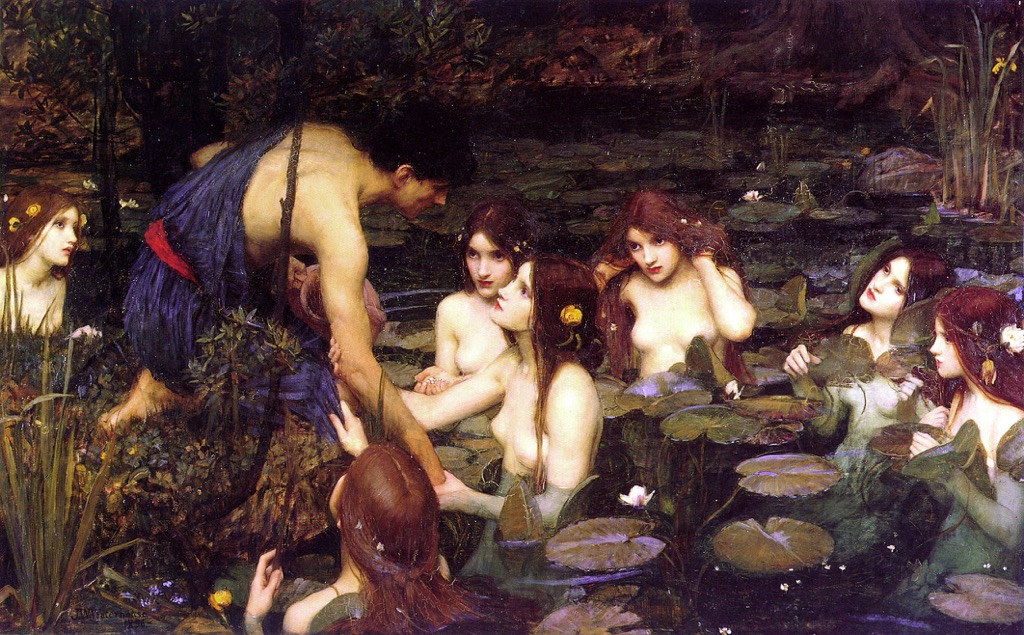
- Hylas and the Nymphs: Compare another major mythological scene.
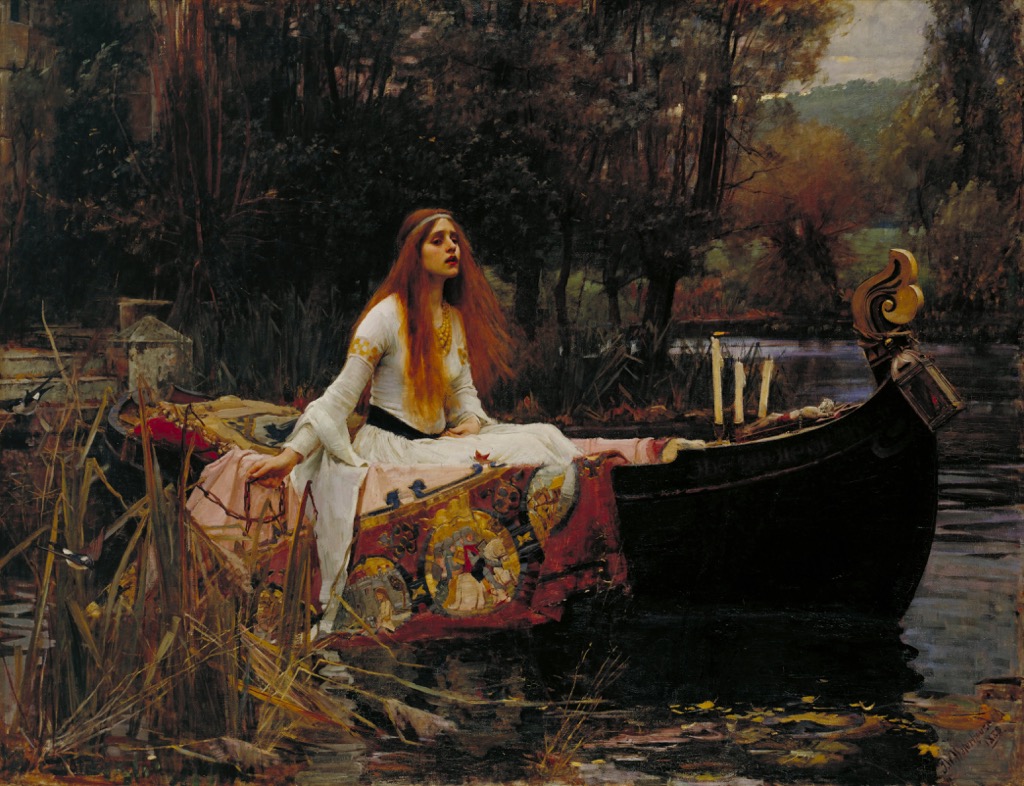
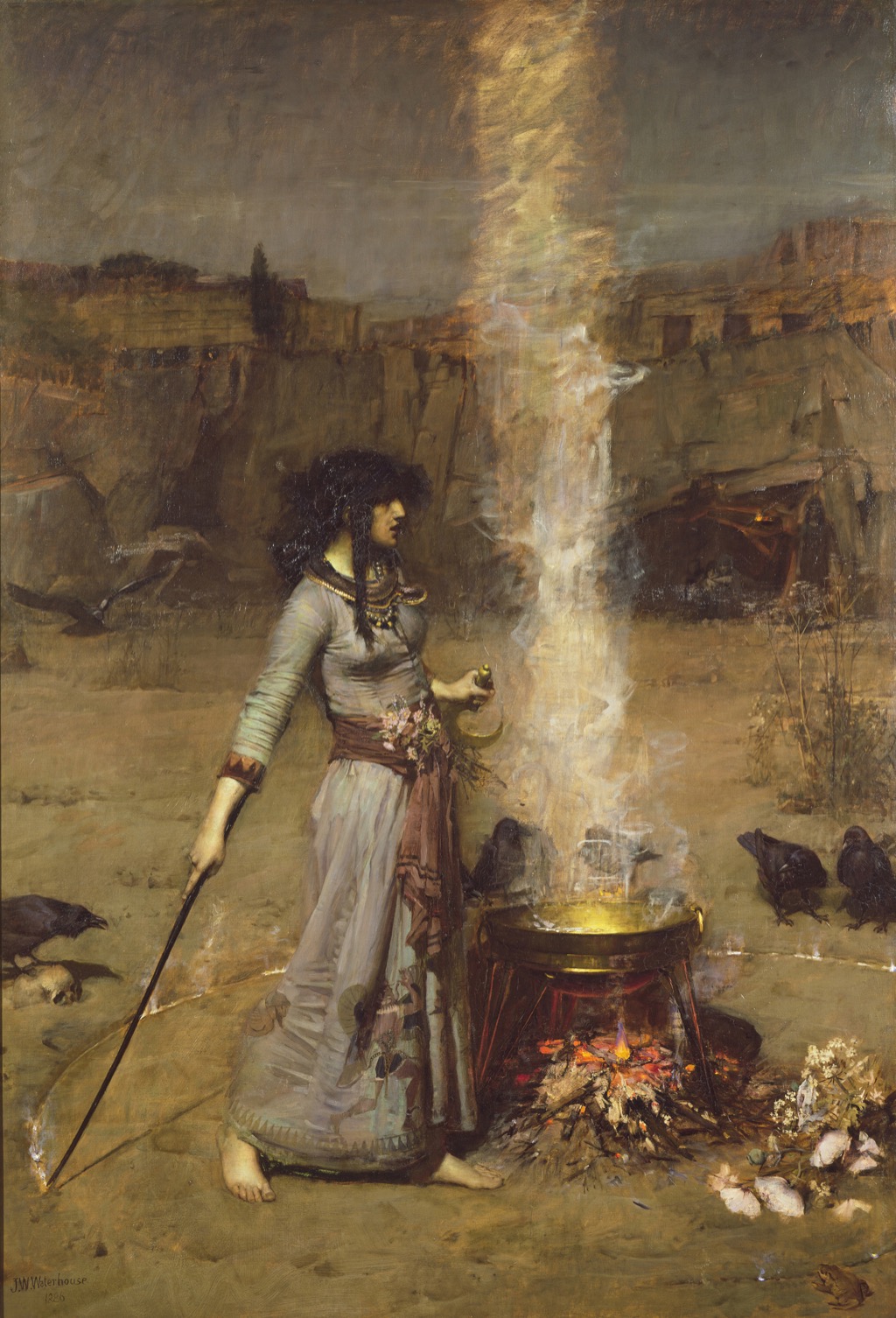
- The Magic Circle: Compare Waterhouse's treatment of ritual and symbolism.
Frequently Asked Questions
No. The 1912 canvas shows a young woman stooping among flowers. The title refers most directly to narcissus blooms, although their name carries the classical myth's associations.
It is recorded in a private collection. [1] A present owner or display location should not be guessed from older reproductions.
They share the charged name and Waterhouse's classical interests, but they are separate compositions. The 1903 work shows Echo and the male Narcissus beside water and belongs to the Walker Art Gallery. [3]
That identification is possible as an interpretive association because Persephone gathers flowers, including narcissus, in the Homeric Hymn to Demeter. [5] Waterhouse did not title the work Persephone, so it should not be stated as fact.
Yes. A pencil sketch of the stooping figure appears on the reverse of a study for Listening to My Sweet Pipings. [2]
Discussion
The most useful question raised by Narcissus is how little narrative a classical picture can retain while still feeling mythic. Waterhouse removes the pool, reflection, rejected lover and visible metamorphosis. He keeps a name, a flower and a beautiful absorbed body.
That reduction makes the viewer work differently. Instead of decoding a climactic episode, we move between what is visible and what the title remembers. The woman gathers a real plant; the plant gathers stories.
Reader Insights
Which visible detail most changes the way you read this page?
Which source or comparison helps the work feel less familiar and more specific?
What question would you bring back to the painting after reading?
Join the Conversation
Share your reading of this page below.
References
- Wikimedia Commons, “John William Waterhouse: Narcissus (1912),” object and image metadata, recording oil on canvas, 94 × 62 cm, private collection. View source.
- Christie's, “Study for Listening to My Sweet Pipings (recto); and Sketches including a study for Narcissus (verso),” lot record and essay, noting the stooping study and the 1913 Royal Academy exhibition. View source.
- National Museums Liverpool, Art UK, “Echo and Narcissus,” collection record for the 1903 painting in the Walker Art Gallery. View source.
- Ovid, Metamorphoses, Book III, Echo and Narcissus, translated by A. S. Kline, Poetry in Translation. View source.
- Homeric Hymn to Demeter, translated by Gregory Nagy, Center for Hellenic Studies, Harvard University. View source.
- Christie's, “John William Waterhouse: Boreas,” lot essay discussing the late flower-gathering group and the 1913 exhibition of Narcissus and A Song of Springtime. View source.
- Christie's, “Study of the head of a young man, possibly for Narcissus,” lot record and essay. View source.