

 by Tom Gurney
Tom Gurney BSc (Hons) is an art history expert with over 20 years experience
Published on August 14, 2026 / Updated on August 14, 2026
Email: tomgurney1@gmail.com / Phone: +44 7429 011000
Boreas: Introduction
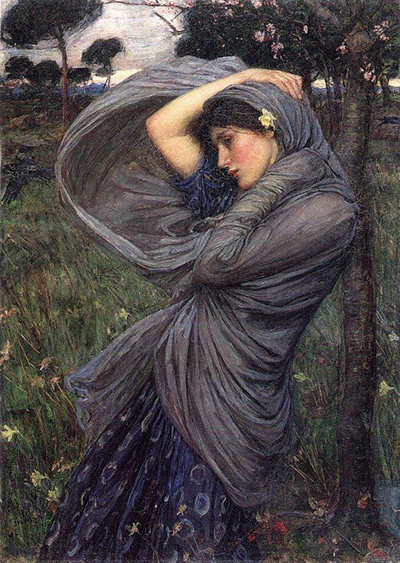
A young woman crosses a spring landscape while a hard wind drives her drapery sideways. Pink blossom and yellow daffodils announce the season; slate-blue folds still carry the cold. John William Waterhouse's Boreas contains no mythological god in visible form. The north wind is known through what it does to cloth, hair, branches and the effort of walking.
Signed in 1903 and exhibited at the Royal Academy in 1904, the painting is among Waterhouse's most concentrated studies of weather and inward mood. Its title gives a classical name to an ordinary encounter with wind. The resulting image is neither full narrative nor simple portrait. A passing figure becomes the place where winter and spring meet.
At a Glance
- ArtistJohn William Waterhouse (1849–1917)
- TitleBoreas
- Date1903
- MediumOil on canvas
- Dimensions94 × 68.8 cm
- SignatureSigned and dated “J.W. Waterhouse 1903” at lower left
- Current statusPrivate collection
- First exhibitedRoyal Academy, London, 1904, no. 618 [1]
- SubjectA young woman moving through a spring landscape in a strong north wind
- Title sourceBoreas, the Greek personification of the cold north wind [2]
- Related Waterhouse paintingsWindflowers (exhibited 1903), the lost or unlocated March Winds, and later flower-gathering figures [1]
- RediscoveryStill described as lost in Waterhouse scholarship of 1989 before its reappearance on the art market [1]
Contents
- Introduction
- Wind Made Visible
- Boreas in Greek Tradition
- Why the God Does Not Appear
- Drapery and the Body in Motion
- Daffodils and Pink Blossom
- The Wistful Expression
- Colour, Pattern and Movement
- An Ordinary Walk with a Classical Title
- Aesthetic Painting and the Question of Narrative
Wind Made Visible
Wind has no fixed body. A painter can show it only through effects: fabric lifted, stems bent, hair displaced, a figure braced against pressure. Waterhouse makes those effects the action of Boreas.
The woman's shawl or drapery expands around her, turning a private garment into a large field of movement. Its folds do not simply trail elegantly. They push across and partly enclose the body, showing weather as resistance.
Her progress is slow enough to be read as effort. She is not blown into melodramatic danger, but the landscape does not permit effortless passage. Walking becomes negotiation.
The title makes the air personal without showing a personification. Boreas exists in every displaced edge. This allows Waterhouse to join classical myth with observed weather more subtly than a winged wind-god would allow.
The event is small. No ship is wrecked and no tree falls. Yet human scale makes the wind immediate. We can imagine cold against skin and the instinct to gather cloth closer.
That sensory accessibility partly explains the picture's popularity. It offers a poetic title without requiring knowledge of a complicated story. The experience of being caught by a cold wind is enough to enter the image.
Boreas in Greek Tradition
Boreas is the Greek north wind, imagined both as a natural force and a divine person. Ancient literature associates him with the cold blast arriving from Thrace. He belongs to the group of directional winds and is known especially through the story of his seizure of the Athenian princess Oreithyia. [2]
Waterhouse does not illustrate that violent myth. There is no pursuing male god, no abduction and no identifiable Athenian riverbank. The woman in the painting should not automatically be named Oreithyia.
Instead, the title activates Boreas at the level of season. The north wind brings winter's remaining force into a landscape already producing spring flowers. Christie’s catalogue interprets him as an old, harsh order against which tender growth struggles. [1]
This reading is persuasive because it arises from the visible opposition of cold movement and spring bloom. It should not become a claim that Waterhouse encoded a complete mythological allegory with named characters.
The Roman equivalent Aquilo and the wider ancient tradition are useful background, but the Greek title is sufficient. Waterhouse often drew upon classical names to intensify natural experience without constructing a literal scene from one text.
Calling the painting “mythological” is therefore both true and incomplete. Myth supplies the name of the force; modern-looking human experience supplies the content.
Why the God Does Not Appear
Personifications in art often appear as winged figures blowing air, carrying clouds or driving horses. Waterhouse refuses that conventional solution.
An invisible Boreas makes the woman's body more important. She becomes the instrument that records direction, temperature and strength. The god's action is visible only because she resists it.
This also prevents the scene from becoming an encounter between two characters. There is no question of whether Boreas courts, chases or attacks her. Weather remains impersonal even after receiving a divine name.
The absence creates a different kind of symbolism. Winter is not a villain standing opposite Spring. It is a pressure still active inside springtime.
Waterhouse's method resembles his handling of song or enchantment in other works. Invisible forces are given material consequence through pose, fabric, gaze and surrounding nature. What cannot be painted directly becomes the organiser of everything visible.
The title may initially lead viewers to search for a male deity. Discovering that Boreas is the wind itself changes the act of looking. Blown drapery ceases to be decorative and becomes the central subject.
Drapery and the Body in Motion
The woman's slate, blue and blue-black garments dominate the composition. Contemporary Academy Notes described her in “wind-blown draperies” passing through a spring landscape. [1]
Cloth gives wind a surface. Folds stretch, gather and reverse direction; edges catch air; weight pulls against lift. Waterhouse can therefore paint several moments of pressure within one frozen image.
The body beneath is partly concealed. This makes pose less available through anatomy than through the total silhouette. Head, shoulders and implied step must be read through fabric.
Her arms appear occupied with controlling or holding the garment. A gesture of ordinary self-protection becomes compositional structure.
Diagonal forces disturb the vertical figure. The woman may move in one direction while the cloth is driven in another. Progress and resistance create a visual counterpoint.
Because her stride is not exaggerated, the image avoids theatrical storm. This is persistent weather, not catastrophe. The challenge lies in endurance across a field.
Daffodils and Pink Blossom
The landscape is unmistakably springlike. Pink blossom and daffodils bring fragile, bright accents to a scene dominated by cool cloth and wind. [1]
A daffodil worn in the woman's hair links her to the season. Christie's treats it as both symbolic and formally necessary: a small bright note that joins figure and flowers. [1]
Daffodils traditionally signal returning spring because they bloom early. In Boreas, early flowering means exposure. New growth appears before cold force has finished.
The blossom likewise records vulnerability. Petals seem liable to be torn away by the same air that catches the woman's garment. Beauty exists under pressure.
This does not require a fixed allegory in which the woman literally is Spring. She can identify with the landscape without personifying it. Her youth, flower and wistful expression create affinity.
The seasonal threshold gives the painting emotional depth. Spring is present but incomplete; winter is losing authority but still felt. Hope and discomfort occupy the same day.
The Wistful Expression
The woman's face is quieter than the drapery. She appears absorbed, pensive or wistful rather than alarmed. Christie's uses “wistful” in connecting her with the change of season. [1]
That expression prevents the picture from becoming only a display of movement. Weather outside is answered by stillness within.
It is tempting to invent a narrative—perhaps she leaves a lover, remembers a loss or anticipates arrival. No title, letter or attribute securely supports one. Waterhouse withholds story so that mood can remain available.
The turned or lowered face also reduces contact with the spectator. She passes through the field without presenting herself as a formal portrait.
Her inwardness may mirror the landscape's transition. Neither woman nor season is resolved. Both carry signs of what has been and what is beginning.
This ambiguity connects Boreas with Aesthetic painting, where beautiful figures and harmonious colour could take precedence over explicit narrative. The work offers meaning through relation rather than plot.
Colour, Pattern and Movement
Cool blue, slate and black-blue drapery carries the wind's chill. Warm skin, yellow daffodils and pink blossom oppose it in small concentrated notes.
This imbalance matters. Spring colours have appeared, but they do not yet dominate the field. Cold remains the largest visual force.
The patterned or layered fabric prevents the moving mass from becoming one flat shape. Folds break colour into changing planes and make gusts legible.
Background branches and flowers answer those planes at smaller scale. The whole image seems crossed by one current, but different materials respond differently.
No cited technical report identifies pigments or underdrawing. Christie's records oil on canvas and the dated signature; visible interpretation should stop short of reconstructing Waterhouse's complete method. [1]
The design demonstrates how much narrative can be generated from form. Blue moves; yellow persists; pink trembles. Weather and season become colour relations.
An Ordinary Walk with a Classical Title
Nothing in the woman's costume or surroundings requires a remote mythological age. She could be encountered as a modern poetic figure crossing an English or imagined European landscape. The Greek title elevates the experience without converting it into costume drama.
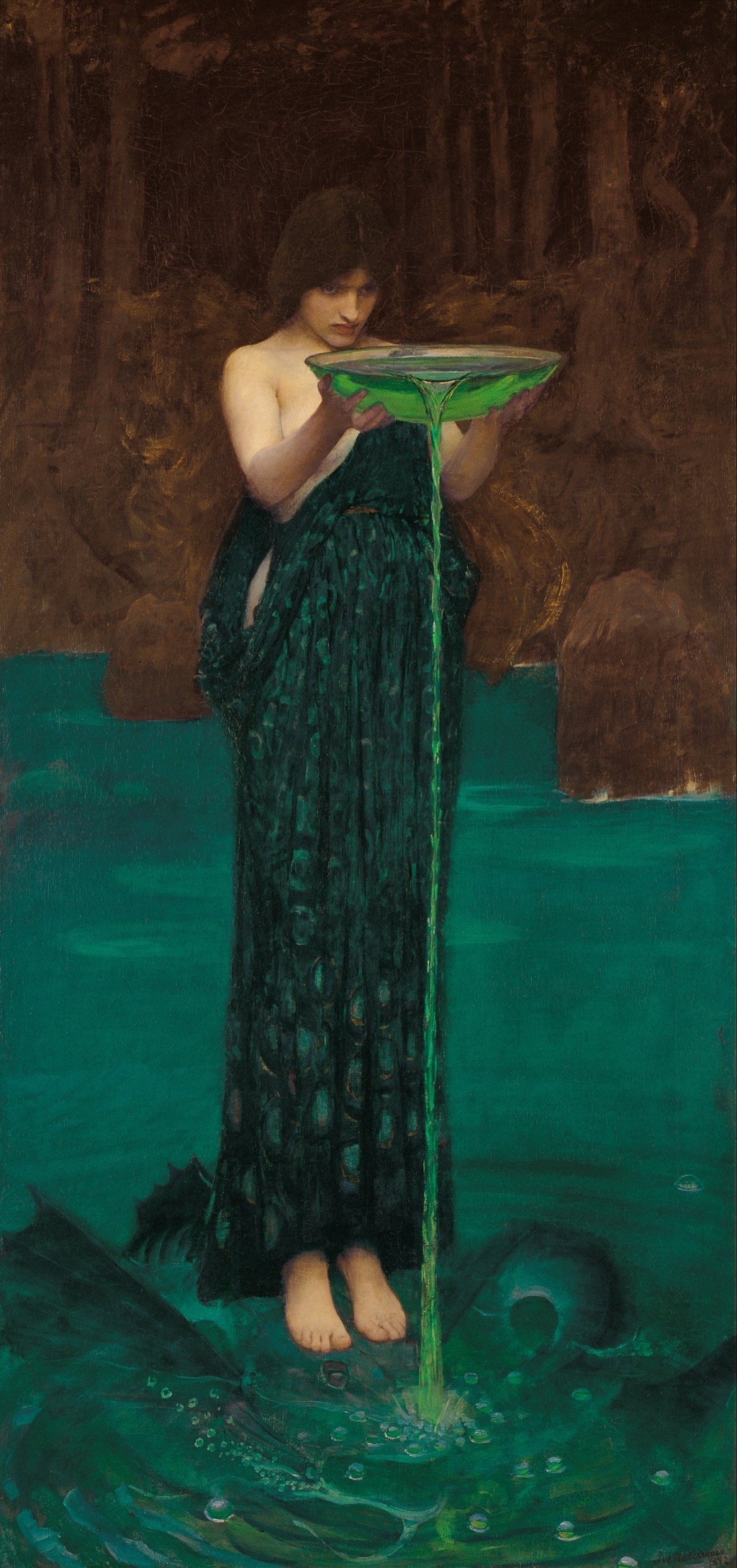
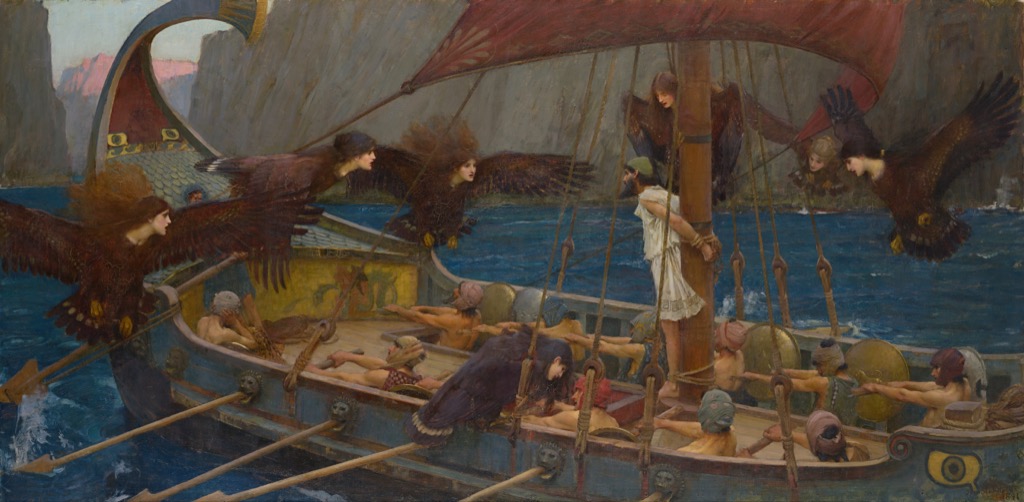
This is different from Waterhouse's paintings of Circe, Psyche or Ulysses, where named figures, objects and actions lead back to identifiable stories. Boreas supplies a named force but no plot.
The distinction matters because searches for “what story is shown” can produce false certainty. There is no documented lost narrative in which this particular woman walks through these flowers. The painting's event is complete in what we see.
Classical naming changes the scale of that event. A gust becomes the continuing North Wind known across ancient poetry and myth. Personal discomfort belongs to a seasonal power older than the walker.
At the same time, the human figure domesticates the god. Boreas is experienced not through shipwreck or abduction but through the difficulty of controlling a shawl. Myth enters bodily life at its most recognisable level.
This meeting of the elevated and ordinary helps explain why the image can feel timeless without being historically specific. Weather repeats; people continue to brace, wrap and walk.
The title also determines direction. Without it, the canvas would show “wind.” With it, the air is cold, northern and seasonally charged. One word supplies what colour and posture imply but cannot geographically prove.
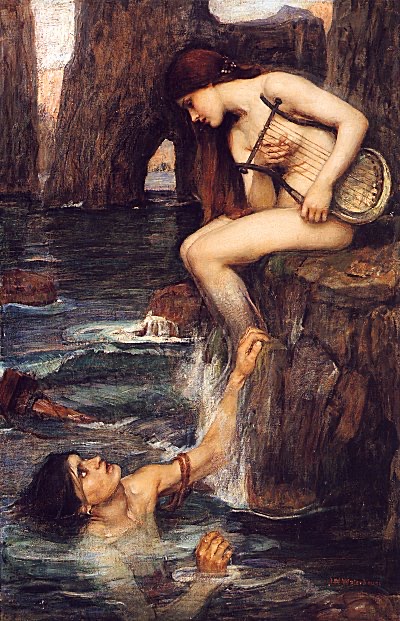
Waterhouse often uses titles to focus ambiguous images. The Soul of the Rose turns a sensory moment into an allusion; A Mermaid identifies a supernatural body; Boreas identifies an invisible cause. In each case, language does not explain every detail but changes what is available to see.
The woman's anonymity is equally productive. A named heroine would bring biography and outcome. An unnamed walker lets sensation remain primary.
She is therefore neither merely “decorative” nor secretly part of an elaborate story. Waterhouse makes the conditions of walking—air, temperature, cloth, thought—sufficient for a major figure painting.
Aesthetic Painting and the Question of Narrative
Christie's compares Boreas with windblown women in Albert Moore's Shells and Sea-Gulls, exhibited in the early 1870s. [1] Moore's art was closely associated with Aesthetic ideals in which formal harmony and beauty could take precedence over moral anecdote.
The comparison explains the reticence of Waterhouse's picture. Figure, colour and drapery offer visual satisfaction before any symbolic interpretation is attempted.
Waterhouse nevertheless retains more seasonal narrative than pure formalism would require. Daffodils, blossom and the title establish a contest between remaining cold and emerging spring.
The picture can therefore be entered in two ways. One may follow the movement of blue across the surface, enjoying balance and rhythm. One may also understand those same folds as evidence of Boreas pressing against new growth.
Form and meaning do not occupy separate layers. The daffodil is both a yellow accent needed near the face and a spring flower carried against northern wind. Christie's explicitly notes this coincidence. [1]
Waterhouse's restraint also belongs to the changing exhibition world around 1900. The elaborate literary and historical pictures that had dominated earlier Victorian reviews were losing fashion, while portraiture and different modern styles competed for attention. [1]
Rather than abandoning imaginative art, he concentrated some later pictures around mood, season and one figure. Boreas does not attempt the crowded archaeological spectacle of his 1880s canvases.
This simplicity should not be mistaken for lack of design. A sparse narrative increases the responsibility placed upon pose, colour and interval. If the wind does not feel present, the entire image fails.
The successful painting makes viewers supply sensation from static marks. Its subject is as much the imagination of movement as the woman herself.
That is why reproduction can preserve the image's broad appeal while losing some of its achievement. At original scale, the relation between small flower, face and large moving textile must be read bodily rather than as a decorative thumbnail.
Cloth as Shelter and Obstacle
The drapery protects the woman from cold, but the wind turns that protection into resistance. More fabric offers warmth and more surface for Boreas to seize.
This contradiction is visible in gathered folds near the body and expanded folds farther away. Cloth alternately clings, wraps and escapes.
The woman appears to use her arms and torso to control it, so movement through the field includes a second task: keeping a mobile enclosure around herself.
Her shawl can resemble a wing without giving her flight. The wind lifts shape while the body remains earthbound. This produces visual freedom and physical burden at once.
Fabric also conceals the exact stride. We infer legs and direction from the total mass. Waterhouse makes an uncertain body legible through what surrounds it.
The cool colours strengthen the sensation of weight and air. Dark folds can feel dense; lighter edges catch implied light and gust. Named pigment claims are unnecessary to recognise this tonal structure.
The garment's historicising quality distances the woman from a contemporary street while leaving period unresolved. Waterhouse creates poetic time from costume rather than reconstructing one documented decade.
The face emerges as the stillest point within the moving mass. This is not only psychological contrast. It gives the eye a place to rest so that the drapery can appear more active around it.
Cloth finally becomes an externalised weather record. Every fold remembers a force that cannot itself be seen, making dress the true landscape of the north wind.
Spring Under Pressure
Spring in Boreas is not an accomplished state. It exists through early flowers vulnerable to reversal. This differs from Waterhouse's later scenes of abundant flower-gathering, where the season appears more fully established.
The daffodil in the woman's hair is particularly exposed. Removed from the ground and carried with the body, it becomes a portable sign of change.
Pink blossom occupies branches or distance with a lightness opposed to the heavy drapery. Petals, unlike cloth, cannot be gathered securely against wind. Their survival appears temporary.
The old seasonal reading identified in the Christie's essay does not require a moral struggle between good Spring and evil Winter. [1] Cold and renewal are parts of one transition.
The woman's expression may register that mixed condition. Wistfulness suits a season in which promise is present but comfort delayed.
Waterhouse avoids the brighter triumph of an allegorical Spring crowned with flowers. The single daffodil is enough. Modesty of attribute corresponds to uncertainty of weather.
This threshold can support emotional analogy without fixing a biography. Viewers may connect it with endurance, recovery or change, but the painting never states what private winter the woman has experienced.
Its openness makes seasonal recognition available across time. The first warm signs of a year often arrive before cold has released its hold. Waterhouse builds an entire mood from that common contradiction.
Landscape Without a Destination
The woman crosses the picture, but Waterhouse withholds a visible destination. No house, companion or road sign turns the movement into travel with a stated end.
This absence keeps attention on passage itself. She is defined by being between places just as the landscape is between seasons.
The field does not behave as untouched wilderness. Flowering plants and the scale of her route suggest a humanly accessible countryside, but no labour or settlement interrupts the poetic encounter.
Waterhouse compresses depth around the figure so that the wind feels immediate. A panoramic view would make her one small element in weather; the vertical format makes weather one large element around her.
Branches and blossoms create an upper field of smaller motions while flowers punctuate the lower ground. The body links them through sweeping cloth.
The lack of destination also prevents the face from resolving into anticipation or farewell. Wistfulness remains a quality of movement without a narrated cause.
Viewers may imagine that she struggles home, leaves someone or walks without urgency. The canvas accommodates these stories because it confirms none.
This openness is not incompleteness. It is how an image about seasonal feeling avoids becoming an illustration of one incident.
Why Boreas Became a Popular Waterhouse Image
The painting's modern appeal rests partly on immediate readability. A single figure, strong colour and visible wind survive reproduction more easily than a complex multi-figure history painting.
Its mood is also available without specialist reading. Knowing Boreas enriches the title, but viewers can feel cold movement before identifying the Greek god.
The woman's anonymity encourages identification. She is not confined to the biography of a named tragic heroine, and the painting does not require admiration for a dangerous enchantress.
At the same time, the image retains enough mystery to resist simple illustration. Why she looks inward, where she travels and what the change of season means to her remain unresolved.
This balance between clarity and uncertainty is characteristic of Waterhouse at his most accessible. One sensory event supports a range of emotional responses without collapsing into vagueness.
The rediscovery history added another layer to its reputation. A picture known to scholarship but long treated as lost re-entered public view, giving familiar reproductions a newly secured material object. [1]
Popularity can encourage sentimental simplification. Boreas is often presented as merely a pretty windblown woman. Close looking restores the tension between cold and growth, shelter and obstacle, bodily effort and inward stillness.
Its lasting strength lies in that tension. Waterhouse gives no dramatic climax, yet every fold and flower records change.
Related Wind and Spring Paintings
Christie's places Boreas beside Windflowers, exhibited at the Royal Academy in 1903, and a contemporary work called March Winds whose location was unknown. [1]
In Windflowers, a full-length woman crosses open country carrying anemones while her drapery blows. The theme is not repetition but variation: figure, flower and air are rearranged to test another balance.
These works anticipate Waterhouse's later women gathering or carrying flowers in spring landscapes, including Narcissus and A Song of Springtime, exhibited in 1913. [1]
The sequence shows a late-career movement away from tightly specified literary events towards seasonal images with lighter narrative obligation. Mythic title and symbolic weather can coexist with near-contemporary pastoral experience.
It also reveals Waterhouse's sustained interest in fabric as an active medium. Earlier drapery identifies ancient or medieval setting; here it records air.
The broader grouping should not imply that all flower pictures tell one concealed story. Their connection lies in motif, mood and formal experiment.
Royal Academy Exhibition and Rediscovery
Although signed and dated 1903, Boreas was exhibited at the Royal Academy in 1904 as no. 618. [1] Distinguishing making date from exhibition date avoids the common confusion between 1903 and 1904.
The historical Academy register independently lists Waterhouse's Boreas among his exhibited works. [3]
The painting attracted little extensive critical discussion. Christie's notes that reviews of romantic figure subjects had grown shorter as fashion changed and Waterhouse increasingly supported his career with portrait commissions while continuing imaginative works. [1]
Its later location became unknown. Anthony Hobson still described it as lost in his 1989 Waterhouse book. The canvas's reappearance was therefore a significant rediscovery. [1]
The official auction record documents only “with N. Mitchell, London” in the published provenance, leaving much of its early and middle ownership unresolved. [1] It is better to acknowledge that gap than invent a continuous history.
Its private status means it is not attached to a permanent public museum page. The Christie's record remains the strongest accessible source for signature, dimensions, exhibition and rediscovery.
The painting's modern fame has grown largely through reproduction. Its simple silhouette survives at small scale, but the original dimensions—94 × 68.8 cm—make the relation between near-life-sized figure and delicate flowers more substantial. [1]
How to Look at Boreas
First ignore the face and trace the drapery. Find each point at which cloth reveals wind direction.
Then locate the daffodil in the woman's hair and compare it with those in the field. She carries spring while being struck by winter.
Notice how small the warm colours are against the cool garment. Seasonal change has begun but is not complete.
Look for a narrative and observe how little evidence the painting supplies. Its openness is deliberate: weather is the event.
Finally ask whether Boreas is outside the figure or also a name for mood. The painting does not collapse weather into emotion, but it lets each give form to the other.
Related Pages
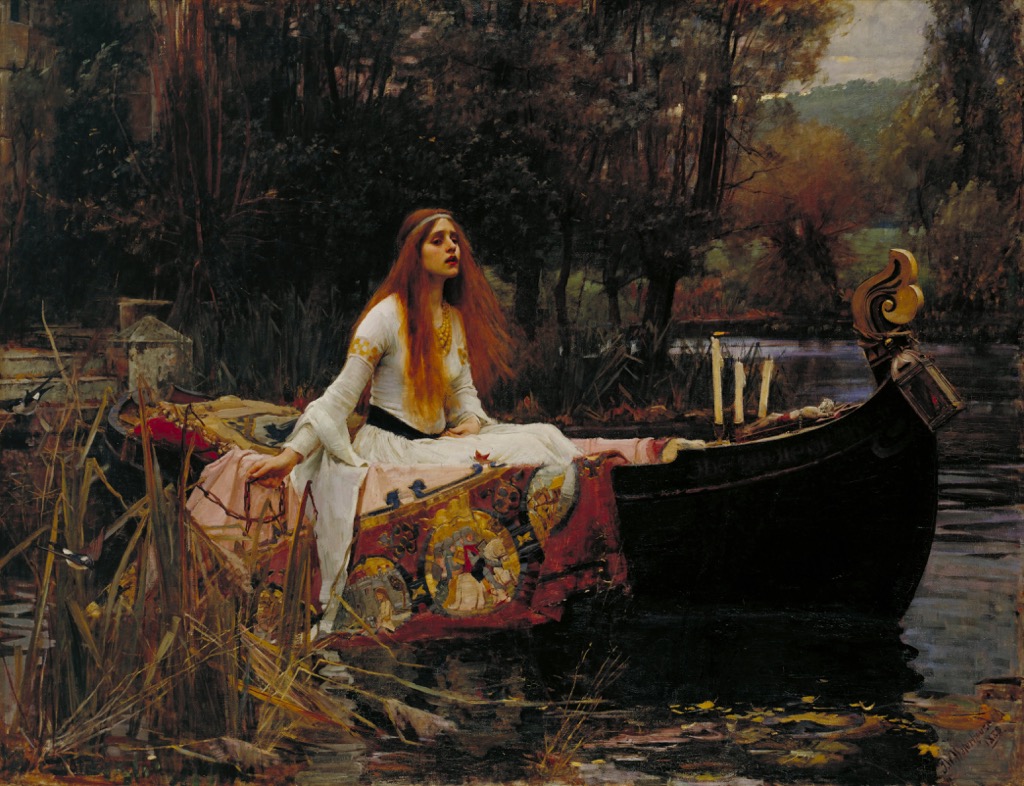
- The Lady of Shalott: Compare Waterhouse's best-known literary composition.
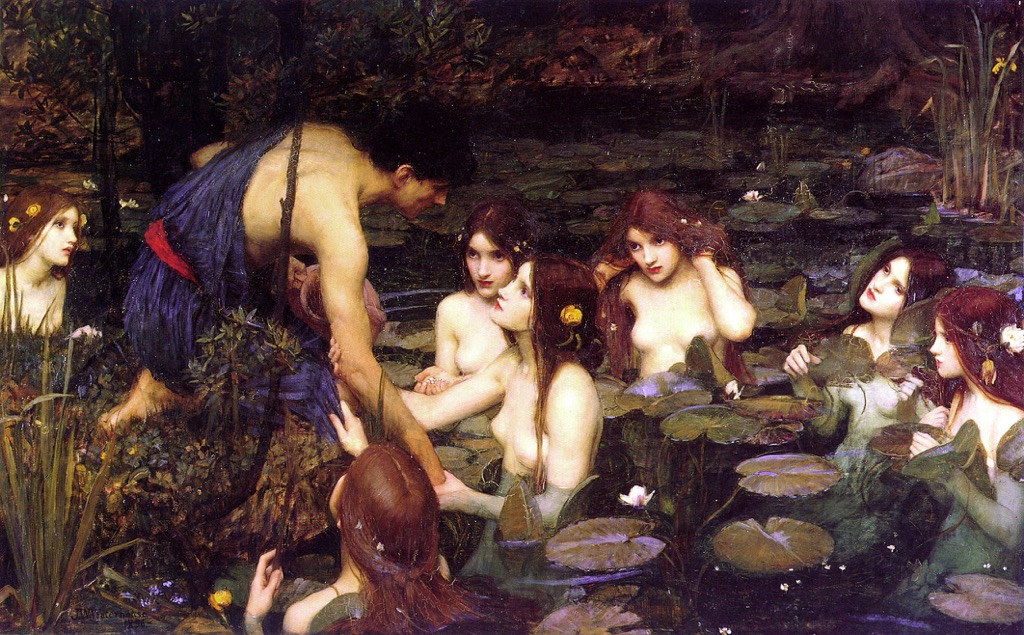
- Hylas and the Nymphs: Compare another major mythological scene.
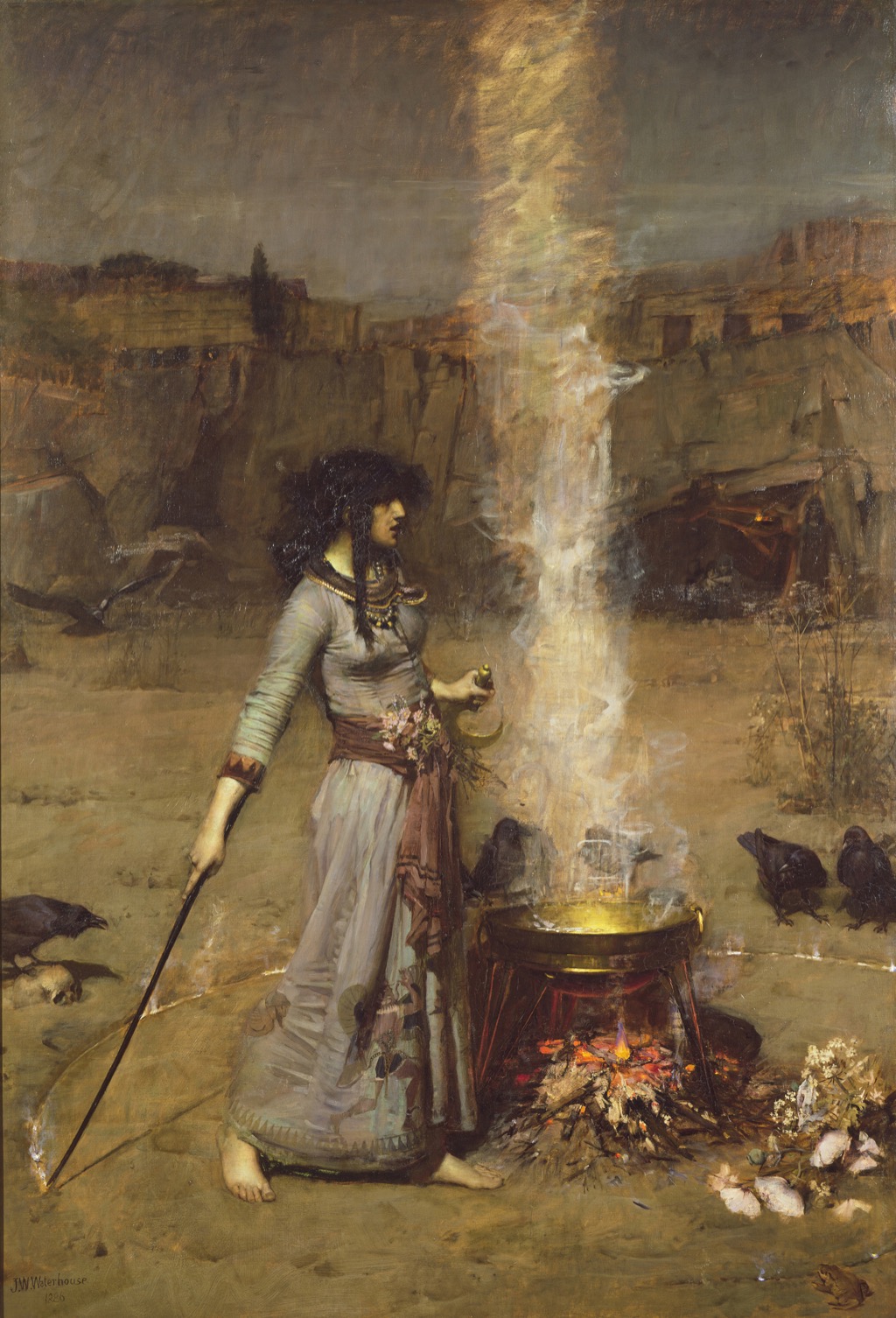
- The Magic Circle: Compare Waterhouse's treatment of ritual and symbolism.
Frequently Asked Questions
Boreas is the Greek personification of the north wind, associated with cold air arriving from Thrace. [2]
No surviving evidence identifies her as a named goddess. Spring flowers connect her to seasonal change, but calling her Spring as a fixed identity would be interpretive.
The painting does not show the abduction described in Greek myth. Boreas is present as wind, not as a visible male god, and the woman is not securely identified as Oreithyia. [2]
Waterhouse signed and dated it in 1903. It was exhibited at the Royal Academy in 1904. [1]
It is in a private collection. It had been considered lost before its rediscovery and auction appearance. [1]
The canvas measures 94 × 68.8 cm. [1]
Discussion
Boreas gives classical myth the lightest possible touch. The god is a title, a direction and a temperature. Waterhouse leaves viewers with a woman, flowers and the bodily experience of crossing wind.
The painting's apparent simplicity is its discipline. It does not explain why the woman looks wistful or where she is going. Instead it makes transition itself meaningful: winter has not ended, spring has already begun, and a human figure moves between them carrying the pressure of both.
Reader Insights
Which visible detail most changes the way you read this page?
Which source or comparison helps the work feel less familiar and more specific?
What question would you bring back to the painting after reading?
Join the Conversation
Share your reading of this page below.
References
- Christie's. “John William Waterhouse, Boreas,” object record and catalogue essay, with signature, dimensions, Royal Academy exhibition, rediscovery and related works. View source
- Oxford Classical Dictionary. “Boreas,” account of the Greek north wind and the Oreithyia tradition. View source
- Algernon Graves. The Royal Academy of Arts: A Complete Dictionary of Contributors and Their Work from Its Foundation in 1769 to 1904, Waterhouse entry. View source