

 Buy Art Prints Now
from Amazon
* As an Amazon Associate I earn from qualifying purchases.
Image reference [image]
 by Tom Gurney
Tom Gurney BSc (Hons) is an art history expert with over 20 years experience
Published on August 14, 2026 / Updated on August 14, 2026
Email: tomgurney1@gmail.com / Phone: +44 7429 011000
Dolce Far Niente (1880): Introduction
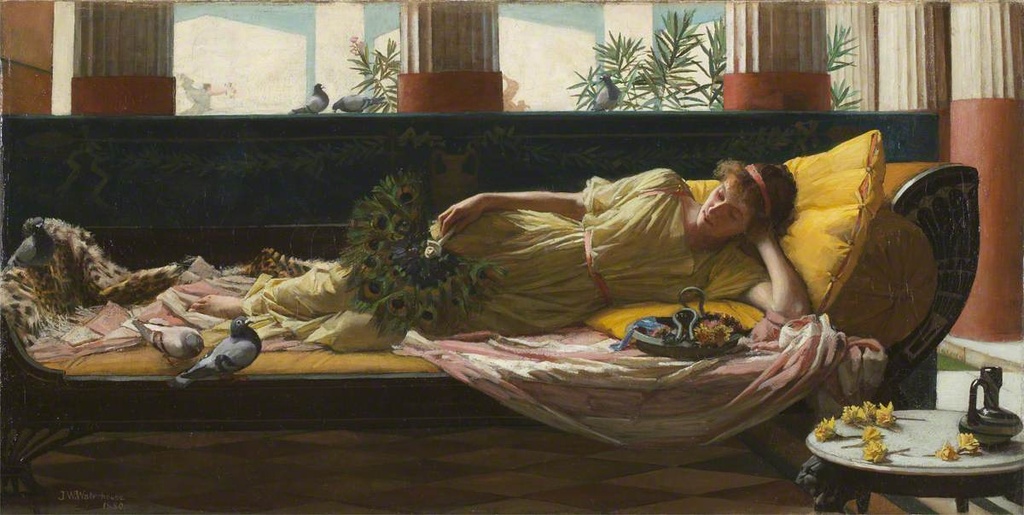
John William Waterhouse's Dolce Far Niente of 1880 presents idleness as an intricately arranged condition. A young woman reclines across a long, low couch in an imagined classical interior. She holds a peacock-feather fan while birds, flowers, patterned fabric and animal skin distribute small visual pleasures around her. Nothing urgent happens, yet the painting is far from empty.
The Italian title means the sweetness or pleasure of doing nothing. Waterhouse had used it one year earlier for a different upright painting, creating an identity problem that follows both works online. This page concerns the wide 1880 canvas in the Fife Council collection at Kirkcaldy Galleries, accession KIRMG:15—not the smaller 1879 picture once miscatalogued as The White Feather Fan. [1] [2] [3]
At a Glance
- ArtistJohn William Waterhouse
- Date1880 [1] [2]
- MediumOil on canvas [1] [2]
- Dimensions50 × 97 cm [1]
- CollectionFife Council; held at Kirkcaldy Galleries [1] [2]
- Accession numberKIRMG:15 [1]
- Credit lineGiven by Mrs John Harley in 1927 [1]
- SubjectA reclining woman at leisure in an imagined classical interior
- Title meaningThe sweetness or pleasure of doing nothing
- Identity warningA distinct 1879 Waterhouse painting bears the same title [3]
Contents
- Introduction
- Which Dolce Far Niente is this?
- What the 1880 painting shows
- The meaning of “dolce far niente”
- Reclining, looking and doing nothing
- Fan, birds, flowers and animal skin
- Classical interior and Victorian Aestheticism
- Light, colour and painterly change
- Comparison with the 1879 version
- From private gift to Kirkcaldy Galleries
Which Dolce Far Niente is this?
Waterhouse made two very different paintings titled Dolce Far Niente in consecutive years. The distinction must be established before interpretation begins.
The 1880 work is a broad horizontal oil measuring 50 by 97 centimetres. It belongs to Fife Council and is associated with Kirkcaldy Galleries under accession number KIRMG:15. [1] [2] Its reclining figure stretches across the composition and holds a peacock-feather fan.
The 1879 work is an upright oil measuring 49.6 by 36.2 centimetres. It is signed and dated and has a separate provenance through the Dudley Gallery and later sales. Its woman holds a white feather fan, and the picture was at one point mistakenly catalogued as The White Feather Fan. [3]
These are not preparatory and finished states of one composition. Christie's explicitly describes them as “two totally different paintings bearing the same title.” [3] Their figures, orientations, fans, surroundings and ownership histories differ.
Search results often collapse them because titles are treated as unique identifiers. The problem becomes worse when an image of one version is paired with the dimensions or date of the other.
The safest naming practice adds the year: Dolce Far Niente (1879) and Dolce Far Niente (1880). For the 1880 work, collection and accession number provide further confirmation.
That precision is not pedantry. The two paintings offer different answers to the same theme. Comparing them is valuable only after each object has been kept intact.
What the 1880 painting shows
A young woman reclines from left to right across a couch or bed-like support. Her body creates the composition's main horizontal rhythm, while the folds and edges beneath her extend that rhythm across the long canvas.
She holds a large fan formed from peacock feathers. Its eyespots introduce an arresting decorative pattern near her upper body. The fan may provide relief from heat, occupy an idle hand or function principally as an Aesthetic object.
Birds—often described as doves or pigeons—appear within the surrounding space. Their small bodies offer another kind of leisurely life: feeding, resting or moving without narrative consequence.
Flowers punctuate the interior with living colour. Fabric and a spotted animal skin produce contrasting surfaces beneath and around the figure. These materials ask to be seen slowly.
The setting evokes the ancient Mediterranean through costume, furniture and architecture, but it does not announce one named historical event. The woman is not identified as a goddess, empress or literary heroine.
That absence of narrative is intentional. The title tells us what kind of time we are seeing rather than who the protagonist is. Her inactivity is the subject.
The wide format encourages the eye to wander rather than strike one climax. Figure, fan, birds and flowers form stopping places across a continuous field. Looking becomes analogous to lingering.
The meaning of “dolce far niente”
The Italian phrase dolce far niente is usually translated as “the sweetness of doing nothing” or “sweet idleness.” “Nothing” does not mean unconsciousness or absolute vacancy. It suggests time released from duty, production and haste.
Waterhouse's woman still performs small actions. She holds a fan, looks, shifts weight and occupies a sensorial environment. The title removes those actions from a plot of useful labour.
For a Victorian audience, leisure carried questions of class and gender. Sustained idleness required material support, and paintings of beautiful women at rest could turn privilege into spectacle. The scene does not show who maintains the room, grows the flowers or supplies the luxurious objects.
At the same time, the picture offers a genuine imaginative pleasure. Its pace opposes the disciplined schedules of industrial and professional life. A viewer can inhabit pause through sustained looking even without sharing the figure's circumstances.
The Italian wording contributes distance. It makes leisure sound culturally specific, elegant and connected to Mediterranean climate. In a British exhibition or home, the phrase could evoke warmth and travel as much as inactivity.
The title is therefore both descriptive and promotional. It gives the work an atmosphere that a literal title such as Reclining Woman with a Fan would not.
Waterhouse used the phrase twice because it named a theme rather than a unique episode. In both versions, doing nothing frees painting from the demand to explain what happens next.
There is also a productive paradox in the title's grammar. “Doing” remains present even when its object is “nothing.” Leisure is represented as a chosen practice rather than a blank interval accidentally left between meaningful events. The woman occupies her time through sensation: the movement of air from the fan, the nearness of birds, the softness and warmth of layered materials. Waterhouse's own labour is still more evident. Every appearance of effortless ease depends upon decisions about pose, colour, texture and proportion. The finished canvas makes strenuous construction disappear into apparent naturalness. In that sense, dolce far niente names what the artwork offers its viewer, not how the artwork was produced. We may pause before it; painter and model had to work to create the conditions of that pause.
Reclining, looking and doing nothing
The reclining pose offers rest while also making the body available across the picture surface. Waterhouse must negotiate between the woman's apparent self-possession and the spectator's ability to inspect her.
She does not labour, plead or suffer. Unlike many later Waterhouse heroines, she is not trapped by prophecy, curse or violent myth. Her situation has no declared danger.
Yet leisure is not identical to freedom. The figure remains arranged within an interior and within a painting made for view. Her stillness can become decorative, much as the flowers and fabrics do.
The fan helps preserve agency. It belongs to her hand and can hide, reveal, cool or distract. A fan is an object with mobile possibilities even when the composition fixes it.
Her body does not align perfectly with the room's hard edges. Curves, bent limbs and drapery soften architectural order. Waterhouse makes relaxation legible through the contrast between an yielding figure and structured setting.
The spectator's time is equally important. A plot-driven picture rewards quick recognition of a crisis. Dolce Far Niente rewards delay. Its minor motifs become significant because there is no urgent centre to hurry towards.
The work can thus be understood as a picture about looking at a person who has time not to act. That situation is attractive, but it also reveals the social privilege embedded in “sweet idleness.”
Waterhouse does not solve the tension. He turns it into the painting's condition: sensuous ease offered for contemplation, constructed through careful artistic work.
Fan, birds, flowers and animal skin
The peacock-feather fan is the most memorable accessory. Its repeated eyes create the curious sensation of a decorative object that seems to look back. It is both useful prop and concentrated ornament.
Peacock feathers could suggest splendour, display and cultivated taste. It is unnecessary to force them into one symbolic code. Their immediate function is visual: dark eyespots, iridescent associations and radiating structure oppose the long horizontals of couch and body.
Birds give the interior a gentle animation. They prevent idleness from appearing as frozen isolation. Their presence also strengthens the sense of a permeable Mediterranean domestic space, open enough for animal life.
Flowers introduce fragility. Like leisure, bloom is temporary. Yet the painting does not convert them into an explicit moral warning about death. They contribute to abundance and to the sensorial present.
The spotted animal skin beneath the woman provides irregular pattern and tactile contrast. It can evoke luxury and exotic acquisition while functioning as a softened support.
Fabric joins these materials through fold and colour. Waterhouse's subject gives him permission to make texture itself eventful. Feather, petal, fur, cloth and flesh become the picture's vocabulary.
None of these objects advances a story in the conventional sense. They instead organise attention. One looks from fan to bird, flower to skin, then returns to the reclining figure.
This circuit explains why “doing nothing” is not pictorial emptiness. The woman's leisure creates room for things to become noticeable.
Classical interior and Victorian Aestheticism
Waterhouse's architecture and costume evoke classical antiquity, a field he had explored throughout the 1870s. Yet Dolce Far Niente does not reconstruct a recorded Roman incident.
Its classical world functions as aesthetic permission. Draped dress, low furniture, open architectural space and luxurious accessories remove the figure from modern British routine.
The work also participates in Aestheticism, the late-nineteenth-century emphasis on beauty, formal harmony and artistic experience rather than compulsory moral narrative. Christie's explains that Aesthetic-minded artists favoured idleness because it released them from illustrating stories or pointing morals. [3]
The 1879 version makes that relation especially explicit through sunflowers and a self-contained woman. The 1880 canvas changes the composition but retains the broader Aesthetic premise: atmosphere can be sufficient subject.
Lawrence Alma-Tadema and Albert Moore provided important contemporary precedents for classically dressed figures engaged in trivial or indeterminate activity. Christie's identifies both artists when discussing Waterhouse's 1879 experiment. [3] The 1880 work continues the conversation in a more panoramic form.
Influence does not mean imitation without difference. Waterhouse's handling, figure type and later narrative interests would develop in their own direction. These early leisure pictures show him testing how little story a successful classical painting required.
The imagined past also protects the scene from immediate social specificity. The viewer can enjoy leisure as “Roman” beauty without confronting a recognisable modern drawing room. That distance is part of the work's charm and its ideology.
Light, colour and painterly change
The two Dolce Far Niente pictures belong to a moment when Waterhouse's palette and handling were becoming lighter. Christie's describes the 1879 canvas as a turn away from the dark, melancholy interiors of works such as A Sick Child Brought into the Temple of Aesculapius and The Remorse of Nero. [3]
It connects this change with European naturalism, French Impressionist controversy and Alma-Tadema's lighter tonal example. Waterhouse used shorter, broken strokes and thicker paint in places. [3]
Those observations apply directly to the 1879 work, but they illuminate the 1880 version's place within an experiment. The wide painting opens space around its reclining figure and distributes light across varied objects.
The lighter key is not simply cheerfulness. It changes how form is built. Instead of emerging from a dark dramatic chamber, the figure shares visibility with wall, couch, feathers and flowers.
Colour can therefore create pace. Repeated notes draw the eye horizontally; sharper accents interrupt them. The viewer's wandering route embodies the picture's leisure.
The public digital image should be treated as a guide rather than a perfect record of colour. Screens, photography and reproduction alter the balance among warm stone, fabric and flesh. Dimensions and composition remain firmer catalogue facts. [1] [2]
Waterhouse's eventual reputation for jewel-like Pre-Raphaelite colour can make early tonal development seem inevitable. It was not. These works show an artist actively testing alternatives to the sombre history painting with which he had first attracted attention.
Comparison with the 1879 version
The 1879 Dolce Far Niente places a different woman in a compact upright interior. She holds a white feather fan, and three loose feathers lead the eye through the space towards a hanging lamp. Sunflowers reinforce the picture's Aesthetic context. [3]
Its dimensions—49.6 by 36.2 centimetres—make it much narrower than the 1880 painting. [3] The woman's partially averted face and closed setting intensify self-containment.
The 1880 version expands sideways. Its peacock fan is denser and more patterned, its body more fully extended and its surrounding objects more widely dispersed.
Both works turn idleness into a formal opportunity, but the structures differ. The 1879 canvas emphasises asymmetry, upward arcs and mottled wall. The 1880 canvas emphasises breadth and recumbent rhythm.
The earlier work's mistaken title, The White Feather Fan, arose because its accessory is so distinctive. [3] That label should never be applied to the Kirkcaldy painting, whose fan is made from peacock feathers.
The 1879 provenance includes the Dudley Gallery that year, Charles J. Galloway and a Christie's sale in 1905; it later appeared in the 2008–10 Waterhouse retrospective and at auction in 2010. [3] None of that is the 1880 object's provenance.
Comparison is valuable because it reveals Waterhouse treating a title like a prompt. He did not make a replica. He asked twice how a body, room and collection of beautiful things might suspend useful time.
From private gift to Kirkcaldy Galleries
The 1880 painting belongs to Fife Council's collection and is held at Kirkcaldy Galleries. Its accession number is KIRMG:15, and the collection record reproduced through Art UK states that Mrs John Harley gave it in 1927. [1] [2]
That credit line distinguishes it decisively from the 1879 private work. It also connects a London artist's classical reverie with a Scottish civic collection.
OnFife describes its fine-art holdings as more than 1,200 works, with particular strengths in nineteenth- and early-twentieth-century art. The collection grew around Kirkcaldy Museum & Art Gallery and the activity of industrialist and collector J. W. Blyth. [5]
Dolce Far Niente sits within that broader public history. An image initially made for the art market became a civic object accessible through a museum service.
Art UK's record and shop reproduction identify Fife Council and credit Fife Cultural Trust on behalf of the council. [2] Collection names can vary across platforms—Kirkcaldy Museum and Art Gallery, Kirkcaldy Galleries, Fife Council—but accession number anchors the object.
Because display status can change, the painting can be described as “held by” Kirkcaldy Galleries without guaranteeing that it hangs in a permanent room on every visit. OnFife advises visitors about current exhibitions and access. [4]
The 1927 gift is also a reminder that provenance is part of public value. Mrs John Harley's act moved a private painting into collective stewardship, allowing the wide 1880 version to remain institutionally visible while its 1879 counterpart returned to private ownership.
Why the painting matters
The 1880 Dolce Far Niente is important because it shows Waterhouse before the literary heroines that dominate his popular reputation. Its woman is unnamed, its classical setting untethered to a famous myth and its action deliberately slight.
The work demonstrates that narrative reduction was not a late retreat. Waterhouse explored atmosphere, surface and suspended time early in his career.
It also records his engagement with Aestheticism and with artists such as Alma-Tadema and Albert Moore. Leisure gives him a testing ground for lighter colour, textured paint and the decorative arrangement of the body.
The painting's title remains intellectually useful. “Sweet doing nothing” describes both the woman's state and the viewer's invitation. The eye is permitted to linger without solving a crisis.
Yet the social conditions of that sweetness should remain visible. Her leisure is materially luxurious, gendered and presented for inspection. Pleasure and critique can coexist.
Most of all, the painting deserves an identity independent from the 1879 version. The Kirkcaldy canvas has its own dimensions, fan, collection history and horizontal rhythm. Once those facts are secure, comparison enriches both works instead of confusing them.
Related Pages
- A Roman Offering: Compare another compact classical interior by Waterhouse.
- The Shrine: Compare Waterhouse’s interest in richly arranged ritual interiors.
- The Charmer: Compare a later Waterhouse figure whose meaning stays deliberately open.
Frequently Asked Questions
It means the sweetness or pleasure of doing nothing—an ideal of unhurried leisure.
It measures 50 by 97 centimetres. [1]
No reliable object record used here identifies her as a named historical, mythological or literary figure.
No. That mistaken alternate title was applied to the different 1879 Dolce Far Niente, whose model holds a white feather fan. [3]
Two distinct compositions are securely documented, one dated 1879 and the other 1880. [3]
The work is held there, but gallery displays can change. Check the venue's current information before travelling. [4]
Discussion
Dolce Far Niente turns apparent inactivity into an active way of seeing. Because no myth demands explanation, peacock feather, bird, flower, fabric and skin receive unusual attention. The wide canvas makes looking itself unhurried.
Waterhouse's pleasure in surface does not eliminate complexity. The reclining woman is both self-contained and displayed; the classical setting is both escapist and formally experimental; leisure is both desirable and privileged.
Reader Insights
Which visible detail most changes the way you read this page?
Which source or comparison helps the work feel less familiar and more specific?
What question would you bring back to the painting after reading?
Join the Conversation
Share your reading of this page below.
References
- Image reference
- Wikimedia Commons / Art UK object data, “John William Waterhouse — Dolce Far Niente (1880),” date, medium, dimensions, collection, accession number and 1927 credit line. View source
- Art UK, “Dolce far niente by John William Waterhouse,” collection and image record identifying the 1880 oil and Fife Council ownership. View source
- Christie's, “John William Waterhouse, Dolce Far Niente,” record and scholarly catalogue essay for the distinct 1879 version, including dimensions, provenance, exhibition history and comparison with the Kirkcaldy painting. View source
- OnFife, “Kirkcaldy Galleries,” official venue information and current-visit guidance. View source
- OnFife, “Fine Art,” official overview of the Fife fine-art collection and its institutional history. View source