 by Tom Gurney
Tom Gurney BSc (Hons) is an art history expert with over 20 years experience
Email: tomgurney1@gmail.com / Phone: +44 7429 011000
A Coign of Vantage: Introduction
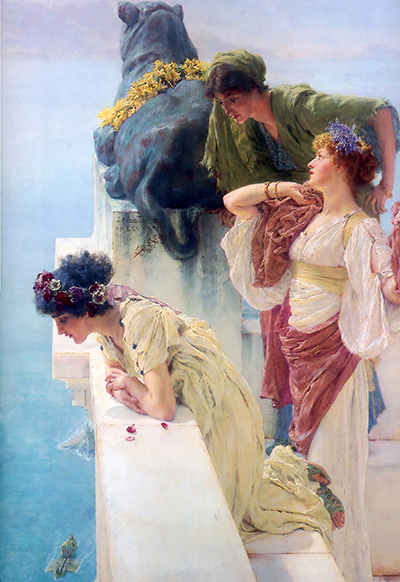
Three women occupy a marble lookout high above a Mediterranean bay in Lawrence Alma-Tadema’s A Coign of Vantage. The nearest has sunk to her knees to see over the edge. Behind her, a bronze sphinx faces the open water, while two tiny vessels pass far below. Alma-Tadema painted the scene in 1895 in oil on a panel measuring 63.8 by 44.7 centimetres. He put his signature and opus number, CCCXXXIII, on the sphinx’s plinth, making the record of his authorship look like an inscription within the scene. [1]
At a Glance
- Date1895 [1]
- MediumOil on panel, 63.8 × 44.7 cm [1]
- OpusCCCXXXIII [1]
- Alternate titleOn the Terrace, recorded at the 1964 sale [1]
This work across Lawrence Alma-Tadema’s career
Contents
- The view from the parapet
- The bronze and its possible model on Capri
- What are the women watching?
- How Alma-Tadema returned to the composition
- From London to New York and back
- Annotated details
The view from the parapet
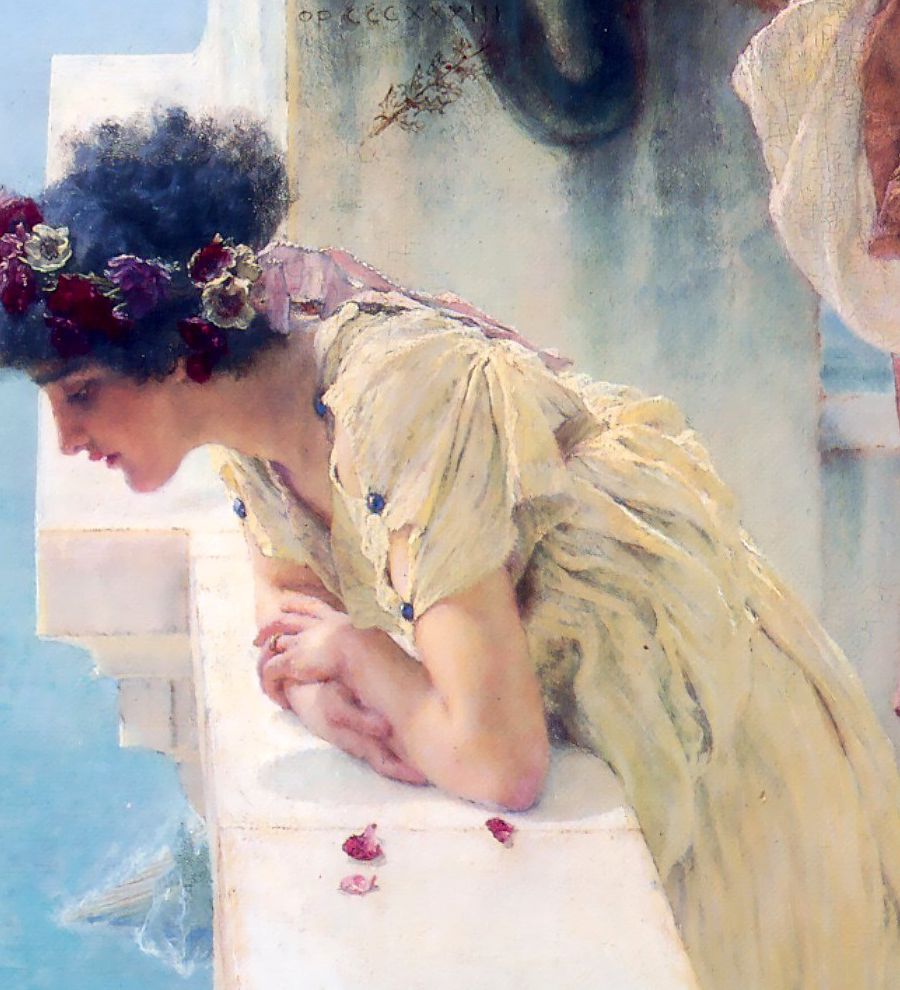
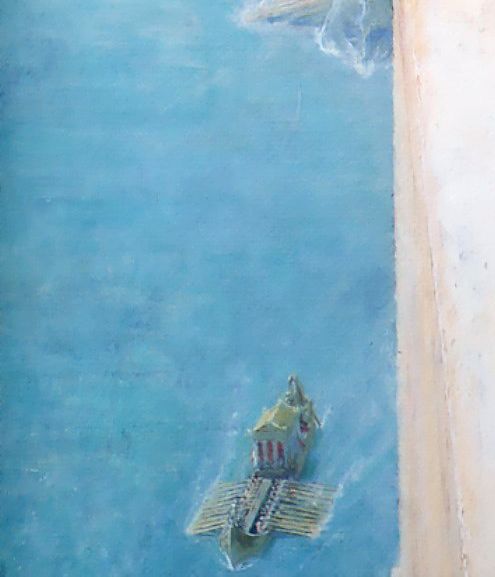
The breadth of the parapet in the foreground gives us a good sense of where we are standing. Its polished top enters at the bottom of the picture and narrows towards the woman in pale yellow. Her forearms rest on it, her hands loosely folded. Along the outer edge, a little section of moulding projects over the water. Beyond that lip there is a sheer exposure from the marble to the blue. One vessel passes partly out of view behind the wall, and the other sits close to the lower left corner of the panel. Their size relative to the women makes it possible to gauge the fall even though the foot of the building is out of sight. [1]
Above the figures, the painter gives us a gentler measure of distance. The sea pales as it meets the thin strip of sky, and the distant slopes fade into a lavender haze. There is little to fix the eye there. The colour is strongest where the water comes nearest the wall in the picture, so the blue appears both just beyond reach and a long way down. The narrow format can hold those two sensations at once. It keeps the shoreline and the boats within a single field of view while asking us to look first outwards, then down. [1]
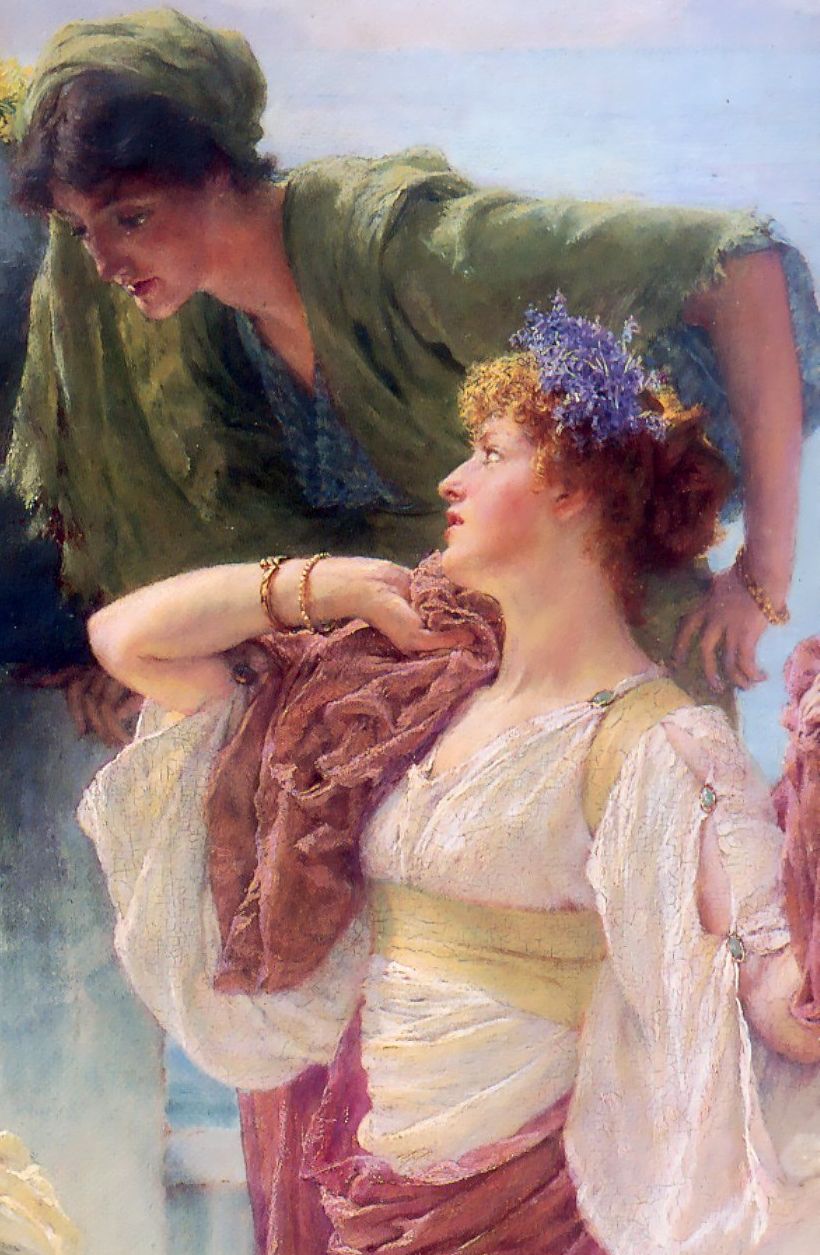
The woman in white at the right turns her face towards the woman in green, who bends over her shoulder. The woman in yellow, with her weight on both forearms, is already intent on something below. The others seem to be taking their cue from her. The differing angles of their heads allow for an exchange that might last only a moment. A few petals on the parapet sit close to the folded hands, while the open sleeves and delicate bracelets at the right sharpen the contrast between the women's small movements and the heavy slabs that support them. [1]
A coign is a corner, and the phrase in the title evokes a position that offers an advantage. In Shakespeare’s Macbeth, Banquo uses it when describing the corners and projections of the castle where martlets have found places to nest. The phrase suits Alma-Tadema’s terrace in both senses. There is a usable corner of masonry and a view that opens up only when someone reaches it. Part of the pleasure of the painting comes from finding out what the figures can see from such a small patch of stone. [5]
Annotated Details from A Coign of Vantage
The numbered points mark details in A Coign of Vantage. Catalogue record. Public domain.
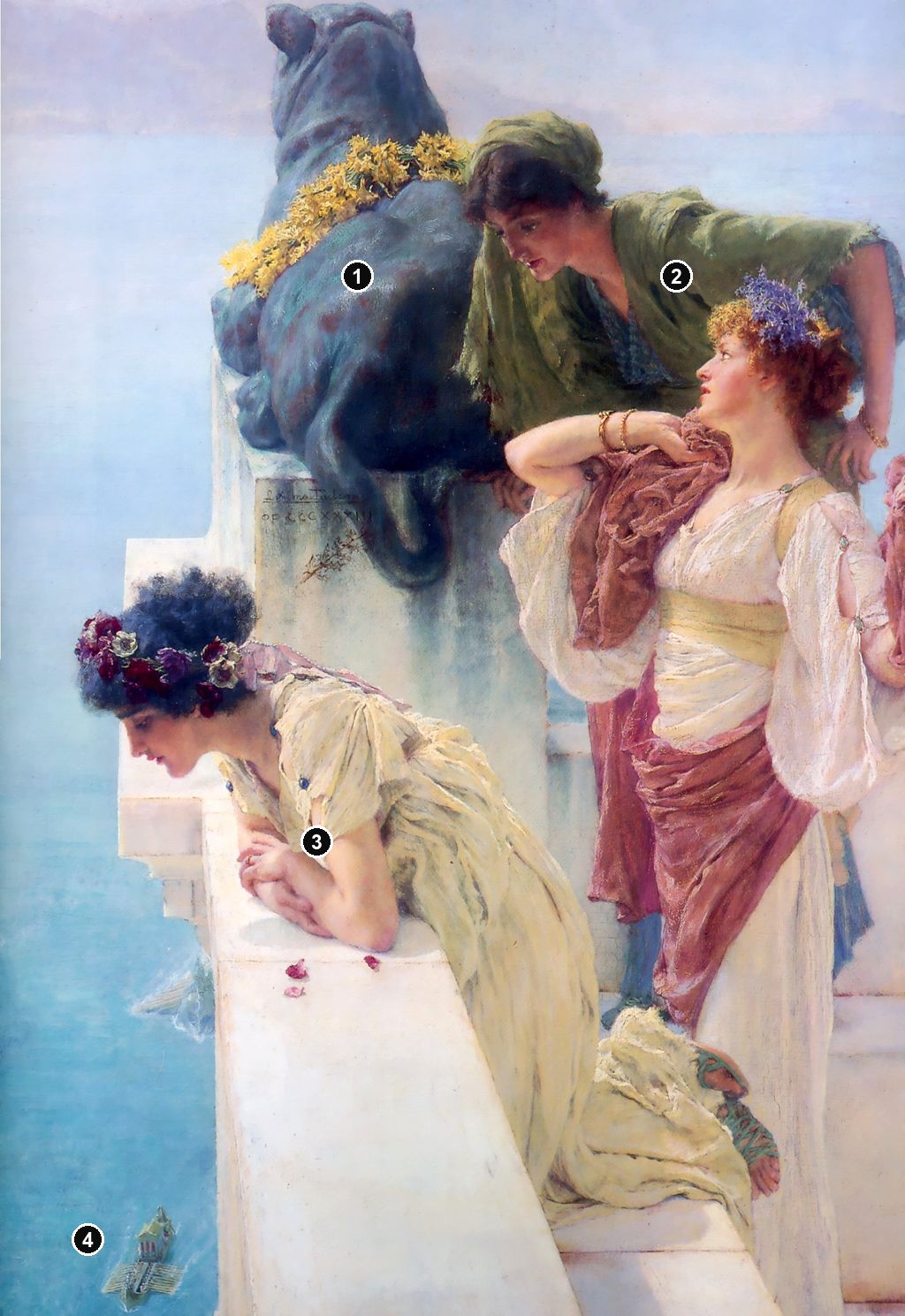
Details from A COIGN OF VANTAGE
Select a numbered point or use the details below to examine a part of the painting.
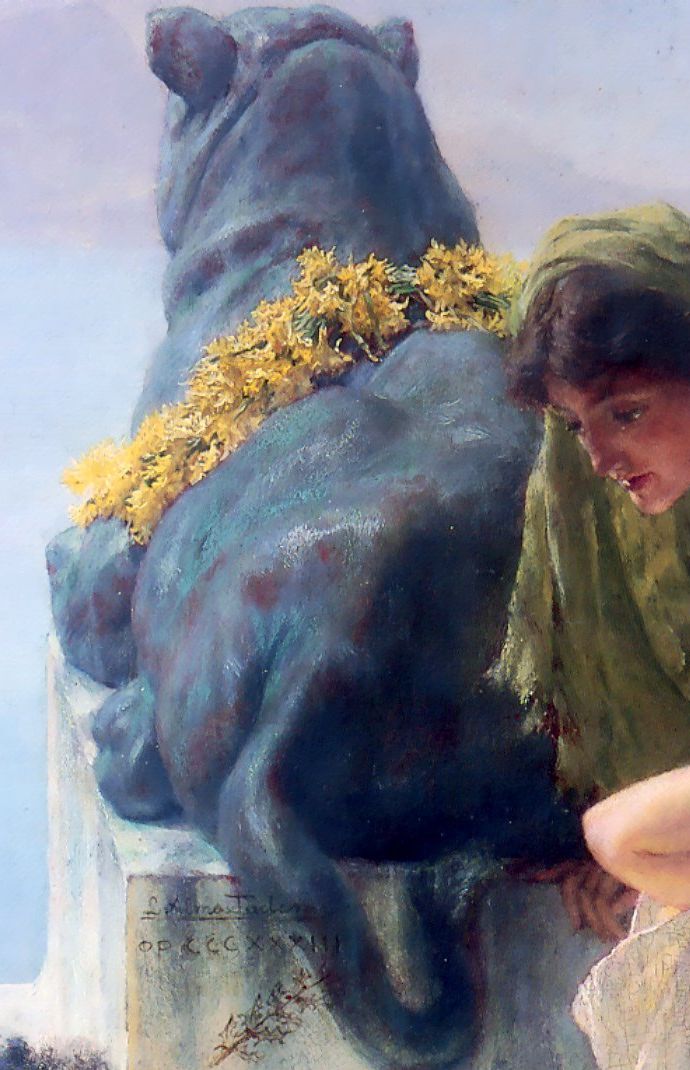
The bronze and its garland
The curl of the bronze’s tail and the flowers across its back stand out against the blue water. The plinth carries the partly visible signature and opus inscription.
Two women look in different directions
The woman in pink turns up towards her companion. The nearer woman in green bends forward and looks down over the terrace.
Hands, petals and the edge of the terrace
The folded arms settle on the bright stone. The scattered petals interrupt the bare parapet and point towards the drop beneath it.
The boat far below the terrace
The oars spread on either side of the boat and a small covering rises above the hull. The view from the terrace makes the boat appear tiny.
The bronze and its possible model on Capri
The sculpture sits higher than the women and faces away from us. Its broad back catches a dull green light, its tail curls down across the plinth, and a garland of yellow flowers lies across its shoulders. From behind, its feline body is easy to read and its face is hidden. A reviewer for The Athenæum in November 1895 called it a crouching bronze lioness. The catalogue of the 2023 sale uses sphinx. The difference is understandable given the view the painter affords us. The flowers make the sculpture part of the social life of the terrace, and the darkness of the bronze makes the flesh, the marble and the pale clothes around it seem brighter. [6] [1]
As reported by Sotheby’s, the Dutch scholar Frederic Bastet proposed that Alma-Tadema freely adapted the Egyptian sphinx now at Villa San Michele in Anacapri. The villa describes its sphinx as around 3,200 years old and carved in red granite. The comparison is particularly persuasive as an arrangement. A crouching animal crowns a high coastal lookout in each case. In the painting the sculpture has the dark and mottled surface of bronze, and the plinth, garland and view from behind all help give it a character of its own. [7] [8]
The stone sculpture has its own uncertain history. Axel Munthe described dreaming about it and going in search of it, but the villa treats the circumstances of its acquisition as unknown. Archaeologist Kristine Bülow Clausen discusses a suggested association with the sanctuary of Isis at Benevento on the strength of similarities to sculptures found there. She also notes the possibility that Munthe acquired it through the antiquities market in Rome or Pozzuoli. His biographer Bengt Jangfeldt traces the villa’s development through letters from the years after Alma-Tadema finished the picture. The completed terrace at Anacapri makes a good comparison, although its construction chronology leaves open where the sphinx was in 1895 and how Alma-Tadema might have known it. [8] [9] [10]
What are the women watching?
The Athenæum read the boats as war galleys. Its reviewer imagined that the woman at the edge was trying to pick out a lover among the crew of the nearest vessel and found the attitudes of her companions particularly animated. The view also encouraged that reviewer to picture a whole procession beyond the space shown. The surviving image gives us two craft, one of them substantially obscured, and plenty of room to wonder what else may be passing below. [6] [1]
Writing more than a century later, the classicist Quentin Broughall saw greater likeness to leisure craft on the Bay of Naples, where wealthy Romans had coastal villas and went out boating. He pointed to Seneca’s account of pleasure parties at Baiae. Christie’s likewise draws attention to what looks like a deck awning on the more visible vessel. That detail favours the leisure reading, although the distance makes it hard to infer the crews’ purpose or the identities of individual passengers. Broughall reads the spaciousness and serenity of the bay as part of Alma-Tadema’s larger interest in how privileged Romans experienced the Mediterranean. Here there is room in the scene for the work of rowing, the comfort of travellers under cover and the leisure of those who look down on them. [11] [1]
A romantic reading can survive either identification of the boats. Art historian Joan Mut i Arbós places the painting in a group of Alma-Tadema subjects in which women look from terraces or passages towards a desired figure whose presence the viewer can only infer. In Unconscious Rivals of 1893, the richly carved rail and the cropped figure of an ancient statue help suggest an interest beyond the figures’ immediate surroundings. In A Coign of Vantage, whatever draws the closest woman to the edge is at a scale that makes it impossible for us to recognise. The 1903 Silver Favourites offers another comparison. Its figures direct their attention into a pool much nearer at hand, with the open Mediterranean beyond them. The three paintings show how a change in the object of attention can make a marble terrace the setting for quite different kinds of leisure and expectancy. [12] [13] [11] [14]
How Alma-Tadema returned to the composition
Alma-Tadema revisited the high coastal terrace in The Ever-New Horizon, dated 1903 in the auction records. Charles Oliver Murray’s signed 1904 engraving preserves its three-figure arrangement. One woman stretches out a veil beside the high wall, while the pale parapet retains its steep diagonal. The print places an arched inset where the earlier picture gives such prominence to the plinth and bronze. The sphinx is absent even at this intermediate stage. Christie’s and Sotheby’s trace the subsequent At Aphrodite’s Cradle, Opus CCCLXXXIX, to a substantial reworking of the 1903 composition for Thomas Agnew & Sons, documented in November 1908. In the reworking five women gather on a narrower stretch of marble. The 1895 panel has an independent history, and it is the arrangement of figures, stone and sea that the artist returns to across these works. [15] [16] [7]
The bronze is absent from At Aphrodite’s Cradle as well. The later group presses closer together, and the yellow flower held in a woman’s hand picks up a colour that Alma-Tadema had lavished on the sculpted animal’s garland in 1895. The two boats that help orient the eye in 1895 give way in the later picture to open water. Wherever the women are looking, we are left to follow the direction of their gaze. In the 1895 panel, by comparison, the ships keep sending the eye back from the women and the sphinx to the depth beneath the terrace. [1] [7] [16]
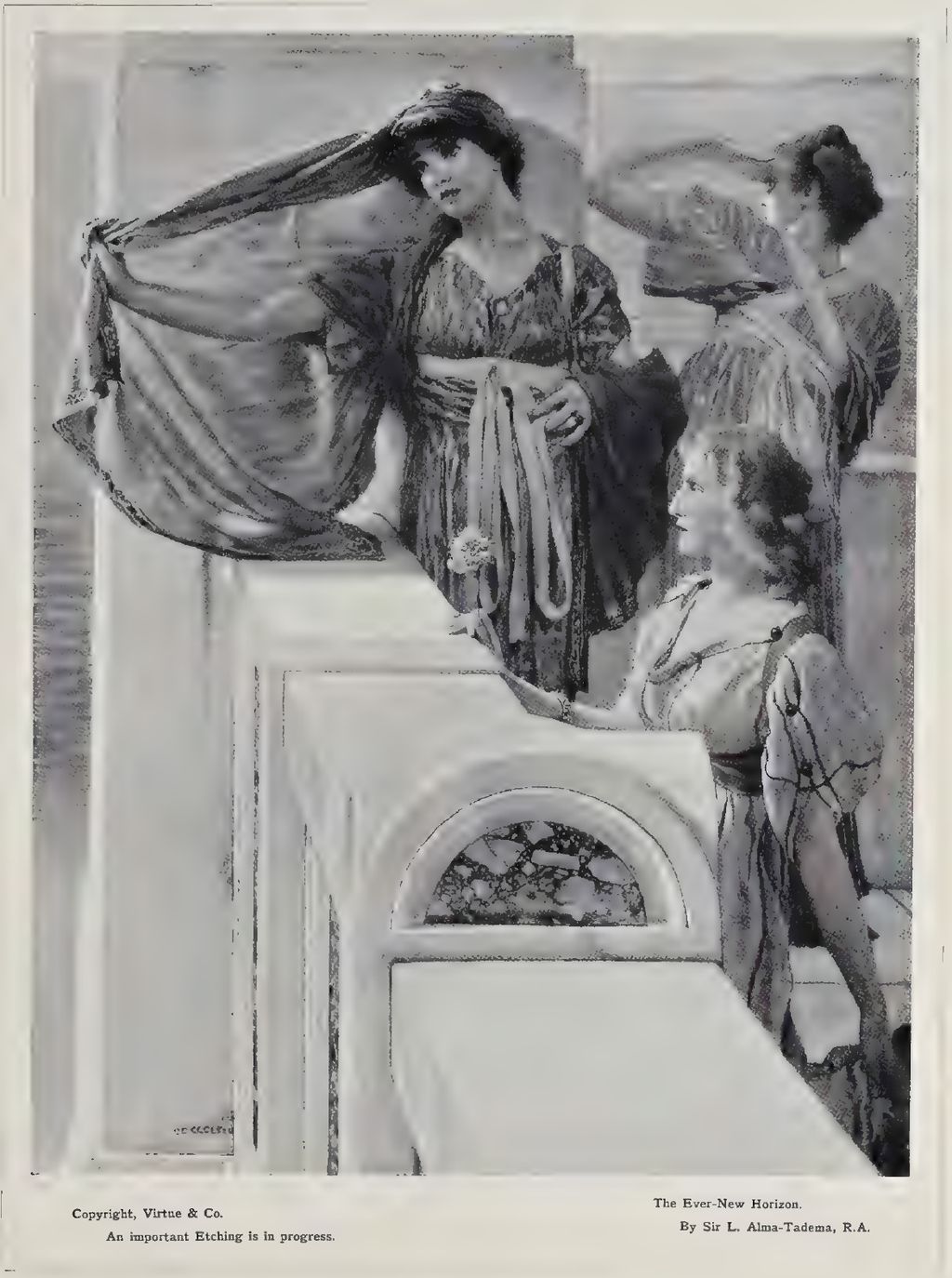
The earlier, three-figure Ever-New Horizon as reproduced in The Art Journal’s Royal Academy review, 1904, p. 183. Getty Research Institute copy, digitised by Internet Archive. Image source. Public domain.
From London to New York and back
On 30 November 1895, The Athenæum told its readers that the newly finished picture would soon go to New York. Christie’s records the painting with the London dealer Arthur Tooth & Sons, probably direct from Alma-Tadema. M. Knoedler & Co. acquired it from Tooth on 23 December. Clarence Melville Hyde and Lillia Babbitt Hyde bought it from Knoedler on 19 February 1896. The image began a separate life in print quite early. The Akron Art Museum holds a photogravure dated 1897, given by Knoedler. Akron connects the steep perspective of the image to Alma-Tadema’s interest in photography and Japanese prints. The tight crop and the way the parapet divides the open sea from the light-filled terrace give the composition a structure that readily carries over into print. [6] [1] [17]
Christie’s traces the panel from Lillia Hyde’s estate sale at Parke-Bernet in 1940 to the dealer L. J. Marion, probably Louis J. Marion, and records it with Gimbels Art Gallery by 1945. It next appears in the collection of the designer Terrence Harold Robsjohn-Gibbings. At his Sotheby’s sale in London in February 1964, it was catalogued under the title On the Terrace and was acquired by Charles Jerdein. The title in the 1895 review establishes that A Coign of Vantage was already in use when the work was new. [1] [6]
By 1969, the painting belonged to Allen and Marilyn Funt. It was on loan to the Metropolitan Museum of Art in 1971–72 and then appeared there as catalogue number 27 in Victorians in Togas. The museum brought together 35 paintings from the Funts’ collection between 9 March and 29 April 1973. That November the Fine Art Society bought the picture at the Funt sale in London. John Stanley Marshall Scott owned it from 1974 to at least 1977. In April 1977 Ann and Gordon Getty acquired the panel from the London firm M. Newman for their private collection. [1] [18]
In 1996 the Van Gogh Museum used A Coign of Vantage to promote its Alma-Tadema retrospective. The historian Robert Verhoogt recalls that the image was seen across Amsterdam on posters at tram and bus stops, as well as on the catalogue cover and on postcards. The panel later travelled with At Home in Antiquity, which took it to Leeuwarden, Vienna and London in 2016–17. The Belvedere again used the image on the cover of its press material for the Vienna exhibition. [19] [1] [20]
The Gettys’ home in Berkeley was called Temple of Wings. In the 2023 sale catalogue, Christie’s compared its position overlooking San Francisco Bay to that of an ancient coastal villa on the Bay of Naples. There the painting’s outlook would have echoed the view from the house. On 14 June 2023 the panel returned to auction in New York, where Christie’s reported a price of $7,068,000. [1] [21]
Lawrence Alma-Tadema artworks directory
Search by title or medium. The directory includes Alma-Tadema’s numbered compositions, separately catalogued fragments, and selected drawings and historic prints. Dates for unlinked works follow the catalogue’s year groupings. View the numbered opus catalogue
| Name | Date | Medium |
|---|---|---|
| Portrait of my sister Artje | 1851 | Painting |
| Selfportrait | 1852 | Painting |
| Portrait of my mother (oval) | 1852 | Painting |
| The alm | 1856 | Painting |
| The inundation of the Biesbosch in 1421 | 1857 | Painting |
| The destruction of Terdoest Abbey in 1571 | 1857 | Painting |
| Faust en Marguerite | 1857 | Watercolour |
| Clotilde at the tomb of her grandchildren | 1858 | Painting |
| Marius on the ruins of Carthage | 1858 | Watercolour |
| The sad father: the unfavourable oracle (Death of the first-born, first version) | 1859 | Painting |
| The death of Attila, 453 AD | 1859 | Watercolour |
| Triumphal return of Sir Willem van Saeftingen | 1860 | Painting |
| The death of Hippolyte | 1860 | Watercolour |
| The Education of the Children of Clovis | 1861 | Painting |
| Venantius Fortunatus reading his poems to Radagonda VI | 1862 | Painting |
| Gunthram Bose and his daughters, 572 AD: the Ambuscade | 1862 | Painting |
| A medieval Flemish interior | 1863 | Painting |
| Pastimes in Ancient Egypt: 3.000 years ago | 1863 | Painting |
| Interior of the Church San Clemente, Rome: a study | 1863 | Painting |
| Queen Fredegonda at the deathbed of Bishop Praetextatus (first version) | 1864 | Painting |
| Leaving Church in the fifteenth century | 1864 | Painting |
| Egyptian Chess Players (An Egyptian Game) | 1865 | Painting |
| Birthday presents in the sixteenth century | 1865 | Painting |
| Gallo-Roman women | 1865 | Painting |
| Entering Church in the fourteenth century | 1865 | Painting |
| An Egyptian at his doorway in Memphis | 1865 | Painting |
| Catallus ten huize van Lesbia | 1865 | Painting |
| The discourse | 1865 | Painting |
| A Roman scribe writing despatches | 1865 | Painting |
| A soldier of Marathon | 1865 | Painting |
| Home from market | 1865 | Painting |
| Death of Galeswinthe | 1865 | Painting |
| An Egyptian Game (preparatory drawing) | 1865 | Drawing |
| Making wreaths for festivities in a Pompeian house | 1866 | Painting |
| Vespasian hearing of the taking of Jerusalem by Titus | 1866 | Painting |
| Entrance to a Roman theatre | 1866 | Painting |
| In the peristyle | 1866 | Painting |
| Agrippina visiting the ashes of Germanicus | 1866 | Painting |
| Tibullus at Delia's | 1866 | Painting |
| A Roman dance | 1866 | Painting |
| Lesbia weeping over a sparrow | 1866 | Painting |
| The armourer's shop in ancient Rome | 1866 | Painting |
| The Education of the Children of Clovis (Rennefeld print after Alma-Tadema) | 1866 | |
| The mummy: Roman period: Egyptians lamenting their dead | 1867 | Painting |
| The honeymoon | 1867 | Painting |
| Cuckoo | 1867 | Painting |
| The aesthetic view: Madame Dumoulin, Pauline, and Laurence | 1867 | Painting |
| Glaucus and Nydia | 1867 | Painting |
| Portrait of Mr A. Bonnefoy | 1867 | Painting |
| Proclaiming Claudius Emperor | 1867 | Painting |
| A sculpture gallery in Rome at the time of Augustus | 1867 | Painting |
| A collector of pictures at the time of Augustus | 1867 | Painting |
| Tarquinius Superbus before Galba | 1867 | Painting |
| A Roman family | 1867 | Painting |
| Italian women | 1867 | Painting |
| Portrait of Madame Bonnefoy and Mr Puttemans | 1867 | Painting |
| The siësta (first version) | 1868 | Drawing |
| The embarkation | 1868 | Painting |
| The siësta (second version) | 1868 | Painting |
| A Roman art lover | 1868 | Painting |
| Woman and flowers | 1868 | Painting |
| Phidias and the Parthenon, Athens | 1868 | Painting |
| The flower girl | 1868 | Painting |
| A Roman flower market: Pompeii | 1868 | Painting |
| Egyptian game | 1868 | Watercolour |
| Education of the children of Clovis | 1868 | Painting |
| A Roman art lover: silver statue | 1868 | Painting |
| Egyptian dancing girls | 1868 | Watercolour |
| Catalina | 1869 | Painting |
| The visit: Sunday morning before churching (first version): a birth chamber, seventeenth century | 1869 | Painting |
| The Pyrrhic dance | 1869 | Painting |
| The Grand Chamberlain of Sesostris the Great | 1869 | Painting |
| The convalescent | 1869 | Painting |
| Confidences | 1869 | Painting |
| A Greek Woman | 1869 | Painting |
| At the wine shop | 1869 | Painting |
| An Exedra (first version) | 1869 | Painting |
| Portrait of Master Ernest Angely | 1870 | Painting |
| A juggler | 1870 | Painting |
| A nurse, seventeenth century: Sunday morning (second version) | 1870 | Watercolour |
| Roman art lover (the runner ) | 1870 | Painting |
| Anacreon reading his poems at Lesbia's house | 1870 | Painting |
| The vintage festival (first version) | 1870 | Painting |
| The first whisper of love | 1870 | Painting |
| The letter: from an absent one (first version) | 1870 | Painting |
| A staircase (first version) | 1870 | Painting |
| Hush, she sleeps | 1870 | Painting |
| The letter: from an absent one (second version) | 1871 | Watercolour |
| The vintage festival (second version) | 1871 | Painting |
| A Roman Emperor (second version) | 1871 | Painting |
| In the temple (first version) | 1871 | Painting |
| Portrait of Miss Laura Theresa Epps | 1871 | Painting |
| A Bacchic dance | 1871 | Painting |
| Fredegonda and Praetextatus (second version) | 1871 | Painting |
| Portrait study for Mrs H.W. Mesdag | 1871 | Painting |
| Greek potters | 1871 | Painting |
| An exedra (second version) | 1871 | Watercolour |
| Sunday morning: the two sisters (third version) | 1871 | Painting |
| In the temple (second version) | 1872 | Watercolour |
| The first reproach | 1872 | Painting |
| An Egyptian widow | 1872 | Painting |
| Improvisatore | 1872 | Painting |
| A halt (first version) | 1872 | Painting |
| The last roses | 1872 | Painting |
| Death of the first-born (second version) | 1872 | Painting |
| Portrait of Dr Franz and Mrs Catherine Hueffer 'When I am dead, oh dearest sing' | 1872 | Painting |
| The nurse | 1872 | Painting |
| Greek wine (first version) | 1872 | Painting |
| Goldfish (first version) | 1872 | Painting |
| On a Roman staircase (second version) | 1872 | Watercolour |
| Hercules | 1872 | Painting |
| Portrait of Miss Kate Thompson | 1873 | Painting |
| The dinner (first version) | 1873 | Painting |
| The siësta (third version) | 1873 | Painting |
| A visit to the studio (second version) | 1873 | Watercolour |
| Cherries | 1873 | Painting |
| Greek wine (second version) | 1873 | Watercolour |
| This is our corner | 1873 | Painting |
| A picture gallery (third version) | 1873 | Painting |
| The last roses (second version) | 1873 | Watercolour |
| Fishing (first version) | 1873 | Painting |
| Music has charms | 1873 | Watercolour |
| Counting the passers-by | 1873 | Watercolour |
| Portrait of Mrs Frederick George Stephens | 1873 | Painting |
| Two heads from 'The Picture Gallery': A visit to the studio by Charles W. Deschamps and his wife (first version) | 1874 | Watercolour |
| Joseph, overseer of Pharaoh's granaries | 1874 | Painting |
| A sculpturegallery (first version) | 1874 | Painting |
| A picture gallery in Rome at the time of Augustus (fourth version) | 1874 | Painting |
| Portrait of Charles W. Deschamps and his wife (second version) | 1874 | Painting |
| Autumn | 1874 | Watercolour |
| Reflections: fishing (second version) | 1874 | Painting |
| A Roman artist | 1874 | Watercolour |
| Good friends | 1874 | Watercolour |
| On the steps of the Capitol (first version) | 1874 | Painting |
| Water pets: goldfish (second version) | 1874 | Painting |
| Münster Cathedral | 1874 | Painting |
| Landscape near Münster | 1874 | Painting |
| Antistius Labeon, 75 AD: A Roman amateur artist | 1874 | Painting |
| Sunny days | 1874 | Painting |
| Spring flowers: garland seller on the steps of the Capitol (second version) | 1874 | Watercolour |
| Through an archway | 1874 | Painting |
| (A, B) Decoration for my piano: 'Serious and merry music' | 1874 | Painting |
| Rêverie | 1874 | Painting |
| The Roman architect | 1874 | Painting |
| Sunflowers | 1874 | Painting |
| Landscape: carriage drive by the outskirts of a wood, Penhill Castle | 1875 | Painting |
| A peep through the trees | 1875 | Painting |
| Cleopatra (first version) | 1875 | Painting |
| (a, b, c) The tragedy of an honest wife | 1875 | Watercolour |
| The architect of the Coliseum | 1875 | Watercolour |
| Fishing | 1875 | Watercolour |
| Cherry blossom | 1875 | Painting |
| Water pets: goldfish (third version) | 1875 | Painting |
| 'There he is!' | 1875 | Painting |
| Play Garden | 1875 | Painting |
| Portrait of Miss Thackeray's 'Elisabeth' | 1875 | Painting |
| A nymphaeum from the Villa Aldobrandini in Rome | 1875 | Painting |
| Haystacks | 1875 | Painting |
| A sculpture gallery (second version) | 1875 | Painting |
| After the dance: a bacchanal | 1875 | Painting |
| Landscape: a breezy day in August near Innsbruck | 1875 | Painting |
| The service | 1875 | Painting |
| An audience at Agrippa's (first version) | 1875 | Painting |
| Kriemhild’s Tryste | 1875 | |
| Portrait of my wife | 1876 | Painting |
| Between hope and fear | 1876 | Painting |
| 94 Degrees in the Shade | 1876 | Painting |
| An antique custom | 1876 | Painting |
| Portrait of Jules Dalou, his wife and his daughter | 1876 | Painting |
| Pleading (first version) | 1876 | Painting |
| Hide and seek | 1876 | Painting |
| Balneatrix | 1876 | Watercolour |
| A mirror | 1877 | Painting |
| An interesting scroll | 1877 | Watercolour |
| Winter | 1877 | Painting |
| Autumn-vintage festival | 1877 | Painting |
| Summer | 1877 | Painting |
| Spring in the gardens of the Villa Borghese (first version) | 1877 | Painting |
| A balneator | 1877 | Watercolour |
| Painting in Ancient Rome | 1877 | Painting |
| A balneatrix | 1877 | Painting |
| The sculptor's model (Venus Esquilina) | 1877 | Painting |
| The sculptor's studio in ancient Rome | 1877 | Painting |
| Architecture in ancient Rome | 1877 | Painting |
| Cleopatra (second version) | 1877 | Painting |
| Spring in the gardens of the Villa Borghese (second version) | 1877 | Painting |
| Panel for H. W. Mesdag's studio door: Spring in the gardens of the Villa Borghese (third version) | 1877 | Painting |
| The question: Pleading (second version) | 1877 | Painting |
| A kitchen garden | 1877 | Painting |
| Flora: Spring in the gardens of the Villa Borghese (fourth version) | 1877 | Watercolour |
| A silent counsellor | 1878 | Watercolour |
| A sollicitation | 1878 | Watercolour |
| A hearty welcome | 1878 | Painting |
| A landscape | 1878 | Painting |
| In the time of Constantine | 1878 | Painting |
| A love missile | 1878 | Painting |
| Fredegonda en Galswintha, 566 AD | 1878 | Painting |
| A safe confidant | 1878 | Painting |
| After the audience (second version) | 1879 | Painting |
| Strigils andsponges | 1879 | Watercolour |
| E festival in Pomona | 1879 | Painting |
| Prose | 1879 | Painting |
| Going down to the river | 1879 | Painting |
| The Roman wine tasters | 1879 | Watercolour |
| Portrait of th singer George Henschel Esq. at the piano | 1879 | Painting |
| Poetry | 1879 | Painting |
| A well-protected slumber | 1879 | Painting |
| A garden altar | 1879 | Painting |
| Beauties | 1879 | Painting |
| Portrait of Thekla Friedländer | 1879 | Unspecified |
| On the road to the Temple of Ceres: A springfestival | 1879 | Painting |
| Autumn (third version) | 1879 | Drawing |
| 'Not at home' | 1879 | Painting |
| An old bachelor after the bath | 1879 | Watercolour |
| Spring (Blanchard print after Alma-Tadema’s 1877 painting) | 1879 | |
| The first course: the dinner | 1880 | Painting |
| Interrupted | 1880 | Painting |
| Grapes | 1880 | Watercolour |
| A pastoral | 1880 | Painting |
| A portrait of Dr Felix and Mrs August Redeker Semon | 1880 | Painting |
| Ave Caesar! Io Saturnalia! (third version) | 1880 | Painting |
| A prize for the artist's corps | 1880 | Painting |
| The departure (first version) | 1880 | Painting |
| A harvest festival | 1880 | Painting |
| 'Your carriage stops the way' | 1880 | Painting |
| Autumn (Scene in a Roman Garden) | c.1880 | Drawing |
| The torch dance | 1881 | Painting |
| Sappho and Alcaeus | 1881 | Painting |
| A kiss | 1881 | Watercolour |
| A Bacchante dancing before the thymele | 1881 | Watercolour |
| An audience | 1881 | Painting |
| Portrait of Dr Hans Richter | 1881 | Painting |
| Pandora | 1881 | Watercolour |
| The Tepidarium | 1881 | Painting |
| Quiet pets | 1881 | Painting |
| A priestess of Apollo | 1881 | Watercolour |
| A difficult line from Horace (first version) | 1881 | Painting |
| A stranger in my studio (one of a pair) | 1881 | Painting |
| Amo te ama me | 1881 | Painting |
| The First Course–The Dinner (Löwenstam print after Alma-Tadema) | 1881 | |
| Young affections | 1882 | Painting |
| A difficult line from Horace (second version) | 1882 | Drawing |
| Portrait of John F. Whichcord Esq., PRIBA, FSA | 1882 | Painting |
| Portrait of Ludwig Barnay as Marcus Antonius | 1882 | Painting |
| The way to the temple | 1882 | Painting |
| A parting kiss | 1882 | Painting |
| Reflections | 1882 | Painting |
| Between Venus and Bacchus | 1882 | Watercolour |
| Dolce far niente (first version) | 1882 | Watercolour |
| Dolce far niente (second version) | 1882 | Painting |
| An Oleander | 1882 | Painting |
| The meeting of Antony and Cleopatra | 1883 | Painting |
| Portrait of Catherine, Duchess of Cleveland | 1883 | Painting |
| Portrait of my daughter Anna Alma-Tadema | 1883 | Painting |
| Shy | 1883 | Painting |
| Portrait of His Excellency the Duke of Bylandt | 1883 | Painting |
| Una Carita: The three graces: Laura, Laurence, and Anna | 1883 | Painting |
| Portrait of Leopold Lowenstam, the engraver | 1883 | Painting |
| Portrait of Lady Thompson | 1883 | Painting |
| Portrait of Professor Giovanni Battista Amendola | 1883 | Painting |
| 'Der alte Menander ist doch nicht gestorben!' Paulus and Hermas | 1883 | Drawing |
| A street altar | 1883 | Watercolour |
| Welcome Footsteps (The Well-Known Footsteps) | 1883 | Painting |
| A declaration: an old, old story | 1883 | Watercolour |
| Xanthe and Phaon | 1883 | Watercolour |
| Selfportrait | 1883 | Painting |
| Hadrian in England: visiting a Roman-British Pottery (original, later divided) | 1884 | Painting |
| A Roman-British pottery | 1884 | Painting |
| Emperor Hadrian's visit to a British pottery | 1884 | Painting |
| A Roman-British potter | 1884 | Painting |
| Portrait of Miss Alice Lewis | 1884 | Painting |
| Who is it? | 1884 | Painting |
| Portrait of Moses Ezekiel | 1884 | Painting |
| Portrait of Sir Francis Powell | 1884 | Painting |
| Egyptien à l’entrée de sa demeure (Ramus print after Alma-Tadema) | 1884 | |
| Expectations | 1885 | Painting |
| A Reading from Homer | 1885 | Painting |
| Portrait of Dr Wahington Napoleon Epps: my docter | 1885 | Painting |
| The triumph of Titus: the Flavians | 1885 | Painting |
| Ariadne | 1885 | Painting |
| Portrait of Mrs W. M. Baker | 1885 | Painting |
| Rose of all roses | 1885 | Painting |
| A foregone conclusion | 1885 | Painting |
| A apodyterium | 1886 | Painting |
| Portrait of James Reld Esq. | 1886 | Painting |
| Portrait of Mrs Frank D. Millet | 1886 | Painting |
| A secret | 1887 | Painting |
| The Women of Amphissa | 1887 | Painting |
| A new dress | 1887 | Watercolour |
| 'He loves me, he loves me not' | 1887 | Painting |
| Illuminated letter 'W' for the Royal Academy address to Queen Victoria | 1887 | Watercolour |
| Portia | 1887 | Painting |
| The Roses of Heliogabalus | 1888 | Painting |
| Fair tresses: a sketch | 1888 | Painting |
| Midday slumbers | 1888 | Watercolour |
| Portrait of the honourable Adama van Scheltema | 1888 | Painting |
| Venus and Mars | 1888 | Painting |
| Portrait of Jules de Soria | 1888 | Painting |
| At the shrine of Venus | 1888 | Painting |
| The Favourite Poet | 1888 | Painting |
| The Favourite Poet (Löwenstam print after Alma-Tadema) | c.1888 | |
| Sisters | 1889 | Painting |
| Cloaked in yellow | 1889 | Painting |
| A dedication to Bacchus (first version) | 1889 | Painting |
| A dedication to Bacchus (second version) | 1889 | Painting |
| Portrait of Mrs Ralph Sneyd | 1889 | Painting |
| Portrait of Miss MacWhirter (Mrs Charles Sims) | 1889 | Painting |
| Portrait of young gentleman John Parsons Millet | 1889 | Painting |
| In a rose garden | 1889 | Painting |
| A Silent Greeting | 1889 | Painting |
| Portrait of Sir Ernest A. Waterlow, Esq., RA | 1889 | Painting |
| Eloquent silence | 1890 | Painting |
| The Frigidarium | 1890 | Painting |
| Promise of Spring | 1890 | Painting |
| Portrait of Miss Agnes Marks | 1890 | Painting |
| Rêverie: a sketch | 1890 | Painting |
| Portrait of the Right Hon. Arthur James Balfour | 1891 | Painting |
| An earthly paradise | 1891 | Painting |
| Love's votaries; Love in idleness | 1891 | Painting |
| Portrait of the Honourable Archdean Watkins of Durham, DD | 1891 | Painting |
| Portrait of Alfred Waterhouse Esq. RA | 1891 | Painting |
| Portrait of Ignacy Jan Paderewski | 1891 | Painting |
| The kiss | 1891 | Painting |
| Calling the worshippers | 1892 | Watercolour |
| The poet Gallus dreaming | 1892 | Painting |
| Courtship | 1892 | Painting |
| Comparisons | 1892 | Painting |
| The inner sanctuary | 1892 | Painting |
| Portrait of Dr Joseph Joachim | 1893 | Painting |
| In the corner of my studio | 1893 | Painting |
| Portrait of Mrs Charles Wyllie | 1893 | Painting |
| Unconscious Rivals | 1893 | Painting |
| Godspeed | 1893 | Painting |
| Portrait of Mrs Theyre Smith | 1893 | Painting |
| At the close of a joyful day | 1894 | Painting |
| The benediction | 1894 | Painting |
| Spring | 1894 | Painting |
| Past and present generations | 1894 | Painting |
| God Speed (Löwenstam print after Alma-Tadema) | 1894 | |
| Love's jewelled fetter | 1895 | Painting |
| Fortune's favourite | 1895 | Painting |
| Portrait of Mrs Roland Hill and her children | 1895 | Painting |
| Portrait of George Simmonds and family | 1895 | Painting |
| Unwelcome confidence | 1895 | Painting |
| A Coign of Vantage | 1895 | Painting |
| Portrait of Mrs Marcus Stone | 1895 | Painting |
| Whispering Noon | 1896 | Painting |
| The Coliseum | 1896 | Painting |
| Familygroup | 1896 | Painting |
| Portrait of Miss Onslow Ford | 1896 | Painting |
| A Difference of Opinion | 1896 | Painting |
| Portrait of Maurice Sons Esq. playing the violin in Alma-Tadema's studio | 1896 | Painting |
| Selfportrait | 1896 | Painting |
| 'Nobody asked you sir!' she said | 1896 | Watercolour |
| Portrait of J. M. Zarifi Esq. | 1897 | Painting |
| Watching and waiting | 1897 | Painting |
| 'Her eyes are with her thoughts, and they are far away' | 1897 | Painting |
| Wandering thoughts | 1897 | Painting |
| Melody on a Mediterranean terrace | 1897 | Painting |
| Roses, love's delight | 1897 | Painting |
| A Difference of Opinion (Boulard print after Alma-Tadema) | 1897 | |
| Portrait of Lady Sydney (Margaret) Waterlow | 1898 | Painting |
| The conversion of Paula by St. Jerome | 1898 | Painting |
| Portrait of Tine Son-Maris | 1898 | Painting |
| Hero | 1898 | Painting |
| Portrait of Mrs George Lewis and her daughter Elisabeth | 1899 | Painting |
| The listeners | 1899 | Painting |
| Attracted: watchers | 1899 | Watercolour |
| The Baths of Caracalla (Thermae Antoninianae) | 1899 | Painting |
| Bluebells | 1899 | Painting |
| Study for Thermaie Antoniniane | 1899 | Drawing |
| A flag of truce | 1900 | Painting |
| Goldfish (fourth version) | 1900 | Painting |
| Portrait of Mrs Armour from Princeton | 1900 | Painting |
| Portrait of George Aitchison, PRIBA, RA | 1900 | Painting |
| Vain courtship | 1900 | Painting |
| Under the roof of blue Ionian weather | 1901 | Painting |
| Death of the first born (third version) | 1901 | Drawing |
| A priestess of Hymen | 1901 | Watercolour |
| Fair tresses | 1901 | Painting |
| Impatient | 1901 | Watercolour |
| Portrait of Sir Max Waechter High Sheriff of Sussex | 1901 | Painting |
| The year's at the spring, all's right with the world | 1902 | Painting |
| Caracalla | 1902 | Painting |
| A crown | 1902 | Watercolour |
| Amongst the ruins | 1902 | Painting |
| Silver Favourites | 1903 | Painting |
| A peaceful wooing | 1903 | Painting |
| The ever-new horizon | 1903 | Painting |
| Thalia's homage to Aesculapius | 1904 | Drawing |
| The Finding of Moses | 1904 | Painting |
| A world of their own | 1905 | Painting |
| Ask Me No More | 1906 | Painting |
| Entering the Coliseum (first version) | 1907 | Watercolour |
| Geta and his sister | 1907 | Drawing |
| Caracalla and Geta | 1907 | Painting |
| Orante (oval, one of a pair) | 1907 | Painting |
| Bacchante (oval, one of a pair) | 1907 | Painting |
| Melodie del mare e dell'amore | 1907 | Watercolour |
| Youth | 1907 | Watercolour |
| Portrait of myself for the R. Accademia Romana di San Luca | 1907 | Painting |
| The golden hour | 1907 | Painting |
| At Aphrodite’s Cradle | 1908 | Painting |
| A message of love | 1909 | Painting |
| A Favourite Custom | 1909 | Painting |
| Splashing | 1909 | Drawing |
| Portrait of Mrs Washington Epps | 1909 | Drawing |
| Hopeful | 1909 | Painting |
| Portrait of Dr J. M. W. van der Poorten-Schwartz (Maarten Maartens) | 1909 | Drawing |
| Portrait of Ilona Eibenschutz | 1909 | Painting |
| The voice of spring | 1910 | Painting |
| Principal figure of 'The voice of spring' | 1910 | Drawing |
| A border for the King's letter to the nation | 1910 | Drawing |
| Heading: the Royal Academy address to H.M. King George on his accession to the throne | 1910 | Watercolour |
| Title unknown | 1910 | Unspecified |
| When flowers return (one of a pair) | 1911 | Painting |
| Summer Offering | 1911 | Painting |
| Title unknown | 1911 | Unspecified |
| Entering the Coliseum (second version) | 1911 | Painting |
| Portrait of William Whitaker Thompson Esq. | 1911 | Painting |
| Portrait of myself for the R. Accademia Romana di San Luca | 1912 | Painting |
| Preparations in the Coliseum | 1912 | Painting |
Discussion
Look again at the images and ideas explored in A Coign of Vantage. These editorial prompts invite your observations.
Reader Insights
Where does the view make the terrace feel highest?
How does each woman’s gaze change your sense of what is happening below?
Join the Conversation
Share a detail, comparison or question about A Coign of Vantage below.
References
- Christie’s, A Coign of Vantage, Temple of Wings, lot 26, 14 June 2023, illustrated object entry, provenance and exhibitions. View source.
- Walters Art Museum, Sappho and Alcaeus. View source.
- Christie’s, The Roses of Heliogabalus. View source.
- Tate, A Favourite Custom. View source.
- William Shakespeare, Macbeth, act 1, scene 6, Banquo’s speech outside the castle, Folger Shakespeare Library edition. View source.
- The Athenæum, ‘Fine Art Gossip’, no. 3553, 30 November 1895, pp. 759–760. View source.
- Sotheby’s, At Aphrodite’s Cradle (The Ever-New Horizon), lot 204, 2006, catalogue note and provenance, citing Frederic Bastet in Sir Lawrence Alma-Tadema (1996), p. 256. View source.
- Villa San Michele, ‘The Collection’, entry and photographs for the Egyptian sphinx. View source.
- Kristine Bülow Clausen, The Flavian Isea in Beneventum and Rome, University of Copenhagen, 2015, n. 406. View source.
- Bengt Jangfeldt, Axel Munthe: The Road to San Michele, ‘The Dream of San Michele’, pp. 153–157. View source.
- Quentin J. Broughall, ‘Changing Their Sky, Not Their Soul: Lawrence Alma-Tadema’s Vision of the Ancient Mediterranean’, in Rosario Rovira Guardiola (ed.), The Ancient Mediterranean Sea in Modern Visual and Performing Arts, Bloomsbury Academic, 2017, pp. 204–205 and notes 56–62. View source.
- Joan Mut i Arbós, ‘The Symbolism of Love and Death in The Coliseum by Alma-Tadema’, Polysèmes 29, 2023, paras. 19–20 and figs. 12–14. View source.
- Bristol Museums, Galleries and Archives, Unconscious Rivals, illustrated collection entry. View source.
- Manchester Art Gallery, Silver Favourites, artwork image and object details via Art UK. View source.
- Inter-antiquariaat Mefferdt & De Jonge, Alma-Tadema en de Klassieke Oudheid, no. 36, Charles Oliver Murray’s 1904 engraving after The Ever-New Horizon, Opus CCCLXXV. View source.
- Christie’s, At Aphrodite’s Cradle, lot 96, 25 May 1995, lot essay and Agnew provenance. View source.
- Akron Art Museum, A Coign of Vantage, 1897 photogravure, accession 1959.35. View source.
- Metropolitan Museum of Art, ‘Exhibition of Paintings by Sir Lawrence Alma-Tadema Opens at Metropolitan Museum’, 1973, press release 1973_014_001. View source.
- Robert Verhoogt, Kunst in reproductie, University of Amsterdam, 2004, introduction, ‘Kunstreproductie’. View source.
- Belvedere, Lawrence Alma-Tadema: Dekadenz & Antike, 2017, press material cover and exhibition dates. View source.
- Christie’s, The Ann & Gordon Getty Collection: Temple of Wings, post-sale results, 15 June 2023, lot 26. View source.