 by Tom Gurney
Tom Gurney BSc (Hons) is an art history expert with over 20 years experience
Email: tomgurney1@gmail.com / Phone: +44 7429 011000
Spring by Lawrence Alma-Tadema: Introduction
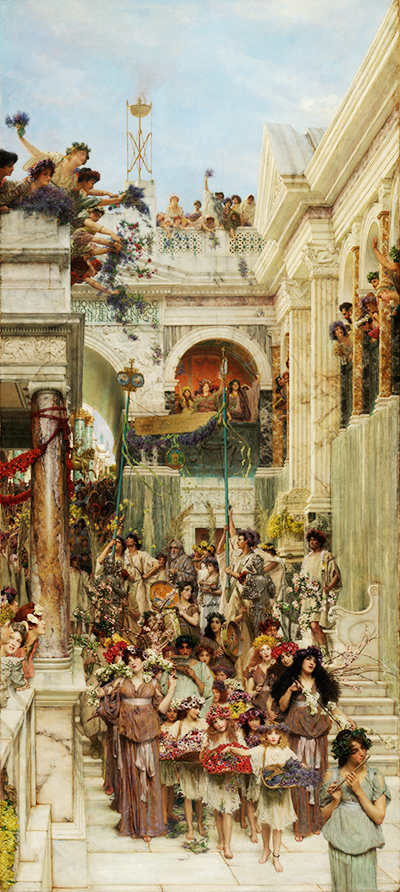
A basket of scarlet poppies comes down the last few marble steps. A little girl leans across the basket, a flute player passes almost within reach, and high above them a spectator raises a bunch of flowers to throw. Lawrence Alma-Tadema’s Spring puts us at the foot of a Roman procession with both the street and the sky in view. The J. Paul Getty Museum dates the oil on canvas to 1894. It measures 178.4 by 80.3 centimetres, giving all that activity a field more than twice as high as it is wide. Look below the column at left for the artist’s small signature and opus number, CCCXXVI. [1]
At a Glance
- Date1894
- MediumOil on canvas, 178.4 × 80.3 cm
- CollectionJ. Paul Getty Museum, 72.PA.3
- OpusCCCXXVI
- First exhibitionRoyal Academy, London, 1895
This work across Lawrence Alma-Tadema’s career
Contents
- From the first step to the rooftop
- How Alma-Tadema made a Roman street
- What kind of Roman festival?
- The flute, the pipes and the tambourines
- English May Day in an antique city
- Two visions of May Day
- The poem on the frame
- The Academy and the market for Spring
- Annotated details
From the first step to the rooftop
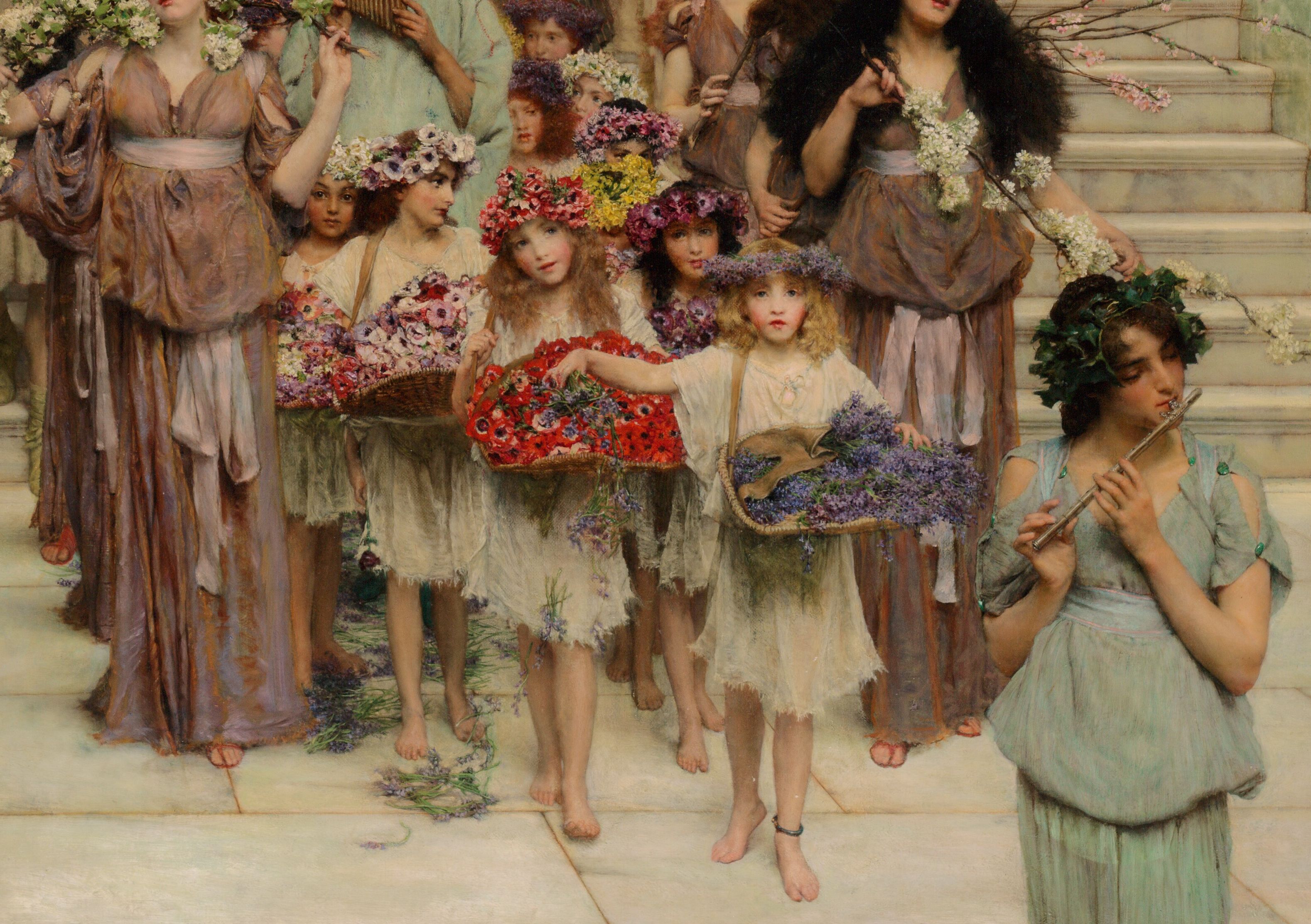
Watch the bare feet on the last few steps. The two girls nearest us have started down at slightly different moments, and the girl behind the poppies tilts her head as though adjusting to the basket’s weight or to someone beside her. A younger child in a ring of pale purple flowers looks straight out. These small differences give each child a pace of her own. The curve of the staircase brings the crowd diagonally forward out of the dark arch and spreads it across the bottom of the canvas, where the soft mauve robes of two branch-bearers give it broad edges. Beyond the girls, branches interrupt our view of faces and bodies. A few people are enough to make the steps seem packed. [1] [4]
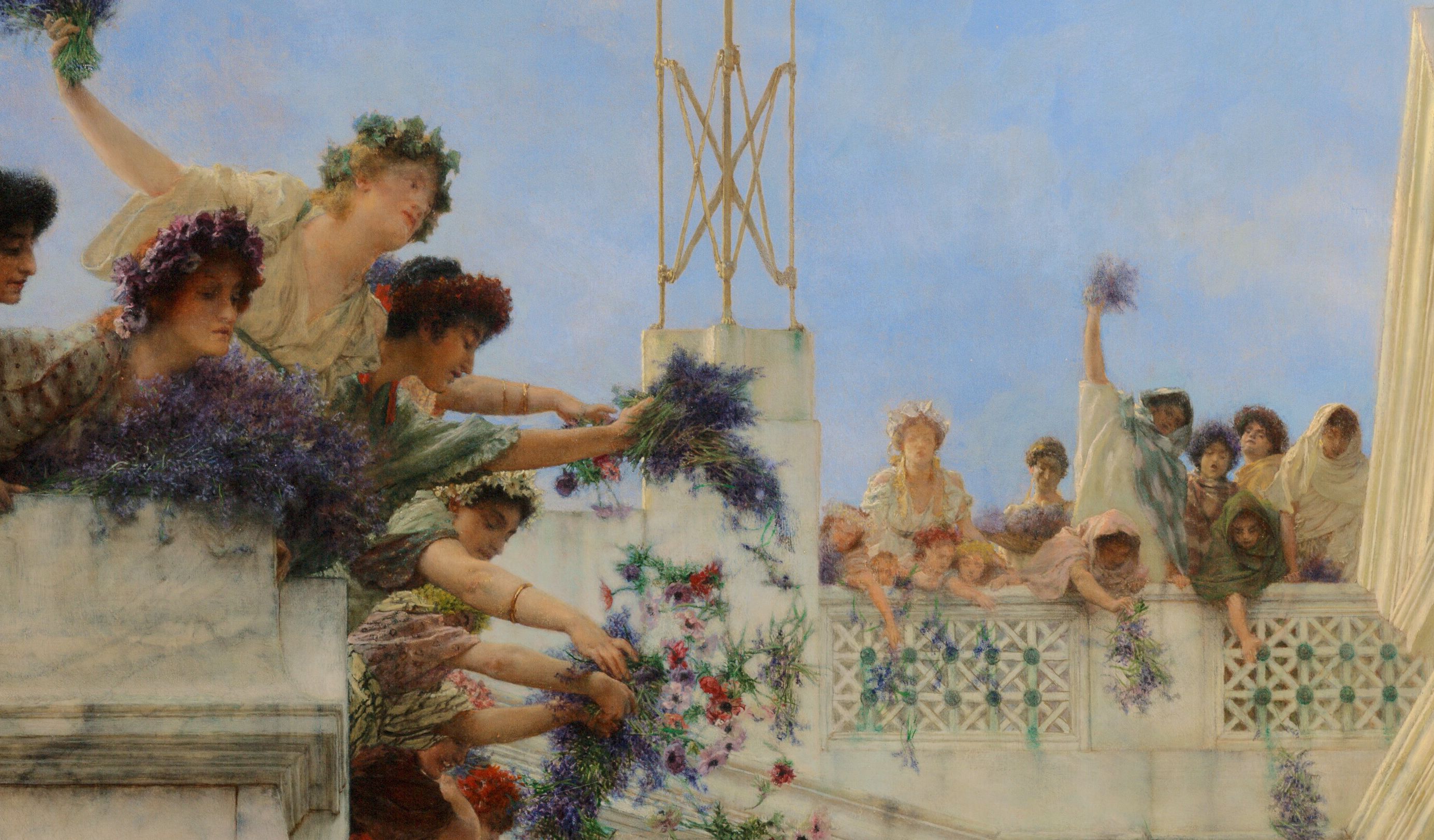
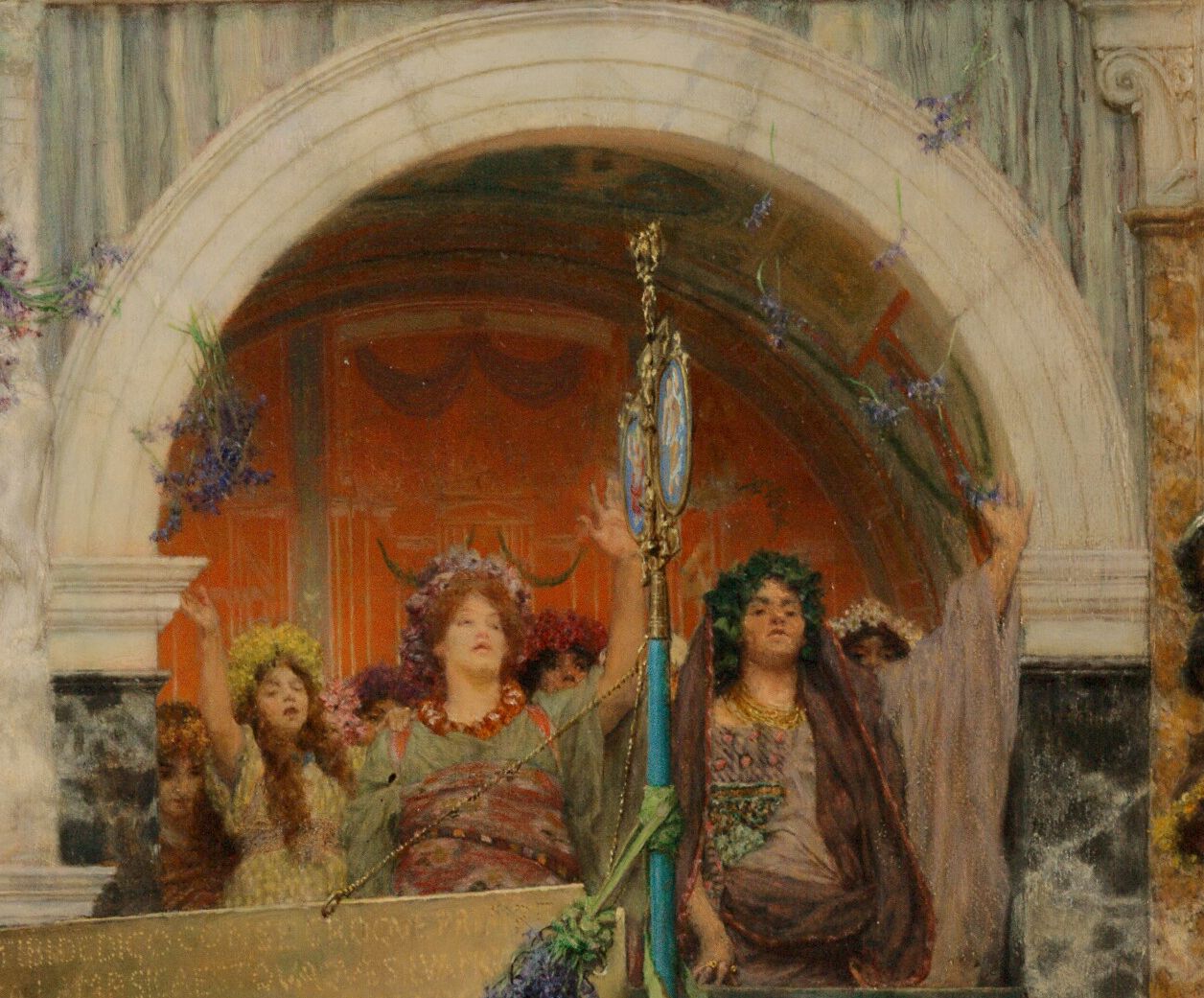
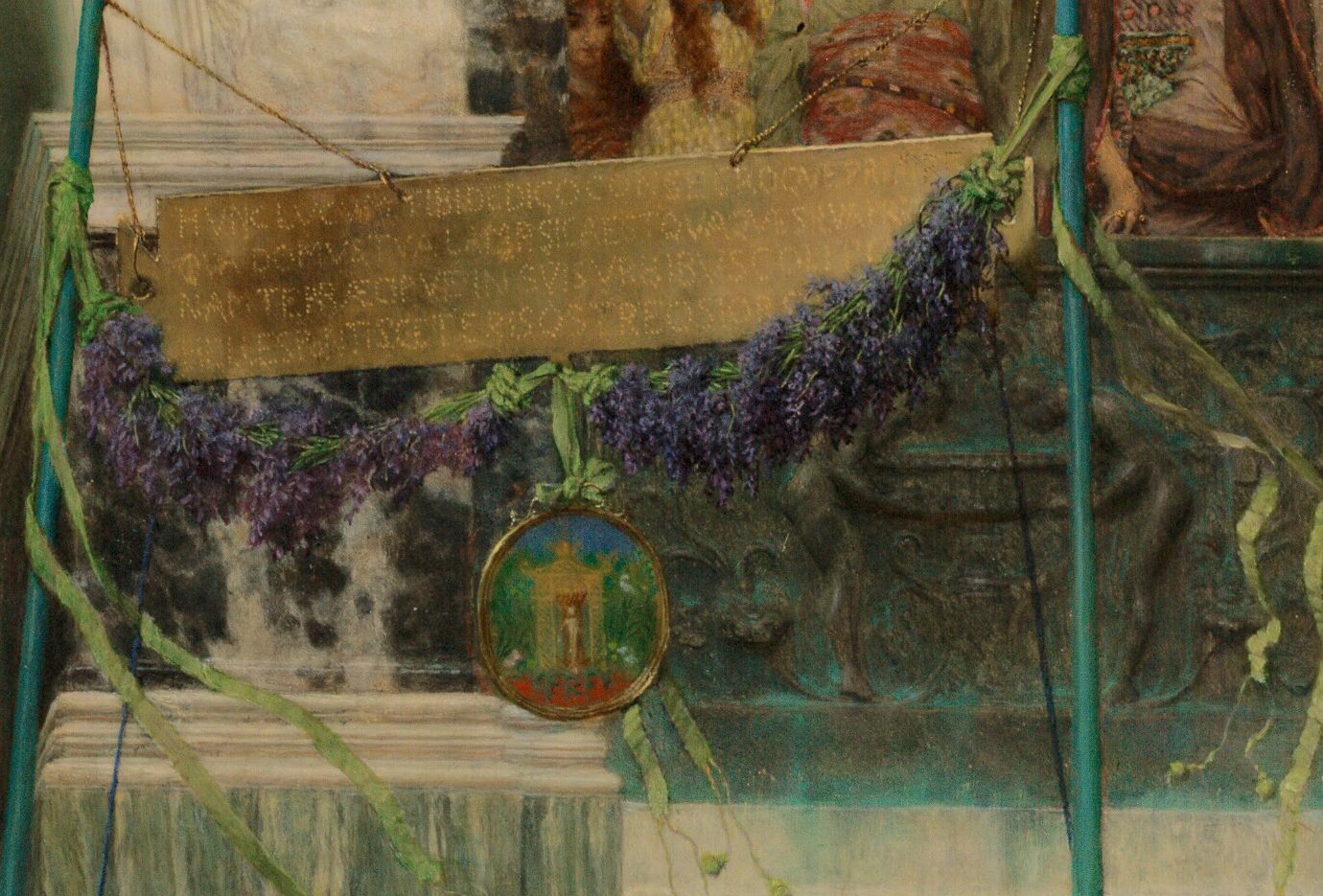
The blue-green poles lead in the opposite direction. Start at the hands grasping them and follow them up past the loop of purple flowers to the gold panel hanging between the poles. At this height the panel passes directly in front of the spectators in a red-backed alcove. The people there have a place apart, under cover, with a railing and carved stone beneath their feet. Their station is so close to the procession that the standard briefly hides some of them from us. Higher up, at the left, a row of people leans out and throws flowers. A bouquet breaks into individual petals and stems as it falls across the pale masonry. Its descent lets us gauge just how far those spectators are from the street. [1] [4]
Under the big arch at left there is a second view down the street. A horse and rider rise above the crowd, and the crowd itself dissolves into small heads and points of light. To the right, people look down from gaps between columns. Helen Zimmern, writing in 1902, singled out the population of roofs, porticoes and intermediate levels. A useful way to see what caught her attention is to look from the spectators on the far right to the girls at the foot of the stairs. The spectators appear over one another’s shoulders in a series of narrow openings. The flower bearers below have enough room on the steps for us to read an entire movement, from the twist of a shoulder to the placement of a foot. [1] [4] [5]
Above the highest figures, open sky takes up enough room for the eye to rest. Its light catches the roof edges, picks up the glossy curve of a column and reaches the bare arms of the children. The recess of the viewing box holds a muted red that can be seen from across a room. The poppies reach out with a brighter red from almost the same vertical line, and the airborne flowers between them and the rooftop seem to move because the smallest flecks are separated against clear stone. Light and colour let all three distances register before we have looked at any face closely. [1] [4]
Alma-Tadema’s Roman crowds have a modern counterpart in Elizabeth Prettejohn’s study of his city paintings. She argues that their oblique viewpoints and figures cut off at the edge can convey the abrupt sensations of living in a modern metropolis, much as other nineteenth-century painters used such devices in pictures of Paris. In Spring the near edge of the street seems barely wide enough for the flautist to pass. The people with the widest view are those separated from the movement and music by a whole storey of stone. [6]
Annotated Details from Spring
The numbered points mark details in Spring. Getty collection record. Getty Open Content.
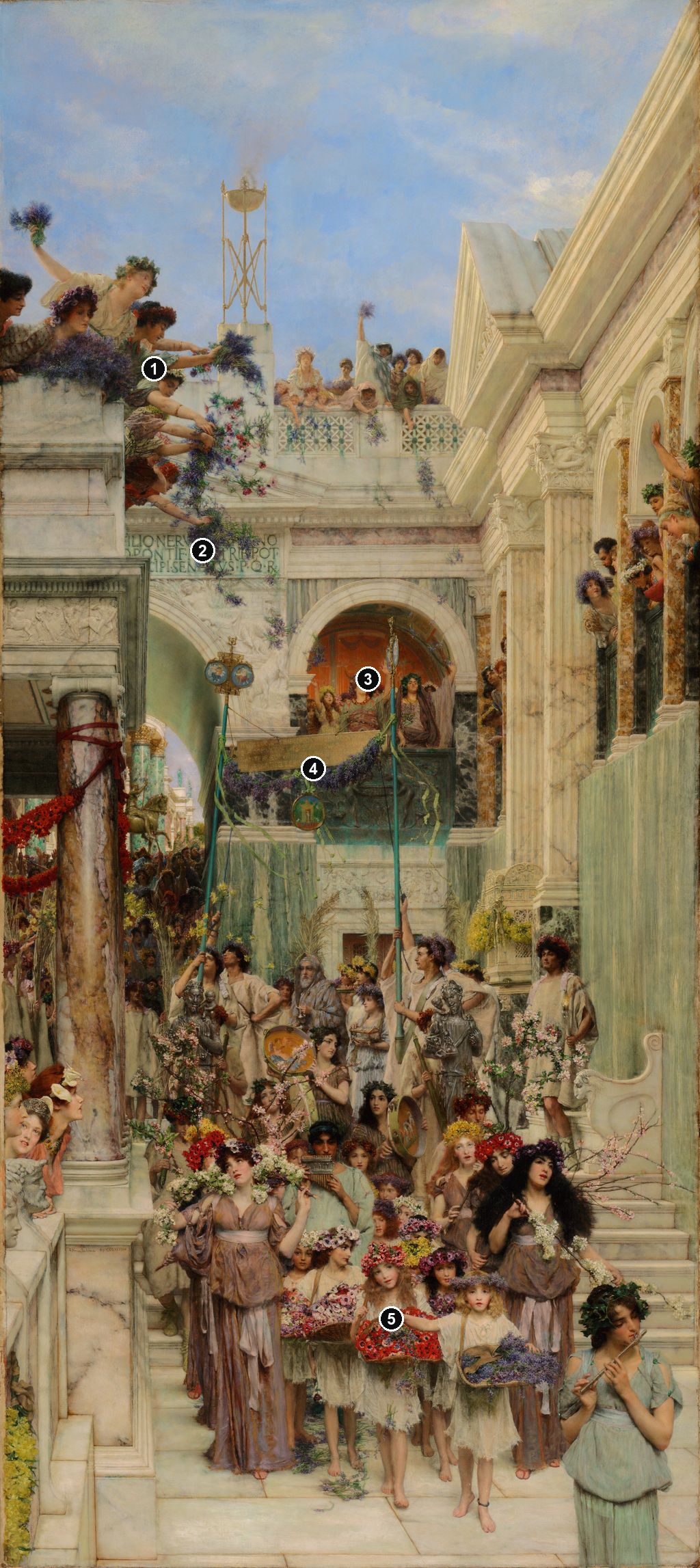
Details from SPRING
Select a numbered point or use the details below to examine a part of the painting.
Spectators above the street
The upper spectators lean over the stone balustrades and look down. Pink flowers interrupt the repeating upright lines of the architecture.
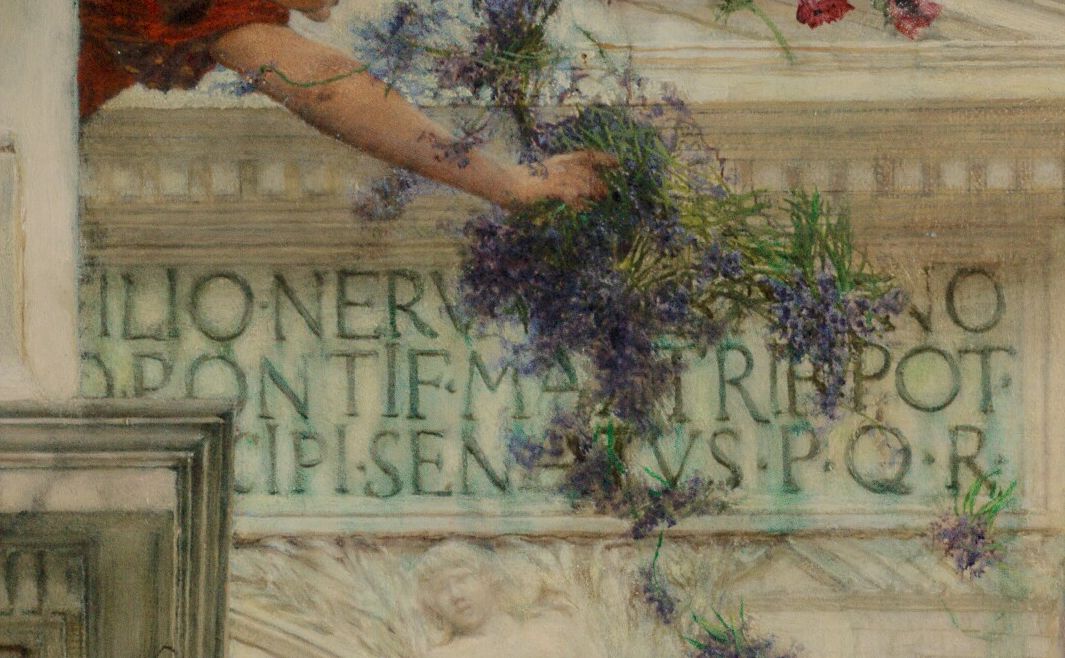
Inscription at the left arch
Letters cut into the stone at the arch add a small scale of detail to the monumental façade.
Spectators beneath the central arch
Figures gather in the openings and behind the ledges. Their positions help establish how far the procession extends into the street.
Garlanded standard
Flowers hang from an inscribed banner between two upright poles. A round emblem sits directly below the garland.
Flower carriers on the steps
The flower carriers at the front of the procession are large enough for their faces and expressions to register. The paved steps and the figures behind them lead back into the street.
How Alma-Tadema made a Roman street
High on the left, where foliage and a shower of flowers cover some of the lettering, the painter gives the street one of its clearest Roman credentials. The Getty identifies the inscription as a borrowing from the Arch of Trajan at Benevento, completed around AD 114–118. Below it, the river god and his spilling vessel recall a relief on Rome’s Arch of Constantine, built about two centuries later. Giovanni Battista Piranesi’s 1748 etching shows Constantine’s arch as a freestanding monument. In Alma-Tadema’s composition, the piece he takes from it reads as part of an inhabited street. Lippincott reproduces late nineteenth-century photographs of both monuments that belonged to the artist. The join in the painting is convincing enough that the green cast of the lettering and the pale relief seem to have aged on the same wall. [1] [4] [7]
Under the viewing box, flowers and fruit hang in a relief cut into pale stone. Lippincott identifies its model in the artist’s photographs as a broken portion of a Roman sarcophagus. The fragment could donate a garland to a much larger design, where it echoes the living flowers strung between columns and carried on poles. She also connects the equestrian figures under the arch with drawings the artist owned of two marble statues from Herculaneum, traditionally identified as Marcus Nonius Balbus and his son. Alma-Tadema paints the riders in a dark bronze tone. The clearer of the two is legible in silhouette amid the crowd because the rider and horse are so much darker than the architecture around them. [4]
An early critic, led by the inscription, placed the scene in Hadrian’s Rome. The river god complicates that reading. The Arch of Constantine incorporates some older reliefs, but the river god belongs to the later monument. Time of year may matter more here than the reign of an emperor. Lippincott compares the sheep and bovine near the relief with signs for April and May on a Roman calendar stone, a possible hint at a celebration stretching across both months. She also compares the street’s layout to Roman illusionistic wall painting, where fantastical upper levels, overhangs and vistas can coexist on a single wall. Follow the route of one distant marcher and the perspective holds together. Try to account for every opening as part of an actual Roman building and the design leads instead to the liberties of Pompeian painting and Victorian theatre. [4]
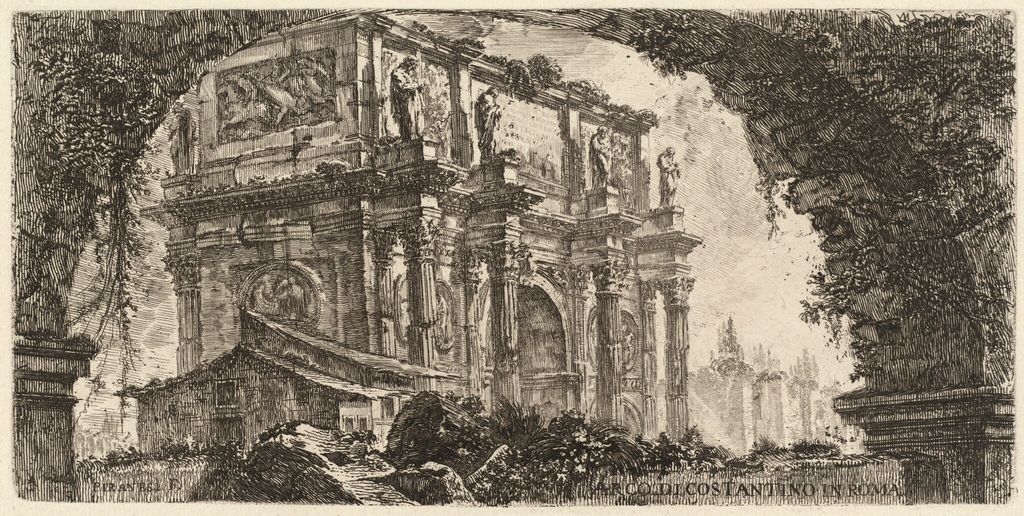
Piranesi’s Arco di Costantino, 1748. The print shows the Roman monument from which Alma-Tadema adapted a relief. National Gallery of Art, 2002.66.1.9. Image source. Public domain.
What kind of Roman festival?
The Getty finds the closest ancient parallel in the Floralia, a Roman festival for Flora that began in late April and continued into May. In Book V of his Fasti, Ovid has the goddess tell him about her garden, where the Hours collect flowers in baskets and the Graces weave them into garlands. Those are close visual correspondences. Ovid also describes the bright clothes of her festival and the release of hares and goats at the games. The canvas gives us the colour and the abundance. It shows a measured, musical progress through the city, leaving out the animal releases and the rowdier entertainments that an ancient audience might have associated with the holiday. A supplement on the 1895 Royal Academy exhibition made the same association with the goddess of blossoms. The animals carved on the painted arch might point to April and May, while the little shrine under the gold banner invites a different reading of whom the marchers honour. [1] [4] [8]
Cerealia, the April festival of Ceres, offers another association with the fertility of the fields. Alma-Tadema had already painted worshippers with flowers in his 1879 On the Road to the Temple of Ceres (opus CCVIII). That painting brings its garlanded group along a path between buildings with a view of the open country beyond. [9] Walter Pater’s Marius the Epicurean offers a third comparison, with a household version of the Ambarvalia. Girls fill baskets with apple and cherry blossom, youths carry sacred images, and the procession moves through vineyards and cornfields with water for purification and a box of incense. Pater makes the procession almost entirely silent, save for its priests. The tambourine players in Spring suggest a livelier rite, but the veiled elder, vessels and upright stalks on the upper steps have some of the solemnity of Pater’s ceremony. The people at the rear make it possible to imagine an offering even though its destination is out of sight. [4] [10]
The gold banner carries the clearest statement of religious purpose. Lippincott traces its faint lettering to the opening of an ancient poem preserved among the fragments of Catullus. The speaker dedicates a grove to Priapus and names Lampsacus as the god’s home. A small shrine, in Lippincott’s reading, occupies the roundel below. Priapus was a garden protector and a god of fertility whose ancient images could be explicitly sexual. His presence makes sense amid the garlands and offerings and lends an earthy note to a parade that might otherwise look as decorous as a school celebration. The silver figures beneath the standards add a related hint. Lippincott traces them to ancient carvings of satyrs carrying the infant Bacchus. By giving the revellers a place in objects held aloft, Alma-Tadema puts the less orderly creatures of classical myth inside the celebration without breaking the measured movement of the crowd. [4] [11]
The flute, the pipes and the tambourines
At the lower right, the flautist lowers her eyes to the side as she brings the instrument to her lips. Lippincott proposes a source for the pose in a photograph of a bearded male flute player, carved as a terminal figure and filed among statues of men in Alma-Tadema’s collection. The statue’s lower body merged into its support. The painting’s lower edge cuts the flautist off where her stride would otherwise have to begin. Her cropped figure can be read as a result of how closely she passes us. In adapting the statue, Alma-Tadema traded fixed stone for bare arms, a softly belted tunic and the impression that the music will be out of earshot in a moment. [4]
Up and to the left, a young musician raises a set of pipes. Lippincott compares his pose with a Pompeian fresco of a faun and his instrument with a bronze one discovered at Pompeii. She also identifies a separate object borrowed for the ornamental strip. Its detail faces the viewer in the painting because Alma-Tadema reversed the band’s orientation. Behind the player, a young woman raises a tambourine beside her head, repeating a gesture from a carved, dancing follower of Bacchus on a capital from the House of the Figured Capitals at Pompeii. A version of the capital itself appears above right. This is one passage where the still stone and the street seem to be keeping time together. [4]
The National Portrait Gallery’s catalogue also identifies Alma-Tadema himself, in Roman priest’s costume, among the celebrants. The priest with his head covered can be seen just left of centre. Flower bearers and musicians form a screen in front of him, and the taller standards draw attention above him. In the lower part of the picture, the instruments encourage us to imagine a different pace for every gesture. The pipes call for a drawn breath. A tambourine held by the head can be sounded with a flick of the hand. The flower bearer’s bare foot is already over the edge of the next stair. [4] [12]
English May Day in an antique city
Nineteenth-century British writers sometimes understood maying as a descendant of the Roman flower festivals. What spectators could recognise directly was the gathering of children and branches on the first of May. At Whitelands College in Chelsea, the Reverend John Pincher Faunthorpe took up John Ruskin’s suggestion of an annual festival in 1881. Students chose their May Queen by secret ballot. The election turned a proposal for a book prize into a ceremony in which the chosen student could decide who should receive Ruskin’s book on plants, Proserpina. Flowers, singing and a formal procession gave the day its shape. [4] [13]
The college’s photographs show how deliberately this modern rite acquired an old look. A gown designed by the illustrator Kate Greenaway was first worn in 1887 and was reused by later queens. The college records describe apple-green silk, embroidered pansies and a crown of pear blossom. Lippincott compares Whitelands and related ceremonies with the high branches and loose robes of the young women in Spring. The picture has several girls in floral crowns, without a single figure dressed to command attention as May Queen. The similarity lies in the pageant the young women make together. [4] [14]
A separate Continental custom offers a closer parallel to the flower-throwers. Lippincott reproduces an illustration of the 1889 Battle of Flowers at Cannes, a Carnival entertainment in which people in carriages pelted one another with bouquets. She also reproduces an illustrated report of Queen Victoria watching the flower procession in Florence in 1893. The little red alcove in Spring creates much the same distinction between an honoured company with a designated place to watch and people in close contact with the passing flowers. Look at the upper-left ledge and at the spectator directly below it. The people above can cast flowers clear of the wall, while the figure lower down seems almost caught under the shower. [4]
The mix of blooms reflects what a late Victorian gardener could grow or obtain. In Lippincott’s account, hawthorn and the branches of fruit blossom are recognisable signs of British maying, while seasonal gaps between the flowering plants point toward a world of hothouses and imports. Even in British ceremonies, the right branches could be elusive at the beginning of May. The painting can have hawthorn, papery poppies and daffodils all at once. Alma-Tadema could walk straight from his studio into his own garden, and his collection of photographs included studies of flowers and fruit blossom. Which specimens he used for the canvas is open. Poppies and forget-me-nots offered possible associations with oblivion and remembrance, though a few calla lilies in the hair of a redheaded spectator at left may owe more to fashion than symbolism. Flowers do their most immediate work in plain sight. Notice how the tiny dark centres of the poppies make a close pattern across the red basket, while the more scattered yellows mark out the distance to the people behind it. [1] [4]
Two visions of May Day
In 1891 Linley Sambourne made Flora preside over London’s spring exhibition season in a Punch cartoon. His Frederic Leighton, president of the Royal Academy, plays pipes in classical dress as if a gallery opening were one of the May rites. The accompanying parody imagines pink hawthorn about the city’s art venues and calls for Leighton to pipe in opening day. The joke depends on the ease with which the ancient festival could be fitted to a modern social calendar. In Spring, that association can be read seriously. A clean, brightly lit city accommodates a ritual of shared pleasure, with a hierarchy made visible by the space allotted to the people in the box. [4] [15] [16]
The same May Day could bring a different procession into view. Walter Crane’s The Triumph of Labour commemorates International Labour Day on 1 May 1891. Its participants carry banners and flowers, and there are tambourines in Crane as there are in Alma-Tadema’s Roman street. The women personifying Liberty, Equality and Fraternity accompany a collective display of labour and its claims. At the head of Alma-Tadema’s procession, young women and children are central to public life because they present the season’s flowers and supply its music. His picture concentrates on roles that late Victorian celebrations such as Whitelands made familiar. Seen alongside Crane, the lack of a demand on Spring’s gold banner, with its dedication to a garden god, helps explain Lippincott’s reading of the scene as an ideal of aristocratic leisure. The two pictures offer evidence of what a May procession could mean in the 1890s. [4] [17]
The poem on the frame
The original gilded frame, designed by Alma-Tadema and almost 244 centimetres high, makes the picture a little like a portal before the viewer sees a single painted wall. The title is at the top. At the foot are four lines from Algernon Charles Swinburne’s dedication to Edward Burne-Jones, beginning “In a land of clear colours and stories” and ending with “a murmur of musical flowers”. With the words at the bottom, readers have the baskets and the flautist before them as they come up from the verse. Swinburne’s last phrase finds a visible equivalent in the way the instruments are held among branches, garlands and cut flowers. [1] [4] [18]
In the complete poem, those lines form part of a question about whether there is room in that beautiful country for songs, memories and people already touched by loss. Alma-Tadema’s selection stops before the question is asked. It leaves just enough of the poem to make the light seem self-sufficient, though the baskets hold cut flowers and some of the blooms are already scattered on the pavement. Only the frame gives a reader a text at a convenient height. In the painting, the words that name the emperor on the arch and the god on the standard are half lost to shadow, flowers or distance. The more closely we read them, the more kinds of time are present in the same street. [1] [4] [11] [18]
The Academy and the market for Spring
F. G. Stephens saw the picture in progress and described it in June 1894 with girls carrying flowers and boys making music. His notice of May 1895 comments on a change in the musicians. Lippincott uses the two descriptions to argue that some boys disappeared or were transformed into young women, and to suggest the possible later addition of the branch-bearers and religious attendants. The notices are evidence from two viewings, which leaves the exact sequence of repainting open. Her reading helps explain why the young women with tambourines and the darker, more enigmatic boy with pipes feel like different kinds of presence in the same group. [4]
The work appeared as no. 262 at the Royal Academy in 1895. Algernon Graves lists the opening words of the poem alongside the title. The first exhibition was popular, according to Getty curator Burton B. Fredericksen. Percy Cross Standing would discuss the painting in 1905 alongside other late works with ceremonial subjects, including At the Close of a Joyful Day, which he records as an Academy exhibit of 1894. The first showing of Spring in 1895 is consistent with the Getty’s 1894 object date and the fact that the composition was still attracting comments about revisions in the interval. [1] [4] [19] [20] [21]
The buyer was already lined up. Lippincott records a sale arranged before completion to Robert von Mendelssohn, a Berlin banker who shared Alma-Tadema’s interest in music. The Getty lists Mendelssohn as owner from 1895 and records exhibitions in Berlin in 1899 and at the Paris Exposition Universelle in 1900. He sold the work to Thomas Agnew & Sons in 1900. The firm sold it the next year to the American collector Charles Tyson Yerkes, a transfer also recorded in his estate’s auction catalogue. It was sold at the Yerkes sale in 1910. Thomas F. Cole lent it to the Toledo Museum of Art’s inaugural exhibition in 1912, where a photograph in the catalogue shows the same flower bearers and high, crowded ledges. Lippincott also records the painting at Alma-Tadema’s memorial exhibition in 1913. [1] [4] [22] [23]
After a sale from the Fricke collection in 1945 and several further changes of hands, the Getty bought it at auction in 1972. Lippincott records the competition at the sale from the television producer Allen Funt, an avid Alma-Tadema collector. In 1974, the painting went on display in the Getty’s recreated Roman villa. That setting presented an interesting reversal. Fragments of actual Roman buildings had helped Alma-Tadema invent his marble street, and the whole painting now hung in an American re-creation of a building from antiquity. [1] [4] [24]
The canvas also travelled through reproduction. The German catalogue of the Photographische Gesellschaft lists its no. 2429 as Frühlingsfest (Spring) and offers an extra-format photogravure, 90 by 40 centimetres, at 50 marks. The English Berlin Photographic Company catalogue advertises the same composition with praise attributed to the future Edward VII at the Academy banquet in 1895. It lists 250 artist’s proofs on Japan paper and 150 on India paper, both already marked sold out. At those dimensions the printed scene kept the proportions that let a viewer read from the rooftops to the pavement in one glance. A copyright line bearing the year 1894 identifies the publisher’s claim and leaves the printing date of any individual impression open. [25] [26]
The title can lead to a quite different print. The Metropolitan Museum of Art’s Spring, an 1879 proof engraved by Auguste-Thomas-Marie Blanchard, reproduces an oil Alma-Tadema completed in 1877. The earlier painting, since destroyed, showed girls gathering flowers in an open field. In the Blanchard print, people bend to find flowers where they grow. In the later Spring, they have brought their flowers into the city. The arch and the tall standards make the object immediately identifiable even when the words beside the print are the same. [27]
The picture found a later audience through Cecil B. DeMille’s 1934 Cleopatra. Lippincott reproduces a publicity still of Caesar’s triumphal entry into Rome, where flower bearers pass below tiers of spectators. Her comparison is specific to that sequence. The film puts the crowd to work welcoming a conqueror, but preserves the pleasure of seeing ceremony from many heights at once. Return to the left edge of Alma-Tadema’s roof. One arm is drawn back with a blue bunch still in hand, even as other blossoms fall into the street. At the bottom of the same canvas a flute is already at someone’s lips. For as long as a viewer looks, the next shower of flowers and the next note are about to arrive. [4]
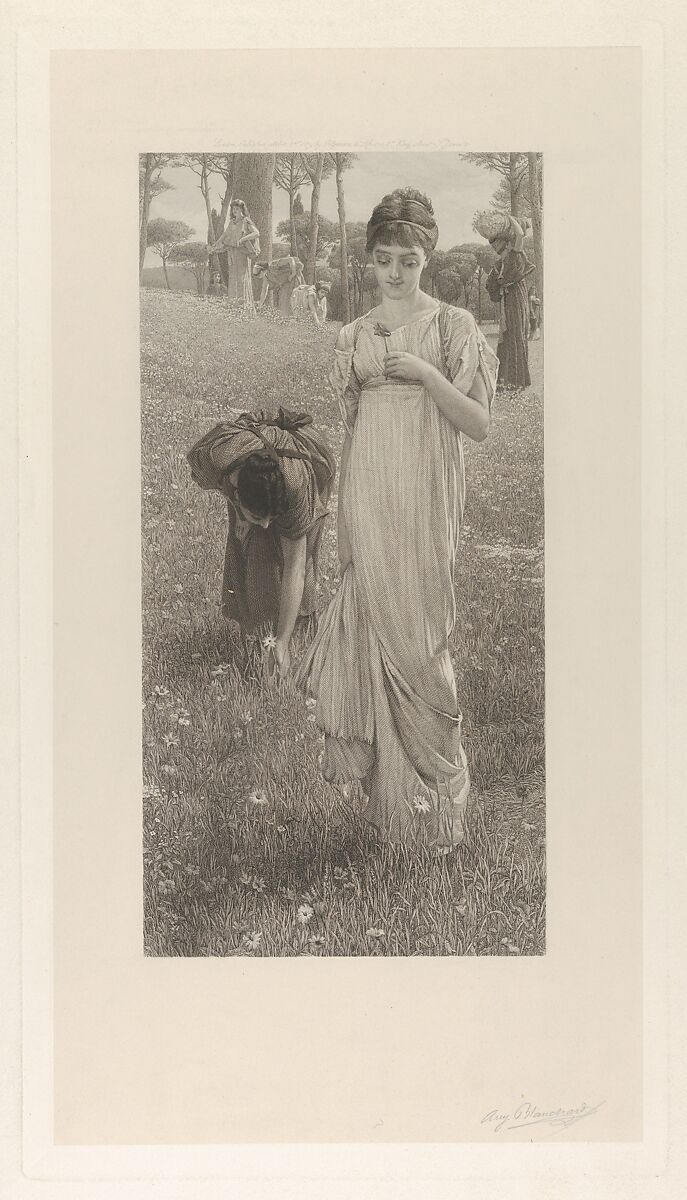
Blanchard’s 1879 proof engraving after Alma-Tadema’s separate 1877 Spring. Its flower gatherers walk through a field. Metropolitan Museum of Art, 63.648.16. Image source. CC0 / Public domain.
Further reading
Lawrence Alma Tadema: Spring. Louise Lippincott, Getty Museum Studies on Art, 1991
The Getty publication links to the complete illustrated study, including details of the frame, the antique objects and the painting’s reception. Read the Getty study.
Lawrence Alma-Tadema artworks directory
Search by title or medium. The directory includes Alma-Tadema’s numbered compositions, separately catalogued fragments, and selected drawings and historic prints. Dates for unlinked works follow the catalogue’s year groupings. View the numbered opus catalogue
| Name | Date | Medium |
|---|---|---|
| Portrait of my sister Artje | 1851 | Painting |
| Selfportrait | 1852 | Painting |
| Portrait of my mother (oval) | 1852 | Painting |
| The alm | 1856 | Painting |
| The inundation of the Biesbosch in 1421 | 1857 | Painting |
| The destruction of Terdoest Abbey in 1571 | 1857 | Painting |
| Faust en Marguerite | 1857 | Watercolour |
| Clotilde at the tomb of her grandchildren | 1858 | Painting |
| Marius on the ruins of Carthage | 1858 | Watercolour |
| The sad father: the unfavourable oracle (Death of the first-born, first version) | 1859 | Painting |
| The death of Attila, 453 AD | 1859 | Watercolour |
| Triumphal return of Sir Willem van Saeftingen | 1860 | Painting |
| The death of Hippolyte | 1860 | Watercolour |
| The Education of the Children of Clovis | 1861 | Painting |
| Venantius Fortunatus reading his poems to Radagonda VI | 1862 | Painting |
| Gunthram Bose and his daughters, 572 AD: the Ambuscade | 1862 | Painting |
| A medieval Flemish interior | 1863 | Painting |
| Pastimes in Ancient Egypt: 3.000 years ago | 1863 | Painting |
| Interior of the Church San Clemente, Rome: a study | 1863 | Painting |
| Queen Fredegonda at the deathbed of Bishop Praetextatus (first version) | 1864 | Painting |
| Leaving Church in the fifteenth century | 1864 | Painting |
| Egyptian Chess Players (An Egyptian Game) | 1865 | Painting |
| Birthday presents in the sixteenth century | 1865 | Painting |
| Gallo-Roman women | 1865 | Painting |
| Entering Church in the fourteenth century | 1865 | Painting |
| An Egyptian at his doorway in Memphis | 1865 | Painting |
| Catallus ten huize van Lesbia | 1865 | Painting |
| The discourse | 1865 | Painting |
| A Roman scribe writing despatches | 1865 | Painting |
| A soldier of Marathon | 1865 | Painting |
| Home from market | 1865 | Painting |
| Death of Galeswinthe | 1865 | Painting |
| An Egyptian Game (preparatory drawing) | 1865 | Drawing |
| Making wreaths for festivities in a Pompeian house | 1866 | Painting |
| Vespasian hearing of the taking of Jerusalem by Titus | 1866 | Painting |
| Entrance to a Roman theatre | 1866 | Painting |
| In the peristyle | 1866 | Painting |
| Agrippina visiting the ashes of Germanicus | 1866 | Painting |
| Tibullus at Delia's | 1866 | Painting |
| A Roman dance | 1866 | Painting |
| Lesbia weeping over a sparrow | 1866 | Painting |
| The armourer's shop in ancient Rome | 1866 | Painting |
| The Education of the Children of Clovis (Rennefeld print after Alma-Tadema) | 1866 | |
| The mummy: Roman period: Egyptians lamenting their dead | 1867 | Painting |
| The honeymoon | 1867 | Painting |
| Cuckoo | 1867 | Painting |
| The aesthetic view: Madame Dumoulin, Pauline, and Laurence | 1867 | Painting |
| Glaucus and Nydia | 1867 | Painting |
| Portrait of Mr A. Bonnefoy | 1867 | Painting |
| Proclaiming Claudius Emperor | 1867 | Painting |
| A sculpture gallery in Rome at the time of Augustus | 1867 | Painting |
| A collector of pictures at the time of Augustus | 1867 | Painting |
| Tarquinius Superbus before Galba | 1867 | Painting |
| A Roman family | 1867 | Painting |
| Italian women | 1867 | Painting |
| Portrait of Madame Bonnefoy and Mr Puttemans | 1867 | Painting |
| The siësta (first version) | 1868 | Drawing |
| The embarkation | 1868 | Painting |
| The siësta (second version) | 1868 | Painting |
| A Roman art lover | 1868 | Painting |
| Woman and flowers | 1868 | Painting |
| Phidias and the Parthenon, Athens | 1868 | Painting |
| The flower girl | 1868 | Painting |
| A Roman flower market: Pompeii | 1868 | Painting |
| Egyptian game | 1868 | Watercolour |
| Education of the children of Clovis | 1868 | Painting |
| A Roman art lover: silver statue | 1868 | Painting |
| Egyptian dancing girls | 1868 | Watercolour |
| Catalina | 1869 | Painting |
| The visit: Sunday morning before churching (first version): a birth chamber, seventeenth century | 1869 | Painting |
| The Pyrrhic dance | 1869 | Painting |
| The Grand Chamberlain of Sesostris the Great | 1869 | Painting |
| The convalescent | 1869 | Painting |
| Confidences | 1869 | Painting |
| A Greek Woman | 1869 | Painting |
| At the wine shop | 1869 | Painting |
| An Exedra (first version) | 1869 | Painting |
| Portrait of Master Ernest Angely | 1870 | Painting |
| A juggler | 1870 | Painting |
| A nurse, seventeenth century: Sunday morning (second version) | 1870 | Watercolour |
| Roman art lover (the runner ) | 1870 | Painting |
| Anacreon reading his poems at Lesbia's house | 1870 | Painting |
| The vintage festival (first version) | 1870 | Painting |
| The first whisper of love | 1870 | Painting |
| The letter: from an absent one (first version) | 1870 | Painting |
| A staircase (first version) | 1870 | Painting |
| Hush, she sleeps | 1870 | Painting |
| The letter: from an absent one (second version) | 1871 | Watercolour |
| The vintage festival (second version) | 1871 | Painting |
| A Roman Emperor (second version) | 1871 | Painting |
| In the temple (first version) | 1871 | Painting |
| Portrait of Miss Laura Theresa Epps | 1871 | Painting |
| A Bacchic dance | 1871 | Painting |
| Fredegonda and Praetextatus (second version) | 1871 | Painting |
| Portrait study for Mrs H.W. Mesdag | 1871 | Painting |
| Greek potters | 1871 | Painting |
| An exedra (second version) | 1871 | Watercolour |
| Sunday morning: the two sisters (third version) | 1871 | Painting |
| In the temple (second version) | 1872 | Watercolour |
| The first reproach | 1872 | Painting |
| An Egyptian widow | 1872 | Painting |
| Improvisatore | 1872 | Painting |
| A halt (first version) | 1872 | Painting |
| The last roses | 1872 | Painting |
| Death of the first-born (second version) | 1872 | Painting |
| Portrait of Dr Franz and Mrs Catherine Hueffer 'When I am dead, oh dearest sing' | 1872 | Painting |
| The nurse | 1872 | Painting |
| Greek wine (first version) | 1872 | Painting |
| Goldfish (first version) | 1872 | Painting |
| On a Roman staircase (second version) | 1872 | Watercolour |
| Hercules | 1872 | Painting |
| Portrait of Miss Kate Thompson | 1873 | Painting |
| The dinner (first version) | 1873 | Painting |
| The siësta (third version) | 1873 | Painting |
| A visit to the studio (second version) | 1873 | Watercolour |
| Cherries | 1873 | Painting |
| Greek wine (second version) | 1873 | Watercolour |
| This is our corner | 1873 | Painting |
| A picture gallery (third version) | 1873 | Painting |
| The last roses (second version) | 1873 | Watercolour |
| Fishing (first version) | 1873 | Painting |
| Music has charms | 1873 | Watercolour |
| Counting the passers-by | 1873 | Watercolour |
| Portrait of Mrs Frederick George Stephens | 1873 | Painting |
| Two heads from 'The Picture Gallery': A visit to the studio by Charles W. Deschamps and his wife (first version) | 1874 | Watercolour |
| Joseph, overseer of Pharaoh's granaries | 1874 | Painting |
| A sculpturegallery (first version) | 1874 | Painting |
| A picture gallery in Rome at the time of Augustus (fourth version) | 1874 | Painting |
| Portrait of Charles W. Deschamps and his wife (second version) | 1874 | Painting |
| Autumn | 1874 | Watercolour |
| Reflections: fishing (second version) | 1874 | Painting |
| A Roman artist | 1874 | Watercolour |
| Good friends | 1874 | Watercolour |
| On the steps of the Capitol (first version) | 1874 | Painting |
| Water pets: goldfish (second version) | 1874 | Painting |
| Münster Cathedral | 1874 | Painting |
| Landscape near Münster | 1874 | Painting |
| Antistius Labeon, 75 AD: A Roman amateur artist | 1874 | Painting |
| Sunny days | 1874 | Painting |
| Spring flowers: garland seller on the steps of the Capitol (second version) | 1874 | Watercolour |
| Through an archway | 1874 | Painting |
| (A, B) Decoration for my piano: 'Serious and merry music' | 1874 | Painting |
| Rêverie | 1874 | Painting |
| The Roman architect | 1874 | Painting |
| Sunflowers | 1874 | Painting |
| Landscape: carriage drive by the outskirts of a wood, Penhill Castle | 1875 | Painting |
| A peep through the trees | 1875 | Painting |
| Cleopatra (first version) | 1875 | Painting |
| (a, b, c) The tragedy of an honest wife | 1875 | Watercolour |
| The architect of the Coliseum | 1875 | Watercolour |
| Fishing | 1875 | Watercolour |
| Cherry blossom | 1875 | Painting |
| Water pets: goldfish (third version) | 1875 | Painting |
| 'There he is!' | 1875 | Painting |
| Play Garden | 1875 | Painting |
| Portrait of Miss Thackeray's 'Elisabeth' | 1875 | Painting |
| A nymphaeum from the Villa Aldobrandini in Rome | 1875 | Painting |
| Haystacks | 1875 | Painting |
| A sculpture gallery (second version) | 1875 | Painting |
| After the dance: a bacchanal | 1875 | Painting |
| Landscape: a breezy day in August near Innsbruck | 1875 | Painting |
| The service | 1875 | Painting |
| An audience at Agrippa's (first version) | 1875 | Painting |
| Kriemhild’s Tryste | 1875 | |
| Portrait of my wife | 1876 | Painting |
| Between hope and fear | 1876 | Painting |
| 94 Degrees in the Shade | 1876 | Painting |
| An antique custom | 1876 | Painting |
| Portrait of Jules Dalou, his wife and his daughter | 1876 | Painting |
| Pleading (first version) | 1876 | Painting |
| Hide and seek | 1876 | Painting |
| Balneatrix | 1876 | Watercolour |
| A mirror | 1877 | Painting |
| An interesting scroll | 1877 | Watercolour |
| Winter | 1877 | Painting |
| Autumn-vintage festival | 1877 | Painting |
| Summer | 1877 | Painting |
| Spring in the gardens of the Villa Borghese (first version) | 1877 | Painting |
| A balneator | 1877 | Watercolour |
| Painting in Ancient Rome | 1877 | Painting |
| A balneatrix | 1877 | Painting |
| The sculptor's model (Venus Esquilina) | 1877 | Painting |
| The sculptor's studio in ancient Rome | 1877 | Painting |
| Architecture in ancient Rome | 1877 | Painting |
| Cleopatra (second version) | 1877 | Painting |
| Spring in the gardens of the Villa Borghese (second version) | 1877 | Painting |
| Panel for H. W. Mesdag's studio door: Spring in the gardens of the Villa Borghese (third version) | 1877 | Painting |
| The question: Pleading (second version) | 1877 | Painting |
| A kitchen garden | 1877 | Painting |
| Flora: Spring in the gardens of the Villa Borghese (fourth version) | 1877 | Watercolour |
| A silent counsellor | 1878 | Watercolour |
| A sollicitation | 1878 | Watercolour |
| A hearty welcome | 1878 | Painting |
| A landscape | 1878 | Painting |
| In the time of Constantine | 1878 | Painting |
| A love missile | 1878 | Painting |
| Fredegonda en Galswintha, 566 AD | 1878 | Painting |
| A safe confidant | 1878 | Painting |
| After the audience (second version) | 1879 | Painting |
| Strigils andsponges | 1879 | Watercolour |
| E festival in Pomona | 1879 | Painting |
| Prose | 1879 | Painting |
| Going down to the river | 1879 | Painting |
| The Roman wine tasters | 1879 | Watercolour |
| Portrait of th singer George Henschel Esq. at the piano | 1879 | Painting |
| Poetry | 1879 | Painting |
| A well-protected slumber | 1879 | Painting |
| A garden altar | 1879 | Painting |
| Beauties | 1879 | Painting |
| Portrait of Thekla Friedländer | 1879 | Unspecified |
| On the road to the Temple of Ceres: A springfestival | 1879 | Painting |
| Autumn (third version) | 1879 | Drawing |
| 'Not at home' | 1879 | Painting |
| An old bachelor after the bath | 1879 | Watercolour |
| Spring (Blanchard print after Alma-Tadema’s 1877 painting) | 1879 | |
| The first course: the dinner | 1880 | Painting |
| Interrupted | 1880 | Painting |
| Grapes | 1880 | Watercolour |
| A pastoral | 1880 | Painting |
| A portrait of Dr Felix and Mrs August Redeker Semon | 1880 | Painting |
| Ave Caesar! Io Saturnalia! (third version) | 1880 | Painting |
| A prize for the artist's corps | 1880 | Painting |
| The departure (first version) | 1880 | Painting |
| A harvest festival | 1880 | Painting |
| 'Your carriage stops the way' | 1880 | Painting |
| Autumn (Scene in a Roman Garden) | c.1880 | Drawing |
| The torch dance | 1881 | Painting |
| Sappho and Alcaeus | 1881 | Painting |
| A kiss | 1881 | Watercolour |
| A Bacchante dancing before the thymele | 1881 | Watercolour |
| An audience | 1881 | Painting |
| Portrait of Dr Hans Richter | 1881 | Painting |
| Pandora | 1881 | Watercolour |
| The Tepidarium | 1881 | Painting |
| Quiet pets | 1881 | Painting |
| A priestess of Apollo | 1881 | Watercolour |
| A difficult line from Horace (first version) | 1881 | Painting |
| A stranger in my studio (one of a pair) | 1881 | Painting |
| Amo te ama me | 1881 | Painting |
| The First Course–The Dinner (Löwenstam print after Alma-Tadema) | 1881 | |
| Young affections | 1882 | Painting |
| A difficult line from Horace (second version) | 1882 | Drawing |
| Portrait of John F. Whichcord Esq., PRIBA, FSA | 1882 | Painting |
| Portrait of Ludwig Barnay as Marcus Antonius | 1882 | Painting |
| The way to the temple | 1882 | Painting |
| A parting kiss | 1882 | Painting |
| Reflections | 1882 | Painting |
| Between Venus and Bacchus | 1882 | Watercolour |
| Dolce far niente (first version) | 1882 | Watercolour |
| Dolce far niente (second version) | 1882 | Painting |
| An Oleander | 1882 | Painting |
| The meeting of Antony and Cleopatra | 1883 | Painting |
| Portrait of Catherine, Duchess of Cleveland | 1883 | Painting |
| Portrait of my daughter Anna Alma-Tadema | 1883 | Painting |
| Shy | 1883 | Painting |
| Portrait of His Excellency the Duke of Bylandt | 1883 | Painting |
| Una Carita: The three graces: Laura, Laurence, and Anna | 1883 | Painting |
| Portrait of Leopold Lowenstam, the engraver | 1883 | Painting |
| Portrait of Lady Thompson | 1883 | Painting |
| Portrait of Professor Giovanni Battista Amendola | 1883 | Painting |
| 'Der alte Menander ist doch nicht gestorben!' Paulus and Hermas | 1883 | Drawing |
| A street altar | 1883 | Watercolour |
| Welcome Footsteps (The Well-Known Footsteps) | 1883 | Painting |
| A declaration: an old, old story | 1883 | Watercolour |
| Xanthe and Phaon | 1883 | Watercolour |
| Selfportrait | 1883 | Painting |
| Hadrian in England: visiting a Roman-British Pottery (original, later divided) | 1884 | Painting |
| A Roman-British pottery | 1884 | Painting |
| Emperor Hadrian's visit to a British pottery | 1884 | Painting |
| A Roman-British potter | 1884 | Painting |
| Portrait of Miss Alice Lewis | 1884 | Painting |
| Who is it? | 1884 | Painting |
| Portrait of Moses Ezekiel | 1884 | Painting |
| Portrait of Sir Francis Powell | 1884 | Painting |
| Egyptien à l’entrée de sa demeure (Ramus print after Alma-Tadema) | 1884 | |
| Expectations | 1885 | Painting |
| A Reading from Homer | 1885 | Painting |
| Portrait of Dr Wahington Napoleon Epps: my docter | 1885 | Painting |
| The triumph of Titus: the Flavians | 1885 | Painting |
| Ariadne | 1885 | Painting |
| Portrait of Mrs W. M. Baker | 1885 | Painting |
| Rose of all roses | 1885 | Painting |
| A foregone conclusion | 1885 | Painting |
| A apodyterium | 1886 | Painting |
| Portrait of James Reld Esq. | 1886 | Painting |
| Portrait of Mrs Frank D. Millet | 1886 | Painting |
| A secret | 1887 | Painting |
| The Women of Amphissa | 1887 | Painting |
| A new dress | 1887 | Watercolour |
| 'He loves me, he loves me not' | 1887 | Painting |
| Illuminated letter 'W' for the Royal Academy address to Queen Victoria | 1887 | Watercolour |
| Portia | 1887 | Painting |
| The Roses of Heliogabalus | 1888 | Painting |
| Fair tresses: a sketch | 1888 | Painting |
| Midday slumbers | 1888 | Watercolour |
| Portrait of the honourable Adama van Scheltema | 1888 | Painting |
| Venus and Mars | 1888 | Painting |
| Portrait of Jules de Soria | 1888 | Painting |
| At the shrine of Venus | 1888 | Painting |
| The Favourite Poet | 1888 | Painting |
| The Favourite Poet (Löwenstam print after Alma-Tadema) | c.1888 | |
| Sisters | 1889 | Painting |
| Cloaked in yellow | 1889 | Painting |
| A dedication to Bacchus (first version) | 1889 | Painting |
| A dedication to Bacchus (second version) | 1889 | Painting |
| Portrait of Mrs Ralph Sneyd | 1889 | Painting |
| Portrait of Miss MacWhirter (Mrs Charles Sims) | 1889 | Painting |
| Portrait of young gentleman John Parsons Millet | 1889 | Painting |
| In a rose garden | 1889 | Painting |
| A Silent Greeting | 1889 | Painting |
| Portrait of Sir Ernest A. Waterlow, Esq., RA | 1889 | Painting |
| Eloquent silence | 1890 | Painting |
| The Frigidarium | 1890 | Painting |
| Promise of Spring | 1890 | Painting |
| Portrait of Miss Agnes Marks | 1890 | Painting |
| Rêverie: a sketch | 1890 | Painting |
| Portrait of the Right Hon. Arthur James Balfour | 1891 | Painting |
| An earthly paradise | 1891 | Painting |
| Love's votaries; Love in idleness | 1891 | Painting |
| Portrait of the Honourable Archdean Watkins of Durham, DD | 1891 | Painting |
| Portrait of Alfred Waterhouse Esq. RA | 1891 | Painting |
| Portrait of Ignacy Jan Paderewski | 1891 | Painting |
| The kiss | 1891 | Painting |
| Calling the worshippers | 1892 | Watercolour |
| The poet Gallus dreaming | 1892 | Painting |
| Courtship | 1892 | Painting |
| Comparisons | 1892 | Painting |
| The inner sanctuary | 1892 | Painting |
| Portrait of Dr Joseph Joachim | 1893 | Painting |
| In the corner of my studio | 1893 | Painting |
| Portrait of Mrs Charles Wyllie | 1893 | Painting |
| Unconscious Rivals | 1893 | Painting |
| Godspeed | 1893 | Painting |
| Portrait of Mrs Theyre Smith | 1893 | Painting |
| At the close of a joyful day | 1894 | Painting |
| The benediction | 1894 | Painting |
| Spring | 1894 | Painting |
| Past and present generations | 1894 | Painting |
| God Speed (Löwenstam print after Alma-Tadema) | 1894 | |
| Love's jewelled fetter | 1895 | Painting |
| Fortune's favourite | 1895 | Painting |
| Portrait of Mrs Roland Hill and her children | 1895 | Painting |
| Portrait of George Simmonds and family | 1895 | Painting |
| Unwelcome confidence | 1895 | Painting |
| A Coign of Vantage | 1895 | Painting |
| Portrait of Mrs Marcus Stone | 1895 | Painting |
| Whispering Noon | 1896 | Painting |
| The Coliseum | 1896 | Painting |
| Familygroup | 1896 | Painting |
| Portrait of Miss Onslow Ford | 1896 | Painting |
| A Difference of Opinion | 1896 | Painting |
| Portrait of Maurice Sons Esq. playing the violin in Alma-Tadema's studio | 1896 | Painting |
| Selfportrait | 1896 | Painting |
| 'Nobody asked you sir!' she said | 1896 | Watercolour |
| Portrait of J. M. Zarifi Esq. | 1897 | Painting |
| Watching and waiting | 1897 | Painting |
| 'Her eyes are with her thoughts, and they are far away' | 1897 | Painting |
| Wandering thoughts | 1897 | Painting |
| Melody on a Mediterranean terrace | 1897 | Painting |
| Roses, love's delight | 1897 | Painting |
| A Difference of Opinion (Boulard print after Alma-Tadema) | 1897 | |
| Portrait of Lady Sydney (Margaret) Waterlow | 1898 | Painting |
| The conversion of Paula by St. Jerome | 1898 | Painting |
| Portrait of Tine Son-Maris | 1898 | Painting |
| Hero | 1898 | Painting |
| Portrait of Mrs George Lewis and her daughter Elisabeth | 1899 | Painting |
| The listeners | 1899 | Painting |
| Attracted: watchers | 1899 | Watercolour |
| The Baths of Caracalla (Thermae Antoninianae) | 1899 | Painting |
| Bluebells | 1899 | Painting |
| Study for Thermaie Antoniniane | 1899 | Drawing |
| A flag of truce | 1900 | Painting |
| Goldfish (fourth version) | 1900 | Painting |
| Portrait of Mrs Armour from Princeton | 1900 | Painting |
| Portrait of George Aitchison, PRIBA, RA | 1900 | Painting |
| Vain courtship | 1900 | Painting |
| Under the roof of blue Ionian weather | 1901 | Painting |
| Death of the first born (third version) | 1901 | Drawing |
| A priestess of Hymen | 1901 | Watercolour |
| Fair tresses | 1901 | Painting |
| Impatient | 1901 | Watercolour |
| Portrait of Sir Max Waechter High Sheriff of Sussex | 1901 | Painting |
| The year's at the spring, all's right with the world | 1902 | Painting |
| Caracalla | 1902 | Painting |
| A crown | 1902 | Watercolour |
| Amongst the ruins | 1902 | Painting |
| Silver Favourites | 1903 | Painting |
| A peaceful wooing | 1903 | Painting |
| The ever-new horizon | 1903 | Painting |
| Thalia's homage to Aesculapius | 1904 | Drawing |
| The Finding of Moses | 1904 | Painting |
| A world of their own | 1905 | Painting |
| Ask Me No More | 1906 | Painting |
| Entering the Coliseum (first version) | 1907 | Watercolour |
| Geta and his sister | 1907 | Drawing |
| Caracalla and Geta | 1907 | Painting |
| Orante (oval, one of a pair) | 1907 | Painting |
| Bacchante (oval, one of a pair) | 1907 | Painting |
| Melodie del mare e dell'amore | 1907 | Watercolour |
| Youth | 1907 | Watercolour |
| Portrait of myself for the R. Accademia Romana di San Luca | 1907 | Painting |
| The golden hour | 1907 | Painting |
| At Aphrodite’s Cradle | 1908 | Painting |
| A message of love | 1909 | Painting |
| A Favourite Custom | 1909 | Painting |
| Splashing | 1909 | Drawing |
| Portrait of Mrs Washington Epps | 1909 | Drawing |
| Hopeful | 1909 | Painting |
| Portrait of Dr J. M. W. van der Poorten-Schwartz (Maarten Maartens) | 1909 | Drawing |
| Portrait of Ilona Eibenschutz | 1909 | Painting |
| The voice of spring | 1910 | Painting |
| Principal figure of 'The voice of spring' | 1910 | Drawing |
| A border for the King's letter to the nation | 1910 | Drawing |
| Heading: the Royal Academy address to H.M. King George on his accession to the throne | 1910 | Watercolour |
| Title unknown | 1910 | Unspecified |
| When flowers return (one of a pair) | 1911 | Painting |
| Summer Offering | 1911 | Painting |
| Title unknown | 1911 | Unspecified |
| Entering the Coliseum (second version) | 1911 | Painting |
| Portrait of William Whitaker Thompson Esq. | 1911 | Painting |
| Portrait of myself for the R. Accademia Romana di San Luca | 1912 | Painting |
| Preparations in the Coliseum | 1912 | Painting |
Discussion
Look again at the images and ideas explored in Spring by Lawrence Alma-Tadema. These editorial prompts invite your observations.
Reader Insights
How does your view of the procession change as you look from the pavement up to the spectators?
Compare the flowers in the Blanchard print and the Getty canvas. What does carrying them into a city do to the scene?
Join the Conversation
Share a detail, comparison or question about Spring by Lawrence Alma-Tadema below.
References
- J. Paul Getty Museum, Spring, object 72.PA.3, object details, inscriptions, provenance and exhibitions. View source.
- Christie’s, The Roses of Heliogabalus. View source.
- Sotheby’s, The Finding of Moses. View source.
- Louise Lippincott, Lawrence Alma Tadema: Spring, J. Paul Getty Museum, 1991, pp. 7–90 and notes. View source.
- Helen Zimmern, Sir Lawrence Alma Tadema, London, 1902, discussion of Spring. View source.
- Elizabeth Prettejohn, “Lawrence Alma-Tadema and the Modern City of Ancient Rome”, The Art Bulletin 84, no. 1, 2002, pp. 115–129, abstract. View source.
- National Gallery of Art, Giovanni Battista Piranesi, Arco di Costantino, 1748, object record. View source.
- Ovid, Fasti, Book V, lines 183–378, Latin text and annotated French translation, Bibliotheca Classica Selecta, UCLouvain. View source.
- Sotheby’s, Lawrence Alma-Tadema, A Spring Festival (On the Road to the Temple of Ceres), 2015, lot 48. View source.
- Walter Pater, Marius the Epicurean, vol. 1, chapter 1, “The Religion of Numa”, 1885. View source.
- Catullus, Carmina, ed. R. A. B. Mynors, Oxford Classical Texts, Fragmenta 1, hosted by the University of Macerata. View source.
- National Portrait Gallery, Later Victorian Portraits Catalogue, Lawrence Alma-Tadema, “Self-portraits”, 1894. View source.
- University of Roehampton, “May Day at Whitelands College”, the founding of the festival and Ruskin’s correspondence. View source.
- University of Roehampton, “May Monarchs”, Whitelands College photographs and archival descriptions, entry for 1890. View source.
- National Portrait Gallery, Later Victorian Portraits Catalogue, Frederic Leighton, entry for the 1891 Linley Sambourne illustration. View source.
- Punch, or the London Charivari, “Fashion’s Floralia, or the Urban Queen of the May”, vol. 100, 9 May 1891. View source.
- British Library, Walter Crane, The Triumph of Labour, Add MS 89029/4/6, Archives and Manuscripts Catalogue. View source.
- Algernon Charles Swinburne, “Dedication, 1865”, Poems and Ballads, First Series, The Algernon Charles Swinburne Project. View source.
- Burton B. Fredericksen, Alma Tadema’s Spring, J. Paul Getty Museum, 1976, publication record. View source.
- Algernon Graves, The Royal Academy of Arts: A Complete Dictionary of Contributors and Their Work, vol. 1, 1905, p. 29, Academy exhibit 262. View source.
- Percy Cross Standing, Sir Lawrence Alma-Tadema, O.M., R.A., 1905, p. 99. View source.
- American Art Association, Catalogue of Exceedingly Valuable Ancient and Modern Paintings Forming the Famous Collection of the Late Charles T. Yerkes, Spring entry. View source.
- Toledo Museum of Art, Catalogue of the Inaugural Exhibition, 1912, pp. 70–71, no. 159 and facing illustration. View source.
- J. Paul Getty Museum, The J. Paul Getty Museum and Its Collections: A Museum for the New Century, p. 26, acquisition and display history. View source.
- Photographische Gesellschaft, Bilderkatalog der Photographischen Gesellschaft, p. 129, no. 2429. View source.
- Berlin Photographic Company, Catalogue of Select Publications of the Berlin Photographic Company, no. 2429. View source.
- Metropolitan Museum of Art, Auguste-Thomas-Marie Blanchard after Alma-Tadema, Spring, 1879, proof, object 63.648.16. View source.