 by Tom Gurney
Tom Gurney BSc (Hons) is an art history expert with over 20 years experience
Email: tomgurney1@gmail.com / Phone: +44 7429 011000
The Roses of Heliogabalus: Introduction
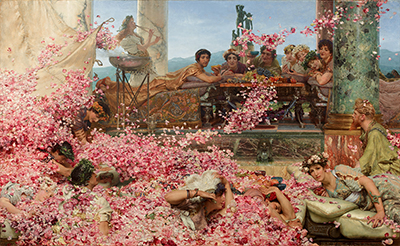
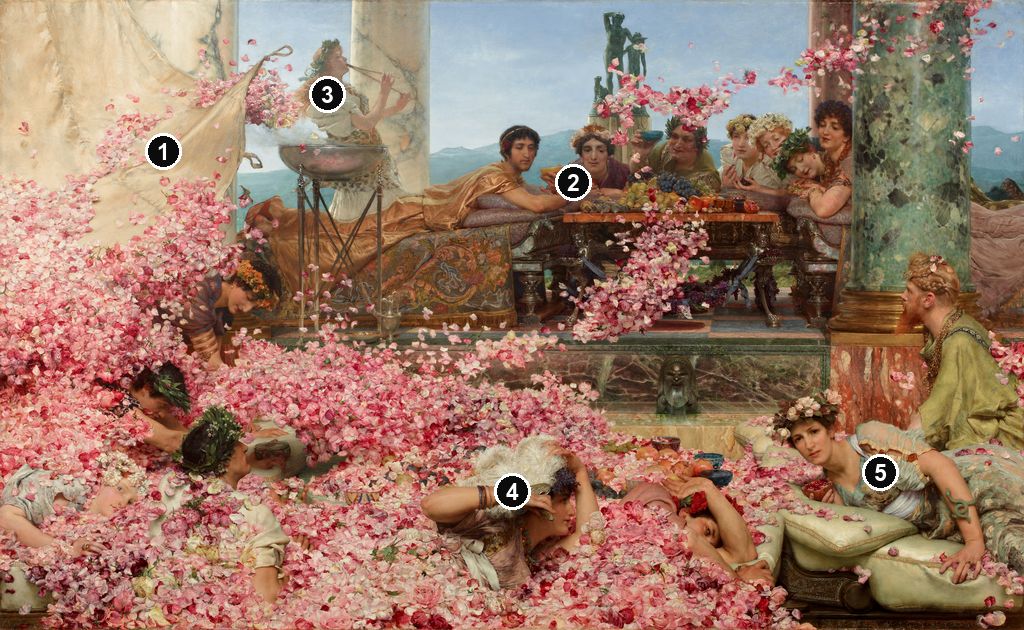
A sheet of pale fabric has swept to one side. Roses hang in the air above a banquet table, and a guest wearing a wreath looks out from a drift of petals. Farther back, the young Roman emperor Heliogabalus reclines in gold with a cup in his hand. The petals fall between him and the people below, some of whom are already hard to see. Lawrence Alma-Tadema painted The Roses of Heliogabalus in 1888. Its subject is an ancient story about a banquet at which a display of imperial generosity turns deadly. [1] [2]
The finished picture is an oil on canvas signed with Alma-Tadema’s name and the opus number CCLXXXIII. Christie’s and the Spanish state loan schedule for its 2014 Madrid exhibition give the dimensions as 132.7 × 214.4 cm. An account of its display in Rome gives 131.8 × 213.4 cm. Both describe the large canvas from the Pérez Simón collection. A much smaller oil on wood, also dated 1888, is the artist’s study for it. [1] [3] [4]
At a Glance
- Date1888
- SubjectRose petals descend over the emperor’s guests at a banquet.
- PatronageSir John Aird owned the finished picture by May 1891.
This work across Lawrence Alma-Tadema’s career
Contents
- What happened at the banquet?
- Above and below the table
- Marble, music and the study
- Fresh roses in winter
- Aird and the painting’s travels
- The appeal of a dangerous flower
- Annotated details
What happened at the banquet?
Heliogabalus, also known as Elagabalus, came to power as a teenager and ruled from AD 218 to 222. He had been a priest of the god Elagabal at Emesa in Roman Syria. The stories attached to his short reign are often hostile, and his reputation for extravagance owes much to the way ancient writers told them. The banquet appears in the Historia Augusta, a collection of imperial biographies compiled long after his reign. Its author claims that the emperor overwhelmed his dinner guests with flowers from a movable ceiling and that some suffocated when they could no longer force their way to the surface. The account gives us the story Alma-Tadema painted. Whether the banquet happened that way remains uncertain. [2] [8]
The Latin account says violis et floribus, meaning violets and other flowers. Roses appear in the very next passage, where the biographer mentions rose essence among the scents used in bathing water. David Magie, the translator, points to two other descriptions of remarkable ceilings, in Suetonius’ account of Nero and in the fictional feast of Trimalchio by Petronius. The parallel with a work of fiction is especially telling. A storyteller could use the sudden descent of flowers to make a host’s wealth and ingenuity seem almost fantastic. [2] [9]
Roses had become part of the story well before Alma-Tadema painted it. Matteo Piccioni traces versions in which earlier writers explicitly name them, among them the Italian poet Ippolito Pindemonte. He also points to Ovid’s Fasti, where showering a table with roses belongs to the pleasures of dining. In the painting, wreaths and individual blossoms still look entirely at home at a feast. It is the accumulation that makes the familiar threatening. Alma-Tadema uses a narrow range of related colours, from milky pink to red, to make the stream of petals and the heaps below feel like successive stages of the same fall. [10]
Above and below the table
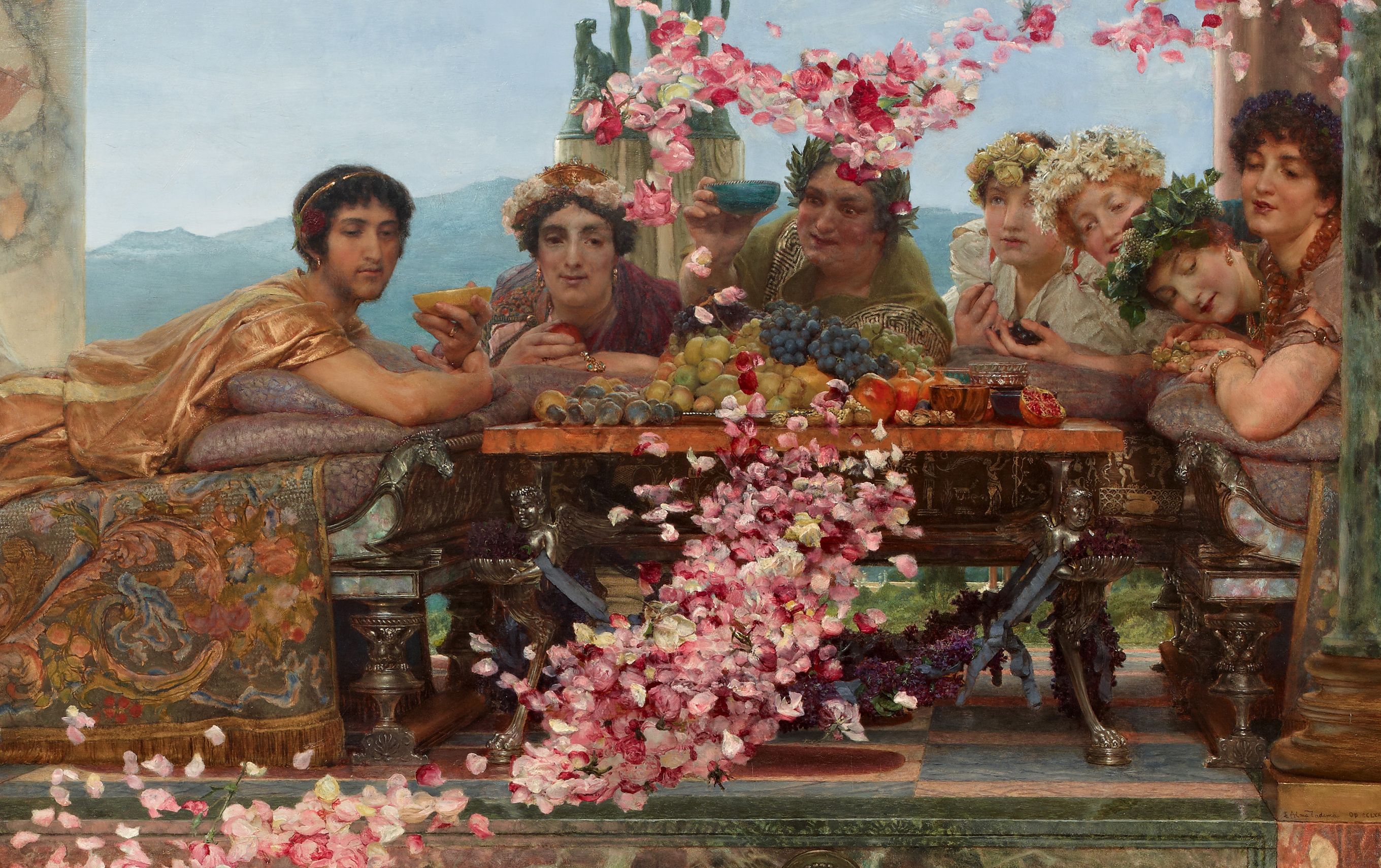
The raised platform is the clearest way into the composition. Its polished front runs horizontally through the picture, and the emperor’s guests can lean on the table to watch the lower company. You can follow the painted fruit from the bowls in front of the emperor to a few pieces still visible among the petals below. Near the right edge, cream cushions still hold their shape. Elsewhere, the furnishings and people have almost dissolved into a single pink surface. A forearm, a wreath or part of a sleeve may be all that connects one patch of colour to a reclining figure. [8] [11]
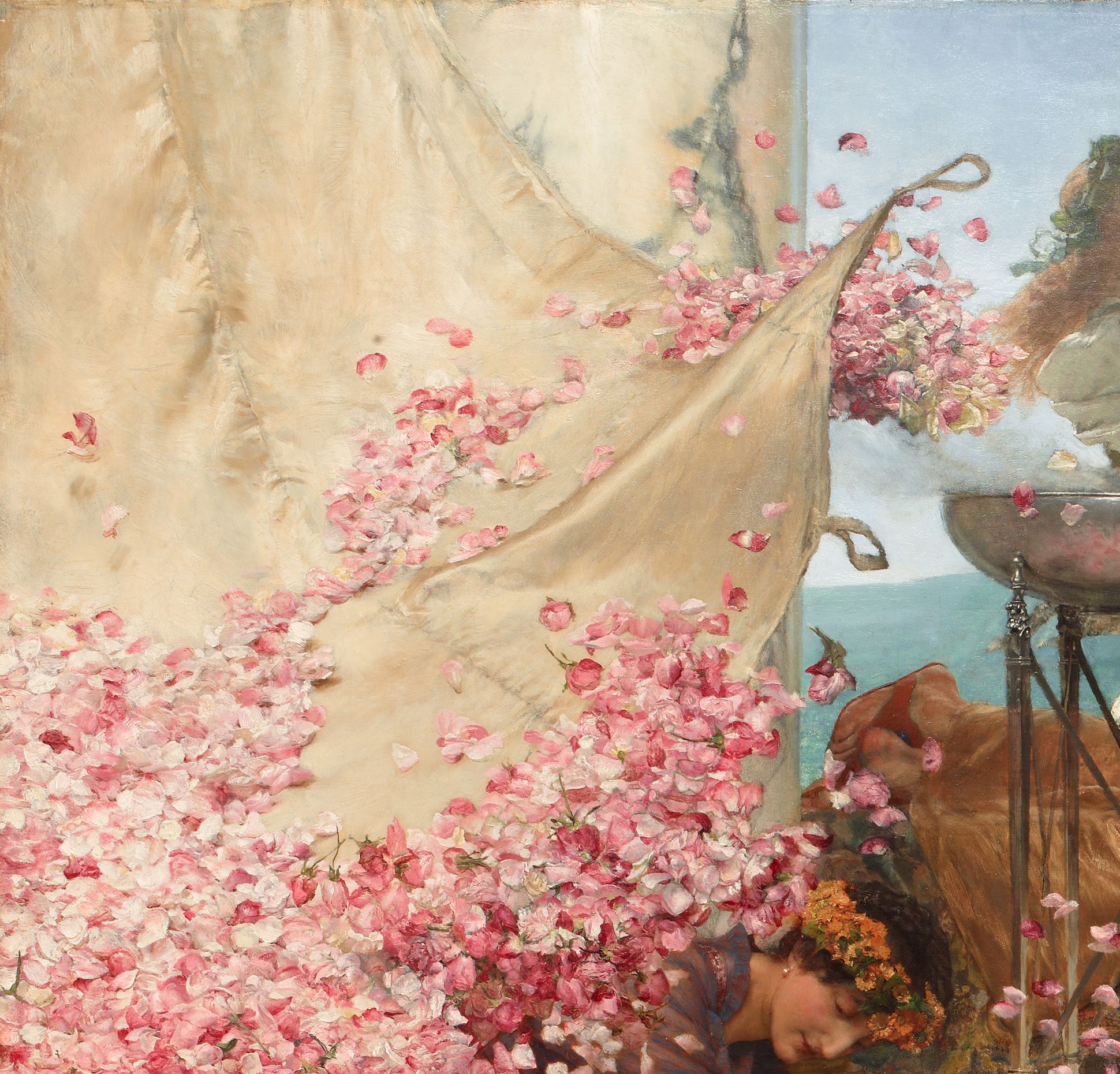
Look at how the cloth over the left half of the canvas swells before narrowing to a corner. The flowers follow its arc, spill down across the foreground and pass in front of the table in smaller pockets. A streak of airborne petals crosses the open sky and cuts in front of the dark green column on the right. Each break in the cascade gives the eye a glimpse of the room and of the space in which the petals are moving. The sheer overlap of flowers across the lower left is especially effective because Alma-Tadema keeps a few individual roses distinct. The depth of the pile is conveyed through their scale, the way they catch light and the gradually disappearing outlines of the guests. [4] [10]
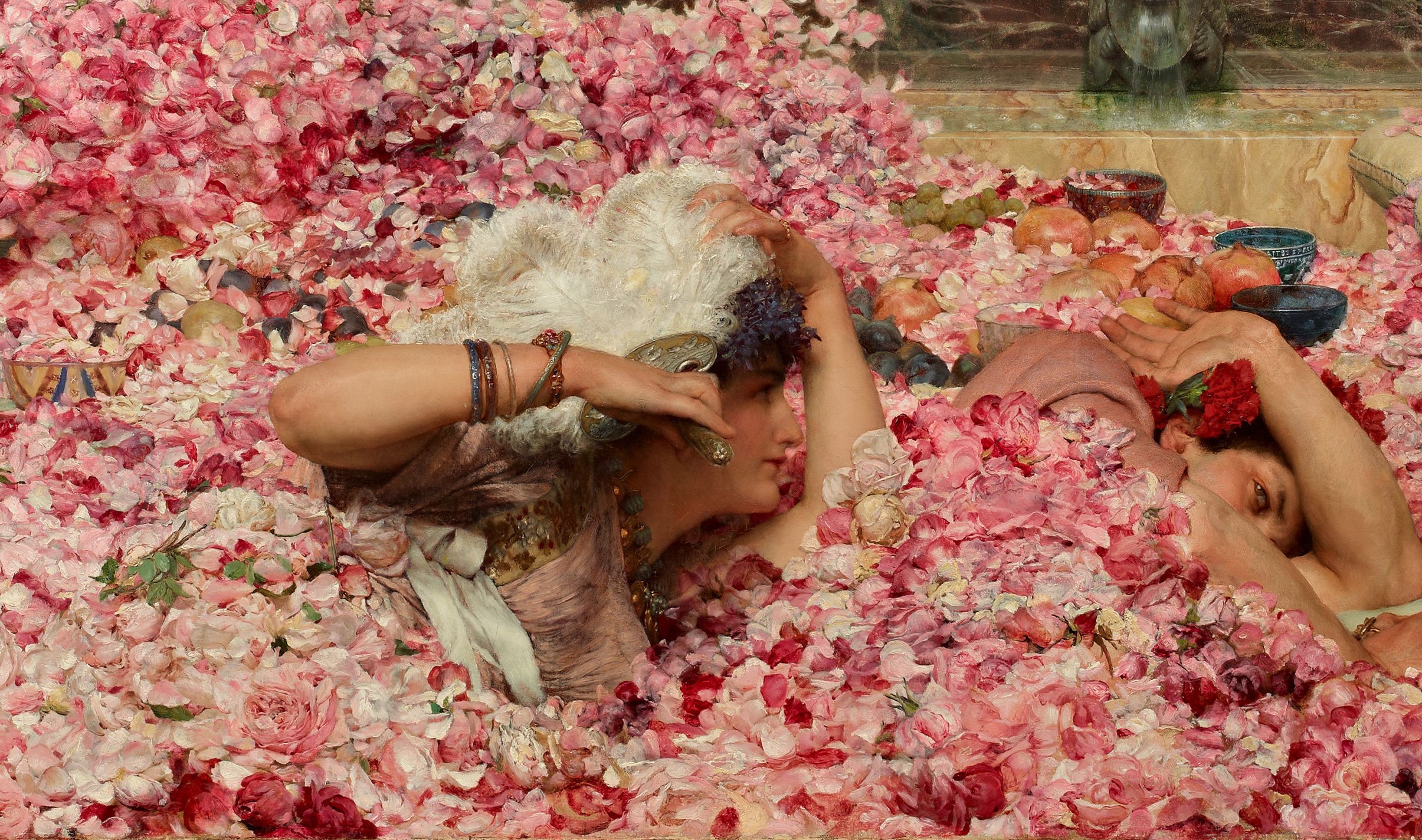
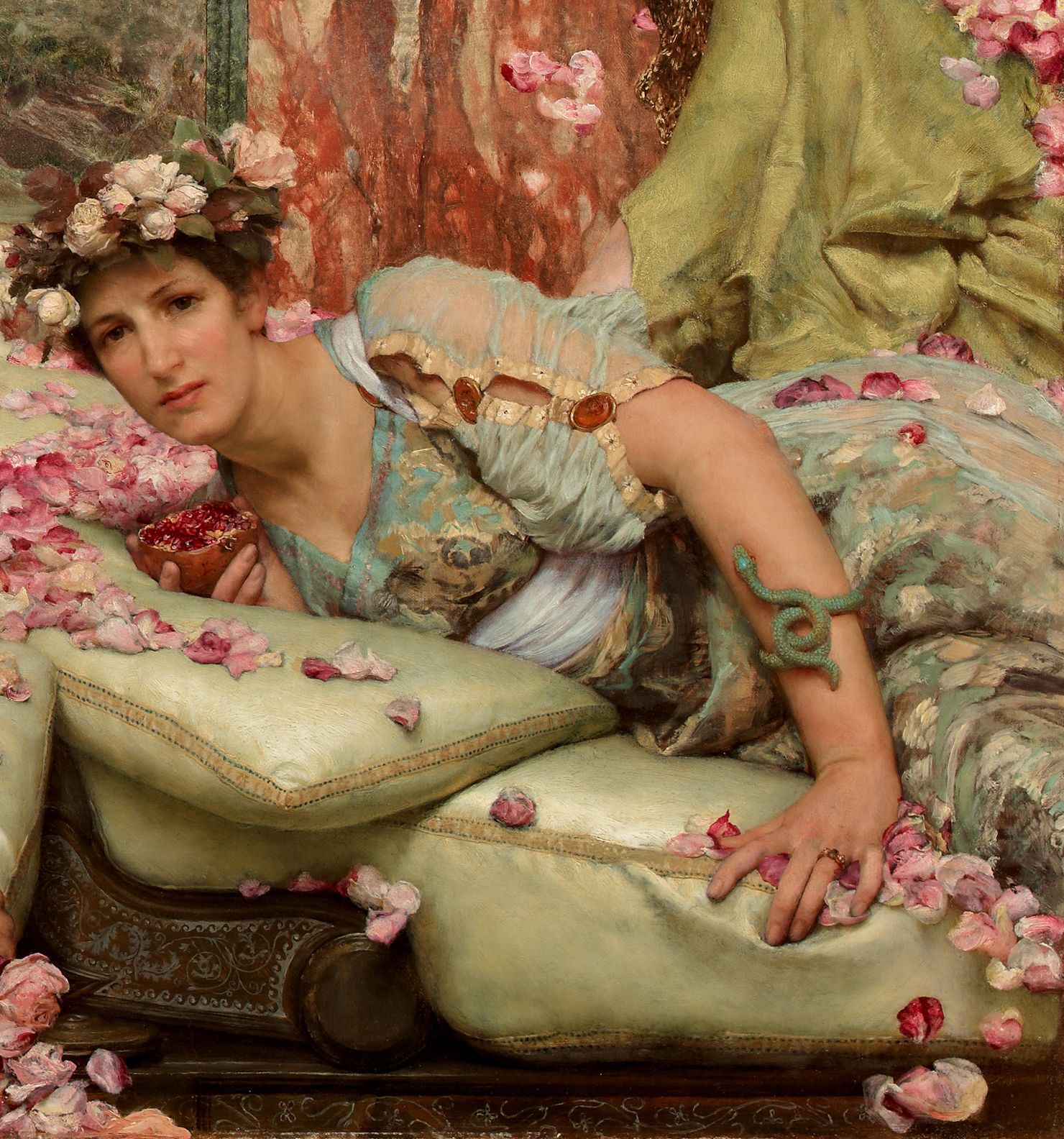
The guests below react at different speeds. Near the centre a diner lifts both arms to the head, while another figure lies folded in on herself. At the outer right a woman braces herself against a cushion and meets our gaze. A seated man behind her turns his head towards the banquet. Their staggered responses make it possible to read the shower first as a prank and then as a trap. That uncertainty matters to Isobel Hurst’s account of the painting as a Roman cena, or dinner, in which the elevated guests are spectators. Hurst cites Elizabeth Prettejohn’s reading of the languid poses as part of the painting’s erotic charge. Alma-Tadema keeps the danger visible through postures that can also suggest pleasure or repose. [10] [11]
The people around the table have sometimes been identified as members of the imperial family and court. The Musée Jacquemart-André dossier reads the older woman near the emperor as his grandmother Julia Maesa and proposes others, including his mother Julia Soaemias. These are readings of the painted company. The visual hierarchy is easier to establish. Heliogabalus is recognisable in gold and the guests closest to him can stay where they are, cup or fruit in hand, while the other diners struggle to sit up. The only people at an even safer distance are those standing in front of the painting. [4] [8] [11]
Annotated Details from The Roses of Heliogabalus
The numbered points mark details in The Roses of Heliogabalus. Catalogue record. Public domain.
Details from THE ROSES OF HELIOGABALUS
Select a numbered point or use the details below to examine a part of the painting.
Petals released from the pale canopy
A sheet of pale fabric sweeps down from the upper edge. Petals cross its diagonal and gather into a heavier pink mass on the left.
The ruler and the banquet platform
The emperor and his companions recline above the other guests. The edge of their platform, partly obscured by falling petals, marks the division between the two groups.
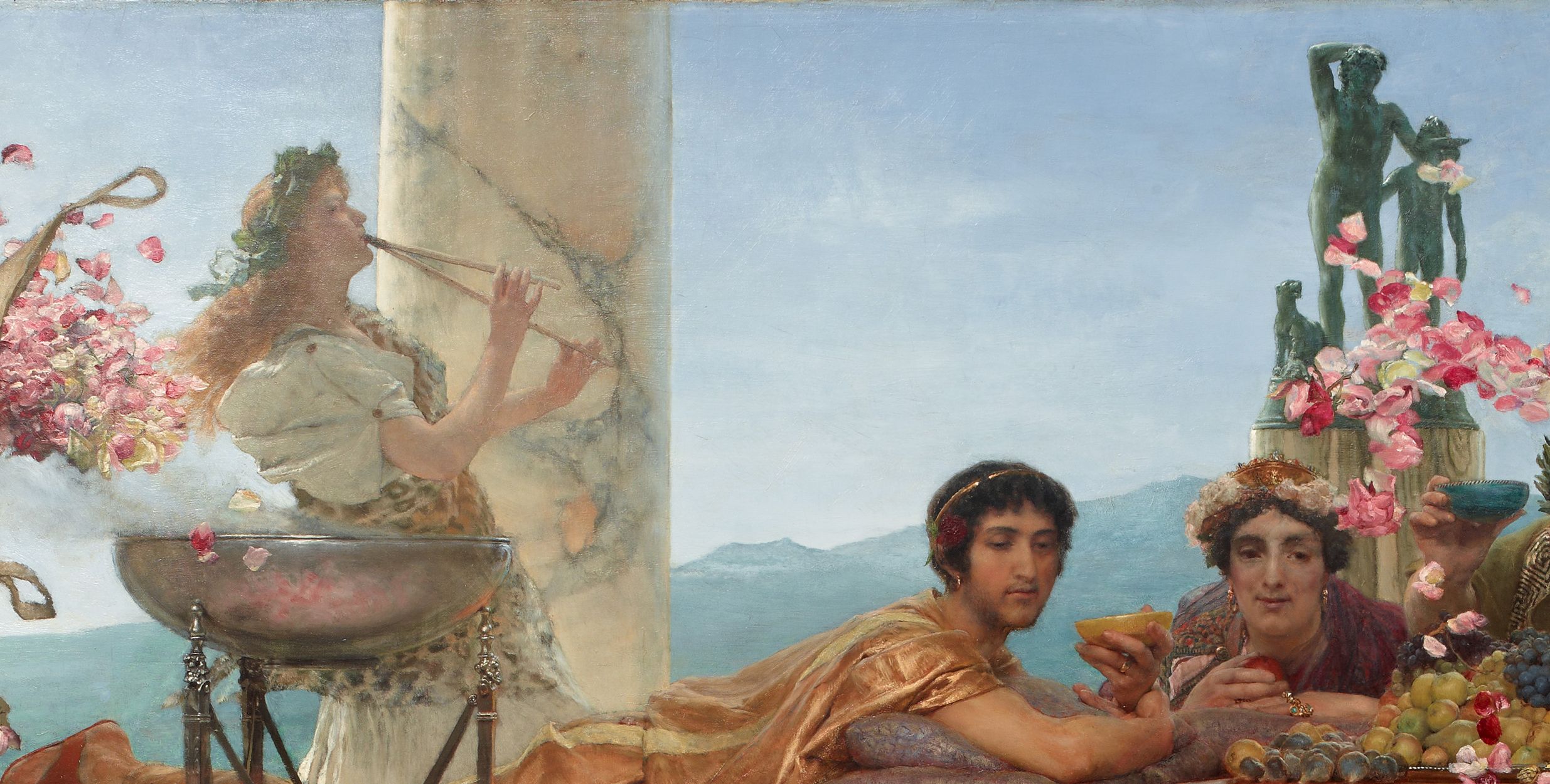
The musician and the bronze in the background
The pipe player and bronze figure punctuate the view through the columns. Their upright silhouettes remain legible beyond the busy banquet table.
A raised forearm amid the petals
A raised arm, white plumes and patches of cloth emerge from the mound of petals. Their edges are almost lost among the clustered blossoms.
The figure on the pale cushions
The pale cushions stay visibly separate from the petals. One guest’s outstretched hand and flower wreath trace a diagonal across the right foreground.
Marble, music and the study
The architecture gives the episode its physical setting. The Musée Jacquemart-André describes the portico in terms of red porphyry and green Laconian marble. Their weight and polished edges register against the thin cloth and the flowers. Look just to the left of the emperor, where a shallow metal vessel catches light above a stand whose delicate legs can still be followed through the roses. A musician plays a double pipe behind it. Her animal skin and the sculpture farther back evoke the company of Dionysus, the Greek god of wine whom the Romans called Bacchus. The Italian scholar Alessandra Pedersoli pairs the painted figure with the colossus of Dionysus and a satyr in Rome’s Palazzo Altemps. The leaning god and the companion who supports him make an instructive comparison, even though similar sculptural groups survive and the precise model Alma-Tadema used is uncertain. [4] [8] [10] [12]
Alma-Tadema worked out the arrangement on a panel just 23.5 × 38.2 cm. In the study, the imperial table already sits above a foreground almost full of flowers. A flight of pale steps marks the separation. Deep shadows dominate the area behind the table, and a broad vessel protrudes diagonally from the middle of the shower. In the canvas, a faced platform with a small sculpted ornament takes the place of the open steps, and there is a stretch of clear sky behind the imperial company. The equivalent passage in the foreground is largely given over to flowers and half-covered figures. The study lays out the two levels and the sweep of falling colour. The canvas uses the extra space to make the architecture legible through the shower and to show exactly how far the roses have travelled. [3] [13] [14]
Both pictures had independent exhibition histories. The study appeared at the New Gallery in London in 1888. That same year the finished canvas hung at the Royal Academy as catalogue number 298. The Art Journal acclaimed it as a masterpiece, according to Christie’s, which also records a contemporary Illustrated London News critic who thought the larger version had improved in the course of revision and still had reservations about its poetic imagination. Both works were also included in the Academy’s memorial exhibition of 1913, under separate entries. A visitor comparing the same two works today could judge how much of the effect comes from that daylit opening in the finished painting. The sky offers relief from the visual density below and makes the spectators at the table harder to miss. [1] [13] [15]
Fresh roses in winter
In an 1899 interview with The Strand Magazine, Alma-Tadema pointed out the place in his home where he had worked on the flowers. “It was here that I painted the flowers,” he said. The interviewer saw withered rose leaves beside a marble basin and recorded the painter’s recollection of boxes sent from the Riviera while he painted through the winter. Helen Zimmern’s early account also describes repeated orders for fresh roses while the canvas was in progress. Published accounts differ on the frequency. They give a sense of why keeping fresh models mattered. An open rose seen sideways, a single petal edged with light and a bruised-looking mass of darker reds all behave differently under the same light. [1] [16] [17]
Several years later, M. H. Spielmann relayed an Academician’s account of Alma-Tadema painting passages of silverwork, marble and mother-of-pearl on Varnishing Day, with the canvas already on the wall at the Royal Academy. According to Spielmann, the painter responded that he had worked it all out beforehand. The story has the relish of studio lore. Its emphasis on reflected colour makes sense in front of the picture, where a vessel, a stone surface and a fold of fabric can each carry something of the pink or gold next to it and still look like separate materials. [8] [18]
Aird and the painting’s travels
By May 1891 the contractor and collector John Aird owned the finished canvas. Writing in the Art Journal that month, J. F. Boyes described it hanging in the back drawing room of Aird’s London house in Hyde Park Terrace. Aird’s friends regarded it as the finest painting in his collection. Beside it hung the small sketch shown at the New Gallery, which, Boyes reported, Alma-Tadema had given to Aird. The article describes Marcus Stone’s nearby Asleep as a commission and gives no equivalent details for the large Alma-Tadema. [19]
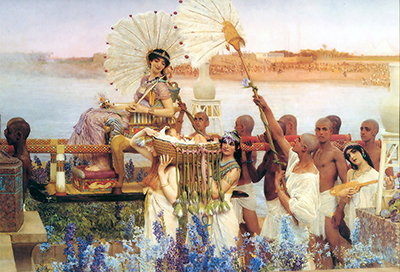
Christie’s catalogues the canvas as an 1888 commission and reports that Alma-Tadema received £4,000. Sotheby’s dates the purchase to 1891, while the Musée Jacquemart-André describes the work as a project the artist began on his own initiative. The date and terms of Aird’s initial commitment remain uncertain. In 1902 Aird invited the artist to Egypt for the opening of the Aswan dam and acquired The Finding of Moses, the large painting that followed the visit. [1] [8] [7]
After its Royal Academy début, the canvas went to the Paris Salon in 1893, the Guildhall loan exhibition in London in 1894 and the Royal Birmingham Society of Artists in 1896. It sold at Christie’s from the Aird collection in 1935 for 483 guineas and went unsold when it returned to the auction house in 1960. Christie’s records the panel study in the ownership of Aird’s son Malcolm by 1913. By 1973 the canvas belonged to the American television producer Allen Funt and was exhibited at New York’s Metropolitan Museum of Art in Victorians in Togas, a show drawn from his collection of Alma-Tadema’s paintings. The work passed through Sotheby’s in November of that year. Auction records and loan lists make it possible to follow this unusually mobile picture while distinguishing it from the small study. [1] [13] [20]
The Paris exhibition Désirs et volupté à l’époque victorienne reunited the canvas and the study in 2013–14. In Rome in 2014 the Chiostro del Bramante organised the exhibition around flowers. Pedersoli describes the canvas in the final room, against dark walls and amid floral scents. She also recalls the falling petals in American Beauty as a modern parallel evoked by the exhibition. The Thyssen-Bornemisza then presented the work in Madrid as a major loan from the private Pérez Simón collection. Spain’s state guarantee lists the Fundación JAPS loans as two separate works, the canvas as inventory 10304 and the oil-on-wood study as 10305. At Leighton House the canvas appeared in A Victorian Obsession in 2014–15 and returned for Alma-Tadema: At Home in Antiquity in 2017, when more than 130 works were displayed throughout the house. [3] [4] [8] [21] [22] [23]
The appeal of a dangerous flower
The Rome exhibition proposed Joris-Karl Huysmans’s À rebours (1884) as a source. Elagabalus does appear in the novel, as an example of the dazzling excess that fascinates its reclusive aristocrat, Des Esseintes. Joseph Bristow puts the novel and painting in a wider late nineteenth-century interest in the emperor, also visible in Simeon Solomon’s 1866 watercolour of Heliogabalus as a high priest, robed in gold and red and holding a censer. That literary and artistic setting helps explain the appeal of Alma-Tadema’s subject. The link to Huysmans remains a proposed influence. The specific episode of the flowers can be traced directly to its ancient literary source. [2] [21] [24] [25]
Other paintings by Alma-Tadema give the rose different work to do. Piccioni compares the fallen petals in Caracalla and the festoons in Caracalla and Geta, where flowers belong to the display of imperial power. The artist’s In a Rose Garden puts them within reach of two women in a quieter scene, where the association is with conversation and private pleasure. Piccioni also sets the suffocating banquet beside a strand of European literature about death by floral perfume, including the flower-filled room in Émile Zola’s La Faute de l’abbé Mouret. That parallel helps make sense of the scented gallery in Rome. In the ancient banquet story the mass of flowers is what traps the guests. An imagined scent belongs to the sensory world the picture evokes. [2] [4] [10] [26]
Fabric does something comparable in Alma-Tadema’s A Roman Emperor: 41 AD, where a soldier pulls aside a curtain to reveal Claudius in hiding. Bodies lie openly on the floor at the back of that painting. In The Roses of Heliogabalus, the drawn fabric gives way to flowers that make it harder to see the people on the ground. [27]
The petals also travelled into other media. Maria Wyke compares the feast in Louis Feuillade’s 1911 film Héliogabale, ou l’orgie romaine with the canvas, whose composition also circulated in prints. The film’s stencil-coloured pinks and the clustering of bodies at the feast invite comparison. Film makes the flowers move and lets us see the guests scatter. In a more explicit response, Ennio Flaiano brings a copy of the painting into his story La penultima cena, published in Le ombre bianche in 1972. As Guido Mattia Gallerani shows, a group’s cultivated dinner entertainment ends with the narrator shoved from a terrace and his belongings thrown down after him as his “rose petals”. Flaiano carries over the distinction between an amused party and the guest it chooses to humiliate. It is there from the start in Alma-Tadema, in the modest difference in height between a man who can watch the flowers fall and a diner who cannot get clear of them. [28] [29] [30]
Lawrence Alma-Tadema artworks directory
Search by title or medium. The directory includes Alma-Tadema’s numbered compositions, separately catalogued fragments, and selected drawings and historic prints. Dates for unlinked works follow the catalogue’s year groupings. View the numbered opus catalogue
| Name | Date | Medium |
|---|---|---|
| Portrait of my sister Artje | 1851 | Painting |
| Selfportrait | 1852 | Painting |
| Portrait of my mother (oval) | 1852 | Painting |
| The alm | 1856 | Painting |
| The inundation of the Biesbosch in 1421 | 1857 | Painting |
| The destruction of Terdoest Abbey in 1571 | 1857 | Painting |
| Faust en Marguerite | 1857 | Watercolour |
| Clotilde at the tomb of her grandchildren | 1858 | Painting |
| Marius on the ruins of Carthage | 1858 | Watercolour |
| The sad father: the unfavourable oracle (Death of the first-born, first version) | 1859 | Painting |
| The death of Attila, 453 AD | 1859 | Watercolour |
| Triumphal return of Sir Willem van Saeftingen | 1860 | Painting |
| The death of Hippolyte | 1860 | Watercolour |
| The Education of the Children of Clovis | 1861 | Painting |
| Venantius Fortunatus reading his poems to Radagonda VI | 1862 | Painting |
| Gunthram Bose and his daughters, 572 AD: the Ambuscade | 1862 | Painting |
| A medieval Flemish interior | 1863 | Painting |
| Pastimes in Ancient Egypt: 3.000 years ago | 1863 | Painting |
| Interior of the Church San Clemente, Rome: a study | 1863 | Painting |
| Queen Fredegonda at the deathbed of Bishop Praetextatus (first version) | 1864 | Painting |
| Leaving Church in the fifteenth century | 1864 | Painting |
| Egyptian Chess Players (An Egyptian Game) | 1865 | Painting |
| Birthday presents in the sixteenth century | 1865 | Painting |
| Gallo-Roman women | 1865 | Painting |
| Entering Church in the fourteenth century | 1865 | Painting |
| An Egyptian at his doorway in Memphis | 1865 | Painting |
| Catallus ten huize van Lesbia | 1865 | Painting |
| The discourse | 1865 | Painting |
| A Roman scribe writing despatches | 1865 | Painting |
| A soldier of Marathon | 1865 | Painting |
| Home from market | 1865 | Painting |
| Death of Galeswinthe | 1865 | Painting |
| An Egyptian Game (preparatory drawing) | 1865 | Drawing |
| Making wreaths for festivities in a Pompeian house | 1866 | Painting |
| Vespasian hearing of the taking of Jerusalem by Titus | 1866 | Painting |
| Entrance to a Roman theatre | 1866 | Painting |
| In the peristyle | 1866 | Painting |
| Agrippina visiting the ashes of Germanicus | 1866 | Painting |
| Tibullus at Delia's | 1866 | Painting |
| A Roman dance | 1866 | Painting |
| Lesbia weeping over a sparrow | 1866 | Painting |
| The armourer's shop in ancient Rome | 1866 | Painting |
| The Education of the Children of Clovis (Rennefeld print after Alma-Tadema) | 1866 | |
| The mummy: Roman period: Egyptians lamenting their dead | 1867 | Painting |
| The honeymoon | 1867 | Painting |
| Cuckoo | 1867 | Painting |
| The aesthetic view: Madame Dumoulin, Pauline, and Laurence | 1867 | Painting |
| Glaucus and Nydia | 1867 | Painting |
| Portrait of Mr A. Bonnefoy | 1867 | Painting |
| Proclaiming Claudius Emperor | 1867 | Painting |
| A sculpture gallery in Rome at the time of Augustus | 1867 | Painting |
| A collector of pictures at the time of Augustus | 1867 | Painting |
| Tarquinius Superbus before Galba | 1867 | Painting |
| A Roman family | 1867 | Painting |
| Italian women | 1867 | Painting |
| Portrait of Madame Bonnefoy and Mr Puttemans | 1867 | Painting |
| The siësta (first version) | 1868 | Drawing |
| The embarkation | 1868 | Painting |
| The siësta (second version) | 1868 | Painting |
| A Roman art lover | 1868 | Painting |
| Woman and flowers | 1868 | Painting |
| Phidias and the Parthenon, Athens | 1868 | Painting |
| The flower girl | 1868 | Painting |
| A Roman flower market: Pompeii | 1868 | Painting |
| Egyptian game | 1868 | Watercolour |
| Education of the children of Clovis | 1868 | Painting |
| A Roman art lover: silver statue | 1868 | Painting |
| Egyptian dancing girls | 1868 | Watercolour |
| Catalina | 1869 | Painting |
| The visit: Sunday morning before churching (first version): a birth chamber, seventeenth century | 1869 | Painting |
| The Pyrrhic dance | 1869 | Painting |
| The Grand Chamberlain of Sesostris the Great | 1869 | Painting |
| The convalescent | 1869 | Painting |
| Confidences | 1869 | Painting |
| A Greek Woman | 1869 | Painting |
| At the wine shop | 1869 | Painting |
| An Exedra (first version) | 1869 | Painting |
| Portrait of Master Ernest Angely | 1870 | Painting |
| A juggler | 1870 | Painting |
| A nurse, seventeenth century: Sunday morning (second version) | 1870 | Watercolour |
| Roman art lover (the runner ) | 1870 | Painting |
| Anacreon reading his poems at Lesbia's house | 1870 | Painting |
| The vintage festival (first version) | 1870 | Painting |
| The first whisper of love | 1870 | Painting |
| The letter: from an absent one (first version) | 1870 | Painting |
| A staircase (first version) | 1870 | Painting |
| Hush, she sleeps | 1870 | Painting |
| The letter: from an absent one (second version) | 1871 | Watercolour |
| The vintage festival (second version) | 1871 | Painting |
| A Roman Emperor (second version) | 1871 | Painting |
| In the temple (first version) | 1871 | Painting |
| Portrait of Miss Laura Theresa Epps | 1871 | Painting |
| A Bacchic dance | 1871 | Painting |
| Fredegonda and Praetextatus (second version) | 1871 | Painting |
| Portrait study for Mrs H.W. Mesdag | 1871 | Painting |
| Greek potters | 1871 | Painting |
| An exedra (second version) | 1871 | Watercolour |
| Sunday morning: the two sisters (third version) | 1871 | Painting |
| In the temple (second version) | 1872 | Watercolour |
| The first reproach | 1872 | Painting |
| An Egyptian widow | 1872 | Painting |
| Improvisatore | 1872 | Painting |
| A halt (first version) | 1872 | Painting |
| The last roses | 1872 | Painting |
| Death of the first-born (second version) | 1872 | Painting |
| Portrait of Dr Franz and Mrs Catherine Hueffer 'When I am dead, oh dearest sing' | 1872 | Painting |
| The nurse | 1872 | Painting |
| Greek wine (first version) | 1872 | Painting |
| Goldfish (first version) | 1872 | Painting |
| On a Roman staircase (second version) | 1872 | Watercolour |
| Hercules | 1872 | Painting |
| Portrait of Miss Kate Thompson | 1873 | Painting |
| The dinner (first version) | 1873 | Painting |
| The siësta (third version) | 1873 | Painting |
| A visit to the studio (second version) | 1873 | Watercolour |
| Cherries | 1873 | Painting |
| Greek wine (second version) | 1873 | Watercolour |
| This is our corner | 1873 | Painting |
| A picture gallery (third version) | 1873 | Painting |
| The last roses (second version) | 1873 | Watercolour |
| Fishing (first version) | 1873 | Painting |
| Music has charms | 1873 | Watercolour |
| Counting the passers-by | 1873 | Watercolour |
| Portrait of Mrs Frederick George Stephens | 1873 | Painting |
| Two heads from 'The Picture Gallery': A visit to the studio by Charles W. Deschamps and his wife (first version) | 1874 | Watercolour |
| Joseph, overseer of Pharaoh's granaries | 1874 | Painting |
| A sculpturegallery (first version) | 1874 | Painting |
| A picture gallery in Rome at the time of Augustus (fourth version) | 1874 | Painting |
| Portrait of Charles W. Deschamps and his wife (second version) | 1874 | Painting |
| Autumn | 1874 | Watercolour |
| Reflections: fishing (second version) | 1874 | Painting |
| A Roman artist | 1874 | Watercolour |
| Good friends | 1874 | Watercolour |
| On the steps of the Capitol (first version) | 1874 | Painting |
| Water pets: goldfish (second version) | 1874 | Painting |
| Münster Cathedral | 1874 | Painting |
| Landscape near Münster | 1874 | Painting |
| Antistius Labeon, 75 AD: A Roman amateur artist | 1874 | Painting |
| Sunny days | 1874 | Painting |
| Spring flowers: garland seller on the steps of the Capitol (second version) | 1874 | Watercolour |
| Through an archway | 1874 | Painting |
| (A, B) Decoration for my piano: 'Serious and merry music' | 1874 | Painting |
| Rêverie | 1874 | Painting |
| The Roman architect | 1874 | Painting |
| Sunflowers | 1874 | Painting |
| Landscape: carriage drive by the outskirts of a wood, Penhill Castle | 1875 | Painting |
| A peep through the trees | 1875 | Painting |
| Cleopatra (first version) | 1875 | Painting |
| (a, b, c) The tragedy of an honest wife | 1875 | Watercolour |
| The architect of the Coliseum | 1875 | Watercolour |
| Fishing | 1875 | Watercolour |
| Cherry blossom | 1875 | Painting |
| Water pets: goldfish (third version) | 1875 | Painting |
| 'There he is!' | 1875 | Painting |
| Play Garden | 1875 | Painting |
| Portrait of Miss Thackeray's 'Elisabeth' | 1875 | Painting |
| A nymphaeum from the Villa Aldobrandini in Rome | 1875 | Painting |
| Haystacks | 1875 | Painting |
| A sculpture gallery (second version) | 1875 | Painting |
| After the dance: a bacchanal | 1875 | Painting |
| Landscape: a breezy day in August near Innsbruck | 1875 | Painting |
| The service | 1875 | Painting |
| An audience at Agrippa's (first version) | 1875 | Painting |
| Kriemhild’s Tryste | 1875 | |
| Portrait of my wife | 1876 | Painting |
| Between hope and fear | 1876 | Painting |
| 94 Degrees in the Shade | 1876 | Painting |
| An antique custom | 1876 | Painting |
| Portrait of Jules Dalou, his wife and his daughter | 1876 | Painting |
| Pleading (first version) | 1876 | Painting |
| Hide and seek | 1876 | Painting |
| Balneatrix | 1876 | Watercolour |
| A mirror | 1877 | Painting |
| An interesting scroll | 1877 | Watercolour |
| Winter | 1877 | Painting |
| Autumn-vintage festival | 1877 | Painting |
| Summer | 1877 | Painting |
| Spring in the gardens of the Villa Borghese (first version) | 1877 | Painting |
| A balneator | 1877 | Watercolour |
| Painting in Ancient Rome | 1877 | Painting |
| A balneatrix | 1877 | Painting |
| The sculptor's model (Venus Esquilina) | 1877 | Painting |
| The sculptor's studio in ancient Rome | 1877 | Painting |
| Architecture in ancient Rome | 1877 | Painting |
| Cleopatra (second version) | 1877 | Painting |
| Spring in the gardens of the Villa Borghese (second version) | 1877 | Painting |
| Panel for H. W. Mesdag's studio door: Spring in the gardens of the Villa Borghese (third version) | 1877 | Painting |
| The question: Pleading (second version) | 1877 | Painting |
| A kitchen garden | 1877 | Painting |
| Flora: Spring in the gardens of the Villa Borghese (fourth version) | 1877 | Watercolour |
| A silent counsellor | 1878 | Watercolour |
| A sollicitation | 1878 | Watercolour |
| A hearty welcome | 1878 | Painting |
| A landscape | 1878 | Painting |
| In the time of Constantine | 1878 | Painting |
| A love missile | 1878 | Painting |
| Fredegonda en Galswintha, 566 AD | 1878 | Painting |
| A safe confidant | 1878 | Painting |
| After the audience (second version) | 1879 | Painting |
| Strigils andsponges | 1879 | Watercolour |
| E festival in Pomona | 1879 | Painting |
| Prose | 1879 | Painting |
| Going down to the river | 1879 | Painting |
| The Roman wine tasters | 1879 | Watercolour |
| Portrait of th singer George Henschel Esq. at the piano | 1879 | Painting |
| Poetry | 1879 | Painting |
| A well-protected slumber | 1879 | Painting |
| A garden altar | 1879 | Painting |
| Beauties | 1879 | Painting |
| Portrait of Thekla Friedländer | 1879 | Unspecified |
| On the road to the Temple of Ceres: A springfestival | 1879 | Painting |
| Autumn (third version) | 1879 | Drawing |
| 'Not at home' | 1879 | Painting |
| An old bachelor after the bath | 1879 | Watercolour |
| Spring (Blanchard print after Alma-Tadema’s 1877 painting) | 1879 | |
| The first course: the dinner | 1880 | Painting |
| Interrupted | 1880 | Painting |
| Grapes | 1880 | Watercolour |
| A pastoral | 1880 | Painting |
| A portrait of Dr Felix and Mrs August Redeker Semon | 1880 | Painting |
| Ave Caesar! Io Saturnalia! (third version) | 1880 | Painting |
| A prize for the artist's corps | 1880 | Painting |
| The departure (first version) | 1880 | Painting |
| A harvest festival | 1880 | Painting |
| 'Your carriage stops the way' | 1880 | Painting |
| Autumn (Scene in a Roman Garden) | c.1880 | Drawing |
| The torch dance | 1881 | Painting |
| Sappho and Alcaeus | 1881 | Painting |
| A kiss | 1881 | Watercolour |
| A Bacchante dancing before the thymele | 1881 | Watercolour |
| An audience | 1881 | Painting |
| Portrait of Dr Hans Richter | 1881 | Painting |
| Pandora | 1881 | Watercolour |
| The Tepidarium | 1881 | Painting |
| Quiet pets | 1881 | Painting |
| A priestess of Apollo | 1881 | Watercolour |
| A difficult line from Horace (first version) | 1881 | Painting |
| A stranger in my studio (one of a pair) | 1881 | Painting |
| Amo te ama me | 1881 | Painting |
| The First Course–The Dinner (Löwenstam print after Alma-Tadema) | 1881 | |
| Young affections | 1882 | Painting |
| A difficult line from Horace (second version) | 1882 | Drawing |
| Portrait of John F. Whichcord Esq., PRIBA, FSA | 1882 | Painting |
| Portrait of Ludwig Barnay as Marcus Antonius | 1882 | Painting |
| The way to the temple | 1882 | Painting |
| A parting kiss | 1882 | Painting |
| Reflections | 1882 | Painting |
| Between Venus and Bacchus | 1882 | Watercolour |
| Dolce far niente (first version) | 1882 | Watercolour |
| Dolce far niente (second version) | 1882 | Painting |
| An Oleander | 1882 | Painting |
| The meeting of Antony and Cleopatra | 1883 | Painting |
| Portrait of Catherine, Duchess of Cleveland | 1883 | Painting |
| Portrait of my daughter Anna Alma-Tadema | 1883 | Painting |
| Shy | 1883 | Painting |
| Portrait of His Excellency the Duke of Bylandt | 1883 | Painting |
| Una Carita: The three graces: Laura, Laurence, and Anna | 1883 | Painting |
| Portrait of Leopold Lowenstam, the engraver | 1883 | Painting |
| Portrait of Lady Thompson | 1883 | Painting |
| Portrait of Professor Giovanni Battista Amendola | 1883 | Painting |
| 'Der alte Menander ist doch nicht gestorben!' Paulus and Hermas | 1883 | Drawing |
| A street altar | 1883 | Watercolour |
| Welcome Footsteps (The Well-Known Footsteps) | 1883 | Painting |
| A declaration: an old, old story | 1883 | Watercolour |
| Xanthe and Phaon | 1883 | Watercolour |
| Selfportrait | 1883 | Painting |
| Hadrian in England: visiting a Roman-British Pottery (original, later divided) | 1884 | Painting |
| A Roman-British pottery | 1884 | Painting |
| Emperor Hadrian's visit to a British pottery | 1884 | Painting |
| A Roman-British potter | 1884 | Painting |
| Portrait of Miss Alice Lewis | 1884 | Painting |
| Who is it? | 1884 | Painting |
| Portrait of Moses Ezekiel | 1884 | Painting |
| Portrait of Sir Francis Powell | 1884 | Painting |
| Egyptien à l’entrée de sa demeure (Ramus print after Alma-Tadema) | 1884 | |
| Expectations | 1885 | Painting |
| A Reading from Homer | 1885 | Painting |
| Portrait of Dr Wahington Napoleon Epps: my docter | 1885 | Painting |
| The triumph of Titus: the Flavians | 1885 | Painting |
| Ariadne | 1885 | Painting |
| Portrait of Mrs W. M. Baker | 1885 | Painting |
| Rose of all roses | 1885 | Painting |
| A foregone conclusion | 1885 | Painting |
| A apodyterium | 1886 | Painting |
| Portrait of James Reld Esq. | 1886 | Painting |
| Portrait of Mrs Frank D. Millet | 1886 | Painting |
| A secret | 1887 | Painting |
| The Women of Amphissa | 1887 | Painting |
| A new dress | 1887 | Watercolour |
| 'He loves me, he loves me not' | 1887 | Painting |
| Illuminated letter 'W' for the Royal Academy address to Queen Victoria | 1887 | Watercolour |
| Portia | 1887 | Painting |
| The Roses of Heliogabalus | 1888 | Painting |
| Fair tresses: a sketch | 1888 | Painting |
| Midday slumbers | 1888 | Watercolour |
| Portrait of the honourable Adama van Scheltema | 1888 | Painting |
| Venus and Mars | 1888 | Painting |
| Portrait of Jules de Soria | 1888 | Painting |
| At the shrine of Venus | 1888 | Painting |
| The Favourite Poet | 1888 | Painting |
| The Favourite Poet (Löwenstam print after Alma-Tadema) | c.1888 | |
| Sisters | 1889 | Painting |
| Cloaked in yellow | 1889 | Painting |
| A dedication to Bacchus (first version) | 1889 | Painting |
| A dedication to Bacchus (second version) | 1889 | Painting |
| Portrait of Mrs Ralph Sneyd | 1889 | Painting |
| Portrait of Miss MacWhirter (Mrs Charles Sims) | 1889 | Painting |
| Portrait of young gentleman John Parsons Millet | 1889 | Painting |
| In a rose garden | 1889 | Painting |
| A Silent Greeting | 1889 | Painting |
| Portrait of Sir Ernest A. Waterlow, Esq., RA | 1889 | Painting |
| Eloquent silence | 1890 | Painting |
| The Frigidarium | 1890 | Painting |
| Promise of Spring | 1890 | Painting |
| Portrait of Miss Agnes Marks | 1890 | Painting |
| Rêverie: a sketch | 1890 | Painting |
| Portrait of the Right Hon. Arthur James Balfour | 1891 | Painting |
| An earthly paradise | 1891 | Painting |
| Love's votaries; Love in idleness | 1891 | Painting |
| Portrait of the Honourable Archdean Watkins of Durham, DD | 1891 | Painting |
| Portrait of Alfred Waterhouse Esq. RA | 1891 | Painting |
| Portrait of Ignacy Jan Paderewski | 1891 | Painting |
| The kiss | 1891 | Painting |
| Calling the worshippers | 1892 | Watercolour |
| The poet Gallus dreaming | 1892 | Painting |
| Courtship | 1892 | Painting |
| Comparisons | 1892 | Painting |
| The inner sanctuary | 1892 | Painting |
| Portrait of Dr Joseph Joachim | 1893 | Painting |
| In the corner of my studio | 1893 | Painting |
| Portrait of Mrs Charles Wyllie | 1893 | Painting |
| Unconscious Rivals | 1893 | Painting |
| Godspeed | 1893 | Painting |
| Portrait of Mrs Theyre Smith | 1893 | Painting |
| At the close of a joyful day | 1894 | Painting |
| The benediction | 1894 | Painting |
| Spring | 1894 | Painting |
| Past and present generations | 1894 | Painting |
| God Speed (Löwenstam print after Alma-Tadema) | 1894 | |
| Love's jewelled fetter | 1895 | Painting |
| Fortune's favourite | 1895 | Painting |
| Portrait of Mrs Roland Hill and her children | 1895 | Painting |
| Portrait of George Simmonds and family | 1895 | Painting |
| Unwelcome confidence | 1895 | Painting |
| A Coign of Vantage | 1895 | Painting |
| Portrait of Mrs Marcus Stone | 1895 | Painting |
| Whispering Noon | 1896 | Painting |
| The Coliseum | 1896 | Painting |
| Familygroup | 1896 | Painting |
| Portrait of Miss Onslow Ford | 1896 | Painting |
| A Difference of Opinion | 1896 | Painting |
| Portrait of Maurice Sons Esq. playing the violin in Alma-Tadema's studio | 1896 | Painting |
| Selfportrait | 1896 | Painting |
| 'Nobody asked you sir!' she said | 1896 | Watercolour |
| Portrait of J. M. Zarifi Esq. | 1897 | Painting |
| Watching and waiting | 1897 | Painting |
| 'Her eyes are with her thoughts, and they are far away' | 1897 | Painting |
| Wandering thoughts | 1897 | Painting |
| Melody on a Mediterranean terrace | 1897 | Painting |
| Roses, love's delight | 1897 | Painting |
| A Difference of Opinion (Boulard print after Alma-Tadema) | 1897 | |
| Portrait of Lady Sydney (Margaret) Waterlow | 1898 | Painting |
| The conversion of Paula by St. Jerome | 1898 | Painting |
| Portrait of Tine Son-Maris | 1898 | Painting |
| Hero | 1898 | Painting |
| Portrait of Mrs George Lewis and her daughter Elisabeth | 1899 | Painting |
| The listeners | 1899 | Painting |
| Attracted: watchers | 1899 | Watercolour |
| The Baths of Caracalla (Thermae Antoninianae) | 1899 | Painting |
| Bluebells | 1899 | Painting |
| Study for Thermaie Antoniniane | 1899 | Drawing |
| A flag of truce | 1900 | Painting |
| Goldfish (fourth version) | 1900 | Painting |
| Portrait of Mrs Armour from Princeton | 1900 | Painting |
| Portrait of George Aitchison, PRIBA, RA | 1900 | Painting |
| Vain courtship | 1900 | Painting |
| Under the roof of blue Ionian weather | 1901 | Painting |
| Death of the first born (third version) | 1901 | Drawing |
| A priestess of Hymen | 1901 | Watercolour |
| Fair tresses | 1901 | Painting |
| Impatient | 1901 | Watercolour |
| Portrait of Sir Max Waechter High Sheriff of Sussex | 1901 | Painting |
| The year's at the spring, all's right with the world | 1902 | Painting |
| Caracalla | 1902 | Painting |
| A crown | 1902 | Watercolour |
| Amongst the ruins | 1902 | Painting |
| Silver Favourites | 1903 | Painting |
| A peaceful wooing | 1903 | Painting |
| The ever-new horizon | 1903 | Painting |
| Thalia's homage to Aesculapius | 1904 | Drawing |
| The Finding of Moses | 1904 | Painting |
| A world of their own | 1905 | Painting |
| Ask Me No More | 1906 | Painting |
| Entering the Coliseum (first version) | 1907 | Watercolour |
| Geta and his sister | 1907 | Drawing |
| Caracalla and Geta | 1907 | Painting |
| Orante (oval, one of a pair) | 1907 | Painting |
| Bacchante (oval, one of a pair) | 1907 | Painting |
| Melodie del mare e dell'amore | 1907 | Watercolour |
| Youth | 1907 | Watercolour |
| Portrait of myself for the R. Accademia Romana di San Luca | 1907 | Painting |
| The golden hour | 1907 | Painting |
| At Aphrodite’s Cradle | 1908 | Painting |
| A message of love | 1909 | Painting |
| A Favourite Custom | 1909 | Painting |
| Splashing | 1909 | Drawing |
| Portrait of Mrs Washington Epps | 1909 | Drawing |
| Hopeful | 1909 | Painting |
| Portrait of Dr J. M. W. van der Poorten-Schwartz (Maarten Maartens) | 1909 | Drawing |
| Portrait of Ilona Eibenschutz | 1909 | Painting |
| The voice of spring | 1910 | Painting |
| Principal figure of 'The voice of spring' | 1910 | Drawing |
| A border for the King's letter to the nation | 1910 | Drawing |
| Heading: the Royal Academy address to H.M. King George on his accession to the throne | 1910 | Watercolour |
| Title unknown | 1910 | Unspecified |
| When flowers return (one of a pair) | 1911 | Painting |
| Summer Offering | 1911 | Painting |
| Title unknown | 1911 | Unspecified |
| Entering the Coliseum (second version) | 1911 | Painting |
| Portrait of William Whitaker Thompson Esq. | 1911 | Painting |
| Portrait of myself for the R. Accademia Romana di San Luca | 1912 | Painting |
| Preparations in the Coliseum | 1912 | Painting |
Discussion
Look again at the images and ideas explored in The Roses of Heliogabalus. These editorial prompts invite your observations.
Reader Insights
Where does the veil of petals first interrupt your view of a figure?
How does the artist make the same flower carry both pleasure and menace?
Join the Conversation
Share a detail, comparison or question about The Roses of Heliogabalus below.
References
- Christie’s, The Roses of Heliogabalus, lot 3008572, signature, provenance, exhibitions and lot essay. View source.
- Historia Augusta, Life of Elagabalus, 21.5–6, translated by David Magie, Loeb Classical Library. View source.
- Boletín Oficial del Estado, Orden ECD/560/2014, annex, nos. 1–2. View source.
- Alessandra Pedersoli, A Rose Path, La Rivista di Engramma 115, 2014, pp. 72–77. View source.
- Christie’s, The Roses of Heliogabalus. View source.
- J. Paul Getty Museum, Spring. View source.
- Sotheby’s, The Finding of Moses, lot 56, catalogue essay on Aird’s collection and acquisition of The Roses of Heliogabalus. View source.
- Musée Jacquemart-André, Désirs et volupté à l’époque victorienne, exhibition dossier, 2013, pp. 14 and 22. View source.
- Historia Augusta, Vita Heliogabali, XXI.5–6, Latin text. View source.
- Matteo Piccioni, Una morte profumata. Il mito di Eliogabalo e l’ambiguità della rosa nel decadentismo europeo, La Rivista di Engramma 121, 2014. View source.
- Isobel Hurst, Nineteenth-Century Literary and Artistic Responses to Roman Decadence, in Decadence and Literature, 2019, author manuscript, p. 18. View source.
- Galleria Borghese, Colossal Statue of Dionysus, object essay comparing the Ludovisi Dionysus, Palazzo Altemps, inv. 8606. View source.
- Christie’s, A Study for ‘The Roses of Heliogabalus’, lot 3008573, medium, provenance and exhibitions. View source.
- Bridgeman Images, Study for The Roses of Heliogabalus, reproduction, asset 7085082. View source.
- Algernon Graves, The Royal Academy of Arts, vol. I, printed p. 29, Royal Academy exhibition entry 298. View source.
- The Strand Magazine, Illustrated Interviews, 1899, printed p. 611. View source.
- Helen Zimmern, Sir Lawrence Alma Tadema, account of the artist’s working methods. View source.
- M. H. Spielmann, Lawrence Alma-Tadema, R.A.: A Sketch, The Magazine of Art, vol. XXI, 1896–97, p. 48. View source.
- J. F. Boyes, The Private Art Collections of London. Mr. John Aird’s, in Hyde Park Terrace, The Art Journal, May 1891, pp. 135–140. View source.
- The Metropolitan Museum of Art, exhibition chronology, Victorians in Togas: Paintings by Sir Lawrence Alma-Tadema, 1973. View source.
- Chiostro del Bramante, Alma-Tadema and the British Painters of the 19th Century, Rome exhibition overview, 2014. View source.
- Museo Nacional Thyssen-Bornemisza, Alma-Tadema and Victorian Painting in the Pérez-Simón Collection, Madrid exhibition overview, 2014. View source.
- Leighton House, past exhibitions archive, A Victorian Obsession and Alma-Tadema: At Home in Antiquity. View source.
- Joris-Karl Huysmans, À rebours, 1884, chapter III. View source.
- Joseph Bristow, Decadent Historicism, Volupté, 2020, pp. 2–3. View source.
- Christie’s, In a Rose Garden, lot 5563217. View source.
- The Walters Art Museum, A Roman Emperor: 41 AD, 1871, accession 37.165. View source.
- Maria Wyke, The Pleasures and Punishments of Roman Error: Emperor Elagabalus at the Court of Early Cinema, in Roman Error, 2017, author manuscript, pp. 21–22. View source.
- Guido Mattia Gallerani, Ekphrasis and Narrative, or the Ideological Critique of Artworks: Alma-Tadema, Ennio Flaiano and the Legacy of Heliogabalus, Linguae &, 15(2), 2016, pp. 41–42. View source.
- Adelphi Edizioni, Ennio Flaiano, Le ombre bianche, publication history. View source.