 by Tom Gurney
Tom Gurney BSc (Hons) is an art history expert with over 20 years experience
Email: tomgurney1@gmail.com / Phone: +44 7429 011000
The Finding of Moses: Introduction
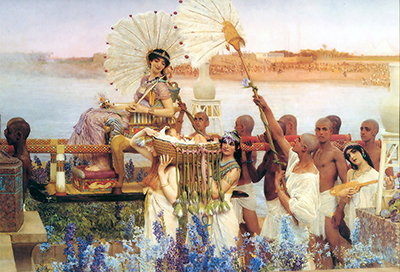
Two women carry a wicker basket along the Nile. It is high enough to hide part of one woman's face, low enough for Pharaoh's daughter to glance into it from her raised chair. Within the broad fan of white feathers, the princess inclines her head. Follow her gaze and a small foot comes into view. Lawrence Alma-Tadema gives the baby only a sliver of a canvas more than two metres wide, yet the tilt of the princess's head and the hands steadying the basket bring him to the centre of the scene. [1]
Alma-Tadema finished The Finding of Moses in 1904 and showed it at the Royal Academy the following year. The oil on canvas measures 136.7 by 213.4 centimetres. His signature and the inscription OP. CCCLXXVII appear at the lower left. Sir John Aird, the contractor whose company built the first Aswan Dam, commissioned the picture after inviting the artist to Egypt in 1902. The meeting of his patron's modern connection to the Nile and a story from Exodus gave Alma-Tadema the occasion for one of his largest and most elaborate late paintings. [1] [2]
At a Glance
- Date1904, shown at the Royal Academy in 1905 [1][2]
- MediumOil on canvas, 136.7 × 213.4 cm [1]
- OpusCCCLXXVII [1]
- CommissionSir John Aird [1][2]
This work across Lawrence Alma-Tadema’s career
Contents
- After the basket is found
- How the procession moves
- A commission beside the modern Nile
- What the painter learned from Egyptian objects
- Earlier visions of Egypt
- From the Royal Academy to Leeuwarden
- The painting and DeMille's Egypt
After the basket is found
In Exodus, Pharaoh has ordered the death of the newborn Hebrew boys. Moses' mother hides her son for three months, then seals a papyrus basket to keep water out and places it among the reeds. His sister stays close enough to see what happens. When Pharaoh's daughter comes to bathe in the river, she spots the basket and sends a servant to fetch it. She opens it, sees the child crying, recognises him as Hebrew and takes pity on him. His sister offers to find a nurse, brings back their mother and so secures the child's care. Later the mother brings the boy to the princess, who takes him as her son and names him Moses. [5]
The title suggests the instant when the basket is opened. The painting shows a discovery that has already happened. The infant is travelling in full view amid garlands, attendants and musicians, and the princess is already dressed and seated in state. The women bear a decorated basket at shoulder height across the foreground of a formal procession. Exodus gives the sister and the mother much of the initiative. There are numerous women in the painting, but its most legible exchange takes place between the princess and the child, and it leaves the other participants' identities open. The public display belongs to Alma-Tadema's version of the story. Standing, writing in 1905, thought the title could have called it an episode from the finding, with the child already on his way from the river. [1] [5] [6]
Another way to read the march is as an image of the change in the child's prospects. The basket was originally a hiding place, its seams sealed against the water. Here its rim bristles with flowers and long green stems hang down almost to the carriers' waists. Small blue ankhs, Egyptian signs of life, dangle on ribbons below it. The child sleeps or rests within all this movement. The emblem has an immediate point in the image of a baby lifted out of danger, even for a viewer who knows nothing of his later role. There is still a tension between the tiny passenger's vulnerability and the wealth of the household that has taken charge of him. [1] [5]
How the procession moves
The chair's carrying poles set a firm line across the middle of the picture. The weight of the chair and its passenger registers in the men with poles braced against their shoulders. At the front, the basket tilts just enough to open a view of its interior. Hands reach from below and over the rim. The women's overlapping profiles and the bearer at the far left, partly hidden by the stone pedestal, make it easy to imagine the group continuing beyond the edge. At the other end a woman holds a lute, and a glimpse of another instrument and the hands that play it survives beside the tall vessel. The procession feels larger than the company the frame can hold. [1]
The bright blue flower spikes at the bottom of the canvas partly screen the figures. They make a low, irregular edge under the straighter poles and the quiet bands of water and shore. Follow the diagonal of the fan's stem upward and the picture's space opens up. The pale river takes very little sharp detail, and the busy far bank is reduced to small marks and patches of warm earth. Even the pyramids, on the right horizon, are soft in the haze. Alma-Tadema asks the eye to adjust between the precision of a ribbon or a bit of jewellery and a distance in which whole groups of people are hard to separate. [1]
That difference in focus gives the nearer objects much of their weight. The rough, reddish pedestal is close enough for its coloured signs to register before its statue can be seen whole. At far right, a pale vessel and its stand interrupt the ranks of bare shoulders. The feathers above the princess are almost translucent by comparison. They also provide a quiet frame around her face in a painting that everywhere else invites the eye to move. Even the quiet is temporary. Above the men, the second fan rises on a sharply slanted stem and its feathers press against the top of the canvas. [1]
A commission beside the modern Nile
In late 1902 Alma-Tadema travelled to Egypt as Aird's guest for the celebrations marking the opening of the Aswan Low Dam. Aird had already acquired The Roses of Heliogabalus, the painter's large Roman banquet scene. This time he wanted an Egyptian subject. The near-contemporary biographer Percy Cross Standing describes discussions between patron and painter, followed by Alma-Tadema offering a choice of three subjects. Aird settled on Moses. Aird's direct association with the river gave the choice a personal significance. [1] [2] [6]
The photographs of the first Aswan Dam offer a different view of the river that brought the two men together. The Huntington's collection preserves albums from the first phase of construction and from later works. Three presentation albums bear inscriptions associated with Aird. In the photographs of the works, labourers, excavations and partly built locks and gates show the machinery and human effort behind the project. The Institution of Civil Engineers preserves a view of the completed first dam from upstream in 1902. Its caption gives Benjamin Baker as engineer and Aird as contractor. These records explain the occasion for the journey and the patron's particular interest in the Nile. The pyramids and the imagined royal outing belong to the painter's separate reconstruction of antiquity. [7] [8]
Back in Britain, Alma-Tadema developed the immense river scene over many months. Standing dates the work in the studio to 1903–04 and relates Laura Alma-Tadema's joke that the baby had grown old enough to walk by the time the picture was done. A conservation report published for Sotheby's 2010 sale offers a glimpse of the revisions that made the joke apt. The conservator found traces of painted-over upright elements in the sky and on the far left bank. Their precise form was uncertain. The report also noted retouching near the base of the carried chair that appeared to soften earlier changes by the painter. The unobstructed distance behind the procession and the platform that supports the chair demanded adjustments of their own. [1] [6]
What the painter learned from Egyptian objects
Sotheby's catalogue connects the painting's archaeology to the collections of the British Museum and to illustrated surveys such as Émile Prisse d'Avennes's Histoire de l'art égyptien d'après les monuments. The French publication gave readers access to coloured plates of Egyptian art and ornament. One plate of Theban tomb decorations shows how many ways ancient artists arranged lotus blossoms, papyrus heads and rosettes into repeating patterns. The catalogue also points to drawings and photographs from Alma-Tadema's visit to Egypt. Old objects reached the canvas through a mixture of direct observation, published images and the artist's own records. The raised chair has precedents in published tomb paintings. The bound figures on the footstool beneath it belong to a tradition of royal imagery that places defeated enemies under the ruler's feet. The golden, shrine-shaped ornament on the princess's chest gives a further indication of rank. [1] [9]
Maarten J. Raven, writing in Dutch in the Bulletin van het Rijksmuseum, followed one detail from Egyptian sculpture to the body of a painted figure. He traced the marking on the chest of one of the priests to an inscription on a priest statue referring to the domain of Ptah. In the statue, the sign had a symbolic function. On the canvas, the artist makes it read as a mark on living skin. The transformation is easy to miss in the full picture. It shows how closely Alma-Tadema could follow the shape of an ancient sign while assigning it a different place in the world he imagined. [10]
Raven also sees a change from the colourful robes of some of the early Egyptian pictures to the simpler white linen of the priests here. On the right, the folds of the fan bearer's drapery catch the light as he stretches upwards. The plain fabric makes small areas of colour, such as the beads and the green stems wound around his staff, more conspicuous. Raven identifies a cartouche of Ramses II among the painted inscriptions, a clue to the period Alma-Tadema had in mind. Exodus leaves its pharaoh unnamed. The royal name is evidence of the painter's choice of setting. [1] [5] [10]
Earlier visions of Egypt
The trip of 1902 came late in a long engagement with ancient Egypt. Raven traces that interest back to Alma-Tadema's study of the illustrated work of Sir Gardner Wilkinson and to his growing familiarity with the British Museum's collection. An Egyptian in a Doorway, a small oil on wood dated 1865 and now at the Metropolitan Museum of Art, belongs to the group of Egyptian subjects he painted in the mid-1860s. The museum compares his recreation of everyday life in antiquity to the practice of Jean-Léon Gérôme. A doorway and an individual figure were enough for that early experiment. In The Finding of Moses, the same impulse to imagine people physically inhabiting ancient surroundings extends to a whole riverbank. [10] [11]
The Rijksmuseum's The Egyptian Widow of 1872 turns to a different kind of ceremony. A woman mourns beside the inner case containing her husband's body. The sarcophagus at the left, the musicians and the priests give her grief a public setting, and the indoor space presses the group together. The year also produced The Death of the Pharaoh’s Firstborn Son, another episode from Exodus. In that painting, the bereaved ruler holds his dead son, and Moses and Aaron are hard to make out in the darkness at the upper right. One picture makes the viewer peer into a room to find the participants. The later picture makes the viewer look through a glittering crowd to find the child. [12] [13]
The comparison gives the two Exodus pictures a particular poignancy. In the 1872 canvas an Egyptian father suffers the death of his son in the last plague. In the 1904 canvas an Egyptian princess acts to save a child from the consequences of her father's decree. In both, royal power is visible in objects and attendants, while the body of a child brings it down to a human scale. The earlier figures gather in grief, while the attendants by the Nile move onwards. Painting the two episodes more than thirty years apart allowed Alma-Tadema to give them radically different light, space and pace. [1] [5] [13]
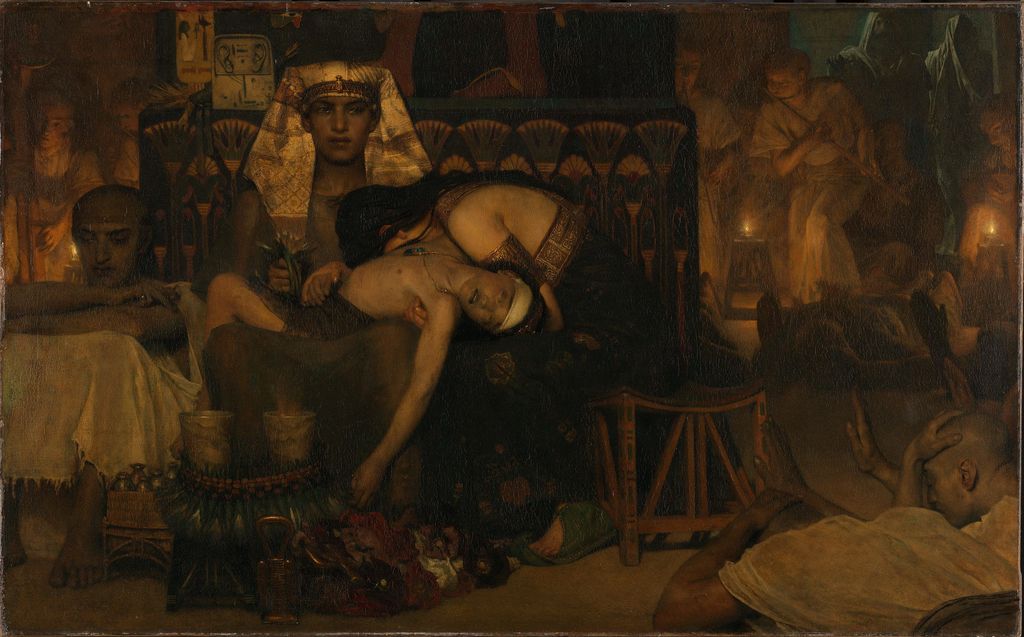
The Death of the Pharaoh’s Firstborn Son, 1872. Rijksmuseum, SK-A-2664. Image source. Public domain.
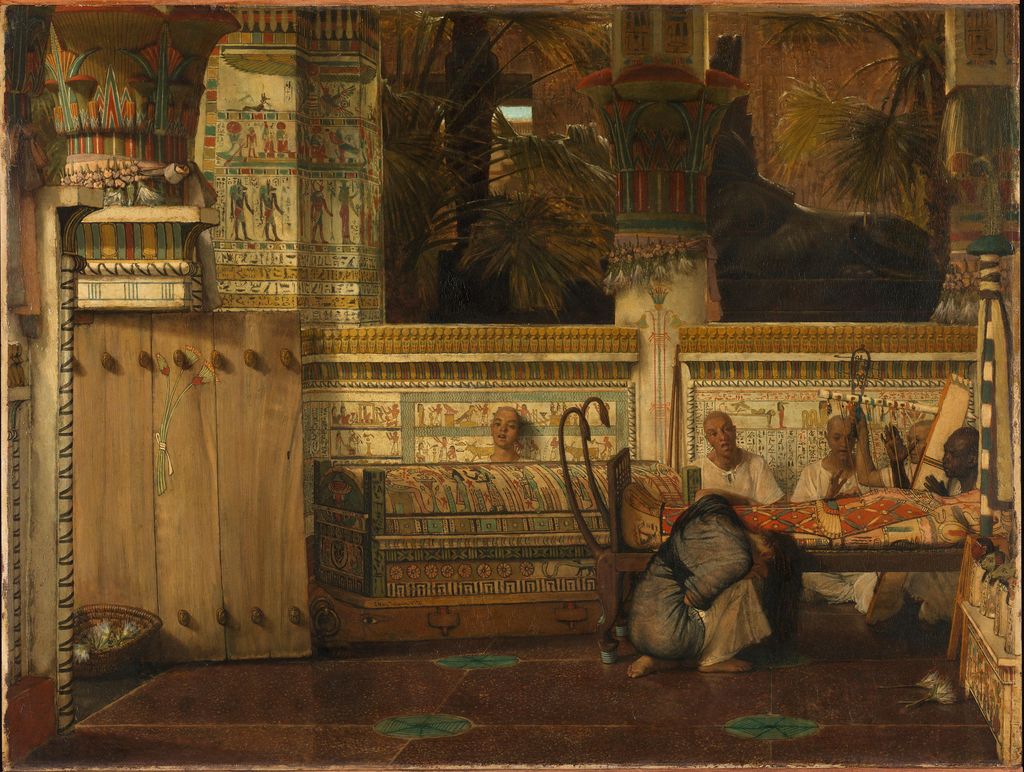
The Egyptian Widow, 1872. Rijksmuseum, SK-A-2427. Image source. Public domain.
From the Royal Academy to Leeuwarden
The Royal Academy exhibited The Finding of Moses in 1905 as no. 212 and again in 1913 as no. 155 in its exhibition of the late artist's work. The responses to the first showing exposed a tension in Alma-Tadema's approach to history. The Gardeners' Chronicle praised the extent of his finish. The review reprinted in The Living Age admired the costumes and other details but found the scene too harmonious for a story that begins with a threat of massacre. The picture could persuade a viewer that they were looking at a well-researched past while leaving the violence of the original story almost entirely to memory. [1] [14]
The canvas passed by descent in the Aird family and came to auction in 1935. The later provenance records a period with an English restaurant among its owners, followed by a sale to a New York gallery in 1967. Eventually it joined the collection of Allen Funt, creator of the television programme Candid Camera. The Metropolitan Museum of Art showed it as no. 31 in Victorians in Togas, an exhibition of Funt's Alma-Tadema paintings held from 9 March to 29 April 1973. Its presence in New York, among enough of the painter's canvases to see the range of his work, gave the picture a new public context after decades of changing private hands. [1] [14] [15]
In October 2016 the painting went on view at the Fries Museum in Leeuwarden for Alma-Tadema, Classical Charm. The museum announced this as the work's first exhibition in the Netherlands. It presented the canvas with an excerpt from Cecil B. DeMille's The Ten Commandments of 1956, asking audiences to look at what nineteenth-century paintings and twentieth-century films made of ancient Egypt. The decision brought a work made for a private London patron into a Dutch exhibition where it could be viewed alongside one of the great popular retellings of its subject. [2]
The painting and DeMille's Egypt
The film adapts several bodies of material. In studying the discovery and adoption of Moses, Nuno Simões Rodrigues argues that the ancient Jewish historian Josephus helped shape the scene alongside Exodus, and that Alma-Tadema's picture contributed to its visual atmosphere. In Exodus a servant goes for the basket, while in Josephus the princess sends swimmers after it. The film includes both swimmers and a servant but gives the princess the decisive part in retrieving the child. [5] [16]
Guillermo Juberías Gracia draws a visual parallel elsewhere in the film. He sets the canvas beside the scene of Queen Nefretiri, a different royal woman, being carried in a palanquin with attendants holding broad feather fans. He also draws attention to the pale blue, yellow and mauve in the film's daytime palace scenes. The same study places Alma-Tadema's 1872 painting of the firstborn beside DeMille's much darker version of that episode, with the dead child's head falling back. The two comparisons suggest how differently the painter's visions of Egypt could translate into settings for a film. [17]
The resemblance is easiest to see at the level of staging. A raised seat brings a face above a crowded field of shoulders, a broad fan gives the scene a visible centre, and a procession turns a display of costume into movement. The effect in the painting depends on the viewer discovering the baby within that arrangement. Look again past the dyed fabric, the jewellery and the gilded chair and the child comes back into focus. The royal party is making its way down the riverbank because someone picked up a basket. [1] [17]
Lawrence Alma-Tadema artworks directory
Search by title or medium. The directory includes Alma-Tadema’s numbered compositions, separately catalogued fragments, and selected drawings and historic prints. Dates for unlinked works follow the catalogue’s year groupings. View the numbered opus catalogue
| Name | Date | Medium |
|---|---|---|
| Portrait of my sister Artje | 1851 | Painting |
| Selfportrait | 1852 | Painting |
| Portrait of my mother (oval) | 1852 | Painting |
| The alm | 1856 | Painting |
| The inundation of the Biesbosch in 1421 | 1857 | Painting |
| The destruction of Terdoest Abbey in 1571 | 1857 | Painting |
| Faust en Marguerite | 1857 | Watercolour |
| Clotilde at the tomb of her grandchildren | 1858 | Painting |
| Marius on the ruins of Carthage | 1858 | Watercolour |
| The sad father: the unfavourable oracle (Death of the first-born, first version) | 1859 | Painting |
| The death of Attila, 453 AD | 1859 | Watercolour |
| Triumphal return of Sir Willem van Saeftingen | 1860 | Painting |
| The death of Hippolyte | 1860 | Watercolour |
| The Education of the Children of Clovis | 1861 | Painting |
| Venantius Fortunatus reading his poems to Radagonda VI | 1862 | Painting |
| Gunthram Bose and his daughters, 572 AD: the Ambuscade | 1862 | Painting |
| A medieval Flemish interior | 1863 | Painting |
| Pastimes in Ancient Egypt: 3.000 years ago | 1863 | Painting |
| Interior of the Church San Clemente, Rome: a study | 1863 | Painting |
| Queen Fredegonda at the deathbed of Bishop Praetextatus (first version) | 1864 | Painting |
| Leaving Church in the fifteenth century | 1864 | Painting |
| Egyptian Chess Players (An Egyptian Game) | 1865 | Painting |
| Birthday presents in the sixteenth century | 1865 | Painting |
| Gallo-Roman women | 1865 | Painting |
| Entering Church in the fourteenth century | 1865 | Painting |
| An Egyptian at his doorway in Memphis | 1865 | Painting |
| Catallus ten huize van Lesbia | 1865 | Painting |
| The discourse | 1865 | Painting |
| A Roman scribe writing despatches | 1865 | Painting |
| A soldier of Marathon | 1865 | Painting |
| Home from market | 1865 | Painting |
| Death of Galeswinthe | 1865 | Painting |
| An Egyptian Game (preparatory drawing) | 1865 | Drawing |
| Making wreaths for festivities in a Pompeian house | 1866 | Painting |
| Vespasian hearing of the taking of Jerusalem by Titus | 1866 | Painting |
| Entrance to a Roman theatre | 1866 | Painting |
| In the peristyle | 1866 | Painting |
| Agrippina visiting the ashes of Germanicus | 1866 | Painting |
| Tibullus at Delia's | 1866 | Painting |
| A Roman dance | 1866 | Painting |
| Lesbia weeping over a sparrow | 1866 | Painting |
| The armourer's shop in ancient Rome | 1866 | Painting |
| The Education of the Children of Clovis (Rennefeld print after Alma-Tadema) | 1866 | |
| The mummy: Roman period: Egyptians lamenting their dead | 1867 | Painting |
| The honeymoon | 1867 | Painting |
| Cuckoo | 1867 | Painting |
| The aesthetic view: Madame Dumoulin, Pauline, and Laurence | 1867 | Painting |
| Glaucus and Nydia | 1867 | Painting |
| Portrait of Mr A. Bonnefoy | 1867 | Painting |
| Proclaiming Claudius Emperor | 1867 | Painting |
| A sculpture gallery in Rome at the time of Augustus | 1867 | Painting |
| A collector of pictures at the time of Augustus | 1867 | Painting |
| Tarquinius Superbus before Galba | 1867 | Painting |
| A Roman family | 1867 | Painting |
| Italian women | 1867 | Painting |
| Portrait of Madame Bonnefoy and Mr Puttemans | 1867 | Painting |
| The siësta (first version) | 1868 | Drawing |
| The embarkation | 1868 | Painting |
| The siësta (second version) | 1868 | Painting |
| A Roman art lover | 1868 | Painting |
| Woman and flowers | 1868 | Painting |
| Phidias and the Parthenon, Athens | 1868 | Painting |
| The flower girl | 1868 | Painting |
| A Roman flower market: Pompeii | 1868 | Painting |
| Egyptian game | 1868 | Watercolour |
| Education of the children of Clovis | 1868 | Painting |
| A Roman art lover: silver statue | 1868 | Painting |
| Egyptian dancing girls | 1868 | Watercolour |
| Catalina | 1869 | Painting |
| The visit: Sunday morning before churching (first version): a birth chamber, seventeenth century | 1869 | Painting |
| The Pyrrhic dance | 1869 | Painting |
| The Grand Chamberlain of Sesostris the Great | 1869 | Painting |
| The convalescent | 1869 | Painting |
| Confidences | 1869 | Painting |
| A Greek Woman | 1869 | Painting |
| At the wine shop | 1869 | Painting |
| An Exedra (first version) | 1869 | Painting |
| Portrait of Master Ernest Angely | 1870 | Painting |
| A juggler | 1870 | Painting |
| A nurse, seventeenth century: Sunday morning (second version) | 1870 | Watercolour |
| Roman art lover (the runner ) | 1870 | Painting |
| Anacreon reading his poems at Lesbia's house | 1870 | Painting |
| The vintage festival (first version) | 1870 | Painting |
| The first whisper of love | 1870 | Painting |
| The letter: from an absent one (first version) | 1870 | Painting |
| A staircase (first version) | 1870 | Painting |
| Hush, she sleeps | 1870 | Painting |
| The letter: from an absent one (second version) | 1871 | Watercolour |
| The vintage festival (second version) | 1871 | Painting |
| A Roman Emperor (second version) | 1871 | Painting |
| In the temple (first version) | 1871 | Painting |
| Portrait of Miss Laura Theresa Epps | 1871 | Painting |
| A Bacchic dance | 1871 | Painting |
| Fredegonda and Praetextatus (second version) | 1871 | Painting |
| Portrait study for Mrs H.W. Mesdag | 1871 | Painting |
| Greek potters | 1871 | Painting |
| An exedra (second version) | 1871 | Watercolour |
| Sunday morning: the two sisters (third version) | 1871 | Painting |
| In the temple (second version) | 1872 | Watercolour |
| The first reproach | 1872 | Painting |
| An Egyptian widow | 1872 | Painting |
| Improvisatore | 1872 | Painting |
| A halt (first version) | 1872 | Painting |
| The last roses | 1872 | Painting |
| Death of the first-born (second version) | 1872 | Painting |
| Portrait of Dr Franz and Mrs Catherine Hueffer 'When I am dead, oh dearest sing' | 1872 | Painting |
| The nurse | 1872 | Painting |
| Greek wine (first version) | 1872 | Painting |
| Goldfish (first version) | 1872 | Painting |
| On a Roman staircase (second version) | 1872 | Watercolour |
| Hercules | 1872 | Painting |
| Portrait of Miss Kate Thompson | 1873 | Painting |
| The dinner (first version) | 1873 | Painting |
| The siësta (third version) | 1873 | Painting |
| A visit to the studio (second version) | 1873 | Watercolour |
| Cherries | 1873 | Painting |
| Greek wine (second version) | 1873 | Watercolour |
| This is our corner | 1873 | Painting |
| A picture gallery (third version) | 1873 | Painting |
| The last roses (second version) | 1873 | Watercolour |
| Fishing (first version) | 1873 | Painting |
| Music has charms | 1873 | Watercolour |
| Counting the passers-by | 1873 | Watercolour |
| Portrait of Mrs Frederick George Stephens | 1873 | Painting |
| Two heads from 'The Picture Gallery': A visit to the studio by Charles W. Deschamps and his wife (first version) | 1874 | Watercolour |
| Joseph, overseer of Pharaoh's granaries | 1874 | Painting |
| A sculpturegallery (first version) | 1874 | Painting |
| A picture gallery in Rome at the time of Augustus (fourth version) | 1874 | Painting |
| Portrait of Charles W. Deschamps and his wife (second version) | 1874 | Painting |
| Autumn | 1874 | Watercolour |
| Reflections: fishing (second version) | 1874 | Painting |
| A Roman artist | 1874 | Watercolour |
| Good friends | 1874 | Watercolour |
| On the steps of the Capitol (first version) | 1874 | Painting |
| Water pets: goldfish (second version) | 1874 | Painting |
| Münster Cathedral | 1874 | Painting |
| Landscape near Münster | 1874 | Painting |
| Antistius Labeon, 75 AD: A Roman amateur artist | 1874 | Painting |
| Sunny days | 1874 | Painting |
| Spring flowers: garland seller on the steps of the Capitol (second version) | 1874 | Watercolour |
| Through an archway | 1874 | Painting |
| (A, B) Decoration for my piano: 'Serious and merry music' | 1874 | Painting |
| Rêverie | 1874 | Painting |
| The Roman architect | 1874 | Painting |
| Sunflowers | 1874 | Painting |
| Landscape: carriage drive by the outskirts of a wood, Penhill Castle | 1875 | Painting |
| A peep through the trees | 1875 | Painting |
| Cleopatra (first version) | 1875 | Painting |
| (a, b, c) The tragedy of an honest wife | 1875 | Watercolour |
| The architect of the Coliseum | 1875 | Watercolour |
| Fishing | 1875 | Watercolour |
| Cherry blossom | 1875 | Painting |
| Water pets: goldfish (third version) | 1875 | Painting |
| 'There he is!' | 1875 | Painting |
| Play Garden | 1875 | Painting |
| Portrait of Miss Thackeray's 'Elisabeth' | 1875 | Painting |
| A nymphaeum from the Villa Aldobrandini in Rome | 1875 | Painting |
| Haystacks | 1875 | Painting |
| A sculpture gallery (second version) | 1875 | Painting |
| After the dance: a bacchanal | 1875 | Painting |
| Landscape: a breezy day in August near Innsbruck | 1875 | Painting |
| The service | 1875 | Painting |
| An audience at Agrippa's (first version) | 1875 | Painting |
| Kriemhild’s Tryste | 1875 | |
| Portrait of my wife | 1876 | Painting |
| Between hope and fear | 1876 | Painting |
| 94 Degrees in the Shade | 1876 | Painting |
| An antique custom | 1876 | Painting |
| Portrait of Jules Dalou, his wife and his daughter | 1876 | Painting |
| Pleading (first version) | 1876 | Painting |
| Hide and seek | 1876 | Painting |
| Balneatrix | 1876 | Watercolour |
| A mirror | 1877 | Painting |
| An interesting scroll | 1877 | Watercolour |
| Winter | 1877 | Painting |
| Autumn-vintage festival | 1877 | Painting |
| Summer | 1877 | Painting |
| Spring in the gardens of the Villa Borghese (first version) | 1877 | Painting |
| A balneator | 1877 | Watercolour |
| Painting in Ancient Rome | 1877 | Painting |
| A balneatrix | 1877 | Painting |
| The sculptor's model (Venus Esquilina) | 1877 | Painting |
| The sculptor's studio in ancient Rome | 1877 | Painting |
| Architecture in ancient Rome | 1877 | Painting |
| Cleopatra (second version) | 1877 | Painting |
| Spring in the gardens of the Villa Borghese (second version) | 1877 | Painting |
| Panel for H. W. Mesdag's studio door: Spring in the gardens of the Villa Borghese (third version) | 1877 | Painting |
| The question: Pleading (second version) | 1877 | Painting |
| A kitchen garden | 1877 | Painting |
| Flora: Spring in the gardens of the Villa Borghese (fourth version) | 1877 | Watercolour |
| A silent counsellor | 1878 | Watercolour |
| A sollicitation | 1878 | Watercolour |
| A hearty welcome | 1878 | Painting |
| A landscape | 1878 | Painting |
| In the time of Constantine | 1878 | Painting |
| A love missile | 1878 | Painting |
| Fredegonda en Galswintha, 566 AD | 1878 | Painting |
| A safe confidant | 1878 | Painting |
| After the audience (second version) | 1879 | Painting |
| Strigils andsponges | 1879 | Watercolour |
| E festival in Pomona | 1879 | Painting |
| Prose | 1879 | Painting |
| Going down to the river | 1879 | Painting |
| The Roman wine tasters | 1879 | Watercolour |
| Portrait of th singer George Henschel Esq. at the piano | 1879 | Painting |
| Poetry | 1879 | Painting |
| A well-protected slumber | 1879 | Painting |
| A garden altar | 1879 | Painting |
| Beauties | 1879 | Painting |
| Portrait of Thekla Friedländer | 1879 | Unspecified |
| On the road to the Temple of Ceres: A springfestival | 1879 | Painting |
| Autumn (third version) | 1879 | Drawing |
| 'Not at home' | 1879 | Painting |
| An old bachelor after the bath | 1879 | Watercolour |
| Spring (Blanchard print after Alma-Tadema’s 1877 painting) | 1879 | |
| The first course: the dinner | 1880 | Painting |
| Interrupted | 1880 | Painting |
| Grapes | 1880 | Watercolour |
| A pastoral | 1880 | Painting |
| A portrait of Dr Felix and Mrs August Redeker Semon | 1880 | Painting |
| Ave Caesar! Io Saturnalia! (third version) | 1880 | Painting |
| A prize for the artist's corps | 1880 | Painting |
| The departure (first version) | 1880 | Painting |
| A harvest festival | 1880 | Painting |
| 'Your carriage stops the way' | 1880 | Painting |
| Autumn (Scene in a Roman Garden) | c.1880 | Drawing |
| The torch dance | 1881 | Painting |
| Sappho and Alcaeus | 1881 | Painting |
| A kiss | 1881 | Watercolour |
| A Bacchante dancing before the thymele | 1881 | Watercolour |
| An audience | 1881 | Painting |
| Portrait of Dr Hans Richter | 1881 | Painting |
| Pandora | 1881 | Watercolour |
| The Tepidarium | 1881 | Painting |
| Quiet pets | 1881 | Painting |
| A priestess of Apollo | 1881 | Watercolour |
| A difficult line from Horace (first version) | 1881 | Painting |
| A stranger in my studio (one of a pair) | 1881 | Painting |
| Amo te ama me | 1881 | Painting |
| The First Course–The Dinner (Löwenstam print after Alma-Tadema) | 1881 | |
| Young affections | 1882 | Painting |
| A difficult line from Horace (second version) | 1882 | Drawing |
| Portrait of John F. Whichcord Esq., PRIBA, FSA | 1882 | Painting |
| Portrait of Ludwig Barnay as Marcus Antonius | 1882 | Painting |
| The way to the temple | 1882 | Painting |
| A parting kiss | 1882 | Painting |
| Reflections | 1882 | Painting |
| Between Venus and Bacchus | 1882 | Watercolour |
| Dolce far niente (first version) | 1882 | Watercolour |
| Dolce far niente (second version) | 1882 | Painting |
| An Oleander | 1882 | Painting |
| The meeting of Antony and Cleopatra | 1883 | Painting |
| Portrait of Catherine, Duchess of Cleveland | 1883 | Painting |
| Portrait of my daughter Anna Alma-Tadema | 1883 | Painting |
| Shy | 1883 | Painting |
| Portrait of His Excellency the Duke of Bylandt | 1883 | Painting |
| Una Carita: The three graces: Laura, Laurence, and Anna | 1883 | Painting |
| Portrait of Leopold Lowenstam, the engraver | 1883 | Painting |
| Portrait of Lady Thompson | 1883 | Painting |
| Portrait of Professor Giovanni Battista Amendola | 1883 | Painting |
| 'Der alte Menander ist doch nicht gestorben!' Paulus and Hermas | 1883 | Drawing |
| A street altar | 1883 | Watercolour |
| Welcome Footsteps (The Well-Known Footsteps) | 1883 | Painting |
| A declaration: an old, old story | 1883 | Watercolour |
| Xanthe and Phaon | 1883 | Watercolour |
| Selfportrait | 1883 | Painting |
| Hadrian in England: visiting a Roman-British Pottery (original, later divided) | 1884 | Painting |
| A Roman-British pottery | 1884 | Painting |
| Emperor Hadrian's visit to a British pottery | 1884 | Painting |
| A Roman-British potter | 1884 | Painting |
| Portrait of Miss Alice Lewis | 1884 | Painting |
| Who is it? | 1884 | Painting |
| Portrait of Moses Ezekiel | 1884 | Painting |
| Portrait of Sir Francis Powell | 1884 | Painting |
| Egyptien à l’entrée de sa demeure (Ramus print after Alma-Tadema) | 1884 | |
| Expectations | 1885 | Painting |
| A Reading from Homer | 1885 | Painting |
| Portrait of Dr Wahington Napoleon Epps: my docter | 1885 | Painting |
| The triumph of Titus: the Flavians | 1885 | Painting |
| Ariadne | 1885 | Painting |
| Portrait of Mrs W. M. Baker | 1885 | Painting |
| Rose of all roses | 1885 | Painting |
| A foregone conclusion | 1885 | Painting |
| A apodyterium | 1886 | Painting |
| Portrait of James Reld Esq. | 1886 | Painting |
| Portrait of Mrs Frank D. Millet | 1886 | Painting |
| A secret | 1887 | Painting |
| The Women of Amphissa | 1887 | Painting |
| A new dress | 1887 | Watercolour |
| 'He loves me, he loves me not' | 1887 | Painting |
| Illuminated letter 'W' for the Royal Academy address to Queen Victoria | 1887 | Watercolour |
| Portia | 1887 | Painting |
| The Roses of Heliogabalus | 1888 | Painting |
| Fair tresses: a sketch | 1888 | Painting |
| Midday slumbers | 1888 | Watercolour |
| Portrait of the honourable Adama van Scheltema | 1888 | Painting |
| Venus and Mars | 1888 | Painting |
| Portrait of Jules de Soria | 1888 | Painting |
| At the shrine of Venus | 1888 | Painting |
| The Favourite Poet | 1888 | Painting |
| The Favourite Poet (Löwenstam print after Alma-Tadema) | c.1888 | |
| Sisters | 1889 | Painting |
| Cloaked in yellow | 1889 | Painting |
| A dedication to Bacchus (first version) | 1889 | Painting |
| A dedication to Bacchus (second version) | 1889 | Painting |
| Portrait of Mrs Ralph Sneyd | 1889 | Painting |
| Portrait of Miss MacWhirter (Mrs Charles Sims) | 1889 | Painting |
| Portrait of young gentleman John Parsons Millet | 1889 | Painting |
| In a rose garden | 1889 | Painting |
| A Silent Greeting | 1889 | Painting |
| Portrait of Sir Ernest A. Waterlow, Esq., RA | 1889 | Painting |
| Eloquent silence | 1890 | Painting |
| The Frigidarium | 1890 | Painting |
| Promise of Spring | 1890 | Painting |
| Portrait of Miss Agnes Marks | 1890 | Painting |
| Rêverie: a sketch | 1890 | Painting |
| Portrait of the Right Hon. Arthur James Balfour | 1891 | Painting |
| An earthly paradise | 1891 | Painting |
| Love's votaries; Love in idleness | 1891 | Painting |
| Portrait of the Honourable Archdean Watkins of Durham, DD | 1891 | Painting |
| Portrait of Alfred Waterhouse Esq. RA | 1891 | Painting |
| Portrait of Ignacy Jan Paderewski | 1891 | Painting |
| The kiss | 1891 | Painting |
| Calling the worshippers | 1892 | Watercolour |
| The poet Gallus dreaming | 1892 | Painting |
| Courtship | 1892 | Painting |
| Comparisons | 1892 | Painting |
| The inner sanctuary | 1892 | Painting |
| Portrait of Dr Joseph Joachim | 1893 | Painting |
| In the corner of my studio | 1893 | Painting |
| Portrait of Mrs Charles Wyllie | 1893 | Painting |
| Unconscious Rivals | 1893 | Painting |
| Godspeed | 1893 | Painting |
| Portrait of Mrs Theyre Smith | 1893 | Painting |
| At the close of a joyful day | 1894 | Painting |
| The benediction | 1894 | Painting |
| Spring | 1894 | Painting |
| Past and present generations | 1894 | Painting |
| God Speed (Löwenstam print after Alma-Tadema) | 1894 | |
| Love's jewelled fetter | 1895 | Painting |
| Fortune's favourite | 1895 | Painting |
| Portrait of Mrs Roland Hill and her children | 1895 | Painting |
| Portrait of George Simmonds and family | 1895 | Painting |
| Unwelcome confidence | 1895 | Painting |
| A Coign of Vantage | 1895 | Painting |
| Portrait of Mrs Marcus Stone | 1895 | Painting |
| Whispering Noon | 1896 | Painting |
| The Coliseum | 1896 | Painting |
| Familygroup | 1896 | Painting |
| Portrait of Miss Onslow Ford | 1896 | Painting |
| A Difference of Opinion | 1896 | Painting |
| Portrait of Maurice Sons Esq. playing the violin in Alma-Tadema's studio | 1896 | Painting |
| Selfportrait | 1896 | Painting |
| 'Nobody asked you sir!' she said | 1896 | Watercolour |
| Portrait of J. M. Zarifi Esq. | 1897 | Painting |
| Watching and waiting | 1897 | Painting |
| 'Her eyes are with her thoughts, and they are far away' | 1897 | Painting |
| Wandering thoughts | 1897 | Painting |
| Melody on a Mediterranean terrace | 1897 | Painting |
| Roses, love's delight | 1897 | Painting |
| A Difference of Opinion (Boulard print after Alma-Tadema) | 1897 | |
| Portrait of Lady Sydney (Margaret) Waterlow | 1898 | Painting |
| The conversion of Paula by St. Jerome | 1898 | Painting |
| Portrait of Tine Son-Maris | 1898 | Painting |
| Hero | 1898 | Painting |
| Portrait of Mrs George Lewis and her daughter Elisabeth | 1899 | Painting |
| The listeners | 1899 | Painting |
| Attracted: watchers | 1899 | Watercolour |
| The Baths of Caracalla (Thermae Antoninianae) | 1899 | Painting |
| Bluebells | 1899 | Painting |
| Study for Thermaie Antoniniane | 1899 | Drawing |
| A flag of truce | 1900 | Painting |
| Goldfish (fourth version) | 1900 | Painting |
| Portrait of Mrs Armour from Princeton | 1900 | Painting |
| Portrait of George Aitchison, PRIBA, RA | 1900 | Painting |
| Vain courtship | 1900 | Painting |
| Under the roof of blue Ionian weather | 1901 | Painting |
| Death of the first born (third version) | 1901 | Drawing |
| A priestess of Hymen | 1901 | Watercolour |
| Fair tresses | 1901 | Painting |
| Impatient | 1901 | Watercolour |
| Portrait of Sir Max Waechter High Sheriff of Sussex | 1901 | Painting |
| The year's at the spring, all's right with the world | 1902 | Painting |
| Caracalla | 1902 | Painting |
| A crown | 1902 | Watercolour |
| Amongst the ruins | 1902 | Painting |
| Silver Favourites | 1903 | Painting |
| A peaceful wooing | 1903 | Painting |
| The ever-new horizon | 1903 | Painting |
| Thalia's homage to Aesculapius | 1904 | Drawing |
| The Finding of Moses | 1904 | Painting |
| A world of their own | 1905 | Painting |
| Ask Me No More | 1906 | Painting |
| Entering the Coliseum (first version) | 1907 | Watercolour |
| Geta and his sister | 1907 | Drawing |
| Caracalla and Geta | 1907 | Painting |
| Orante (oval, one of a pair) | 1907 | Painting |
| Bacchante (oval, one of a pair) | 1907 | Painting |
| Melodie del mare e dell'amore | 1907 | Watercolour |
| Youth | 1907 | Watercolour |
| Portrait of myself for the R. Accademia Romana di San Luca | 1907 | Painting |
| The golden hour | 1907 | Painting |
| At Aphrodite’s Cradle | 1908 | Painting |
| A message of love | 1909 | Painting |
| A Favourite Custom | 1909 | Painting |
| Splashing | 1909 | Drawing |
| Portrait of Mrs Washington Epps | 1909 | Drawing |
| Hopeful | 1909 | Painting |
| Portrait of Dr J. M. W. van der Poorten-Schwartz (Maarten Maartens) | 1909 | Drawing |
| Portrait of Ilona Eibenschutz | 1909 | Painting |
| The voice of spring | 1910 | Painting |
| Principal figure of 'The voice of spring' | 1910 | Drawing |
| A border for the King's letter to the nation | 1910 | Drawing |
| Heading: the Royal Academy address to H.M. King George on his accession to the throne | 1910 | Watercolour |
| Title unknown | 1910 | Unspecified |
| When flowers return (one of a pair) | 1911 | Painting |
| Summer Offering | 1911 | Painting |
| Title unknown | 1911 | Unspecified |
| Entering the Coliseum (second version) | 1911 | Painting |
| Portrait of William Whitaker Thompson Esq. | 1911 | Painting |
| Portrait of myself for the R. Accademia Romana di San Luca | 1912 | Painting |
| Preparations in the Coliseum | 1912 | Painting |
Discussion
Look again at the images and ideas explored in The Finding of Moses. These editorial prompts invite your observations.
Reader Insights
Which gestures lead your eye to the child in the basket?
How does the procession alter the moment described in Exodus?
Join the Conversation
Share a detail, comparison or question about The Finding of Moses below.
References
- Sotheby's, The Finding of Moses, New York, 2010, lot 56, illustrated catalogue, provenance, exhibition history and Simon Parkes Art Conservation condition report,. View source.
- Fries Museum, Valuable Tadema in Leeuwarden, 2016 exhibition announcement,. View source.
- Sotheby’s, The Education of the Children of Clovis. View source.
- Colección AMALITA, Egyptian Chess Players (An Egyptian Game). View source.
- United States Conference of Catholic Bishops, Exodus 2:1–10, New American Bible, Revised Edition,. View source.
- Percy Cross Standing, Sir Lawrence Alma-Tadema, O.M., R.A., 1905, especially pp. 110–112,. View source.
- The Huntington Library, Aswan Dam Photographs, collection photCL Burndy 1,. View source.
- Institution of Civil Engineers, The Completed First Aswan Dam from Upstream, 1902, Engineering Image Library, ID71,. View source.
- Émile Prisse d'Avennes, Histoire de l'art égyptien d'après les monuments, Bibliothèque nationale de France, coloured plate from the atlas,. View source.
- Maarten J. Raven, Alma Tadema als amateur-egyptoloog, Bulletin van het Rijksmuseum 28, no. 3, 1980, pp. 103–117, especially pp. 114–115,. View source.
- The Metropolitan Museum of Art, An Egyptian in a Doorway, 1865, object 2017.202.1,. View source.
- Rijksmuseum, The Egyptian Widow, 1872, object SK-A-2427,. View source.
- Rijksmuseum, The Death of the Pharaoh’s Firstborn Son, 1872, object SK-A-2664,. View source.
- Christie's, The Finding of Moses, New York, 1995, lot 87, provenance and exhibition history,. View source.
- Thomas J. Watson Library, The Metropolitan Museum of Art, Museum Exhibitions, 1870–2022, entry for Victorians in Togas,. View source.
- Nuno Simões Rodrigues, Josephus as Source of the Egyptian Sequences in Cecil B. DeMille’s The Ten Commandments (1956), in How Pharaohs Became Media Stars, Archaeopress, 2023, p. 117 and n. 16,. View source.
- Guillermo Juberías Gracia, From Alma-Tadema to Cecil B. DeMille, in How Pharaohs Became Media Stars, Archaeopress, 2023, pp. 153–156 and figs. 15–18,. View source.