 by Tom Gurney
Tom Gurney BSc (Hons) is an art history expert with over 20 years experience
Email: tomgurney1@gmail.com / Phone: +44 7429 011000
Lawrence Alma-Tadema: Introduction
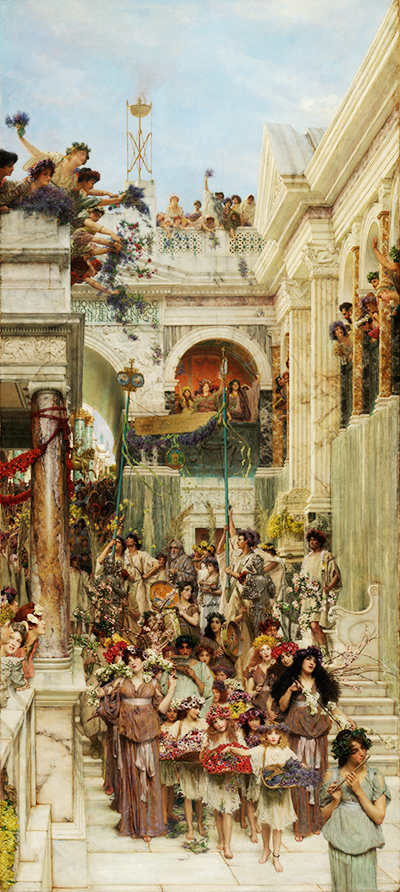
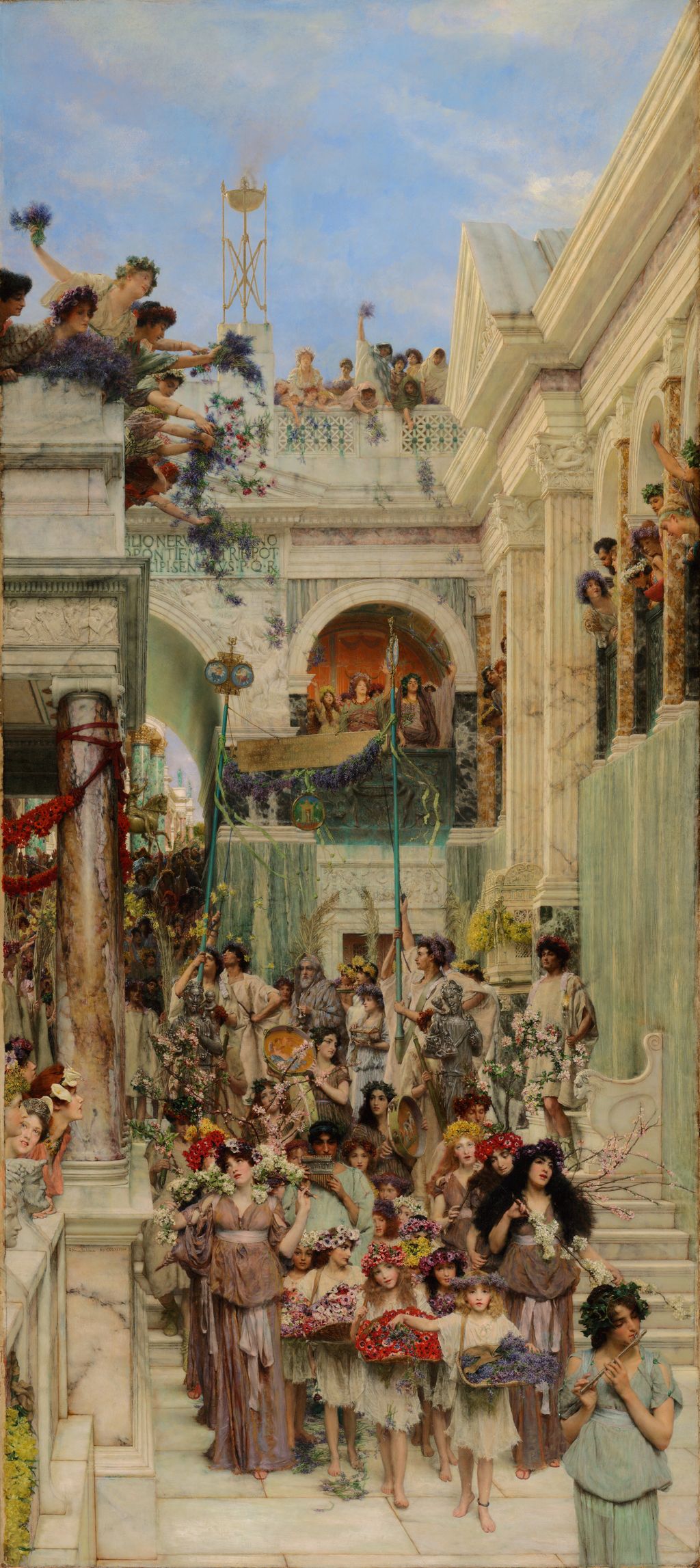
In Spring, Lawrence Alma-Tadema lets a procession come towards us down a narrow Roman street. Children carry flowers at ground level while spectators lean out above them, their faces and garlands almost lost among the mouldings and columns. The street is crowded, but the marchers have a clear path. We can follow it through the picture before we know what the procession is for. Painted in 1894 and exhibited at the Royal Academy in 1895, Spring imagines a Roman celebration through details drawn from antiquity and a custom familiar to Victorian viewers, the gathering of flowers for May Day. [1]
Alma-Tadema (1836–1912) was born in Friesland, trained in Antwerp and made his name in London. He painted early medieval kings, Egyptian households and Greek poets as well as the Romans for whom he is best known. He studied objects and buildings closely enough to give an invented setting the character of a place someone might have lived in. What happens there can be as small as a woman deciding whether to speak or as appalling as an emperor watching his guests smother. The scale of the event mattered less to him than the arrangement of people in the space. [2] [3]
At a Glance
- ArtistLawrence Alma-Tadema (1836–1912) [2][3]
- CareerFriesland and Belgium, then London from 1870 [2]
- ExploreHistory painting, ancient daily life, major commissions and their afterlife on screen
Lawrence Alma-Tadema’s artistic connections
Studio training, patronage and the later circulation of the paintings connect these people and works.
- Henri Leys: The artist worked in Leys’s Antwerp studio, where early history subjects demanded close attention to costume and setting. [2]
- Ernest Gambart: The Egyptian game oil was the first picture Alma-Tadema completed under his agreement to supply works to Gambart. [4]
- Laura Theresa Alma-Tadema: Laura made her own paintings and established a studio at Townshend House. [5]
- Frederic Leighton: Leighton and Alma-Tadema exchanged pictures. Both contributed to Henry Marquand’s music room. [6]
- James Tissot: Tissot painted the garden at Grove End Road before the Alma-Tademas remade the property. [7]
- Sir John Aird: Aird commissioned the painting after Alma-Tadema’s visit to Egypt during the celebrations around the Aswan dam. [8]
- Early Italian cinema: Ivo Blom traces specific motifs from nineteenth-century history painting into early films about the ancient world. [9]
Lawrence Alma-Tadema in context
Victorian painting
1837–1901 [10]Aestheticism in late Victorian Britain
c.1860–1900 [11]Jean-Léon Gérôme
1824–1904 [12]Frederic Leighton
1830–1896 [11]Lawrence Alma-Tadema
1836–1912 [2]James Tissot
1836–1902 [13]Laura Theresa Alma-Tadema
1852–1909 [14]Essential Lawrence Alma-Tadema works
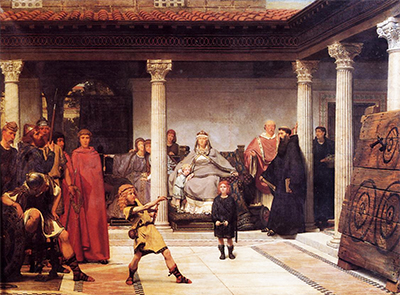
The Education of the Children of Clovis
1861 · Clotilde and her children gather around a lesson in throwing an axe.[15]
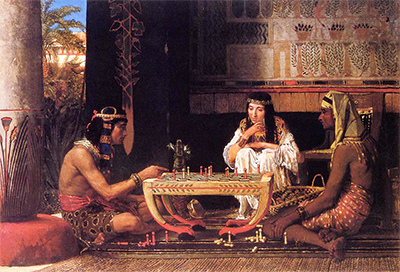
Egyptian Chess Players (An Egyptian Game)
1865 · A player’s extended hand draws the eye towards a small board.[16]
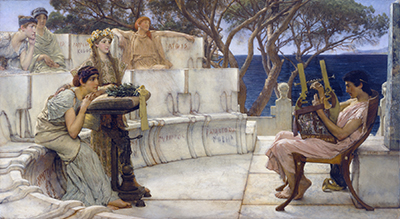
Sappho and Alcaeus
1881 · A performance unfolds before Sappho and the women seated beside her.[17]
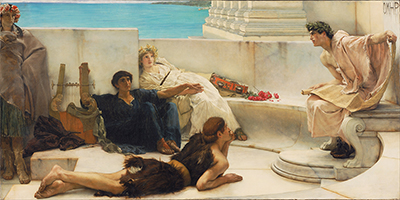
A Reading from Homer
1885 · The reader’s scroll and the listeners’ bodies mark two ends of a long terrace.[18]
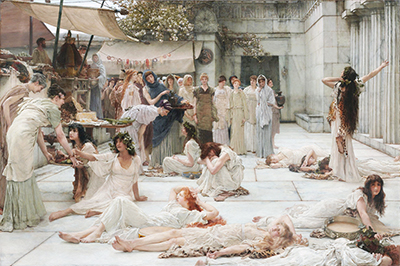
The Women of Amphissa
1887 · Market women gather around the sleeping followers of Dionysus.[19]
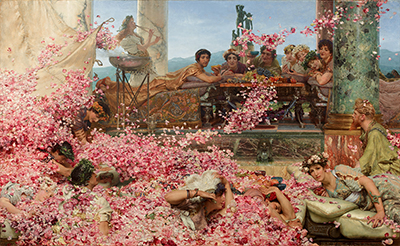
The Roses of Heliogabalus
1888 · Rose petals descend across the banquet from a suspended canopy.[20]
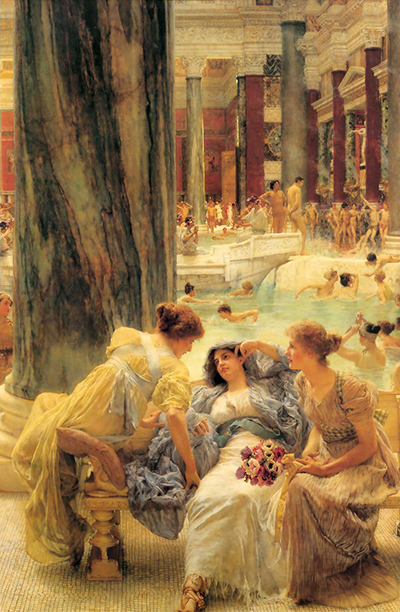
The Baths of Caracalla (Thermae Antoninianae)
1899 · Columns and steps carry the eye from the foreground bathers into an immense interior.[21]
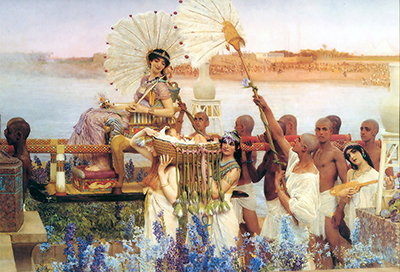
The Finding of Moses
1904 · Two attendants carry the basket along the Nile after the discovery.[8]
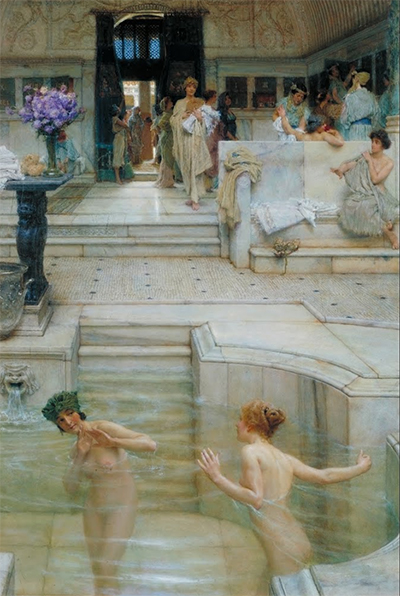
A Favourite Custom
1909 · Two women play in the shallow water of a marble bath.[22]
Contents
- Learning to give history a setting
- The objects in the studio
- From the Royal Academy to a New York music room
- Marble, flowers and scale
- How the pictures reached the cinema
Learning to give history a setting
The Rijksmuseum groups paintings, drawings and other collection material under Lourens Alma Tadema. The Getty Research Institute records that Dutch form alongside Lawrence Alma-Tadema, the name by which the painter became known in Britain. Both point to a career that took shape across several countries. Born in Dronryp and raised from early childhood in Leeuwarden, Alma-Tadema entered Antwerp's art academy at sixteen. His subsequent work with Louis De Taeye and Henri Leys gave him two kinds of preparation for history painting. De Taeye stressed the study of sources and costume. Leys showed how buildings, furnishings and clothes could give an episode from the past a particular place and period. In nineteenth-century Belgium, where artists and audiences were keenly interested in the region's earlier history, the young painter found his first conspicuous success with a subject drawn from the early Frankish kingdom. [2] [3] [23] [15]
In The Education of the Children of Clovis, exhibited at Antwerp in 1861, Clotilde watches her sons practise throwing a hatchet. There is time in the picture to study the seated figures and the shaded architecture, though the child's raised arm keeps bringing the eye back to the exercise. The courtly setting makes room for a lesson in violence. Exhibitions in Antwerp, The Hague, Paris and elsewhere put the work before an international audience while Alma-Tadema was still building his career in Belgium. The painting already shows how much he could communicate by deciding who would act and who would watch. [15]
His 1863 honeymoon with Pauline took him to Rome, Naples and Pompeii, where he sketched ruins and measured what he could see. The trip gave him a store of material for classical painting. Egypt and the early medieval world remained part of his work as the classical subjects developed. An oil completed in 1865, conventionally called Egyptian Chess Players, was the first picture he completed for the dealer Ernest Gambart. Its alternative title, An Egyptian Game, conveys the event without identifying the rules. In 1868 he returned to the composition in watercolour and gave that version an opus number of its own. The two works show how early his attention to ordinary pastimes and his relationship with the British art market began. [2] [4]
In Glaucus and Nydia (1867), painted in Brussels for a London dealer, a blind servant seated on a mosaic floor makes a garland for the man reclining above her. The roses occupy her hands while an unspoken feeling gives the exchange its tension. Alma-Tadema took the episode from Edward Bulwer-Lytton's novel The Last Days of Pompeii. The wall painting, sculpture and furnishings help to put the reader's imagined Pompeii on a human scale. A novelist supplied the encounter, and the material record supplied things for the characters to sit on, handle and live among. By the time Alma-Tadema moved to London in 1870, he had already learned how well those two kinds of evidence could work together. [24] [25]
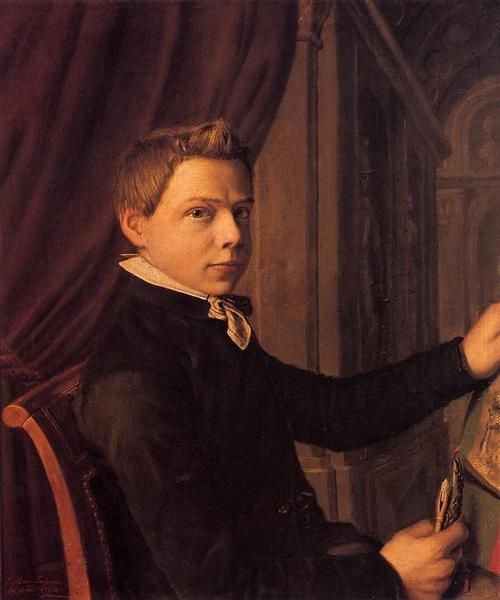
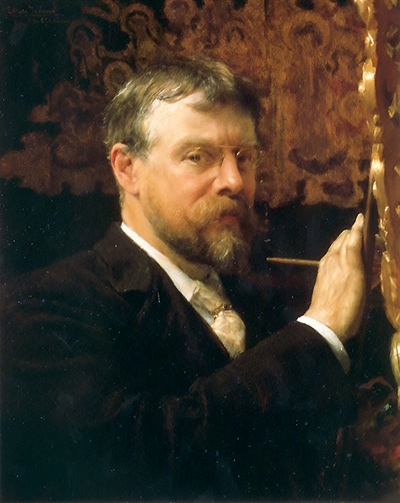
Self-Portrait, 1852. Fries Museum, S1957-848. Image source. Public domain.
Four stages of Lawrence Alma-Tadema’s career
These periods group related developments; painting, travel and local work overlap across their boundaries.
Training in history painting
Training at Antwerp’s academy and in the studios of Louis De Taeye and Henri Leys shaped his approach to historical subjects.[2]
From Frankish history to ancient daily life
An early Frankish subject brought public attention. Pictures of Egyptian and Roman life followed as he travelled to Italy and began working for Gambart.[15] [2] [4]
The objects in the studio
Archaeologist Stephanie Moser has identified four resources behind the paintings. Alma-Tadema collected photographs and drawings and copied illustrations himself. He maintained a library of books, periodicals and excavation reports. He acquired and commissioned props, including an Egyptian stool copied from a British Museum example. He also decorated his houses with materials and objects that he could study in changing light. The Cadbury Research Library at the University of Birmingham preserves 164 portfolios organised by culture and subject. Their studies of clothing, hairstyles, utensils and architectural features give a sense of how often he needed to answer a practical question about the appearance of a scene before he could paint it. [7]
An antique object could keep its shape while acquiring a new use in a picture. In Sappho and Alcaeus, the listeners sit on marble seats modelled on those of the Theatre of Dionysos in Athens. Alma-Tadema moved the design to a gathering on Lesbos and put names associated with Sappho on seats that bore officials' names in the Athenian theatre. The carved letters give the women a place of their own and make the borrowed furniture look as if it belongs there. This is a case where the Walters Art Museum identifies both the prototype and the change the painter made to it. Plenty of details in his pictures have yet to be connected to a particular surviving object. The degree of finish alone tells us little about where any one of them came from. [7] [17]
The two London studio-houses, Townshend House and later Grove End Road, were also collective projects. His second wife, Laura Theresa Epps, painted and exhibited in her own right. His younger daughter Anna made detailed watercolours of interiors, including her father's study at Townshend House. Her pictures allow us to see rooms the family had a hand in creating through the eyes of another practising artist. The elder daughter, Laurence, was a writer. Her 1935 bequest of material from both London homes to the Fries Museum helped shift attention towards how the family made and used these rooms. The family arrived at Grove End Road after another artist, James Tissot, had made repeated use of its house and grounds in his paintings. Tissot drew scenes of fashionable life from the garden and its colonnade. The Alma-Tademas extensively remodelled the property, but an artist could still set scenes there with recognisable features of the home in view. Laura painted Dutch interiors and furnished her studios with Dutch objects, some of which had belonged to Lawrence's mother. The same household sustained more than one idea of the past. [3] [7] [5]
Alma-Tadema's In My Studio, exhibited in 1893, brings that traffic between art and home into view. A woman in classical dress pauses beside a vase of roses. Light filters through an onyx window, catches the embroidered border of an Indian textile and picks up the glint of a brass step. The title puts us in a London studio, surrounded by things gathered from across centuries and continents. It is easy to see how a room like this could prompt an experiment in painting the past. Every object offers a different response to the same light, and the arrangement already gives the figure a place to stand and something to do. [5]
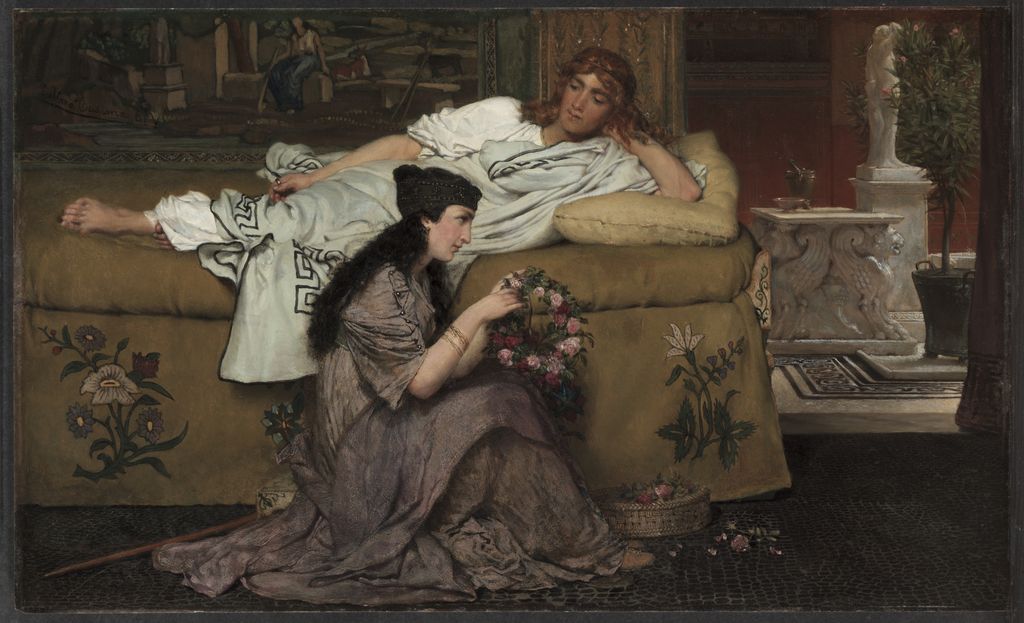
Glaucus and Nydia, 1867. Cleveland Museum of Art, 1977.128. Image source. CC0 / Public domain.
Watch films about Lawrence Alma-Tadema
Tour the exhibitions, see how the paintings reached the screen and explore the Getty Villa.
Alma-Tadema: At Home in Antiquity at Leighton House Museum (7 July - 29 October 2017)
A short introduction to the Leighton House retrospective.
Watch on YouTubeFrom the Royal Academy to a New York music room
Alma-Tadema received British denization in 1873 and was elected an Associate of the Royal Academy in 1876 and a full Academician in 1879. His pictures nonetheless resisted tidy assignment to a national school. At the Paris Universal Exposition of 1878, ten of them hung in the English section. The American commissioner William Wetmore Story singled out their treatment of cloth and marble and the archaeological study behind them. He still judged their subjects and manner foreign to English art. His report records the response of one viewer looking at a substantial group of pictures assembled under a national label. Among the gallery scenes, Roman festivities and imperial subjects on that wall was a painting about the death of Pharaoh's firstborn. [25] [27]
In After the Audience (1879), now in the National Gallery in London, Agrippa leaves the people who have come to petition him. His red cloak leads the eye up the stairs. The petitioners and the gifts they have brought stay below, beside a statue of Augustus based on the figure found at Prima Porta in 1863. This was then a recent archaeological discovery. In the picture, the statue's extended arm directs attention from the heap of offerings back towards the upper level. Its position makes a point about the hierarchy of the room. The people below look towards the man who is leaving, while the carved figure of the ruler commands the foreground long after the meeting is over. [28]
A comparison between two pictures of people listening gives a sense of what patrons saw in this work. In Sappho and Alcaeus, the curved marble seating gathers an audience around a musician. In A Reading from Homer, four listeners settle at different heights along a bench and on the floor. One sprawls, another sits upright, and their attention holds the group together. Henry Marquand hung the painting in his New York mansion's music room, for which Alma-Tadema also designed furnishings. Frederic Leighton supplied ceiling paintings. A recital in that room would have drawn its listeners into a situation close to the one on the canvas. [17] [26]
Letters quoted in the Metropolitan Museum's study of the mansion show Alma-Tadema asking where the painting would hang so he could have a frame made to suit. They also show him struggling to get the composition to work and starting again. The Dahesh Museum's early study preserves a different arrangement, two of whose figures later turned up in Love's Votaries. The polished finish of the exhibited canvas gives little hint of the reworking behind it. Seeing the study makes the finished listeners' apparent ease an achievement in its own right. [26] [29]
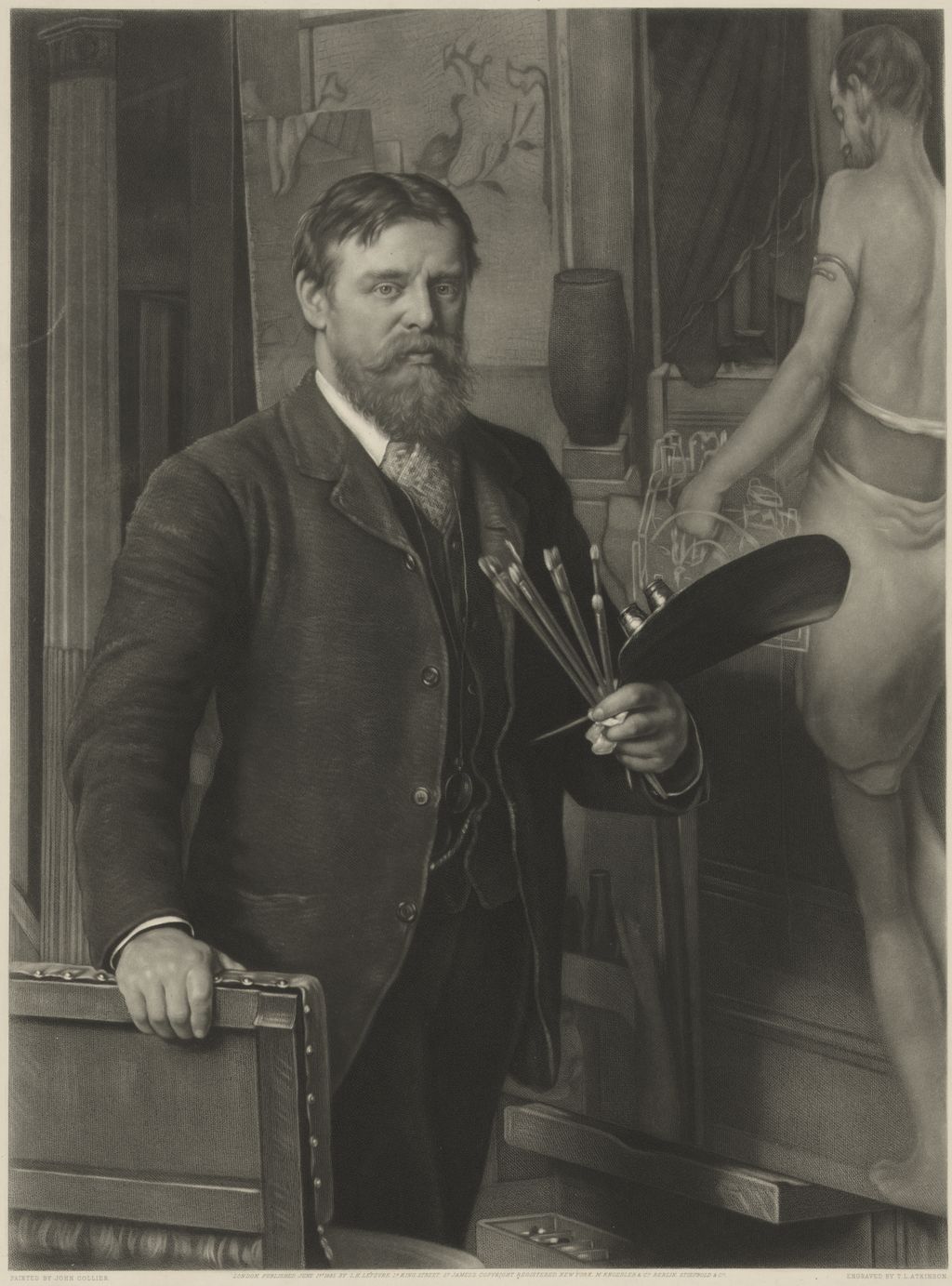
Lawrence Alma-Tadema in his studio. Detail from a Library of Congress print, LCCN 2003679912. Image source. Public domain.
Marble, flowers and scale
The marble that drew Story's attention is often the means by which Alma-Tadema places us in a picture. In A Favourite Custom, the stone edge of the pool gives us a position close to the bathers. The pale surfaces make the ripples and the figures' movements easier to see. In Spring, the street's height lets spectators watch from balconies and windows while the figures at pavement level come towards us. In each picture stone marks where people can go, how far away we are and what part of the action is in view. [1] [22]
In The Roses of Heliogabalus, exhibited in 1888, Alma-Tadema uses the difference in height between two groups to unsettling effect. The emperor and diners in the background can see the guests below them, who are disappearing under petals. Each small petal contributes to a mass that spreads almost the width of the painting. The late Roman account that supplied the incident names violets among the flowers. Alma-Tadema makes the fall a flood of roses, whose beauty holds the eye long enough for us to realise what is happening. Seen beside Spring, the picture shows how the same abundance of flowers can organise two scenes with entirely different consequences. [20] [30]
The engineer and collector Sir John Aird owned The Roses of Heliogabalus. In 1902, three years after Alma-Tadema received his knighthood, he went to Egypt as Aird's guest for the opening of the Aswan Dam. The visit fed into Aird's commission for The Finding of Moses, completed in 1904 and shown at the Academy the following year. The Rijksmuseum's Egyptian paintings, among them The Egyptian Widow and The Death of the Pharaoh's Firstborn Son, give a sense of the work to which he was returning. Those intimate scenes of grief help bring out the difference in the later canvas, where Pharaoh's daughter is carried above a retinue, the rescued baby rides in his basket and the whole party moves along the Nile. A meeting by the water in Exodus grows into a public procession. The effect depends as much on the gaps and gestures along the line of figures as on the documented Egyptian models for pieces of furniture. [2] [23] [8]
How the pictures reached the cinema
People could know Alma-Tadema's compositions through prints. Professional printmakers translated them into ink on paper. One of the surviving examples in the National Trust is Leopold Lowenstam's etching after The Favourite Poet. Photographs and postcards gave paintings a life well beyond the dealers, exhibitions and houses where the originals could be seen. Many of the same objects and interiors were becoming widely familiar through photographs of archaeological sites. Film historian Ivo Blom has traced how these overlapping kinds of reproduction helped early filmmakers and audiences recognise a plausible Roman setting. [31] [32]
Blom compares the view from a domestic atrium through to a colonnaded inner court in The Convalescent (1869) with a similarly arranged interior in Enrico Guazzoni's Quo Vadis? (1913). The film uses the line of sight through a sequence of spaces and changes details of the furnishings. The comparison helps explain what a director could learn from these pictures. An audience could take in people close to the camera and still see where another figure might appear at the back. Blom also compares the curved bench in Decoroso Bonifanti's design for the 1908 Gli ultimi giorni di Pompei with the one in Alma-Tadema's An Exedra. These are comparisons of particular settings and staging choices. Blom's broader account, which also examines Giovanni Pastrone's Cabiria (1914), follows a field of sources that includes theatre, archaeology and paintings by Jean-Léon Gérôme and Georges Rochegrosse. [32] [9]
After Alma-Tadema's death in Wiesbaden in 1912, academic historical painting lost much of its standing. His pictures continued to circulate and later found new audiences in museums. The Metropolitan Museum showed 35 works from the collection of Allen Funt and his wife in its 1973 exhibition Victorians in Togas. In 2016–17 the Fries Museum staged Classical Charm, with a programme developed with Eye Filmmuseum and Slieker Film and a catalogue issued in Dutch, English and German. The exhibition travelled to Vienna's Belvedere and to Leighton House in London. The London setting gave visitors the chance to think about the Alma-Tademas' rooms while standing in the studio-house of a painter with whom Lawrence had worked. [25] [5] [33] [34]
One way to get to know Alma-Tadema is to begin with three different distances. In Glaucus and Nydia, the flowers are close enough to pass from one person to another. In Spring, they travel the length of the street. In The Roses of Heliogabalus, they fill the gap between an emperor and his guests, and then obscure the guests themselves. The paintings guide follows these changes of subject and scale across the rest of his work. The biography traces the people, places and commissions that gave him room to make those pictures.
Lawrence Alma-Tadema, Spring, 1894. The J. Paul Getty Museum, 72.PA.3. The Getty Museum. Image source. Public domain.
Lawrence Alma-Tadema artworks directory
Search by title or medium. The directory includes Alma-Tadema’s numbered compositions, separately catalogued fragments, and selected drawings and historic prints. Dates for unlinked works follow the catalogue’s year groupings. View the numbered opus catalogue
| Name | Date | Medium |
|---|---|---|
| Portrait of my sister Artje | 1851 | Painting |
| Selfportrait | 1852 | Painting |
| Portrait of my mother (oval) | 1852 | Painting |
| The alm | 1856 | Painting |
| The inundation of the Biesbosch in 1421 | 1857 | Painting |
| The destruction of Terdoest Abbey in 1571 | 1857 | Painting |
| Faust en Marguerite | 1857 | Watercolour |
| Clotilde at the tomb of her grandchildren | 1858 | Painting |
| Marius on the ruins of Carthage | 1858 | Watercolour |
| The sad father: the unfavourable oracle (Death of the first-born, first version) | 1859 | Painting |
| The death of Attila, 453 AD | 1859 | Watercolour |
| Triumphal return of Sir Willem van Saeftingen | 1860 | Painting |
| The death of Hippolyte | 1860 | Watercolour |
| The Education of the Children of Clovis | 1861 | Painting |
| Venantius Fortunatus reading his poems to Radagonda VI | 1862 | Painting |
| Gunthram Bose and his daughters, 572 AD: the Ambuscade | 1862 | Painting |
| A medieval Flemish interior | 1863 | Painting |
| Pastimes in Ancient Egypt: 3.000 years ago | 1863 | Painting |
| Interior of the Church San Clemente, Rome: a study | 1863 | Painting |
| Queen Fredegonda at the deathbed of Bishop Praetextatus (first version) | 1864 | Painting |
| Leaving Church in the fifteenth century | 1864 | Painting |
| Egyptian Chess Players (An Egyptian Game) | 1865 | Painting |
| Birthday presents in the sixteenth century | 1865 | Painting |
| Gallo-Roman women | 1865 | Painting |
| Entering Church in the fourteenth century | 1865 | Painting |
| An Egyptian at his doorway in Memphis | 1865 | Painting |
| Catallus ten huize van Lesbia | 1865 | Painting |
| The discourse | 1865 | Painting |
| A Roman scribe writing despatches | 1865 | Painting |
| A soldier of Marathon | 1865 | Painting |
| Home from market | 1865 | Painting |
| Death of Galeswinthe | 1865 | Painting |
| An Egyptian Game (preparatory drawing) | 1865 | Drawing |
| Making wreaths for festivities in a Pompeian house | 1866 | Painting |
| Vespasian hearing of the taking of Jerusalem by Titus | 1866 | Painting |
| Entrance to a Roman theatre | 1866 | Painting |
| In the peristyle | 1866 | Painting |
| Agrippina visiting the ashes of Germanicus | 1866 | Painting |
| Tibullus at Delia's | 1866 | Painting |
| A Roman dance | 1866 | Painting |
| Lesbia weeping over a sparrow | 1866 | Painting |
| The armourer's shop in ancient Rome | 1866 | Painting |
| The Education of the Children of Clovis (Rennefeld print after Alma-Tadema) | 1866 | |
| The mummy: Roman period: Egyptians lamenting their dead | 1867 | Painting |
| The honeymoon | 1867 | Painting |
| Cuckoo | 1867 | Painting |
| The aesthetic view: Madame Dumoulin, Pauline, and Laurence | 1867 | Painting |
| Glaucus and Nydia | 1867 | Painting |
| Portrait of Mr A. Bonnefoy | 1867 | Painting |
| Proclaiming Claudius Emperor | 1867 | Painting |
| A sculpture gallery in Rome at the time of Augustus | 1867 | Painting |
| A collector of pictures at the time of Augustus | 1867 | Painting |
| Tarquinius Superbus before Galba | 1867 | Painting |
| A Roman family | 1867 | Painting |
| Italian women | 1867 | Painting |
| Portrait of Madame Bonnefoy and Mr Puttemans | 1867 | Painting |
| The siësta (first version) | 1868 | Drawing |
| The embarkation | 1868 | Painting |
| The siësta (second version) | 1868 | Painting |
| A Roman art lover | 1868 | Painting |
| Woman and flowers | 1868 | Painting |
| Phidias and the Parthenon, Athens | 1868 | Painting |
| The flower girl | 1868 | Painting |
| A Roman flower market: Pompeii | 1868 | Painting |
| Egyptian game | 1868 | Watercolour |
| Education of the children of Clovis | 1868 | Painting |
| A Roman art lover: silver statue | 1868 | Painting |
| Egyptian dancing girls | 1868 | Watercolour |
| Catalina | 1869 | Painting |
| The visit: Sunday morning before churching (first version): a birth chamber, seventeenth century | 1869 | Painting |
| The Pyrrhic dance | 1869 | Painting |
| The Grand Chamberlain of Sesostris the Great | 1869 | Painting |
| The convalescent | 1869 | Painting |
| Confidences | 1869 | Painting |
| A Greek Woman | 1869 | Painting |
| At the wine shop | 1869 | Painting |
| An Exedra (first version) | 1869 | Painting |
| Portrait of Master Ernest Angely | 1870 | Painting |
| A juggler | 1870 | Painting |
| A nurse, seventeenth century: Sunday morning (second version) | 1870 | Watercolour |
| Roman art lover (the runner ) | 1870 | Painting |
| Anacreon reading his poems at Lesbia's house | 1870 | Painting |
| The vintage festival (first version) | 1870 | Painting |
| The first whisper of love | 1870 | Painting |
| The letter: from an absent one (first version) | 1870 | Painting |
| A staircase (first version) | 1870 | Painting |
| Hush, she sleeps | 1870 | Painting |
| The letter: from an absent one (second version) | 1871 | Watercolour |
| The vintage festival (second version) | 1871 | Painting |
| A Roman Emperor (second version) | 1871 | Painting |
| In the temple (first version) | 1871 | Painting |
| Portrait of Miss Laura Theresa Epps | 1871 | Painting |
| A Bacchic dance | 1871 | Painting |
| Fredegonda and Praetextatus (second version) | 1871 | Painting |
| Portrait study for Mrs H.W. Mesdag | 1871 | Painting |
| Greek potters | 1871 | Painting |
| An exedra (second version) | 1871 | Watercolour |
| Sunday morning: the two sisters (third version) | 1871 | Painting |
| In the temple (second version) | 1872 | Watercolour |
| The first reproach | 1872 | Painting |
| An Egyptian widow | 1872 | Painting |
| Improvisatore | 1872 | Painting |
| A halt (first version) | 1872 | Painting |
| The last roses | 1872 | Painting |
| Death of the first-born (second version) | 1872 | Painting |
| Portrait of Dr Franz and Mrs Catherine Hueffer 'When I am dead, oh dearest sing' | 1872 | Painting |
| The nurse | 1872 | Painting |
| Greek wine (first version) | 1872 | Painting |
| Goldfish (first version) | 1872 | Painting |
| On a Roman staircase (second version) | 1872 | Watercolour |
| Hercules | 1872 | Painting |
| Portrait of Miss Kate Thompson | 1873 | Painting |
| The dinner (first version) | 1873 | Painting |
| The siësta (third version) | 1873 | Painting |
| A visit to the studio (second version) | 1873 | Watercolour |
| Cherries | 1873 | Painting |
| Greek wine (second version) | 1873 | Watercolour |
| This is our corner | 1873 | Painting |
| A picture gallery (third version) | 1873 | Painting |
| The last roses (second version) | 1873 | Watercolour |
| Fishing (first version) | 1873 | Painting |
| Music has charms | 1873 | Watercolour |
| Counting the passers-by | 1873 | Watercolour |
| Portrait of Mrs Frederick George Stephens | 1873 | Painting |
| Two heads from 'The Picture Gallery': A visit to the studio by Charles W. Deschamps and his wife (first version) | 1874 | Watercolour |
| Joseph, overseer of Pharaoh's granaries | 1874 | Painting |
| A sculpturegallery (first version) | 1874 | Painting |
| A picture gallery in Rome at the time of Augustus (fourth version) | 1874 | Painting |
| Portrait of Charles W. Deschamps and his wife (second version) | 1874 | Painting |
| Autumn | 1874 | Watercolour |
| Reflections: fishing (second version) | 1874 | Painting |
| A Roman artist | 1874 | Watercolour |
| Good friends | 1874 | Watercolour |
| On the steps of the Capitol (first version) | 1874 | Painting |
| Water pets: goldfish (second version) | 1874 | Painting |
| Münster Cathedral | 1874 | Painting |
| Landscape near Münster | 1874 | Painting |
| Antistius Labeon, 75 AD: A Roman amateur artist | 1874 | Painting |
| Sunny days | 1874 | Painting |
| Spring flowers: garland seller on the steps of the Capitol (second version) | 1874 | Watercolour |
| Through an archway | 1874 | Painting |
| (A, B) Decoration for my piano: 'Serious and merry music' | 1874 | Painting |
| Rêverie | 1874 | Painting |
| The Roman architect | 1874 | Painting |
| Sunflowers | 1874 | Painting |
| Landscape: carriage drive by the outskirts of a wood, Penhill Castle | 1875 | Painting |
| A peep through the trees | 1875 | Painting |
| Cleopatra (first version) | 1875 | Painting |
| (a, b, c) The tragedy of an honest wife | 1875 | Watercolour |
| The architect of the Coliseum | 1875 | Watercolour |
| Fishing | 1875 | Watercolour |
| Cherry blossom | 1875 | Painting |
| Water pets: goldfish (third version) | 1875 | Painting |
| 'There he is!' | 1875 | Painting |
| Play Garden | 1875 | Painting |
| Portrait of Miss Thackeray's 'Elisabeth' | 1875 | Painting |
| A nymphaeum from the Villa Aldobrandini in Rome | 1875 | Painting |
| Haystacks | 1875 | Painting |
| A sculpture gallery (second version) | 1875 | Painting |
| After the dance: a bacchanal | 1875 | Painting |
| Landscape: a breezy day in August near Innsbruck | 1875 | Painting |
| The service | 1875 | Painting |
| An audience at Agrippa's (first version) | 1875 | Painting |
| Kriemhild’s Tryste | 1875 | |
| Portrait of my wife | 1876 | Painting |
| Between hope and fear | 1876 | Painting |
| 94 Degrees in the Shade | 1876 | Painting |
| An antique custom | 1876 | Painting |
| Portrait of Jules Dalou, his wife and his daughter | 1876 | Painting |
| Pleading (first version) | 1876 | Painting |
| Hide and seek | 1876 | Painting |
| Balneatrix | 1876 | Watercolour |
| A mirror | 1877 | Painting |
| An interesting scroll | 1877 | Watercolour |
| Winter | 1877 | Painting |
| Autumn-vintage festival | 1877 | Painting |
| Summer | 1877 | Painting |
| Spring in the gardens of the Villa Borghese (first version) | 1877 | Painting |
| A balneator | 1877 | Watercolour |
| Painting in Ancient Rome | 1877 | Painting |
| A balneatrix | 1877 | Painting |
| The sculptor's model (Venus Esquilina) | 1877 | Painting |
| The sculptor's studio in ancient Rome | 1877 | Painting |
| Architecture in ancient Rome | 1877 | Painting |
| Cleopatra (second version) | 1877 | Painting |
| Spring in the gardens of the Villa Borghese (second version) | 1877 | Painting |
| Panel for H. W. Mesdag's studio door: Spring in the gardens of the Villa Borghese (third version) | 1877 | Painting |
| The question: Pleading (second version) | 1877 | Painting |
| A kitchen garden | 1877 | Painting |
| Flora: Spring in the gardens of the Villa Borghese (fourth version) | 1877 | Watercolour |
| A silent counsellor | 1878 | Watercolour |
| A sollicitation | 1878 | Watercolour |
| A hearty welcome | 1878 | Painting |
| A landscape | 1878 | Painting |
| In the time of Constantine | 1878 | Painting |
| A love missile | 1878 | Painting |
| Fredegonda en Galswintha, 566 AD | 1878 | Painting |
| A safe confidant | 1878 | Painting |
| After the audience (second version) | 1879 | Painting |
| Strigils andsponges | 1879 | Watercolour |
| E festival in Pomona | 1879 | Painting |
| Prose | 1879 | Painting |
| Going down to the river | 1879 | Painting |
| The Roman wine tasters | 1879 | Watercolour |
| Portrait of th singer George Henschel Esq. at the piano | 1879 | Painting |
| Poetry | 1879 | Painting |
| A well-protected slumber | 1879 | Painting |
| A garden altar | 1879 | Painting |
| Beauties | 1879 | Painting |
| Portrait of Thekla Friedländer | 1879 | Unspecified |
| On the road to the Temple of Ceres: A springfestival | 1879 | Painting |
| Autumn (third version) | 1879 | Drawing |
| 'Not at home' | 1879 | Painting |
| An old bachelor after the bath | 1879 | Watercolour |
| Spring (Blanchard print after Alma-Tadema’s 1877 painting) | 1879 | |
| The first course: the dinner | 1880 | Painting |
| Interrupted | 1880 | Painting |
| Grapes | 1880 | Watercolour |
| A pastoral | 1880 | Painting |
| A portrait of Dr Felix and Mrs August Redeker Semon | 1880 | Painting |
| Ave Caesar! Io Saturnalia! (third version) | 1880 | Painting |
| A prize for the artist's corps | 1880 | Painting |
| The departure (first version) | 1880 | Painting |
| A harvest festival | 1880 | Painting |
| 'Your carriage stops the way' | 1880 | Painting |
| Autumn (Scene in a Roman Garden) | c.1880 | Drawing |
| The torch dance | 1881 | Painting |
| Sappho and Alcaeus | 1881 | Painting |
| A kiss | 1881 | Watercolour |
| A Bacchante dancing before the thymele | 1881 | Watercolour |
| An audience | 1881 | Painting |
| Portrait of Dr Hans Richter | 1881 | Painting |
| Pandora | 1881 | Watercolour |
| The Tepidarium | 1881 | Painting |
| Quiet pets | 1881 | Painting |
| A priestess of Apollo | 1881 | Watercolour |
| A difficult line from Horace (first version) | 1881 | Painting |
| A stranger in my studio (one of a pair) | 1881 | Painting |
| Amo te ama me | 1881 | Painting |
| The First Course–The Dinner (Löwenstam print after Alma-Tadema) | 1881 | |
| Young affections | 1882 | Painting |
| A difficult line from Horace (second version) | 1882 | Drawing |
| Portrait of John F. Whichcord Esq., PRIBA, FSA | 1882 | Painting |
| Portrait of Ludwig Barnay as Marcus Antonius | 1882 | Painting |
| The way to the temple | 1882 | Painting |
| A parting kiss | 1882 | Painting |
| Reflections | 1882 | Painting |
| Between Venus and Bacchus | 1882 | Watercolour |
| Dolce far niente (first version) | 1882 | Watercolour |
| Dolce far niente (second version) | 1882 | Painting |
| An Oleander | 1882 | Painting |
| The meeting of Antony and Cleopatra | 1883 | Painting |
| Portrait of Catherine, Duchess of Cleveland | 1883 | Painting |
| Portrait of my daughter Anna Alma-Tadema | 1883 | Painting |
| Shy | 1883 | Painting |
| Portrait of His Excellency the Duke of Bylandt | 1883 | Painting |
| Una Carita: The three graces: Laura, Laurence, and Anna | 1883 | Painting |
| Portrait of Leopold Lowenstam, the engraver | 1883 | Painting |
| Portrait of Lady Thompson | 1883 | Painting |
| Portrait of Professor Giovanni Battista Amendola | 1883 | Painting |
| 'Der alte Menander ist doch nicht gestorben!' Paulus and Hermas | 1883 | Drawing |
| A street altar | 1883 | Watercolour |
| Welcome Footsteps (The Well-Known Footsteps) | 1883 | Painting |
| A declaration: an old, old story | 1883 | Watercolour |
| Xanthe and Phaon | 1883 | Watercolour |
| Selfportrait | 1883 | Painting |
| Hadrian in England: visiting a Roman-British Pottery (original, later divided) | 1884 | Painting |
| A Roman-British pottery | 1884 | Painting |
| Emperor Hadrian's visit to a British pottery | 1884 | Painting |
| A Roman-British potter | 1884 | Painting |
| Portrait of Miss Alice Lewis | 1884 | Painting |
| Who is it? | 1884 | Painting |
| Portrait of Moses Ezekiel | 1884 | Painting |
| Portrait of Sir Francis Powell | 1884 | Painting |
| Egyptien à l’entrée de sa demeure (Ramus print after Alma-Tadema) | 1884 | |
| Expectations | 1885 | Painting |
| A Reading from Homer | 1885 | Painting |
| Portrait of Dr Wahington Napoleon Epps: my docter | 1885 | Painting |
| The triumph of Titus: the Flavians | 1885 | Painting |
| Ariadne | 1885 | Painting |
| Portrait of Mrs W. M. Baker | 1885 | Painting |
| Rose of all roses | 1885 | Painting |
| A foregone conclusion | 1885 | Painting |
| A apodyterium | 1886 | Painting |
| Portrait of James Reld Esq. | 1886 | Painting |
| Portrait of Mrs Frank D. Millet | 1886 | Painting |
| A secret | 1887 | Painting |
| The Women of Amphissa | 1887 | Painting |
| A new dress | 1887 | Watercolour |
| 'He loves me, he loves me not' | 1887 | Painting |
| Illuminated letter 'W' for the Royal Academy address to Queen Victoria | 1887 | Watercolour |
| Portia | 1887 | Painting |
| The Roses of Heliogabalus | 1888 | Painting |
| Fair tresses: a sketch | 1888 | Painting |
| Midday slumbers | 1888 | Watercolour |
| Portrait of the honourable Adama van Scheltema | 1888 | Painting |
| Venus and Mars | 1888 | Painting |
| Portrait of Jules de Soria | 1888 | Painting |
| At the shrine of Venus | 1888 | Painting |
| The Favourite Poet | 1888 | Painting |
| The Favourite Poet (Löwenstam print after Alma-Tadema) | c.1888 | |
| Sisters | 1889 | Painting |
| Cloaked in yellow | 1889 | Painting |
| A dedication to Bacchus (first version) | 1889 | Painting |
| A dedication to Bacchus (second version) | 1889 | Painting |
| Portrait of Mrs Ralph Sneyd | 1889 | Painting |
| Portrait of Miss MacWhirter (Mrs Charles Sims) | 1889 | Painting |
| Portrait of young gentleman John Parsons Millet | 1889 | Painting |
| In a rose garden | 1889 | Painting |
| A Silent Greeting | 1889 | Painting |
| Portrait of Sir Ernest A. Waterlow, Esq., RA | 1889 | Painting |
| Eloquent silence | 1890 | Painting |
| The Frigidarium | 1890 | Painting |
| Promise of Spring | 1890 | Painting |
| Portrait of Miss Agnes Marks | 1890 | Painting |
| Rêverie: a sketch | 1890 | Painting |
| Portrait of the Right Hon. Arthur James Balfour | 1891 | Painting |
| An earthly paradise | 1891 | Painting |
| Love's votaries; Love in idleness | 1891 | Painting |
| Portrait of the Honourable Archdean Watkins of Durham, DD | 1891 | Painting |
| Portrait of Alfred Waterhouse Esq. RA | 1891 | Painting |
| Portrait of Ignacy Jan Paderewski | 1891 | Painting |
| The kiss | 1891 | Painting |
| Calling the worshippers | 1892 | Watercolour |
| The poet Gallus dreaming | 1892 | Painting |
| Courtship | 1892 | Painting |
| Comparisons | 1892 | Painting |
| The inner sanctuary | 1892 | Painting |
| Portrait of Dr Joseph Joachim | 1893 | Painting |
| In the corner of my studio | 1893 | Painting |
| Portrait of Mrs Charles Wyllie | 1893 | Painting |
| Unconscious Rivals | 1893 | Painting |
| Godspeed | 1893 | Painting |
| Portrait of Mrs Theyre Smith | 1893 | Painting |
| At the close of a joyful day | 1894 | Painting |
| The benediction | 1894 | Painting |
| Spring | 1894 | Painting |
| Past and present generations | 1894 | Painting |
| God Speed (Löwenstam print after Alma-Tadema) | 1894 | |
| Love's jewelled fetter | 1895 | Painting |
| Fortune's favourite | 1895 | Painting |
| Portrait of Mrs Roland Hill and her children | 1895 | Painting |
| Portrait of George Simmonds and family | 1895 | Painting |
| Unwelcome confidence | 1895 | Painting |
| A Coign of Vantage | 1895 | Painting |
| Portrait of Mrs Marcus Stone | 1895 | Painting |
| Whispering Noon | 1896 | Painting |
| The Coliseum | 1896 | Painting |
| Familygroup | 1896 | Painting |
| Portrait of Miss Onslow Ford | 1896 | Painting |
| A Difference of Opinion | 1896 | Painting |
| Portrait of Maurice Sons Esq. playing the violin in Alma-Tadema's studio | 1896 | Painting |
| Selfportrait | 1896 | Painting |
| 'Nobody asked you sir!' she said | 1896 | Watercolour |
| Portrait of J. M. Zarifi Esq. | 1897 | Painting |
| Watching and waiting | 1897 | Painting |
| 'Her eyes are with her thoughts, and they are far away' | 1897 | Painting |
| Wandering thoughts | 1897 | Painting |
| Melody on a Mediterranean terrace | 1897 | Painting |
| Roses, love's delight | 1897 | Painting |
| A Difference of Opinion (Boulard print after Alma-Tadema) | 1897 | |
| Portrait of Lady Sydney (Margaret) Waterlow | 1898 | Painting |
| The conversion of Paula by St. Jerome | 1898 | Painting |
| Portrait of Tine Son-Maris | 1898 | Painting |
| Hero | 1898 | Painting |
| Portrait of Mrs George Lewis and her daughter Elisabeth | 1899 | Painting |
| The listeners | 1899 | Painting |
| Attracted: watchers | 1899 | Watercolour |
| The Baths of Caracalla (Thermae Antoninianae) | 1899 | Painting |
| Bluebells | 1899 | Painting |
| Study for Thermaie Antoniniane | 1899 | Drawing |
| A flag of truce | 1900 | Painting |
| Goldfish (fourth version) | 1900 | Painting |
| Portrait of Mrs Armour from Princeton | 1900 | Painting |
| Portrait of George Aitchison, PRIBA, RA | 1900 | Painting |
| Vain courtship | 1900 | Painting |
| Under the roof of blue Ionian weather | 1901 | Painting |
| Death of the first born (third version) | 1901 | Drawing |
| A priestess of Hymen | 1901 | Watercolour |
| Fair tresses | 1901 | Painting |
| Impatient | 1901 | Watercolour |
| Portrait of Sir Max Waechter High Sheriff of Sussex | 1901 | Painting |
| The year's at the spring, all's right with the world | 1902 | Painting |
| Caracalla | 1902 | Painting |
| A crown | 1902 | Watercolour |
| Amongst the ruins | 1902 | Painting |
| Silver Favourites | 1903 | Painting |
| A peaceful wooing | 1903 | Painting |
| The ever-new horizon | 1903 | Painting |
| Thalia's homage to Aesculapius | 1904 | Drawing |
| The Finding of Moses | 1904 | Painting |
| A world of their own | 1905 | Painting |
| Ask Me No More | 1906 | Painting |
| Entering the Coliseum (first version) | 1907 | Watercolour |
| Geta and his sister | 1907 | Drawing |
| Caracalla and Geta | 1907 | Painting |
| Orante (oval, one of a pair) | 1907 | Painting |
| Bacchante (oval, one of a pair) | 1907 | Painting |
| Melodie del mare e dell'amore | 1907 | Watercolour |
| Youth | 1907 | Watercolour |
| Portrait of myself for the R. Accademia Romana di San Luca | 1907 | Painting |
| The golden hour | 1907 | Painting |
| At Aphrodite’s Cradle | 1908 | Painting |
| A message of love | 1909 | Painting |
| A Favourite Custom | 1909 | Painting |
| Splashing | 1909 | Drawing |
| Portrait of Mrs Washington Epps | 1909 | Drawing |
| Hopeful | 1909 | Painting |
| Portrait of Dr J. M. W. van der Poorten-Schwartz (Maarten Maartens) | 1909 | Drawing |
| Portrait of Ilona Eibenschutz | 1909 | Painting |
| The voice of spring | 1910 | Painting |
| Principal figure of 'The voice of spring' | 1910 | Drawing |
| A border for the King's letter to the nation | 1910 | Drawing |
| Heading: the Royal Academy address to H.M. King George on his accession to the throne | 1910 | Watercolour |
| Title unknown | 1910 | Unspecified |
| When flowers return (one of a pair) | 1911 | Painting |
| Summer Offering | 1911 | Painting |
| Title unknown | 1911 | Unspecified |
| Entering the Coliseum (second version) | 1911 | Painting |
| Portrait of William Whitaker Thompson Esq. | 1911 | Painting |
| Portrait of myself for the R. Accademia Romana di San Luca | 1912 | Painting |
| Preparations in the Coliseum | 1912 | Painting |
Discussion
Look again at the images and ideas explored in Lawrence Alma-Tadema. These editorial prompts invite your observations.
Reader Insights
Which object draws you into one of Alma-Tadema’s scenes before you take in its architecture?
How does the distance between the figures and the viewer change from Egyptian Chess Players to Spring?
Join the Conversation
Share a detail, comparison or question about Lawrence Alma-Tadema below.
References
- J. Paul Getty Museum, Spring, collection record 72.PA.3,. View source.
- Fries Museum, Sir Lawrence Alma-Tadema, collection profile,. View source.
- Getty Research Institute, Alma-Tadema, Sir Lawrence, Union List of Artist Names 500008100,. View source.
- Christie's, Egyptian Chess-Players (An Egyptian Game), watercolour catalogue entry,. View source.
- Elizabeth Prettejohn and Peter Trippi, Introduction: The Alma-Tademas' Studio-Houses and Beyond, British Art Studies 9, 2018,. View source.
- Leighton House, Bringing Home Alma-Tadema’s In My Studio. View source.
- Stephanie Moser, Caroline Dakers and Melissa Buron, contributions on archaeology, Dutch identity and Grove End Road, in Laboratories of Creativity: The Alma-Tademas' Studio-Houses and Beyond, British Art Studies 9, 2018,. View source.
- Sotheby's, The Finding of Moses, New York sale catalogue, 2010, lot 56,. View source.
- Ivo Blom, Quo vadis?, Cabiria and the ‘Archaeologists’: Early Italian Cinema's Appropriation of Art and Archaeology, 2023, publication abstract and record,. View source.
- National Gallery, London, Lawrence Alma-Tadema, artist biography. View source.
- National Portrait Gallery, Frederic Leighton, Baron Leighton, artist biography. View source.
- J. Paul Getty Museum, The Age of Augustus, the Birth of Christ, collection record and biographical dates. View source.
- National Gallery, London, James Tissot. View source.
- National Gallery of Art, Washington, Laura Theresa Alma-Tadema. View source.
- Sotheby's, Education of the Children of Clovis, New York sale catalogue, 2011, lot 64,. View source.
- Colección AMALITA, Egyptian Chess Players (An Egyptian Game). View source.
- The Walters Art Museum, Sappho and Alcaeus, 37.159,. View source.
- Philadelphia Museum of Art, A Reading from Homer. View source.
- Clark Art Institute, The Women of Amphissa. View source.
- Christie's, The Roses of Heliogabalus, sale catalogue entry including 1888 Royal Academy exhibition and Aird ownership,. View source.
- American Art Association, The Baths of Caracalla, New York sale catalogue, 1907. View source.
- Tate, A Favourite Custom, collection image and artwork summary,. View source.
- Rijksmuseum, Lourens Alma Tadema, artist and collection index,. View source.
- Cleveland Museum of Art, Glaucus and Nydia, 1977.128,. View source.
- The National Gallery, The National Gallery acquires major painting by Lawrence Alma-Tadema, 2024,. View source.
- Daniëlle O. Kisluk-Grosheide, The Marquand Mansion, Metropolitan Museum Journal 29, 1994, especially pp. 159–164,. View source.
- William Wetmore Story, Fine Arts, in Reports of the United States Commissioners to the Paris Universal Exposition, 1878, vol. 2, pp. 63–64,. View source.
- The National Gallery, After the Audience, NG6703,. View source.
- Dahesh Museum of Art, First concept for A Reading of Homer, object and catalogue record,. View source.
- Musée Jacquemart-André, Désirs et volupté à l'époque victorienne, exhibition teaching dossier,. View source.
- National Trust, The Favourite Poet (after Sir Lawrence Alma-Tadema RA), 1214841,. View source.
- Ivo Blom, The Second Life of Alma-Tadema, in Lawrence Alma-Tadema: At Home in Antiquity, 2016, especially pp. 187–190,. View source.
- The Metropolitan Museum of Art, Exhibition of Paintings by Sir Lawrence Alma-Tadema Opens at Metropolitan Museum, 1973 press release,. View source.
- Fries Museum, Alma-Tadema: Classical Charm, 2016–17 exhibition and programme,. View source.