 by Tom Gurney
Tom Gurney BSc (Hons) is an art history expert with over 20 years experience
Email: tomgurney1@gmail.com / Phone: +44 7429 011000
Egyptian Chess Players (An Egyptian Game): Introduction
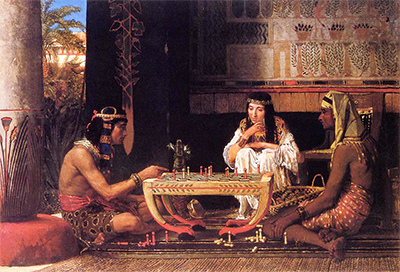
In Lawrence Alma-Tadema’s Egyptian Chess Players, a man reaches towards a low gaming table while two people watch. The board is small enough to miss amid the patterned clothes, painted walls and glimpse of a garden. Once you notice the extended hand, however, the whole room seems to wait for it. The picture shown here is the 1865 oil, Opus XXII, measuring 40.5 by 55.5 centimetres. Colección AMALITA in Buenos Aires catalogues it as Chess Players and records the support as wood panel. The artist made a related pencil study in 1865 and returned to the composition in a signed watercolour in 1868. [1] [2] [3]
At a Glance
- Date1865 [1]
- MediumOil on wood panel, 40.5 × 55.5 cm [1]
- CollectionColección AMALITA, Buenos Aires [1]
- OpusXXII [1][2]
This work across Lawrence Alma-Tadema’s career
Contents
- How the painting holds a moment
- What game are they playing?
- A drawing and a second version
- An Egyptian interior made in the 1860s
How the painting holds a moment
Alma-Tadema gives the most decisive gesture to the man on the left. His bent arm leads towards the nearest edge of the board, and the horizontal reach of his hand interrupts a row of upright pegs. Across from him, the man in a yellow head covering and patterned red wrap stays folded close to the floor. Between the two men, a woman in white rests a hand near her chin. Her gaze follows the play. She occupies the brightest patch of cloth in the room, and the raised level of her face makes her attention almost as conspicuous as the other man’s movement. The scene gives us a player about to act, a watchful opponent and someone who can follow the contest from outside it. [1]
The board is seen at a steep angle, squeezed into a narrow band above the table’s decorated front. Its pale edges and the sweeping curves of the legs help the little red and light-coloured pieces stand out. Some pieces stand on the board and more lie or stand on the mat below, in groups of red and pale wood tones. Their placement suggests that the game is already under way, though it gives us scant evidence for what happened before this turn. Look beneath the tabletop and there is still room for the curve of a vessel in shadow and the woman’s white drapery. The painter uses that strip of open space to keep the furniture distinct from the seated bodies. [1]
The architecture controls what the eye sees beyond the game. A massive column cuts off the left edge of the picture, while a narrow opening admits a wedge of blue sky, palms and a sunlit enclosure. Behind the players, the long horizontal band below the wall painting keeps the gaze inside. The building can be read from near to far through that small opening, then from left to right through the figures. In the dimness, a blue ornament by the left player’s cheek, bands at his wrist and the bare skin of his forearm give the eye enough to follow his movement. The surface alternates between broad areas of shade and finely worked passages that reward a closer look. [1]
What game are they playing?
The titles Egyptian Chess Players and Chess Players tell us how the picture has circulated. The board tells a more complicated story. In Het Damspel, the Dutch draughts writer Wim van Mourik reads the finished oil’s pattern as ten squares by ten, a layout familiar from international draughts. The tall pegs, with slight variations in their tops, differ from both flat draughts counters and the recognisable ranks of pieces associated with modern chess. Van Mourik also compares them with Egyptian gaming pieces. The image brings those features together in a single plausible-looking object. The particular ancient game remains unidentified. [1] [6]
Surviving equipment helps put the visible differences into perspective. A game box at the Metropolitan Museum of Art, dated about 1580–1458 BCE, carries two distinct playing faces. One has thirty squares for senet. The other has twenty squares for a game introduced into Egypt from the ancient Near East. The Met describes both as races in which the players’ moves depended on throws of sticks or knucklebones. Taia’s later game box, also at the Met, has a drawer for keeping equipment. Its twenty-square layout is on top and the thirty-square senet grid underneath. The same piece of furniture could serve two games, and a photograph can show one board while concealing the other. [7] [8]
The Egypt Exploration Society’s modern versions of ancient games draw on boards, pieces and images. A surviving object can give archaeologists the shape of a board and the markings on it, while the sequence of play often has to be reconstructed. Nefertari’s tomb shows a player in front of a table in a scene that the Met interprets as a passage towards the afterlife. A twentieth-century facsimile records the queen alone before the board, playing against an invisible opponent. Alma-Tadema’s scene makes the exchange between visible opponents its focus. The poised hand makes the idea of a turn instantly legible, even if the painted game cannot be identified. [7] [8] [9] [10]
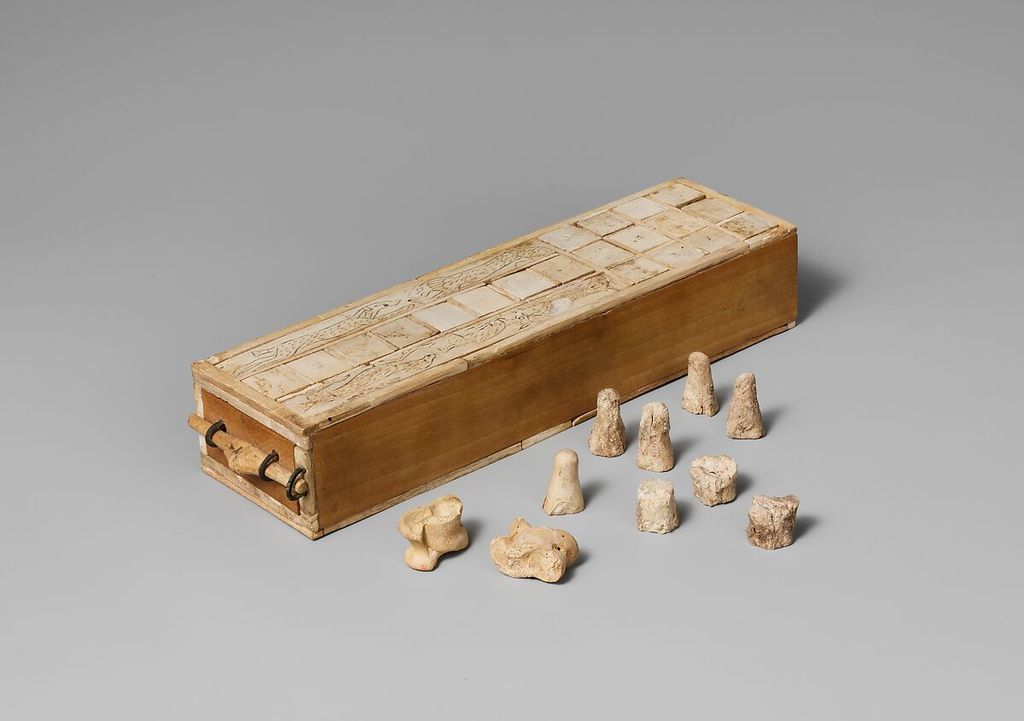
An Egyptian game box with surviving pieces and casting bones, c. 1580–1458 BCE. Metropolitan Museum of Art, 16.10.475a. Image source. CC0 / Public domain.
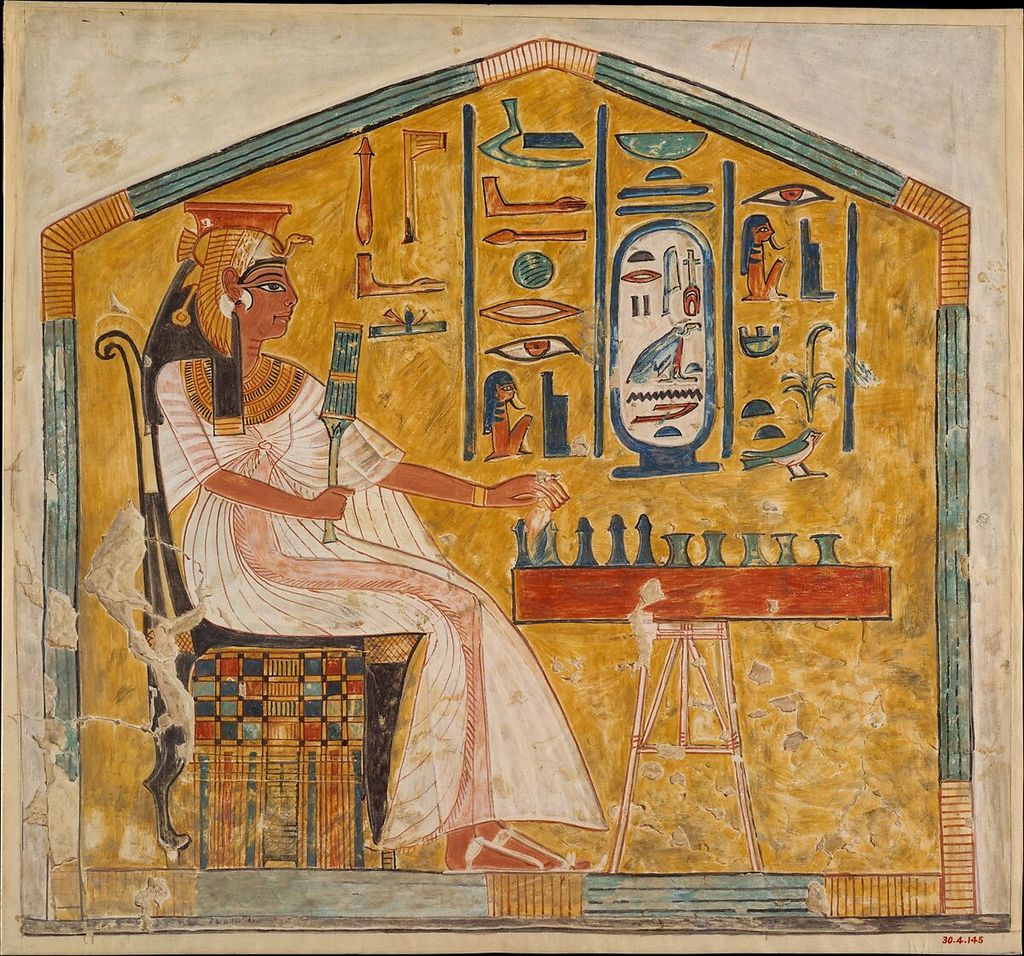
Queen Nefertari playing senet. Nina de Garis Davies’s facsimile of a tomb painting, 1921–22. Metropolitan Museum of Art, 30.4.145. Image source. CC0 / Public domain.
A drawing and a second version
The Rijksmuseum’s pencil drawing measures 25 by 35 centimetres and bears the title An Egyptian Game. The artist gave it to the writer and critic Carel Vosmaer, and it descended through Vosmaer’s family before the museum acquired it in 1989. J. F. Heijbroek’s study of their friendship reproduces the sheet and links it to the Egyptian pictures Alma-Tadema began making in 1863. The dark passages of the oil are still open space in the drawing. The tabletop looks longer and has no clearly articulated checker pattern, but the players’ bent limbs and the woman’s upright figure already give the group its rhythm. In the drawing one can follow how much of the composition was possible with posture and outline alone. [3] [6] [11]
The 1868 watercolour, catalogued by Christie’s as Egyptian Chess-Players (An Egyptian Game), is close to the oil in overall size but recasts the scene in a different key. The chair behind the man on the right is more clearly visible and his wrap is pale. Details of the plants and figures on the upper wall and the black-and-white play surface stand out more sharply. His opponent’s hand still advances over the board and the woman still sits with her chin close to her hand. The positions sustain the same story even as the change of medium alters the balance between the figures and their surroundings. [1] [2] [12]
The watercolour has its own signature and date, and Christie’s records the inscription Opus LXXIII beneath the mount. The auction catalogue describes it as the first time Alma-Tadema gave a watercolour made after one of his oils an independent opus number. It was shown at the Brussels Exposition des Aquarellistes in 1868 and again at Agnew’s in London in 1880, by which time the design was already familiar enough to have gone through several sales. Each version therefore has its own history, even though a description as simple as two men playing a board game could apply to either of them. [2]
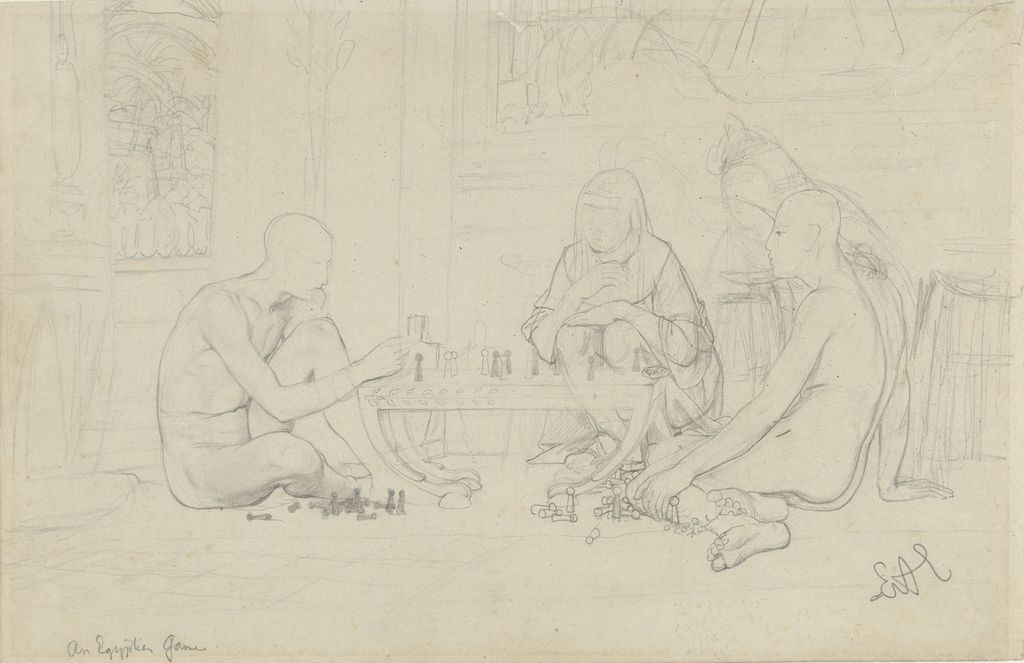
An Egyptian Game, Alma-Tadema’s 1865 pencil study. Rijksmuseum, RP-T-1989-172. Image source. Public domain.
An Egyptian interior made in the 1860s
In Pastimes in Ancient Egypt, painted in 1863 and awarded a medal at the Paris Salon in 1864, Alma-Tadema staged a much larger gathering around music and dance. Stephanie Moser has traced the ornate stool in that painting to a British Museum object the artist studied. For Egyptian Chess Players, María Victoria Álvarez Rodríguez points to a different route into the ancient material. She connects the gaming furniture and headdresses with engravings in John Gardner Wilkinson’s Manners and Customs of the Ancient Egyptians and traces the imagery on the back wall to a reproduction of a Theban tomb painting in the book’s discussion of agriculture. On the panel, rows of plants and tall vessels form a domestic backdrop. The movement from tomb decoration to a painted room suggests how freely a nineteenth-century artist could reposition closely studied motifs. [13] [14]
Haruka Sekine has argued that the earlier Pastimes helped Alma-Tadema reach buyers beyond his existing patrons by pairing archaeological material with a scene a broad public could understand. Egyptian Chess Players shows how that pairing could work on a smaller scale. A nineteenth-century viewer could recognise the concentration around a game, just as a viewer today can, without recognising the wall painting or the lotus decoration on the column. The ornaments reward another kind of attention. They allow a viewer to pause over the interior while the trio gives the painting a human action that can be read at a glance. [1] [15]
Christie’s identifies the oil as the first painting Alma-Tadema completed for Ernest Gambart and records its later sale in New York on 15 February 1985. The study of Gambart’s London business by Jan Dirk Baetens distinguishes the dealer’s early purchases from the stories told about his first encounter with the artist. Gambart promoted painters associated with the Belgian school to British audiences and presented Alma-Tadema as a pupil of Henri Leys. The Egyptian pictures gave the younger painter a distinctive subject within that market. In 1894 Ellen Gosse called the game chess, but her most telling observation was about the figures. She recalled Alma-Tadema talking about how difficult it was for many Europeans to sit comfortably for long in the low position he gave the players. The Egyptologist Georg Ebers also praised how lifelike the group was and recalled seeing a pencil sketch. Their impressions show how much of the picture’s effect depended on the way the people occupied the room. [2] [16] [17] [18]
There may even be a glimpse of the gaming composition in another painting from these years. Van Mourik points to the blurred figures in the painting within My Studio, a 1867 view of Alma-Tadema’s Brussels workplace. The Groninger Museum identifies the women on the studio bench as the artist’s wife Marie Pauline and her mother, with his daughter Laurence nearby. Whether or not one can make out the game in the tiny painted scene, the family portrait puts a domestic gathering within sight of the artist’s historical work. In Egyptian Chess Players, he gives a similarly intimate scale to ancient life. An outstretched arm and two pairs of eyes carry the action, while all the elaborate details of the room make it feel possible that the players have spent the afternoon there. [6] [19]
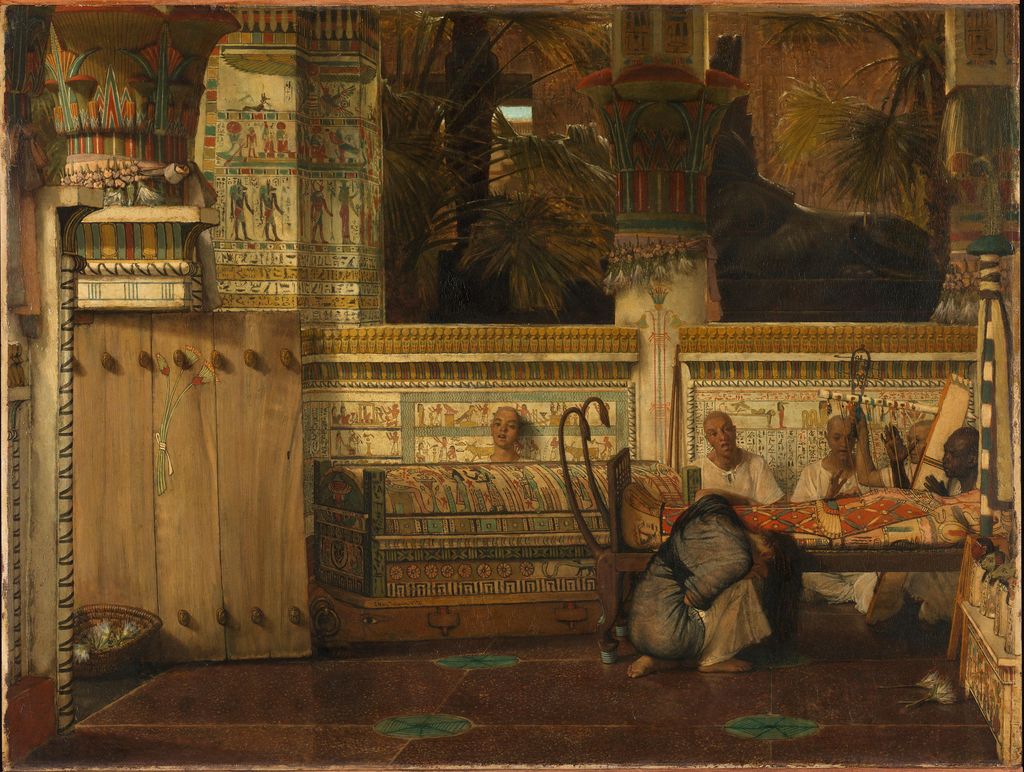
The Egyptian Widow, 1872. Rijksmuseum, SK-A-2427. Image source. Public domain.
Lawrence Alma-Tadema artworks directory
Search by title or medium. The directory includes Alma-Tadema’s numbered compositions, separately catalogued fragments, and selected drawings and historic prints. Dates for unlinked works follow the catalogue’s year groupings. View the numbered opus catalogue
| Name | Date | Medium |
|---|---|---|
| Portrait of my sister Artje | 1851 | Painting |
| Selfportrait | 1852 | Painting |
| Portrait of my mother (oval) | 1852 | Painting |
| The alm | 1856 | Painting |
| The inundation of the Biesbosch in 1421 | 1857 | Painting |
| The destruction of Terdoest Abbey in 1571 | 1857 | Painting |
| Faust en Marguerite | 1857 | Watercolour |
| Clotilde at the tomb of her grandchildren | 1858 | Painting |
| Marius on the ruins of Carthage | 1858 | Watercolour |
| The sad father: the unfavourable oracle (Death of the first-born, first version) | 1859 | Painting |
| The death of Attila, 453 AD | 1859 | Watercolour |
| Triumphal return of Sir Willem van Saeftingen | 1860 | Painting |
| The death of Hippolyte | 1860 | Watercolour |
| The Education of the Children of Clovis | 1861 | Painting |
| Venantius Fortunatus reading his poems to Radagonda VI | 1862 | Painting |
| Gunthram Bose and his daughters, 572 AD: the Ambuscade | 1862 | Painting |
| A medieval Flemish interior | 1863 | Painting |
| Pastimes in Ancient Egypt: 3.000 years ago | 1863 | Painting |
| Interior of the Church San Clemente, Rome: a study | 1863 | Painting |
| Queen Fredegonda at the deathbed of Bishop Praetextatus (first version) | 1864 | Painting |
| Leaving Church in the fifteenth century | 1864 | Painting |
| Egyptian Chess Players (An Egyptian Game) | 1865 | Painting |
| Birthday presents in the sixteenth century | 1865 | Painting |
| Gallo-Roman women | 1865 | Painting |
| Entering Church in the fourteenth century | 1865 | Painting |
| An Egyptian at his doorway in Memphis | 1865 | Painting |
| Catallus ten huize van Lesbia | 1865 | Painting |
| The discourse | 1865 | Painting |
| A Roman scribe writing despatches | 1865 | Painting |
| A soldier of Marathon | 1865 | Painting |
| Home from market | 1865 | Painting |
| Death of Galeswinthe | 1865 | Painting |
| An Egyptian Game (preparatory drawing) | 1865 | Drawing |
| Making wreaths for festivities in a Pompeian house | 1866 | Painting |
| Vespasian hearing of the taking of Jerusalem by Titus | 1866 | Painting |
| Entrance to a Roman theatre | 1866 | Painting |
| In the peristyle | 1866 | Painting |
| Agrippina visiting the ashes of Germanicus | 1866 | Painting |
| Tibullus at Delia's | 1866 | Painting |
| A Roman dance | 1866 | Painting |
| Lesbia weeping over a sparrow | 1866 | Painting |
| The armourer's shop in ancient Rome | 1866 | Painting |
| The Education of the Children of Clovis (Rennefeld print after Alma-Tadema) | 1866 | |
| The mummy: Roman period: Egyptians lamenting their dead | 1867 | Painting |
| The honeymoon | 1867 | Painting |
| Cuckoo | 1867 | Painting |
| The aesthetic view: Madame Dumoulin, Pauline, and Laurence | 1867 | Painting |
| Glaucus and Nydia | 1867 | Painting |
| Portrait of Mr A. Bonnefoy | 1867 | Painting |
| Proclaiming Claudius Emperor | 1867 | Painting |
| A sculpture gallery in Rome at the time of Augustus | 1867 | Painting |
| A collector of pictures at the time of Augustus | 1867 | Painting |
| Tarquinius Superbus before Galba | 1867 | Painting |
| A Roman family | 1867 | Painting |
| Italian women | 1867 | Painting |
| Portrait of Madame Bonnefoy and Mr Puttemans | 1867 | Painting |
| The siësta (first version) | 1868 | Drawing |
| The embarkation | 1868 | Painting |
| The siësta (second version) | 1868 | Painting |
| A Roman art lover | 1868 | Painting |
| Woman and flowers | 1868 | Painting |
| Phidias and the Parthenon, Athens | 1868 | Painting |
| The flower girl | 1868 | Painting |
| A Roman flower market: Pompeii | 1868 | Painting |
| Egyptian game | 1868 | Watercolour |
| Education of the children of Clovis | 1868 | Painting |
| A Roman art lover: silver statue | 1868 | Painting |
| Egyptian dancing girls | 1868 | Watercolour |
| Catalina | 1869 | Painting |
| The visit: Sunday morning before churching (first version): a birth chamber, seventeenth century | 1869 | Painting |
| The Pyrrhic dance | 1869 | Painting |
| The Grand Chamberlain of Sesostris the Great | 1869 | Painting |
| The convalescent | 1869 | Painting |
| Confidences | 1869 | Painting |
| A Greek Woman | 1869 | Painting |
| At the wine shop | 1869 | Painting |
| An Exedra (first version) | 1869 | Painting |
| Portrait of Master Ernest Angely | 1870 | Painting |
| A juggler | 1870 | Painting |
| A nurse, seventeenth century: Sunday morning (second version) | 1870 | Watercolour |
| Roman art lover (the runner ) | 1870 | Painting |
| Anacreon reading his poems at Lesbia's house | 1870 | Painting |
| The vintage festival (first version) | 1870 | Painting |
| The first whisper of love | 1870 | Painting |
| The letter: from an absent one (first version) | 1870 | Painting |
| A staircase (first version) | 1870 | Painting |
| Hush, she sleeps | 1870 | Painting |
| The letter: from an absent one (second version) | 1871 | Watercolour |
| The vintage festival (second version) | 1871 | Painting |
| A Roman Emperor (second version) | 1871 | Painting |
| In the temple (first version) | 1871 | Painting |
| Portrait of Miss Laura Theresa Epps | 1871 | Painting |
| A Bacchic dance | 1871 | Painting |
| Fredegonda and Praetextatus (second version) | 1871 | Painting |
| Portrait study for Mrs H.W. Mesdag | 1871 | Painting |
| Greek potters | 1871 | Painting |
| An exedra (second version) | 1871 | Watercolour |
| Sunday morning: the two sisters (third version) | 1871 | Painting |
| In the temple (second version) | 1872 | Watercolour |
| The first reproach | 1872 | Painting |
| An Egyptian widow | 1872 | Painting |
| Improvisatore | 1872 | Painting |
| A halt (first version) | 1872 | Painting |
| The last roses | 1872 | Painting |
| Death of the first-born (second version) | 1872 | Painting |
| Portrait of Dr Franz and Mrs Catherine Hueffer 'When I am dead, oh dearest sing' | 1872 | Painting |
| The nurse | 1872 | Painting |
| Greek wine (first version) | 1872 | Painting |
| Goldfish (first version) | 1872 | Painting |
| On a Roman staircase (second version) | 1872 | Watercolour |
| Hercules | 1872 | Painting |
| Portrait of Miss Kate Thompson | 1873 | Painting |
| The dinner (first version) | 1873 | Painting |
| The siësta (third version) | 1873 | Painting |
| A visit to the studio (second version) | 1873 | Watercolour |
| Cherries | 1873 | Painting |
| Greek wine (second version) | 1873 | Watercolour |
| This is our corner | 1873 | Painting |
| A picture gallery (third version) | 1873 | Painting |
| The last roses (second version) | 1873 | Watercolour |
| Fishing (first version) | 1873 | Painting |
| Music has charms | 1873 | Watercolour |
| Counting the passers-by | 1873 | Watercolour |
| Portrait of Mrs Frederick George Stephens | 1873 | Painting |
| Two heads from 'The Picture Gallery': A visit to the studio by Charles W. Deschamps and his wife (first version) | 1874 | Watercolour |
| Joseph, overseer of Pharaoh's granaries | 1874 | Painting |
| A sculpturegallery (first version) | 1874 | Painting |
| A picture gallery in Rome at the time of Augustus (fourth version) | 1874 | Painting |
| Portrait of Charles W. Deschamps and his wife (second version) | 1874 | Painting |
| Autumn | 1874 | Watercolour |
| Reflections: fishing (second version) | 1874 | Painting |
| A Roman artist | 1874 | Watercolour |
| Good friends | 1874 | Watercolour |
| On the steps of the Capitol (first version) | 1874 | Painting |
| Water pets: goldfish (second version) | 1874 | Painting |
| Münster Cathedral | 1874 | Painting |
| Landscape near Münster | 1874 | Painting |
| Antistius Labeon, 75 AD: A Roman amateur artist | 1874 | Painting |
| Sunny days | 1874 | Painting |
| Spring flowers: garland seller on the steps of the Capitol (second version) | 1874 | Watercolour |
| Through an archway | 1874 | Painting |
| (A, B) Decoration for my piano: 'Serious and merry music' | 1874 | Painting |
| Rêverie | 1874 | Painting |
| The Roman architect | 1874 | Painting |
| Sunflowers | 1874 | Painting |
| Landscape: carriage drive by the outskirts of a wood, Penhill Castle | 1875 | Painting |
| A peep through the trees | 1875 | Painting |
| Cleopatra (first version) | 1875 | Painting |
| (a, b, c) The tragedy of an honest wife | 1875 | Watercolour |
| The architect of the Coliseum | 1875 | Watercolour |
| Fishing | 1875 | Watercolour |
| Cherry blossom | 1875 | Painting |
| Water pets: goldfish (third version) | 1875 | Painting |
| 'There he is!' | 1875 | Painting |
| Play Garden | 1875 | Painting |
| Portrait of Miss Thackeray's 'Elisabeth' | 1875 | Painting |
| A nymphaeum from the Villa Aldobrandini in Rome | 1875 | Painting |
| Haystacks | 1875 | Painting |
| A sculpture gallery (second version) | 1875 | Painting |
| After the dance: a bacchanal | 1875 | Painting |
| Landscape: a breezy day in August near Innsbruck | 1875 | Painting |
| The service | 1875 | Painting |
| An audience at Agrippa's (first version) | 1875 | Painting |
| Kriemhild’s Tryste | 1875 | |
| Portrait of my wife | 1876 | Painting |
| Between hope and fear | 1876 | Painting |
| 94 Degrees in the Shade | 1876 | Painting |
| An antique custom | 1876 | Painting |
| Portrait of Jules Dalou, his wife and his daughter | 1876 | Painting |
| Pleading (first version) | 1876 | Painting |
| Hide and seek | 1876 | Painting |
| Balneatrix | 1876 | Watercolour |
| A mirror | 1877 | Painting |
| An interesting scroll | 1877 | Watercolour |
| Winter | 1877 | Painting |
| Autumn-vintage festival | 1877 | Painting |
| Summer | 1877 | Painting |
| Spring in the gardens of the Villa Borghese (first version) | 1877 | Painting |
| A balneator | 1877 | Watercolour |
| Painting in Ancient Rome | 1877 | Painting |
| A balneatrix | 1877 | Painting |
| The sculptor's model (Venus Esquilina) | 1877 | Painting |
| The sculptor's studio in ancient Rome | 1877 | Painting |
| Architecture in ancient Rome | 1877 | Painting |
| Cleopatra (second version) | 1877 | Painting |
| Spring in the gardens of the Villa Borghese (second version) | 1877 | Painting |
| Panel for H. W. Mesdag's studio door: Spring in the gardens of the Villa Borghese (third version) | 1877 | Painting |
| The question: Pleading (second version) | 1877 | Painting |
| A kitchen garden | 1877 | Painting |
| Flora: Spring in the gardens of the Villa Borghese (fourth version) | 1877 | Watercolour |
| A silent counsellor | 1878 | Watercolour |
| A sollicitation | 1878 | Watercolour |
| A hearty welcome | 1878 | Painting |
| A landscape | 1878 | Painting |
| In the time of Constantine | 1878 | Painting |
| A love missile | 1878 | Painting |
| Fredegonda en Galswintha, 566 AD | 1878 | Painting |
| A safe confidant | 1878 | Painting |
| After the audience (second version) | 1879 | Painting |
| Strigils andsponges | 1879 | Watercolour |
| E festival in Pomona | 1879 | Painting |
| Prose | 1879 | Painting |
| Going down to the river | 1879 | Painting |
| The Roman wine tasters | 1879 | Watercolour |
| Portrait of th singer George Henschel Esq. at the piano | 1879 | Painting |
| Poetry | 1879 | Painting |
| A well-protected slumber | 1879 | Painting |
| A garden altar | 1879 | Painting |
| Beauties | 1879 | Painting |
| Portrait of Thekla Friedländer | 1879 | Unspecified |
| On the road to the Temple of Ceres: A springfestival | 1879 | Painting |
| Autumn (third version) | 1879 | Drawing |
| 'Not at home' | 1879 | Painting |
| An old bachelor after the bath | 1879 | Watercolour |
| Spring (Blanchard print after Alma-Tadema’s 1877 painting) | 1879 | |
| The first course: the dinner | 1880 | Painting |
| Interrupted | 1880 | Painting |
| Grapes | 1880 | Watercolour |
| A pastoral | 1880 | Painting |
| A portrait of Dr Felix and Mrs August Redeker Semon | 1880 | Painting |
| Ave Caesar! Io Saturnalia! (third version) | 1880 | Painting |
| A prize for the artist's corps | 1880 | Painting |
| The departure (first version) | 1880 | Painting |
| A harvest festival | 1880 | Painting |
| 'Your carriage stops the way' | 1880 | Painting |
| Autumn (Scene in a Roman Garden) | c.1880 | Drawing |
| The torch dance | 1881 | Painting |
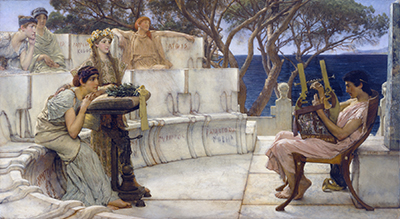
| Sappho and Alcaeus | 1881 | Painting |
| A kiss | 1881 | Watercolour |
| A Bacchante dancing before the thymele | 1881 | Watercolour |
| An audience | 1881 | Painting |
| Portrait of Dr Hans Richter | 1881 | Painting |
| Pandora | 1881 | Watercolour |
| The Tepidarium | 1881 | Painting |
| Quiet pets | 1881 | Painting |
| A priestess of Apollo | 1881 | Watercolour |
| A difficult line from Horace (first version) | 1881 | Painting |
| A stranger in my studio (one of a pair) | 1881 | Painting |
| Amo te ama me | 1881 | Painting |
| The First Course–The Dinner (Löwenstam print after Alma-Tadema) | 1881 | |
| Young affections | 1882 | Painting |
| A difficult line from Horace (second version) | 1882 | Drawing |
| Portrait of John F. Whichcord Esq., PRIBA, FSA | 1882 | Painting |
| Portrait of Ludwig Barnay as Marcus Antonius | 1882 | Painting |
| The way to the temple | 1882 | Painting |
| A parting kiss | 1882 | Painting |
| Reflections | 1882 | Painting |
| Between Venus and Bacchus | 1882 | Watercolour |
| Dolce far niente (first version) | 1882 | Watercolour |
| Dolce far niente (second version) | 1882 | Painting |
| An Oleander | 1882 | Painting |
| The meeting of Antony and Cleopatra | 1883 | Painting |
| Portrait of Catherine, Duchess of Cleveland | 1883 | Painting |
| Portrait of my daughter Anna Alma-Tadema | 1883 | Painting |
| Shy | 1883 | Painting |
| Portrait of His Excellency the Duke of Bylandt | 1883 | Painting |
| Una Carita: The three graces: Laura, Laurence, and Anna | 1883 | Painting |
| Portrait of Leopold Lowenstam, the engraver | 1883 | Painting |
| Portrait of Lady Thompson | 1883 | Painting |
| Portrait of Professor Giovanni Battista Amendola | 1883 | Painting |
| 'Der alte Menander ist doch nicht gestorben!' Paulus and Hermas | 1883 | Drawing |
| A street altar | 1883 | Watercolour |
| Welcome Footsteps (The Well-Known Footsteps) | 1883 | Painting |
| A declaration: an old, old story | 1883 | Watercolour |
| Xanthe and Phaon | 1883 | Watercolour |
| Selfportrait | 1883 | Painting |
| Hadrian in England: visiting a Roman-British Pottery (original, later divided) | 1884 | Painting |
| A Roman-British pottery | 1884 | Painting |
| Emperor Hadrian's visit to a British pottery | 1884 | Painting |
| A Roman-British potter | 1884 | Painting |
| Portrait of Miss Alice Lewis | 1884 | Painting |
| Who is it? | 1884 | Painting |
| Portrait of Moses Ezekiel | 1884 | Painting |
| Portrait of Sir Francis Powell | 1884 | Painting |
| Egyptien à l’entrée de sa demeure (Ramus print after Alma-Tadema) | 1884 | |
| Expectations | 1885 | Painting |
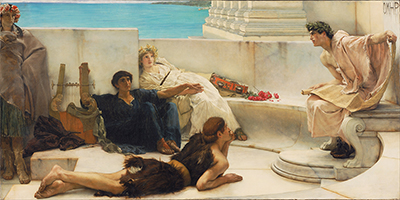
| A Reading from Homer | 1885 | Painting |
| Portrait of Dr Wahington Napoleon Epps: my docter | 1885 | Painting |
| The triumph of Titus: the Flavians | 1885 | Painting |
| Ariadne | 1885 | Painting |
| Portrait of Mrs W. M. Baker | 1885 | Painting |
| Rose of all roses | 1885 | Painting |
| A foregone conclusion | 1885 | Painting |
| A apodyterium | 1886 | Painting |
| Portrait of James Reld Esq. | 1886 | Painting |
| Portrait of Mrs Frank D. Millet | 1886 | Painting |
| A secret | 1887 | Painting |
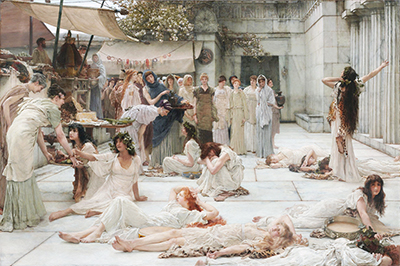
| The Women of Amphissa | 1887 | Painting |
| A new dress | 1887 | Watercolour |
| 'He loves me, he loves me not' | 1887 | Painting |
| Illuminated letter 'W' for the Royal Academy address to Queen Victoria | 1887 | Watercolour |
| Portia | 1887 | Painting |
| The Roses of Heliogabalus | 1888 | Painting |
| Fair tresses: a sketch | 1888 | Painting |
| Midday slumbers | 1888 | Watercolour |
| Portrait of the honourable Adama van Scheltema | 1888 | Painting |
| Venus and Mars | 1888 | Painting |
| Portrait of Jules de Soria | 1888 | Painting |
| At the shrine of Venus | 1888 | Painting |
| The Favourite Poet | 1888 | Painting |
| The Favourite Poet (Löwenstam print after Alma-Tadema) | c.1888 | |
| Sisters | 1889 | Painting |
| Cloaked in yellow | 1889 | Painting |
| A dedication to Bacchus (first version) | 1889 | Painting |
| A dedication to Bacchus (second version) | 1889 | Painting |
| Portrait of Mrs Ralph Sneyd | 1889 | Painting |
| Portrait of Miss MacWhirter (Mrs Charles Sims) | 1889 | Painting |
| Portrait of young gentleman John Parsons Millet | 1889 | Painting |
| In a rose garden | 1889 | Painting |
| A Silent Greeting | 1889 | Painting |
| Portrait of Sir Ernest A. Waterlow, Esq., RA | 1889 | Painting |
| Eloquent silence | 1890 | Painting |
| The Frigidarium | 1890 | Painting |
| Promise of Spring | 1890 | Painting |
| Portrait of Miss Agnes Marks | 1890 | Painting |
| Rêverie: a sketch | 1890 | Painting |
| Portrait of the Right Hon. Arthur James Balfour | 1891 | Painting |
| An earthly paradise | 1891 | Painting |
| Love's votaries; Love in idleness | 1891 | Painting |
| Portrait of the Honourable Archdean Watkins of Durham, DD | 1891 | Painting |
| Portrait of Alfred Waterhouse Esq. RA | 1891 | Painting |
| Portrait of Ignacy Jan Paderewski | 1891 | Painting |
| The kiss | 1891 | Painting |
| Calling the worshippers | 1892 | Watercolour |
| The poet Gallus dreaming | 1892 | Painting |
| Courtship | 1892 | Painting |
| Comparisons | 1892 | Painting |
| The inner sanctuary | 1892 | Painting |
| Portrait of Dr Joseph Joachim | 1893 | Painting |
| In the corner of my studio | 1893 | Painting |
| Portrait of Mrs Charles Wyllie | 1893 | Painting |
| Unconscious Rivals | 1893 | Painting |
| Godspeed | 1893 | Painting |
| Portrait of Mrs Theyre Smith | 1893 | Painting |
| At the close of a joyful day | 1894 | Painting |
| The benediction | 1894 | Painting |
| Spring | 1894 | Painting |
| Past and present generations | 1894 | Painting |
| God Speed (Löwenstam print after Alma-Tadema) | 1894 | |
| Love's jewelled fetter | 1895 | Painting |
| Fortune's favourite | 1895 | Painting |
| Portrait of Mrs Roland Hill and her children | 1895 | Painting |
| Portrait of George Simmonds and family | 1895 | Painting |
| Unwelcome confidence | 1895 | Painting |
| A Coign of Vantage | 1895 | Painting |
| Portrait of Mrs Marcus Stone | 1895 | Painting |
| Whispering Noon | 1896 | Painting |
| The Coliseum | 1896 | Painting |
| Familygroup | 1896 | Painting |
| Portrait of Miss Onslow Ford | 1896 | Painting |
| A Difference of Opinion | 1896 | Painting |
| Portrait of Maurice Sons Esq. playing the violin in Alma-Tadema's studio | 1896 | Painting |
| Selfportrait | 1896 | Painting |
| 'Nobody asked you sir!' she said | 1896 | Watercolour |
| Portrait of J. M. Zarifi Esq. | 1897 | Painting |
| Watching and waiting | 1897 | Painting |
| 'Her eyes are with her thoughts, and they are far away' | 1897 | Painting |
| Wandering thoughts | 1897 | Painting |
| Melody on a Mediterranean terrace | 1897 | Painting |
| Roses, love's delight | 1897 | Painting |
| A Difference of Opinion (Boulard print after Alma-Tadema) | 1897 | |
| Portrait of Lady Sydney (Margaret) Waterlow | 1898 | Painting |
| The conversion of Paula by St. Jerome | 1898 | Painting |
| Portrait of Tine Son-Maris | 1898 | Painting |
| Hero | 1898 | Painting |
| Portrait of Mrs George Lewis and her daughter Elisabeth | 1899 | Painting |
| The listeners | 1899 | Painting |
| Attracted: watchers | 1899 | Watercolour |
| The Baths of Caracalla (Thermae Antoninianae) | 1899 | Painting |
| Bluebells | 1899 | Painting |
| Study for Thermaie Antoniniane | 1899 | Drawing |
| A flag of truce | 1900 | Painting |
| Goldfish (fourth version) | 1900 | Painting |
| Portrait of Mrs Armour from Princeton | 1900 | Painting |
| Portrait of George Aitchison, PRIBA, RA | 1900 | Painting |
| Vain courtship | 1900 | Painting |
| Under the roof of blue Ionian weather | 1901 | Painting |
| Death of the first born (third version) | 1901 | Drawing |
| A priestess of Hymen | 1901 | Watercolour |
| Fair tresses | 1901 | Painting |
| Impatient | 1901 | Watercolour |
| Portrait of Sir Max Waechter High Sheriff of Sussex | 1901 | Painting |
| The year's at the spring, all's right with the world | 1902 | Painting |
| Caracalla | 1902 | Painting |
| A crown | 1902 | Watercolour |
| Amongst the ruins | 1902 | Painting |
| Silver Favourites | 1903 | Painting |
| A peaceful wooing | 1903 | Painting |
| The ever-new horizon | 1903 | Painting |
| Thalia's homage to Aesculapius | 1904 | Drawing |
| The Finding of Moses | 1904 | Painting |
| A world of their own | 1905 | Painting |
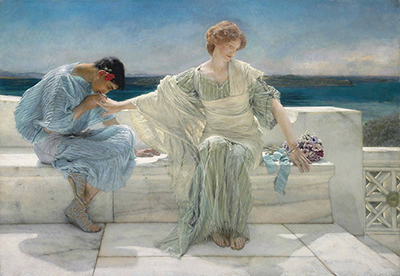
| Ask Me No More | 1906 | Painting |
| Entering the Coliseum (first version) | 1907 | Watercolour |
| Geta and his sister | 1907 | Drawing |
| Caracalla and Geta | 1907 | Painting |
| Orante (oval, one of a pair) | 1907 | Painting |
| Bacchante (oval, one of a pair) | 1907 | Painting |
| Melodie del mare e dell'amore | 1907 | Watercolour |
| Youth | 1907 | Watercolour |
| Portrait of myself for the R. Accademia Romana di San Luca | 1907 | Painting |
| The golden hour | 1907 | Painting |
| At Aphrodite’s Cradle | 1908 | Painting |
| A message of love | 1909 | Painting |
| A Favourite Custom | 1909 | Painting |
| Splashing | 1909 | Drawing |
| Portrait of Mrs Washington Epps | 1909 | Drawing |
| Hopeful | 1909 | Painting |
| Portrait of Dr J. M. W. van der Poorten-Schwartz (Maarten Maartens) | 1909 | Drawing |
| Portrait of Ilona Eibenschutz | 1909 | Painting |
| The voice of spring | 1910 | Painting |
| Principal figure of 'The voice of spring' | 1910 | Drawing |
| A border for the King's letter to the nation | 1910 | Drawing |
| Heading: the Royal Academy address to H.M. King George on his accession to the throne | 1910 | Watercolour |
| Title unknown | 1910 | Unspecified |
| When flowers return (one of a pair) | 1911 | Painting |
| Summer Offering | 1911 | Painting |
| Title unknown | 1911 | Unspecified |
| Entering the Coliseum (second version) | 1911 | Painting |
| Portrait of William Whitaker Thompson Esq. | 1911 | Painting |
| Portrait of myself for the R. Accademia Romana di San Luca | 1912 | Painting |
| Preparations in the Coliseum | 1912 | Painting |
Discussion
Look again at the images and ideas explored in Egyptian Chess Players (An Egyptian Game). These editorial prompts invite your observations.
Reader Insights
What do the player’s hand and the arrangement of pieces suggest about the pause in the game?
What becomes easier to examine when you compare the pencil drawing with the oil?
Join the Conversation
Share a detail, comparison or question about Egyptian Chess Players (An Egyptian Game) below.
References
- Colección AMALITA, Chess Players, 1865, illustrated collection record. View source.
- Christie’s, Egyptian Chess-Players (An Egyptian Game), lot 3017995, details, provenance, exhibition history and lot essay. View source.
- Rijksmuseum, An Egyptian Game, 1865, drawing RP-T-1989-172, inscription, technique and provenance. View source.
- Sotheby’s, The Education of the Children of Clovis. View source.
- Sotheby’s, The Finding of Moses. View source.
- Wim van Mourik, ‘Een Egyptisch sprookje door een Friese bril’, Het Damspel, February 2008, pp. 34–35. View source.
- The Metropolitan Museum of Art, Game Box for Playing Senet and Twenty Squares, collection record 553268. View source.
- The Metropolitan Museum of Art, Game Box Inscribed for Taia and His Family, collection record 548482. View source.
- Egypt Exploration Society, ‘Games in Ancient Egypt’, discussion and reconstruction of senet. View source.
- The Metropolitan Museum of Art, Nina de Garis Davies, Queen Nefertari Playing Senet, facsimile of a tomb painting, accession 30.4.145. View source.
- J. F. Heijbroek, ‘The Exhausted Maenads: Lawrence Alma-Tadema and Carel Vosmaer’, Van Gogh Museum Journal (1996), fig. 11 and accompanying discussion. View source.
- Bridgeman Images, Egyptian Chess Players, 1868, watercolour image record CH361185, photograph from Christie’s Images. View source.
- Stephanie Moser, ‘The engagement of Victorian artists with the Egyptian collection in the British Museum’, Egypt and Sudan Newsletter 6 (2019), p. 39. View source.
- María Victoria Álvarez Rodríguez, ‘El ciclo egipcio de la eterna regeneración a través de la tumba de Nebamun’, El Futuro del Pasado 10 (2019), pp. 541–544. View source.
- Haruka Sekine, ‘ローレンス・アルマ゠タデマのエジプト作品における表象の背景’, proceedings of the 70th conference of the Japanese Society for Aesthetics (2020), pp. 37–46. View source.
- Jan Dirk Baetens, ‘The Belgian Brand: Ernest Gambart and the British Market for Modern Belgian Art, c. 1850–1870’, Revue belge de Philologie et d’Histoire 92 (2014), pp. 1292–1293. View source.
- Ellen Gosse, ‘Laurens Alma-Tadema’, The Century Magazine, February 1894, p. 489. View source.
- Georg Ebers, Lorenz Alma Tadema: His Life and Works, trans. Mary J. Safford (1886), p. 39 and the illustration of the players. View source.
- Groninger Museum, Kunstbeschouwing (Mijn atelier), 1867, object 1903.0002 and description of the Brussels studio. View source.