 by Tom Gurney
Tom Gurney BSc (Hons) is an art history expert with over 20 years experience
Email: tomgurney1@gmail.com / Phone: +44 7429 011000
A Favourite Custom: Introduction
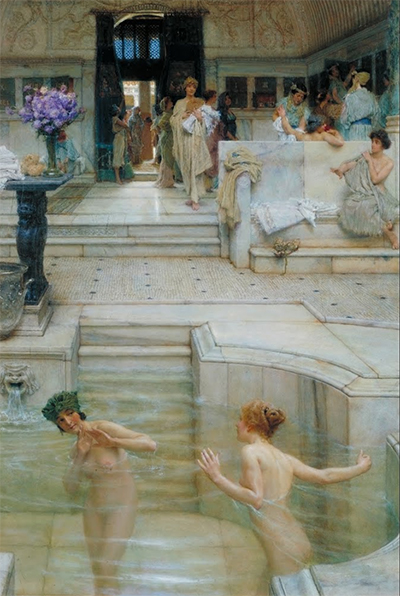
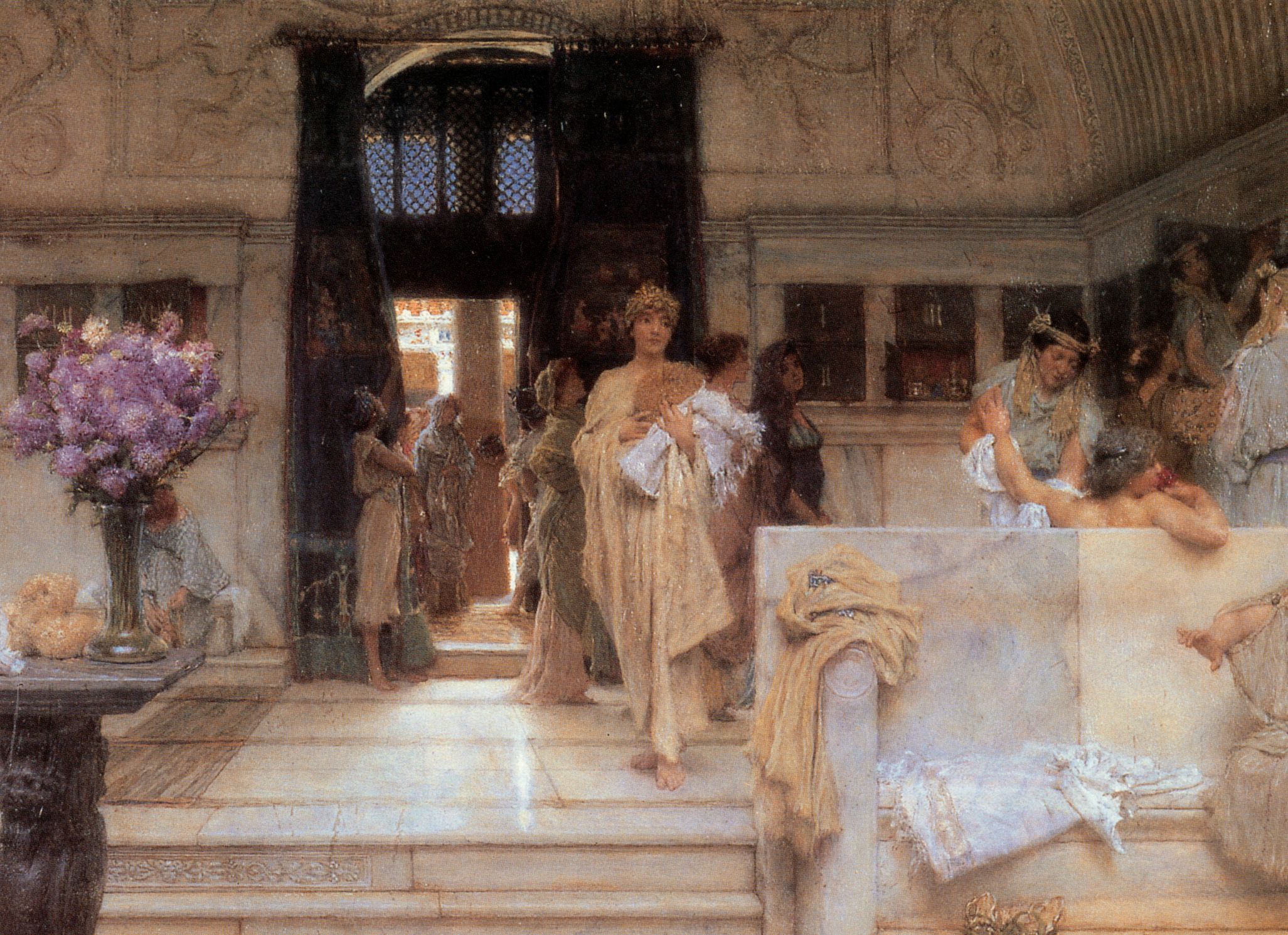
Two women have waded into a sunken pool. The one on the right turns towards her companion, her arms spread and the surface of the water breaking around her. The other tilts her head away and brings her hands up to her face. Higher in the picture, women are still arranging their clothes and towels. Lawrence Alma-Tadema painted this exchange in 1909, setting a moment of play amid the orderly routines of a Roman bathhouse. A Favourite Custom is an oil on wood measuring 66 × 45.1 cm and belongs to Tate, where it is catalogued as N02675. Tate identifies the setting as the Stabian Baths at Pompeii and describes the foreground pool as a cold bath. [1] [2]
Jacob Simon’s survey for the National Portrait Gallery records a red label for the artists’ colourmen Charles Roberson & Co. of 99 Long Acre, London. The wood support carries both Alma-Tadema’s reconstruction of an ancient interior and the mark of a London supplier. [3]
At a Glance
- Date1909 [1]
- MediumOil on wood, 66 × 45.1 cm [1]
- CollectionTate, N02675 [1]
- AcquisitionPurchased through the Chantrey Bequest [1]
This work across Lawrence Alma-Tadema’s career
Contents
- The splash and the steps
- What Alma-Tadema took from Pompeii
- At the Royal Academy and in reproduction
- Other bathing pictures
- Annotated details
The splash and the steps
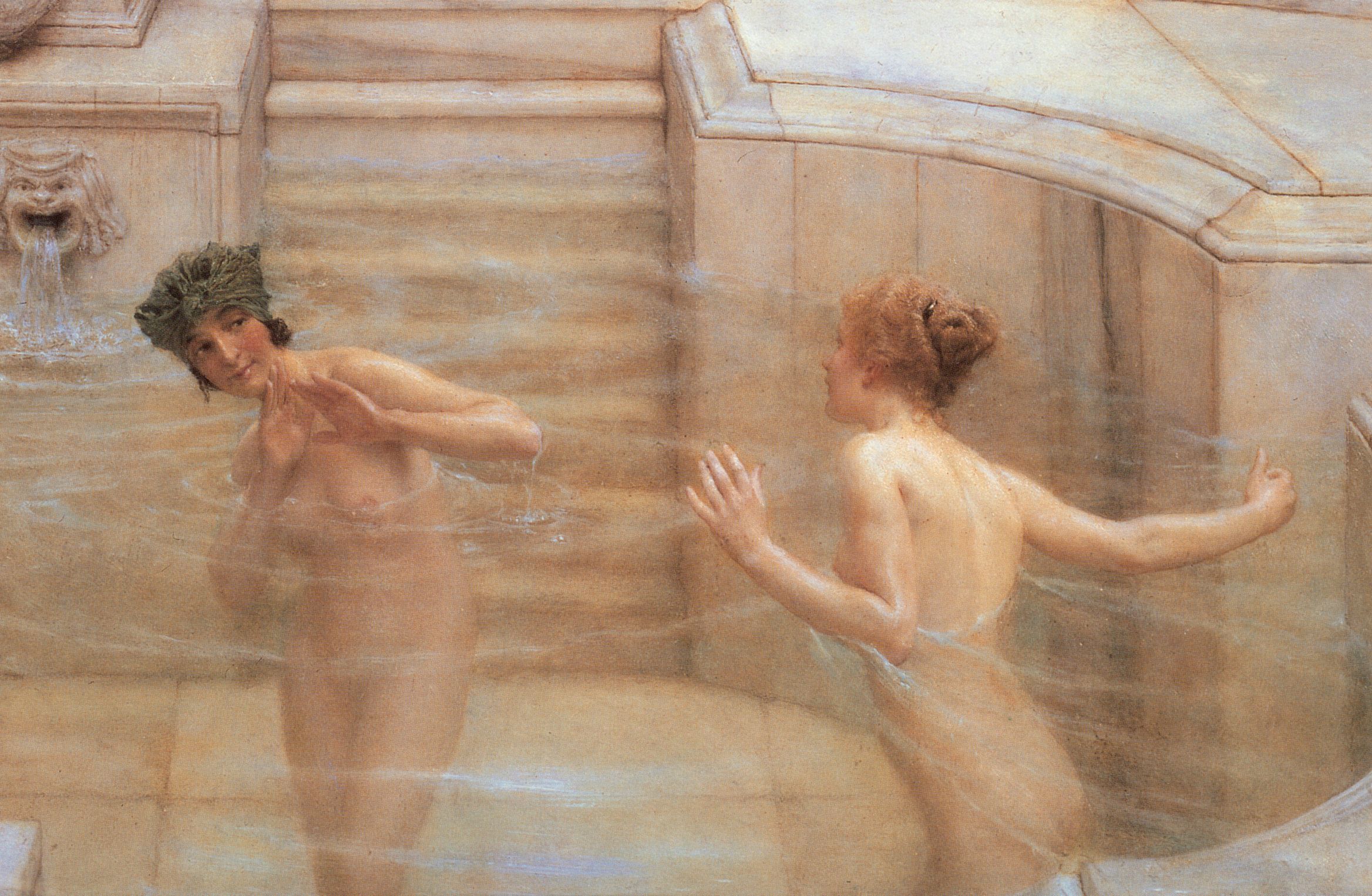
The figures tell you what the water is doing. The woman on the left has drawn her elbows in. Her fingers nearly meet beneath her chin, and the green cloth over her hair makes her head easy to follow as she ducks. The bather on the right turns enough that we see her in profile and from behind, with one hand extended to either side. The gestures make sense as a pair. Her companion seems to anticipate a second splash, and the water is already unsettled around both of them. The pale surface streaks are broadest low in the picture, where soft reflections break across the view of the submerged bodies. [2]
The steps register several different kinds of change. Above the pool, pale stone has crisp edges and rectangular joins. The submerged treads still show through, but their outlines soften and their colour approaches the greenish ochre of the surrounding water. A vertical streak from the carved spout at the left ends in a small patch of foam. Its steady flow is distinct from the wider ripples made by the women. The semicircular reach of the rim on the right folds the pool around the bather’s body, while the straight run of steps leads the eye back to the dry floor. The water covers much of the foreground even though the physical distance between the bathers and the steps is small. [2]
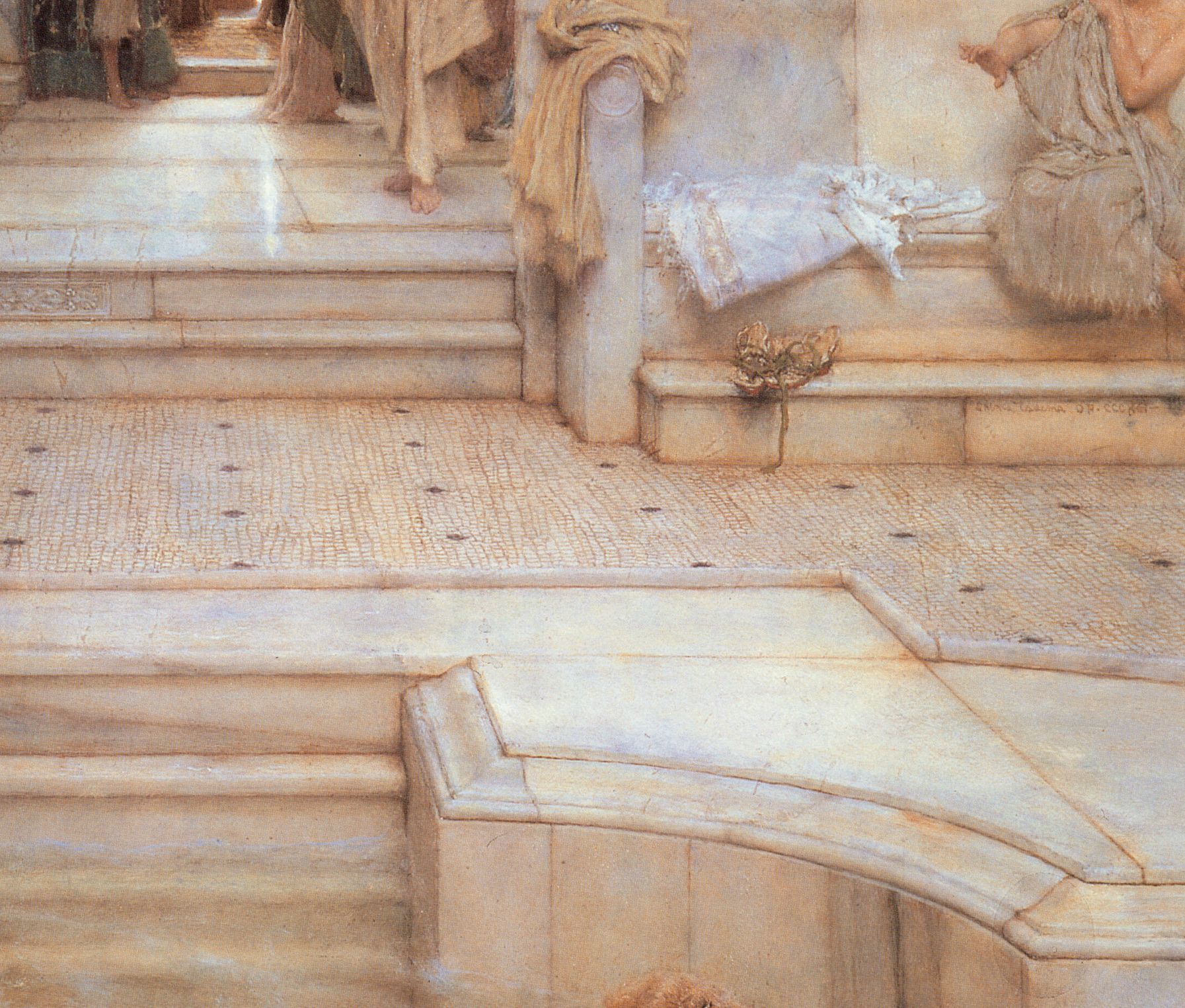
Alma-Tadema measures the depth of the room in three stages. The pool is sunk below a narrow expanse of pale mosaic, its dark accents spaced across a regular grid. A second set of steps rises to the changing area. On the right a broad marble partition divides the women further. One figure sits close to us gathering up a fringed garment, while behind the partition another can be seen only from the shoulders upwards. A piece of cloth hanging over the rounded end of the partition makes a soft break in the stone. Farther back, dark curtains and a latticed opening frame a bright passage with smaller figures. This sequence of surfaces and thresholds lets the painting accommodate several stages of the visit at once. [2]
The brightest stretch of the upper floor leads from the opening past a barefoot woman carrying white cloth. The lower pool has its own shifting bands of light, so the eye alternates between the brightness that draws it farther into the building and the brightness that makes it stop at the surface. A bouquet of violet flowers on the left and a rose held near a woman’s face on the right interrupt the pale architecture. Giacomo Savani points to that rose, the sounding water and the implied feel of the stone as ways the painting suggests a visit through several senses. Susan Harrow reads the bathers’ spontaneous play and the water that partly reveals and partly veils them as a way of making ancient bodies feel familiar to a modern viewer. The room’s material luxury makes that ease look like a privilege. [2] [7] [8]
What Alma-Tadema took from Pompeii
Tate explains that Alma-Tadema worked from photographs of the Stabian Baths and gave the setting marble walls and floors of a grandeur associated with larger imperial baths. The catalogue of his surviving research collection at the University of Birmingham shows how such material was organised. Aqueducts, fountains and baths occupied three portfolios of their own. Savani, drawing on Rosemary Barrow’s research, identifies features of the men’s changing room at the Stabian Baths and compares the fluted vault to the men’s hot room in Pompeii’s Forum Baths. The bathhouse in the painting reads as a coherent interior even though its sources lead to separate rooms and buildings. [2] [7] [9]
The excavated Stabian Baths had separate suites for men and women. A field report by Monika Trümper and colleagues records trenches in the service and furnace area between the two hot rooms and evidence of changes in the walls of the heating zone. The later archaeological account identifies four main building phases, with separate provision for cold bathing introduced during the development of the complex. In its final arrangement the women’s cold pool stood in their apodyterium, or changing room. The men’s suite had a frigidarium, a room with a cold pool, and an open-air swimming pool occupied the western wing. Christie’s, discussing the painting in its catalogue for the related drawing, calls the foreground a caldarium, a hot room. Tate’s description of the scene as cold bathing gives a plausible reading of the depicted activity. The practical arrangements at Pompeii show how freely the painter assembled the pool, steps and changing space. [2] [10] [11] [12] [13]
The props bring together material from farther afield. At the far left, the panel cuts off part of a silver vessel below the table, close to the carved spout. Ian Jenkins connects it with a large mixing vessel from the Hildesheim silver treasure and identifies the same vessel in Alma-Tadema’s A Dedication to Bacchus. Savani records that the painter owned a replica. Here the bright metal gives a different kind of gleam beside the carved leg of the table and the tall flower vase. The cut at the side makes the vessel feel like part of a room extending beyond our view. [2] [7] [14]
Sadi Maréchal places Alma-Tadema’s bathing scenes in a nineteenth-century tradition that invited spectators to look into an enclosed space occupied by women. That invitation matters to the composition. The view from beside the pool is close enough to follow the women’s private joke, while the tiled floor and marble partition give their companions farther back some visual distance. The absorbed figures appear to have little interest in how they look to a visitor. The painter gives us precisely the position from which their absorption is most visible. [2] [15]
Annotated Details from A Favourite Custom
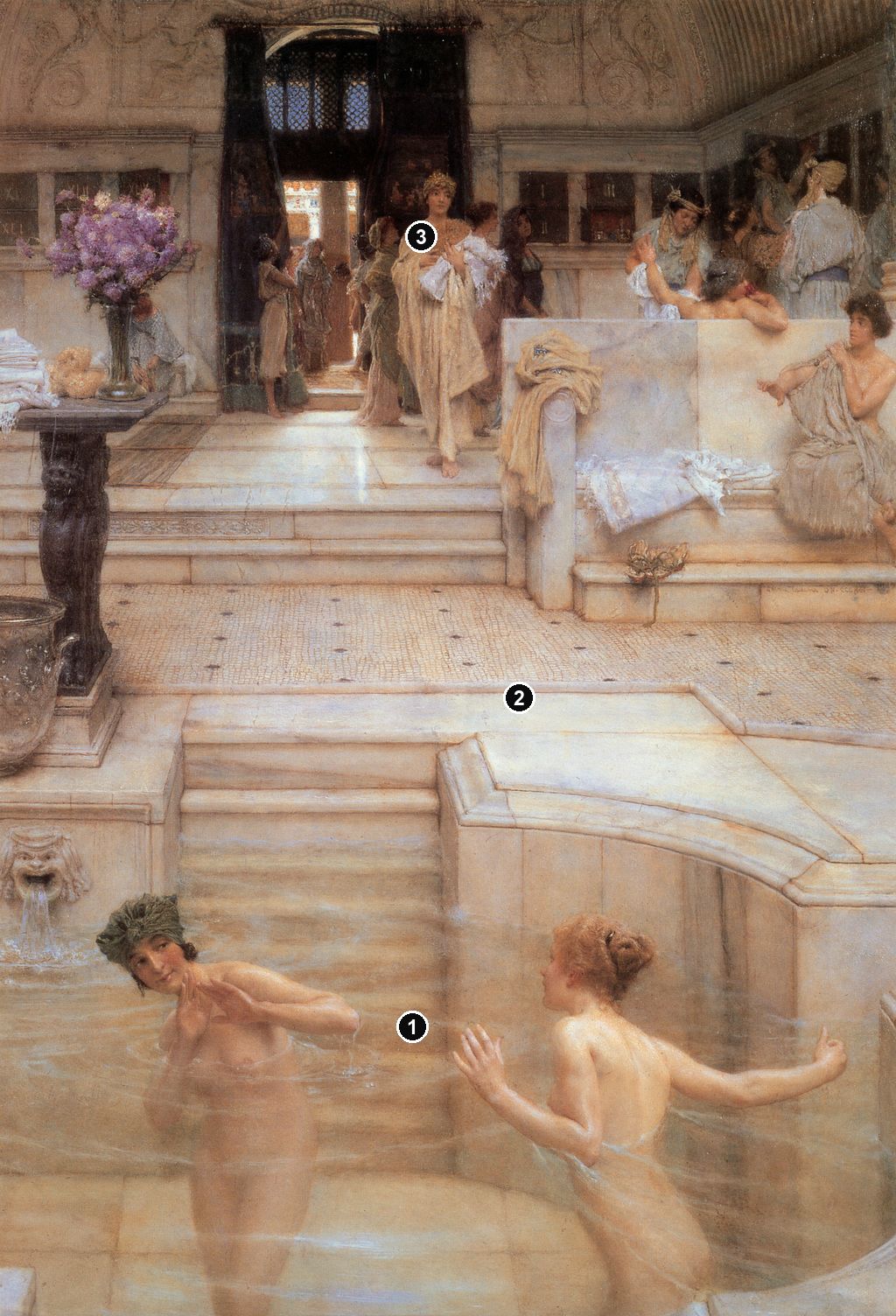
The numbered points mark details in A Favourite Custom. Catalogue record. Public domain.
Details from A FAVOURITE CUSTOM
Select a numbered point or use the details below to examine a part of the painting.
Two bathers in motion
One bather ducks beneath her green headcloth. The other extends both arms. The difference in posture carries the play of the water across the pool.
Shallow steps and the end of the bath
The stairs remain visible below the water. At the end of the bath the pale partition and mosaic floor divide the foreground from the changing area.
Looking through the bath-room doorway
A figure carries pale cloth through the illuminated passage. Beyond her, the dark doorway and lattice place the farthest visible space behind the upper steps.
At the Royal Academy and in reproduction
Christie’s dates the oil, Op. CCCXCI, to April 1909. It reports that Alma-Tadema wrote to the Royal Academy to ask for a room in which to finish the painting during the Varnishing Days, the period when exhibitors could attend to their works before the show opened. The Academy catalogue lists A Favourite Custom in Gallery III as no. 181 and records its purchase by the President and Council under the terms of the Chantrey Bequest. Samuel Shaw gives the price as £1,750 and notes that the purchase was announced at the opening of the Summer Exhibition. Tate records the trustees’ presentation in the same year. [1] [13] [16] [17]
The choice drew objections about what public funds should buy. Shaw traces the question to the critic P. G. Konody, who challenged the Academy’s decision in The Observer on 9 May 1909 and drew attention to work available elsewhere in London. The purchase gave the panel a permanent institutional home and made it part of a public argument about taste. Shaw also records a later Tate Britain hang that put the panel alongside Walter Sickert’s La Hollandaise. The pairing drew attention to the part light plays in shaping each painter’s view of the nude. In Alma-Tadema’s panel figures can be discovered at intervals all the way to the far doorway, and it takes a moment to notice how much of the foreground action he has entrusted to the reflection and refraction of light. [17]
The lower portion of the panel also had an independent life in print. In Splashing: the bathers, Alma-Tadema used pencil on buff paper to isolate the two women, the water and the immediate edges of the pool in a wide format. Christie’s records its appearance in the 1909 Pall Mall Magazine supplement Pictures of the Year and its later exhibition at the Academy’s 1913 memorial. The catalogue treats it as a drawing made for reproduction. A photogravure published by the Berlin Photographic Company circulated the full composition under the titles A Favourite Custom and The Bath. The drawings and prints through which people encountered the image could therefore give different weight to the same episode, one concentrating on the splash and another carrying over the building around it. [13] [18]
Other bathing pictures
Alma-Tadema had used the bathhouse to tell several quite different stories. The Lady Lever Art Gallery’s The Tepidarium of 1881 is a small horizontal panel focused on a reclining woman with a strigil, a curved tool used to scrape the skin. In An Apodyterium of 1886 the changing room provides the subject. In The Frigidarium of 1890, a broad canvas painted for Max Waechter, the foreground is occupied by a dressed figure and her attendant, with the pool seen beyond a drawn-back curtain. In the 1899 Baths of Caracalla, three women converse in the foreground while the deeper spaces are crowded with small figures. In A Favourite Custom, the curtain hangs at the far end and the bathing itself occupies the front. The 1909 panel lets the eye travel the length of the room, then returns it to an incident that might be over in an instant. [2] [7] [8] [19] [20] [21]
Further reading
Sensing the past. Giacomo Savani, The Smells and Senses of Antiquity in the Modern Imagination
Read the discussion of how Alma-Tadema combined different bathing interiors. View source.
Lawrence Alma-Tadema artworks directory
Search by title or medium. The directory includes Alma-Tadema’s numbered compositions, separately catalogued fragments, and selected drawings and historic prints. Dates for unlinked works follow the catalogue’s year groupings. View the numbered opus catalogue
| Name | Date | Medium |
|---|---|---|
| Portrait of my sister Artje | 1851 | Painting |
| Selfportrait | 1852 | Painting |
| Portrait of my mother (oval) | 1852 | Painting |
| The alm | 1856 | Painting |
| The inundation of the Biesbosch in 1421 | 1857 | Painting |
| The destruction of Terdoest Abbey in 1571 | 1857 | Painting |
| Faust en Marguerite | 1857 | Watercolour |
| Clotilde at the tomb of her grandchildren | 1858 | Painting |
| Marius on the ruins of Carthage | 1858 | Watercolour |
| The sad father: the unfavourable oracle (Death of the first-born, first version) | 1859 | Painting |
| The death of Attila, 453 AD | 1859 | Watercolour |
| Triumphal return of Sir Willem van Saeftingen | 1860 | Painting |
| The death of Hippolyte | 1860 | Watercolour |
| The Education of the Children of Clovis | 1861 | Painting |
| Venantius Fortunatus reading his poems to Radagonda VI | 1862 | Painting |
| Gunthram Bose and his daughters, 572 AD: the Ambuscade | 1862 | Painting |
| A medieval Flemish interior | 1863 | Painting |
| Pastimes in Ancient Egypt: 3.000 years ago | 1863 | Painting |
| Interior of the Church San Clemente, Rome: a study | 1863 | Painting |
| Queen Fredegonda at the deathbed of Bishop Praetextatus (first version) | 1864 | Painting |
| Leaving Church in the fifteenth century | 1864 | Painting |
| Egyptian Chess Players (An Egyptian Game) | 1865 | Painting |
| Birthday presents in the sixteenth century | 1865 | Painting |
| Gallo-Roman women | 1865 | Painting |
| Entering Church in the fourteenth century | 1865 | Painting |
| An Egyptian at his doorway in Memphis | 1865 | Painting |
| Catallus ten huize van Lesbia | 1865 | Painting |
| The discourse | 1865 | Painting |
| A Roman scribe writing despatches | 1865 | Painting |
| A soldier of Marathon | 1865 | Painting |
| Home from market | 1865 | Painting |
| Death of Galeswinthe | 1865 | Painting |
| An Egyptian Game (preparatory drawing) | 1865 | Drawing |
| Making wreaths for festivities in a Pompeian house | 1866 | Painting |
| Vespasian hearing of the taking of Jerusalem by Titus | 1866 | Painting |
| Entrance to a Roman theatre | 1866 | Painting |
| In the peristyle | 1866 | Painting |
| Agrippina visiting the ashes of Germanicus | 1866 | Painting |
| Tibullus at Delia's | 1866 | Painting |
| A Roman dance | 1866 | Painting |
| Lesbia weeping over a sparrow | 1866 | Painting |
| The armourer's shop in ancient Rome | 1866 | Painting |
| The Education of the Children of Clovis (Rennefeld print after Alma-Tadema) | 1866 | |
| The mummy: Roman period: Egyptians lamenting their dead | 1867 | Painting |
| The honeymoon | 1867 | Painting |
| Cuckoo | 1867 | Painting |
| The aesthetic view: Madame Dumoulin, Pauline, and Laurence | 1867 | Painting |
| Glaucus and Nydia | 1867 | Painting |
| Portrait of Mr A. Bonnefoy | 1867 | Painting |
| Proclaiming Claudius Emperor | 1867 | Painting |
| A sculpture gallery in Rome at the time of Augustus | 1867 | Painting |
| A collector of pictures at the time of Augustus | 1867 | Painting |
| Tarquinius Superbus before Galba | 1867 | Painting |
| A Roman family | 1867 | Painting |
| Italian women | 1867 | Painting |
| Portrait of Madame Bonnefoy and Mr Puttemans | 1867 | Painting |
| The siësta (first version) | 1868 | Drawing |
| The embarkation | 1868 | Painting |
| The siësta (second version) | 1868 | Painting |
| A Roman art lover | 1868 | Painting |
| Woman and flowers | 1868 | Painting |
| Phidias and the Parthenon, Athens | 1868 | Painting |
| The flower girl | 1868 | Painting |
| A Roman flower market: Pompeii | 1868 | Painting |
| Egyptian game | 1868 | Watercolour |
| Education of the children of Clovis | 1868 | Painting |
| A Roman art lover: silver statue | 1868 | Painting |
| Egyptian dancing girls | 1868 | Watercolour |
| Catalina | 1869 | Painting |
| The visit: Sunday morning before churching (first version): a birth chamber, seventeenth century | 1869 | Painting |
| The Pyrrhic dance | 1869 | Painting |
| The Grand Chamberlain of Sesostris the Great | 1869 | Painting |
| The convalescent | 1869 | Painting |
| Confidences | 1869 | Painting |
| A Greek Woman | 1869 | Painting |
| At the wine shop | 1869 | Painting |
| An Exedra (first version) | 1869 | Painting |
| Portrait of Master Ernest Angely | 1870 | Painting |
| A juggler | 1870 | Painting |
| A nurse, seventeenth century: Sunday morning (second version) | 1870 | Watercolour |
| Roman art lover (the runner ) | 1870 | Painting |
| Anacreon reading his poems at Lesbia's house | 1870 | Painting |
| The vintage festival (first version) | 1870 | Painting |
| The first whisper of love | 1870 | Painting |
| The letter: from an absent one (first version) | 1870 | Painting |
| A staircase (first version) | 1870 | Painting |
| Hush, she sleeps | 1870 | Painting |
| The letter: from an absent one (second version) | 1871 | Watercolour |
| The vintage festival (second version) | 1871 | Painting |
| A Roman Emperor (second version) | 1871 | Painting |
| In the temple (first version) | 1871 | Painting |
| Portrait of Miss Laura Theresa Epps | 1871 | Painting |
| A Bacchic dance | 1871 | Painting |
| Fredegonda and Praetextatus (second version) | 1871 | Painting |
| Portrait study for Mrs H.W. Mesdag | 1871 | Painting |
| Greek potters | 1871 | Painting |
| An exedra (second version) | 1871 | Watercolour |
| Sunday morning: the two sisters (third version) | 1871 | Painting |
| In the temple (second version) | 1872 | Watercolour |
| The first reproach | 1872 | Painting |
| An Egyptian widow | 1872 | Painting |
| Improvisatore | 1872 | Painting |
| A halt (first version) | 1872 | Painting |
| The last roses | 1872 | Painting |
| Death of the first-born (second version) | 1872 | Painting |
| Portrait of Dr Franz and Mrs Catherine Hueffer 'When I am dead, oh dearest sing' | 1872 | Painting |
| The nurse | 1872 | Painting |
| Greek wine (first version) | 1872 | Painting |
| Goldfish (first version) | 1872 | Painting |
| On a Roman staircase (second version) | 1872 | Watercolour |
| Hercules | 1872 | Painting |
| Portrait of Miss Kate Thompson | 1873 | Painting |
| The dinner (first version) | 1873 | Painting |
| The siësta (third version) | 1873 | Painting |
| A visit to the studio (second version) | 1873 | Watercolour |
| Cherries | 1873 | Painting |
| Greek wine (second version) | 1873 | Watercolour |
| This is our corner | 1873 | Painting |
| A picture gallery (third version) | 1873 | Painting |
| The last roses (second version) | 1873 | Watercolour |
| Fishing (first version) | 1873 | Painting |
| Music has charms | 1873 | Watercolour |
| Counting the passers-by | 1873 | Watercolour |
| Portrait of Mrs Frederick George Stephens | 1873 | Painting |
| Two heads from 'The Picture Gallery': A visit to the studio by Charles W. Deschamps and his wife (first version) | 1874 | Watercolour |
| Joseph, overseer of Pharaoh's granaries | 1874 | Painting |
| A sculpturegallery (first version) | 1874 | Painting |
| A picture gallery in Rome at the time of Augustus (fourth version) | 1874 | Painting |
| Portrait of Charles W. Deschamps and his wife (second version) | 1874 | Painting |
| Autumn | 1874 | Watercolour |
| Reflections: fishing (second version) | 1874 | Painting |
| A Roman artist | 1874 | Watercolour |
| Good friends | 1874 | Watercolour |
| On the steps of the Capitol (first version) | 1874 | Painting |
| Water pets: goldfish (second version) | 1874 | Painting |
| Münster Cathedral | 1874 | Painting |
| Landscape near Münster | 1874 | Painting |
| Antistius Labeon, 75 AD: A Roman amateur artist | 1874 | Painting |
| Sunny days | 1874 | Painting |
| Spring flowers: garland seller on the steps of the Capitol (second version) | 1874 | Watercolour |
| Through an archway | 1874 | Painting |
| (A, B) Decoration for my piano: 'Serious and merry music' | 1874 | Painting |
| Rêverie | 1874 | Painting |
| The Roman architect | 1874 | Painting |
| Sunflowers | 1874 | Painting |
| Landscape: carriage drive by the outskirts of a wood, Penhill Castle | 1875 | Painting |
| A peep through the trees | 1875 | Painting |
| Cleopatra (first version) | 1875 | Painting |
| (a, b, c) The tragedy of an honest wife | 1875 | Watercolour |
| The architect of the Coliseum | 1875 | Watercolour |
| Fishing | 1875 | Watercolour |
| Cherry blossom | 1875 | Painting |
| Water pets: goldfish (third version) | 1875 | Painting |
| 'There he is!' | 1875 | Painting |
| Play Garden | 1875 | Painting |
| Portrait of Miss Thackeray's 'Elisabeth' | 1875 | Painting |
| A nymphaeum from the Villa Aldobrandini in Rome | 1875 | Painting |
| Haystacks | 1875 | Painting |
| A sculpture gallery (second version) | 1875 | Painting |
| After the dance: a bacchanal | 1875 | Painting |
| Landscape: a breezy day in August near Innsbruck | 1875 | Painting |
| The service | 1875 | Painting |
| An audience at Agrippa's (first version) | 1875 | Painting |
| Kriemhild’s Tryste | 1875 | |
| Portrait of my wife | 1876 | Painting |
| Between hope and fear | 1876 | Painting |
| 94 Degrees in the Shade | 1876 | Painting |
| An antique custom | 1876 | Painting |
| Portrait of Jules Dalou, his wife and his daughter | 1876 | Painting |
| Pleading (first version) | 1876 | Painting |
| Hide and seek | 1876 | Painting |
| Balneatrix | 1876 | Watercolour |
| A mirror | 1877 | Painting |
| An interesting scroll | 1877 | Watercolour |
| Winter | 1877 | Painting |
| Autumn-vintage festival | 1877 | Painting |
| Summer | 1877 | Painting |
| Spring in the gardens of the Villa Borghese (first version) | 1877 | Painting |
| A balneator | 1877 | Watercolour |
| Painting in Ancient Rome | 1877 | Painting |
| A balneatrix | 1877 | Painting |
| The sculptor's model (Venus Esquilina) | 1877 | Painting |
| The sculptor's studio in ancient Rome | 1877 | Painting |
| Architecture in ancient Rome | 1877 | Painting |
| Cleopatra (second version) | 1877 | Painting |
| Spring in the gardens of the Villa Borghese (second version) | 1877 | Painting |
| Panel for H. W. Mesdag's studio door: Spring in the gardens of the Villa Borghese (third version) | 1877 | Painting |
| The question: Pleading (second version) | 1877 | Painting |
| A kitchen garden | 1877 | Painting |
| Flora: Spring in the gardens of the Villa Borghese (fourth version) | 1877 | Watercolour |
| A silent counsellor | 1878 | Watercolour |
| A sollicitation | 1878 | Watercolour |
| A hearty welcome | 1878 | Painting |
| A landscape | 1878 | Painting |
| In the time of Constantine | 1878 | Painting |
| A love missile | 1878 | Painting |
| Fredegonda en Galswintha, 566 AD | 1878 | Painting |
| A safe confidant | 1878 | Painting |
| After the audience (second version) | 1879 | Painting |
| Strigils andsponges | 1879 | Watercolour |
| E festival in Pomona | 1879 | Painting |
| Prose | 1879 | Painting |
| Going down to the river | 1879 | Painting |
| The Roman wine tasters | 1879 | Watercolour |
| Portrait of th singer George Henschel Esq. at the piano | 1879 | Painting |
| Poetry | 1879 | Painting |
| A well-protected slumber | 1879 | Painting |
| A garden altar | 1879 | Painting |
| Beauties | 1879 | Painting |
| Portrait of Thekla Friedländer | 1879 | Unspecified |
| On the road to the Temple of Ceres: A springfestival | 1879 | Painting |
| Autumn (third version) | 1879 | Drawing |
| 'Not at home' | 1879 | Painting |
| An old bachelor after the bath | 1879 | Watercolour |
| Spring (Blanchard print after Alma-Tadema’s 1877 painting) | 1879 | |
| The first course: the dinner | 1880 | Painting |
| Interrupted | 1880 | Painting |
| Grapes | 1880 | Watercolour |
| A pastoral | 1880 | Painting |
| A portrait of Dr Felix and Mrs August Redeker Semon | 1880 | Painting |
| Ave Caesar! Io Saturnalia! (third version) | 1880 | Painting |
| A prize for the artist's corps | 1880 | Painting |
| The departure (first version) | 1880 | Painting |
| A harvest festival | 1880 | Painting |
| 'Your carriage stops the way' | 1880 | Painting |
| Autumn (Scene in a Roman Garden) | c.1880 | Drawing |
| The torch dance | 1881 | Painting |
| Sappho and Alcaeus | 1881 | Painting |
| A kiss | 1881 | Watercolour |
| A Bacchante dancing before the thymele | 1881 | Watercolour |
| An audience | 1881 | Painting |
| Portrait of Dr Hans Richter | 1881 | Painting |
| Pandora | 1881 | Watercolour |
| The Tepidarium | 1881 | Painting |
| Quiet pets | 1881 | Painting |
| A priestess of Apollo | 1881 | Watercolour |
| A difficult line from Horace (first version) | 1881 | Painting |
| A stranger in my studio (one of a pair) | 1881 | Painting |
| Amo te ama me | 1881 | Painting |
| The First Course–The Dinner (Löwenstam print after Alma-Tadema) | 1881 | |
| Young affections | 1882 | Painting |
| A difficult line from Horace (second version) | 1882 | Drawing |
| Portrait of John F. Whichcord Esq., PRIBA, FSA | 1882 | Painting |
| Portrait of Ludwig Barnay as Marcus Antonius | 1882 | Painting |
| The way to the temple | 1882 | Painting |
| A parting kiss | 1882 | Painting |
| Reflections | 1882 | Painting |
| Between Venus and Bacchus | 1882 | Watercolour |
| Dolce far niente (first version) | 1882 | Watercolour |
| Dolce far niente (second version) | 1882 | Painting |
| An Oleander | 1882 | Painting |
| The meeting of Antony and Cleopatra | 1883 | Painting |
| Portrait of Catherine, Duchess of Cleveland | 1883 | Painting |
| Portrait of my daughter Anna Alma-Tadema | 1883 | Painting |
| Shy | 1883 | Painting |
| Portrait of His Excellency the Duke of Bylandt | 1883 | Painting |
| Una Carita: The three graces: Laura, Laurence, and Anna | 1883 | Painting |
| Portrait of Leopold Lowenstam, the engraver | 1883 | Painting |
| Portrait of Lady Thompson | 1883 | Painting |
| Portrait of Professor Giovanni Battista Amendola | 1883 | Painting |
| 'Der alte Menander ist doch nicht gestorben!' Paulus and Hermas | 1883 | Drawing |
| A street altar | 1883 | Watercolour |
| Welcome Footsteps (The Well-Known Footsteps) | 1883 | Painting |
| A declaration: an old, old story | 1883 | Watercolour |
| Xanthe and Phaon | 1883 | Watercolour |
| Selfportrait | 1883 | Painting |
| Hadrian in England: visiting a Roman-British Pottery (original, later divided) | 1884 | Painting |
| A Roman-British pottery | 1884 | Painting |
| Emperor Hadrian's visit to a British pottery | 1884 | Painting |
| A Roman-British potter | 1884 | Painting |
| Portrait of Miss Alice Lewis | 1884 | Painting |
| Who is it? | 1884 | Painting |
| Portrait of Moses Ezekiel | 1884 | Painting |
| Portrait of Sir Francis Powell | 1884 | Painting |
| Egyptien à l’entrée de sa demeure (Ramus print after Alma-Tadema) | 1884 | |
| Expectations | 1885 | Painting |
| A Reading from Homer | 1885 | Painting |
| Portrait of Dr Wahington Napoleon Epps: my docter | 1885 | Painting |
| The triumph of Titus: the Flavians | 1885 | Painting |
| Ariadne | 1885 | Painting |
| Portrait of Mrs W. M. Baker | 1885 | Painting |
| Rose of all roses | 1885 | Painting |
| A foregone conclusion | 1885 | Painting |
| A apodyterium | 1886 | Painting |
| Portrait of James Reld Esq. | 1886 | Painting |
| Portrait of Mrs Frank D. Millet | 1886 | Painting |
| A secret | 1887 | Painting |
| The Women of Amphissa | 1887 | Painting |
| A new dress | 1887 | Watercolour |
| 'He loves me, he loves me not' | 1887 | Painting |
| Illuminated letter 'W' for the Royal Academy address to Queen Victoria | 1887 | Watercolour |
| Portia | 1887 | Painting |
| The Roses of Heliogabalus | 1888 | Painting |
| Fair tresses: a sketch | 1888 | Painting |
| Midday slumbers | 1888 | Watercolour |
| Portrait of the honourable Adama van Scheltema | 1888 | Painting |
| Venus and Mars | 1888 | Painting |
| Portrait of Jules de Soria | 1888 | Painting |
| At the shrine of Venus | 1888 | Painting |
| The Favourite Poet | 1888 | Painting |
| The Favourite Poet (Löwenstam print after Alma-Tadema) | c.1888 | |
| Sisters | 1889 | Painting |
| Cloaked in yellow | 1889 | Painting |
| A dedication to Bacchus (first version) | 1889 | Painting |
| A dedication to Bacchus (second version) | 1889 | Painting |
| Portrait of Mrs Ralph Sneyd | 1889 | Painting |
| Portrait of Miss MacWhirter (Mrs Charles Sims) | 1889 | Painting |
| Portrait of young gentleman John Parsons Millet | 1889 | Painting |
| In a rose garden | 1889 | Painting |
| A Silent Greeting | 1889 | Painting |
| Portrait of Sir Ernest A. Waterlow, Esq., RA | 1889 | Painting |
| Eloquent silence | 1890 | Painting |
| The Frigidarium | 1890 | Painting |
| Promise of Spring | 1890 | Painting |
| Portrait of Miss Agnes Marks | 1890 | Painting |
| Rêverie: a sketch | 1890 | Painting |
| Portrait of the Right Hon. Arthur James Balfour | 1891 | Painting |
| An earthly paradise | 1891 | Painting |
| Love's votaries; Love in idleness | 1891 | Painting |
| Portrait of the Honourable Archdean Watkins of Durham, DD | 1891 | Painting |
| Portrait of Alfred Waterhouse Esq. RA | 1891 | Painting |
| Portrait of Ignacy Jan Paderewski | 1891 | Painting |
| The kiss | 1891 | Painting |
| Calling the worshippers | 1892 | Watercolour |
| The poet Gallus dreaming | 1892 | Painting |
| Courtship | 1892 | Painting |
| Comparisons | 1892 | Painting |
| The inner sanctuary | 1892 | Painting |
| Portrait of Dr Joseph Joachim | 1893 | Painting |
| In the corner of my studio | 1893 | Painting |
| Portrait of Mrs Charles Wyllie | 1893 | Painting |
| Unconscious Rivals | 1893 | Painting |
| Godspeed | 1893 | Painting |
| Portrait of Mrs Theyre Smith | 1893 | Painting |
| At the close of a joyful day | 1894 | Painting |
| The benediction | 1894 | Painting |
| Spring | 1894 | Painting |
| Past and present generations | 1894 | Painting |
| God Speed (Löwenstam print after Alma-Tadema) | 1894 | |
| Love's jewelled fetter | 1895 | Painting |
| Fortune's favourite | 1895 | Painting |
| Portrait of Mrs Roland Hill and her children | 1895 | Painting |
| Portrait of George Simmonds and family | 1895 | Painting |
| Unwelcome confidence | 1895 | Painting |
| A Coign of Vantage | 1895 | Painting |
| Portrait of Mrs Marcus Stone | 1895 | Painting |
| Whispering Noon | 1896 | Painting |
| The Coliseum | 1896 | Painting |
| Familygroup | 1896 | Painting |
| Portrait of Miss Onslow Ford | 1896 | Painting |
| A Difference of Opinion | 1896 | Painting |
| Portrait of Maurice Sons Esq. playing the violin in Alma-Tadema's studio | 1896 | Painting |
| Selfportrait | 1896 | Painting |
| 'Nobody asked you sir!' she said | 1896 | Watercolour |
| Portrait of J. M. Zarifi Esq. | 1897 | Painting |
| Watching and waiting | 1897 | Painting |
| 'Her eyes are with her thoughts, and they are far away' | 1897 | Painting |
| Wandering thoughts | 1897 | Painting |
| Melody on a Mediterranean terrace | 1897 | Painting |
| Roses, love's delight | 1897 | Painting |
| A Difference of Opinion (Boulard print after Alma-Tadema) | 1897 | |
| Portrait of Lady Sydney (Margaret) Waterlow | 1898 | Painting |
| The conversion of Paula by St. Jerome | 1898 | Painting |
| Portrait of Tine Son-Maris | 1898 | Painting |
| Hero | 1898 | Painting |
| Portrait of Mrs George Lewis and her daughter Elisabeth | 1899 | Painting |
| The listeners | 1899 | Painting |
| Attracted: watchers | 1899 | Watercolour |
| The Baths of Caracalla (Thermae Antoninianae) | 1899 | Painting |
| Bluebells | 1899 | Painting |
| Study for Thermaie Antoniniane | 1899 | Drawing |
| A flag of truce | 1900 | Painting |
| Goldfish (fourth version) | 1900 | Painting |
| Portrait of Mrs Armour from Princeton | 1900 | Painting |
| Portrait of George Aitchison, PRIBA, RA | 1900 | Painting |
| Vain courtship | 1900 | Painting |
| Under the roof of blue Ionian weather | 1901 | Painting |
| Death of the first born (third version) | 1901 | Drawing |
| A priestess of Hymen | 1901 | Watercolour |
| Fair tresses | 1901 | Painting |
| Impatient | 1901 | Watercolour |
| Portrait of Sir Max Waechter High Sheriff of Sussex | 1901 | Painting |
| The year's at the spring, all's right with the world | 1902 | Painting |
| Caracalla | 1902 | Painting |
| A crown | 1902 | Watercolour |
| Amongst the ruins | 1902 | Painting |
| Silver Favourites | 1903 | Painting |
| A peaceful wooing | 1903 | Painting |
| The ever-new horizon | 1903 | Painting |
| Thalia's homage to Aesculapius | 1904 | Drawing |
| The Finding of Moses | 1904 | Painting |
| A world of their own | 1905 | Painting |
| Ask Me No More | 1906 | Painting |
| Entering the Coliseum (first version) | 1907 | Watercolour |
| Geta and his sister | 1907 | Drawing |
| Caracalla and Geta | 1907 | Painting |
| Orante (oval, one of a pair) | 1907 | Painting |
| Bacchante (oval, one of a pair) | 1907 | Painting |
| Melodie del mare e dell'amore | 1907 | Watercolour |
| Youth | 1907 | Watercolour |
| Portrait of myself for the R. Accademia Romana di San Luca | 1907 | Painting |
| The golden hour | 1907 | Painting |
| At Aphrodite’s Cradle | 1908 | Painting |
| A message of love | 1909 | Painting |
| A Favourite Custom | 1909 | Painting |
| Splashing | 1909 | Drawing |
| Portrait of Mrs Washington Epps | 1909 | Drawing |
| Hopeful | 1909 | Painting |
| Portrait of Dr J. M. W. van der Poorten-Schwartz (Maarten Maartens) | 1909 | Drawing |
| Portrait of Ilona Eibenschutz | 1909 | Painting |
| The voice of spring | 1910 | Painting |
| Principal figure of 'The voice of spring' | 1910 | Drawing |
| A border for the King's letter to the nation | 1910 | Drawing |
| Heading: the Royal Academy address to H.M. King George on his accession to the throne | 1910 | Watercolour |
| Title unknown | 1910 | Unspecified |
| When flowers return (one of a pair) | 1911 | Painting |
| Summer Offering | 1911 | Painting |
| Title unknown | 1911 | Unspecified |
| Entering the Coliseum (second version) | 1911 | Painting |
| Portrait of William Whitaker Thompson Esq. | 1911 | Painting |
| Portrait of myself for the R. Accademia Romana di San Luca | 1912 | Painting |
| Preparations in the Coliseum | 1912 | Painting |
Discussion
Look again at the images and ideas explored in A Favourite Custom. These editorial prompts invite your observations.
Reader Insights
How does the water change the shape and colour of the bath steps?
What do the two bathers’ poses suggest happened in the preceding moment?
Join the Conversation
Share a detail, comparison or question about A Favourite Custom below.
References
- Tate, collection metadata for A Favourite Custom, N02675, including the support dimensions, medium and acquisition credit. View source.
- Tate Britain, A Favourite Custom, image, interpretation and object details, Google Arts & Culture partner record. View source.
- Jacob Simon, National Portrait Gallery, British canvas, stretcher and panel suppliers’ marks, part 8, “Charles Roberson & Co,” entry for the red 8.2 cm label on board. View source.
- J. Paul Getty Museum, Spring. View source.
- American Art Association, The Baths of Caracalla, New York sale catalogue, 1907. View source.
- Tate, A Favourite Custom. View source.
- Giacomo Savani, “Sensing the past: sensory stimuli in nineteenth-century depictions of Roman baths,” in The Smells and Senses of Antiquity in the Modern Imagination, 2022, pp. 119–137, especially the discussion accompanying colour plate 9 and notes 49–53. View source.
- Susan Harrow, “Beautés balnéaires,” Matraga 28, no. 54, 2021, pp. 463–465. View source.
- University of Birmingham, Cadbury Research Library, Sir Lawrence Alma-Tadema Collection, XAT, arrangement of photographic and other visual material, portfolios 10–12. View source.
- Monika Trümper and Christoph Rummel, Bathing Culture and the Development of Urban Space: Case Study Pompeii, fifth-season field report, March 2017, fig. 1 and Area IV. View source.
- Monika Trümper and the Archaeological Park of Pompeii, “Stabian Baths and Republican Baths,” sections on the four Stabian building phases and the separate Republican complex. View source.
- Archaeological Park of Pompeii, “Public Saunas in the Stabian Baths – A privilege of men,” E-Journal degli Scavi di Pompei, 2024, plan and discussion of the separate bathing suites. View source.
- Christie’s, Splashing: the bathers, lot 6542196, object image and details, literature, exhibitions and lot essay. View source.
- Ian Jenkins, “Frederic Lord Leighton and Greek Vases,” The Burlington Magazine 125, no. 967, October 1983, n. 30. View source.
- Sadi Maréchal, “Understanding a Changing Approach to Gender in Studies on Roman Baths,” C@hiers du CRHiDI 47, 2023, section on nineteenth-century paintings and fig. 3. View source.
- Royal Academy of Arts, The Exhibition of the Royal Academy of Arts, The One Hundred and Forty-First, 1909, Gallery III, p. 14, no. 181, facsimile in the Paul Mellon Centre Summer Exhibition catalogue archive. View source.
- Samuel Shaw, “1909: George Clausen and the Woman Reading,” The Royal Academy of Arts Summer Exhibition: A Chronicle, 1769–2018, 2018, opening paragraphs and notes 2–3. View source.
- Inter-Antiquariaat Mefferdt & De Jonge, A Favourite Custom / The Bath, illustrated catalogue entry for a signed Berlin Photographic Company photogravure. View source.
- Joseph Sharples and Lady Lever Art Gallery, The Tepidarium, LL 3130, National Inventory of Continental European Paintings. View source.
- Christie’s, An Apodyterium, lot 260634, object details and discussion of the changing room. View source.
- Sotheby’s, The Frigidarium, European & British Paintings Day Auction, 7 December 2023, lot 10, object image and provenance. View source.