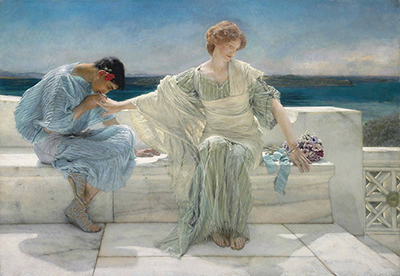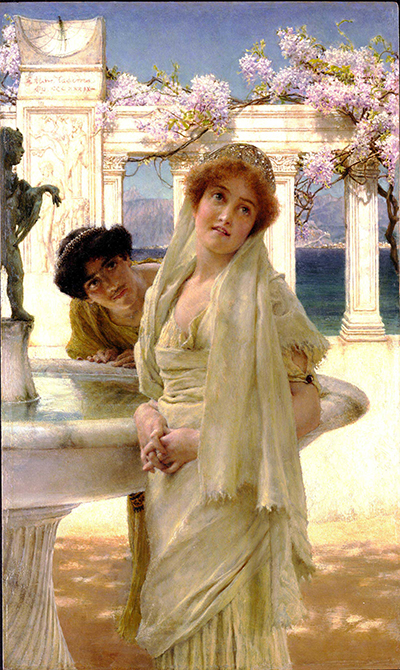
 by Tom Gurney
Tom Gurney BSc (Hons) is an art history expert with over 20 years experience
Email: tomgurney1@gmail.com / Phone: +44 7429 011000
Lawrence Alma-Tadema Biography: Introduction
In a painting he gave Frederic Leighton in 1893, Lawrence Alma-Tadema showed an alcove in his London studio. The title, In My Studio, is unusually direct for an artist whose rooms usually belonged to ancient Rome. Leighton sent a painting in return, and it was fitted into a wall at Alma-Tadema’s house. Works of art could move between friends, become part of a room and change how people used and looked at that room. Alma-Tadema had been thinking about such exchanges since his days as a young painter in Belgium. His most celebrated pictures ask viewers to imagine how the same things might have happened in antiquity. [1] [2]
The artist who became Sir Lawrence Alma-Tadema was born Lourens Alma Tadema in Friesland in 1836. He spent his apprenticeship in Antwerp, made his early name in Belgium and established himself in London after 1870. His reputation depended on knowledge accumulated in all three places and in the galleries, libraries and archaeological sites he visited. At home he worked alongside other artists. His second wife, Laura, and his younger daughter, Anna, exhibited their own pictures, while his elder daughter, Laurence, made a career in literature. The two London houses they furnished and worked in became a setting for these overlapping careers. [2] [3] [4]
At a Glance
- BornDronryp, Friesland, in 1836 [3][4]
- TrainingAntwerp, followed by work with Louis De Taeye and Henri Leys [5][6]
- LondonMoved to London in 1870. His family worked at Townshend House and later at Grove End Road. [2][4]
Lawrence Alma-Tadema in context
Victorian painting
1837–1901 [5]Aestheticism in late Victorian Britain
c.1860–1900 [8]Jean-Léon Gérôme
1824–1904 [9]Frederic Leighton
1830–1896 [8]Lawrence Alma-Tadema
1836–1912 [7]James Tissot
1836–1902 [10]Laura Theresa Alma-Tadema
1852–1909 [11]Contents
- Friesland and the Antwerp workshops
- Italy, Brussels and the British market
- London, Laura and the Royal Academy
- The Grosvenor exhibition and the Marquand commission
- Grove End Road and three artistic careers
- The stage, the late commissions and his final years
- What survived the studio-houses
Friesland and the Antwerp workshops
Alma-Tadema was born in Dronrijp, also written Dronryp, and the family moved nearby to Leeuwarden in 1838. A self-portrait from 1858, dedicated to his cousin Tammera Tadema, survives among the drawings and family material Gerben Dykstra gave to Tresoar in 2016. It had stayed with Tammera’s son, the printer Ferdinand Koksma. The adult painter’s likeness would later circulate in photographs by London portraitists such as Alexander Bassano. The drawing survived through his family. [3] [22] [23]
At sixteen he began studying at Antwerp’s Academy of Fine Arts. Outside the academy, two painters helped shape his sense of what a history picture could be. Louis De Taeye encouraged him to look closely at the physical evidence of earlier ages. Henri Leys, in whose workshop Alma-Tadema refined his practice, had made a career out of giving historical scenes the specificity of a room where people had actually lived. Armour, furniture and paintwork told the viewer who belonged there. The example matters for Alma-Tadema’s later work. An object in a picture could carry some of the story before a figure moved or spoke. Though Leeuwarden recorded his formal departure in 1859, his Antwerp education had begun years earlier. Through Leys he also saw what could happen when the rooms in which a history painter worked became an experiment in historical decoration. [2] [3] [5] [6] [24]
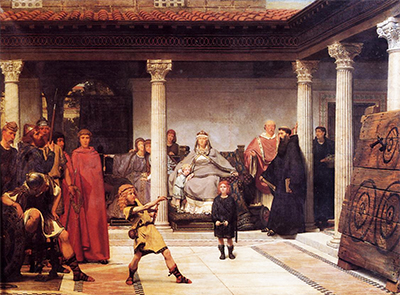
In The Education of the Children of Clovis, signed and exhibited at Antwerp in 1861, Alma-Tadema took his subject from the early medieval Frankish world. Boys practise throwing axes in view of their mother. The act turns education into preparation for vengeance. In Venantius Fortunatus, which earned him a gold medal in Amsterdam in 1862, he showed the poet reading to the former queen Radegund and the abbess Agnes at a monastery in Poitiers. Speech and listening give that scene its shape. Side by side, these early pictures show how much range Alma-Tadema found in a period that Victorian audiences seldom associated with private life. He could use the same attention to dress, setting and gesture to make a lesson ominous or a reading intimate. [12] [25]
He continued to paint Merovingian subjects as his interest in antiquity grew. In the Fries Museum’s 1864 Queen Fredegonda at the Death-Bed of Bishop Praetextatus, the queen sits beside the wounded man and handles the end of her braid. The stillness makes a confrontation out of a quiet moment. The Fries Museum records that its painting was well received at the Brussels Winter Salon. The Pushkin Museum holds a separate version and traces the episode to Gregory of Tours and the nineteenth-century historian Augustin Thierry. Alma-Tadema was still thinking about the oils he had used in a Fredegonda painting when he wrote about his early work in 1902. [26] [27] [28]
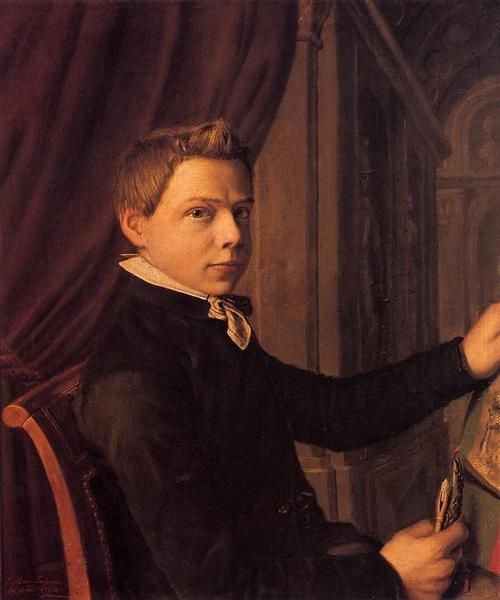
Self-Portrait, 1852. Fries Museum, S1957-848. Image source. Public domain.
Four stages of Lawrence Alma-Tadema’s career
These periods group related developments; painting, travel and local work overlap across their boundaries.
Training in history painting
Training at Antwerp’s academy and in the studios of Louis De Taeye and Henri Leys shaped his approach to historical subjects.[7]
From Frankish history to ancient daily life
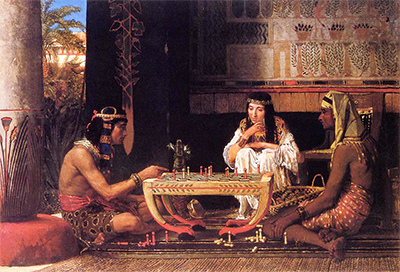
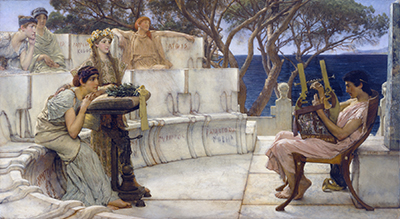
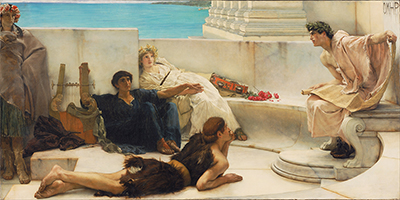
An early Frankish subject brought public attention. Pictures of Egyptian and Roman life followed as he travelled to Italy and began working for Gambart.[12] [7] [29]
Italy, Brussels and the British market
In 1863 he married Marie Pauline Gressin Dumoulin de Boissard. Their Italian honeymoon brought him to Pompeii, where the arrangement and decoration of Roman houses suggested something larger than a repertory of ornaments. A doorway could show how one room led into another, a wall painting could establish the colour of an enclosed space and a household object could suggest an action to build a picture around. After the couple moved to Brussels in 1865, they painted the studio walls a Pompeian red. Alma-Tadema’s portrait of Pauline there, with her mother and their young daughter Laurence, preserves a glimpse of what they made of the room. Pauline was expecting Anna when she sat for it. [2] [3]
His interest in the ancient world also took him beyond Greece and Rome. In Brussels he painted an oil of Egyptian players at a board game in 1865 and returned to the subject in a watercolour shown in the city in 1868. The oil and watercolour have separate opus numbers, XXII and LXXIII. That distinction illuminates his habits as an artist. He could carry an arrangement of figures and objects from one medium into another and still treat the result as a work in its own right. He also drew an Egyptian game in 1865, a related work on paper later given to the Dutch writer and critic Carel Vosmaer. The subject reached the public through several objects, each with its own history. [28] [29]
The dealer Ernest Gambart gave Alma-Tadema a route into the British market while he was still working on the Continent. Gambart arranged London exposure and offered him a contract for twenty-four paintings, followed by a second commission. [31] By 1869 The Pyrrhic Dance had reached the Royal Academy. Its armoured performers and attentive audience show how far the painter’s range had widened since Clovis. Both subjects involve weapons, but the Greek dancers display their skill for spectators. The scene also engaged Vosmaer, whose account dwelt on the armour and the different ages of the men watching. By then a single painting could belong to a London exhibition and a continuing discussion in Dutch about how to represent antiquity. [6] [28] [32]
Pauline died in 1869. The following year, during the Franco-Prussian War, Alma-Tadema moved to London with Laurence and Anna. He had dealings and friendships there already, and the move gave him sustained access to collectors and exhibition rooms where his pictures had begun to sell. He was known professionally in Britain as Lawrence Alma-Tadema. In the London friendships he formed, including that with Ford Madox Brown, his interests overlapped with those of painters whose interest in colour and meticulous observation took them in other directions. Frederic Leighton’s work offered a particularly close point of comparison in its attention to the classical past. [4] [5] [6] [32]
London, Laura and the Royal Academy
In the summer of 1871 Alma-Tadema married the artist Laura Theresa Epps. They made their home at Townshend House, near the north gate of Regent’s Park. Drawing on the example of the Brussels studio, they applied the idea to an entire house. The rooms varied in character and period. Laura took an active part in designing and decorating them, and both painters worked there. Vosmaer’s account of the house after a gunpowder explosion on the Regent’s Canal describes just how detailed the decoration had been. The blast brought down much of the studio ceiling. Alma-Tadema later recalled trying a white studio in Rome during the winter of 1875–76 while the London house was uninhabitable. The light and colour of a workroom mattered from the painter’s side of the easel as well as in the finished pictures. [2] [28]
He received letters of denization from Queen Victoria in 1873. Denization was an older means of acquiring British nationality through a grant from the Crown, with legal consequences distinct from naturalisation. The Home Office’s historical account identifies Alma-Tadema as the last person to obtain British nationality by this means and connects the grant to the membership rules of the Royal Academy. His association with the Academy had already begun through exhibiting. The election records place his election as an Associate in 1876 and as a full Royal Academician in 1879. He went on to sit on the council and serve as a visiting teacher in the Life School and the School of Painting. Those duties made him part of the institution’s daily life as well as one of the names visitors looked for at its exhibitions. [32] [33] [34]
His rise in Britain ran alongside an international exhibition career. The Sculpture Gallery was shown at the Paris Salon in 1874 and at the Royal Academy in 1875. Its subject, visitors inspecting statues in a handsome Roman interior, offered a version of the activity in which the picture’s modern audience was itself engaged. William Wetmore Story, reporting as an American commissioner on the 1878 Paris Universal Exposition, thought Alma-Tadema’s subjects and manner so continental that he questioned calling him an English artist, even though the paintings hung in the British section. He also recognised the painter’s command of ancient clothing, sculpture and furnishings. The French museum record notes the first-class medal Alma-Tadema received at that exposition. By the end of the decade he could belong to the Royal Academy and remain foreign in a critic’s eyes, with both judgements arising from the same body of work. [35] [36] [37]
The means of making those pictures were thoroughly modern. While working in Brussels, he had the photographer Joseph Dupont take photographs of paintings nearing completion so that he could judge their tone and arrangement afresh. His own study collection included photographs of monuments, sculptures and architectural fragments as well as clouds, hairstyles and flowers. The photographs preserved at the University of Birmingham let a reader see both the scale of the collection and the kinds of questions he could answer at home. A view of a monument established its setting, while a print of a capital or carved figure let him study a detail in isolation. Books, photographs and physical objects served different purposes. He kept a replica Egyptian stool made after an example in the British Museum. A cast or copy could be turned in the light and studied from an angle that a photograph did not show. [38] In 1902 he also told J. Six about changes to his paint medium. He remembered turning to an oil-and-copal preparation after consulting Jean-Léon Gérôme in Paris in 1865 and discussed cracking in earlier work. The letter tells us how he understood the problem late in life. Examination of a particular painting would still be needed to establish what was used on it. [28] [39]
Watch films about the studio-houses
Explore the studio-houses, the retrospective and the artist’s wider classical context.
Alma-Tadema: At Home in Antiquity at Leighton House Museum (7 July - 29 October 2017)
A short introduction to the Leighton House retrospective.
Watch on YouTubeThe Grosvenor exhibition and the Marquand commission
In 1881 he exhibited the painting then called Sappho, now Sappho and Alcaeus. Sappho and her companions incline towards the musician, absorbed in his performance. The shape of their seats comes from the Theatre of Dionysus in Athens, but Alma-Tadema changed the carved names to suit his imagined audience on Lesbos. That was a characteristic freedom. Recognisable antiquities could be moved when a subject gave them a new purpose. Writing to T. H. Thomas in 1882 about his Cardiff companion pictures, he distinguished the imaginative activity he associated with poetry and music from the study he associated with prose. The letter concerns those two pictures, but it helps explain why he kept returning to reading and listening as subjects. [14] [40] [41]
The Grosvenor Gallery showed the breadth of his output in the winter of 1882–83. Heijbroek records 130 works entered, and Vosmaer came to London to see them. By then the two men had travelled together in Italy, and Vosmaer had drawn on Alma-Tadema in creating the painter Aisma in his novel Amazone. Alma-Tadema, in turn, could ask Vosmaer to help find a passage in a classical author or consult the writer’s collection of reproductions. Their exchanges help explain why the painter’s move to London left his Dutch connections active. The exhibition sent Vosmaer back to his Dutch readers with an account of the works and of a house that had grown around the same interests. [28]
An ambitious American commission followed. Henry Gurdon Marquand engaged Alma-Tadema to design furniture for his New York music room and commissioned a painting. In March 1884 the painter asked whether the picture would hang there, since that would govern the design of its frame. Correspondence published by the Metropolitan Museum shows him struggling with the first composition, putting it aside and beginning again. The completed A Reading from Homer of 1885 centres on the relation between a reciter and his listeners. It is easy to see why the composition mattered to a room built for performance. The painting arranges a small audience so that its different postures make the poet’s voice seem to travel across the terrace silently. [30] [15]
The settee made to his design by Johnstone Norman & Co. still shows what he expected a real room to do. Contrasting woods and small inlays articulate its frame, while the upholstery seen on the Met’s example is a modern attempt to evoke the original embroidery. The painting and the furniture solved related problems at different scales. One organised bodies and surfaces inside a frame. The other gave real listeners a place to sit in a room whose other artists, craftspeople and furnishings contributed to its effect. [30] [42]
For viewers far from a wealthy collector’s house, prints could carry something of the same experience. An etching published in 1880 by Leopold Löwenstam after Alma-Tadema’s drawing of a Roman garden took an image already in William Henry Vanderbilt’s collection into a different market. The painter’s drawing places figures of several ages around a curved bench derived from a Pompeian tomb. Even without the original’s graphite handling, the viewer can follow the spacing of the figures, their movement along the terrace and the relation of the place to the story. Back in Leeuwarden, the local press continued to follow Alma-Tadema. A Reading from Homer even became a tableau vivant there, with performers putting the painting’s arrangement back into three dimensions. [24] [43]
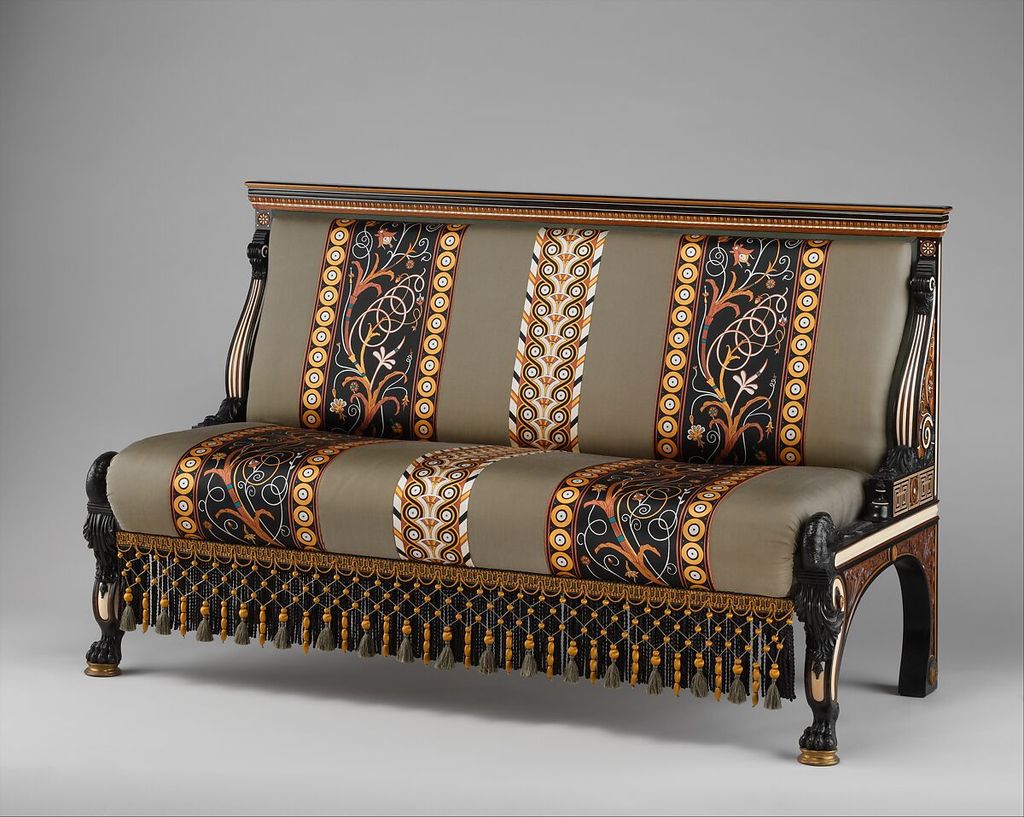
Designed by Alma-Tadema for Marquand’s music room and made by Johnstone Norman & Co., c. 1885. Modern upholstery. Metropolitan Museum of Art. Image source. CC0 / Public domain.
Grove End Road and three artistic careers
The marriage and studio arrangement that took shape at Townshend House continued at Grove End Road in St John’s Wood. Their new house, known as Casa Tadema, was in use by 1889, when The Architect pictured both Laura’s and Lawrence’s studios. His room rose through two storeys, with an alcove and a gleaming metal semi-dome. Laura had a working room of her own. As at Townshend House, ancient, Dutch and Asian objects and styles could meet in the same domestic setting. The result changed from room to room. A visitor walking between them experienced how lighting and scale altered the effect of a painting or a piece of furniture. [2]
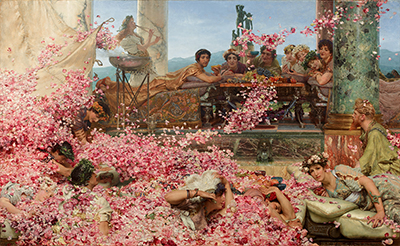
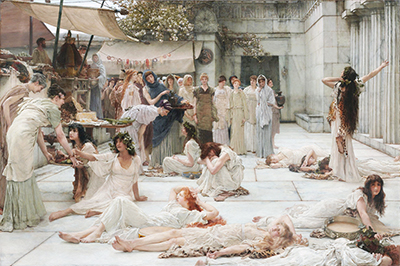
The move came during a run of prominent exhibition pictures. At the Academy in 1887, The Women of Amphissa presented women bringing food and protection to exhausted strangers. The Roses of Heliogabalus, shown the next year, made flowers instruments of cruelty. The inversion is striking. Both scenes require attention to the relative positions of people, yet care circulates in the first and power in the second. By then Alma-Tadema could place two quite different accounts of social behaviour before much the same exhibition public. The roses also show the imaginative distance he could travel from an ancient text. The account in the Historia Augusta describes flowers without specifying this mass of pink roses. [44] [45]
Laura Theresa Alma-Tadema had a career distinct from that of her husband. Their unfinished six-panel Epps Family Screen, made around the time of their marriage, is a work they painted together. Their companion self-portraits of 1871, each painted by the artist it shows, make a different kind of record of that partnership. Her interest in seventeenth-century Dutch domestic painting comes through in pictures of women and children occupied with ordinary household tasks. The small graphite study Young Girl Dressing, around 1889, follows the raised arms of a figure intent on arranging her hair. The movement is momentary, the materials simple and the space around the figure almost blank. Her selection of that absorbed gesture points towards a quieter use of domestic life than the painted gatherings for which her husband was famous. The Fine Art Society included the sheet in its memorial exhibition for Laura in 1910, the year after she died. [2] [46] [47]
Anna Alma-Tadema’s watercolours preserve a record of the interiors she knew and show her skill at making a room intelligible from a carefully chosen position. In her 1884 view of her father’s study, handheld objects, textiles, furniture and books occupy distinct places in an already crowded room. The following year’s Drawing Room, Townshend House looks along a vista of adjoining spaces. It makes the viewer negotiate the edges of furnishings and follow changes of light. One picture shows the equipment of a working study. The other asks how people might move through a room where the family received visitors. Anna also painted subjects beyond the family rooms. At the Royal Academy in 1900 she exhibited The Idler’s Harvest, a small oil on panel. The watercolours and the exhibited oil belong to an artist with her own eye and public career. [2] [48] [49]
Laurence Alma-Tadema pursued literature. Her novel The Wings of Icarus appeared in 1894 and her collection Realms of Unknown Kings in 1897. She also wrote poetry, drama and pieces for periodicals. Her interest in Poland developed into substantial work translating and explaining Polish culture for a British audience, especially around the First World War. Decades after the London studio-houses had been dismantled or altered, her transfer of family objects to the Fries Museum in 1935 gave curators in Leeuwarden material with which to reconstruct the household’s work. The gift included replicas of ancient silverware after the Hildesheim Treasure, among them a bowl with the infant Hercules strangling serpents that Lawrence kept in his studio. [38] It was an act of collection and transmission with consequences of its own, distinct from her father’s reputation and from her literary career. [2] [50] [51]
The walls of Grove End Road held a record of artistic friendships. In 1893 Lawrence gave In My Studio to Leighton, who installed it in his Silk Room. Alma-Tadema received a small version of Leighton’s Bath of Psyche in return, which joined the tall, narrow pictures by friends set into the Hall of Panels. The exchange tied one working interior to another. It also shows that these rooms were made over time. What a visitor saw depended partly on who had contributed a panel and what space was made for it. Some of those panels entered Calouste Gulbenkian’s collection in 1913, when the contents of the house were dispersed. [1] [2] [52]
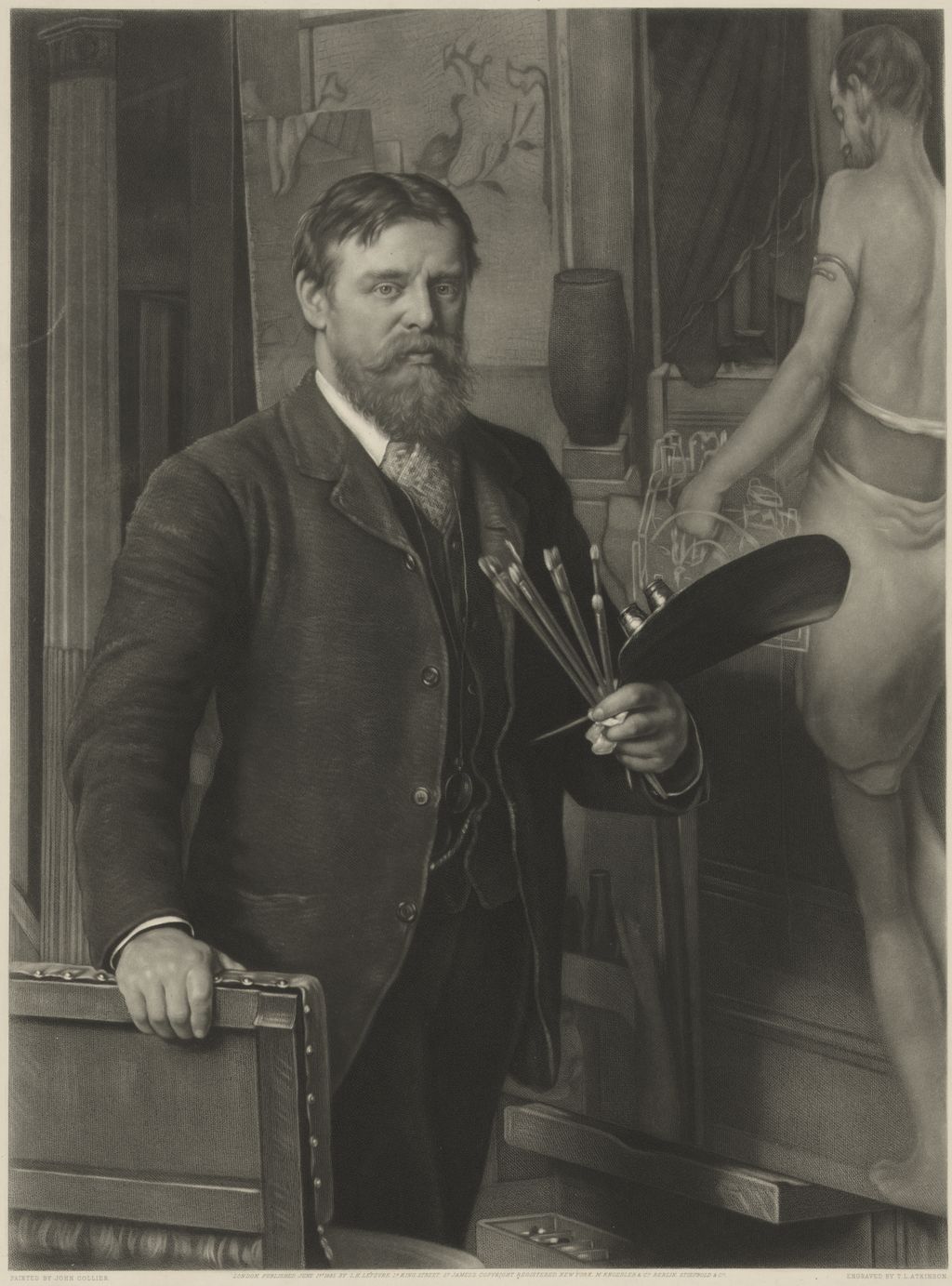
Lawrence Alma-Tadema in his studio. Detail from a Library of Congress print, LCCN 2003679912. Image source. Public domain.
The stage, the late commissions and his final years
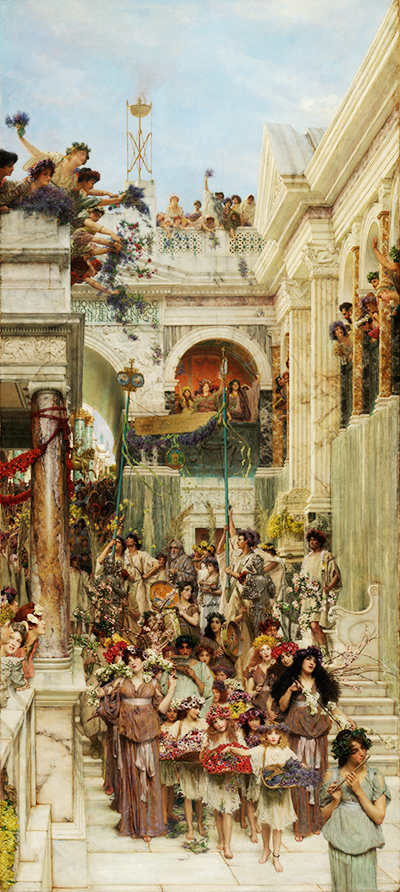
The procession in Spring, dated 1894 and shown at the Royal Academy in 1895, unfolds across an elaborate cityscape. Flowers, bodies and architecture send the eye along several paths at once. The Getty’s account connects the subject to the British custom of gathering flowers for May Day. The painting brings that point of familiarity into an imagined ancient festival. Like the studio-houses, the picture lets people from Alma-Tadema’s own time place themselves in an environment that draws its character from many historical sources. [18]
His knowledge of setting and costume was also put to work in the theatre. Bram Stoker, who worked with the actor-manager Henry Irving, recounts Alma-Tadema advising on Irving’s Cymbeline in 1896. The surviving programme material for Irving’s Coriolanus in 1901 records Alma-Tadema in the production’s design credits. The 1927 Dictionary of National Biography also associates him with Herbert Beerbohm Tree’s Julius Caesar and Hypatia. For a designer on the stage, the arrangement of space had to work for bodies in motion and for an audience looking from several angles. This put to a practical test the sort of perspective and gesture that had occupied him for decades on canvas. [32] [53] [54]
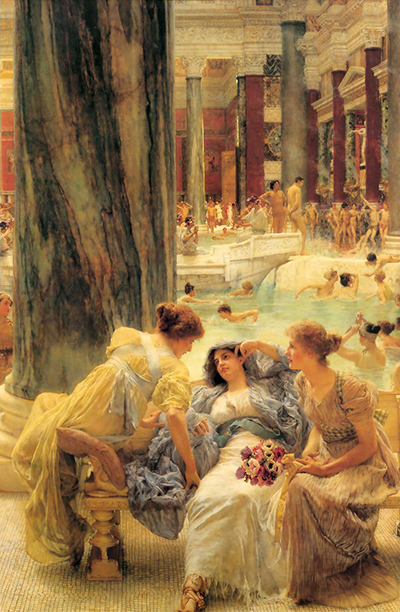
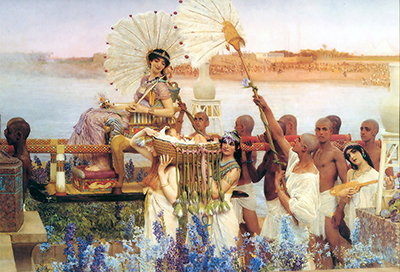
Queen Victoria knighted him in 1899, the year The Baths of Caracalla was dated and when The Strand Magazine published an illustrated studio interview. In 1902 he travelled with Sir John Aird’s party to Egypt for the opening of the Aswan Low Dam. Aird’s commission, The Finding of Moses, was completed in 1904 and exhibited at the Royal Academy in 1905. In it the pharaoh’s daughter is carried along the Nile bank while attendants present the child. The infant is small enough to miss on a first look. The outstretched arms of the attendants and the tilt of the princess’s head guide the eye towards the child amid the many figures. The visit to Egypt came nearly four decades after the first of his pictures of the Egyptian board game. A place he had first approached through photographs, books and objects was now one he could see in person, in the company of the patron who commissioned the picture. [5] [55] [56] [20] [57]
In June 1905 the London Gazette announced his appointment to the Order of Merit. His late work still moved between large narratives and closely judged small scenes. The paired panels When Flowers Return and Summer Offering belong to 1911 and bear successive opus numbers. Dancers swing garlands of daffodils in the first, while bearers carry roses towards a temple in the second. These are small pictures that distinguish two communal rites by how people carry their flowers. [55] [58] The National Portrait Gallery records a painting with opus number 408 completed about two months before his death. The habit of numbering substantial works, already apparent in the Egyptian game pictures of the 1860s, thus followed him into his final months. Alma-Tadema died at Wiesbaden in 1912 and was buried in St Paul’s Cathedral in London. [4] [59] [60]
What survived the studio-houses
The Royal Academy mounted a memorial exhibition in 1913. In the same year, much of the contents of Grove End Road was sold to provide an income for his daughters. Anna inherited the contents of Laura’s studio. Reviewing the exhibition, Roger Fry turned the very qualities that had attracted Victorian viewers into an argument against the painter. The minute attention given to furniture and the polished finish struck him as an appeal to consumer tastes. [38] [61] For much of the following century viewers encountered the pictures apart from the rooms, photographs, books and working relationships that had helped produce them. Some compositions nevertheless found a new audience in the cinema. Ivo Blom has documented the use of Alma-Tadema’s paintings in research on the sets and staging of Enrico Guazzoni’s Quo vadis? of 1913, where the painter’s placement of figures at several depths had consequences for the way spectators looked into a set. Reproductions made the paintings available beyond the collections that owned them. A painting once seen from the front at an exhibition could thus furnish a director with places to put actors, entrances and objects at different distances from the camera. [2] [4] [62]
In 1973 the Metropolitan Museum’s Victorians in Togas gave the paintings a substantial American exhibition. In 2014 the Thyssen-Bornemisza in Madrid showed works from the Pérez Simón collection in the context of Victorian painting. [63] A different emphasis emerged in the 2016–17 project at the Fries Museum, the Belvedere and Leighton House, which returned particular attention to the domestic and professional lives from which those paintings grew. Its separate settings brought different parts of the story forward. Leeuwarden held the objects Laurence had passed on, while Leighton House offered a surviving example of the kind of working interior both friends had built and used. At the start of his career Alma-Tadema had learned to read the history of a room from the things in it. Recovering the history of his own rooms has allowed viewers to see anew how he and the people around him made their art. [2] [64] [65] [66]
Lawrence Alma-Tadema artworks directory
Search by title or medium. The directory includes Alma-Tadema’s numbered compositions, separately catalogued fragments, and selected drawings and historic prints. Dates for unlinked works follow the catalogue’s year groupings. View the numbered opus catalogue
| Name | Date | Medium |
|---|---|---|
| Portrait of my sister Artje | 1851 | Painting |
| Selfportrait | 1852 | Painting |
| Portrait of my mother (oval) | 1852 | Painting |
| The alm | 1856 | Painting |
| The inundation of the Biesbosch in 1421 | 1857 | Painting |
| The destruction of Terdoest Abbey in 1571 | 1857 | Painting |
| Faust en Marguerite | 1857 | Watercolour |
| Clotilde at the tomb of her grandchildren | 1858 | Painting |
| Marius on the ruins of Carthage | 1858 | Watercolour |
| The sad father: the unfavourable oracle (Death of the first-born, first version) | 1859 | Painting |
| The death of Attila, 453 AD | 1859 | Watercolour |
| Triumphal return of Sir Willem van Saeftingen | 1860 | Painting |
| The death of Hippolyte | 1860 | Watercolour |
| The Education of the Children of Clovis | 1861 | Painting |
| Venantius Fortunatus reading his poems to Radagonda VI | 1862 | Painting |
| Gunthram Bose and his daughters, 572 AD: the Ambuscade | 1862 | Painting |
| A medieval Flemish interior | 1863 | Painting |
| Pastimes in Ancient Egypt: 3.000 years ago | 1863 | Painting |
| Interior of the Church San Clemente, Rome: a study | 1863 | Painting |
| Queen Fredegonda at the deathbed of Bishop Praetextatus (first version) | 1864 | Painting |
| Leaving Church in the fifteenth century | 1864 | Painting |
| Egyptian Chess Players (An Egyptian Game) | 1865 | Painting |
| Birthday presents in the sixteenth century | 1865 | Painting |
| Gallo-Roman women | 1865 | Painting |
| Entering Church in the fourteenth century | 1865 | Painting |
| An Egyptian at his doorway in Memphis | 1865 | Painting |
| Catallus ten huize van Lesbia | 1865 | Painting |
| The discourse | 1865 | Painting |
| A Roman scribe writing despatches | 1865 | Painting |
| A soldier of Marathon | 1865 | Painting |
| Home from market | 1865 | Painting |
| Death of Galeswinthe | 1865 | Painting |
| An Egyptian Game (preparatory drawing) | 1865 | Drawing |
| Making wreaths for festivities in a Pompeian house | 1866 | Painting |
| Vespasian hearing of the taking of Jerusalem by Titus | 1866 | Painting |
| Entrance to a Roman theatre | 1866 | Painting |
| In the peristyle | 1866 | Painting |
| Agrippina visiting the ashes of Germanicus | 1866 | Painting |
| Tibullus at Delia's | 1866 | Painting |
| A Roman dance | 1866 | Painting |
| Lesbia weeping over a sparrow | 1866 | Painting |
| The armourer's shop in ancient Rome | 1866 | Painting |
| The Education of the Children of Clovis (Rennefeld print after Alma-Tadema) | 1866 | |
| The mummy: Roman period: Egyptians lamenting their dead | 1867 | Painting |
| The honeymoon | 1867 | Painting |
| Cuckoo | 1867 | Painting |
| The aesthetic view: Madame Dumoulin, Pauline, and Laurence | 1867 | Painting |
| Glaucus and Nydia | 1867 | Painting |
| Portrait of Mr A. Bonnefoy | 1867 | Painting |
| Proclaiming Claudius Emperor | 1867 | Painting |
| A sculpture gallery in Rome at the time of Augustus | 1867 | Painting |
| A collector of pictures at the time of Augustus | 1867 | Painting |
| Tarquinius Superbus before Galba | 1867 | Painting |
| A Roman family | 1867 | Painting |
| Italian women | 1867 | Painting |
| Portrait of Madame Bonnefoy and Mr Puttemans | 1867 | Painting |
| The siësta (first version) | 1868 | Drawing |
| The embarkation | 1868 | Painting |
| The siësta (second version) | 1868 | Painting |
| A Roman art lover | 1868 | Painting |
| Woman and flowers | 1868 | Painting |
| Phidias and the Parthenon, Athens | 1868 | Painting |
| The flower girl | 1868 | Painting |
| A Roman flower market: Pompeii | 1868 | Painting |
| Egyptian game | 1868 | Watercolour |
| Education of the children of Clovis | 1868 | Painting |
| A Roman art lover: silver statue | 1868 | Painting |
| Egyptian dancing girls | 1868 | Watercolour |
| Catalina | 1869 | Painting |
| The visit: Sunday morning before churching (first version): a birth chamber, seventeenth century | 1869 | Painting |
| The Pyrrhic dance | 1869 | Painting |
| The Grand Chamberlain of Sesostris the Great | 1869 | Painting |
| The convalescent | 1869 | Painting |
| Confidences | 1869 | Painting |
| A Greek Woman | 1869 | Painting |
| At the wine shop | 1869 | Painting |
| An Exedra (first version) | 1869 | Painting |
| Portrait of Master Ernest Angely | 1870 | Painting |
| A juggler | 1870 | Painting |
| A nurse, seventeenth century: Sunday morning (second version) | 1870 | Watercolour |
| Roman art lover (the runner ) | 1870 | Painting |
| Anacreon reading his poems at Lesbia's house | 1870 | Painting |
| The vintage festival (first version) | 1870 | Painting |
| The first whisper of love | 1870 | Painting |
| The letter: from an absent one (first version) | 1870 | Painting |
| A staircase (first version) | 1870 | Painting |
| Hush, she sleeps | 1870 | Painting |
| The letter: from an absent one (second version) | 1871 | Watercolour |
| The vintage festival (second version) | 1871 | Painting |
| A Roman Emperor (second version) | 1871 | Painting |
| In the temple (first version) | 1871 | Painting |
| Portrait of Miss Laura Theresa Epps | 1871 | Painting |
| A Bacchic dance | 1871 | Painting |
| Fredegonda and Praetextatus (second version) | 1871 | Painting |
| Portrait study for Mrs H.W. Mesdag | 1871 | Painting |
| Greek potters | 1871 | Painting |
| An exedra (second version) | 1871 | Watercolour |
| Sunday morning: the two sisters (third version) | 1871 | Painting |
| In the temple (second version) | 1872 | Watercolour |
| The first reproach | 1872 | Painting |
| An Egyptian widow | 1872 | Painting |
| Improvisatore | 1872 | Painting |
| A halt (first version) | 1872 | Painting |
| The last roses | 1872 | Painting |
| Death of the first-born (second version) | 1872 | Painting |
| Portrait of Dr Franz and Mrs Catherine Hueffer 'When I am dead, oh dearest sing' | 1872 | Painting |
| The nurse | 1872 | Painting |
| Greek wine (first version) | 1872 | Painting |
| Goldfish (first version) | 1872 | Painting |
| On a Roman staircase (second version) | 1872 | Watercolour |
| Hercules | 1872 | Painting |
| Portrait of Miss Kate Thompson | 1873 | Painting |
| The dinner (first version) | 1873 | Painting |
| The siësta (third version) | 1873 | Painting |
| A visit to the studio (second version) | 1873 | Watercolour |
| Cherries | 1873 | Painting |
| Greek wine (second version) | 1873 | Watercolour |
| This is our corner | 1873 | Painting |
| A picture gallery (third version) | 1873 | Painting |
| The last roses (second version) | 1873 | Watercolour |
| Fishing (first version) | 1873 | Painting |
| Music has charms | 1873 | Watercolour |
| Counting the passers-by | 1873 | Watercolour |
| Portrait of Mrs Frederick George Stephens | 1873 | Painting |
| Two heads from 'The Picture Gallery': A visit to the studio by Charles W. Deschamps and his wife (first version) | 1874 | Watercolour |
| Joseph, overseer of Pharaoh's granaries | 1874 | Painting |
| A sculpturegallery (first version) | 1874 | Painting |
| A picture gallery in Rome at the time of Augustus (fourth version) | 1874 | Painting |
| Portrait of Charles W. Deschamps and his wife (second version) | 1874 | Painting |
| Autumn | 1874 | Watercolour |
| Reflections: fishing (second version) | 1874 | Painting |
| A Roman artist | 1874 | Watercolour |
| Good friends | 1874 | Watercolour |
| On the steps of the Capitol (first version) | 1874 | Painting |
| Water pets: goldfish (second version) | 1874 | Painting |
| Münster Cathedral | 1874 | Painting |
| Landscape near Münster | 1874 | Painting |
| Antistius Labeon, 75 AD: A Roman amateur artist | 1874 | Painting |
| Sunny days | 1874 | Painting |
| Spring flowers: garland seller on the steps of the Capitol (second version) | 1874 | Watercolour |
| Through an archway | 1874 | Painting |
| (A, B) Decoration for my piano: 'Serious and merry music' | 1874 | Painting |
| Rêverie | 1874 | Painting |
| The Roman architect | 1874 | Painting |
| Sunflowers | 1874 | Painting |
| Landscape: carriage drive by the outskirts of a wood, Penhill Castle | 1875 | Painting |
| A peep through the trees | 1875 | Painting |
| Cleopatra (first version) | 1875 | Painting |
| (a, b, c) The tragedy of an honest wife | 1875 | Watercolour |
| The architect of the Coliseum | 1875 | Watercolour |
| Fishing | 1875 | Watercolour |
| Cherry blossom | 1875 | Painting |
| Water pets: goldfish (third version) | 1875 | Painting |
| 'There he is!' | 1875 | Painting |
| Play Garden | 1875 | Painting |
| Portrait of Miss Thackeray's 'Elisabeth' | 1875 | Painting |
| A nymphaeum from the Villa Aldobrandini in Rome | 1875 | Painting |
| Haystacks | 1875 | Painting |
| A sculpture gallery (second version) | 1875 | Painting |
| After the dance: a bacchanal | 1875 | Painting |
| Landscape: a breezy day in August near Innsbruck | 1875 | Painting |
| The service | 1875 | Painting |
| An audience at Agrippa's (first version) | 1875 | Painting |
| Kriemhild’s Tryste | 1875 | |
| Portrait of my wife | 1876 | Painting |
| Between hope and fear | 1876 | Painting |
| 94 Degrees in the Shade | 1876 | Painting |
| An antique custom | 1876 | Painting |
| Portrait of Jules Dalou, his wife and his daughter | 1876 | Painting |
| Pleading (first version) | 1876 | Painting |
| Hide and seek | 1876 | Painting |
| Balneatrix | 1876 | Watercolour |
| A mirror | 1877 | Painting |
| An interesting scroll | 1877 | Watercolour |
| Winter | 1877 | Painting |
| Autumn-vintage festival | 1877 | Painting |
| Summer | 1877 | Painting |
| Spring in the gardens of the Villa Borghese (first version) | 1877 | Painting |
| A balneator | 1877 | Watercolour |
| Painting in Ancient Rome | 1877 | Painting |
| A balneatrix | 1877 | Painting |
| The sculptor's model (Venus Esquilina) | 1877 | Painting |
| The sculptor's studio in ancient Rome | 1877 | Painting |
| Architecture in ancient Rome | 1877 | Painting |
| Cleopatra (second version) | 1877 | Painting |
| Spring in the gardens of the Villa Borghese (second version) | 1877 | Painting |
| Panel for H. W. Mesdag's studio door: Spring in the gardens of the Villa Borghese (third version) | 1877 | Painting |
| The question: Pleading (second version) | 1877 | Painting |
| A kitchen garden | 1877 | Painting |
| Flora: Spring in the gardens of the Villa Borghese (fourth version) | 1877 | Watercolour |
| A silent counsellor | 1878 | Watercolour |
| A sollicitation | 1878 | Watercolour |
| A hearty welcome | 1878 | Painting |
| A landscape | 1878 | Painting |
| In the time of Constantine | 1878 | Painting |
| A love missile | 1878 | Painting |
| Fredegonda en Galswintha, 566 AD | 1878 | Painting |
| A safe confidant | 1878 | Painting |
| After the audience (second version) | 1879 | Painting |
| Strigils andsponges | 1879 | Watercolour |
| E festival in Pomona | 1879 | Painting |
| Prose | 1879 | Painting |
| Going down to the river | 1879 | Painting |
| The Roman wine tasters | 1879 | Watercolour |
| Portrait of th singer George Henschel Esq. at the piano | 1879 | Painting |
| Poetry | 1879 | Painting |
| A well-protected slumber | 1879 | Painting |
| A garden altar | 1879 | Painting |
| Beauties | 1879 | Painting |
| Portrait of Thekla Friedländer | 1879 | Unspecified |
| On the road to the Temple of Ceres: A springfestival | 1879 | Painting |
| Autumn (third version) | 1879 | Drawing |
| 'Not at home' | 1879 | Painting |
| An old bachelor after the bath | 1879 | Watercolour |
| Spring (Blanchard print after Alma-Tadema’s 1877 painting) | 1879 | |
| The first course: the dinner | 1880 | Painting |
| Interrupted | 1880 | Painting |
| Grapes | 1880 | Watercolour |
| A pastoral | 1880 | Painting |
| A portrait of Dr Felix and Mrs August Redeker Semon | 1880 | Painting |
| Ave Caesar! Io Saturnalia! (third version) | 1880 | Painting |
| A prize for the artist's corps | 1880 | Painting |
| The departure (first version) | 1880 | Painting |
| A harvest festival | 1880 | Painting |
| 'Your carriage stops the way' | 1880 | Painting |
| Autumn (Scene in a Roman Garden) | c.1880 | Drawing |
| The torch dance | 1881 | Painting |
| Sappho and Alcaeus | 1881 | Painting |
| A kiss | 1881 | Watercolour |
| A Bacchante dancing before the thymele | 1881 | Watercolour |
| An audience | 1881 | Painting |
| Portrait of Dr Hans Richter | 1881 | Painting |
| Pandora | 1881 | Watercolour |
| The Tepidarium | 1881 | Painting |
| Quiet pets | 1881 | Painting |
| A priestess of Apollo | 1881 | Watercolour |
| A difficult line from Horace (first version) | 1881 | Painting |
| A stranger in my studio (one of a pair) | 1881 | Painting |
| Amo te ama me | 1881 | Painting |
| The First Course–The Dinner (Löwenstam print after Alma-Tadema) | 1881 | |
| Young affections | 1882 | Painting |
| A difficult line from Horace (second version) | 1882 | Drawing |
| Portrait of John F. Whichcord Esq., PRIBA, FSA | 1882 | Painting |
| Portrait of Ludwig Barnay as Marcus Antonius | 1882 | Painting |
| The way to the temple | 1882 | Painting |
| A parting kiss | 1882 | Painting |
| Reflections | 1882 | Painting |
| Between Venus and Bacchus | 1882 | Watercolour |
| Dolce far niente (first version) | 1882 | Watercolour |
| Dolce far niente (second version) | 1882 | Painting |
| An Oleander | 1882 | Painting |
| The meeting of Antony and Cleopatra | 1883 | Painting |
| Portrait of Catherine, Duchess of Cleveland | 1883 | Painting |
| Portrait of my daughter Anna Alma-Tadema | 1883 | Painting |
| Shy | 1883 | Painting |
| Portrait of His Excellency the Duke of Bylandt | 1883 | Painting |
| Una Carita: The three graces: Laura, Laurence, and Anna | 1883 | Painting |
| Portrait of Leopold Lowenstam, the engraver | 1883 | Painting |
| Portrait of Lady Thompson | 1883 | Painting |
| Portrait of Professor Giovanni Battista Amendola | 1883 | Painting |
| 'Der alte Menander ist doch nicht gestorben!' Paulus and Hermas | 1883 | Drawing |
| A street altar | 1883 | Watercolour |
| Welcome Footsteps (The Well-Known Footsteps) | 1883 | Painting |
| A declaration: an old, old story | 1883 | Watercolour |
| Xanthe and Phaon | 1883 | Watercolour |
| Selfportrait | 1883 | Painting |
| Hadrian in England: visiting a Roman-British Pottery (original, later divided) | 1884 | Painting |
| A Roman-British pottery | 1884 | Painting |
| Emperor Hadrian's visit to a British pottery | 1884 | Painting |
| A Roman-British potter | 1884 | Painting |
| Portrait of Miss Alice Lewis | 1884 | Painting |
| Who is it? | 1884 | Painting |
| Portrait of Moses Ezekiel | 1884 | Painting |
| Portrait of Sir Francis Powell | 1884 | Painting |
| Egyptien à l’entrée de sa demeure (Ramus print after Alma-Tadema) | 1884 | |
| Expectations | 1885 | Painting |
| A Reading from Homer | 1885 | Painting |
| Portrait of Dr Wahington Napoleon Epps: my docter | 1885 | Painting |
| The triumph of Titus: the Flavians | 1885 | Painting |
| Ariadne | 1885 | Painting |
| Portrait of Mrs W. M. Baker | 1885 | Painting |
| Rose of all roses | 1885 | Painting |
| A foregone conclusion | 1885 | Painting |
| A apodyterium | 1886 | Painting |
| Portrait of James Reld Esq. | 1886 | Painting |
| Portrait of Mrs Frank D. Millet | 1886 | Painting |
| A secret | 1887 | Painting |
| The Women of Amphissa | 1887 | Painting |
| A new dress | 1887 | Watercolour |
| 'He loves me, he loves me not' | 1887 | Painting |
| Illuminated letter 'W' for the Royal Academy address to Queen Victoria | 1887 | Watercolour |
| Portia | 1887 | Painting |
| The Roses of Heliogabalus | 1888 | Painting |
| Fair tresses: a sketch | 1888 | Painting |
| Midday slumbers | 1888 | Watercolour |
| Portrait of the honourable Adama van Scheltema | 1888 | Painting |
| Venus and Mars | 1888 | Painting |
| Portrait of Jules de Soria | 1888 | Painting |
| At the shrine of Venus | 1888 | Painting |
| The Favourite Poet | 1888 | Painting |
| The Favourite Poet (Löwenstam print after Alma-Tadema) | c.1888 | |
| Sisters | 1889 | Painting |
| Cloaked in yellow | 1889 | Painting |
| A dedication to Bacchus (first version) | 1889 | Painting |
| A dedication to Bacchus (second version) | 1889 | Painting |
| Portrait of Mrs Ralph Sneyd | 1889 | Painting |
| Portrait of Miss MacWhirter (Mrs Charles Sims) | 1889 | Painting |
| Portrait of young gentleman John Parsons Millet | 1889 | Painting |
| In a rose garden | 1889 | Painting |
| A Silent Greeting | 1889 | Painting |
| Portrait of Sir Ernest A. Waterlow, Esq., RA | 1889 | Painting |
| Eloquent silence | 1890 | Painting |
| The Frigidarium | 1890 | Painting |
| Promise of Spring | 1890 | Painting |
| Portrait of Miss Agnes Marks | 1890 | Painting |
| Rêverie: a sketch | 1890 | Painting |
| Portrait of the Right Hon. Arthur James Balfour | 1891 | Painting |
| An earthly paradise | 1891 | Painting |
| Love's votaries; Love in idleness | 1891 | Painting |
| Portrait of the Honourable Archdean Watkins of Durham, DD | 1891 | Painting |
| Portrait of Alfred Waterhouse Esq. RA | 1891 | Painting |
| Portrait of Ignacy Jan Paderewski | 1891 | Painting |
| The kiss | 1891 | Painting |
| Calling the worshippers | 1892 | Watercolour |
| The poet Gallus dreaming | 1892 | Painting |
| Courtship | 1892 | Painting |
| Comparisons | 1892 | Painting |
| The inner sanctuary | 1892 | Painting |
| Portrait of Dr Joseph Joachim | 1893 | Painting |
| In the corner of my studio | 1893 | Painting |
| Portrait of Mrs Charles Wyllie | 1893 | Painting |
| Unconscious Rivals | 1893 | Painting |
| Godspeed | 1893 | Painting |
| Portrait of Mrs Theyre Smith | 1893 | Painting |
| At the close of a joyful day | 1894 | Painting |
| The benediction | 1894 | Painting |
| Spring | 1894 | Painting |
| Past and present generations | 1894 | Painting |
| God Speed (Löwenstam print after Alma-Tadema) | 1894 | |
| Love's jewelled fetter | 1895 | Painting |
| Fortune's favourite | 1895 | Painting |
| Portrait of Mrs Roland Hill and her children | 1895 | Painting |
| Portrait of George Simmonds and family | 1895 | Painting |
| Unwelcome confidence | 1895 | Painting |
| A Coign of Vantage | 1895 | Painting |
| Portrait of Mrs Marcus Stone | 1895 | Painting |
| Whispering Noon | 1896 | Painting |
| The Coliseum | 1896 | Painting |
| Familygroup | 1896 | Painting |
| Portrait of Miss Onslow Ford | 1896 | Painting |
| A Difference of Opinion | 1896 | Painting |
| Portrait of Maurice Sons Esq. playing the violin in Alma-Tadema's studio | 1896 | Painting |
| Selfportrait | 1896 | Painting |
| 'Nobody asked you sir!' she said | 1896 | Watercolour |
| Portrait of J. M. Zarifi Esq. | 1897 | Painting |
| Watching and waiting | 1897 | Painting |
| 'Her eyes are with her thoughts, and they are far away' | 1897 | Painting |
| Wandering thoughts | 1897 | Painting |
| Melody on a Mediterranean terrace | 1897 | Painting |
| Roses, love's delight | 1897 | Painting |
| A Difference of Opinion (Boulard print after Alma-Tadema) | 1897 | |
| Portrait of Lady Sydney (Margaret) Waterlow | 1898 | Painting |
| The conversion of Paula by St. Jerome | 1898 | Painting |
| Portrait of Tine Son-Maris | 1898 | Painting |
| Hero | 1898 | Painting |
| Portrait of Mrs George Lewis and her daughter Elisabeth | 1899 | Painting |
| The listeners | 1899 | Painting |
| Attracted: watchers | 1899 | Watercolour |
| The Baths of Caracalla (Thermae Antoninianae) | 1899 | Painting |
| Bluebells | 1899 | Painting |
| Study for Thermaie Antoniniane | 1899 | Drawing |
| A flag of truce | 1900 | Painting |
| Goldfish (fourth version) | 1900 | Painting |
| Portrait of Mrs Armour from Princeton | 1900 | Painting |
| Portrait of George Aitchison, PRIBA, RA | 1900 | Painting |
| Vain courtship | 1900 | Painting |
| Under the roof of blue Ionian weather | 1901 | Painting |
| Death of the first born (third version) | 1901 | Drawing |
| A priestess of Hymen | 1901 | Watercolour |
| Fair tresses | 1901 | Painting |
| Impatient | 1901 | Watercolour |
| Portrait of Sir Max Waechter High Sheriff of Sussex | 1901 | Painting |
| The year's at the spring, all's right with the world | 1902 | Painting |
| Caracalla | 1902 | Painting |
| A crown | 1902 | Watercolour |
| Amongst the ruins | 1902 | Painting |
| Silver Favourites | 1903 | Painting |
| A peaceful wooing | 1903 | Painting |
| The ever-new horizon | 1903 | Painting |
| Thalia's homage to Aesculapius | 1904 | Drawing |
| The Finding of Moses | 1904 | Painting |
| A world of their own | 1905 | Painting |
| Ask Me No More | 1906 | Painting |
| Entering the Coliseum (first version) | 1907 | Watercolour |
| Geta and his sister | 1907 | Drawing |
| Caracalla and Geta | 1907 | Painting |
| Orante (oval, one of a pair) | 1907 | Painting |
| Bacchante (oval, one of a pair) | 1907 | Painting |
| Melodie del mare e dell'amore | 1907 | Watercolour |
| Youth | 1907 | Watercolour |
| Portrait of myself for the R. Accademia Romana di San Luca | 1907 | Painting |
| The golden hour | 1907 | Painting |
| At Aphrodite’s Cradle | 1908 | Painting |
| A message of love | 1909 | Painting |
| A Favourite Custom | 1909 | Painting |
| Splashing | 1909 | Drawing |
| Portrait of Mrs Washington Epps | 1909 | Drawing |
| Hopeful | 1909 | Painting |
| Portrait of Dr J. M. W. van der Poorten-Schwartz (Maarten Maartens) | 1909 | Drawing |
| Portrait of Ilona Eibenschutz | 1909 | Painting |
| The voice of spring | 1910 | Painting |
| Principal figure of 'The voice of spring' | 1910 | Drawing |
| A border for the King's letter to the nation | 1910 | Drawing |
| Heading: the Royal Academy address to H.M. King George on his accession to the throne | 1910 | Watercolour |
| Title unknown | 1910 | Unspecified |
| When flowers return (one of a pair) | 1911 | Painting |
| Summer Offering | 1911 | Painting |
| Title unknown | 1911 | Unspecified |
| Entering the Coliseum (second version) | 1911 | Painting |
| Portrait of William Whitaker Thompson Esq. | 1911 | Painting |
| Portrait of myself for the R. Accademia Romana di San Luca | 1912 | Painting |
| Preparations in the Coliseum | 1912 | Painting |
Discussion
Look again at the images and ideas explored in Lawrence Alma-Tadema Biography. These editorial prompts invite your observations.
Reader Insights
What can the artist’s painting of his studio tell us about his work that a portrait might miss?
How do Laura’s and Anna’s works change the way you understand the two studio-houses?
Join the Conversation
Share a detail, comparison or question about Lawrence Alma-Tadema Biography below.
References
- Leighton House, Bringing Home Alma-Tadema’s In My Studio,. View source.
- Elizabeth Prettejohn and Peter Trippi, The Alma-Tademas’ Studio-Houses and Beyond, British Art Studies 9,. View source.
- Rijksmuseum, Lourens Alma Tadema, artist record and collection,. View source.
- National Portrait Gallery, Sir Lawrence Alma-Tadema, Later Victorian Portraits catalogue entry and sitter records,. View source.
- National Gallery, London, Lawrence Alma-Tadema, artist biography,. View source.
- Cadbury Research Library, University of Birmingham, Alma-Tadema Letters and Papers, ATLAdd, biographical and collection notes,. View source.
- Fries Museum, Sir Lawrence Alma-Tadema, artist profile. View source.
- National Portrait Gallery, Frederic Leighton, Baron Leighton, artist biography. View source.
- J. Paul Getty Museum, The Age of Augustus, the Birth of Christ, collection record and biographical dates. View source.
- National Gallery, London, James Tissot. View source.
- National Gallery of Art, Washington, Laura Theresa Alma-Tadema. View source.
- Sotheby’s, The Education of the Children of Clovis, New York, 2011, lot 64,. View source.
- Colección AMALITA, Egyptian Chess Players (An Egyptian Game). View source.
- The Walters Art Museum, Sappho and Alcaeus, 1881, accession 37.159,. View source.
- Philadelphia Museum of Art, A Reading from Homer, 1885,. View source.
- Clark Art Institute, The Women of Amphissa. View source.
- Christie’s, The Roses of Heliogabalus. View source.
- J. Paul Getty Museum, Spring, 1894, object and exhibition history,. View source.
- American Art Association, The Baths of Caracalla, New York sale catalogue, 1907. View source.
- Sotheby’s, The Finding of Moses, New York, 2010, lot 56, commission and provenance,. View source.
- Tate, A Favourite Custom. View source.
- Barteld de Vries, Alma Tadema, Tresoar, Letterhoeke, 2016 no. 2, p. 27,. View source.
- Fries Museum, Alma-Tadema: Classical Charm,. View source.
- Doeke Sijens, Onzen beroemden voormaligen gewestgenoot, Fryslân, January/February 2017,. View source.
- Bonnie Effros, Artistic, Scholarly, and Popular Depictions of the Première Race in Late Nineteenth-Century France, pp. 71–72,. View source.
- Fries Museum, Queen Fredegonda at the Death-Bed of Bishop Praetextatus, 1864, object record and exhibition account,. View source.
- Pushkin State Museum of Fine Arts, Fredegonda at the Deathbed of Bishop Praetextatus, historical subject,. View source.
- J. F. Heijbroek, The Exhausted Maenads: Lawrence Alma-Tadema and Carel Vosmaer, Van Gogh Museum Journal 1996, pp. 164–176,. View source.
- Christie’s, Egyptian Chess-Players, watercolour, lot 3017995,. View source.
- Daniëlle O. Kisluk-Grosheide, The Marquand Mansion, Metropolitan Museum Journal 29, 1994, pp. 161–163,. View source.
- Fries Museum, Sir Lawrence Alma-Tadema, artist profile and Gambart’s commission,. View source.
- Dictionary of National Biography, Alma-Tadema, Lawrence, 1927 supplement,. View source.
- Home Office, Denization, historical account,. View source.
- University of Glasgow and HATII, Sir Lawrence Alma-Tadema RA, OM, institutional entries based on Royal Academy records,. View source.
- Hood Museum of Art, Alma-Tadema and Antiquity: Imagining Classical Sculpture in Late-Nineteenth-Century Britain,. View source.
- William Wetmore Story, Fine Arts report in Reports of the United States Commissioners to the Paris Universal Exposition, 1878, p. 63,. View source.
- Musée d’Orsay, Lawrence Alma-Tadema, artist record 446,. View source.
- Stephanie Moser and Marlies Stoter, contributions to Laboratories of Creativity: The Alma-Tademas’ Studio-Houses and Beyond, British Art Studies 9,. View source.
- Cadbury Research Library, University of Birmingham, Alma-Tadema photograph collection, XAT,. View source.
- Yopie Prins, The Touch of Sappho, in Victorian Sappho,. View source.
- Friends of Amgueddfa Cymru, Alma-Tadema’s letter to T. H. Thomas, 1 July 1882, April 2017 issue, p. 6,. View source.
- The Metropolitan Museum of Art, Settee, designed by Lawrence Alma-Tadema and made by Johnstone Norman & Co., accession 1975.219a,. View source.
- The Metropolitan Museum of Art, Autumn (Scene in a Roman Garden), Recent Acquisitions: A Selection, 2018–2020, Part II, p. 24,. View source.
- Walker Art Gallery, Descriptive Catalogue of the Loan Collection of Pictures, no. 38, The Women of Amphissa,. View source.
- Alessandra Pedersoli, A Rose Path, La Rivista di Engramma 115, April 2014,. View source.
- National Gallery of Art, Washington, Laura Theresa Alma-Tadema, Young Girl Dressing, c. 1889, accession 1985.1.1,. View source.
- Peter Trippi, Sweet Industry, in Still Invisible?, British Art Studies 2,. View source.
- Royal Academy of Arts, Anna Alma-Tadema, The Drawing Room, Townshend House, 1885,. View source.
- Christie’s, Anna Alma-Tadema, The Idler’s Harvest, 1900, lot 4860610,. View source.
- Orlando Project, Laurence Alma-Tadema, Cambridge University Press,. View source.
- Karolina Biedka, Laurence Alma-Tadema (1865–1940) jako popularyzatorka historii i kultury polskiej,. View source.
- Museu Calouste Gulbenkian, Sir Lawrence Alma-Tadema, the Hall of Panels and Gulbenkian’s acquisitions,. View source.
- Bram Stoker, Personal Reminiscences of Henry Irving, chapter L,. View source.
- Ellen Terry and Edith Craig Archive, Lyceum Coriolanus programme, 15 April 1901,. View source.
- MpaginaE, L. Alma Tadema: opus 1–408, Dutch opus index based on Vern Grosvenor Swanson’s catalogue raisonné,. View source.
- The Strand Magazine, illustrated interview with Sir Lawrence Alma-Tadema, December 1899,. View source.
- Fries Museum, Valuable Tadema in Leeuwarden,. View source.
- Sotheby’s, Spring Flowers, lot 6, catalogue account of the related 1911 panels,. View source.
- The London Gazette, Order of Merit appointments, 30 June 1905, issue 27811, p. 4549,. View source.
- Christie’s, Preparation in the Colosseum, signed and dated April 1912, lot 3993389,. View source.
- Christopher Reed, What Do We Want from Artists’ Houses? A Reflection, British Art Studies 9, discussion of Roger Fry’s review,. View source.
- Ivo Blom, Quo Vadis?, Cabiria and the ‘Archaeologists’: Early Italian Cinema’s Appropriation of Art and Archaeology, Edizioni Kaplan, 2023,. View source.
- Museo Nacional Thyssen-Bornemisza, Alma-Tadema y la pintura victoriana en la Colección Pérez Simón, 2014 exhibition record,. View source.
- Thomas J. Watson Library, The Metropolitan Museum of Art, exhibition register, Victorians in Togas: Paintings by Sir Lawrence Alma-Tadema, 9 March–29 April 1973,. View source.
- Belvedere, Lawrence Alma-Tadema: Dekadenz & Antike, exhibition record,. View source.
- Leighton House, Alma-Tadema: At Home in Antiquity, exhibition introduction,. View source.