 by Tom Gurney
Tom Gurney BSc (Hons) is an art history expert with over 20 years experience
Published on June 19, 2020 / Updated on November 29, 2026
Email: tomgurney1@gmail.com / Phone: +44 7429 011000
Frederic Leighton: Introduction
A boy holds a painter’s hand in a Florentine procession. A woman sleeps with one knee almost touching her cheek. A bronze athlete wrenches a snake away from his body. Each figure gives us a way into the art of Frederic Leighton (1830–1896), a British painter, draughtsman and sculptor who trained in continental Europe and became president of the Royal Academy in 1878. Whether he was arranging a crowd on a canvas more than five metres wide or fitting a single body into a square, he used the angle of a limb, the fall of a fold and the direction of a glance to decide where our eyes would go. [1] [2] [3] [4]
Start with the bright procession in Cimabue’s Celebrated Madonna and the compressed pose of Flaming June. Between them there is room for the reticence of Captive Andromache, the pull of two bodies towards each other in The Return of Persephone, and the quiet pleasure of looking down on whitewashed houses in Capri. The biography follows the artist from his training in Frankfurt, Rome and Paris through his London career. The works offer their own way through those years. [1] [2] [3] [5] [6] [7]
At a Glance
- Lived1830–1896
- Worked inPainting, drawing and sculpture
- Royal AcademyPresident from 1878
- Start withCimabue’s Celebrated Madonna, Flaming June and An Athlete Wrestling with a Python
Frederic Leighton’s artistic connections
People and institutions that shaped his training, working life and reputation.
- Edward von Steinle: Leighton studied under Steinle in Frankfurt before establishing himself as an independent artist. [1]
- Giovanni Costa: Leighton’s association with Costa connected English and Italian practices of painting from nature. [21]
- George Aitchison: Aitchison designed the Holland Park studio-house and worked with Leighton through its later extensions. [23]
- Museo de Arte de Ponce: The Puerto Rican museum’s exhibitions put the artist’s small landscapes and preparatory work in dialogue with its collection of Victorian paintings. [22]
Frederic Leighton in context
Royal Academy exhibitions
1855–96 [1]London’s Aesthetic Movement
c. 1860–1900 [13]Leighton’s Academy presidency
1878–96 [1]Frederic Leighton
1830–96 [1]Giovanni Costa
1826–1903 [21]George Aitchison
1825–1910 [23]Contents
- A procession built around a painting
- What a story leaves room for
- Two pictures for the Academy in 1895
- When a drawing becomes a reunion
- The figure in the round
- From an oil sketch outdoors to a room in London
A procession built around a painting
Leighton gave the altarpiece in Cimabue’s Celebrated Madonna two jobs. It is the reason the crowd has gathered, and its height and gold ground make it the most conspicuous shape among the bodies that carry it. A row of heads runs across the canvas at street level while the altarpiece tilts forwards above them. Below it, the white-robed Cimabue leads the young Giotto by the hand. At the far right, Dante leans against a pillar, at a slight remove from the ceremony. The boy’s hand and the poet’s detached stance punctuate a picture that could easily overwhelm the viewer with incident. [2]
Leighton painted the canvas in 1853–55 and showed it at the Royal Academy in 1855, where Queen Victoria bought it. Ernest Rhys, writing soon after Leighton’s death, places much of the work on the canvas in Rome, a useful reminder of how far the young painter travelled to arrive at his vision of Florence. The National Gallery records its loan from the Royal Collection and traces the subject to Giorgio Vasari’s account of Cimabue. The Uffizi, which owns the thirteenth-century Rucellai Madonna represented in the procession, identifies it as a commission given to Duccio di Buoninsegna in 1285. The painting’s familiar title preserves the story Leighton set out to tell. The object on the trestle belongs to a separate history, with surviving evidence for a different artist. [2] [8] [9]
Leighton returned to the long, frieze-like arrangement in Captive Andromache, shown at the Academy in 1888 and now in Manchester Art Gallery’s collection. Here the crowd brings vessels to a well. Andromache, Hector’s widow, stands in dark clothing amid people going about an ordinary task. Take a moment to follow what everyone else is doing. The bodies that turn, wait or carry water give the woman standing apart very little room of her own. In the earlier painting a whole street honours an object carried through it. Here public space makes the heroine’s exposure palpable. The exhibition catalogue supported the subject with lines from Homer in Elizabeth Barrett Browning’s translation. The Met preserves a photogravure after the painting, one way the composition travelled beyond the exhibition room. [2] [5] [10]
Four stages of Frederic Leighton’s career
These periods group related developments; painting, travel and local work overlap across their boundaries.
Learning in continental Europe
Born in Scarborough, Leighton trained in several European cities. His work in Frankfurt with Edward von Steinle preceded his first independent period in Rome.[1]
A Florentine procession on a monumental scale
Leighton’s Royal Academy debut in 1855 brought royal patronage. He made the procession into a wide, densely populated demonstration of what a history painting could do.[2]
From London pictures to sculpture in the round
Leighton became a full Academician in 1868. His exhibited sculpture of an athlete and a python gave his study of the figure a new medium in 1877.[4]
An Academy president whose art kept changing
Leighton was elected president in 1878. His last Academy season during his lifetime brought the concentrated designs of Flaming June and Lachrymae before the same audience.[14]
What a story leaves room for
In the Sydney painting Cymon and Iphigenia (1884), an encounter from Boccaccio’s Decameron supplies the action. Cymon comes upon Iphigenia asleep and is changed by the sight. Leighton stops at the encounter itself. The sleeper’s body extends across the canvas, her head falling back as the fabric works its way around her torso and legs. The sidelong encounter and the low light give the scene a sustained pause. You can follow the story through Cymon’s gaze, then take time to follow the folds and the outlines whose effect on that young man is the story’s premise. [11]
In The Bath of Psyche (1890), the Roman author Apuleius supplies a heroine with an eventful history. Leighton gives her an almost solitary architectural setting and a canvas about three times as high as it is wide. A slight bend at the neck and the lifted arms enliven that narrow space. Tate traces the pose to an ancient statue of Venus leaving the bath that Leighton saw in Naples in 1859. The transfer from Venus to Psyche makes a good example of the freedom with which he borrowed from antiquity. He could take the disposition of the body from one figure and find it a place in another story. [12]
Victorian Aestheticism helps explain why the name of the story sometimes feels like only the beginning. In its exhibition on Aestheticism, the Musée d’Orsay placed Leighton alongside artists including Albert Moore and James McNeill Whistler, whose pictures invited attention to colour harmony as an experience in itself. Leighton kept drawing on literature, ancient sculpture and earlier painting. In works such as Cymon and Iphigenia and The Bath of Psyche, the subject could provide a situation in which stillness, intervals of colour and the space around a figure mattered as much as the sequence of events. The paintings bring together his different ways of using stories and figures. [11] [12] [13]
Two pictures for the Academy in 1895
Put Flaming June beside Lachrymae. Both went to the Royal Academy in 1895. The finished Flaming June, now at the Museo de Arte de Ponce in Puerto Rico, fits a sleeping woman into a canvas just under 120 centimetres square. The bent leg rises high within her silhouette and presses back into the arc of her shoulder and head. A narrow band of sea beyond the terrace lets the eye out into the distance before the warm colour pulls it back. The drapery seems to fall freely even where it has to make that tight turn around the knee. Colour, contour and the tilt of the body are enough to keep the pose alive. [3] [14]
In the Met’s Lachrymae (1894–95), the upright form of a cypress echoes the tall memorial and the long silhouette of the figure standing beside it. Her black clothing gathers into a single dark presence. A withered wreath lies at her feet, while a glow behind the trees, which the Met reads as a sunset or funeral fire, gives the dark shapes their edge. Even the frame Leighton designed keeps up that strong emphasis on the vertical. The little wreath has room to lie abandoned because everything above it holds so firmly in place. [14] [15]
Leighton House preserves an oil colour sketch for Flaming June measuring eleven centimetres square, as well as figure studies that show him working through different poses. The museum also documents the picture’s unveiling in the studio on Show Sunday, 7 April 1895, before the Academy exhibition. The studio audience saw the large, finished painting alongside other new works. Readers could study the same composition at the scale of a print when The Graphic distributed a reproduction in its 1896 Christmas issue. [14]
The prints also include work Leighton conceived for print. A surviving impression of Pastoral (1867) in the Pushkin State Museum of Fine Arts is an etching from his own design and carries his monogram in the plate. A reproduction of Flaming June carried an image from one medium to another. In Pastoral, the printed line is already part of the original conception. [14] [16]
When a drawing becomes a reunion
The drawings let us see Leighton work on problems that a finished canvas makes look settled. In a letter to the art writer M. H. Spielmann, published by Emilie Barrington, he described usually fixing the main design in chalk on brown paper. He then drew from a model and could change the pose to accommodate the bulk of the fabric or the particulars of the body in front of him. Folds were part of the design from early on, while observation tested what he had imagined. That helps explain why a figure can look plausible as a body even when it serves an exacting pattern on the surface. [17]
The surviving material for The Return of Persephone makes that exchange unusually easy to see. Two chalk studies in Japan’s National Museum of Western Art isolate the mother and daughter. Demeter opens her arms downwards. Persephone reaches upwards. Tokyo’s catalogue explains how the studio stamps, inscriptions and correspondence of the poses helped identify sheets previously listed without an artist. Set the poses side by side and you can see a reunion in the making, though neither figure needs the other to make sense as a study of balance and reach. [18]
The Met owns a preparatory oil of about 1890–91, only 26 centimetres high, in which Hermes helps Persephone rise and Demeter reaches out to meet her. There the three figures already make a connected group, and a passage of blue sky above the opening gives the ascent a destination. The completed oil of 1891 belongs to Leeds Art Gallery and is more than two metres high. The difference in scale changes the encounter with the viewer. A gesture worked out on a sheet one can hold in the hand becomes large enough to reach through the space of an exhibition painting. [6] [18] [19]
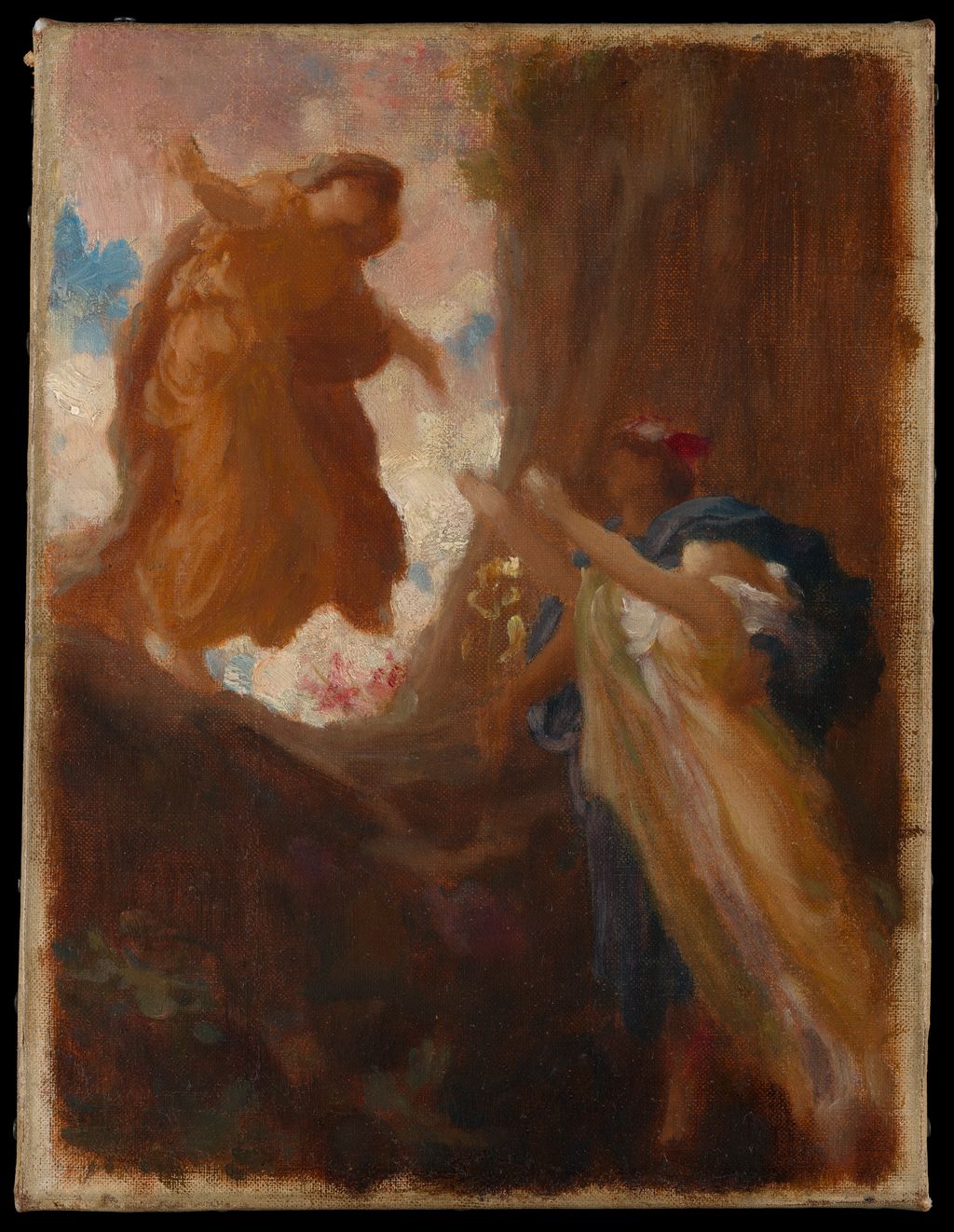
Frederic Leighton, The Return of Persephone, preparatory oil, Metropolitan Museum of Art. The Metropolitan Museum of Art. Image source. CC0 / Public domain. Resized to fit the article.
The figure in the round
Stand where you can see both of the athlete’s hands in An Athlete Wrestling with a Python. One grips the snake near the head while the other draws a loop away from his body. The human figure turns into the space kept under tension by those two grips. Shift your viewpoint and the outline changes. One coil of the snake comes forward as another disappears against a leg. Where the painter could control how shapes overlap from one fixed position, the sculptor had to make those overlaps work as someone walked around the group. [4] [20]
The life-size bronze shown at the Royal Academy in 1877 is now in Tate’s collection. Leighton House has an early plaster model and a reduced bronze and also commissioned a modern bronze version, finished in white, for its staircase. The National Trust records a smaller bronze cast dated 1905, years after Leighton’s death. The familiar title may therefore refer to objects made at different dates and on very different scales. The sculptures bring those distinctions into view alongside other figures, including The Sluggard, whose raised arms open into a stretch instead of holding off another body. [4] [20]
From an oil sketch outdoors to a room in London
In View in Capri, probably painted in 1859, the white walls of a few houses interrupt subdued greens and browns. The view starts high and moves down through the foreground vegetation, up towards an outcrop and out to a distant headland. At about 29 centimetres across, the whole sweep fits inside a canvas smaller than many of Leighton’s studies of a single body. A photograph taken after his death shows this picture among the sketches on his studio walls. These small oils could register a particular light or a configuration of land and buildings, and some stayed with him as things worth looking at in their own right. [7]
The landscapes follow Leighton beyond Capri. His friendship with the Italian painter Giovanni Costa belonged to a wider practice of studying nature in oils, which the National Gallery traced through Costa to the circle of Camille Corot. In the exhibition Frederic Leighton and the Eternal Mediterranean, the Museo de Arte de Ponce brought small landscapes together with figure paintings, colour sketches and preparatory drawings. Seeing those works in company helps put the geography in perspective. A sketch records somewhere Leighton looked closely. The dark horizon in an imagined scene can carry something of that experience without specifying the place. [7] [21] [22]
The studio-house in Holland Park and its Arab Hall offer a further way into Leighton’s use of material gathered on his travels. The architect George Aitchison worked with him on the house and later on the hall, begun in 1877 and completed in 1881. Historical tiles, including panels acquired in Damascus, sit alongside British-made work in an interior whose design drew on several buildings and regions. Look at the pair of grape-patterned panels bought in Damascus by Caspar Purdon Clarke, then at how the gold mosaic above the tiles marks a change in scale as your eye moves up the room. The hall joins the large canvases and the small landscapes as another place to see how carefully Leighton arranged what came into view. [23] [24]
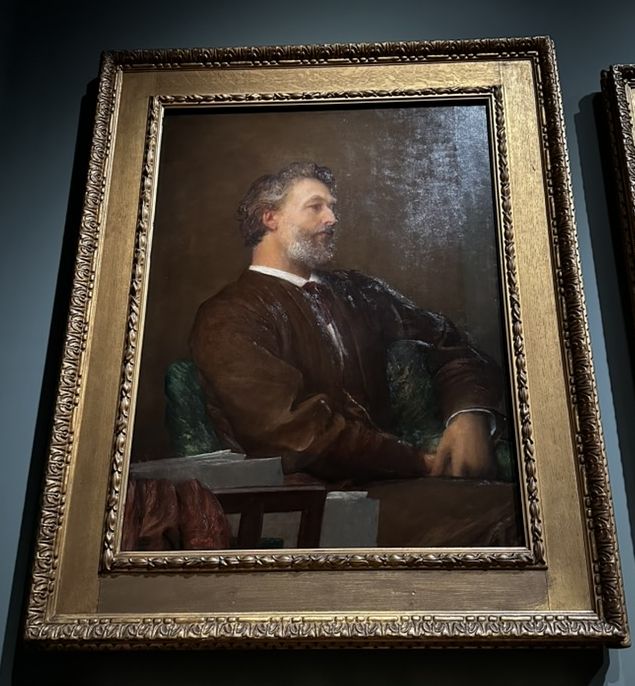
George Frederic Watts’s portrait of Frederic Leighton, 1881, National Portrait Gallery, NPG 1049. My photo from the National Portrait Gallery, London, on 5 November 2026. Image source. Public domain. Gallery photograph cropped to show the framed portrait.
Essential Frederic Leighton works
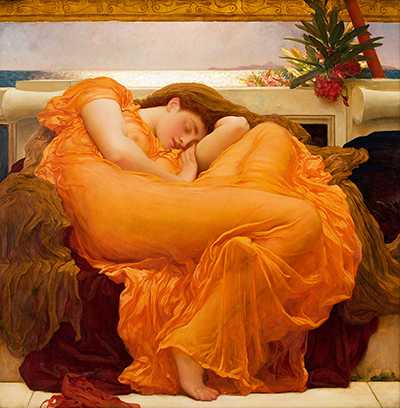
Flaming June
c. 1895 · A sleeping figure folds into a tightly composed square.
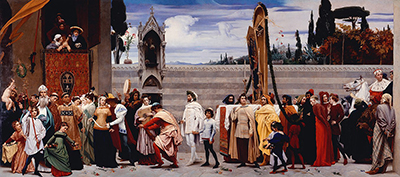
Cimabue’s Celebrated Madonna
1853–55 · A gold altarpiece rises above a crowd on a Florentine street.
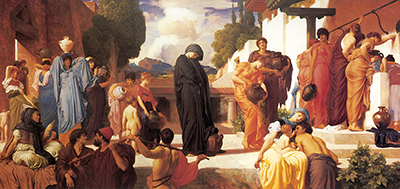
Captive Andromache
1888 · Activity at a well sets off Andromache’s stillness.
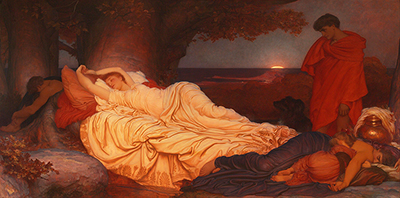
Cymon and Iphigenia
1884 · A literary encounter becomes a study in the rhythms of a sleeping figure.
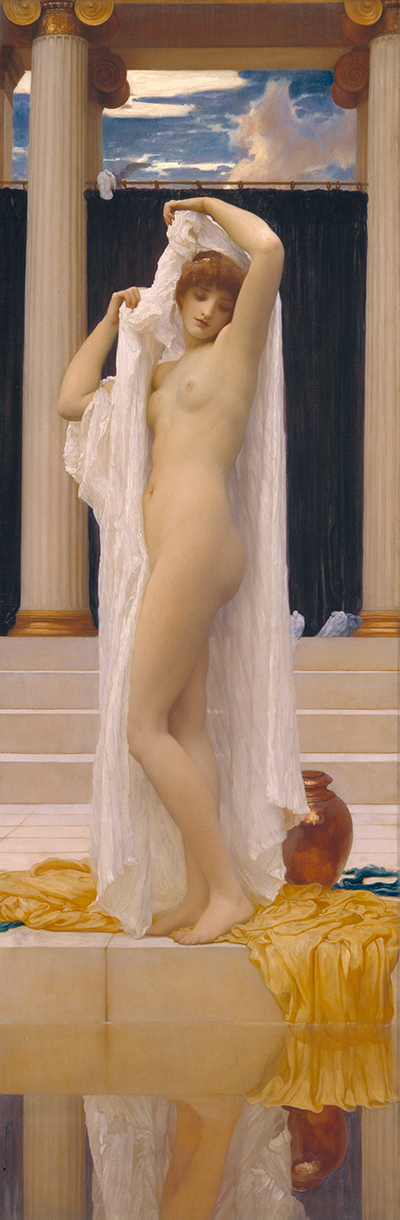
The Bath of Psyche
1890 · A classical story is concentrated into a single standing figure.
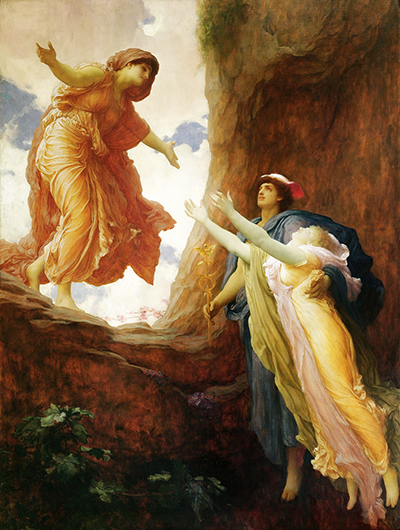
The Return of Persephone
1891 · Three gestures connect the ascent from the underworld with a welcome above.
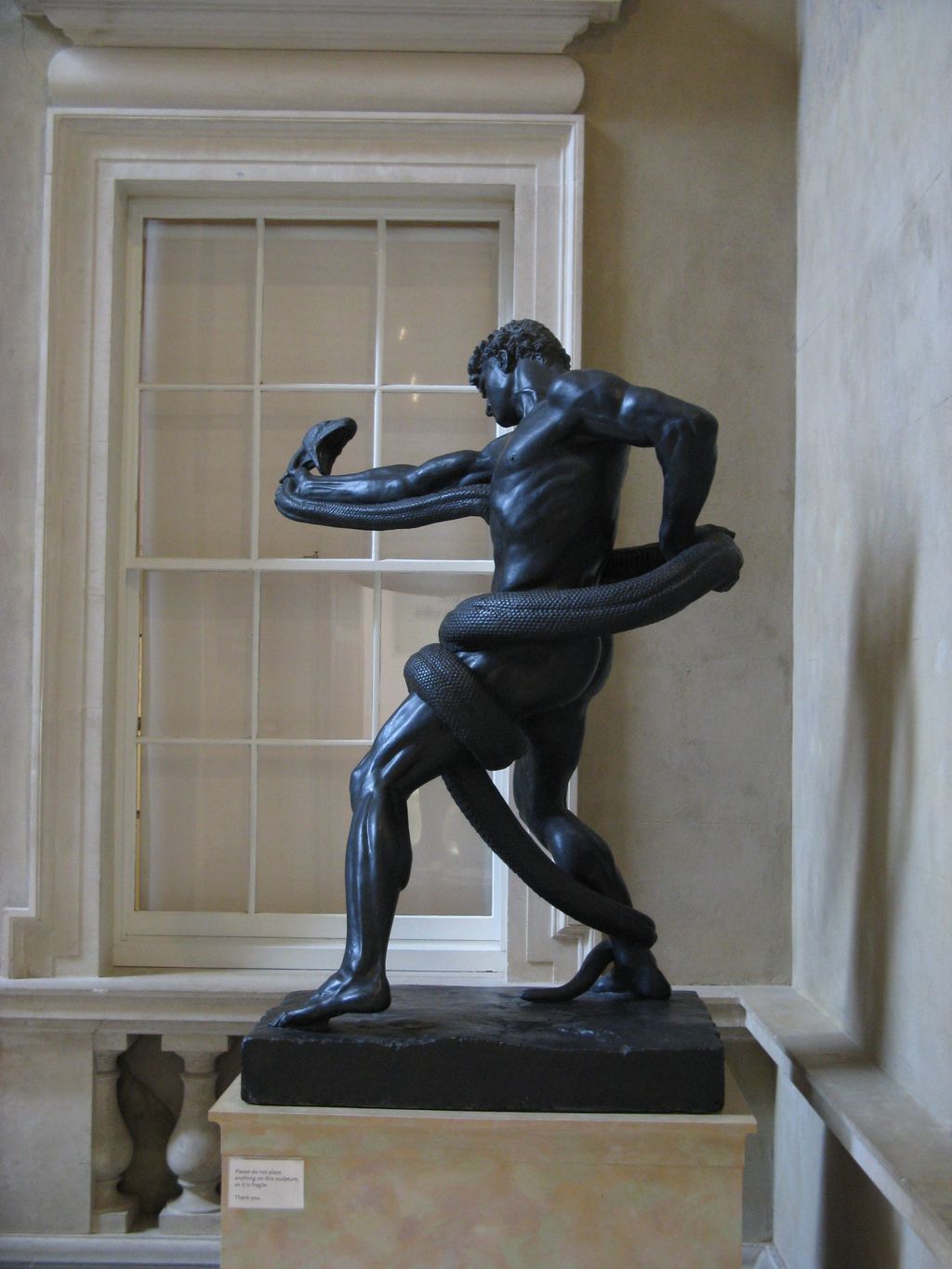
An Athlete Wrestling with a Python
1877 · A twisting figure held under tension by the snake. The photograph shows the Royal Academy plaster.
Photograph by Yair-haklai. Resized photograph under CC BY-SA 3.0. · Image source · CC BY-SA 3.0
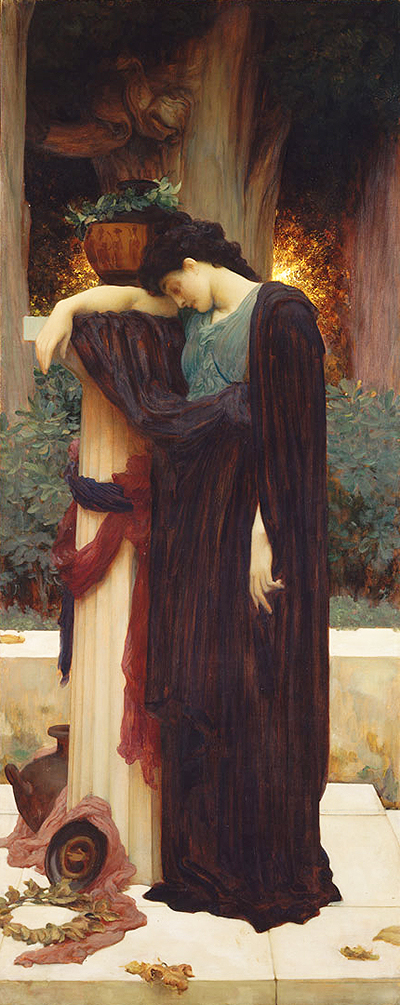
Lachrymae
1894–95 · The long forms of a cypress and monument sustain the figure’s stillness.
Browse Frederic Leighton’s artworks
Explore paintings, drawings, sculptures and prints, with separate rows for identified preparatory works, reproductions and casts.
| Name | Date | Medium |
|---|---|---|
| A Girl Feeding Peacocks | Exhibited 1863 | Painting Catalogue. |
| A Recognition from ‘Romola’, engraved by Swain (Tate N04054) | published 1862 | Print Catalogue. |
| A Roman Lady | 1859 | Painting Catalogue. |
| Abram and the Angel (Tate A00733) | published 1881 | Print Catalogue. |
| Acme and Septimius | Exhibited 1868 | Painting Catalogue. |
| An Athlete Wrestling with a Python (Tate exhibition bronze) | 1877 | Sculpture Catalogue. |
| And the Sea Gave Up the Dead Which Were in It (Tate N01511) | 1891–92 | Painting Catalogue. |
| Andromache in Captivity (photogravure after Leighton) | 1889 | Print Catalogue. |
| Athlete Wrestling with a Python (Anglesey Abbey cast) | model 1877; cast 1905 | Sculpture Catalogue. |
| Athlete Wrestling with a Python (Hood reduced cast) | 1877 (inscribed model date) | Sculpture Catalogue. |
| Athlete Wrestling with a Python (Saint Louis reduced cast) | 1877 (museum date) | Sculpture Catalogue. |
| Cain and Abel (Tate A00731) | published 1881 | Print Catalogue. |
| Captive Andromache | 1888 | Painting Catalogue. |
| Cimabue's Celebrated Madonna | 1853–55 | Painting Catalogue. |
| Cimon and Iphigenia, with Many Smaller Subjects (Tate T09061) | date not known | Drawing Catalogue. |
| Crenaia, the Nymph of the Dargle | Exhibited 1880 | Painting Catalogue. |
| Cymon and Iphigenia | 1884 | Painting Catalogue. |
| Daedalus and Icarus | 1869 | Painting Catalogue. |
| Dante in Exile | 1864 | Painting Catalogue. |
| Death of the First Born (Tate A00737) | published 1881 | Print Catalogue. |
| Electra at the Tomb of Agamemnon | c. 1869 | Painting Catalogue. |
| Eliezer and Rebekah (Tate A00735) | published 1881 | Print Catalogue. |
| Elijah in the Wilderness | 1877–78 | Painting Catalogue. |
| Fanny Kemble: A Study for ‘Jezebel and Ahab’ (Tate T08208) | c.1862 | Drawing Catalogue. |
| Figure Studies | Date not recorded | Drawing Catalogue. |
| Flaming June | 1895 | Painting Catalogue. |
| Gulnihal | Exhibited 1886 | Painting Catalogue. |
| Helios and Rhodes (Tate N03015) | date not known | Painting Catalogue. |
| Hercules Wrestling with Death for the Body of Alcestis | c. 1869–71 | Painting Catalogue. |
| Jonathan's Token to David | c. 1868 | Painting Catalogue. |
| Lachrymae | 1894–95 | Painting Catalogue. |
| Lieder ohne Worte | Exhibited 1861 | Painting Catalogue. |
| Light of the Harem | Exhibited 1880 | Painting Catalogue. |
| Moses Views the Promised Land (Tate A00736) | published 1881 | Print Catalogue. |
| Mrs James Guthrie | 1865 | Painting Catalogue. |
| Mrs John Hanson Walker (Tate N04731) | 1867 | Painting Catalogue. |
| Music Lesson | 1877 | Painting Catalogue. |
| Needless Alarms (Met cast) | modelled 1886; cast nineteenth century | Sculpture Catalogue. |
| Needless Alarms (Tate N05120) | 1886 | Sculpture Catalogue. |
| Pavonia | c. 1859 | Painting Catalogue. |
| Perseus and Andromeda | 1891 | Painting Catalogue. |
| Portrait of May Sartoris | c. 1860 | Painting Catalogue. |
| Preparing for a Festa, Florence (Tate T09062) | date not known | Drawing Catalogue. |
| Puerta de los Vientos, near Ronda, Spain (Tate N04006) | c.1886–9 | Painting Catalogue. |
| Samson and the Lions (Tate A00732) | published 1881 | Print Catalogue. |
| Samson at the Mill (Tate A00734) | published 1881 | Print Catalogue. |
| Samson Carrying the Gate (Tate A00738) | published 1881 | Print Catalogue. |
| Sketch for ‘An Athlete Wrestling with a Python’ (Tate N01761) | c.1877 | Sculpture Catalogue. |
| Sketches for Cimon and Iphigenia (Tate T09060) | date not known | Drawing Catalogue. |
| Study for The Return of Persephone (Demeter) | c. 1890–91 | Drawing Catalogue. |
| Study for The Return of Persephone (Persephone) | c. 1890–91 | Drawing Catalogue. |
| Study for ‘Needless Alarms’ (Tate N02945) | 1886 | Sculpture Catalogue. |
| Study for ‘The Discovery of Juliet Apparently Lifeless’ (Tate N01806) | c.1858 | Painting Catalogue. |
| The Bath of Psyche | Exhibited 1890 | Painting Catalogue. |
| The Daphnephoria | 1874–76 | Painting Catalogue. |
| The Death of Brunelleschi | 1852 | Painting Catalogue. |
| The Fisherman and the Siren | Exhibited 1858 | Painting Catalogue. |
| The Painter's Honeymoon | c. 1864 | Painting Catalogue. |
| The Return of Persephone | 1891 | Painting Leeds painting identified in the Met study record. |
| The Return of Persephone (preparatory oil) | c. 1890–91 | Painting Catalogue. |
| The Sluggard (Anglesey Abbey cast) | probably 1890–about 1906 | Sculpture Catalogue. |
| The Sluggard (Met cast) | modelled 1886; cast possibly before 1896 | Sculpture Catalogue. |
| The Sluggard (Museum Wales) | 1882–85 (museum date) | Sculpture Catalogue. |
| The Sluggard (Tate N01752) | 1885 | Sculpture Catalogue. |
| The Spies Escape (Tate A00730) | published 1881 | Print Catalogue. |
| Various Subjects (Tate T09063) | date not known | Drawing Catalogue. |
| View in Capri | Possibly 1859 | Painting Catalogue. |
| Wedded | 1882 | Painting Catalogue. |
| Winding the Skein | c. 1878 | Painting Catalogue. |
Discussion
Look again at the images and ideas explored in Frederic Leighton. These editorial prompts invite your observations.
Reader Insights
How does Leighton draw your eye into the Florentine procession, and what draws it back towards the sleeping figure in Flaming June?
What can a sculptor show about the turn of a body that depends on where you stand?
Join the Conversation
Share a detail, comparison or question about Frederic Leighton below.
References
- National Portrait Gallery, “Frederic Leighton, Baron Leighton”, biography. View source.
- National Gallery, Cimabue’s Celebrated Madonna, L275. View source.
- Museo de Arte de Ponce, Flaming June, 63.0406. View source.
- Leighton House, “Recreating Leighton’s Athlete Wrestling with a Python”. View source.
- Manchester Art Gallery, “Tales from the Archives: A Brush with the Law, Part 1”. View source.
- Metropolitan Museum of Art, The Return of Persephone, preparatory oil. View source.
- National Gallery, View in Capri, L847. View source.
- Gallerie degli Uffizi, Madonna col Bambino in trono e angeli (detta Madonna Rucellai). View source.
- Ernest Rhys, Frederic Lord Leighton: An Illustrated Record of His Life and Work, ch. XI, “The Artist and His Critics”. View source.
- Metropolitan Museum of Art, Andromache in Captivity, photogravure after Leighton. View source.
- Art Gallery of New South Wales, Cymon and Iphigenia, collection record on Google Arts & Culture. View source.
- Tate, The Bath of Psyche, collection record on Google Arts & Culture. View source.
- Musée d’Orsay, Beauté, morale et volupté dans l’Angleterre d’Oscar Wilde. View source.
- Leighton House, “Frederic Leighton’s Flaming June: The Making of an Icon”. View source.
- Metropolitan Museum of Art, Lachrymae, 96.28. View source.
- Pushkin State Museum of Fine Arts, Pastoral (Пастораль), Г–20099. View source.
- Emilie Barrington, The Life, Letters and Work of Frederic Leighton, vol. II (1906), introductory chapter, letter to M. H. Spielmann. View source.
- National Museum of Western Art, Tokyo, Study for ‘The Return of Persephone’, D.2017-0089 and discussion of D.2017-0092. View source.
- Leeds Museums and Galleries, collection highlights data, The Return of Persephone, LEEAG.1891.0001. View source.
- National Trust, Athlete wrestling with a python, 515041. View source.
- National Gallery, Artistic Exchanges: Corot, Costa, Leighton. View source.
- Museo de Arte de Ponce, Frederic Leighton and the Eternal Mediterranean. View source.
- Leighton House, “History of Leighton House”. View source.
- Leighton House, “Q&A: The Arab Hall at Leighton House”, Melanie Gibson. View source.