 by Tom Gurney
Tom Gurney BSc (Hons) is an art history expert with over 20 years experience
Published on June 19, 2020 / Updated on November 29, 2026
Email: tomgurney1@gmail.com / Phone: +44 7429 011000
Elijah in the Wilderness: Introduction
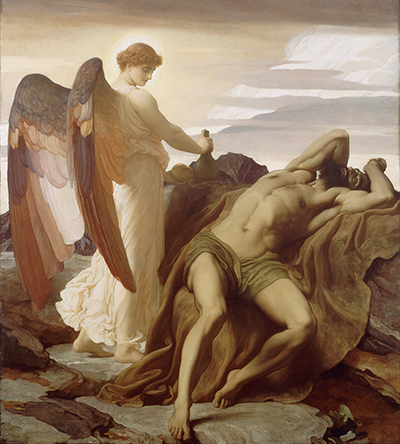
An angel has just reached a man asleep on a bed of rock. The angel’s wings are still settling, and the man lies with his head back and his eyes hidden. In Frederic Leighton’s Elijah in the Wilderness, help has arrived a moment before the person who needs it can know. Bread and water look very small in a picture more than two metres high. They are the things that will get Elijah to his feet. Leighton painted this oil on canvas in 1877–78. The Walker Art Gallery in Liverpool holds the painting (WAG 147). The canvas measures 234.3 cm high by 210.4 cm wide. [1] [2]
At a Glance
- Painted1877–78
- MediumOil on canvas
- CollectionWalker Art Gallery, WAG 147
- ExhibitedParis, 1878 / Royal Academy, 1879
This work across Frederic Leighton’s career
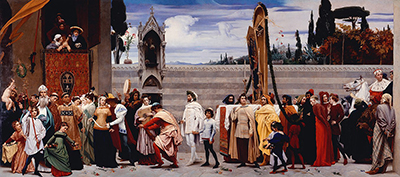
Cimabue’s Celebrated Madonna
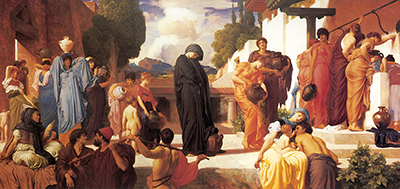
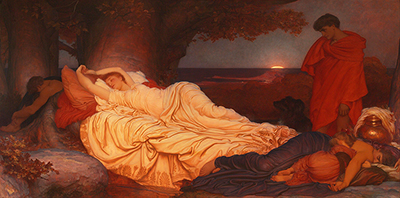
1853–55Lachrymae
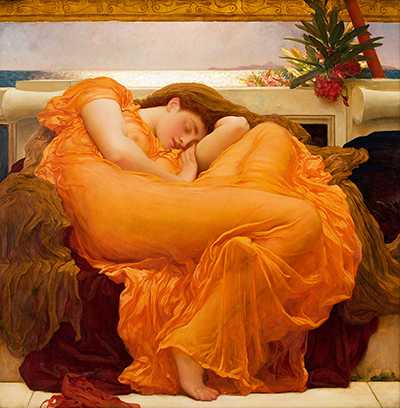
1894–95Flaming June
c. 1895Contents
- The angel arrives before Elijah wakes
- How the bodies carry the story
- A sleeping satyr and a Victorian oratorio
- Chalk, oil and the figures in the studio
- From Paris and London to the Walker
- Other paintings of Elijah and Elisha
- Annotated details
The angel arrives before Elijah wakes
In the First Book of Kings, Elijah has just challenged the prophets of Baal on Mount Carmel. Fire consumes the offering on his altar, and the prophets of Baal are killed. When King Ahab tells Jezebel what has happened, she threatens Elijah’s life. Elijah flees to Beersheba, leaves his servant there and goes a day’s journey into the wilderness. Under a shrub, rendered as a juniper in the King James Bible and as a broom in other translations, he asks God to let him die. The crowd that witnessed his victory has disappeared from the story. He falls asleep alone. [3] [4]
An angel touches him and tells him to rise and eat. Elijah finds a cake baked on coals and a jar of water by his head. He eats, drinks and lies down again. The angel returns and rouses him a second time, explaining that the journey is too much for him. The food sustains him for forty days and forty nights on the way to Horeb. Leighton takes the instant just before the sleeper responds. The angel already has the food and water that the text says Elijah discovers on waking. With a single look from the angel, the painting gathers up the arrival, the touch to come and the promise of a meal. The image leaves open which of the two visits we are seeing. [1] [3] [5]
How the bodies carry the story
Follow the prophet’s body from the feet, close to the lower edge, up over the knees and tilted chest to the head. Leighton sets the body at an angle to the picture surface, so the torso seems to crowd forward as the head retreats. The beard and the angle of the neck make it hard to read Elijah’s expression. His raised arms and the turn of the rib cage give the sleep an uneasy character. The strength in his shoulders is still visible even as the stone takes his weight. [1] [5]
The angel stands almost upright to his left. Pale folds curl around the legs while the wings retain something of the spread they had in flight. The relative stillness of the angel’s face gives the drapery room to suggest movement. Leighton keeps the figures close enough for a quiet exchange, but the difference in their postures gives that exchange the scale of a public picture. Thick white paint in the angel’s drapery catches the light. The flesh is modelled by subtler changes of tone, visible where Elijah’s shoulder and heels turn towards us. The rough, broken strokes of the rock give both surfaces something to play against. [1] [5]
The rocks hold the sleeping figure, crowd the bottom of the canvas and make the open air above feel exposed. A band of luminous sky gives the wings a clear outline. There is little in the setting to distract from the search for water or offer much comfort to a traveller. Looking back from the horizon to the jar, one can see how the landscape gives that small vessel its importance. [1] [3] [5]
Annotated Details from Elijah in the Wilderness
The numbered points identify visible features discussed in this article. Return from each detail to the numbered overview. Each caption identifies the work shown.
Elijah in the Wilderness
Frederic Leighton, Elijah in the Wilderness, 1877–78. Walker Art Gallery. Image source. Public domain. Resized without changing the composition.
Elisha Raising the Son of the Shunamite
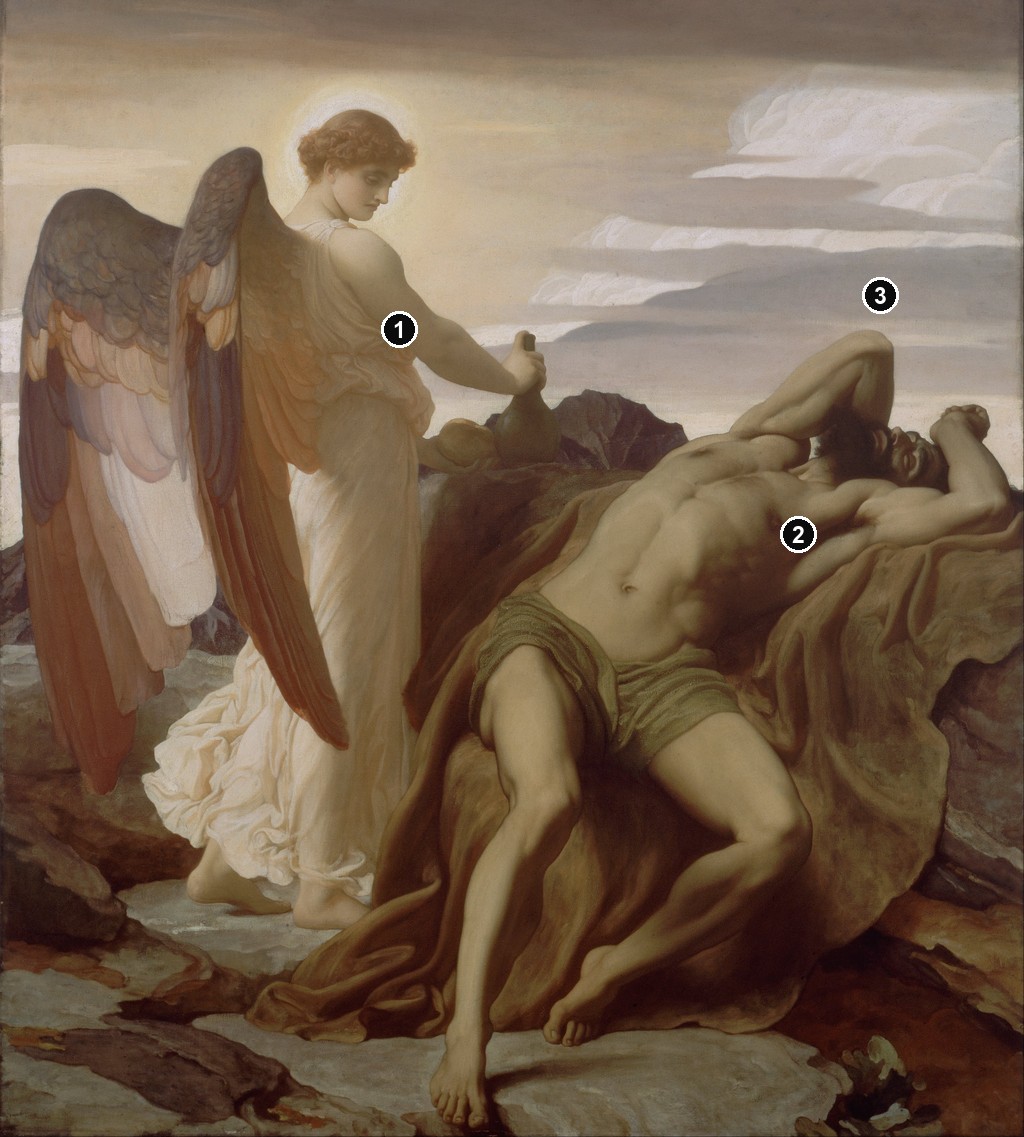
Frederic Leighton, Elisha Raising the Son of the Shunamite, 1881. Leighton House. Photograph by Daderot. Image source. CC0 / Public domain. Trimmed the photographed frame and resized the image.
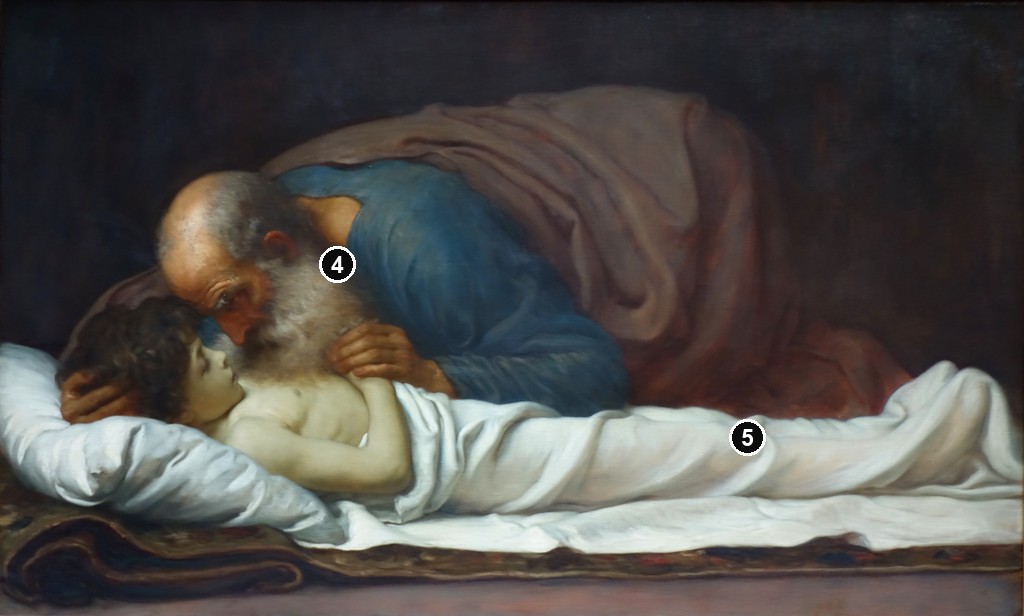
Details from ELIJAH IN THE WILDERNESS
Compare the cropped details with the source images above. Notice how their colours, shapes and positions contribute to the larger compositions.
Elijah in the Wilderness
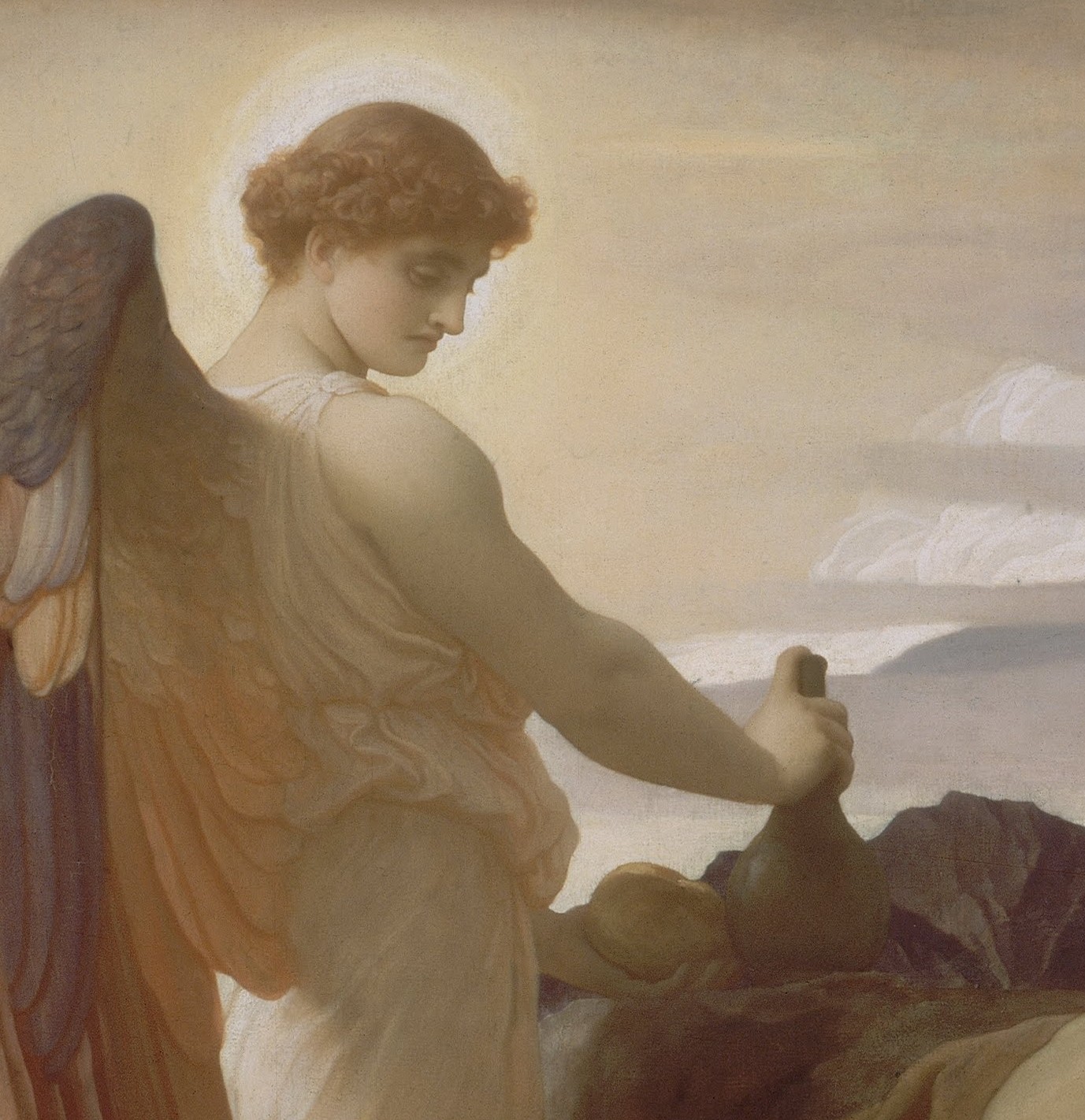
The angel looks down
The angel’s head tilts towards Elijah, while the descending line of the arm continues the movement. The hand reaches towards a sleeper who has yet to respond.
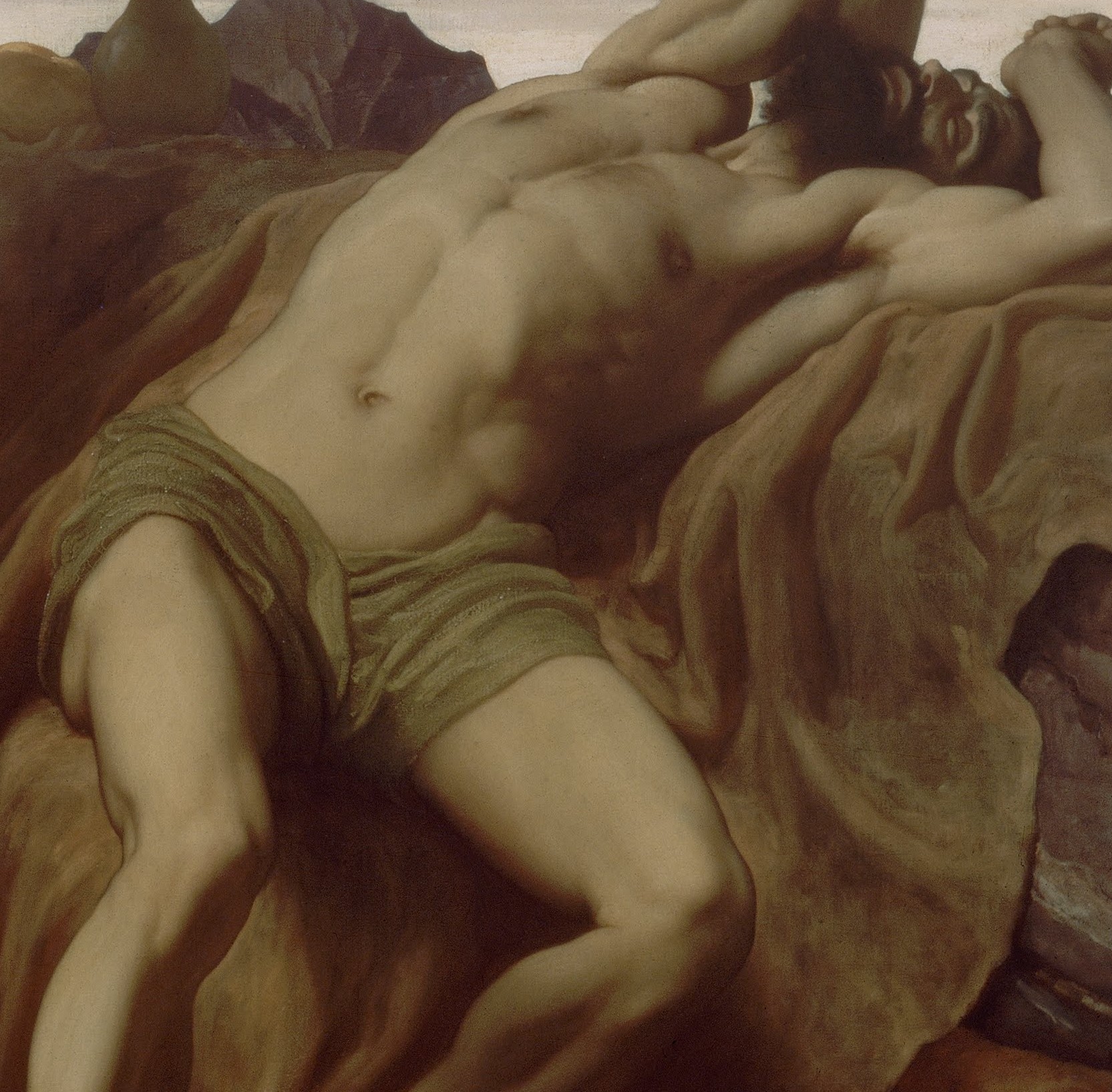
Elijah's weight on the rock
Elijah’s body lies against the folds of his cloak. The light catches the turn of the chest and the raised arm, leaving the other side closer to the dark rock.
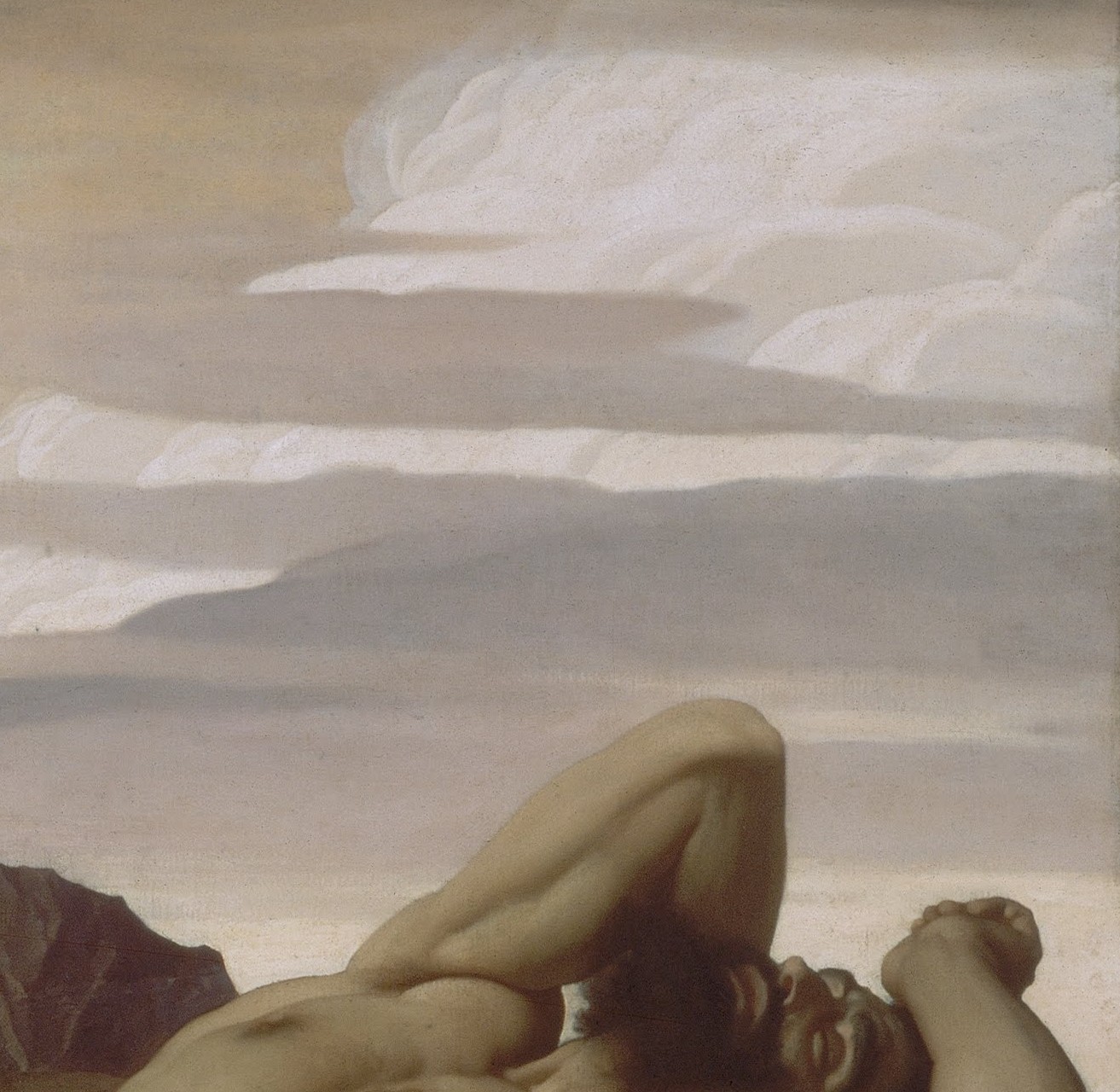
Pale clouds above the rock
The clouds extend in horizontal bands at the opening to the right. The rocky foreground rises sharply towards them, making the pale space behind the two figures easier to see.
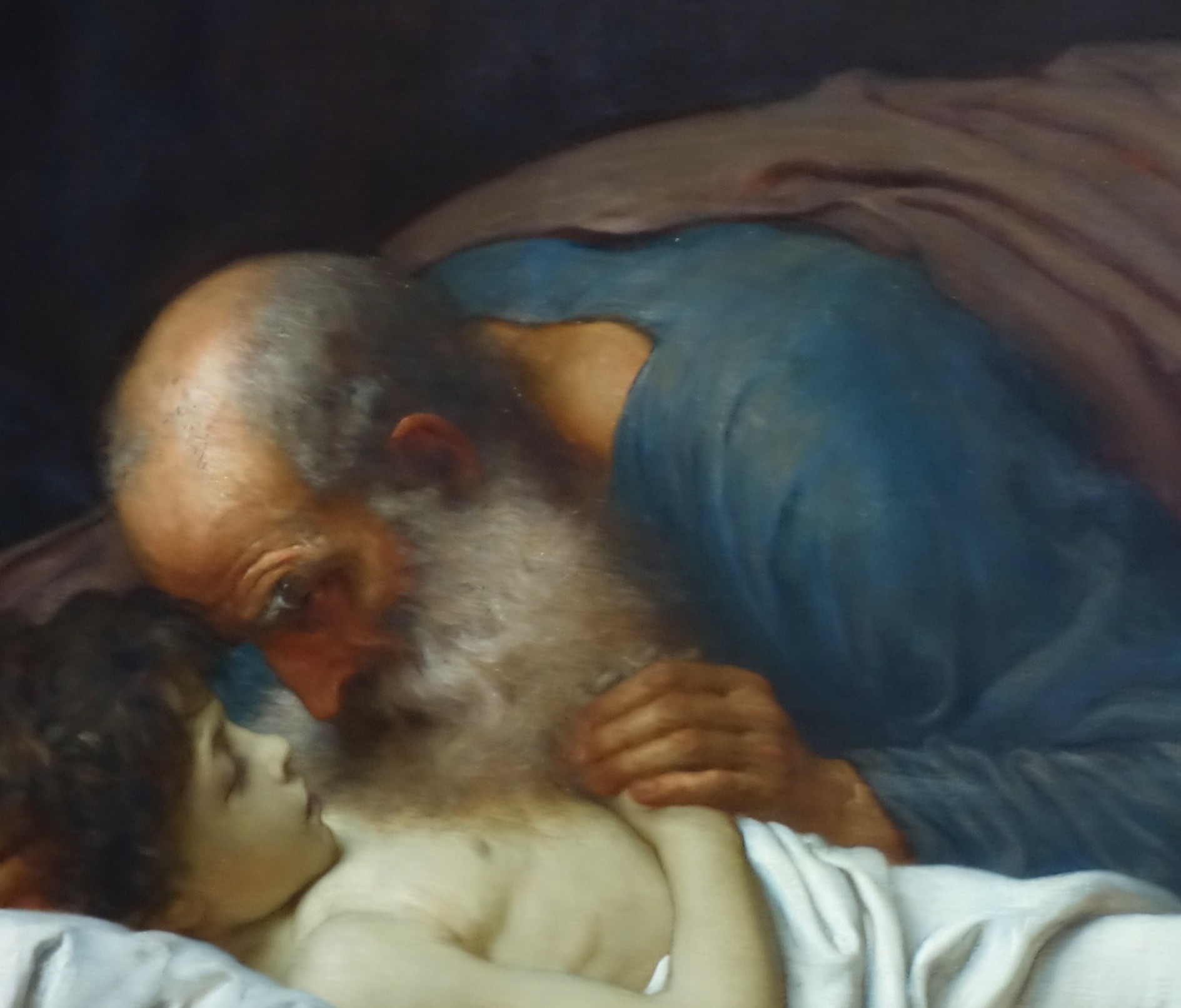
Elisha Raising the Son of the Shunamite
Elisha bends towards the boy
The older man bows his head close to the boy, the two figures occupying the same level against a dark background. The movement differs from the standing angel above Elijah.
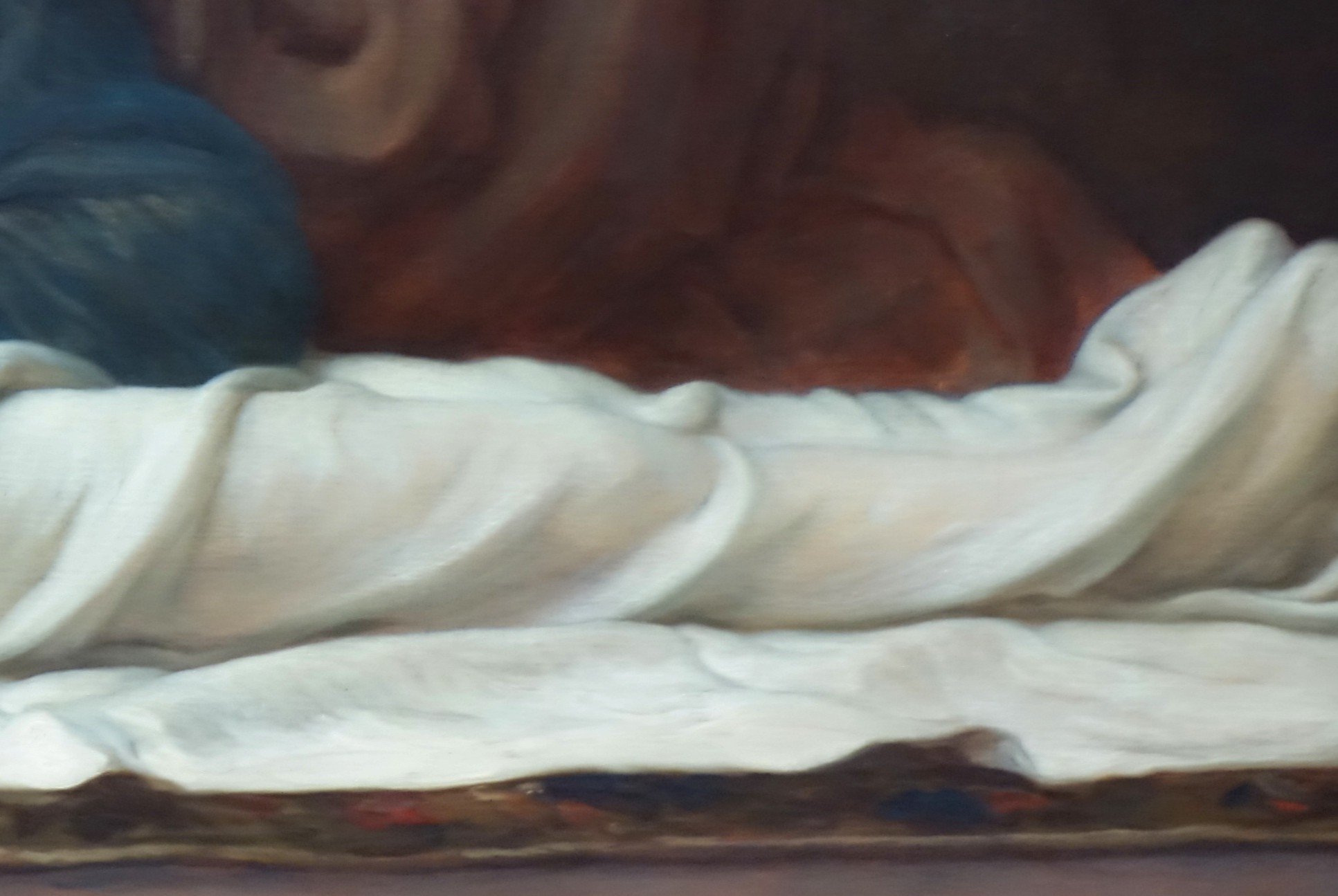
The pale bedding and the dark room
The bedding runs from the two heads to the right edge. The white fabric separates the boy’s form from the much darker room.
A sleeping satyr and a Victorian oratorio
Elijah’s sprawled torso has often been compared to the Barberini Faun, the ancient sculpture of a sleeping satyr now in Munich’s Glyptothek. The resemblance lies in the open pose and the sense of a muscular body left to its own weight. The comparison also makes Leighton’s choices clearer. Elijah has a leaner chest, tenser muscles and olive fabric across his hips. The pose has to convey weariness after a struggle, whereas the satyr’s sleep has traditionally been understood in the context of wine and revelry. Art historian Elizabeth Prettejohn also sees a possible echo of the body of Christ in Michelangelo’s unfinished Entombment. In both paintings, the turn of the body and the rocky setting carry much of the gravity of the scene. [5] [6]
The tension also comes through if we set Elijah beside Leighton’s bronze An Athlete Wrestling with a Python, exhibited in 1877. The athlete’s legs give him a purchase on the ground and his arms actively resist the snake. Keren Rosa Hammerschlag compares Elijah’s distorted anatomy to bodies displayed on a dissecting table. We can see the muscles that would allow the prophet to rise and feel just how little power he presently has over them. [1] [5] [7]
Prettejohn hears another possible echo in Felix Mendelssohn’s oratorio Elijah, first performed in Birmingham in 1846. After Elijah’s plea for death, the angels sing the trio Lift up thine eyes. The quiet passage offers a musical parallel for the way Leighton’s angel enters while the prophet’s ordeal still weighs on the scene. Emilie Barrington recalled that Leighton told a friend how much of himself he had put into the picture. Her account gives some sense of his personal stake in its making. The oratorio is one way a nineteenth-century audience familiar with both works might have experienced the stillness he painted. [5] [8]
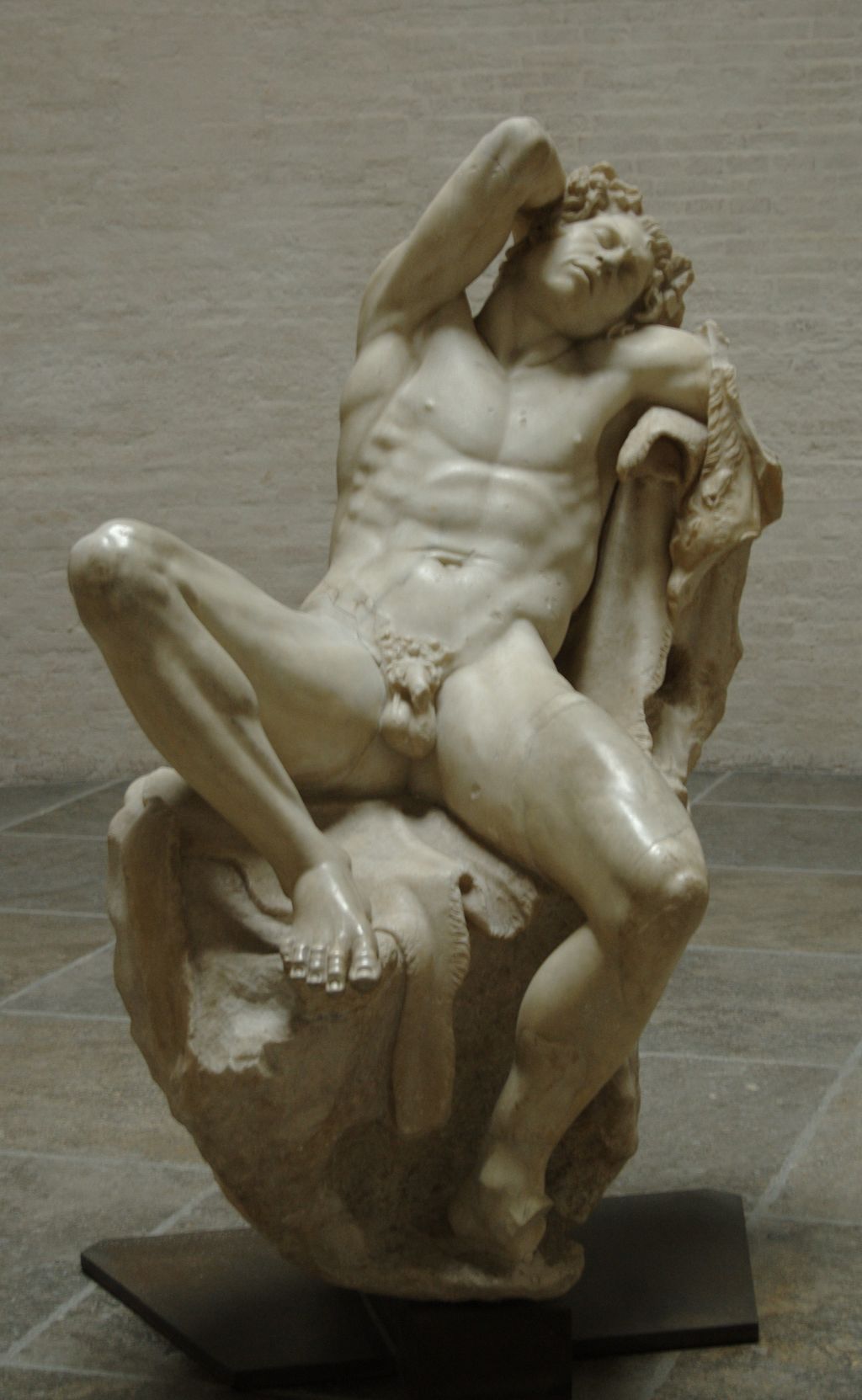
The Barberini Faun, an ancient marble in Munich’s Glyptothek. Photograph by Bibi Saint-Pol. Image source. Public domain. Resized without changing the composition.
Chalk, oil and the figures in the studio
When Andrew George Kurtz, who commissioned the painting, visited Leighton’s studio, he saw sketches and small models of the figures. The studies show how Leighton worked through the relationship between the two bodies before enlarging it. A little National Gallery of Victoria sheet, Study for Elijah in the wilderness, is drawn in black and white chalk on brown paper. The mid-tone of the paper allows dark chalk to establish shadow and white chalk to set a highlight against it. The drawing bears Leighton’s studio stamp and was purchased by the Melbourne gallery in 1897. [1] [9]
A roughly square oil study, just over 22 cm across, was catalogued by Sotheby’s in 2021 as a study of colour and tone for the picture. On that scale Leighton could judge how much light the angel needed and how the figure would sit against the rock without working at the dimensions of the final commission. Three chalk studies lent by the Leighton House Committee went to the 1904 St Louis exposition in one frame. They were shown together as works on paper, decades after the painting’s Paris debut. [1] [10] [11]
From Paris and London to the Walker
Kurtz made his fortune in the chemical industry at St Helens. He commissioned a picture for the Walker in 1877, the year the gallery opened. Although he had initially hoped for a subject centred on female beauty, he left the decision to Leighton. The artist told him he planned to paint the angel feeding Elijah and would make both figures life-size. The first public exhibition took place at the Paris Exposition Universelle in 1878. The British fine art catalogue lists the oil as Elijah, no. 135, alongside Leighton’s The Music Lesson and his portrait of Captain Richard Burton. He was elected president of the Royal Academy later that year. A correspondent for Lippincott’s Magazine reported that even painters as well known as Leighton and Millais struggled to hold the public’s attention in the English galleries in Paris. [1] [5] [12] [13] [14]
It appeared as Elijah in the Wilderness, no. 188, at the Royal Academy in 1879, one of eight paintings Leighton sent to the exhibition. The Examiner thought the angel graceful but took issue with its curling drapery in a landscape that gave the reviewer no sense of wind. It also judged Elijah’s upper body overdeveloped in proportion to his lower body. Ernest Rhys later singled out the painting from Leighton’s eight exhibits and admired its austerity. The careful display of muscle that drew praise from later writers had struck this reviewer as improbable. [15] [16]
Kurtz presented the picture to the Walker in 1879. By the 1897 Royal Academy retrospective it was recorded as a loan from the Corporation of Liverpool. The retrospective catalogue gave it an 1879 date, as did Barrington. The Paris record shows it was already on view the year before, and the Walker dates its making to 1877–78. It later reached readers as a plate in A. Lys Baldry’s illustrated book on Leighton. A reproduction lets the eye take in both figures at once. In front of a canvas of this height, the shift from the foreshortened legs to the angel’s wings takes a longer look. [1] [8] [13] [17] [18]
Other paintings of Elijah and Elisha
Ferdinand Bol painted the encounter with the angel around 1642. In the Leiden Collection canvas, a tree encloses the scene, Elijah supports his head on his hand and the angel approaches with a flask. Bol’s directed light picks out the faces and hands in the darkness. Leighton exposes the sleeper to open sky and gives the whole body over to exhaustion. A seventeenth-century engraving by Conrad Lauwers after Rubens, in Tokyo’s National Museum of Western Art, treats the angel’s meal as part of a series on the Eucharist. Each version gives a different emphasis to the same moment of bodily care. [1] [19] [20]
Elijah also receives food earlier in the First Book of Kings, when ravens bring him bread and meat at the brook Cherith. That episode has its own imagery. In Daniele da Volterra’s Elia nel deserto at the Uffizi, Elijah considers the food brought by a raven. The bird supplies the action in Jan Muller’s drawing at the Metropolitan Museum of Art and in a Mughal manuscript page at the Cleveland Museum of Art, where Elijah sits under a tree like an Indian holy man. [3] [21] [22] [23]
In 1863 Leighton wrote to his mother about a painting he also called Elijah. That was the picture he exhibited as Jezebel and Ahab, a confrontation in Naboth’s vineyard, the episode Frank Dicksee later chose for his Academy Schools prize picture. [3] [8] [16] [24]
The names of Elijah and Elisha were already a source of confusion in the nineteenth century. In his French survey of English painting, Ernest Chesneau described Leighton’s 1881 exhibit as Elijah raising a widow’s son. The Academy listed it as Elisha Raising the Son of the Shunammite, the story of a married woman’s child restored to life in the Second Book of Kings. In the Walker picture the prophet is the helpless one, and everything turns on bread and water reaching him while he sleeps. [1] [25] [26] [27]
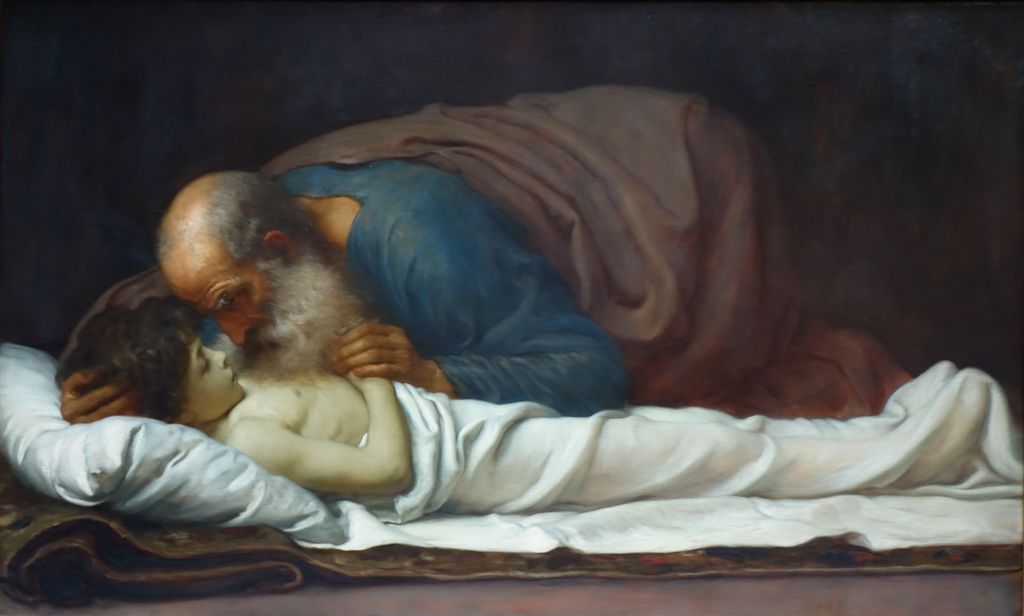
Frederic Leighton, Elisha Raising the Son of the Shunamite, 1881. Leighton House. Photograph by Daderot. Image source. CC0 / Public domain. Trimmed the photographed frame and resized the image.
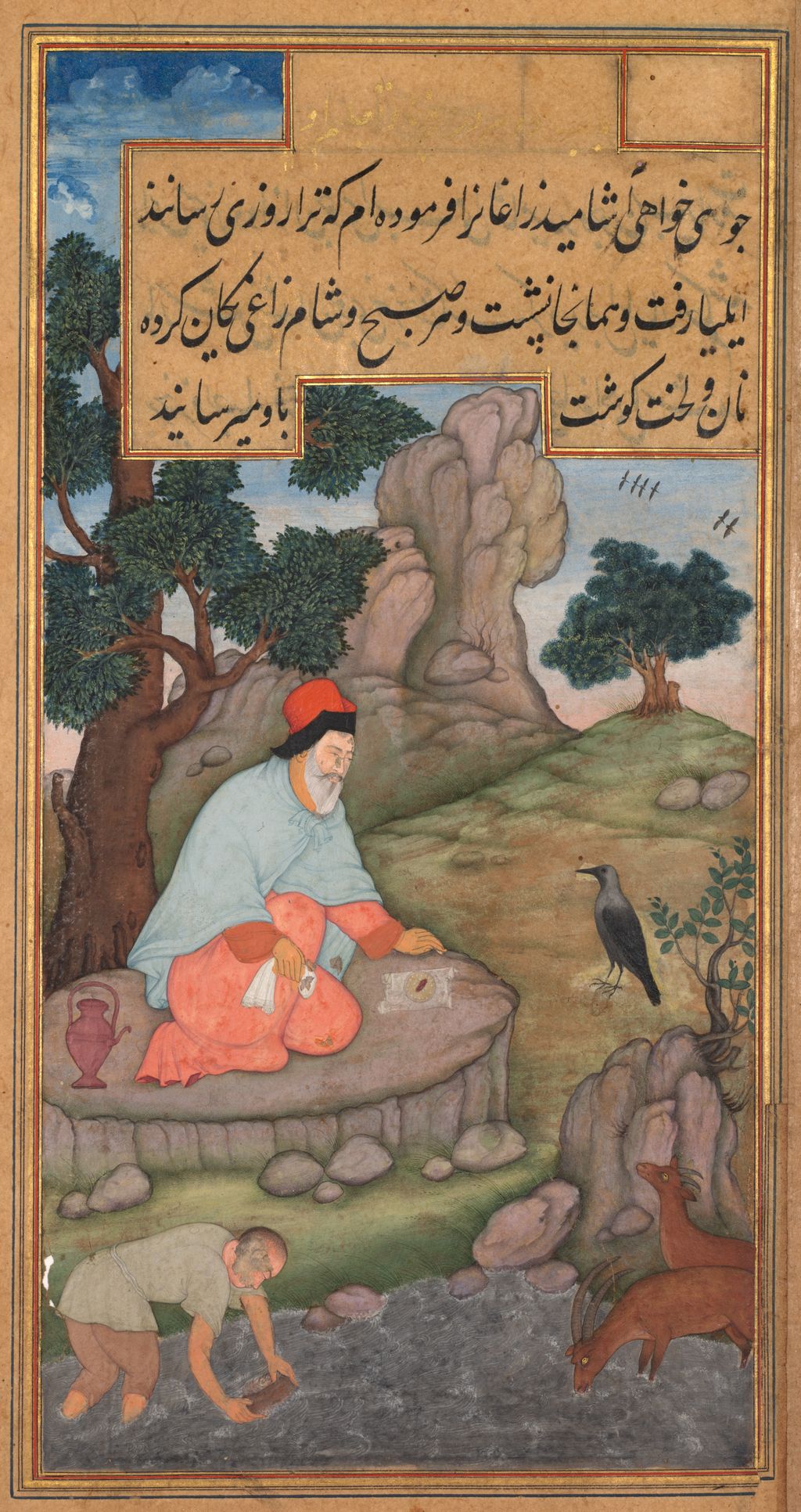
A raven brings food to Elijah, 1602–04. A folio from the Mirror of Holiness. Mughal India. The Cleveland Museum of Art. The Cleveland Museum of Art, John L. Severance Fund. Image source. CC0 / Public domain. Resized without changing the composition.
Browse Frederic Leighton’s artworks
Explore paintings, drawings, sculptures and prints, with separate rows for identified preparatory works, reproductions and casts.
| Name | Date | Medium |
|---|---|---|
| A Girl Feeding Peacocks | Exhibited 1863 | Painting Catalogue. |
| A Recognition from ‘Romola’, engraved by Swain (Tate N04054) | published 1862 | Print Catalogue. |
| A Roman Lady | 1859 | Painting Catalogue. |
| Abram and the Angel (Tate A00733) | published 1881 | Print Catalogue. |
| Acme and Septimius | Exhibited 1868 | Painting Catalogue. |
| An Athlete Wrestling with a Python (Tate exhibition bronze) | 1877 | Sculpture Catalogue. |
| And the Sea Gave Up the Dead Which Were in It (Tate N01511) | 1891–92 | Painting Catalogue. |
| Andromache in Captivity (photogravure after Leighton) | 1889 | Print Catalogue. |
| Athlete Wrestling with a Python (Anglesey Abbey cast) | model 1877; cast 1905 | Sculpture Catalogue. |
| Athlete Wrestling with a Python (Hood reduced cast) | 1877 (inscribed model date) | Sculpture Catalogue. |
| Athlete Wrestling with a Python (Saint Louis reduced cast) | 1877 (museum date) | Sculpture Catalogue. |
| Cain and Abel (Tate A00731) | published 1881 | Print Catalogue. |
| Captive Andromache | 1888 | Painting Catalogue. |
| Cimabue's Celebrated Madonna | 1853–55 | Painting Catalogue. |
| Cimon and Iphigenia, with Many Smaller Subjects (Tate T09061) | date not known | Drawing Catalogue. |
| Crenaia, the Nymph of the Dargle | Exhibited 1880 | Painting Catalogue. |
| Cymon and Iphigenia | 1884 | Painting Catalogue. |
| Daedalus and Icarus | 1869 | Painting Catalogue. |
| Dante in Exile | 1864 | Painting Catalogue. |
| Death of the First Born (Tate A00737) | published 1881 | Print Catalogue. |
| Electra at the Tomb of Agamemnon | c. 1869 | Painting Catalogue. |
| Eliezer and Rebekah (Tate A00735) | published 1881 | Print Catalogue. |
| Elijah in the Wilderness | 1877–78 | Painting Catalogue. |
| Fanny Kemble: A Study for ‘Jezebel and Ahab’ (Tate T08208) | c.1862 | Drawing Catalogue. |
| Figure Studies | Date not recorded | Drawing Catalogue. |
| Flaming June | 1895 | Painting Catalogue. |
| Gulnihal | Exhibited 1886 | Painting Catalogue. |
| Helios and Rhodes (Tate N03015) | date not known | Painting Catalogue. |
| Hercules Wrestling with Death for the Body of Alcestis | c. 1869–71 | Painting Catalogue. |
| Jonathan's Token to David | c. 1868 | Painting Catalogue. |
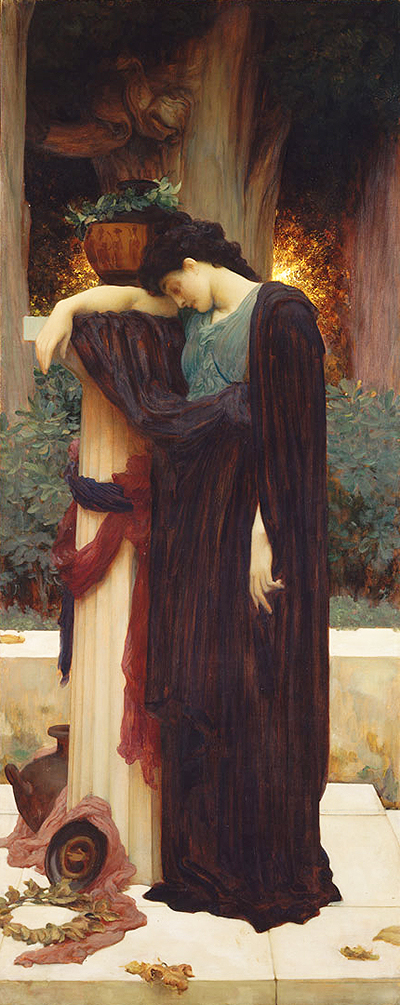
| Lachrymae | 1894–95 | Painting Catalogue. |
| Lieder ohne Worte | Exhibited 1861 | Painting Catalogue. |
| Light of the Harem | Exhibited 1880 | Painting Catalogue. |
| Moses Views the Promised Land (Tate A00736) | published 1881 | Print Catalogue. |
| Mrs James Guthrie | 1865 | Painting Catalogue. |
| Mrs John Hanson Walker (Tate N04731) | 1867 | Painting Catalogue. |
| Music Lesson | 1877 | Painting Catalogue. |
| Needless Alarms (Met cast) | modelled 1886; cast nineteenth century | Sculpture Catalogue. |
| Needless Alarms (Tate N05120) | 1886 | Sculpture Catalogue. |
| Pavonia | c. 1859 | Painting Catalogue. |
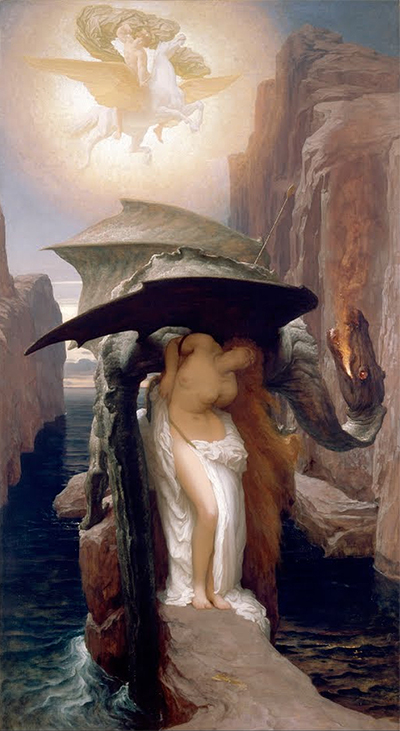
| Perseus and Andromeda | 1891 | Painting Catalogue. |
| Portrait of May Sartoris | c. 1860 | Painting Catalogue. |
| Preparing for a Festa, Florence (Tate T09062) | date not known | Drawing Catalogue. |
| Puerta de los Vientos, near Ronda, Spain (Tate N04006) | c.1886–9 | Painting Catalogue. |
| Samson and the Lions (Tate A00732) | published 1881 | Print Catalogue. |
| Samson at the Mill (Tate A00734) | published 1881 | Print Catalogue. |
| Samson Carrying the Gate (Tate A00738) | published 1881 | Print Catalogue. |
| Sketch for ‘An Athlete Wrestling with a Python’ (Tate N01761) | c.1877 | Sculpture Catalogue. |
| Sketches for Cimon and Iphigenia (Tate T09060) | date not known | Drawing Catalogue. |
| Study for The Return of Persephone (Demeter) | c. 1890–91 | Drawing Catalogue. |
| Study for The Return of Persephone (Persephone) | c. 1890–91 | Drawing Catalogue. |
| Study for ‘Needless Alarms’ (Tate N02945) | 1886 | Sculpture Catalogue. |
| Study for ‘The Discovery of Juliet Apparently Lifeless’ (Tate N01806) | c.1858 | Painting Catalogue. |
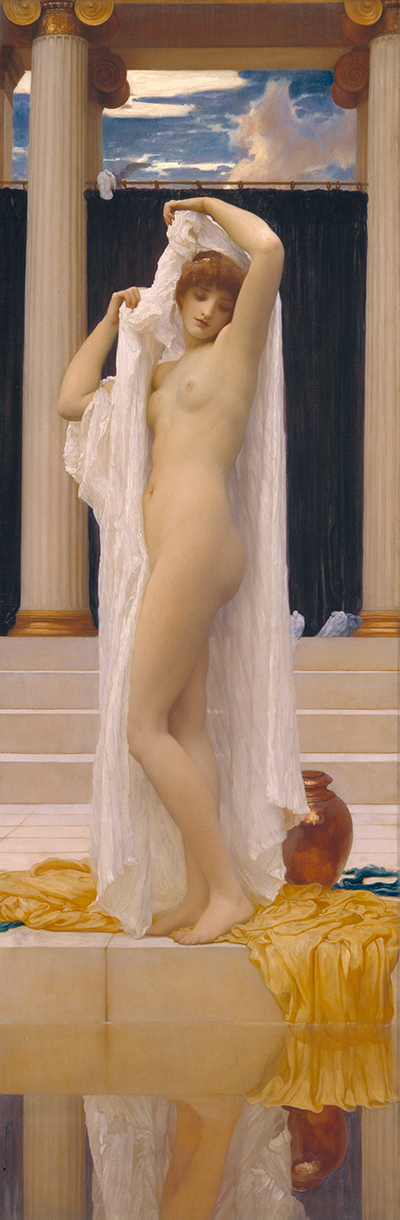
| The Bath of Psyche | Exhibited 1890 | Painting Catalogue. |
| The Daphnephoria | 1874–76 | Painting Catalogue. |
| The Death of Brunelleschi | 1852 | Painting Catalogue. |
| The Fisherman and the Siren | Exhibited 1858 | Painting Catalogue. |
| The Painter's Honeymoon | c. 1864 | Painting Catalogue. |
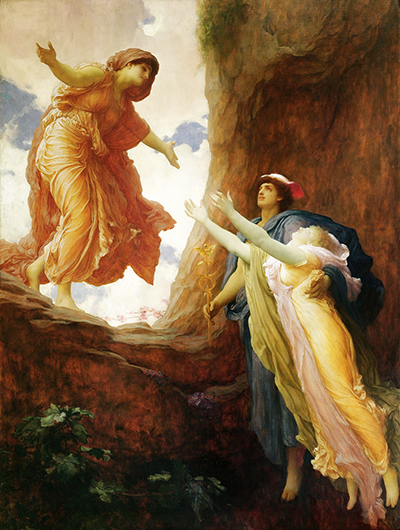
| The Return of Persephone | 1891 | Painting Leeds painting identified in the Met study record. |
| The Return of Persephone (preparatory oil) | c. 1890–91 | Painting Catalogue. |
| The Sluggard (Anglesey Abbey cast) | probably 1890–about 1906 | Sculpture Catalogue. |
| The Sluggard (Met cast) | modelled 1886; cast possibly before 1896 | Sculpture Catalogue. |
| The Sluggard (Museum Wales) | 1882–85 (museum date) | Sculpture Catalogue. |
| The Sluggard (Tate N01752) | 1885 | Sculpture Catalogue. |
| The Spies Escape (Tate A00730) | published 1881 | Print Catalogue. |
| Various Subjects (Tate T09063) | date not known | Drawing Catalogue. |
| View in Capri | Possibly 1859 | Painting Catalogue. |
| Wedded | 1882 | Painting Catalogue. |
| Winding the Skein | c. 1878 | Painting Catalogue. |
Discussion
Look again at the images and ideas explored in Elijah in the Wilderness. These editorial prompts invite your observations.
Reader Insights
Which details make it clear that Elijah has yet to wake?
What changes when you compare Leighton’s treatment of this story with the separate painting of Elisha?
Join the Conversation
Share a detail, comparison or question about Elijah in the Wilderness below.
References
- Walker Art Gallery, National Museums Liverpool, Elijah in the Wilderness, collection record and curatorial interpretation. View source.
- Paul Mellon Centre and A&AePortal, Elijah in the Wilderness, accession WAG 147, image record for Elizabeth Prettejohn’s Art for Art’s Sake. View source.
- First Book of Kings, chapters 17–19 and 21, King James Version. View source.
- Conferencia Episcopal Española, Primero de los Reyes, 19:4–8, Spanish biblical text. View source.
- Elizabeth Prettejohn, “The Future of Winckelmann’s Classical Form: Walter Pater and Frederic Leighton,” Journal of Latin Cosmopolitanism and European Literatures 6, 2021, pp. 34–36. View source.
- Museum für Abgüsse Klassischer Bildwerke München, Barberinischer Faun, catalogue and comparison with the Glyptothek original. View source.
- Keren Rosa Hammerschlag, Frederic Leighton: Death, Mortality, Resurrection, 2015, introduction, pp. 7–8. View source.
- Emilie Barrington, The Life, Letters and Work of Frederic Leighton, vol. II, 1906, letter of 29 April 1863 and chapters V–VI. View source.
- National Gallery of Victoria, Study for Elijah in the wilderness, 38-2. View source.
- Sotheby’s, Study for Elijah in the Wilderness, lot 15, 15 December 2021. View source.
- Universal Exposition, St Louis, Official Catalogue of Exhibitors, 1904, British fine art, no. 622. View source.
- Walker Art Gallery, “Artwork of the Month – September 2007,” republished by Art in Liverpool, the commission and Kurtz’s diaries. View source.
- Paris Universal Exposition, Catalogue of the British Fine Art Section, 1878, p. 21, nos. 135–137. View source.
- Lippincott’s Magazine of Popular Literature and Science, vol. 22, November 1878, report on the Paris Exposition. View source.
- The Examiner, Royal Academy exhibition review, 3 May 1879, no. 188. View source.
- Ernest Rhys, Frederic Lord Leighton: An Illustrated Record of His Life and Work, chapter V and Appendix I. View source.
- Royal Academy of Arts, Exhibition of Works by the Late Lord Leighton of Stretton, 1897, no. 135. View source.
- A. Lys Baldry, Leighton, plate VII, Elijah in the Wilderness. View source.
- Peter Schatborn, The Leiden Collection, Ferdinand Bol, Angel Appearing to Elijah, FB-104. View source.
- National Museum of Western Art, Tokyo, Conrad Lauwers after Peter Paul Rubens, The Prophet Elijah Fed by an Angel, G.1992-0059. View source.
- Gallerie degli Uffizi, Daniele da Volterra, Elia nel deserto, acquisition notice and iconography. View source.
- Metropolitan Museum of Art, Jan Muller, Elijah Fed by Ravens. View source.
- Cleveland Museum of Art, A raven brings food to Elijah, 1602–04, 2005.145.72.a. View source.
- Christie’s, Frank Dicksee, The Symbol, catalogue note on his Royal Academy training and prize painting. View source.
- Ernest Chesneau, Artistes anglais contemporains, 1887, section on Leighton, digitised scan p. 39. View source.
- Algernon Graves, The Royal Academy of Arts: A Complete Dictionary of Contributors and Their Work, vol. V, Leighton’s exhibition entries, 1879 no. 188 and 1881 no. 49. View source.
- Second Book of Kings, chapter 4, verses 8–37, King James Version. View source.