 by Tom Gurney
Tom Gurney BSc (Hons) is an art history expert with over 20 years experience
Published on June 19, 2020 / Updated on November 29, 2026
Email: tomgurney1@gmail.com / Phone: +44 7429 011000
Jonathan’s Token to David: Introduction
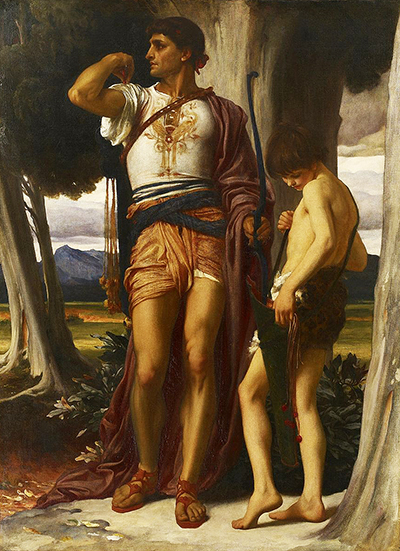
Jonathan stands on a patch of pale ground, holding a tall bow upright. A boy at his side looks down as he steadies a quiver. Beyond the trees, the field opens towards a line of blue hills. David, the man whose life depends on what happens next, is somewhere out of sight. Frederic Leighton painted Jonathan’s Token to David around 1868. The oil on canvas measures 171.5 × 124.5 cm and belongs to the Minneapolis Institute of Art, which records it as accession 74.71. [1]
At a Glance
- PaintedAbout 1868
- ExhibitedRoyal Academy, 1868, no. 227
- SubjectFirst Book of Samuel, chapter 20
- CollectionMinneapolis Institute of Art, 74.71
This work across Frederic Leighton’s career
Cimabue’s Celebrated Madonna
1853–55Lachrymae
1894–95Flaming June
c. 1895Contents
- What Jonathan’s signal means
- The bow, the boy and the view through the trees
- Michelangelo’s David in Jonathan’s pose
- What the Academy audience saw in 1868
- Two other ways of painting David’s story
- Annotated details
What Jonathan’s signal means
In the First Book of Samuel, David fears that King Saul means to kill him. Jonathan, Saul’s son and David’s friend, agrees to find out. David will miss the new-moon feast and stay in hiding. If Saul accepts an excuse for the empty seat, David can return. At first Saul says nothing. On the second day, he demands to know why David is absent. Jonathan defends him, and Saul tells his son that his own claim to the throne is in danger as long as David lives. When Jonathan asks what David has done to deserve death, Saul hurls a spear at him. Jonathan now knows what he must tell his friend. [2]
They have already arranged a signal. Jonathan will shoot towards the place where David is hiding and send an attendant to retrieve the arrows. If he calls out that the arrows are this side of the boy, David is safe. If they have gone beyond him, David must leave. The plan specifies three arrows. In the King James Bible the account of the following morning describes one arrow going beyond the boy before referring to the arrows he brings back. The boy can do exactly what Jonathan asks without knowing that anyone else is listening. [2]
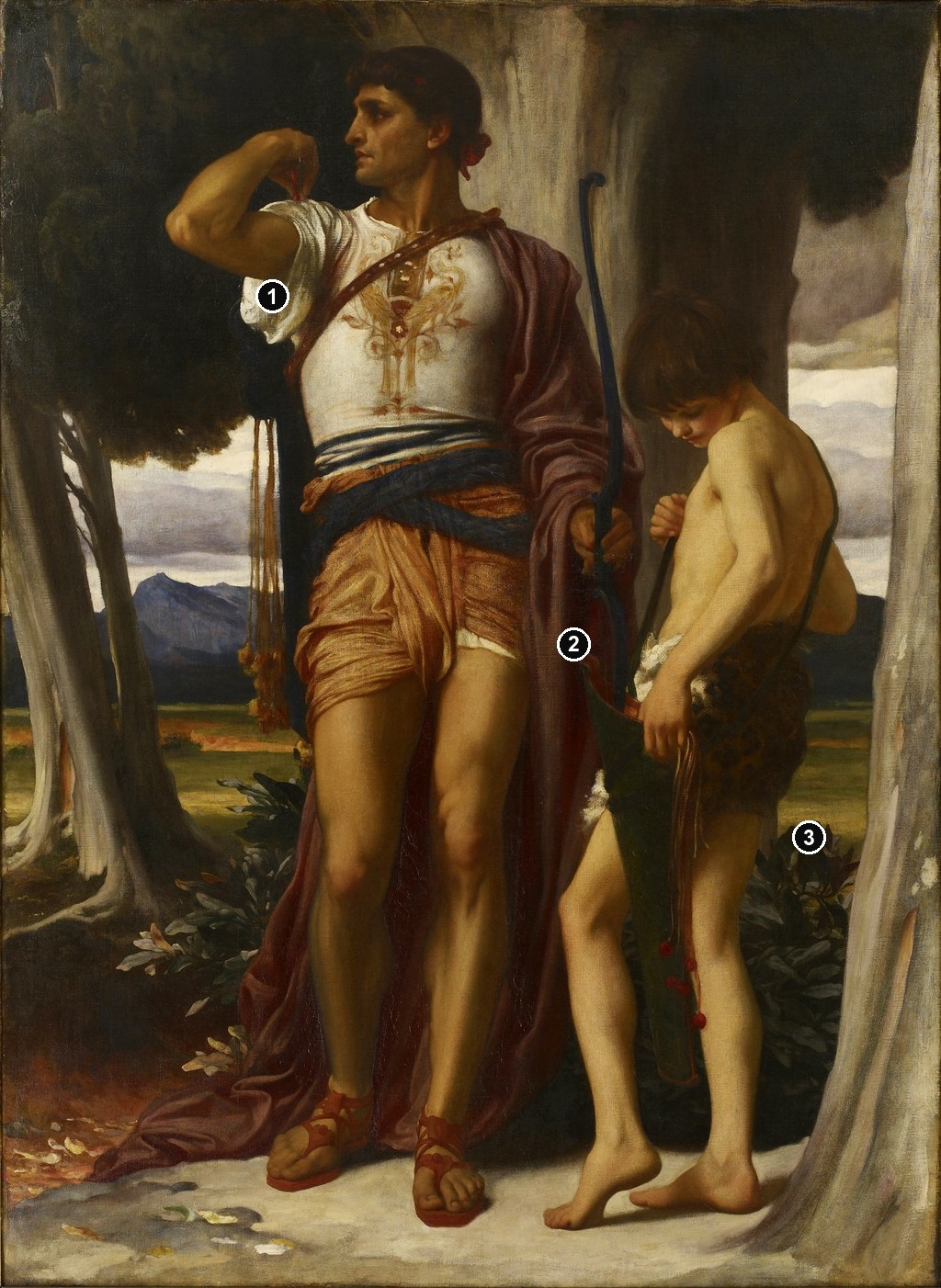
The boy has yet to run in the painting. Jonathan grips the bow low, with his other arm bent up near his shoulder. His eyes are already on the open ground. Leighton’s picture makes sense of the word token in its title through these ordinary objects and movements. The warning will pass as an instruction to fetch an arrow. Once the boy has gathered the equipment and gone back to town, David emerges, and the friends say goodbye. Leighton stays with the moment when Jonathan still has work to do. [1] [2]
The bow, the boy and the view through the trees
Jonathan’s face turns sharply to the left, into the dark of the foliage. His bent arm projects in the same direction, clearing his profile. You can follow the line back down across the gold design on his white chest, then along the dark blue folds wound round his waist. The crossings of the strap and sash break up the light on a figure whose stance is otherwise steady. His reddish cloak drops from one shoulder to the ground and spreads behind him. The cloth sweeps to the left, leaving his bare knees and red-strapped sandals clear against the earth. [1]
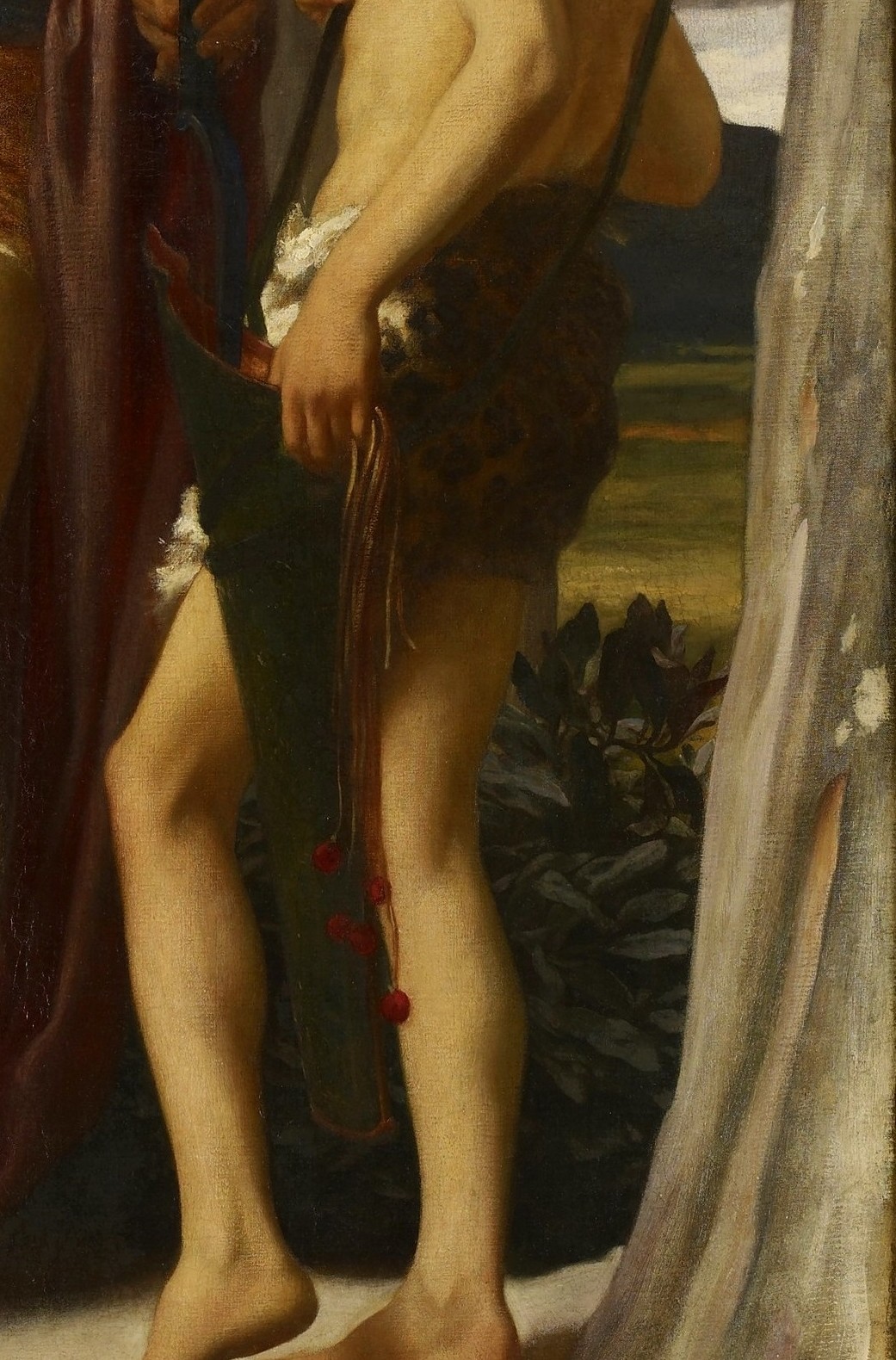
The boy has a narrower part of the canvas. His lowered head brings him into the shadow below Jonathan’s hand, and his bare back takes the light across a single broad curve. He holds the quiver close, with one heel lifted from the ground. Its long body and the curve of the bow almost meet between the figures. Jonathan’s sandals are planted, while the boy is still shifting to balance the quiver. The boy looks ready to move. [1]
Trunks run almost the full height of the picture, with roots and bits of foliage at the figures’ feet. One pale trunk picks up the light behind Jonathan’s head. On the left, dark trees give way to strips of lighter field and sky and then to the distant blue ridge. A second opening lies beyond the boy’s shoulder. The gaps between the trees invite us to look for David while keeping his hiding place a secret. [1] [2]
Annotated Details from Jonathan’s Token to David
The numbered points identify visible features discussed in this article. Return from each detail to the numbered overview. Each caption identifies the work shown.
Jonathan’s Token to David
Frederic Leighton, Jonathan’s Token to David, c. 1868. Minneapolis Institute of Art. Image source. Public domain. Resized proportionally.
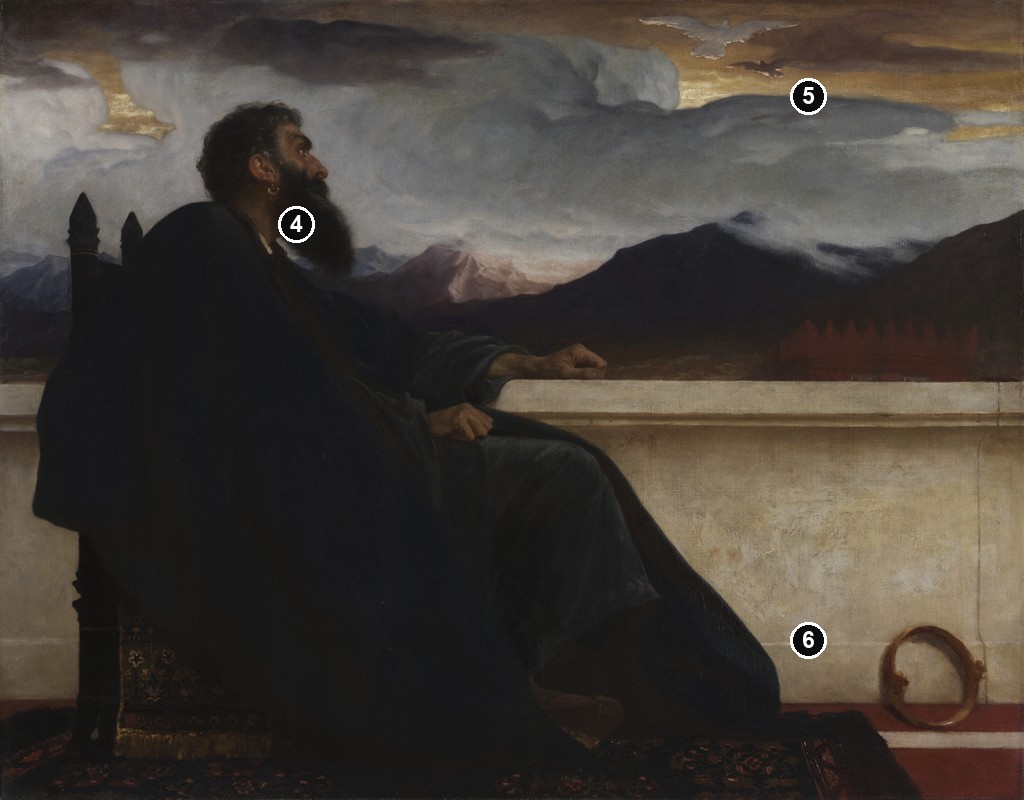
David
Frederic Leighton, David, 1865. The Cleveland Museum of Art. The Cleveland Museum of Art, Leonard C. Hanna Jr. Fund. Image source. CC0 / Public domain. Resized proportionally.
Details from JONATHAN’S TOKEN TO DAVID
Compare the cropped details with the source images above. Notice how their colours, shapes and positions contribute to the larger compositions.
Jonathan’s Token to David
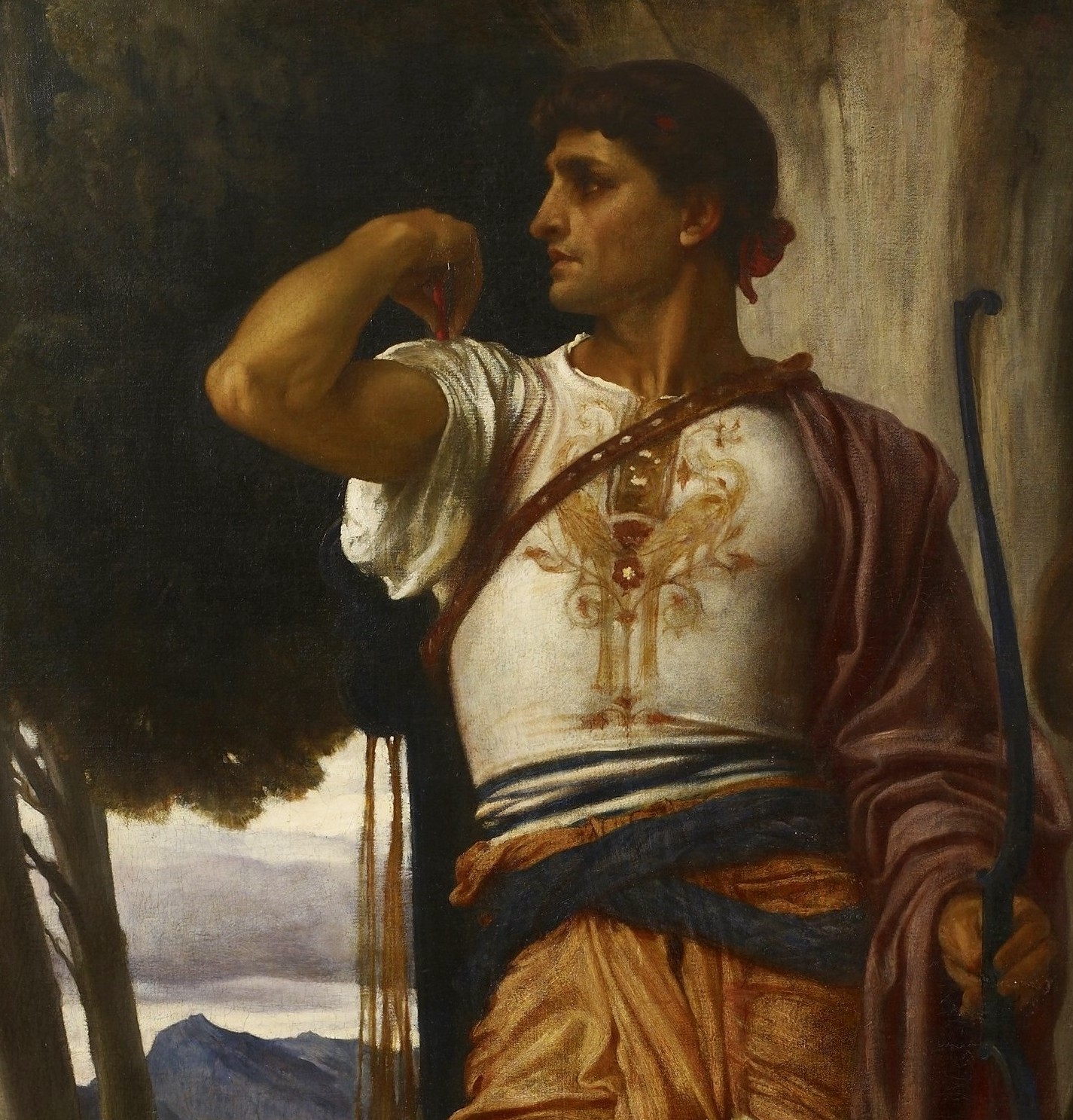
A glance towards the clearing
Jonathan turns his head across the opening while his raised arm draws a curve next to his profile. Bright armour holds his torso against the dark foliage.
The upright bow and the companion
Upright lines separate the two bodies. The young attendant lowers his head as his shoulders, hands and attention remain closer to the ground.
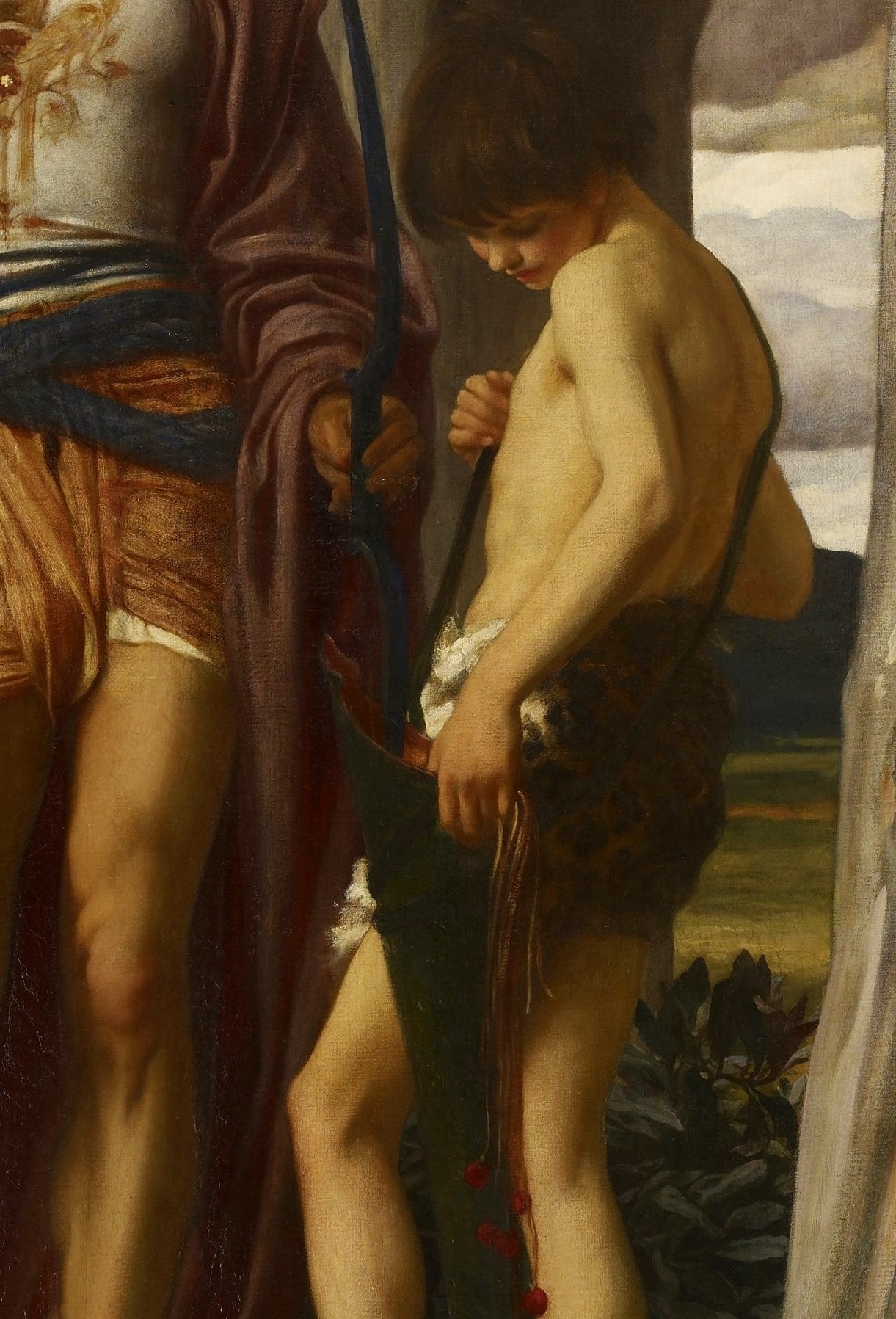
The attendant waits beside the tree
The attendant lowers his head where sunlight catches his limbs. His feet and the root beside them carry the pose down to the forest floor.
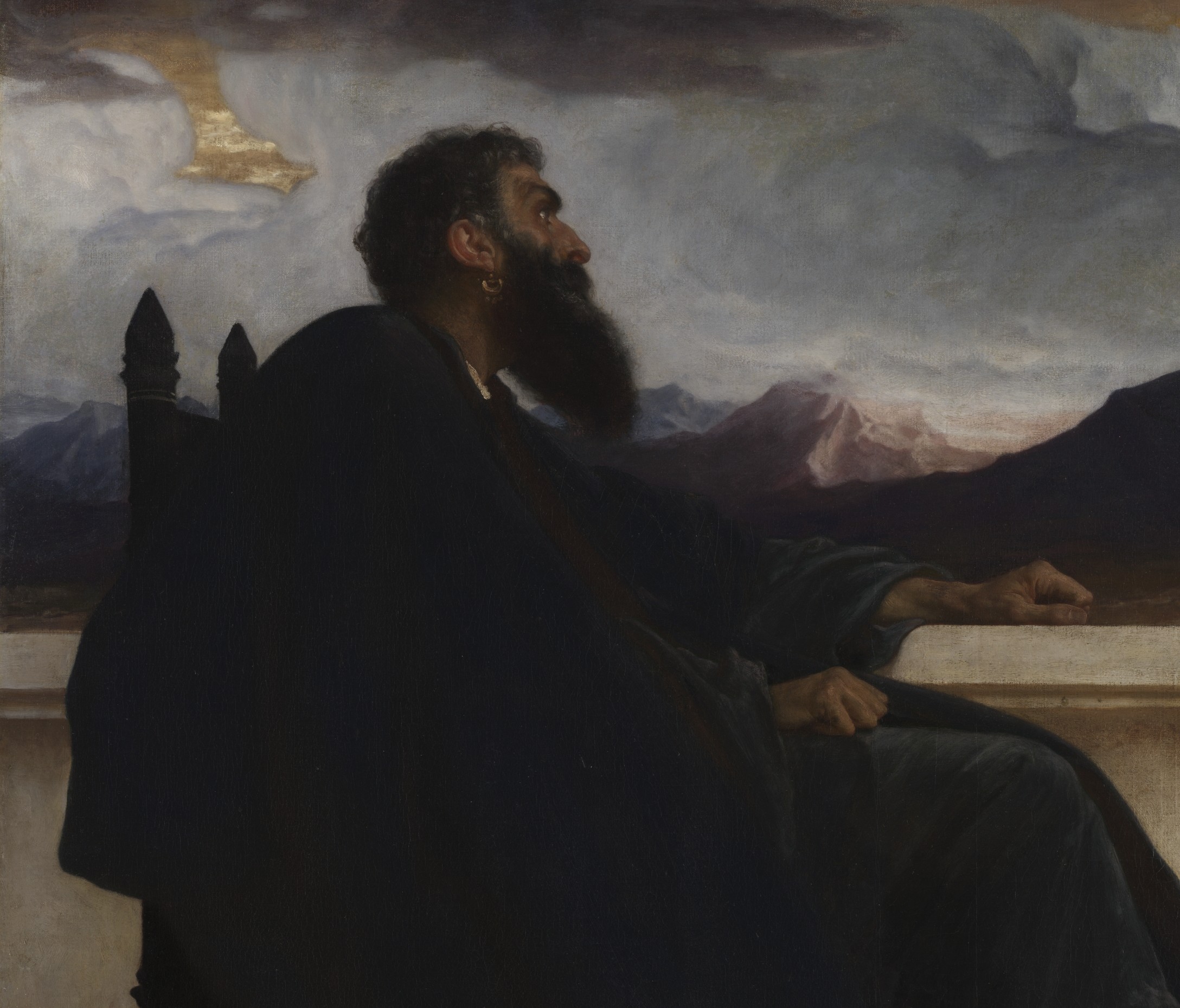
David
David’s profile above the parapet
The edge of David’s dark robe almost merges into the wall and landscape. Light on the face makes the direction of the gaze easier to read.
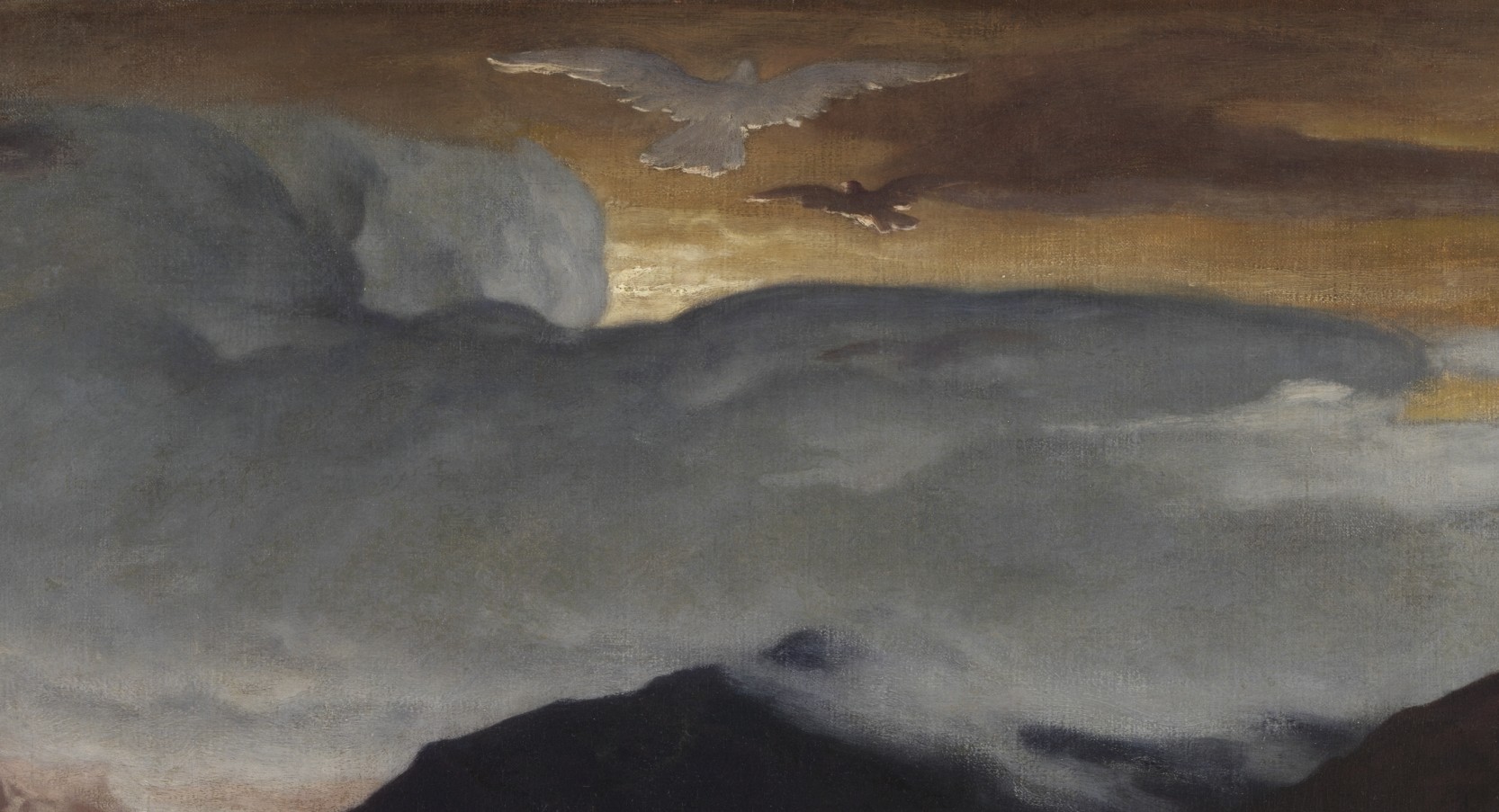
Two birds above the mountains
The lighter bird opens its wings against the sky. The smaller shape below it is close in tone to the clouds. Their movement gives David something to follow across the landscape.
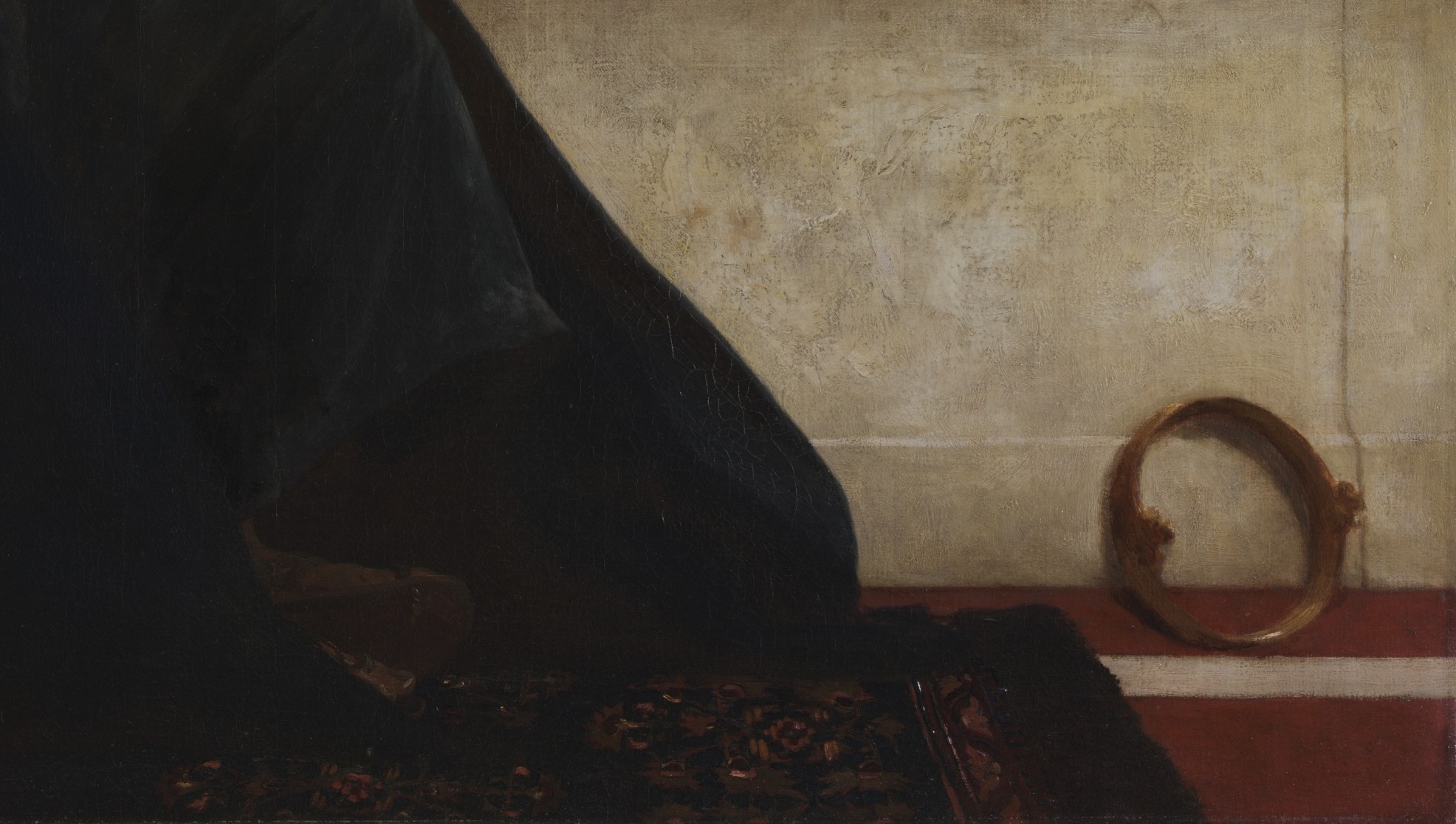
A crown on the pavement
Gold relief catches the light at the lower right. Its small scale and low position leave the king’s face and the far-off horizon to hold the main emphasis.
Michelangelo’s David in Jonathan’s pose
The Minneapolis Institute of Art identifies Michelangelo’s marble David as the source for Jonathan’s pose. The turn of the head, the bent arm and the opposing shifts of the upper body and hips recall the Renaissance sculpture. Michelangelo’s raised hand gathers the sling at his shoulder. The young man’s attention is on an opponent outside our view. Leighton adapts that watchfulness to an archer looking across a field, where the person we have reason to think about is a friend. The sculpture is in the Galleria dell’Accademia in Florence. [1] [3]
Art historian Elizabeth Prettejohn points out that the legs also show how freely Leighton handled the model. Jonathan’s stance is more contained than Michelangelo’s, whose relaxed leg moves farther away from the one carrying his weight. Prettejohn sees a possible parallel in the poised stance of figures associated with the ancient Greek sculptor Polykleitos. She also suggests that giving Jonathan a form recognisable as David may be Leighton’s way of making the intimacy between the two men felt while keeping one of them outside the picture. [4]
A living model may also lie behind Jonathan’s profile and muscular arm. Scott Thomas Buckle has proposed Alessandro di Marco, the Italian model who was working in London by 1867 and began posing regularly at the Royal Academy in 1868. Alphonse Legros’s etched study of a man from around 1867 provides a possible likeness of di Marco away from a biblical role. In the print, close marks pick out the strong nose and hollow of the cheek that draw the eye in Leighton’s profile. The likeness helps explain Buckle’s suggestion. The sitter in Leighton’s painting is still unconfirmed. [5] [6]
What the Academy audience saw in 1868
Leighton exhibited Jonathan’s Token to David in the East Room of the Royal Academy’s 1868 exhibition. The catalogue lists it as no. 227 and pairs the title with the verse in which Jonathan goes into the field with the boy. The catalogue still identifies Leighton as an Associate. He was elected a full Academician later that year. Visitors who crossed into the West Room found his Acme and Septimius, a scene of two lovers from Catullus. [7] [8] [9]
The reviewer for The Art Journal thought the strength of the colour recalled Titian. The two pictures at the Academy gave that critic a way to describe the range of Leighton’s painting. The scene from Catullus was intimate and romantic, while the episode from Samuel called for a more austere manner. Yet the glowing orange cloth and the rose of the cloak give Jonathan a warmth a painter could just as readily have brought to the scene of two lovers. [1] [10]
The poet Algernon Charles Swinburne praised Jonathan’s bearing and read concern for David in his face. He also singled out the boy’s natural movement under the weight of the quiver. In writing about the painting, he recalled David’s lament after Jonathan’s death in the Second Book of Samuel, where David speaks of a love that surpassed the love of women. Swinburne brought that later expression of grief to a scene whose two friends have yet to meet. His appreciation of the boy shows how much the effect depended on the small movements beside Leighton’s heroic figure. [11] [12]
Two other ways of painting David’s story
Rembrandt gives the same episode a later moment in David and Jonathan (1642), now in the State Hermitage Museum. The two men hold each other as their parting sinks in. The viewer is close enough to see the bowed head and feel the embrace draw the figures together. Knowing what preceded that moment gives Leighton’s choice greater weight. With the men still apart, Jonathan must convey his feelings through a series of actions that the boy beside him will take for an ordinary morning’s practice. [1] [2] [13]
Leighton had painted David himself three years earlier. The Cleveland Museum of Art holds that picture, David (1865), whose extended title quotes Psalm 55 and its wish for wings and rest. The older king sits above the city gate after hearing of the death of his son Absalom. He looks across the mountains, with his crown on the ground and two birds in the distance. There, the figure’s gaze carries the desire to get away. In Minneapolis, the gaze is Jonathan’s and it is David who will have to go. Leighton gives a still figure an open view in each work, but the two landscapes hold very different kinds of distance. [1] [14]
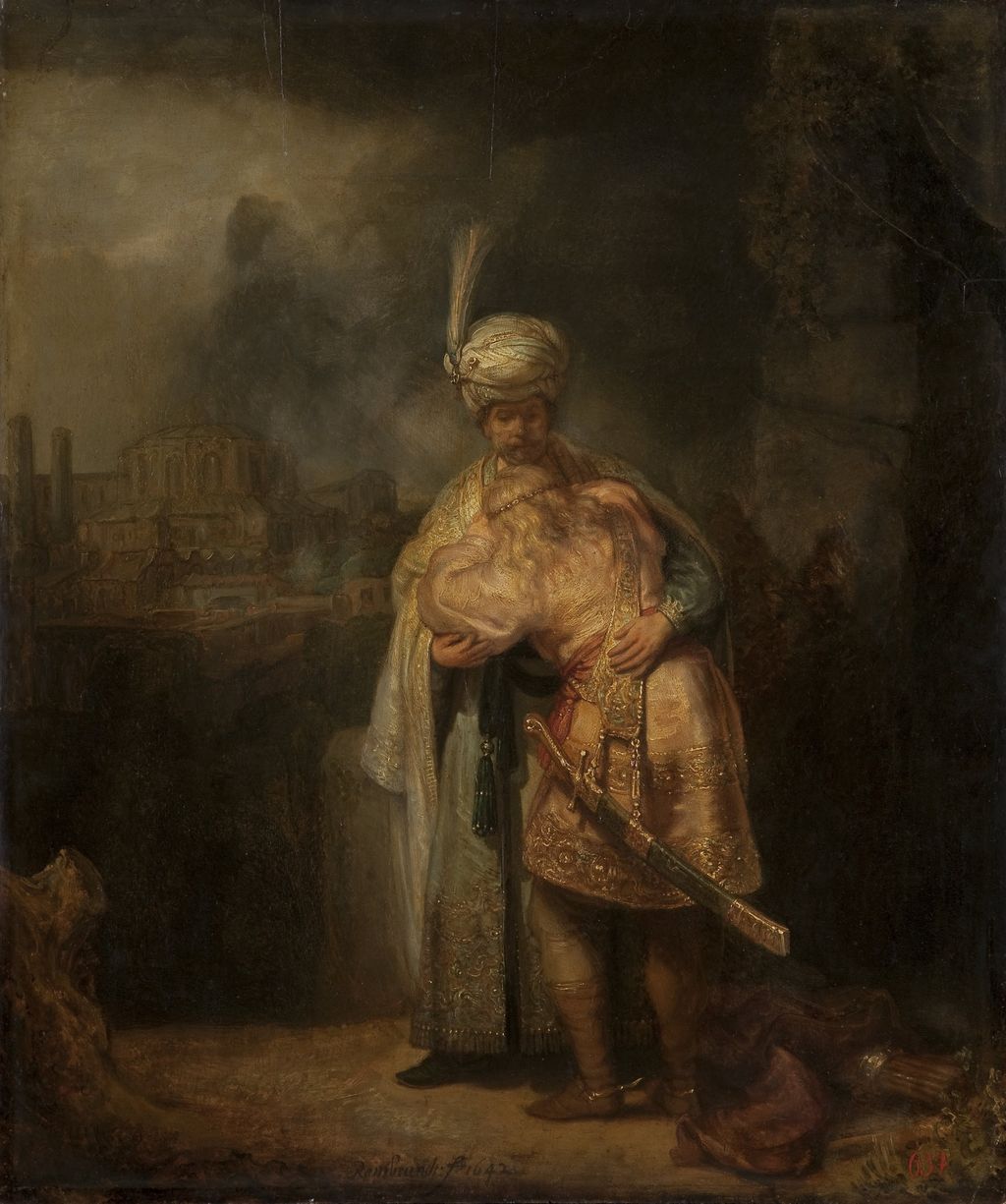
Rembrandt, David and Jonathan, 1642. State Hermitage Museum, St Petersburg. Image source. Public domain. Resized proportionally.
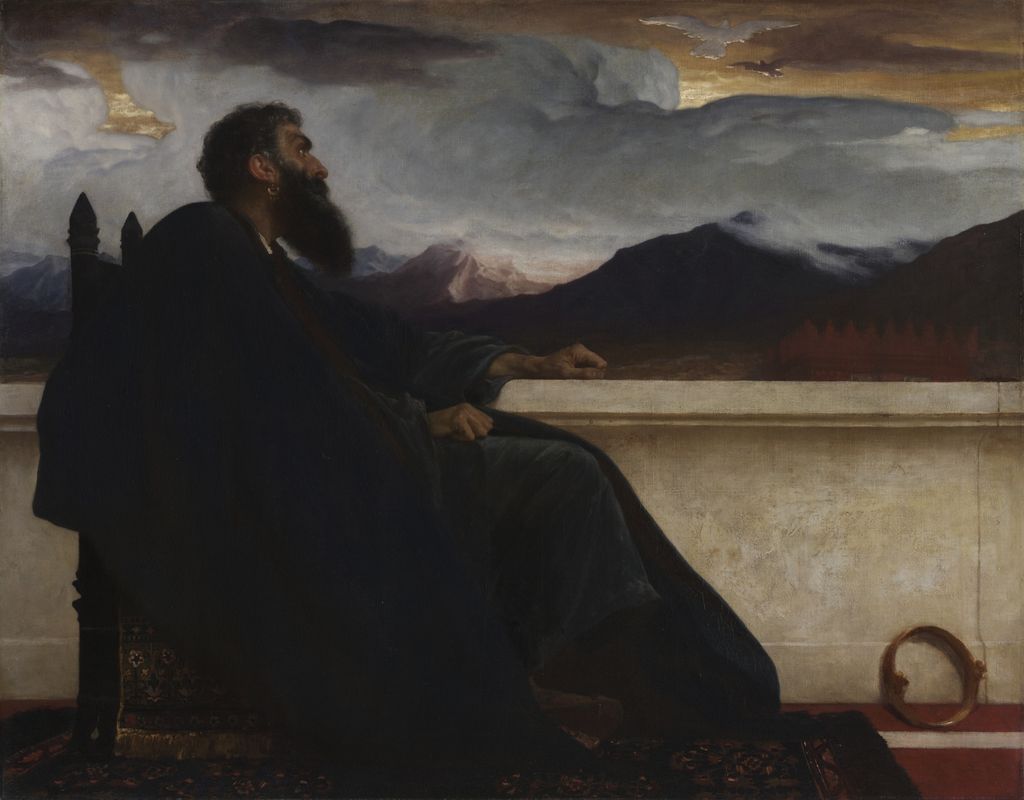
Frederic Leighton, David, 1865. The Cleveland Museum of Art. The Cleveland Museum of Art, Leonard C. Hanna Jr. Fund. Image source. CC0 / Public domain. Resized proportionally.
Browse Frederic Leighton’s artworks
Explore paintings, drawings, sculptures and prints, with separate rows for identified preparatory works, reproductions and casts.
| Name | Date | Medium |
|---|---|---|
| A Girl Feeding Peacocks | Exhibited 1863 | Painting Catalogue. |
| A Recognition from ‘Romola’, engraved by Swain (Tate N04054) | published 1862 | Print Catalogue. |
| A Roman Lady | 1859 | Painting Catalogue. |
| Abram and the Angel (Tate A00733) | published 1881 | Print Catalogue. |
| Acme and Septimius | Exhibited 1868 | Painting Catalogue. |
| An Athlete Wrestling with a Python (Tate exhibition bronze) | 1877 | Sculpture Catalogue. |
| And the Sea Gave Up the Dead Which Were in It (Tate N01511) | 1891–92 | Painting Catalogue. |
| Andromache in Captivity (photogravure after Leighton) | 1889 | Print Catalogue. |
| Athlete Wrestling with a Python (Anglesey Abbey cast) | model 1877; cast 1905 | Sculpture Catalogue. |
| Athlete Wrestling with a Python (Hood reduced cast) | 1877 (inscribed model date) | Sculpture Catalogue. |
| Athlete Wrestling with a Python (Saint Louis reduced cast) | 1877 (museum date) | Sculpture Catalogue. |
| Cain and Abel (Tate A00731) | published 1881 | Print Catalogue. |
| Captive Andromache | 1888 | Painting Catalogue. |
| Cimabue's Celebrated Madonna | 1853–55 | Painting Catalogue. |
| Cimon and Iphigenia, with Many Smaller Subjects (Tate T09061) | date not known | Drawing Catalogue. |
| Crenaia, the Nymph of the Dargle | Exhibited 1880 | Painting Catalogue. |
| Cymon and Iphigenia | 1884 | Painting Catalogue. |
| Daedalus and Icarus | 1869 | Painting Catalogue. |
| Dante in Exile | 1864 | Painting Catalogue. |
| Death of the First Born (Tate A00737) | published 1881 | Print Catalogue. |
| Electra at the Tomb of Agamemnon | c. 1869 | Painting Catalogue. |
| Eliezer and Rebekah (Tate A00735) | published 1881 | Print Catalogue. |
| Elijah in the Wilderness | 1877–78 | Painting Catalogue. |
| Fanny Kemble: A Study for ‘Jezebel and Ahab’ (Tate T08208) | c.1862 | Drawing Catalogue. |
| Figure Studies | Date not recorded | Drawing Catalogue. |
| Flaming June | 1895 | Painting Catalogue. |
| Gulnihal | Exhibited 1886 | Painting Catalogue. |
| Helios and Rhodes (Tate N03015) | date not known | Painting Catalogue. |
| Hercules Wrestling with Death for the Body of Alcestis | c. 1869–71 | Painting Catalogue. |
| Jonathan's Token to David | c. 1868 | Painting Catalogue. |
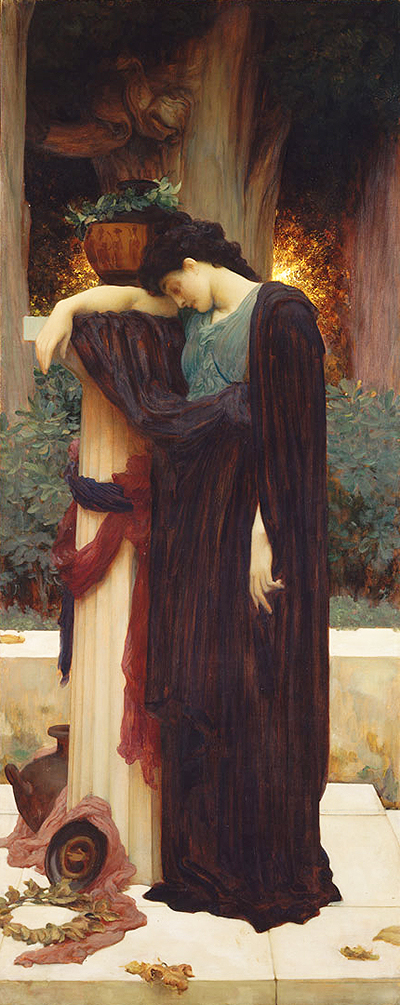
| Lachrymae | 1894–95 | Painting Catalogue. |
| Lieder ohne Worte | Exhibited 1861 | Painting Catalogue. |
| Light of the Harem | Exhibited 1880 | Painting Catalogue. |
| Moses Views the Promised Land (Tate A00736) | published 1881 | Print Catalogue. |
| Mrs James Guthrie | 1865 | Painting Catalogue. |
| Mrs John Hanson Walker (Tate N04731) | 1867 | Painting Catalogue. |
| Music Lesson | 1877 | Painting Catalogue. |
| Needless Alarms (Met cast) | modelled 1886; cast nineteenth century | Sculpture Catalogue. |
| Needless Alarms (Tate N05120) | 1886 | Sculpture Catalogue. |
| Pavonia | c. 1859 | Painting Catalogue. |
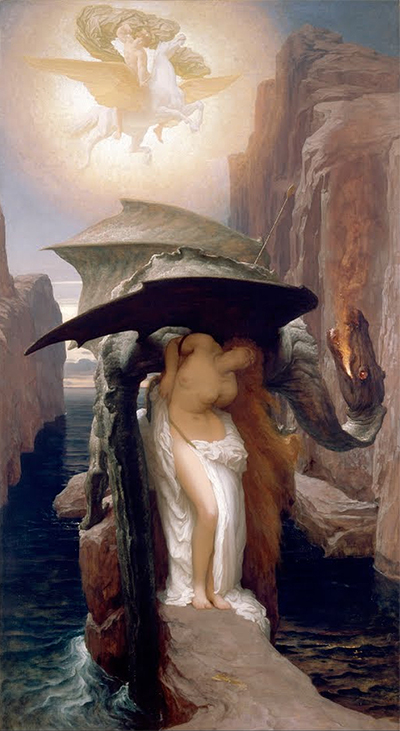
| Perseus and Andromeda | 1891 | Painting Catalogue. |
| Portrait of May Sartoris | c. 1860 | Painting Catalogue. |
| Preparing for a Festa, Florence (Tate T09062) | date not known | Drawing Catalogue. |
| Puerta de los Vientos, near Ronda, Spain (Tate N04006) | c.1886–9 | Painting Catalogue. |
| Samson and the Lions (Tate A00732) | published 1881 | Print Catalogue. |
| Samson at the Mill (Tate A00734) | published 1881 | Print Catalogue. |
| Samson Carrying the Gate (Tate A00738) | published 1881 | Print Catalogue. |
| Sketch for ‘An Athlete Wrestling with a Python’ (Tate N01761) | c.1877 | Sculpture Catalogue. |
| Sketches for Cimon and Iphigenia (Tate T09060) | date not known | Drawing Catalogue. |
| Study for The Return of Persephone (Demeter) | c. 1890–91 | Drawing Catalogue. |
| Study for The Return of Persephone (Persephone) | c. 1890–91 | Drawing Catalogue. |
| Study for ‘Needless Alarms’ (Tate N02945) | 1886 | Sculpture Catalogue. |
| Study for ‘The Discovery of Juliet Apparently Lifeless’ (Tate N01806) | c.1858 | Painting Catalogue. |
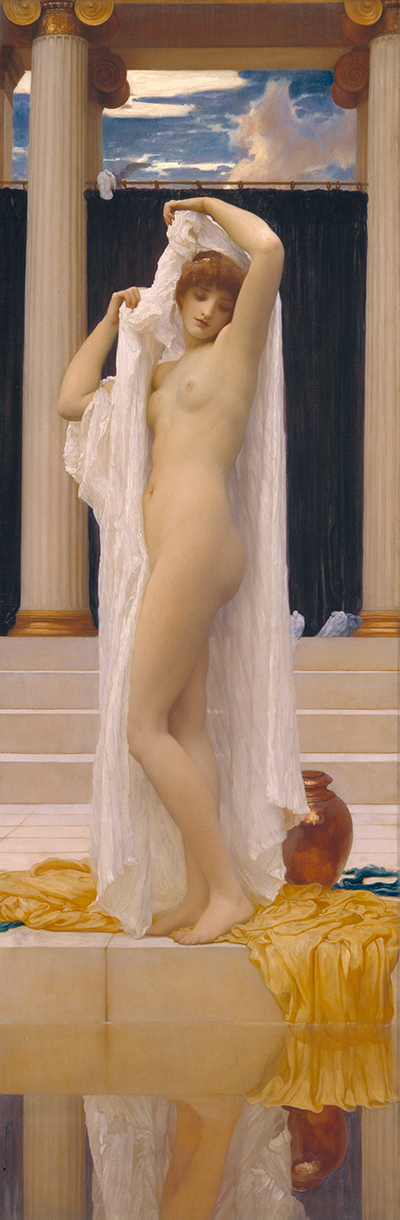
| The Bath of Psyche | Exhibited 1890 | Painting Catalogue. |
| The Daphnephoria | 1874–76 | Painting Catalogue. |
| The Death of Brunelleschi | 1852 | Painting Catalogue. |
| The Fisherman and the Siren | Exhibited 1858 | Painting Catalogue. |
| The Painter's Honeymoon | c. 1864 | Painting Catalogue. |
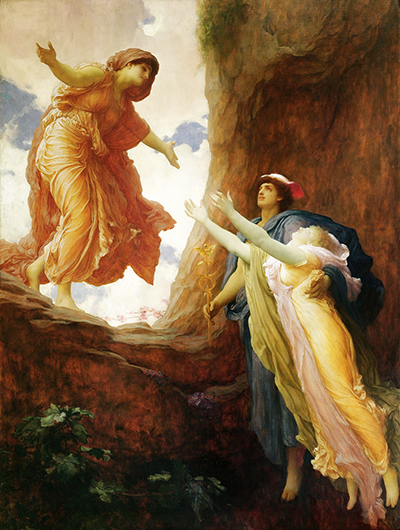
| The Return of Persephone | 1891 | Painting Leeds painting identified in the Met study record. |
| The Return of Persephone (preparatory oil) | c. 1890–91 | Painting Catalogue. |
| The Sluggard (Anglesey Abbey cast) | probably 1890–about 1906 | Sculpture Catalogue. |
| The Sluggard (Met cast) | modelled 1886; cast possibly before 1896 | Sculpture Catalogue. |
| The Sluggard (Museum Wales) | 1882–85 (museum date) | Sculpture Catalogue. |
| The Sluggard (Tate N01752) | 1885 | Sculpture Catalogue. |
| The Spies Escape (Tate A00730) | published 1881 | Print Catalogue. |
| Various Subjects (Tate T09063) | date not known | Drawing Catalogue. |
| View in Capri | Possibly 1859 | Painting Catalogue. |
| Wedded | 1882 | Painting Catalogue. |
| Winding the Skein | c. 1878 | Painting Catalogue. |
Discussion
Look again at the images and ideas explored in Jonathan’s Token to David. These editorial prompts invite your observations.
Reader Insights
Where is Jonathan looking and what can the attendant see from where he stands?
How do you read the painting once you know why David must stay concealed?
Join the Conversation
Share a detail, comparison or question about Jonathan’s Token to David below.
References
- Minneapolis Institute of Art, Jonathan’s Token to David, c. 1868, accession 74.71, object 2127. View collection record. View source.
- First Book of Samuel, chapter 20, King James Version, especially verses 18–42. Read the chapter. View source.
- Galleria dell’Accademia di Firenze, Michelangelo, David. View sculpture. View source.
- Elizabeth Prettejohn, “The Future of Winckelmann’s Classical Form: Walter Pater and Frederic Leighton,” Journal of Latin Cosmopolitanism and European Literatures 6, 2021, pp. 44–46 and fig. 4. Read the article. View source.
- Scott Thomas Buckle, “Is this the face of Alessandro di Marco? The forgotten features of a well-known Italian model,” The British Art Journal, pp. 69–71 and figs. 8–9. Read the article. View source.
- Bibliothèque nationale de France, Alphonse Legros, Étude de tête d’homme, ca. 1867, catalogue record with the Dijon identification. View catalogue data. View source.
- Royal Academy of Arts, The Exhibition of the Royal Academy of Arts, the One Hundredth, 1868, East Room, p. 14, no. 227. View the original catalogue page. View source.
- Royal Academy of Arts, The Exhibition of the Royal Academy of Arts, the One Hundredth, 1868, West Room, p. 25, no. 449. View the original catalogue page. View source.
- Leighton House, “Frederic Leighton,” Royal Academy membership chronology. Read the artist biography. View source.
- The Art Journal, review of the 1868 Royal Academy exhibition, pp. 105–106, no. 227. Read the exhibition review. View source.
- William Michael Rossetti and Algernon Charles Swinburne, Notes on the Royal Academy Exhibition, 1868, pp. 37 and 53. Read the exhibition reviews. View source.
- Second Book of Samuel, chapter 1, verses 17–27, King James Version. Read David’s lament. View source.
- State Hermitage Museum, Rembrandt, David and Jonathan, 1642, inv. ГЭ-713. View collection record. View source.
- Cleveland Museum of Art, Frederic Leighton, David, 1865, accession 1986.74. View collection record. View source.