 by Tom Gurney
Tom Gurney BSc (Hons) is an art history expert with over 20 years experience
Published on June 19, 2020 / Updated on November 29, 2026
Email: tomgurney1@gmail.com / Phone: +44 7429 011000
Cimabue’s Celebrated Madonna: Introduction
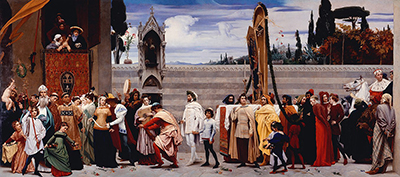
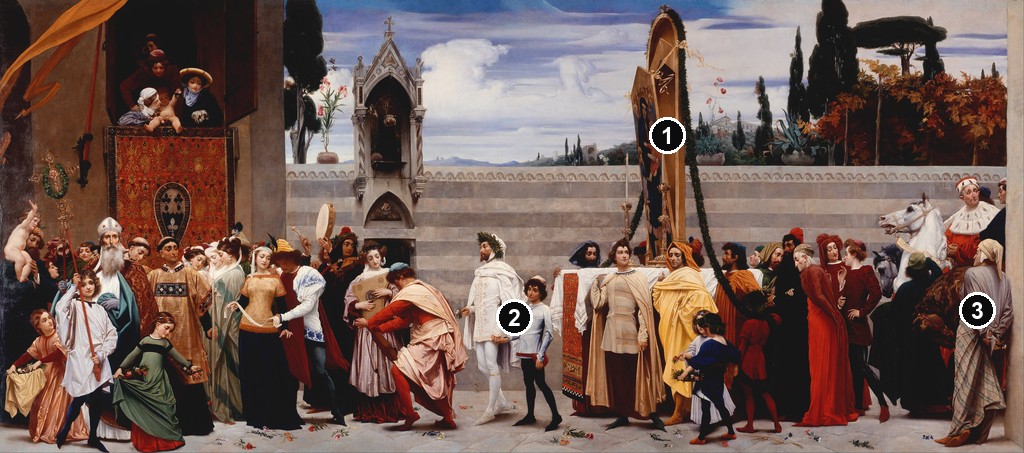
A crowd moves across a sunlit Florentine street. Musicians and clergy lead the way, children bring flowers, and a nursemaid lifts a baby high enough to see. In the middle of it all, a young boy reaches for a man’s hand. The man in white is Cimabue, the boy is his pupil Giotto, and the gold-ground painting behind them is the reason the city has come out. Frederic Leighton painted this scene in 1853–55 and called it Cimabue’s Celebrated Madonna is carried in Procession through the Streets of Florence. The canvas, more than five metres wide, belongs to the Royal Collection and is on loan to the National Gallery in London. The medieval altarpiece that inspired it is in the Uffizi in Florence, which identifies its painter as Duccio di Buoninsegna. [1] [2] [3]
At a Glance
- Painted1853–55
- MediumOil on canvas
- CollectionRoyal Collection, RCIN 401478
- First exhibitedRoyal Academy, 1855
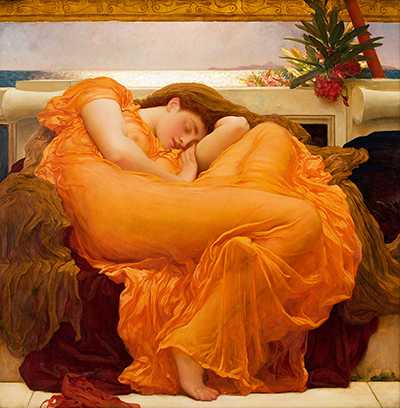
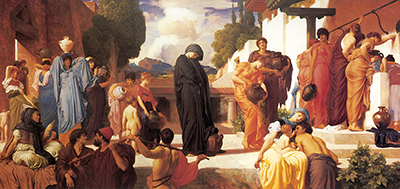
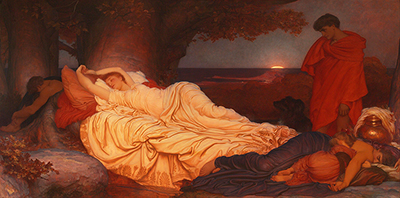
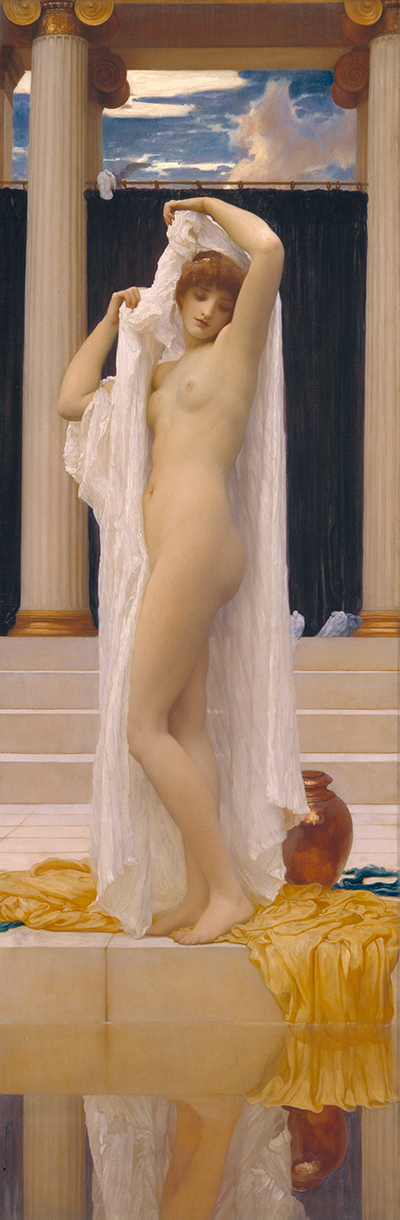
This work across Frederic Leighton’s career
Contents
- A procession across the canvas
- Vasari’s story and Duccio’s altarpiece
- Making Florence in Rome
- Queen Victoria, Ruskin and the Academy
- Annotated details
A procession across the canvas
Leighton gives the crowd room to spread out. A long wall runs behind the figures, setting their faces and costumes off against the pale stone. The upper edge of the wall keeps the movement horizontal until the eye reaches the trees, rooftops and church beyond. High above the street, the people at the window and on the balcony have a different view from ours. The nursemaid leans forward with the child in her arms and, amid all the talking and walking, the baby seems to look directly at the Madonna. Leighton lets a small act of curiosity compete for attention with the ceremony that has brought everyone outside. [1] [2]
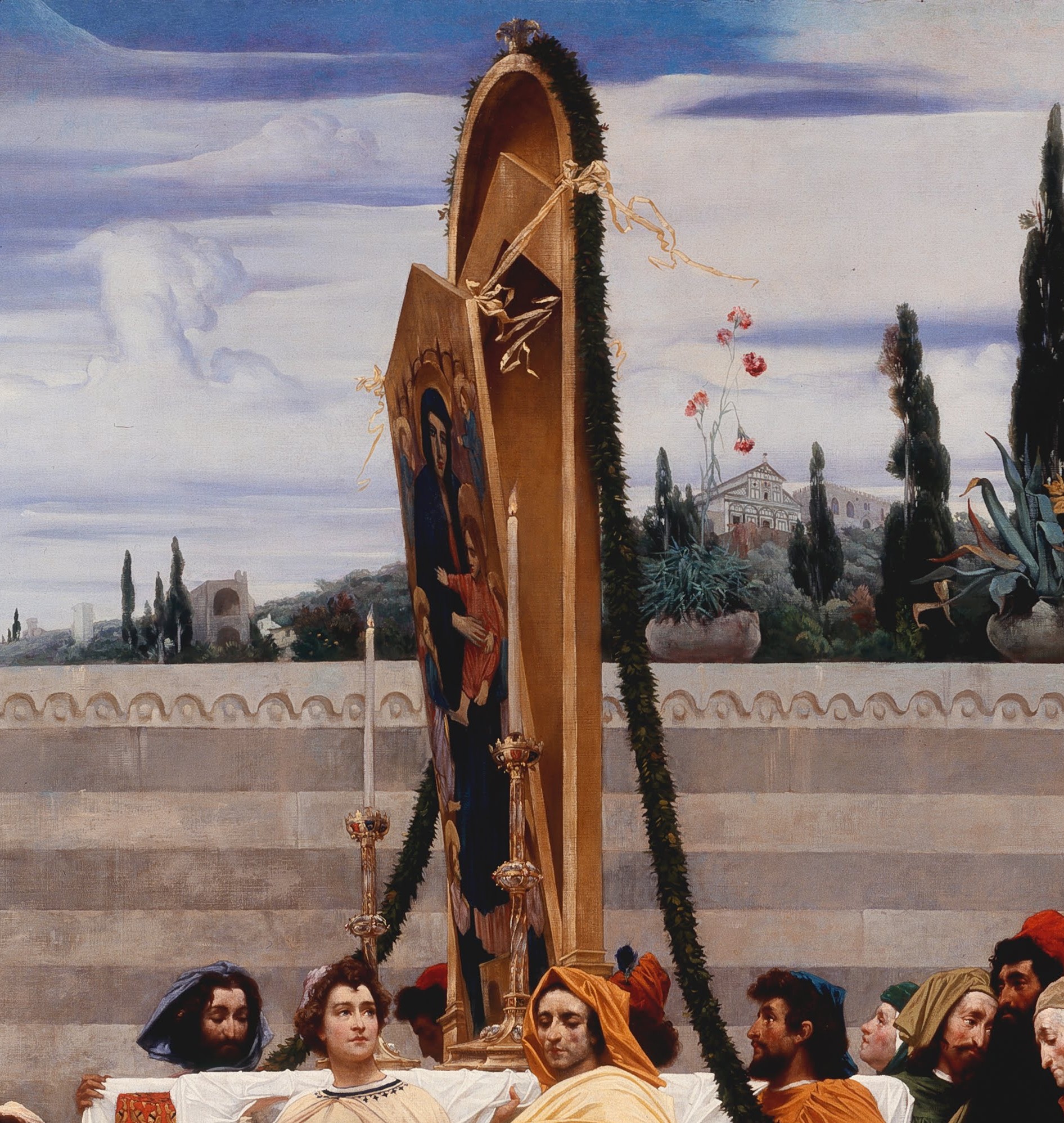
The altarpiece is tipped forward on a draped platform, its gilded surface seen at an angle. Tall candlesticks and the loop of a garland mark out the space around it. The well-dressed men bearing it are identified as painters and sculptors. They seem to take the weight with remarkable ease. The art historian Keith Christiansen notes that the real panel needed nine heavy iron rings to hold it in place in the church. The tilt of Leighton’s panel helps us glimpse the image and sends a diagonal through a crowd that might otherwise read as a continuous band. The platform is convincing as stagecraft. Imagining how the carriers would actually negotiate the street makes the liberties Leighton took all the more apparent. [1] [4]
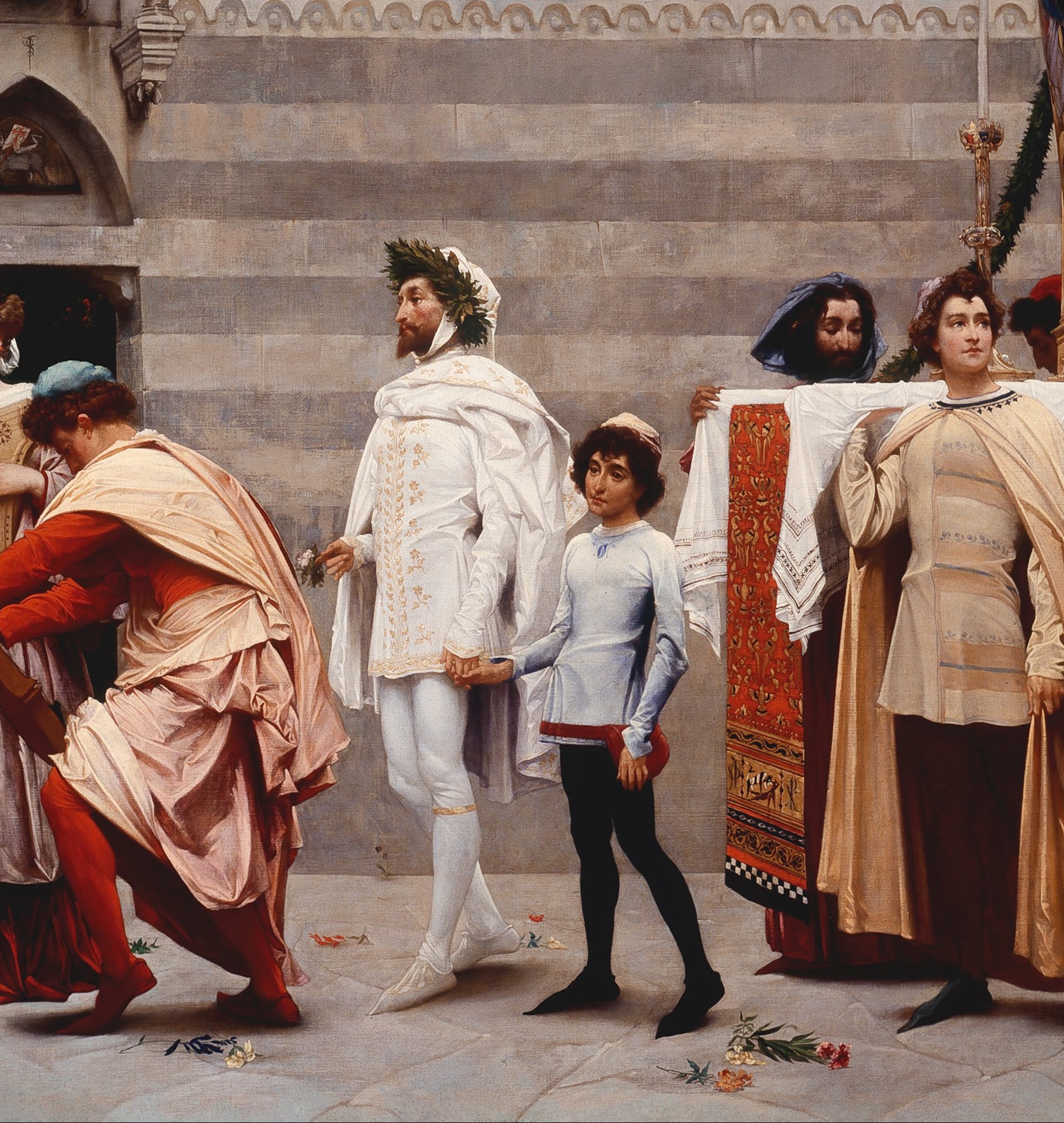
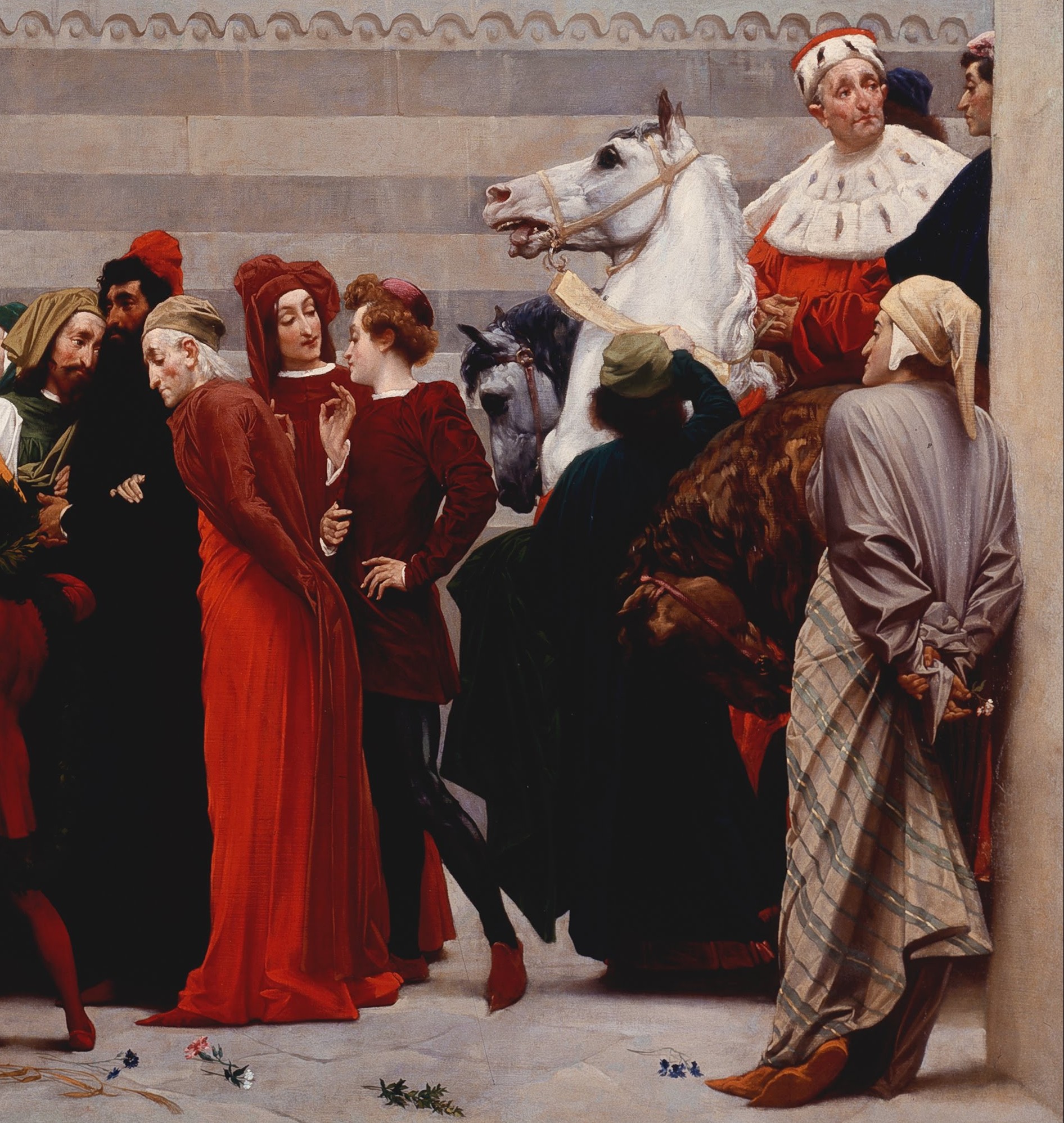
Cimabue stands out in a long white robe and a wreath of laurel. His clothing makes him easy to find, even with the scarlet and ermine of the mounted figure, identified as Charles of Anjou, farther back. Look for the joined hands near the middle. Cimabue’s gesture is small and protective. It draws Giotto into the public occasion and gives the procession a second story, about what passes from a teacher to a pupil. On the far right, Dante leans against a pillar, his still figure set apart from the people on the move. His presence gives the gesture an edge. In Purgatorio, he recalls that Cimabue once thought he held the field in painting and that Giotto’s fame has since eclipsed his. Leighton shows the two artists together while the older man is still being celebrated. [1] [2] [4]
Leighton keeps several kinds of attention alive at once. The bishop and priests give the event its religious form. The mounted king and the civic figures give it public standing. The musicians, flower bearers and people talking in the street make the occasion feel like a Florentine holiday. The sideways glances draw us from group to group. We can return to the Madonna and then pick up the procession where we left off, as a spectator might on the street. [1] [4]
Annotated Details from Cimabue’s Celebrated Madonna
The numbered points identify visible features discussed in this article. Return from each detail to the numbered overview. Frederic Leighton, Cimabue’s Celebrated Madonna, 1853–55. Royal Collection, on loan to the National Gallery. Image source. Public domain. Resized without changing the composition.
Details from CIMABUE’S CELEBRATED MADONNA
Compare the cropped details with the source images above. Notice how their colours, shapes and positions contribute to the larger compositions.
The altarpiece rises above the crowd
The gold panel is tilted towards the street. Its vertical shape breaks the long band of heads and the straight run of the wall.
Cimabue and the young Giotto
Cimabue’s white robe makes him easy to pick out. His arm reaches back to Giotto, linking the two painters through a small gesture in a large procession.
Dante at the edge
Standing against the pillar, Dante turns towards the procession. The distance between him and the Madonna lets the eye follow the painting’s long account of a public event.
Vasari’s story and Duccio’s altarpiece
Giorgio Vasari told the story in his Life of Cimabue, first published in 1550. He described the picture being carried to Santa Maria Novella with music and public rejoicing. In a separate incident, Charles of Anjou is taken to see it while it is still in the artist’s hands, and people converge on the neighbourhood to look. Vasari even traces the name Borgo Allegri to the joy of that day. Leighton brings the mounted king into the procession and adds the encounter with Dante. The painting lets a royal visit, a public celebration and the meeting of celebrated figures play out on the same street. The story survives in Vasari, writing centuries after the supposed event. Christiansen found no document attesting to the procession. [2] [4] [5]
The commission itself has a firmer footing. In 1285 the Laudesi, a Florentine confraternity that sang praises to the Virgin at Santa Maria Novella, commissioned an altarpiece from Duccio, a painter from Siena. Their panel is 450 centimetres high by 290 wide, painted in tempera on wood with a gold ground. The familiar name Rucellai Madonna comes from the family chapel where it was installed late in the sixteenth century. The name therefore records a later home within the church. The art historian Tomoo Matsubara places its enormous size at one end of a wider practice. A great painted Madonna could anchor a confraternity’s collective devotions and make its standing visible. In this respect, the scale of Duccio’s panel tells us something about the people who paid for it. [3] [6]
Viewed face on, Duccio’s panel has a scale and stillness that are easy to miss in Leighton’s crowded street. Mary sits on a carved throne, with the child raising a hand in blessing. Three angels on either side seem suspended as they kneel to support the throne. It is shown at an angle, suggesting depth against the gold. Small figures in roundels occupy the frame, including the Dominican saints Dominic and Peter Martyr near the bottom. Those saints tie the panel to the order that served the church. The flickering edge of the drapery and the slight turn of the throne reward the kind of sustained attention a viewer gives an altarpiece at rest. Leighton lets us see what happens when such a work is put in motion. [1] [3]
The attribution had a long afterlife. The commission document appeared in print in Vincenzio Fineschi’s account of Santa Maria Novella in 1790. Franz Wickhoff took it up in 1889, and debate continued even then. The Uffizi’s attribution also leaves room for the two artists’ proximity: Duccio probably worked alongside Cimabue in the early 1280s. The Louvre’s large, gold-ground Maestà by Cimabue, made for San Francesco in Pisa, helps explain why the resemblance can be persuasive. Here too a gabled frame with roundels encloses the Virgin and Child with six angels. The comparison makes Vasari’s identification understandable and gives greater weight to the surviving commission. Leighton’s title still names the story he chose to paint and the figure he put at the centre. [2] [3] [7] [8]
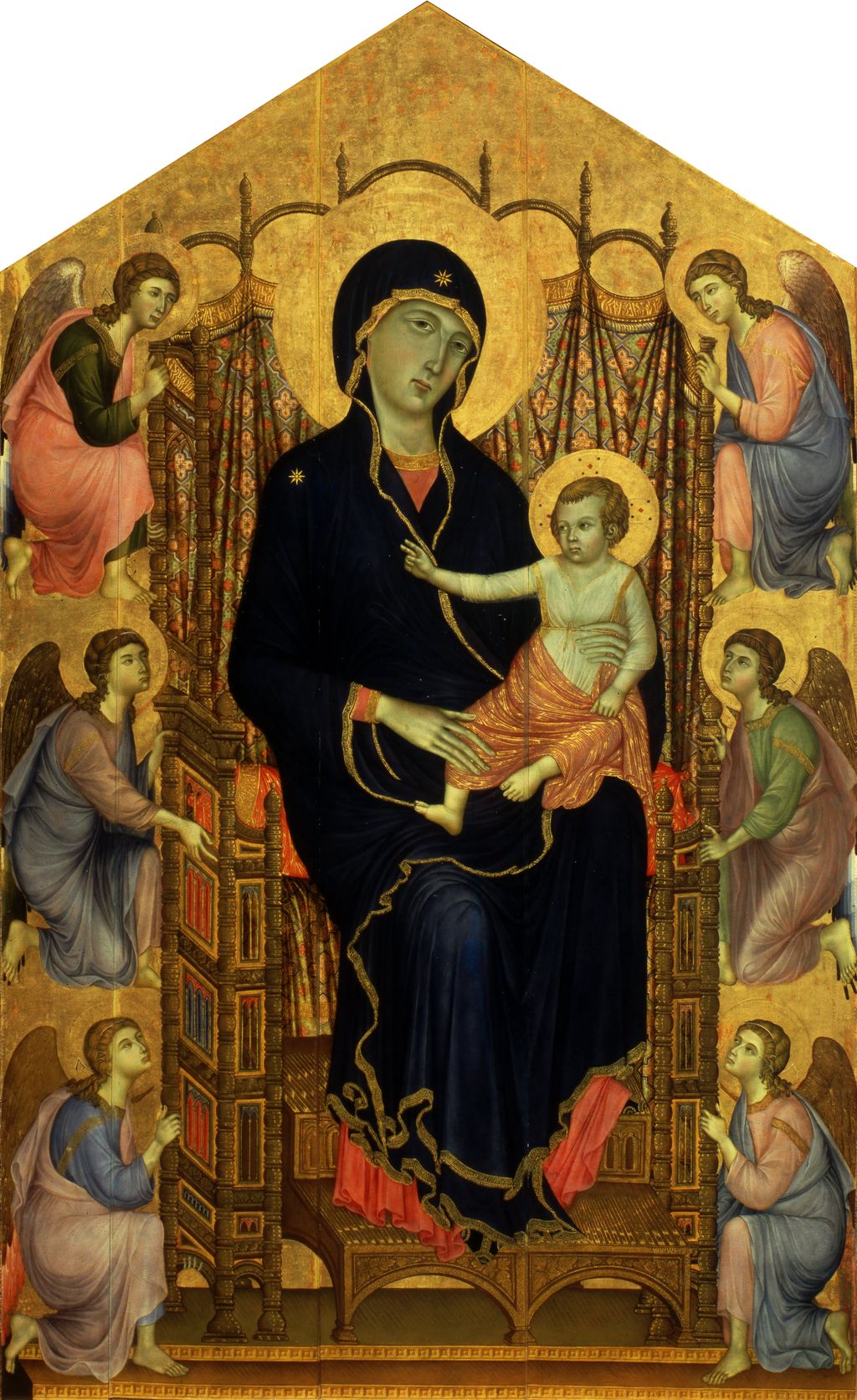
Duccio di Buoninsegna, Rucellai Madonna, 1285. Uffizi, Florence. Image source. Public domain. Resized without changing the composition.
Making Florence in Rome
Leighton developed the canvas in Rome, drawing on advice and experience that reached well beyond the city. His former teacher Eduard von Steinle had directed his attention to early Italian painting. In Florence, Leighton drew from models and made views of the Porta di San Niccolò and San Miniato al Monte. The church gives the landscape behind the wall a recognisable feature, while the striped masonry recalls the enclosure of the cemetery at Santa Maria Novella. The relationship between those features serves the composition. Leighton also consulted pattern books for the costumes. A viewer who knows Florence can recognise individual places, though the arrangement belongs to Leighton. [2] [4]
The left-hand turn also had to be worked out. Writing from Rome in February 1855, Leighton told Steinle that the painter Peter Cornelius had suggested putting members of the clergy near the front and angling the leading group toward the spectator. Cornelius knew the subject from his own designs for the Munich Pinakothek, where he had drawn on Vasari’s account for a lunette. In Leighton’s canvas the turn brings the approaching clergy closer to the viewer. He told Steinle about the drawings of heads and hands he had finished, the drapery he had studied and the grey underpainting that lay beneath the bright surface. [9] [10]
The surviving studies show how differently he could work at each scale. The 1854 oil sketch acquired for Leighton House with Art Fund support in 2011 compresses the entire street into a canvas little more than half a metre wide. It lets the viewer take in the spacing and distribution of colour at once. The Royal Academy’s pencil study for Dante, by contrast, isolates a single figure at the edge of the action. Both objects appeared in the 2024 exhibition Preraffaelliti. Rinascimento moderno in Forlì. The sketch was grouped with medieval Italian art, while the Dante sheet appeared in a later section devoted to Leighton. The exhibition also brought in another Royal Academy sheet, a study of a male figure catalogued as only possibly related. That qualification matters when so many studies of clothing and figures can look at home in the finished crowd. [11] [12] [13]
The scale of the finished work presented a different problem. Leighton wanted to show it to Steinle when he finished, but told him the canvas was so big that moving it to a place where it could be photographed would risk damage. By 1 March he had managed to send a photograph in two pieces, taken indoors. He warned his teacher that the photograph would give him a rough sense of the arrangement but made the bright picture appear dark. Today a small reproduction can convey the sweep of the procession at a glance. Leighton’s complaint reminds us how much he also wanted viewers to see the colour at full scale. [9]
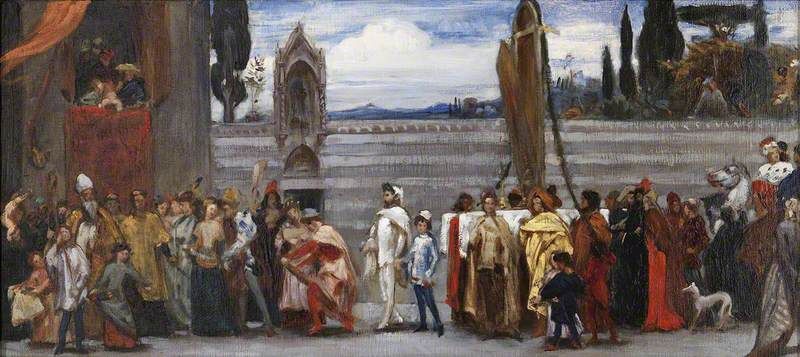
Frederic Leighton, colour sketch for Cimabue’s Celebrated Madonna, 1854. Leighton House. Image source. Public domain. Resized without changing the composition.
Queen Victoria, Ruskin and the Academy
Leighton sent the large canvas to London and a smaller painting on the subject of Romeo and Juliet to Paris. At the Royal Academy in 1855 the procession was his London debut. Queen Victoria recorded her visit on 3 May. The brightness reminded her of Paolo Veronese, and she said Prince Albert had been so taken with the painting that he persuaded her to buy it. Sir Charles Eastlake, the Academy president, wrote to Leighton that day to tell him of the purchase. The price was six hundred guineas, or £630. The Royal Collection records the work in the Music Room at Buckingham Palace in 1862. Albert already collected early Italian pictures, including a triptych by Duccio. Accounts studied by Susanna Avery-Quash show that Leighton’s picture cost more than any single early Italian work Albert bought. The court’s appetite for the history of early painting could command a substantial price when it came in the form of a contemporary canvas. [1] [2] [9] [14]
John Ruskin also thought of Venetian painting when he reviewed the exhibition. He noticed how seriously Leighton treated the church in the distance, the flowers on the wall, the Gothic shrine and the clothes. In reply to those who found the image broken into separate pieces, he argued that sharp divisions were part of the effect of Venetian colour. The white robe was enough to give Cimabue prominence. Ruskin still found several faces weakly drawn and thought the distant, proud Dante a poor conception of the poet. His review admired the young painter’s ambition and demanded more from him in the same breath. [15]
Dante Gabriel Rossetti, writing privately to William Allingham on 11 May, had heard the talk generated by the royal purchase. He suspected that some Academicians were eager to put Leighton forward against William Holman Hunt and John Everett Millais. On looking again, he admired the richness of the arrangement. Like Victoria and Ruskin, he thought of Veronese, especially when considering the freedom of the brushwork. Ford Madox Brown’s diary also registers the sense that the Academy was setting the picture against Millais. These were judgments about the London art world as well as the work on the wall. The juxtaposition was striking: Millais’s The Rescue gave a scene of contemporary life the urgency of history painting, while Leighton filled a scene from art history with everyday talk, play and street activity. [16] [17] [18]
There was a further audience at Manchester’s Art Treasures Exhibition in 1857. An illustrated record shows Leighton’s canvas above the doors of a gallery of modern paintings, in a position that corresponded to a Coronation of the Virgin in a gallery of old masters. Manchester exhibited the Coronation as a Giotto. It is now attributed to Lorenzo Monaco. Art historian Katharine Ault argues that this arrangement encouraged visitors to read the two works in relation to each other. The neighbourly life Leighton imagined for the art of the past had become part of a modern exhibition about how that past should be seen. The story also travelled abroad. In 1859 the Dutch painter Reinier Craeyvanger made a watercolour of the procession arriving at Santa Maria Novella, with the first lines of Dante’s reflection on Cimabue quoted on the mount. The Centraal Museum in Utrecht considers Leighton a likely source for Craeyvanger’s choice of subject. [19] [20]
The picture’s title preserves a moment when a young painter could bring Vasari’s Florence before a London audience and expect it to recognise the drama in a picture being carried to church. Knowing who made the panel makes that encounter more interesting. There is Duccio’s image, made for a community that gathered to sing to the Virgin, and there is Leighton’s moving crowd, in which people of all ages can find a place. In the middle of the procession, Cimabue takes Giotto’s hand. Centuries of stories about who taught whom, and whose work would be remembered, give that simple gesture its charge. [1] [3] [4] [5]
Browse Frederic Leighton’s artworks
Explore paintings, drawings, sculptures and prints, with separate rows for identified preparatory works, reproductions and casts.
| Name | Date | Medium |
|---|---|---|
| A Girl Feeding Peacocks | Exhibited 1863 | Painting Catalogue. |
| A Recognition from ‘Romola’, engraved by Swain (Tate N04054) | published 1862 | Print Catalogue. |
| A Roman Lady | 1859 | Painting Catalogue. |
| Abram and the Angel (Tate A00733) | published 1881 | Print Catalogue. |
| Acme and Septimius | Exhibited 1868 | Painting Catalogue. |
| An Athlete Wrestling with a Python (Tate exhibition bronze) | 1877 | Sculpture Catalogue. |
| And the Sea Gave Up the Dead Which Were in It (Tate N01511) | 1891–92 | Painting Catalogue. |
| Andromache in Captivity (photogravure after Leighton) | 1889 | Print Catalogue. |
| Athlete Wrestling with a Python (Anglesey Abbey cast) | model 1877; cast 1905 | Sculpture Catalogue. |
| Athlete Wrestling with a Python (Hood reduced cast) | 1877 (inscribed model date) | Sculpture Catalogue. |
| Athlete Wrestling with a Python (Saint Louis reduced cast) | 1877 (museum date) | Sculpture Catalogue. |
| Cain and Abel (Tate A00731) | published 1881 | Print Catalogue. |
| Captive Andromache | 1888 | Painting Catalogue. |
| Cimabue's Celebrated Madonna | 1853–55 | Painting Catalogue. |
| Cimon and Iphigenia, with Many Smaller Subjects (Tate T09061) | date not known | Drawing Catalogue. |
| Crenaia, the Nymph of the Dargle | Exhibited 1880 | Painting Catalogue. |
| Cymon and Iphigenia | 1884 | Painting Catalogue. |
| Daedalus and Icarus | 1869 | Painting Catalogue. |
| Dante in Exile | 1864 | Painting Catalogue. |
| Death of the First Born (Tate A00737) | published 1881 | Print Catalogue. |
| Electra at the Tomb of Agamemnon | c. 1869 | Painting Catalogue. |
| Eliezer and Rebekah (Tate A00735) | published 1881 | Print Catalogue. |
| Elijah in the Wilderness | 1877–78 | Painting Catalogue. |
| Fanny Kemble: A Study for ‘Jezebel and Ahab’ (Tate T08208) | c.1862 | Drawing Catalogue. |
| Figure Studies | Date not recorded | Drawing Catalogue. |
| Flaming June | 1895 | Painting Catalogue. |
| Gulnihal | Exhibited 1886 | Painting Catalogue. |
| Helios and Rhodes (Tate N03015) | date not known | Painting Catalogue. |
| Hercules Wrestling with Death for the Body of Alcestis | c. 1869–71 | Painting Catalogue. |
| Jonathan's Token to David | c. 1868 | Painting Catalogue. |
| Lachrymae | 1894–95 | Painting Catalogue. |
| Lieder ohne Worte | Exhibited 1861 | Painting Catalogue. |
| Light of the Harem | Exhibited 1880 | Painting Catalogue. |
| Moses Views the Promised Land (Tate A00736) | published 1881 | Print Catalogue. |
| Mrs James Guthrie | 1865 | Painting Catalogue. |
| Mrs John Hanson Walker (Tate N04731) | 1867 | Painting Catalogue. |
| Music Lesson | 1877 | Painting Catalogue. |
| Needless Alarms (Met cast) | modelled 1886; cast nineteenth century | Sculpture Catalogue. |
| Needless Alarms (Tate N05120) | 1886 | Sculpture Catalogue. |
| Pavonia | c. 1859 | Painting Catalogue. |
| Perseus and Andromeda | 1891 | Painting Catalogue. |
| Portrait of May Sartoris | c. 1860 | Painting Catalogue. |
| Preparing for a Festa, Florence (Tate T09062) | date not known | Drawing Catalogue. |
| Puerta de los Vientos, near Ronda, Spain (Tate N04006) | c.1886–9 | Painting Catalogue. |
| Samson and the Lions (Tate A00732) | published 1881 | Print Catalogue. |
| Samson at the Mill (Tate A00734) | published 1881 | Print Catalogue. |
| Samson Carrying the Gate (Tate A00738) | published 1881 | Print Catalogue. |
| Sketch for ‘An Athlete Wrestling with a Python’ (Tate N01761) | c.1877 | Sculpture Catalogue. |
| Sketches for Cimon and Iphigenia (Tate T09060) | date not known | Drawing Catalogue. |
| Study for The Return of Persephone (Demeter) | c. 1890–91 | Drawing Catalogue. |
| Study for The Return of Persephone (Persephone) | c. 1890–91 | Drawing Catalogue. |
| Study for ‘Needless Alarms’ (Tate N02945) | 1886 | Sculpture Catalogue. |
| Study for ‘The Discovery of Juliet Apparently Lifeless’ (Tate N01806) | c.1858 | Painting Catalogue. |
| The Bath of Psyche | Exhibited 1890 | Painting Catalogue. |
| The Daphnephoria | 1874–76 | Painting Catalogue. |
| The Death of Brunelleschi | 1852 | Painting Catalogue. |
| The Fisherman and the Siren | Exhibited 1858 | Painting Catalogue. |
| The Painter's Honeymoon | c. 1864 | Painting Catalogue. |
| The Return of Persephone | 1891 | Painting Leeds painting identified in the Met study record. |
| The Return of Persephone (preparatory oil) | c. 1890–91 | Painting Catalogue. |
| The Sluggard (Anglesey Abbey cast) | probably 1890–about 1906 | Sculpture Catalogue. |
| The Sluggard (Met cast) | modelled 1886; cast possibly before 1896 | Sculpture Catalogue. |
| The Sluggard (Museum Wales) | 1882–85 (museum date) | Sculpture Catalogue. |
| The Sluggard (Tate N01752) | 1885 | Sculpture Catalogue. |
| The Spies Escape (Tate A00730) | published 1881 | Print Catalogue. |
| Various Subjects (Tate T09063) | date not known | Drawing Catalogue. |
| View in Capri | Possibly 1859 | Painting Catalogue. |
| Wedded | 1882 | Painting Catalogue. |
| Winding the Skein | c. 1878 | Painting Catalogue. |
Discussion
Look again at the images and ideas explored in Cimabue’s Celebrated Madonna. These editorial prompts invite your observations.
Reader Insights
Where does the altarpiece interrupt the pace of the procession?
What does the painted Florence owe to Vasari’s account and to Leighton’s studies of the city?
Join the Conversation
Share a detail, comparison or question about Cimabue’s Celebrated Madonna below.
References
- National Gallery, London, Cimabue’s Celebrated Madonna, L275, collection entry and in-depth account. View source.
- Royal Collection Trust, Cimabue’s Madonna Carried in Procession, RCIN 401478, object and provenance record. View source.
- Daniela Parenti, Gallerie degli Uffizi, Madonna col Bambino in trono e angeli (detta Madonna Rucellai), collection entry. View source.
- Keith Christiansen, Duccio and the Origins of Western Painting, Metropolitan Museum of Art, 2008, pp. 20–22, fig. 17. View source.
- Giorgio Vasari, “Giovanni Cimabue,” Le vite de’ più eccellenti pittori, scultori e architettori, first edition, 1550. View source.
- Tomoo Matsubara, “石の中のイコン” (The Icon in the Stone), Studies in International Culture, Seinan Gakuin University, vol. 21, no. 1, 2006, pp. 256–57 and fig. 33. View source.
- Treccani, “Duccio di Buoninsegna,” Enciclopedia dell’Arte Medievale, 1994, discussion of the Rucellai commission and attribution. View source.
- Musée du Louvre, La Vierge et l’Enfant en majesté entourés de six anges (Maestà), INV 254, collection entry. View source.
- Emilie Barrington, The Life, Letters and Work of Frederic Leighton, vol. I, 1906, chapter II, Leighton’s letters to Steinle and facsimile of Eastlake’s letter, facing p. 194. View source.
- Ernst Förster, Peter von Cornelius: Entwürfe zu den kunstgeschichtlichen Fresken in den Loggien der Königlichen Pinakothek zu München, 1875, discussion of the Cimabue lunette. View source.
- Art Fund, Cimabue’s Celebrated Madonna is Carried in Procession through the Streets of Florence, acquisition of Leighton’s 1854 colour sketch, grant 22308. View source.
- Fondazione Cassa dei Risparmi di Forlì, Preraffaelliti. Rinascimento moderno, 2024, exhibition guide and annotated checklist. View source.
- Royal Academy of Arts, Annual Report 2023–24, appendix 6, Forlì loans, including the Dante study (04/629) and a possible related figure study (04/635). View source.
- Susanna Avery-Quash, “‘Incessant personal exertions and comprehensive artistic knowledge’: Prince Albert’s interest in early Italian art,” Victoria & Albert: Art & Love, Royal Collection, 2012. View source.
- John Ruskin, Academy Notes, 1855, entry 569, in The Works of John Ruskin, vol. XIV, pp. 26–27. View source.
- Dante Gabriel Rossetti, letter to William Allingham, 11 May 1855, in William E. Fredeman, ed., The Correspondence of Dante Gabriel Rossetti, vol. 2, letter 55.24, pp. 36–37. View source.
- Ford Madox Brown, diary for 12 May 1855, in William Michael Rossetti, ed., Præraphaelite Diaries and Letters, 1900, p. 181. View source.
- Morna O’Neill, “1855: Addressing the Eye,” The Royal Academy Summer Exhibition: A Chronicle, 1769–2018. View source.
- Katharine Ault, Giotto and Non-Giotto in Nineteenth-Century Britain, Open University, 2025, pp. 155–57, 176–78 and figs. 89, 107–108. View source.
- Centraal Museum Utrecht, Reinier Craeyvanger, De aankomst van Cimabue’s Madonna bij de S. Maria Novella te Florence, 1859, no. 12956. View source.