 by Tom Gurney
Tom Gurney BSc (Hons) is an art history expert with over 20 years experience
Published on June 19, 2020 / Updated on November 29, 2026
Email: tomgurney1@gmail.com / Phone: +44 7429 011000
Frederic Leighton Quotes: Introduction
In August 1879, Frederic Leighton wrote to the art historian Emilia Pattison, who was preparing an article about him. In December he stood before the students of the Royal Academy to discuss the place of art in modern life. To Pattison he explained how his parents saw his choice of profession. To the students he asked what sort of work might last and why it was worth making. The letters show what Leighton asked of himself. The addresses show what he asked of young artists once he was in a position to teach them. [1] [2]
At a Glance
- Principal documentsLeighton’s letters and Royal Academy addresses
- Other voicesRobert Browning, Dante Gabriel Rossetti and Antonin Proust
- Editorial approachQuotes in their original settings and attributions
Contents
- On choosing art and learning the craft
- On sincerity and the uses of the past
- On what painting can say
- What contemporary readers and artists heard
On choosing art and learning the craft
Pattison received more than Leighton's own recollection. He sent her notes his father had volunteered to write, a gesture that touched him. His parents had given him every opportunity to learn to draw, he explained, while discouraging him from making art his profession “unless I could be eminent in art.” The phrase in his letter of 5 August 1879 makes the distinction clear. A boy's appetite for drawing could be encouraged at home. The prospect of his living as a painter called for a different level of certainty. His father, now helping a writer reconstruct the career, was taking an interest in the very choice he had once questioned. [1]
Writing from Rome on 15 April 1855 to his former teacher Eduard von Steinle, he regretted that Steinle's kind response to a photograph of his work had stopped short of telling him which figures fell below the rest. In the same letter he reflected on what the Roman years had given him and what he still wanted from his education. He cherished his friends there, including the painter Enrico Gamba, whose picture he reported was drawing applause. He wanted, too, the stimulus of working among contemporaries who would put his abilities under pressure. [1] [3]
Leighton took issue with the German painter Peter von Cornelius on the way an artist learns. As Barrington's English translation of the letter has it, “the spirit cannot work effectively until the hand has attained complete pliancy.” Leighton admired Cornelius and thought highly of his talent, but doubted a training that put such a premium on the independence of the spirit that the painter could leave problems of modelling unsolved. He pointed instead to Raphael's frescoes and to the colour of the lower part of Michelangelo's Last Judgment. These were examples of what an artist could accomplish by attending closely to the visible world. The letter catches him testing a teacher's principles against works he could stand in front of and examine for himself. [1]
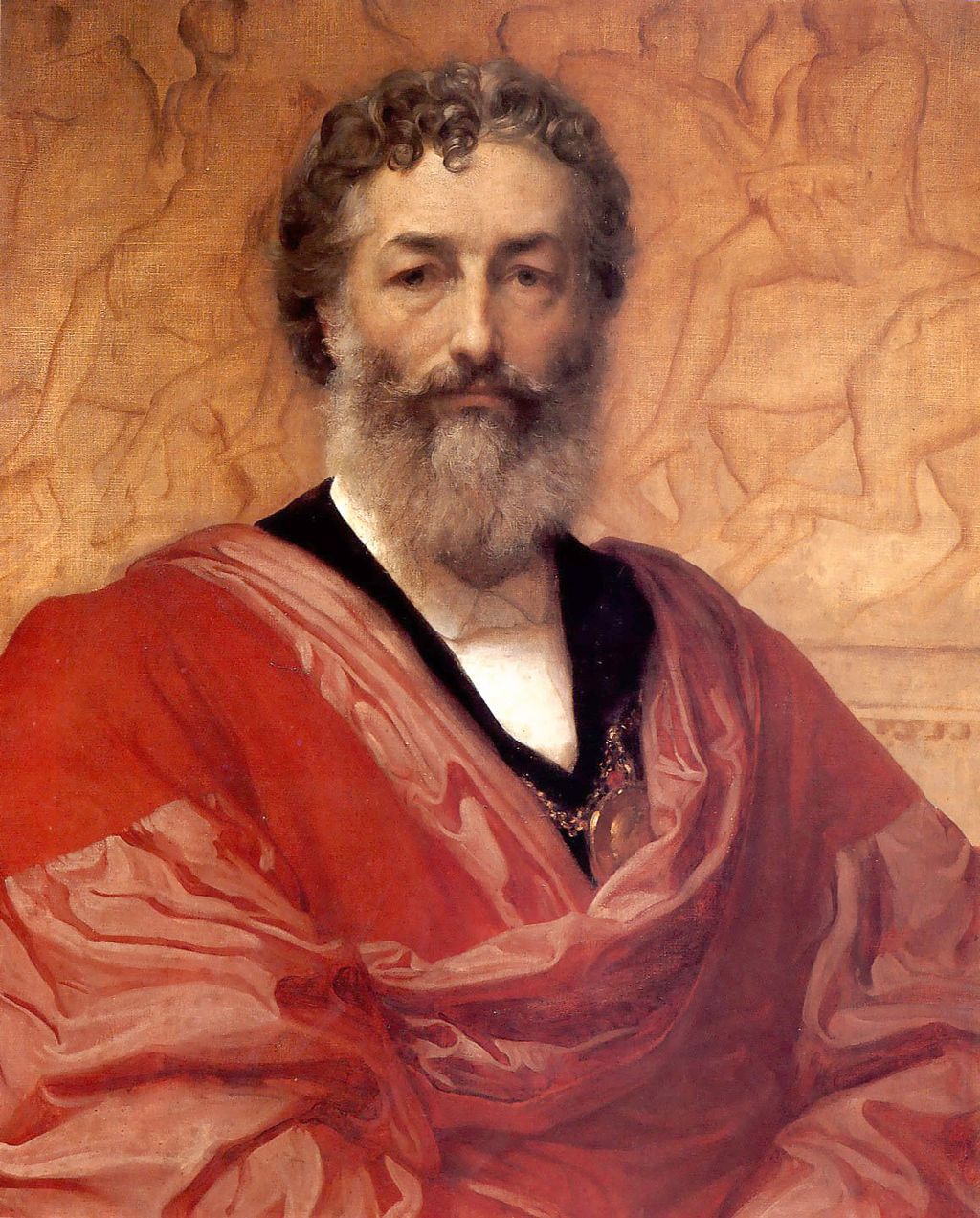
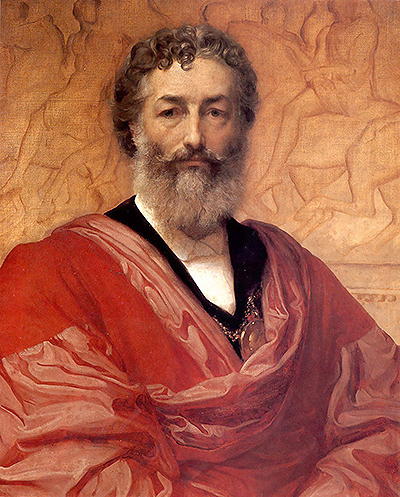
Frederic Leighton, Self-portrait, 1880. Uffizi. Image source. Public domain. Resized without changing the composition.
On sincerity and the uses of the past
By 10 December 1879, Leighton was addressing students as president. He acknowledged their reasons for wondering whether painting and sculpture still had a future, then asked them to study the achievements of earlier artists with care. The end of the address turns on “sincerity of emotion.” Technical fluency could carry a painter a long way, he thought, but a lasting hold on other people depended on the artist having felt the emotion the work conveyed. To close, he borrowed a musical image from Goethe. A chord has to sound first in the artist before it can set another heart vibrating. [2]
The advice gives a purpose to studying old art. A student can examine how a painter has made a crowded composition legible, how a sculptor has suggested a body's weight, or how an architect has given a room its proportions. The study enlarges the means at the student's disposal. It takes an observation or feeling of their own to decide what those means are for. Leighton returned to that point at the Royal Academy banquet before the opening of the 1893 exhibition, when he called the experience of past ages “a precious heritage and not an irksome load.” The passage was reported in The British Architect on 5 May. At the banquet he urged young painters to work patiently and evoked artists embracing “a lovely but lifeless corpse,” as an image of the pessimism he rejected. In the same speech he called sincerity the source of lasting achievement, returning to the point he had made to the students fourteen years earlier. [2] [4] [5]
His friend, the Italian painter Giovanni Costa, remembered a practical connection between the discourses and the study they encouraged. In his memoir he recalled Leighton taking a room at the Albergo Brufani in Perugia to write Academy speeches in the autumn. Their trips in Italy included visits to see Masaccio in Florence, Duccio and Pinturicchio in Siena, and Mantegna in Mantua. Costa also remembered detailed itineraries sent in lively Tuscan Italian. Costa's recollection puts the speaker back in front of the works he was asking the students to study. [6]
On what painting can say
At the students' next biennial gathering, on 10 December 1881, Leighton put a more specific question to them. “What is the relation in which Art stands to Morals and to Religion?” He gave serious attention to the Christian commissions that produced much of the painting students studied. An altarpiece could take its subject from scripture and be made for worship. Its artistic power, in his account, still had to be realised through the arrangement of figures, the character of a gesture and the movement of light. A moral lesson could be given clearly in words. The image had distinct means of working on a viewer. [2]
Music sharpened his point. An instrumental work could raise the spirits or give shape to grief without naming either state or conveying a proposition. He argued that painting, sculpture and architecture could reach emotions through their own means. In the printed address art has “a key” to certain feelings, where a familiar version of the line reads “the key.” In the following lines he identifies form, colour, light and shade as the means of reaching them. When he considers the strength suggested by certain forms or the languor associated with certain colours, he is also giving a pupil a vocabulary for looking at pictures. Colour could recall sensations of heat and cold. A line could suggest movement or repose. Those associations were part of the experience of the work. [2]
The independence he claimed for art came with a place for the artist's moral character. A virtuous subject could confer no artistic merit by itself, yet the painter's dispositions could enter the work through choices that ran deeper than subject matter. By keeping the two questions distinct, Leighton could allow for a beautiful work with no lesson to deliver, and for a work with religious feeling conveyed in the very way it was made. [2]
What contemporary readers and artists heard
In June 1863, the critic William Michael Rossetti wrote in Fraser's Magazine about two Leightons at the Royal Academy, A Girl Feeding Peacocks and Girl with a Basket of Fruit. They belonged to “the art of luxurious exquisiteness; beauty, for beauty’s sake.” For Rossetti this was a way to judge particular pictures. He found the handling of the peacocks and parts of the larger painting's colour remarkable, while the girl's drapery seemed to him less successful. He preferred the smaller work's pearly light, against which the blue of the sky registered as one of its deepest tones. Rossetti was judging how passages of colour worked together. For him, the drapery could disturb the effect of the whole picture. [7] [8]
Leighton himself could joke about the apparent distance between his art and that of critics and friends with Pre-Raphaelite connections. At the end of his letter of 29 January 1860 to Robert Browning, he wrote, “I am hand-and-glove with all my enemies the pre-Raphaelites.” A greeting from the sculptor Thomas Woolner follows. The letter otherwise reads like news from someone who misses his friends in Rome. Leighton asks after Elizabeth Barrett Browning's health, recalls two portraits he drew of the couple and admits that the English atmosphere seems to have sharpened his sense of colour. The joke works as a postscript precisely because the ordinary news has already placed him in that circle of friendships. [9]
That ease with disagreement also comes through in an Academy banquet speech of 5 May 1894. Leighton paid tribute to the recently deceased Albert Moore for the quiet harmony of his paintings and to Ford Madox Brown for his observation of human emotion and gesture. He acknowledged differences with Brown, while giving those two very different painters serious attention in the same speech. Looking around the exhibition, he found a range of approaches to figure painting, landscape and sculpture, a breadth he regarded as a sign of life in British art. [10]
The familiar story about James McNeill Whistler turning a criticism of his unfinished pictures back on Leighton circulates without a reliable occasion or contemporary source for the exchange. The correspondence of 1886 records an actual disagreement over an invitation to an Academy reception. Leighton wrote to Whistler on 30 June to explain that an invitation had been sent. Whistler's surviving draft reply is dated to 1 July. Whistler's friend, the artist Harper Pennington, remembered him anticipating Leighton's answer and composing a retort before the first note had even been sent. Pennington's account shows how deliberately Whistler shaped these exchanges for effect. The surviving letters give that recollection a particular occasion. [11] [12] [13]
In Édouard Manet: Souvenirs, Antonin Proust remembered Manet recounting a visit in which Leighton questioned the looseness of the outlines in Skating. Manet replied, in his own account, that the figures were skating, so he could hardly fix them in place. He recalled the opposite criticism having been made of Olympia. Proust presents this as Manet's story about the previous day. In the painting, the skaters' brushy forms give a sense of motion behind the composed figure in the foreground. Harvard Art Museums notes that Manet also made the child beside her increasingly indistinct as he worked. That revision makes it possible to see another use for softened outlines. They help determine where we look first. [14] [15]
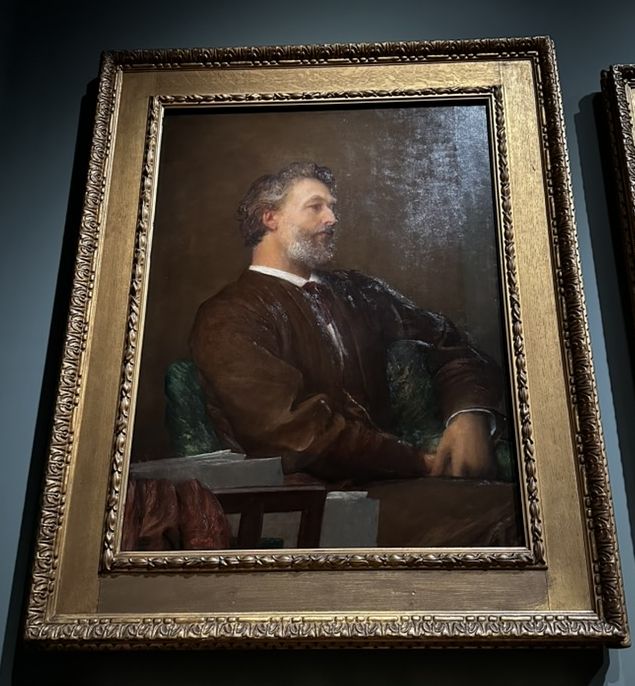
George Frederic Watts’s portrait of Frederic Leighton, 1881, National Portrait Gallery, NPG 1049. My photo from the National Portrait Gallery, London, on 5 November 2026. Image source. Public domain. Gallery photograph cropped to show the framed portrait.
Browse Frederic Leighton’s artworks
Explore paintings, drawings, sculptures and prints, with separate rows for identified preparatory works, reproductions and casts.
| Name | Date | Medium |
|---|---|---|
| A Girl Feeding Peacocks | Exhibited 1863 | Painting Catalogue. |
| A Recognition from ‘Romola’, engraved by Swain (Tate N04054) | published 1862 | Print Catalogue. |
| A Roman Lady | 1859 | Painting Catalogue. |
| Abram and the Angel (Tate A00733) | published 1881 | Print Catalogue. |
| Acme and Septimius | Exhibited 1868 | Painting Catalogue. |
| An Athlete Wrestling with a Python (Tate exhibition bronze) | 1877 | Sculpture Catalogue. |
| And the Sea Gave Up the Dead Which Were in It (Tate N01511) | 1891–92 | Painting Catalogue. |
| Andromache in Captivity (photogravure after Leighton) | 1889 | Print Catalogue. |
| Athlete Wrestling with a Python (Anglesey Abbey cast) | model 1877; cast 1905 | Sculpture Catalogue. |
| Athlete Wrestling with a Python (Hood reduced cast) | 1877 (inscribed model date) | Sculpture Catalogue. |
| Athlete Wrestling with a Python (Saint Louis reduced cast) | 1877 (museum date) | Sculpture Catalogue. |
| Cain and Abel (Tate A00731) | published 1881 | Print Catalogue. |
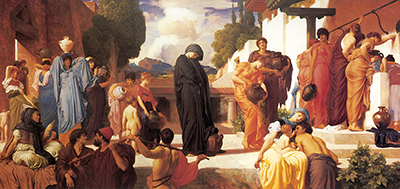
| Captive Andromache | 1888 | Painting Catalogue. |
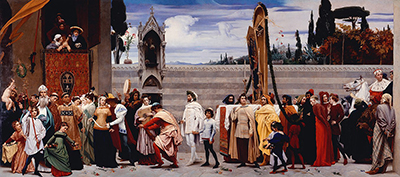
| Cimabue's Celebrated Madonna | 1853–55 | Painting Catalogue. |
| Cimon and Iphigenia, with Many Smaller Subjects (Tate T09061) | date not known | Drawing Catalogue. |
| Crenaia, the Nymph of the Dargle | Exhibited 1880 | Painting Catalogue. |
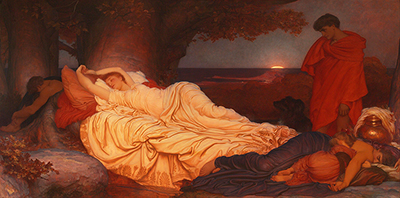
| Cymon and Iphigenia | 1884 | Painting Catalogue. |
| Daedalus and Icarus | 1869 | Painting Catalogue. |
| Dante in Exile | 1864 | Painting Catalogue. |
| Death of the First Born (Tate A00737) | published 1881 | Print Catalogue. |
| Electra at the Tomb of Agamemnon | c. 1869 | Painting Catalogue. |
| Eliezer and Rebekah (Tate A00735) | published 1881 | Print Catalogue. |
| Elijah in the Wilderness | 1877–78 | Painting Catalogue. |
| Fanny Kemble: A Study for ‘Jezebel and Ahab’ (Tate T08208) | c.1862 | Drawing Catalogue. |
| Figure Studies | Date not recorded | Drawing Catalogue. |
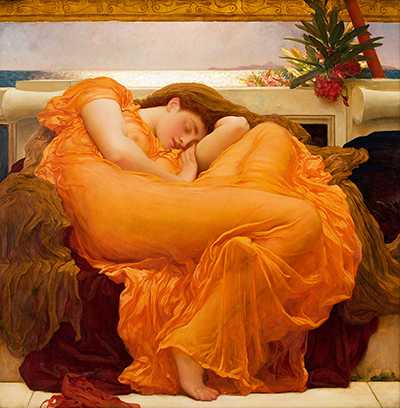
| Flaming June | 1895 | Painting Catalogue. |
| Gulnihal | Exhibited 1886 | Painting Catalogue. |
| Helios and Rhodes (Tate N03015) | date not known | Painting Catalogue. |
| Hercules Wrestling with Death for the Body of Alcestis | c. 1869–71 | Painting Catalogue. |
| Jonathan's Token to David | c. 1868 | Painting Catalogue. |
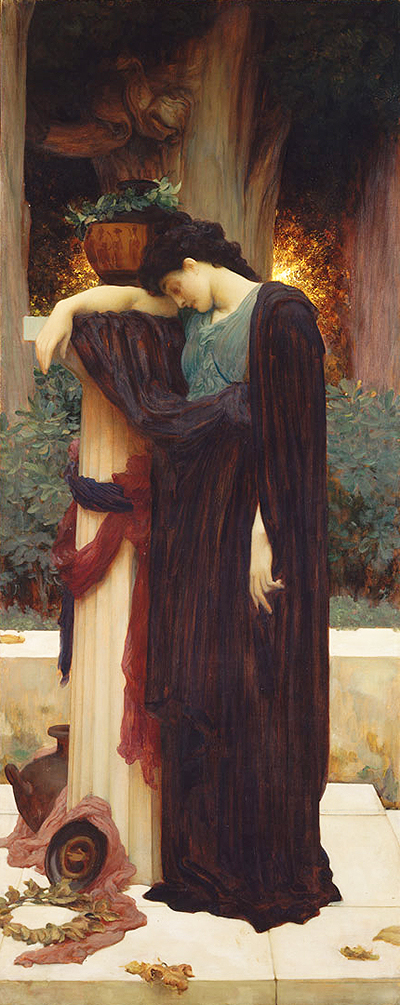
| Lachrymae | 1894–95 | Painting Catalogue. |
| Lieder ohne Worte | Exhibited 1861 | Painting Catalogue. |
| Light of the Harem | Exhibited 1880 | Painting Catalogue. |
| Moses Views the Promised Land (Tate A00736) | published 1881 | Print Catalogue. |
| Mrs James Guthrie | 1865 | Painting Catalogue. |
| Mrs John Hanson Walker (Tate N04731) | 1867 | Painting Catalogue. |
| Music Lesson | 1877 | Painting Catalogue. |
| Needless Alarms (Met cast) | modelled 1886; cast nineteenth century | Sculpture Catalogue. |
| Needless Alarms (Tate N05120) | 1886 | Sculpture Catalogue. |
| Pavonia | c. 1859 | Painting Catalogue. |
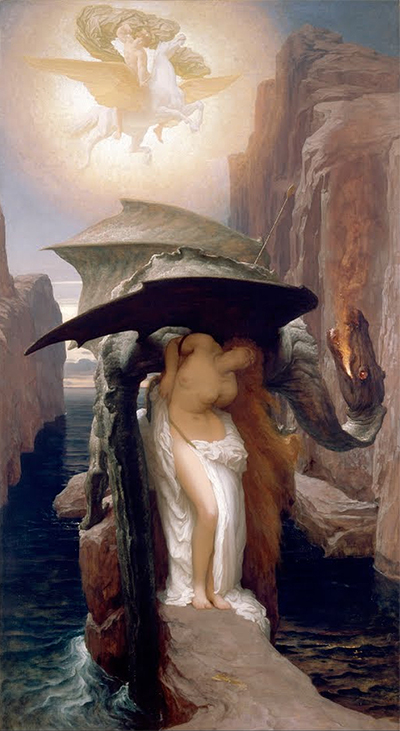
| Perseus and Andromeda | 1891 | Painting Catalogue. |
| Portrait of May Sartoris | c. 1860 | Painting Catalogue. |
| Preparing for a Festa, Florence (Tate T09062) | date not known | Drawing Catalogue. |
| Puerta de los Vientos, near Ronda, Spain (Tate N04006) | c.1886–9 | Painting Catalogue. |
| Samson and the Lions (Tate A00732) | published 1881 | Print Catalogue. |
| Samson at the Mill (Tate A00734) | published 1881 | Print Catalogue. |
| Samson Carrying the Gate (Tate A00738) | published 1881 | Print Catalogue. |
| Sketch for ‘An Athlete Wrestling with a Python’ (Tate N01761) | c.1877 | Sculpture Catalogue. |
| Sketches for Cimon and Iphigenia (Tate T09060) | date not known | Drawing Catalogue. |
| Study for The Return of Persephone (Demeter) | c. 1890–91 | Drawing Catalogue. |
| Study for The Return of Persephone (Persephone) | c. 1890–91 | Drawing Catalogue. |
| Study for ‘Needless Alarms’ (Tate N02945) | 1886 | Sculpture Catalogue. |
| Study for ‘The Discovery of Juliet Apparently Lifeless’ (Tate N01806) | c.1858 | Painting Catalogue. |
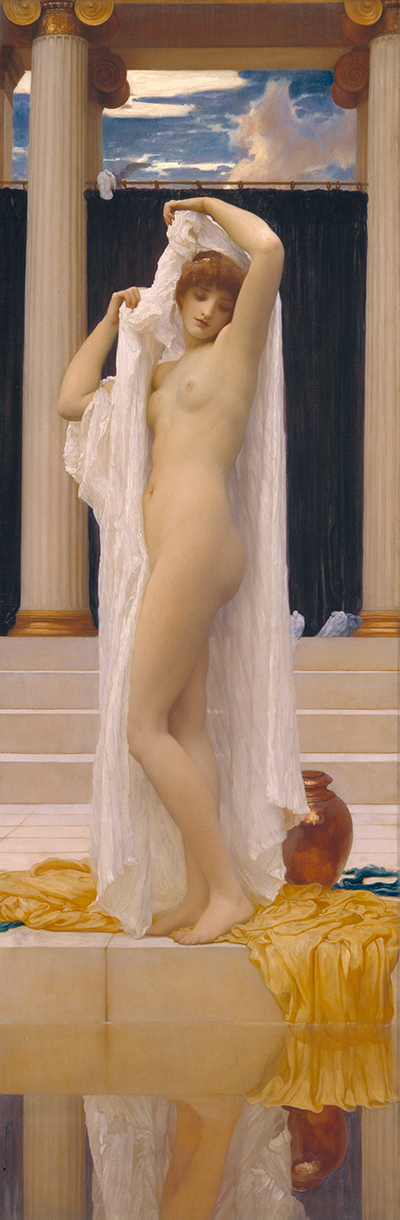
| The Bath of Psyche | Exhibited 1890 | Painting Catalogue. |
| The Daphnephoria | 1874–76 | Painting Catalogue. |
| The Death of Brunelleschi | 1852 | Painting Catalogue. |
| The Fisherman and the Siren | Exhibited 1858 | Painting Catalogue. |
| The Painter's Honeymoon | c. 1864 | Painting Catalogue. |
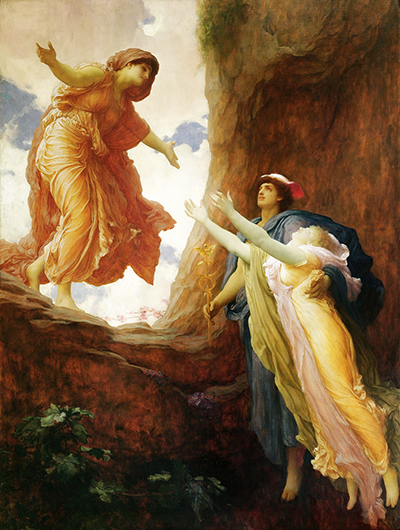
| The Return of Persephone | 1891 | Painting Leeds painting identified in the Met study record. |
| The Return of Persephone (preparatory oil) | c. 1890–91 | Painting Catalogue. |
| The Sluggard (Anglesey Abbey cast) | probably 1890–about 1906 | Sculpture Catalogue. |
| The Sluggard (Met cast) | modelled 1886; cast possibly before 1896 | Sculpture Catalogue. |
| The Sluggard (Museum Wales) | 1882–85 (museum date) | Sculpture Catalogue. |
| The Sluggard (Tate N01752) | 1885 | Sculpture Catalogue. |
| The Spies Escape (Tate A00730) | published 1881 | Print Catalogue. |
| Various Subjects (Tate T09063) | date not known | Drawing Catalogue. |
| View in Capri | Possibly 1859 | Painting Catalogue. |
| Wedded | 1882 | Painting Catalogue. |
| Winding the Skein | c. 1878 | Painting Catalogue. |
Discussion
Look again at the images and ideas explored in Frederic Leighton Quotes. These editorial prompts invite your observations.
Reader Insights
Which remark takes on a different meaning once you know who first heard or recorded it?
How does Leighton’s advice to students differ from his comments in private correspondence?
Join the Conversation
Share a detail, comparison or question about Frederic Leighton Quotes below.
References
- Mrs. Russell Barrington, The Life, Letters and Work of Frederic Leighton, vol. I (George Allen, 1906), pp. 16–17, Leighton to Emilia Pattison, 5 August 1879, and pp. 190–191, Leighton to Eduard von Steinle, 15 April 1855, in English translation. View source.
- Frederic Leighton, Addresses Delivered to the Students of the Royal Academy, 2nd ed. (Kegan Paul, Trench, Trübner & Co., 1897), pp. 32–33, address of 10 December 1879, and pp. 37–42, 53–58, address of 10 December 1881. View source.
- MuseoTorino, biographical record for Enrico Gamba, on Steinle's pupils and the Roman letters. View source.
- Frederic Leighton, “Advice to Young Artists,” 1893 Royal Academy banquet speech, excerpt reproduced by the Art Renewal Center. View source.
- Claire Jones, “Nathaniel Hitch and the Making of Church Sculpture,” 19: Interdisciplinary Studies in the Long Nineteenth Century 22 (2016), pp. 12–13 and note 23, citing Leighton, “A Word to Young Art Students,” The British Architect, 5 May 1893, pp. 321–322. View source.
- Giovanni Costa, Quel che vidi e quel che intesi, ed. Giorgia Guerrazzi Costa (1927), chapter XLI, “A Firenze ed all'arte.” View source.
- William Michael Rossetti, “The Royal Academy Exhibition,” Fraser's Magazine, vol. 67, no. 402 (June 1863), p. 790. View source.
- Marte Stinis, Music as Aesthetic Paradigm: Frederic Leighton, Albert Moore, and James McNeill Whistler (University of York doctoral thesis, 2021), pp. 94–95 and notes 294–298 on William Michael Rossetti and the critical vocabulary. View source.
- Mrs. Russell Barrington, The Life, Letters and Work of Frederic Leighton, vol. II (George Allen, 1906), pp. 51–52, Leighton to Robert Browning, 29 January 1860. View source.
- Frederic Leighton, “Variety in British Art,” Royal Academy banquet speech, 5 May 1894, in Modern Eloquence, vol. II, pp. 713–716. View source.
- Leighton to James McNeill Whistler, 30 June 1886, University of Glasgow, MS Whistler L46, correspondence record 2510. View source.
- Whistler to Leighton, draft dated to 1 July 1886, University of Glasgow, MS Whistler L45, correspondence record 2509. View source.
- Elizabeth Robins Pennell and Joseph Pennell, The Life of James McNeill Whistler, vol. II (1908), p. 22, recalling the Academy reception through Harper Pennington’s testimony. View source.
- Antonin Proust, Édouard Manet: Souvenirs, ed. A. Barthélemy (H. Laurens, 1913), pp. 89–90 and plate 24, Manet's account of the studio visit. View source.
- Harvard Art Museums, Édouard Manet, Skating, 1877, Fogg Museum, 1951.50. View source.