 by Tom Gurney
Tom Gurney BSc (Hons) is an art history expert with over 20 years experience
Published on June 19, 2020 / Updated on November 29, 2026
Email: tomgurney1@gmail.com / Phone: +44 7429 011000
A Girl Feeding Peacocks: Introduction
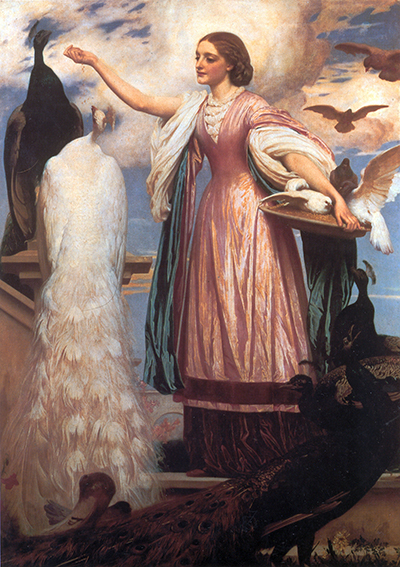
In Frederic Leighton’s oil painting A Girl Feeding Peacocks, a young woman reaches towards a dark bird whose head is almost level with her own. She carries a shallow pan along her other arm, where smaller birds can help themselves. Leighton showed the painting in the West Room of the Royal Academy’s 1863 exhibition, as catalogue number 429. The simple business of scattering grain has the air of a ceremony. [1] [2]
At a Glance
- ExhibitedRoyal Academy, 1863, no. 429
- Exhibition roomWest Room
- Exhibited titleA Girl Feeding Peacocks
This work across Frederic Leighton’s career
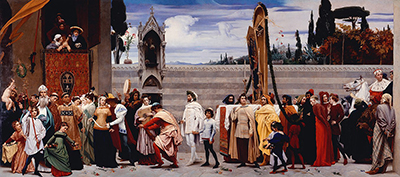
Cimabue’s Celebrated Madonna
1853–55A Girl Feeding Peacocks (current article)
Exhibited 1863 [1]Lachrymae
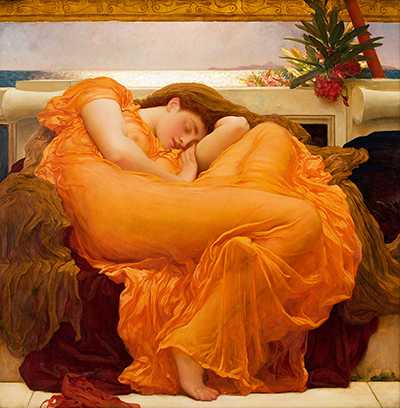
1894–95Flaming June
c. 1895Contents
- The girl on the wall
- The picture at the Royal Academy
- Peacocks in other works by Leighton
- Annotated details
The girl on the wall
Start with the raised hand. The arm stretches into a patch of cloud, clearly outlined against the sky, and ends just short of the waiting bird. The young woman’s face follows the gesture. Her other arm descends towards the pan, whose sloping rim leads to a bird opening its wings at the right edge. The two arms establish different paces. One offers a morsel to a bird poised on the wall. The other supports a feeding place that the birds can approach from the air. [2]
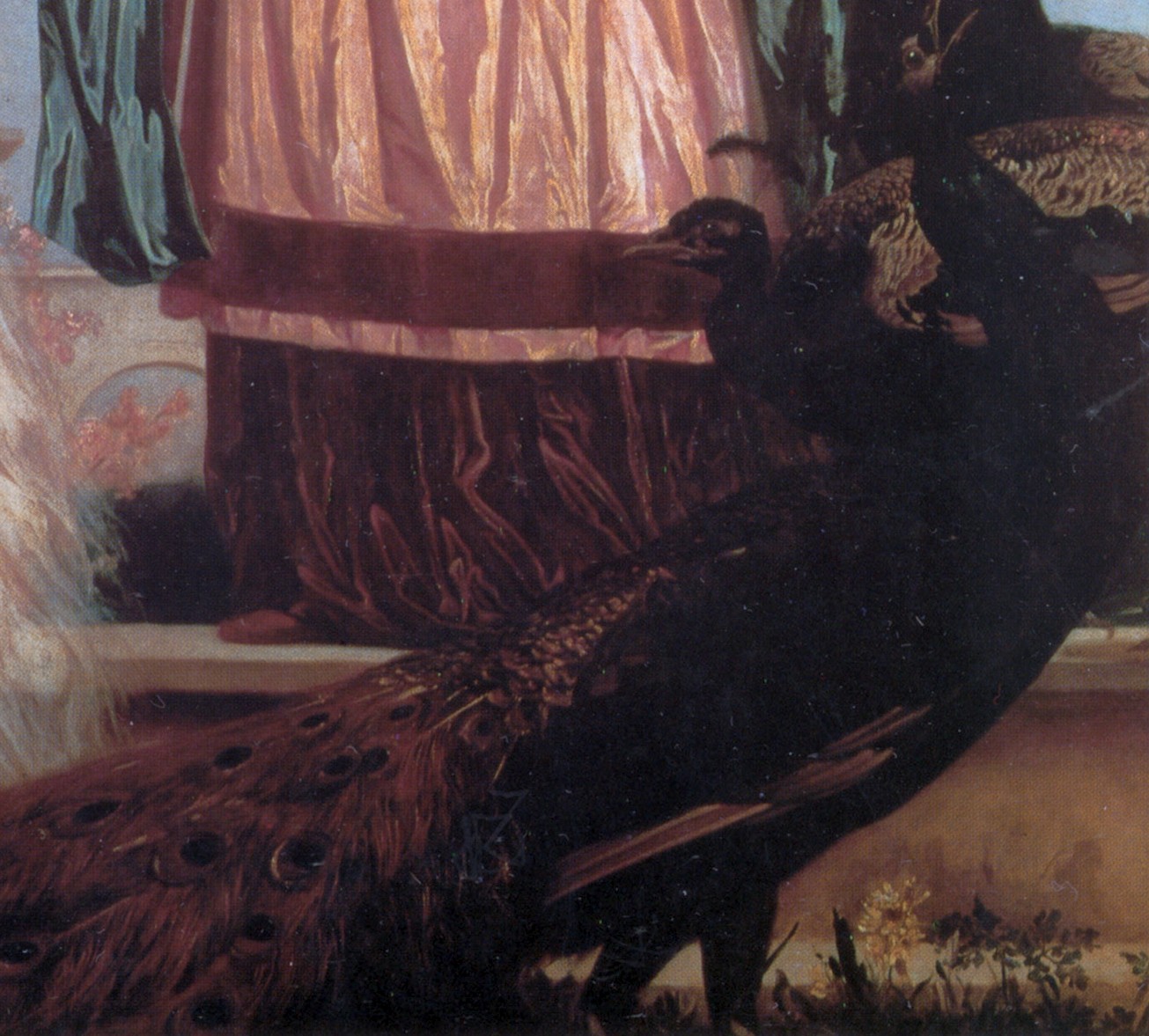
The eye can follow two very different trains. The white bird on the left turns away, displaying the long fall of its feathers. In the foreground a darker bird carries its train in a low sweep across the foot of the picture. The white plumage catches much of the light, while the individual eyespots register through the shadow of the darker train. The girl’s clothes carry the same interplay of light and shadow. A pale wrap gathers in loose folds above the shining rose fabric, and the deep green drapery falls into shadow. The painting gives cloth and plumage comparable weight. Both can look soft at a distance and astonishingly intricate when the eye comes to rest on them. [2]
A writer for The Examiner in May 1863 noticed how the birds occupied different levels. The critic counted six peacocks, three doves at the pan, two more flying in to settle and a pair of pouter pigeons below. The girl’s position seemed the strangest thing of all. Why should she climb onto a wall to feed peacocks when she might just as easily wait for them to come down? The reviewer compared her to Blondin, the tightrope walker, and praised the drawing and colouring while finding the performance affected. The joke draws attention to the way Leighton staged the action. With the girl and birds raised against open sky, their gestures can be read from the turn of a wrist or the tilt of a wing. [3]
Annotated Details from A Girl Feeding Peacocks
The numbered points identify visible features discussed in this article. Return from each detail to the numbered overview. Frederic Leighton, A Girl Feeding Peacocks, exhibited in 1863. Image source. Public domain. Resized proportionally.
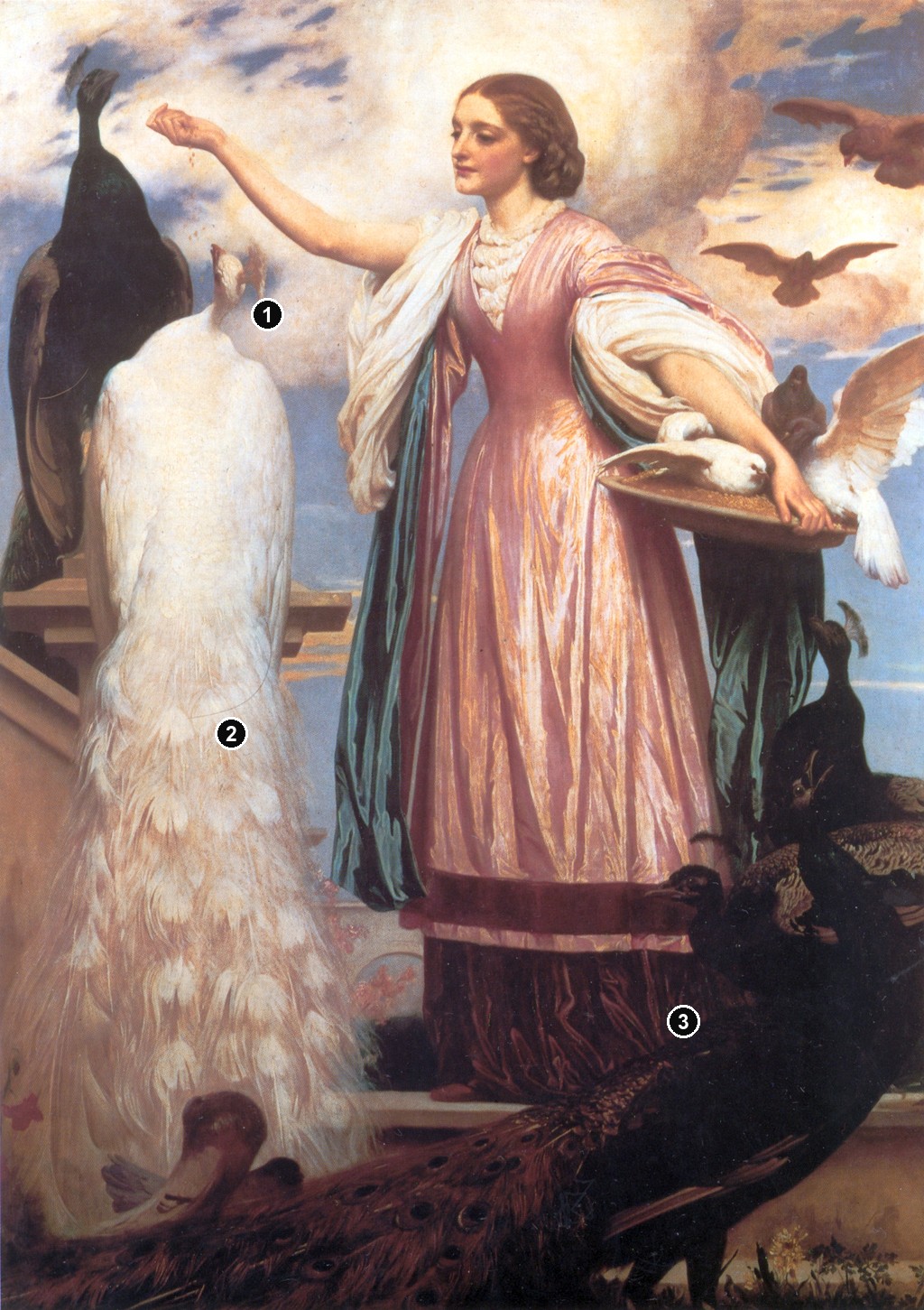
Details from A GIRL FEEDING PEACOCKS
Compare the cropped details with the source images above. Notice how their colours, shapes and positions contribute to the larger compositions.
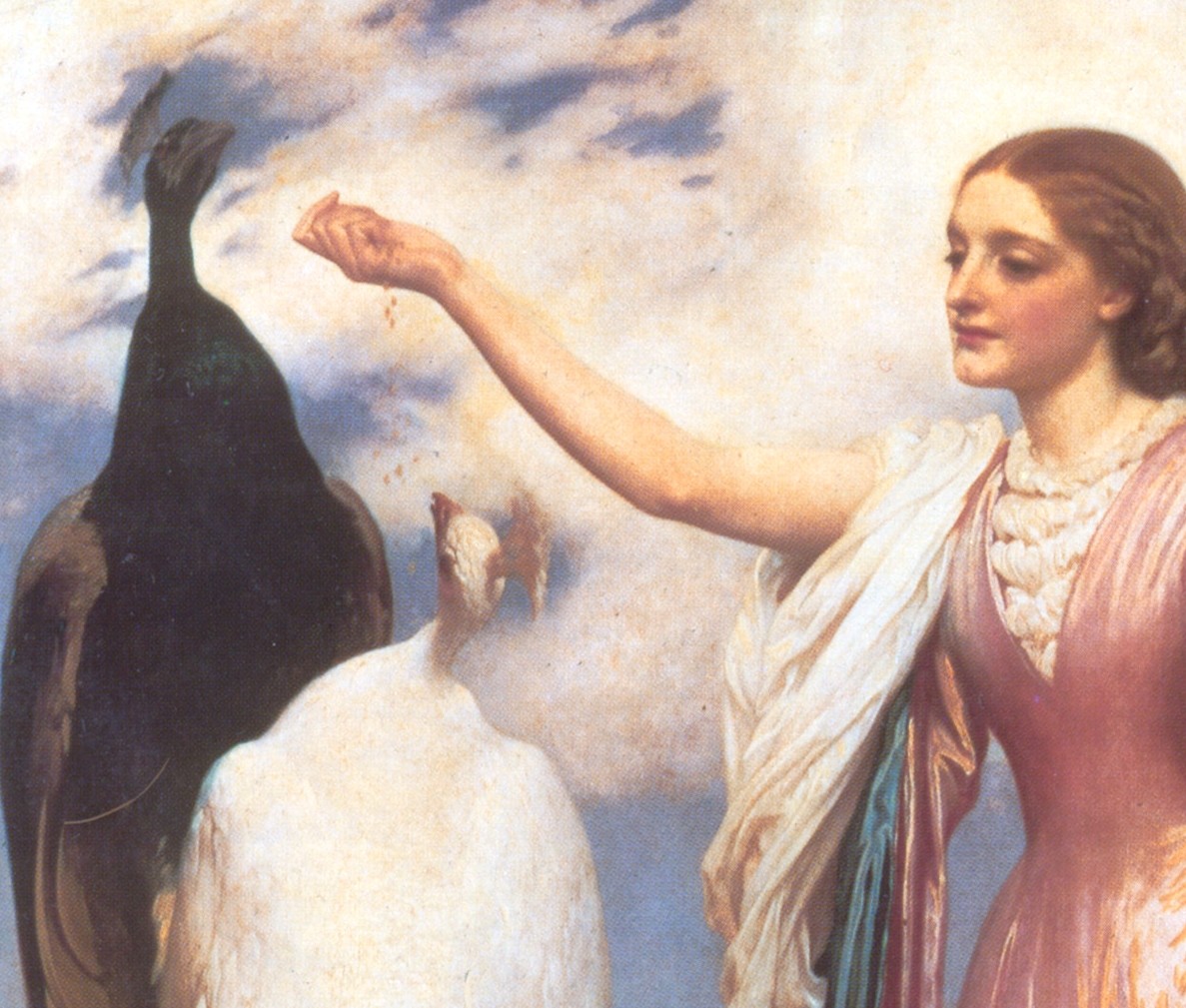
A hand outstretched towards a bird
The offered hand and lifted head of the dark peacock set up a diagonal. The raised arm leads back through the broad sweep of the sleeve.
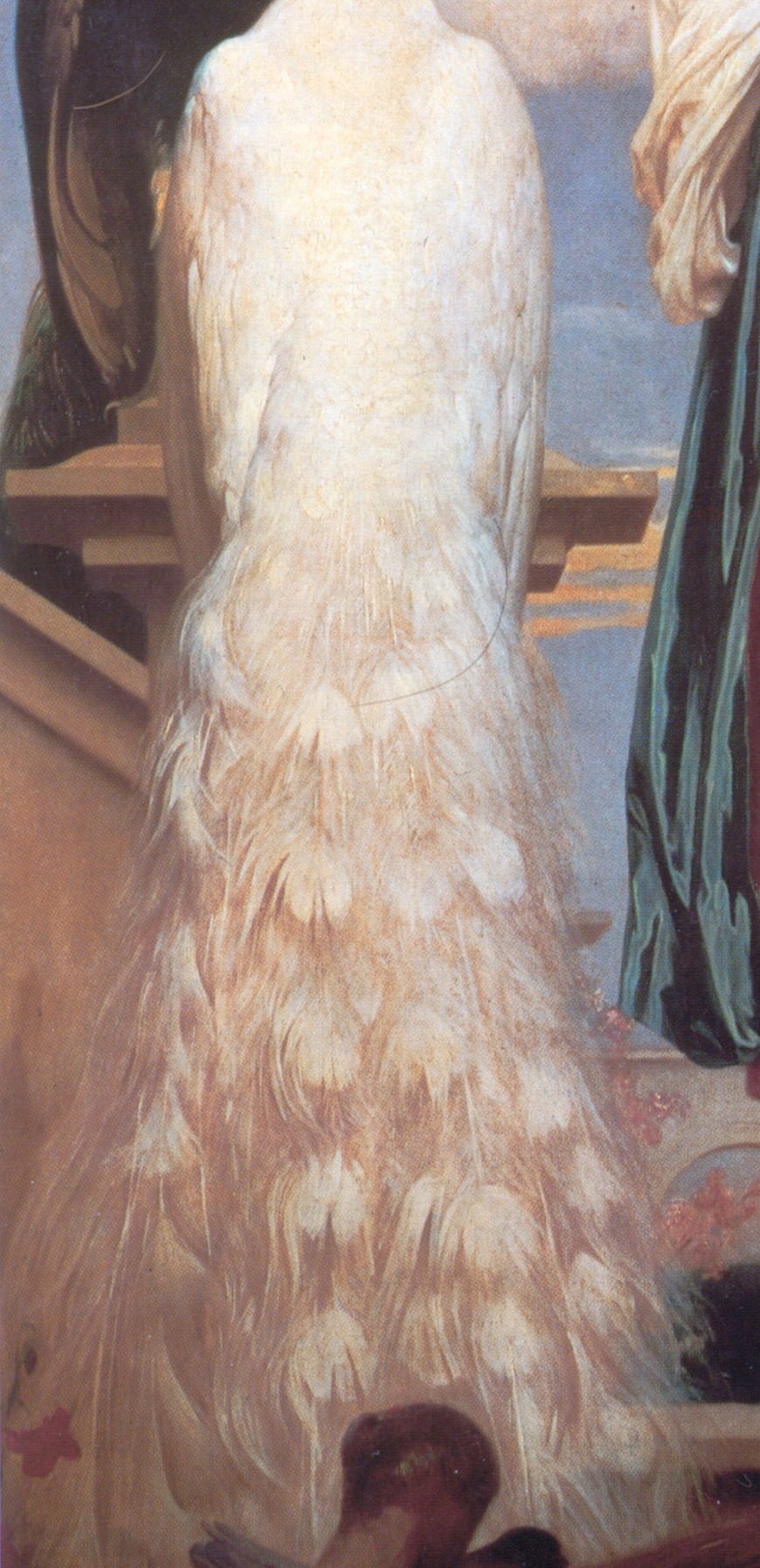
The long pale feathers
Fine edges interrupt the glowing body and tail. The bird passes in front of the wall and widens lower down as its tail descends.
The dark bird in the foreground
The patterned dark body crosses the bottom of the girl’s dress. Its wing and neck are read as much through outline and change of direction as through colour.
The picture at the Royal Academy
Leighton had already seen the picture in place when he wrote to his mother on 29 April 1863. He had been invited to Varnishing Day and was pleased with the position given to his “Peacock Girl.” His other exhibits offered very different impressions. The scene of Elijah confronting Ahab and Jezebel had a central position high on the wall and struck him as much darker than it had looked in the studio. He felt that An Italian Crossbowman and A Girl with a Basket of Fruit, also called Eucharis, had both looked better before they left it. His letter makes the light and placement in the West Room part of the story of how the peacock painting was first seen. [1] [4]
At least one period reviewer thought the light within the picture was questionable. In The Reader, the writer wondered how the girl’s head could look so bright against the cloud. To explain the objection, the critic asked readers to imagine holding a white sheet of paper to the sky. In ordinary daylight, the sheet would look dark against a bright cloud. Direct sunshine could reverse the impression. The point was about chiaroscuro, the pattern of light and dark that gives forms their volume and situates them in space. Leighton lets the girl’s face keep its warmth and clarity in the bright sky. That is precisely the passage where this critic wanted a more convincing account of how the light fell. [5]
The Art-Journal saw something closer to a daydream in colour. Its reviewer admired Leighton’s lines and found the individual effects dazzling, then questioned whether the painter had given those effects enough order. William Michael Rossetti took a more sympathetic view. He discussed the peacock painting alongside A Girl with a Basket of Fruit as an instance of “beauty, for beauty’s sake,” where colour, light and carefully chosen details could themselves be the subject of a painter’s attention. The reviews offer two ways of following the same picture. The line of the extended arm, the rush of wings to the pan and the run of feathers along the bottom are each arresting. The question was whether the pleasure of looking at those passages could carry the picture as a whole. [6] [7]
John Ruskin brought another standard to the birds themselves. In June he wrote to Leighton that the peacock and fruit pictures had both held his interest. In a subsequent letter he teased the painter that he knew more about peacocks than girls, and joked that if he could paint birds as well as Leighton and had painted these as badly, he would have painted them out. His praise and his complaint turn on the same thing. He took the skill in the painting seriously enough to pay close attention to creatures another critic might have treated as incidental. [8]
Peacocks in other works by Leighton
Leighton had already used a spread of peacock feathers to frame the turn of a woman’s head in Pavonia. In Odalisque, exhibited in 1862, the feather screen is held in the figure’s hand, and a live swan reaches up from the water below. The art historians Leonee and Richard Ormond suggested that Odalisque and A Girl Feeding Peacocks could almost be companions. They read Odalisque as suggestive of evening and the peacock scene of morning, and saw affinities with the art of Venice and Florence respectively. Seen alongside Odalisque, the peacock picture carries the encounter with a bird further. Here the feeding sets several animals in motion at once, and the great passages of feather pattern are produced by the birds carrying their own trains. [9] [10]
A different girl and pair of peacocks appear in A Moorish Garden: A Dream of Granada, exhibited in 1874. The Academy’s later memorial exhibition catalogue describes that painting as a view along the watercourse at the Generalife, with a girl carrying a copper vessel in the foreground and two peacocks following her. The long view through trees and arches gives the later picture its depth. In the 1863 scene the wall raises the action into the sky and the nearest birds fill the space in front of the spectator. [1] [2] [11]
The historical records also preserve other versions of the 1863 subject. Leighton’s biographer Emilie Barrington referred to sketches in the Leighton House collection and a small watercolour on ivory that she said was sold after his death. The 1896 Christie’s catalogue lists a work under the same title and describes it as a drawing of the large picture. The records show how the title could also refer to a related version or study. In the painted scene itself, the meeting of the girl’s outstretched fingers and the dark peacock’s lifting head still holds the action in suspense. There is scarcely room between them for the grain to fall. [2] [4] [12]
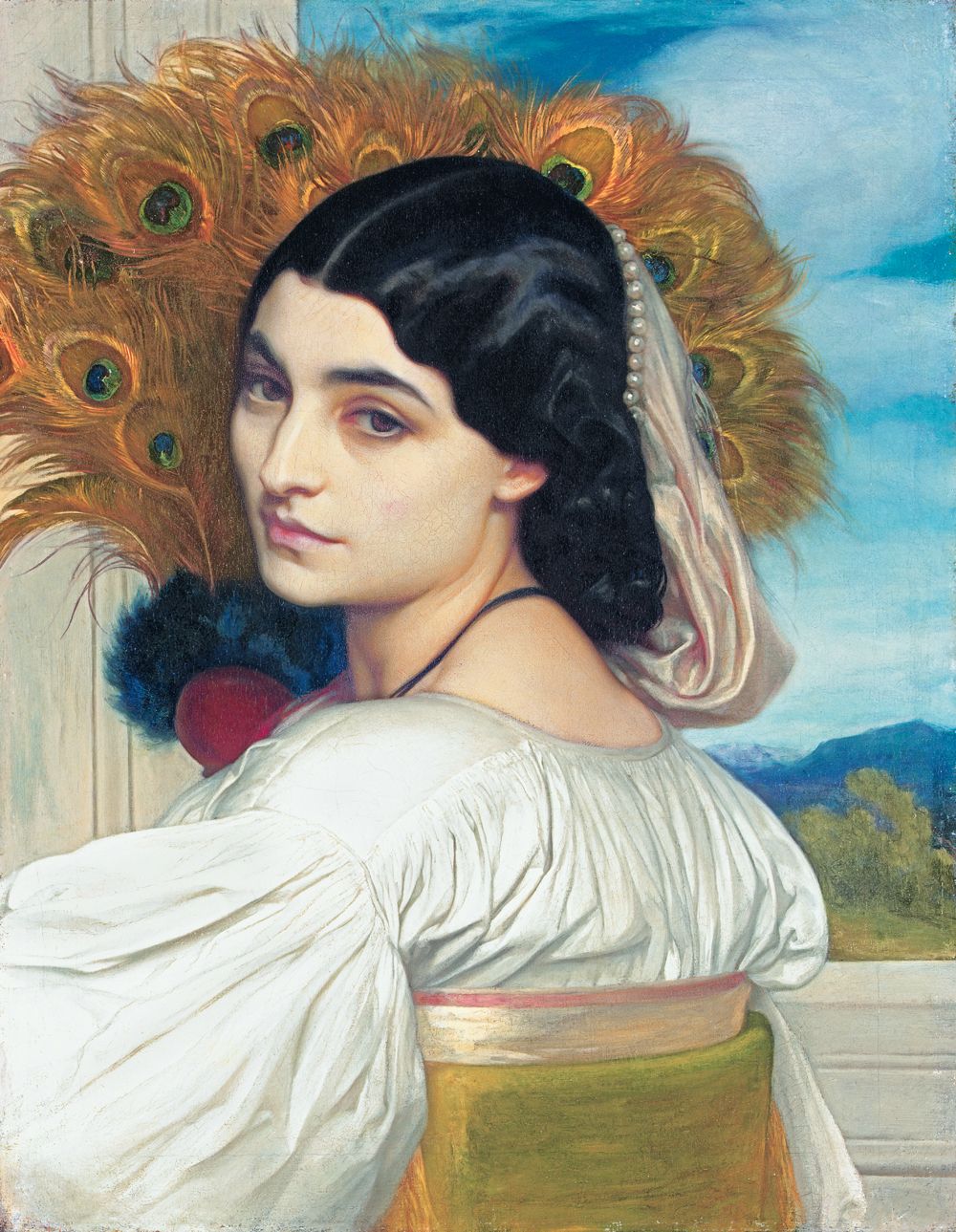
Frederic Leighton, Pavonia, c. 1859. Private collection. Image source. Public domain. Resized proportionally.
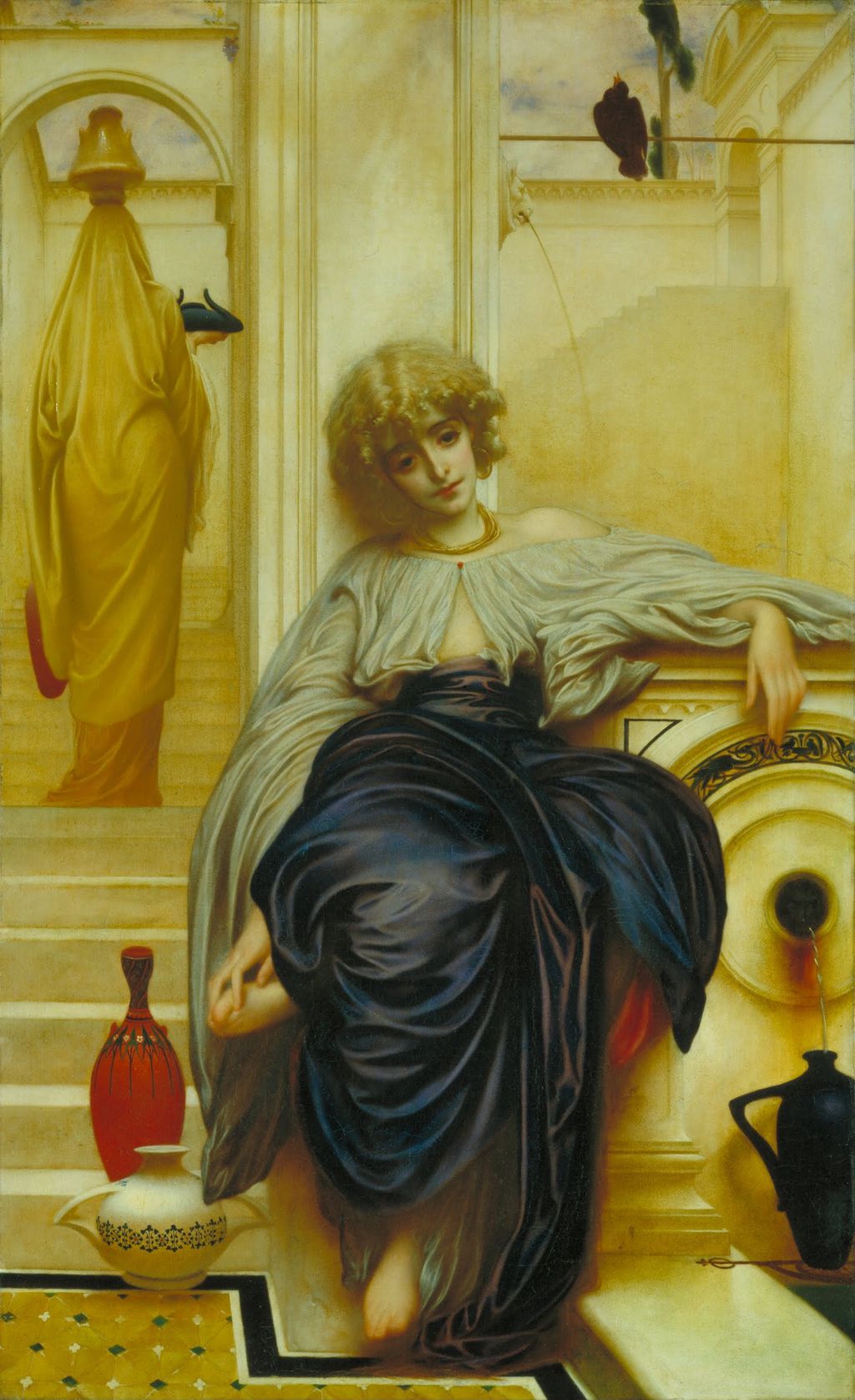
Frederic Leighton, Lieder ohne Worte, 1861. Tate. Image source. Public domain. Resized without changing the composition.
Browse Frederic Leighton’s artworks
Explore paintings, drawings, sculptures and prints, with separate rows for identified preparatory works, reproductions and casts.
| Name | Date | Medium |
|---|---|---|
| A Girl Feeding Peacocks | Exhibited 1863 | Painting Catalogue. |
| A Recognition from ‘Romola’, engraved by Swain (Tate N04054) | published 1862 | Print Catalogue. |
| A Roman Lady | 1859 | Painting Catalogue. |
| Abram and the Angel (Tate A00733) | published 1881 | Print Catalogue. |
| Acme and Septimius | Exhibited 1868 | Painting Catalogue. |
| An Athlete Wrestling with a Python (Tate exhibition bronze) | 1877 | Sculpture Catalogue. |
| And the Sea Gave Up the Dead Which Were in It (Tate N01511) | 1891–92 | Painting Catalogue. |
| Andromache in Captivity (photogravure after Leighton) | 1889 | Print Catalogue. |
| Athlete Wrestling with a Python (Anglesey Abbey cast) | model 1877; cast 1905 | Sculpture Catalogue. |
| Athlete Wrestling with a Python (Hood reduced cast) | 1877 (inscribed model date) | Sculpture Catalogue. |
| Athlete Wrestling with a Python (Saint Louis reduced cast) | 1877 (museum date) | Sculpture Catalogue. |
| Cain and Abel (Tate A00731) | published 1881 | Print Catalogue. |
| Captive Andromache | 1888 | Painting Catalogue. |
| Cimabue's Celebrated Madonna | 1853–55 | Painting Catalogue. |
| Cimon and Iphigenia, with Many Smaller Subjects (Tate T09061) | date not known | Drawing Catalogue. |
| Crenaia, the Nymph of the Dargle | Exhibited 1880 | Painting Catalogue. |
| Cymon and Iphigenia | 1884 | Painting Catalogue. |
| Daedalus and Icarus | 1869 | Painting Catalogue. |
| Dante in Exile | 1864 | Painting Catalogue. |
| Death of the First Born (Tate A00737) | published 1881 | Print Catalogue. |
| Electra at the Tomb of Agamemnon | c. 1869 | Painting Catalogue. |
| Eliezer and Rebekah (Tate A00735) | published 1881 | Print Catalogue. |
| Elijah in the Wilderness | 1877–78 | Painting Catalogue. |
| Fanny Kemble: A Study for ‘Jezebel and Ahab’ (Tate T08208) | c.1862 | Drawing Catalogue. |
| Figure Studies | Date not recorded | Drawing Catalogue. |
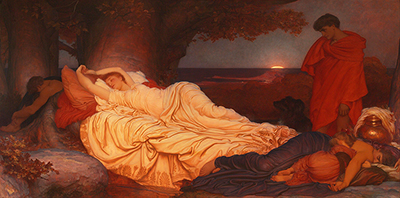
| Flaming June | 1895 | Painting Catalogue. |
| Gulnihal | Exhibited 1886 | Painting Catalogue. |
| Helios and Rhodes (Tate N03015) | date not known | Painting Catalogue. |
| Hercules Wrestling with Death for the Body of Alcestis | c. 1869–71 | Painting Catalogue. |
| Jonathan's Token to David | c. 1868 | Painting Catalogue. |
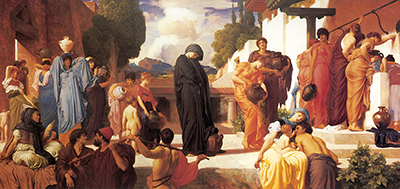
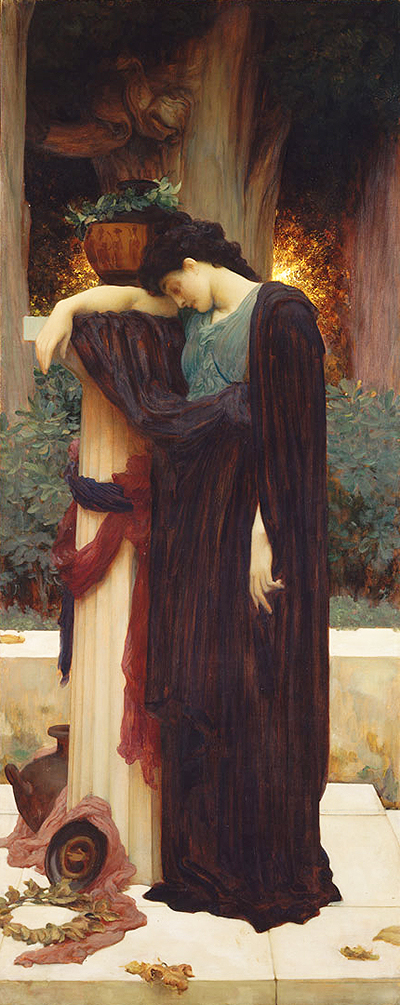
| Lachrymae | 1894–95 | Painting Catalogue. |
| Lieder ohne Worte | Exhibited 1861 | Painting Catalogue. |
| Light of the Harem | Exhibited 1880 | Painting Catalogue. |
| Moses Views the Promised Land (Tate A00736) | published 1881 | Print Catalogue. |
| Mrs James Guthrie | 1865 | Painting Catalogue. |
| Mrs John Hanson Walker (Tate N04731) | 1867 | Painting Catalogue. |
| Music Lesson | 1877 | Painting Catalogue. |
| Needless Alarms (Met cast) | modelled 1886; cast nineteenth century | Sculpture Catalogue. |
| Needless Alarms (Tate N05120) | 1886 | Sculpture Catalogue. |
| Pavonia | c. 1859 | Painting Catalogue. |
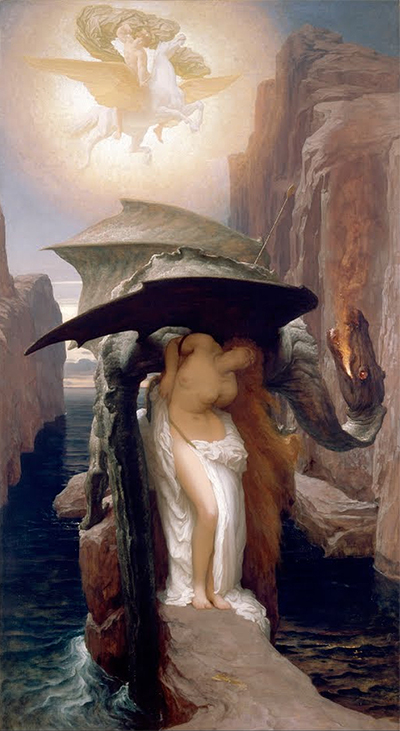
| Perseus and Andromeda | 1891 | Painting Catalogue. |
| Portrait of May Sartoris | c. 1860 | Painting Catalogue. |
| Preparing for a Festa, Florence (Tate T09062) | date not known | Drawing Catalogue. |
| Puerta de los Vientos, near Ronda, Spain (Tate N04006) | c.1886–9 | Painting Catalogue. |
| Samson and the Lions (Tate A00732) | published 1881 | Print Catalogue. |
| Samson at the Mill (Tate A00734) | published 1881 | Print Catalogue. |
| Samson Carrying the Gate (Tate A00738) | published 1881 | Print Catalogue. |
| Sketch for ‘An Athlete Wrestling with a Python’ (Tate N01761) | c.1877 | Sculpture Catalogue. |
| Sketches for Cimon and Iphigenia (Tate T09060) | date not known | Drawing Catalogue. |
| Study for The Return of Persephone (Demeter) | c. 1890–91 | Drawing Catalogue. |
| Study for The Return of Persephone (Persephone) | c. 1890–91 | Drawing Catalogue. |
| Study for ‘Needless Alarms’ (Tate N02945) | 1886 | Sculpture Catalogue. |
| Study for ‘The Discovery of Juliet Apparently Lifeless’ (Tate N01806) | c.1858 | Painting Catalogue. |
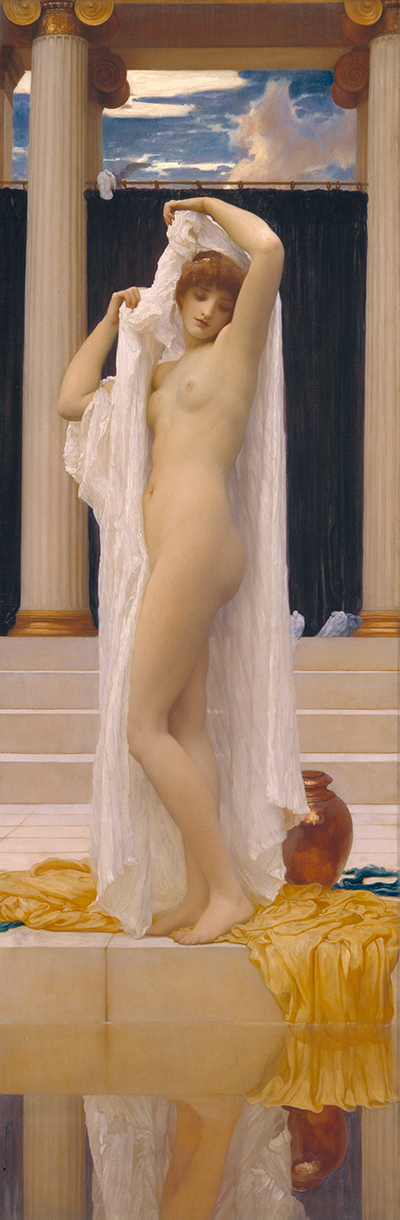
| The Bath of Psyche | Exhibited 1890 | Painting Catalogue. |
| The Daphnephoria | 1874–76 | Painting Catalogue. |
| The Death of Brunelleschi | 1852 | Painting Catalogue. |
| The Fisherman and the Siren | Exhibited 1858 | Painting Catalogue. |
| The Painter's Honeymoon | c. 1864 | Painting Catalogue. |
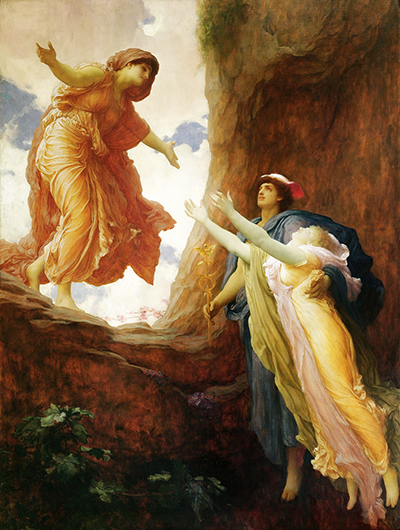
| The Return of Persephone | 1891 | Painting Leeds painting identified in the Met study record. |
| The Return of Persephone (preparatory oil) | c. 1890–91 | Painting Catalogue. |
| The Sluggard (Anglesey Abbey cast) | probably 1890–about 1906 | Sculpture Catalogue. |
| The Sluggard (Met cast) | modelled 1886; cast possibly before 1896 | Sculpture Catalogue. |
| The Sluggard (Museum Wales) | 1882–85 (museum date) | Sculpture Catalogue. |
| The Sluggard (Tate N01752) | 1885 | Sculpture Catalogue. |
| The Spies Escape (Tate A00730) | published 1881 | Print Catalogue. |
| Various Subjects (Tate T09063) | date not known | Drawing Catalogue. |
| View in Capri | Possibly 1859 | Painting Catalogue. |
| Wedded | 1882 | Painting Catalogue. |
| Winding the Skein | c. 1878 | Painting Catalogue. |
Discussion
Look again at the images and ideas explored in A Girl Feeding Peacocks. These editorial prompts invite your observations.
Reader Insights
Where do the different birds lead your eye in relation to the girl’s gesture?
How do the shadows change the colours of the larger birds?
Join the Conversation
Share a detail, comparison or question about A Girl Feeding Peacocks below.
References
- Royal Academy of Arts, The Exhibition of the Royal Academy, 1863, p. 21, West Room, no. 429. Digitised catalogue with the Paul Mellon Centre. View source.
- Marte Stinis, Music as Aesthetic Paradigm: Frederic Leighton, Albert Moore, and James McNeill Whistler, vol. 2, fig. 15, p. 16. Painting reproduction. View source.
- “The Pictures of the Year.—I.”, The Examiner, no. 2883, 2 May 1863, p. 280. View source.
- Frederic Leighton to his mother, 29 April 1863, in Emilie Barrington, The Life, Letters and Work of Frederic Leighton, vol. 2, ch. II, p. 119 and accompanying note, 1906. View source.
- “Art. Royal Academy (Second Notice).”, The Reader, 16 May 1863, pp. 485–486. View source.
- “The Royal Academy.”, The Art-Journal, 1 June 1863, p. 108, entry no. 429. View source.
- William Michael Rossetti, “The Royal Academy Exhibition,” Fraser’s Magazine, June 1863, p. 790, excerpted in Ernest Rhys, Frederic Lord Leighton: An Illustrated Record of His Life and Work, pp. 109–110. View source.
- John Ruskin to Frederic Leighton, June 1863, in E. T. Cook and Alexander Wedderburn, eds., The Works of John Ruskin, vol. 36, pp. 445–447. View source.
- Christie’s, Frederic Leighton, Pavonia, lot 19, 30 June 2016. View source.
- Christie’s, Frederic Leighton, Odalisque, lot essay quoting Leonee and Richard Ormond on the relationship between the two paintings. View source.
- Royal Academy of Arts, Exhibition of Works by the Old Masters, and by Deceased Masters of the British School, 1897, p. 22, no. 78. View source.
- Christie, Manson & Woods, Catalogue of the Remaining Works and the Collection … of Lord Leighton of Stretton, July 1896, p. 7, lot 83. View source.