 by Tom Gurney
Tom Gurney BSc (Hons) is an art history expert with over 20 years experience
Published on June 19, 2020 / Updated on November 29, 2026
Email: tomgurney1@gmail.com / Phone: +44 7429 011000
Pavonia: Introduction
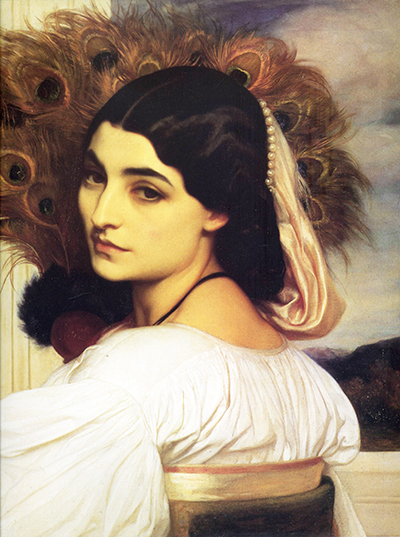
A fan of peacock feathers almost fills the space behind a woman’s head. Her shoulders turn away as her face comes back into view, and her eyes settle slightly to one side of the viewer. Frederic Leighton painted Pavonia around 1859, using a Roman model generally identified as Anna Risi, known as La Nanna. The painting is an oil on canvas measuring 53 by 41.5 centimetres, recorded in a private collection. Christie’s identifies this canvas as no. 32 at the Royal Academy’s 1859 Summer Exhibition. The fan gives the painting its title and helps distinguish it from Leighton’s other paintings of Risi. [1] [2] [3]
At a Glance
- SitterAnna Risi (La Nanna)
- PaintedAbout 1859
- Royal Academy1859, no. 32
- CollectionPrivate collection
This work across Frederic Leighton’s career
Cimabue’s Celebrated Madonna
1853–55Pavonia (current article)
c. 1859 [1]Lachrymae
1894–95Flaming June
c. 1895Contents
- A face framed by feathers
- Anna Risi in Leighton’s Roman studio
- Three peacock pictures and a Roman lady
- The exhibition picture and its return to view
- Annotated details
A face framed by feathers
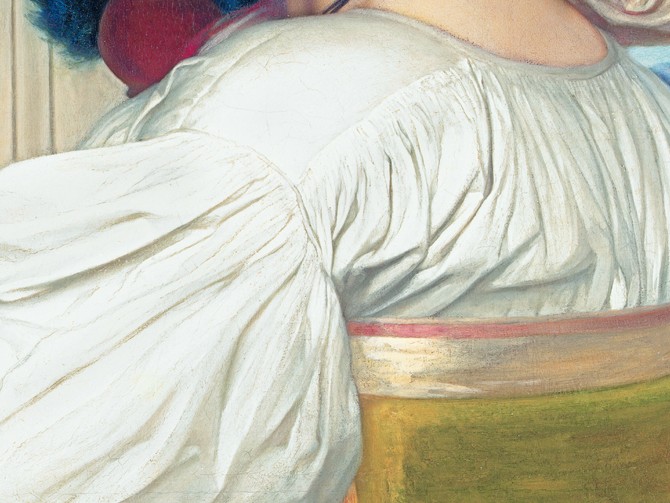
The white blouse fills much of the lower half of the picture. Its sleeve swells out to the left edge, and the folds narrow as they meet the band of fabric around the sitter’s waist. That sideways sweep makes the woman seem to be turning even though her face is remarkably still. A dark cord cuts across the warm skin at her neck. Farther up, a row of pearls traces the edge of her dark hair, next to a light veil that falls in soft pink and grey folds. The layers are easy to follow because Leighton gives each surface a different kind of light. The pearls catch it in points, the blouse in broad ridges, and the skin in a gradual change from brightness on the cheek to shadow near the jaw. [1] [2]
The feathers spread in a wide arc. Near the sitter’s hair, their fine strands stand out against the dark mass of the head. Toward the blue sky the ends nearly dissolve, but the green and blue eyes keep their shape. A few of those blues reappear in the distant ridge at the right of the canvas. There is just enough room to see trees and hills beyond the pale ledge, so that the fan feels close and the landscape feels a long way off. The feathers also throw the woman's own gaze into relief. The eyes on the fan seem to face out from every angle, while hers pass the viewer. [1] [2]
The title points to the peacock fan and makes that object unusually important for a picture centred on a face. An Academy visitor could read the title and then find its meaning in the pattern radiating behind the sitter. The fan works as an accessory in the scene and as a way of organising the painting. Its dense pattern frees Leighton to keep the forehead and cheek relatively quiet. It also makes the sitter's turn more apparent. The fan spreads out almost parallel to the picture surface, while the narrow view of her far cheek makes the head feel rounded in front of it. [1] [2]
Annotated Details from Pavonia
The numbered points identify visible features discussed in this article. Return from each detail to the numbered overview. Frederic Leighton, Pavonia, c. 1859. Private collection. Image source. Public domain. Resized proportionally.
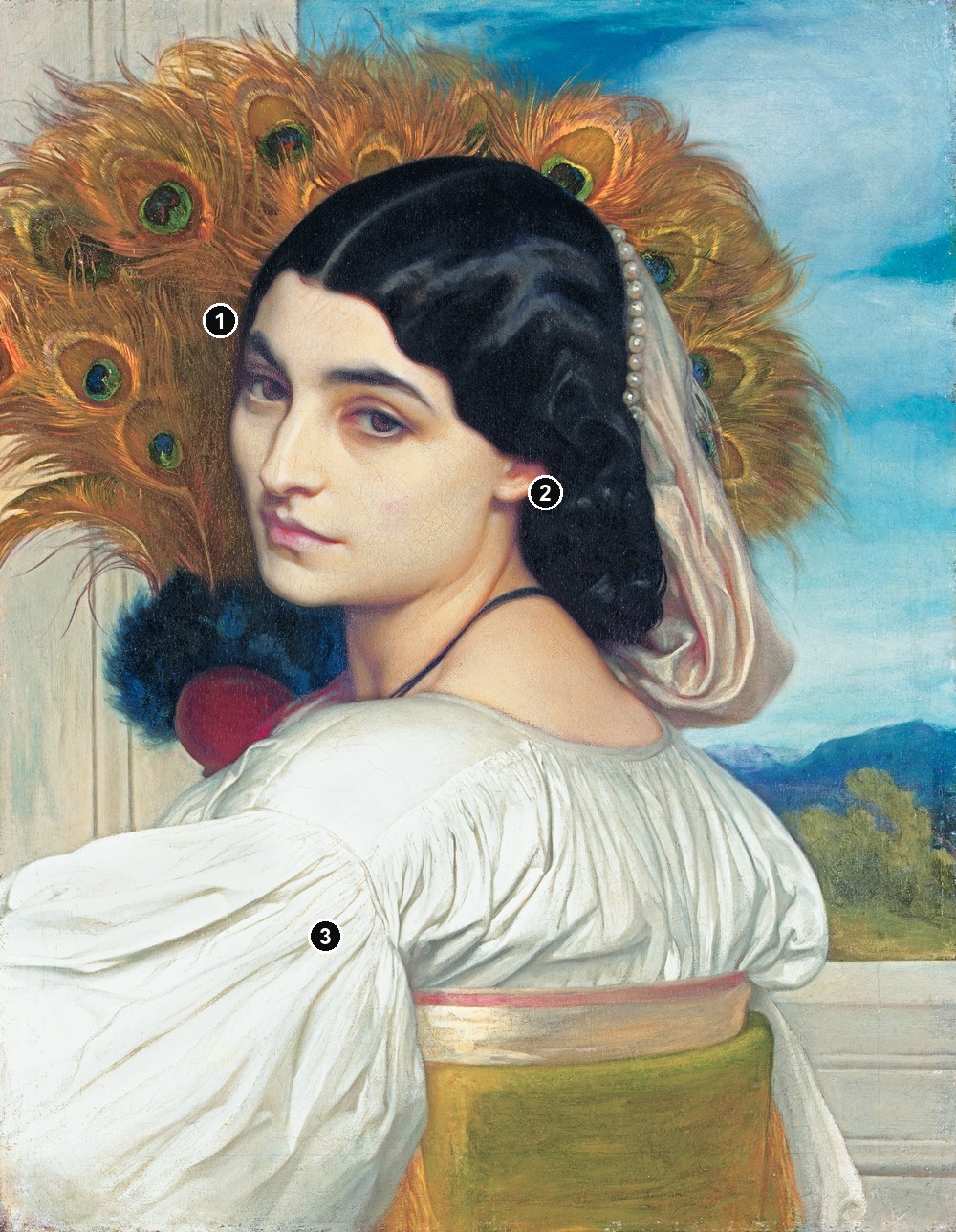
Details from PAVONIA
Compare the cropped details with the source images above. Notice how their colours, shapes and positions contribute to the larger compositions.
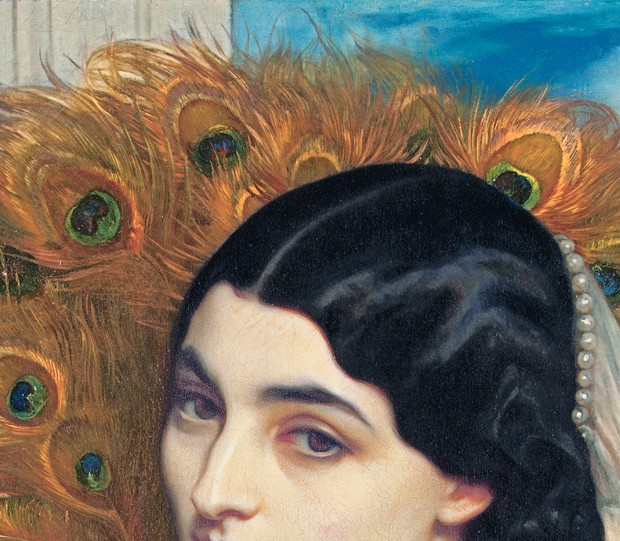
Patterns in the peacock fan
Peacock eyes repeat around the edges of the sitter’s dark hair. Their colours keep the curved fan distinct from the blue background.
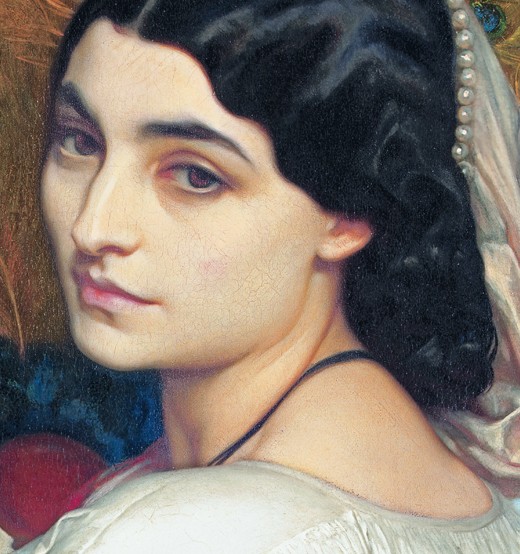
The backward glance
The turn brings one cheek and the line of the nose into clear light. As the eyes look back, the shoulder and the body continue to turn away.
The breadth of the white sleeve
Pale cloth swells across the foreground. The lines of the folds turn around the shoulder while a green band holds the lower part of the shape together.
Anna Risi in Leighton’s Roman studio
Leighton spent the winter of 1858–59 in Rome. In February he wrote to his mother that he was about to send studies of La Nanna to the Royal Academy, calling her a handsome model and reporting how well the pictures had gone over with artists and other visitors to his studio. Annegret Winter’s research traces Risi’s sittings in Leighton’s notes from November into April. The letter and notes establish repeated work with a model whose nickname he already knew. They tell us more about the making of the pictures than about how Risi understood the roles she was asked to play. [4] [5]
Risi is also closely associated with the German painter Anselm Feuerbach. The Bayerische Staatsgemäldesammlungen places their first encounter in Rome in 1860, after Leighton had exhibited his paintings of her. In Feuerbach’s Nanna in Munich, her head is sharply outlined against a plain background, with the light picking out her brow and nose. Leighton surrounds the head with colour and pattern and turns the face farther towards the viewer. The two painters worked with the same woman, and their pictures give her different kinds of presence. Feuerbach later used Risi as a model for historical and mythological figures, giving a woman Leighton’s London audience had seen as Pavonia still other identities. [1] [5] [6]
The word Pavonia also changes what a viewer might expect from a picture made with a known sitter. The historian Juan Carlos Bejarano Veiga places it in the British tradition of the fancy picture, where a model could give a figure the specificity of a portrait and the title could direct attention to another subject. Here the fan is enough to do that work. The steady gaze might carry a suggestion of reserve or self-possession, helped by the way Leighton holds the face in a turn and lets the gaze slip past the viewer. The art historian Anne-Florence Gillard-Estrada places the Risi series among the early examples of the portrait-like subject pictures that later became central to British Aestheticism. A known sitter and a title with a life of its own could coexist in a single image. [1] [5] [7] [8]
Three peacock pictures and a Roman lady
The Royal Academy exhibitors’ register lists Pavonia as no. 32 in 1859, Sunny Hours as no. 118 and La Nanna as no. 281. The number is especially useful for Sunny Hours, which Sotheby’s catalogued in 2013 under the combined title La Nanna (Sunny Hours). Writing later in the nineteenth century, Ernest Rhys distinguished the woman with peacock feathers from the black-haired woman who faced the spectator in the picture then known as A Roman Lady. The latter canvas is now the Philadelphia Art Museum’s Portrait of a Roman Lady (La Nanna). In Philadelphia, the sitter's hand rises to her necklace, and the pale sleeve gleams against deeper tones. Compare that frontal pose with the turning shoulder and backward glance in Pavonia. The dress historian Robyne Calvert suggests that the full white sleeve may represent the same garment appearing as an underlayer in the Philadelphia portrait. Its folds in Pavonia give the shoulder its breadth and make the twist legible. In Philadelphia the fabric instead catches the light below the hand that rises to the necklace. [1] [3] [9] [10] [11] [12]
Two more paintings can cause confusion. The Royal Collection’s Nanna (Pavonia) is signed and dated 1859 and measures 59.4 by 51.1 centimetres. Risi has her back to the viewer and her face in profile, looking down into the dark. The young Prince of Wales saw Leighton’s pictures in his Roman studio. In a letter from Naples, Leighton reported that George de Monbrison had let the Prince have the painting originally promised to him. Leighton had turned down requests to repeat the profile for others, but he offered to paint it again for Monbrison. Christie’s identifies the repetition as Leighton House’s La nanna, Pavonia (LH0376). In both of these closely related compositions, the profile is easier to recognise at a glance than the peacock feathers. In the private Pavonia, the bright patch of sky and the broad fan distinguish the silhouette. [4] [1] [13] [14]
The Royal Collection subsequently treated its painting as a companion to Bianca, which Leighton painted in 1862. The canvases match in size and set the peacock’s dark splendour against the pale drapery and dove in Bianca. Their conservation brought out details including the pearl ornaments in Risi’s hair. That history belongs to the Royal Collection canvas. It offers a glimpse of what one collector saw in a related version of the subject, while the private painting had a separate owner and a different exhibition history. [13] [15]
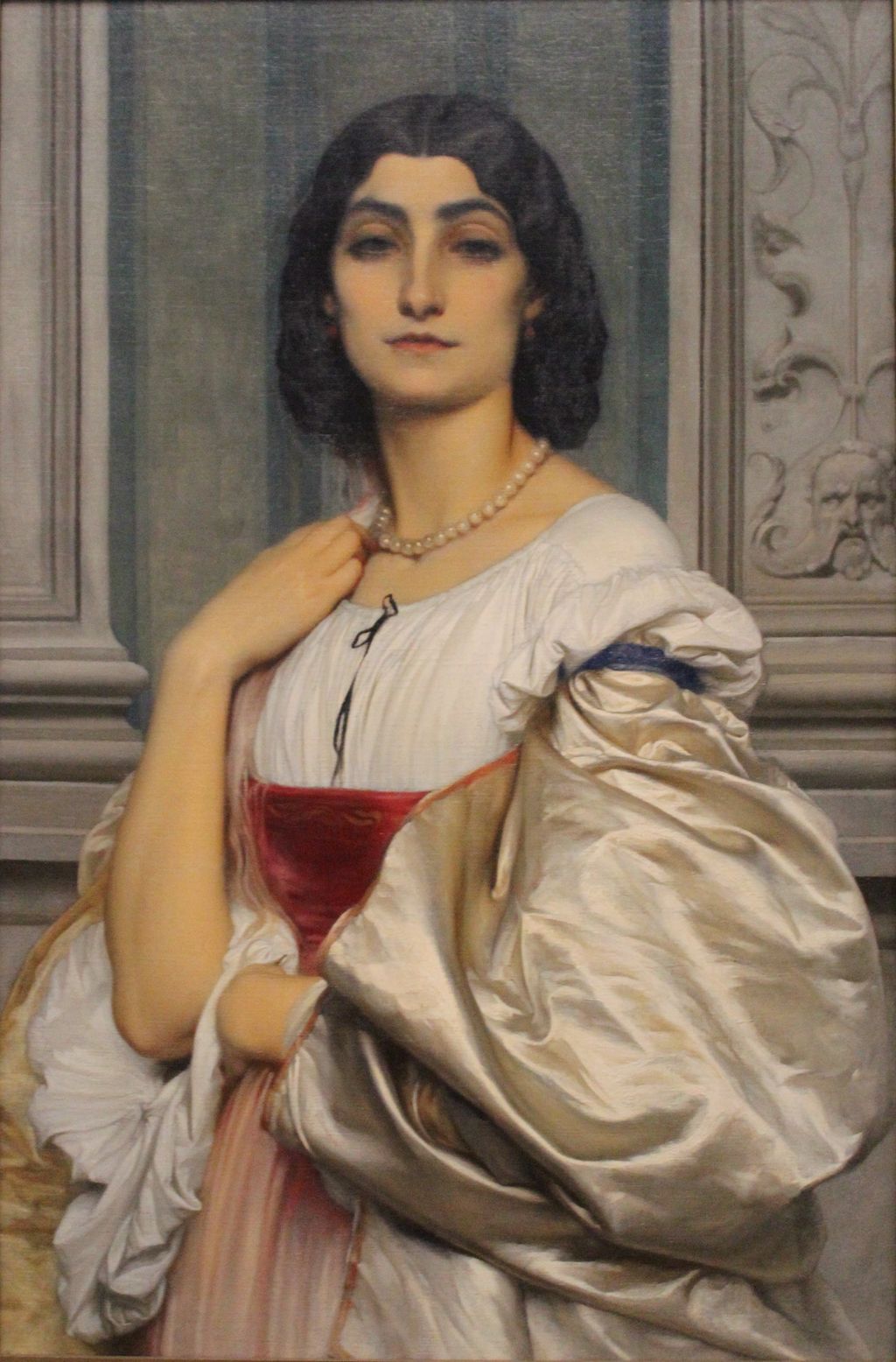
Frederic Leighton, Portrait of a Roman Lady (La Nanna), 1859. Philadelphia Art Museum. Photograph by Miguel Hermoso Cuesta. Image source. CC BY-SA 4.0. Trimmed the frame and resized. The photograph and detail crops remain CC BY-SA 4.0.
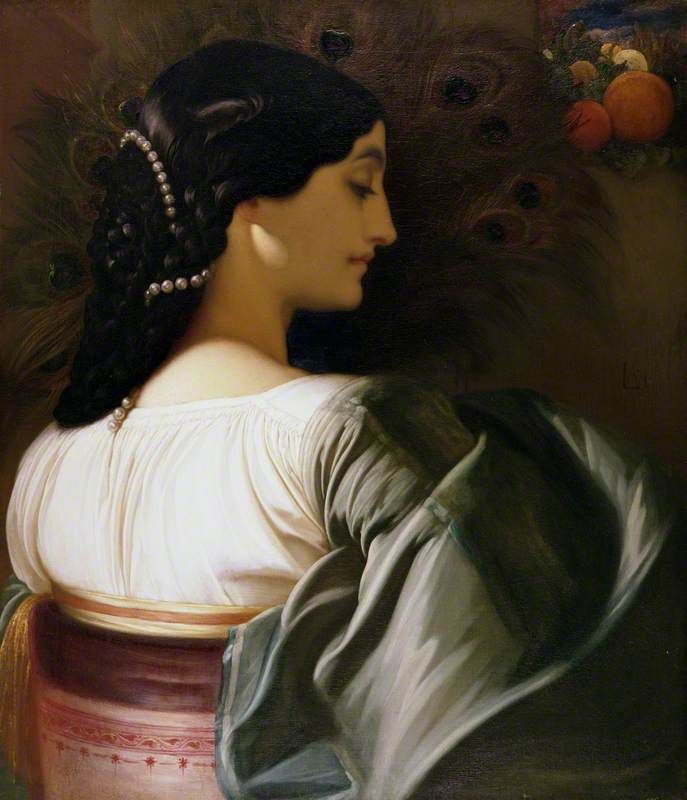
Frederic Leighton, La nanna, Pavonia. Leighton House. Image source. Public domain. Resized proportionally.
The exhibition picture and its return to view
The Academy catalogue number identifies an exhibit, and the nineteenth-century accounts help connect that exhibit to a physical canvas. The critic in The Athenaeum drew attention to the backward look and the subtle shades around the model’s eyes, and compared the figure to Lucrezia Borgia. The Art Journal praised the character of the head and preferred the work to Leighton’s Samson and Delilah, which was shown elsewhere that year. The Borgia comparison tells us how readily a contemporary reviewer supplied a story for the face. The turn of the head also helps place the painting. The private canvas shows the near cheek in full and gives enough of the other side of the face for the look back to register, whereas the royal picture holds its sitter in profile. [1] [3]
According to the Christie’s provenance, George Payne acquired the painting from Leighton and it passed down in his family. When Leighton was proposing works for London’s 1862 International Exhibition, he wrote that he had offered four pictures he called “Nannas.” Christie’s records the Payne picture at that exhibition as no. 429. It came back onto the market at Sotheby’s in New York in 1982. Christie’s says that the surviving reviews allowed researchers to connect the resurfaced canvas with the 1859 Academy number that had previously been associated with the other versions. The painting returned to the Academy for its 1996 Leighton retrospective as no. 14. [1] [4]
The picture's modern exhibitions have asked different questions about it. In 2011 the Musée d’Orsay reproduced the private Pavonia in its account of the early circles of British Aestheticism, where the handling of colour, surface and the figure could carry a painting. The exhibition opened at the Victoria and Albert Museum in London and went on to the Legion of Honor in San Francisco after Paris. In 2014 the Mitsubishi Ichigokan Museum in Tokyo placed the same 53 by 41.5 centimetre canvas in the “Search for a New Beauty” section of The Beautiful, which also included George Frederic Watts’s Study with Peacock’s Feathers. In 2024 the Museo Civico San Domenico in Forlì listed both the private Pavonia and the royal Nanna (Pavonia) in a section on Leighton, Michelangelo and classicism alongside works by Italian Renaissance painters. The pairing in Forlì made the differences in pose available to a single audience. The Tokyo exhibition offered a chance to follow the peacock motif across artists. Both approaches bring the viewer back to what Leighton does with the feathers here. At the right of the fan, a blue-green eye nearly touches the pale veil. Its position brings the feather close enough for the viewer to imagine its fine strands brushing the cloth. [1] [2] [16] [17] [18]
Browse Frederic Leighton’s artworks
Explore paintings, drawings, sculptures and prints, with separate rows for identified preparatory works, reproductions and casts.
| Name | Date | Medium |
|---|---|---|
| A Girl Feeding Peacocks | Exhibited 1863 | Painting Catalogue. |
| A Recognition from ‘Romola’, engraved by Swain (Tate N04054) | published 1862 | Print Catalogue. |
| A Roman Lady | 1859 | Painting Catalogue. |
| Abram and the Angel (Tate A00733) | published 1881 | Print Catalogue. |
| Acme and Septimius | Exhibited 1868 | Painting Catalogue. |
| An Athlete Wrestling with a Python (Tate exhibition bronze) | 1877 | Sculpture Catalogue. |
| And the Sea Gave Up the Dead Which Were in It (Tate N01511) | 1891–92 | Painting Catalogue. |
| Andromache in Captivity (photogravure after Leighton) | 1889 | Print Catalogue. |
| Athlete Wrestling with a Python (Anglesey Abbey cast) | model 1877; cast 1905 | Sculpture Catalogue. |
| Athlete Wrestling with a Python (Hood reduced cast) | 1877 (inscribed model date) | Sculpture Catalogue. |
| Athlete Wrestling with a Python (Saint Louis reduced cast) | 1877 (museum date) | Sculpture Catalogue. |
| Cain and Abel (Tate A00731) | published 1881 | Print Catalogue. |
| Captive Andromache | 1888 | Painting Catalogue. |
| Cimabue's Celebrated Madonna | 1853–55 | Painting Catalogue. |
| Cimon and Iphigenia, with Many Smaller Subjects (Tate T09061) | date not known | Drawing Catalogue. |
| Crenaia, the Nymph of the Dargle | Exhibited 1880 | Painting Catalogue. |
| Cymon and Iphigenia | 1884 | Painting Catalogue. |
| Daedalus and Icarus | 1869 | Painting Catalogue. |
| Dante in Exile | 1864 | Painting Catalogue. |
| Death of the First Born (Tate A00737) | published 1881 | Print Catalogue. |
| Electra at the Tomb of Agamemnon | c. 1869 | Painting Catalogue. |
| Eliezer and Rebekah (Tate A00735) | published 1881 | Print Catalogue. |
| Elijah in the Wilderness | 1877–78 | Painting Catalogue. |
| Fanny Kemble: A Study for ‘Jezebel and Ahab’ (Tate T08208) | c.1862 | Drawing Catalogue. |
| Figure Studies | Date not recorded | Drawing Catalogue. |
| Flaming June | 1895 | Painting Catalogue. |
| Gulnihal | Exhibited 1886 | Painting Catalogue. |
| Helios and Rhodes (Tate N03015) | date not known | Painting Catalogue. |
| Hercules Wrestling with Death for the Body of Alcestis | c. 1869–71 | Painting Catalogue. |
| Jonathan's Token to David | c. 1868 | Painting Catalogue. |
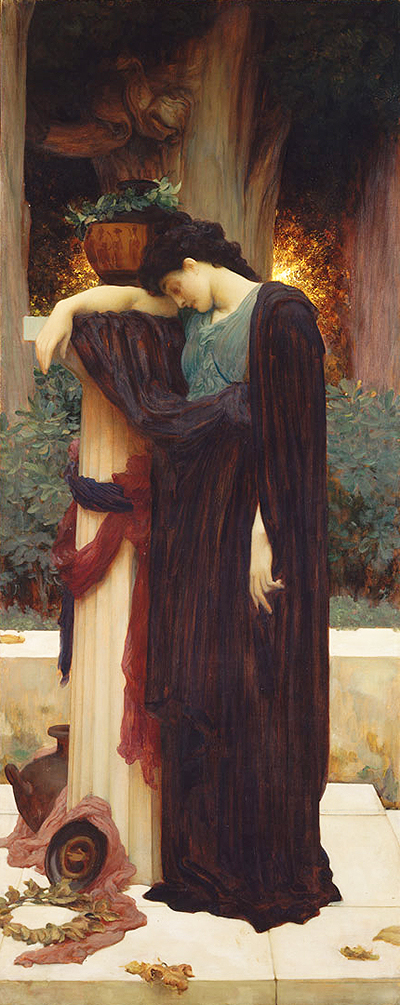
| Lachrymae | 1894–95 | Painting Catalogue. |
| Lieder ohne Worte | Exhibited 1861 | Painting Catalogue. |
| Light of the Harem | Exhibited 1880 | Painting Catalogue. |
| Moses Views the Promised Land (Tate A00736) | published 1881 | Print Catalogue. |
| Mrs James Guthrie | 1865 | Painting Catalogue. |
| Mrs John Hanson Walker (Tate N04731) | 1867 | Painting Catalogue. |
| Music Lesson | 1877 | Painting Catalogue. |
| Needless Alarms (Met cast) | modelled 1886; cast nineteenth century | Sculpture Catalogue. |
| Needless Alarms (Tate N05120) | 1886 | Sculpture Catalogue. |
| Pavonia | c. 1859 | Painting Catalogue. |
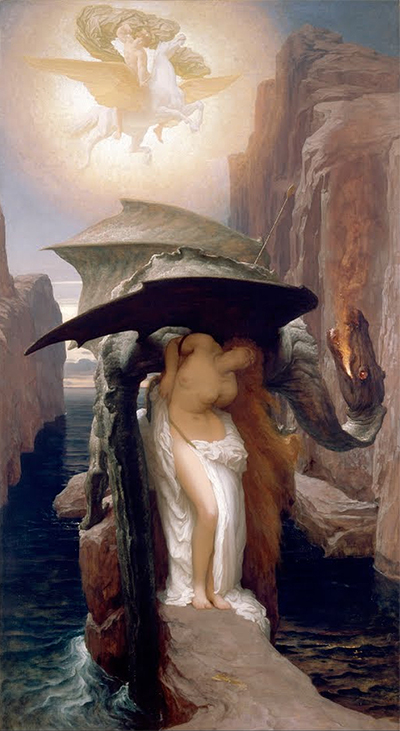
| Perseus and Andromeda | 1891 | Painting Catalogue. |
| Portrait of May Sartoris | c. 1860 | Painting Catalogue. |
| Preparing for a Festa, Florence (Tate T09062) | date not known | Drawing Catalogue. |
| Puerta de los Vientos, near Ronda, Spain (Tate N04006) | c.1886–9 | Painting Catalogue. |
| Samson and the Lions (Tate A00732) | published 1881 | Print Catalogue. |
| Samson at the Mill (Tate A00734) | published 1881 | Print Catalogue. |
| Samson Carrying the Gate (Tate A00738) | published 1881 | Print Catalogue. |
| Sketch for ‘An Athlete Wrestling with a Python’ (Tate N01761) | c.1877 | Sculpture Catalogue. |
| Sketches for Cimon and Iphigenia (Tate T09060) | date not known | Drawing Catalogue. |
| Study for The Return of Persephone (Demeter) | c. 1890–91 | Drawing Catalogue. |
| Study for The Return of Persephone (Persephone) | c. 1890–91 | Drawing Catalogue. |
| Study for ‘Needless Alarms’ (Tate N02945) | 1886 | Sculpture Catalogue. |
| Study for ‘The Discovery of Juliet Apparently Lifeless’ (Tate N01806) | c.1858 | Painting Catalogue. |
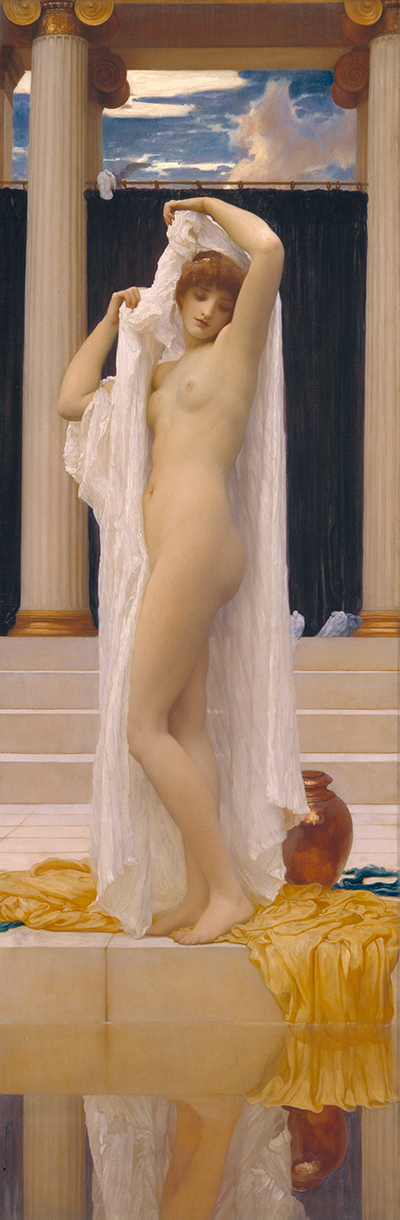
| The Bath of Psyche | Exhibited 1890 | Painting Catalogue. |
| The Daphnephoria | 1874–76 | Painting Catalogue. |
| The Death of Brunelleschi | 1852 | Painting Catalogue. |
| The Fisherman and the Siren | Exhibited 1858 | Painting Catalogue. |
| The Painter's Honeymoon | c. 1864 | Painting Catalogue. |
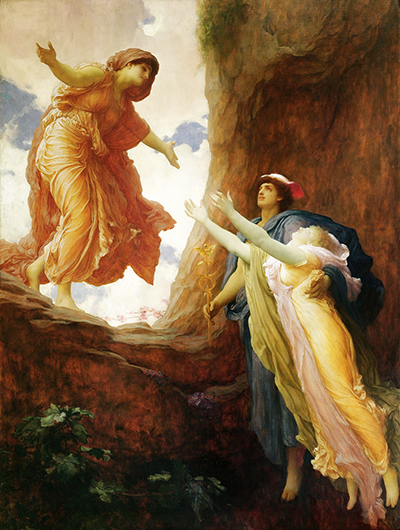
| The Return of Persephone | 1891 | Painting Leeds painting identified in the Met study record. |
| The Return of Persephone (preparatory oil) | c. 1890–91 | Painting Catalogue. |
| The Sluggard (Anglesey Abbey cast) | probably 1890–about 1906 | Sculpture Catalogue. |
| The Sluggard (Met cast) | modelled 1886; cast possibly before 1896 | Sculpture Catalogue. |
| The Sluggard (Museum Wales) | 1882–85 (museum date) | Sculpture Catalogue. |
| The Sluggard (Tate N01752) | 1885 | Sculpture Catalogue. |
| The Spies Escape (Tate A00730) | published 1881 | Print Catalogue. |
| Various Subjects (Tate T09063) | date not known | Drawing Catalogue. |
| View in Capri | Possibly 1859 | Painting Catalogue. |
| Wedded | 1882 | Painting Catalogue. |
| Winding the Skein | c. 1878 | Painting Catalogue. |
Discussion
Look again at the images and ideas explored in Pavonia. These editorial prompts invite your observations.
Reader Insights
How does the fan change where you first look in the portrait?
Which details help you distinguish the exhibited Pavonia from the other images of Anna Risi?
Join the Conversation
Share a detail, comparison or question about Pavonia below.
References
- Christie’s, Frederic, Lord Leighton, Pavonia, c. 1859, lot 6011508 (2016), object details, provenance, exhibitions and essay, including transcribed comments from The Athenaeum, 7 May 1859, p. 618, and The Art Journal, 1859, p. 162. View source.
- Musée d’Orsay, “Beauty, Morals and Voluptuousness in the England of Oscar Wilde” (2011–12), “The Early Aesthetic Circles,” including reproduction of the privately owned Pavonia. View source.
- Algernon Graves, The Royal Academy of Arts: A Complete Dictionary of Contributors and Their Work from its Foundation in 1769 to 1904, vol. V (1906), p. 32, entries for Frederic Leighton in 1859. View source.
- Emilie Barrington, The Life, Letters and Work of Frederic Leighton, vol. II (1906), chapter I, letters from Rome and Naples in 1859 and Leighton’s preparations for the 1862 International Exhibition. View source.
- Annegret Winter, Anselm Feuerbach und sein römisches Modell Anna Risi: eine Spurensuche (2011), pp. 19–20, especially notes 61–64 on Leighton’s correspondence and records of sittings. View source.
- Bayerische Staatsgemäldesammlungen, Anselm Feuerbach, Nanna, Neue Pinakothek, collection entry and catalogue account of the first meeting. View source.
- Juan Carlos Bejarano Veiga, Iconos del Yo: Subjetividad, autorretrato e imagen del artista en el Simbolismo y su repercusión en Cataluña (1872–1914), doctoral thesis (Universitat de Barcelona, 2016), pp. 82–83. View source.
- Anne-Florence Gillard-Estrada, “Ideal yet Actual: Actresses Posing as Antique Heroines in Late-Victorian ‘Classical’ Portraits,” Interfaces 51 (2024), paragraph 22. View source.
- Sotheby’s, Frederic, Lord Leighton, La Nanna (Sunny Hours), sale L13132 (23 May 2013), lot 16. View source.
- Ernest Rhys, Frederic Lord Leighton: An Illustrated Record of His Life and Work (1898), chapter III and appendix I, 1859 entries. View source.
- Philadelphia Art Museum, Frederic Leighton, Portrait of a Roman Lady (La Nanna), 1859, collection object 70918. View source.
- Robyne Erica Calvert, Fashioning the Artist: Artistic Dress in Victorian Britain, 1848–1900, doctoral thesis (University of Glasgow, 2012), chapter 2, pp. 62–63, n. 66 and fig. 2.23. View source.
- Royal Collection Trust, Frederic Leighton, Nanna (Pavonia), signed and dated 1859, RCIN 404570, including provenance and the pairing with Bianca, RCIN 404569. View source.
- Leighton House, Frederic Leighton, La nanna, Pavonia, 1859, LH0376, collection image and metadata supplied by Art UK. View source.
- Royal Collection Trust, “Conserving Edward VII’s favourite paintings: Nanna and Bianca,” conservation case study. View source.
- Rijksmuseum Research Library, Beauté, morale et volupté dans l’Angleterre d’Oscar Wilde (2011), exhibition catalogue record and touring dates. View source.
- Mitsubishi Ichigokan Museum, Tokyo, 2014–15 annual report, checklist for The Beautiful: The Aesthetic Movement 1860–1900, including no. 8, Pavonia. View source.
- Fondazione Cassa dei Risparmi di Forlì, Preraffaelliti. Rinascimento moderno (2024), exhibition checklist, section 11, “Leighton tra Michelangelo e il classicismo,” with entries for both Pavonia canvases. View source.