 by Tom Gurney
Tom Gurney BSc (Hons) is an art history expert with over 20 years experience
Published on June 19, 2020 / Updated on November 29, 2026
Email: tomgurney1@gmail.com / Phone: +44 7429 011000
The Daphnephoria: Introduction
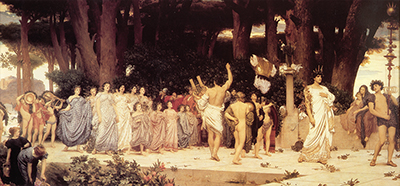
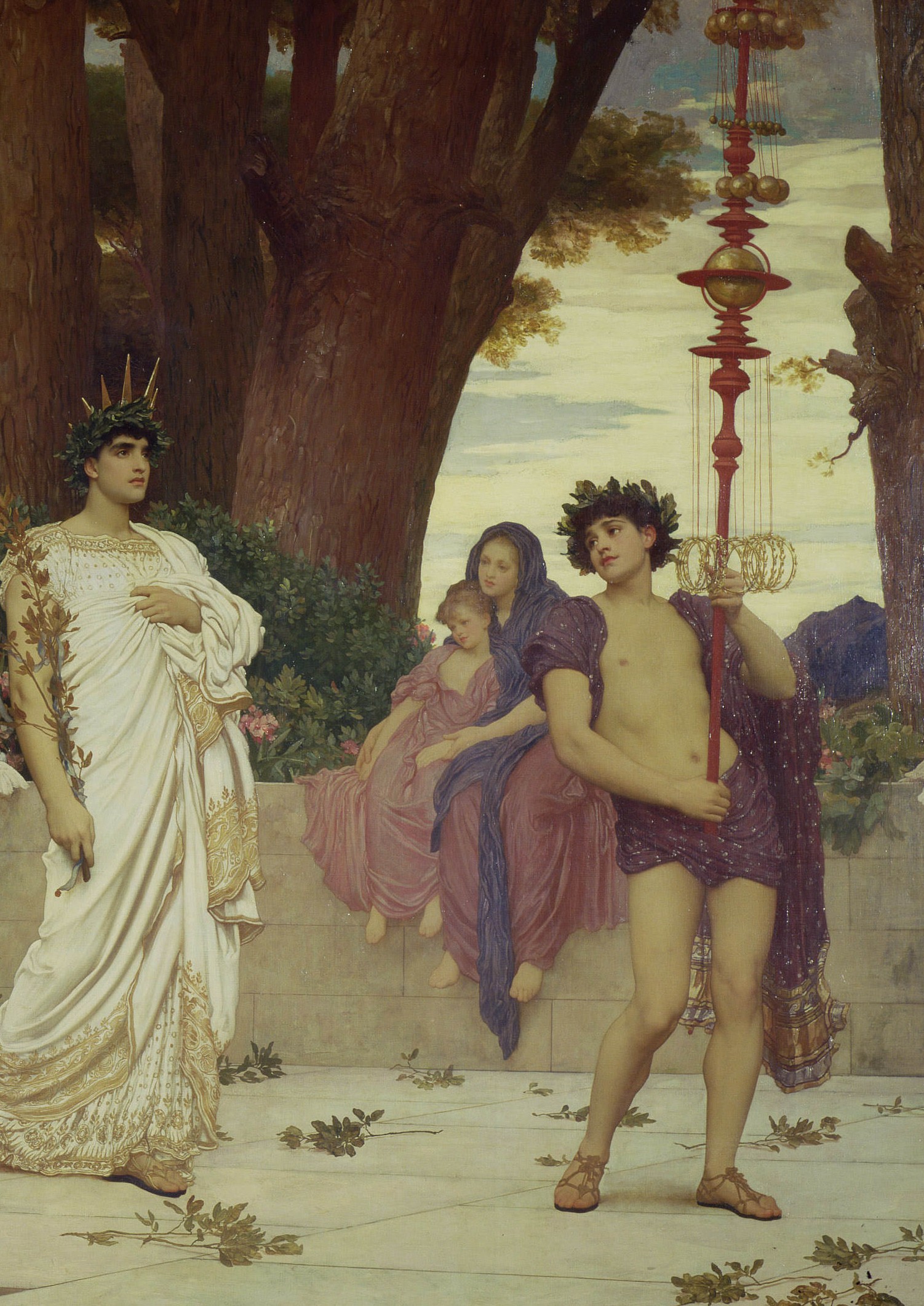
At the far right of Frederic Leighton’s The Daphnephoria, a young man carries a tall standard topped by a golden sun. The objects below it catch the light against the dark trunks. Behind him, a boy in a robe almost as bright as the paving carries a modest spray of laurel. The two figures lead a procession in honour of Apollo, and the line of people behind them stretches almost the full length of the canvas. Leighton painted the work in oil between 1874 and 1876 and first exhibited it at the Royal Academy in 1876 as catalogue no. 241. It is now at the Lady Lever Art Gallery in Port Sunlight (LL 3632). Published measurements put the canvas at roughly 2.3 metres high and more than 5.1 metres wide, enough room for the viewer to linger over the things the procession carries and the people who have come to watch. [1] [2] [3]
Frederic Leighton, The Daphnephoria, 1874–76. Lady Lever Art Gallery. Lady Lever Art Gallery, National Museums Liverpool; image reproduced by British Art Studies. Image source. CC BY-SA 4.0. Resized; the reproduction and detail crops remain CC BY-SA 4.0.
At a Glance
- Painted1874–76
- First exhibitedRoyal Academy, 1876, no. 241
- MediumOil on canvas
- CollectionLady Lever Art Gallery, LL 3632
This work across Frederic Leighton’s career
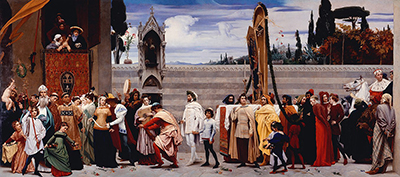
Cimabue’s Celebrated Madonna
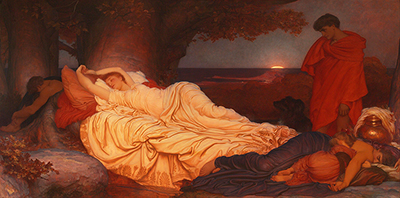
1853–55Lachrymae
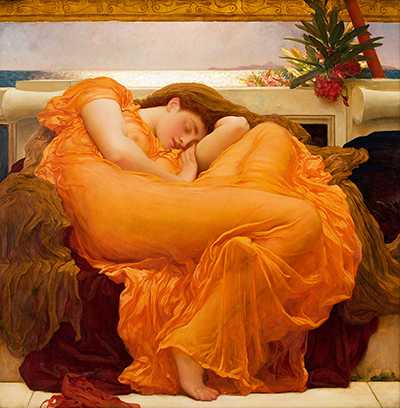
1894–95Flaming June
c. 1895Contents
- What the Thebans carried
- From a line of figures to a procession
- Working out the crowd
- From a country house to Port Sunlight
- Annotated details
What the Thebans carried
The title means “laurel-bearing.” An account attributed to Proclus, preserved in Photios’s Bibliotheca, traces the festival to a victory in the region of ancient Thebes. Polematas, the Boeotian leader, dreams that a young man gives him a full suit of armour and tells him to carry laurel in Apollo’s honour at regular intervals. He wins the battle and holds the first procession. The custom recurs every ninth year in the ancient account, after eight full years have elapsed. Pausanias describes a different interval for the office of the laurel-bearer. A boy from a distinguished family was chosen as priest of Apollo Ismenios for one year. Pausanias also says that some of these boys dedicated bronze tripods and that visitors could still see them at the sanctuary. [4] [5] [6]
Proclus describes an olive-wood pole decked with laurel and flowers. A bronze sphere at its summit represents the sun, a smaller one the moon, and the little spheres the stars. The 365 garlands stand for the days of the year. The priest follows a relative who carries this standard. He wears a gold crown and a long robe, and a choir of girls follows with branches and sings. The description printed for Leighton’s exhibition gave visitors a way to identify the priest, the standard-bearer and the singers. It also drew attention to the boys who carry the armour and bring up the rear with votive tripods. The armour in the ancient account belongs to Polematas’s dream. Leighton gives it a second appearance as a trophy in the procession. The tripod bearers at the far left bring another Theban custom into the procession. [2] [4] [5] [6]
The old exhibition description identifies the distant city at the left as Thebes. Most of what we see, however, happens on a terrace above it. The gaps before and behind the white-robed priest give his hem, fistful of leaves and crown clear outlines. Three boys crowd in under the raised armour, then the route opens again around the bare back of the choirmaster, whose raised hand directs the singers. Their mouths and lifted heads give his gesture its meaning. There is a second pace to notice among the seated spectators. At the right, a child and a woman watch from the low wall. In the left foreground two figures occupy a lower level beside the flowers. Those bystanders help us gauge the scale of the ceremony and the nearness of the terrace’s edge. An ancient chorus called on Apollo with sung words as well as gestures. A fragment of a song by the Theban poet Pindar survives from one such celebration. It praises the participants and their family, a reminder that the singers are taking part in an occasion of consequence to the households in the city below. [2] [7] [8]
Annotated Details from The Daphnephoria
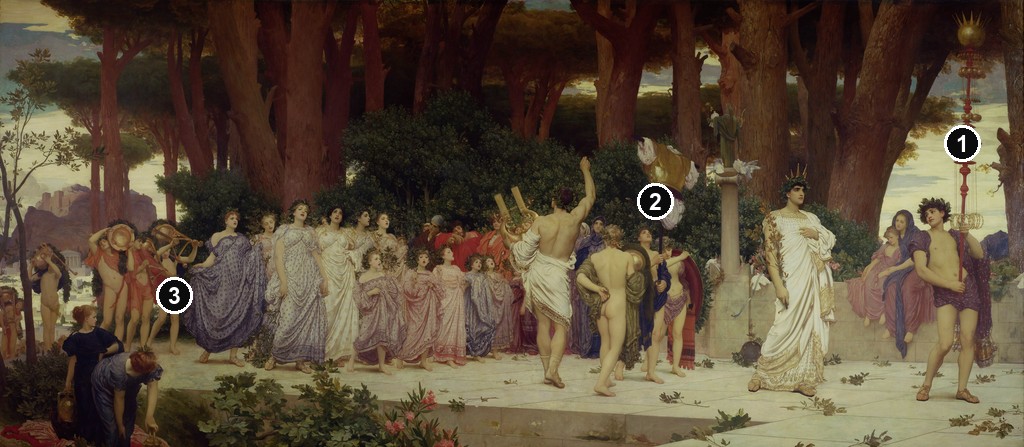
The numbered points identify visible features discussed in this article. Return from each detail to the numbered overview. Each caption identifies the work shown.
The Daphnephoria
Frederic Leighton, The Daphnephoria, 1874–76. Lady Lever Art Gallery. Lady Lever Art Gallery, National Museums Liverpool; image reproduced by British Art Studies. Image source. CC BY-SA 4.0. The numbered overview and each detail crop are available under CC BY-SA 4.0.
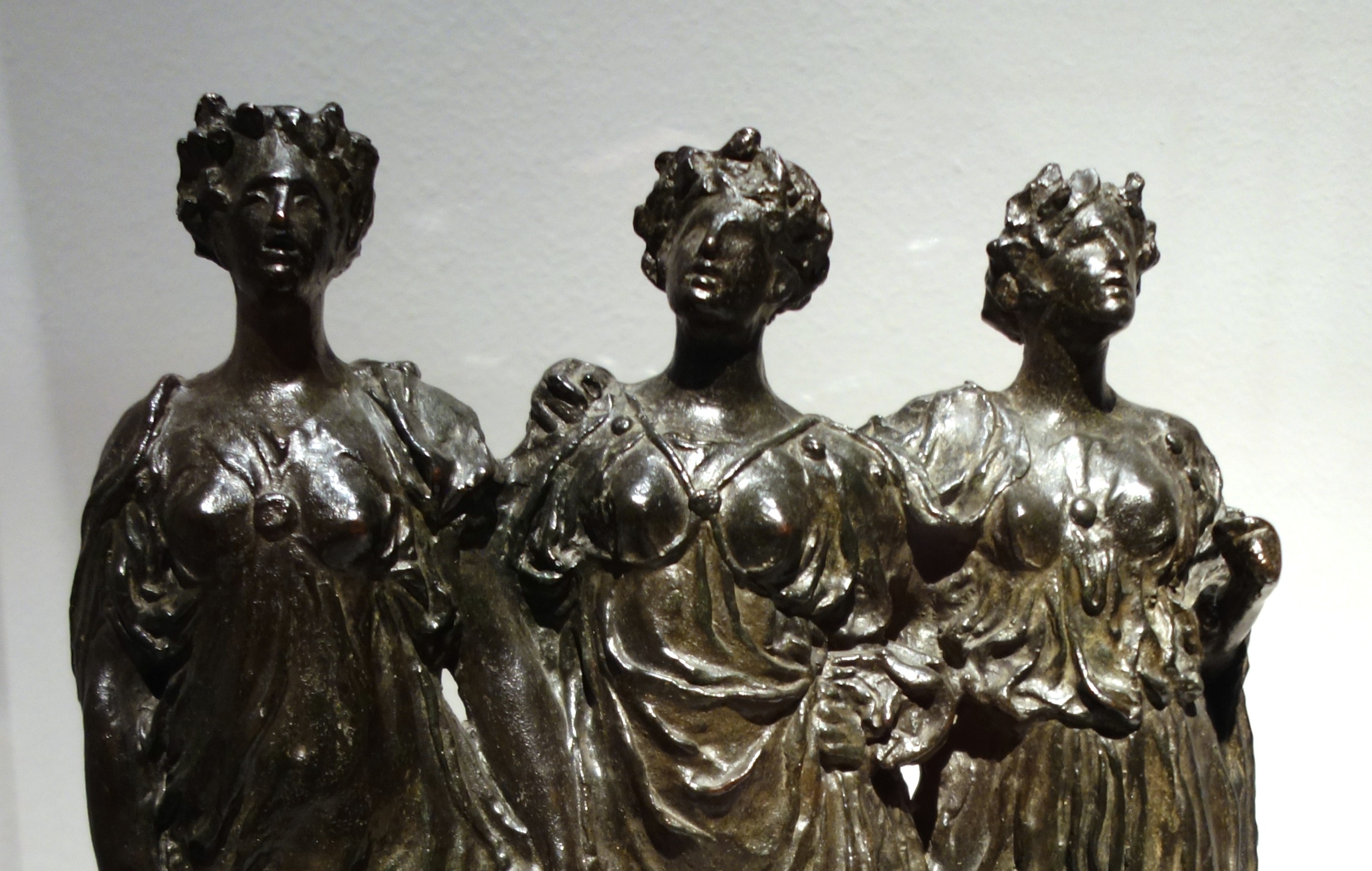
Sketch model for three figures in The Daphnephoria
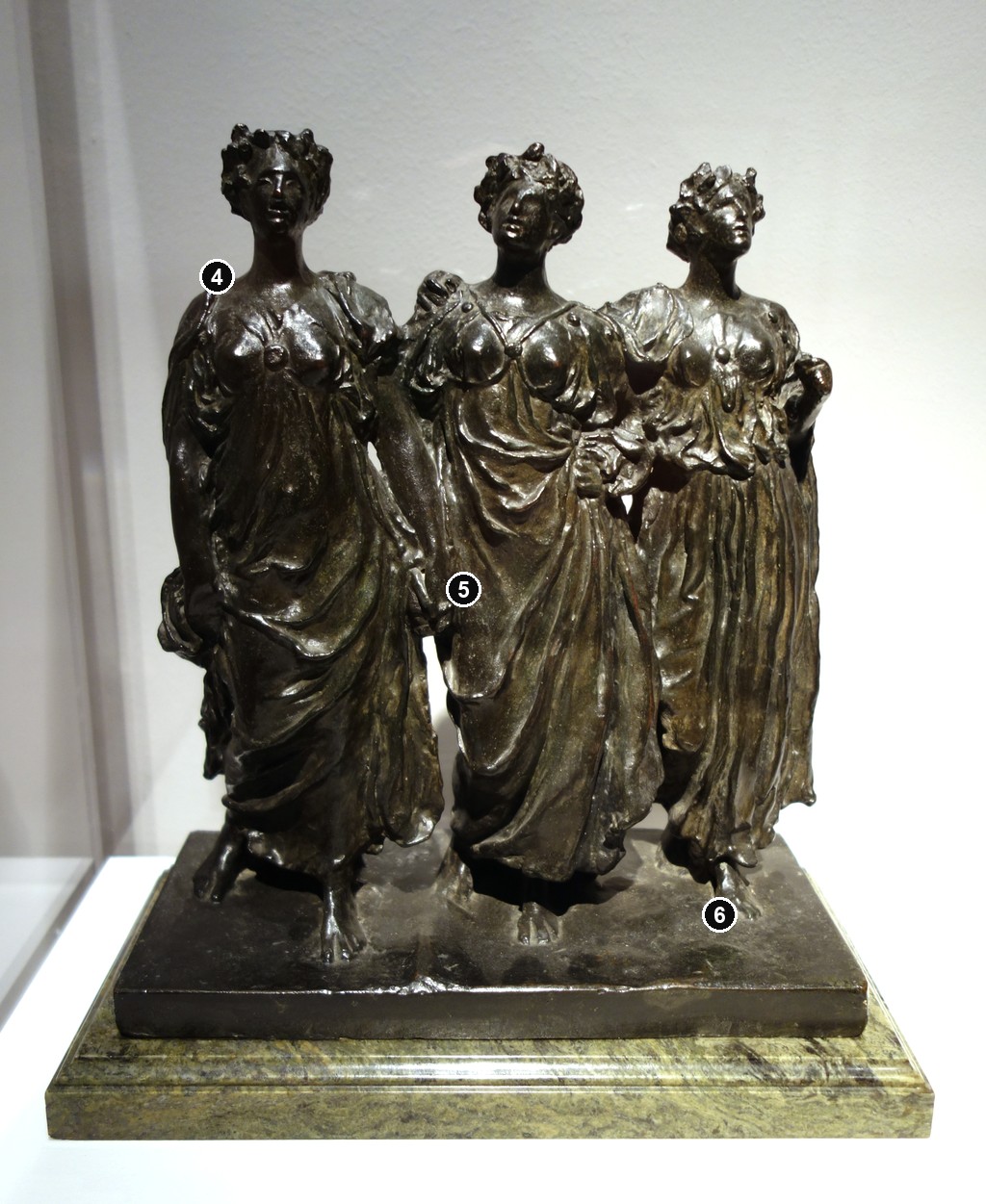
Frederic Leighton, sketch model for three figures in The Daphnephoria, c. 1876, cast c. 1896. Royal Academy of Arts. Image source. Public domain. Resized proportionally.
Details from THE DAPHNEPHORIA
Compare the cropped details with the source images above. Notice how their colours, shapes and positions contribute to the larger compositions.
The Daphnephoria
The bright robe and the standard
The bright-robed laurel-bearer and the tall standard catch against the shadowed trees. A break in the procession leaves the figures at the head room to move.
A raised hand times the singing
The choirmaster turns towards the girls. Pale shoulders and forearms stand clear against the trunks and overlap the deep red cloth.
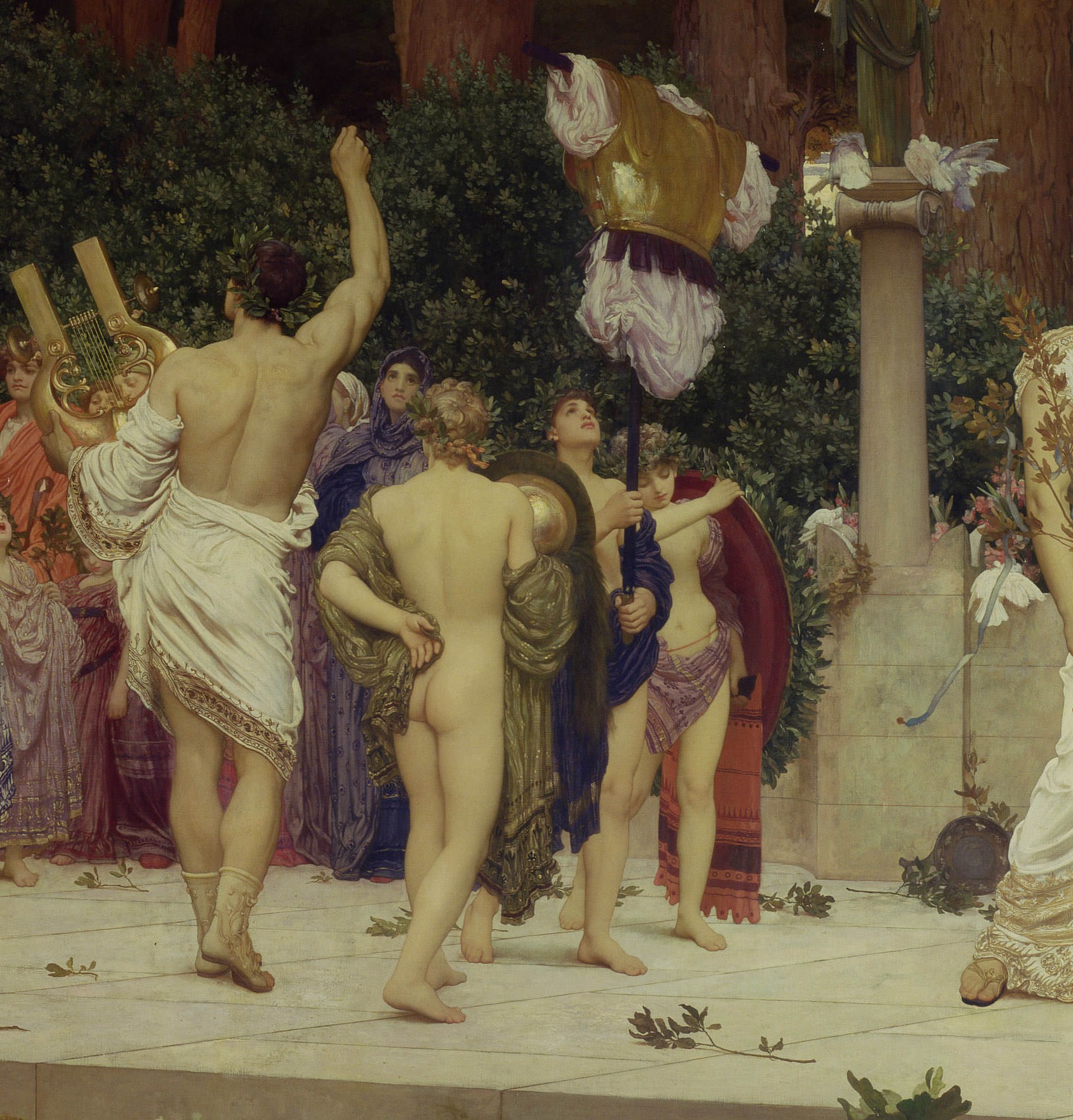
The other end of the procession
At the left, bodies overlap above the terrace edge. The lower foreground seating gives a second level to the procession’s shallow band of figures.
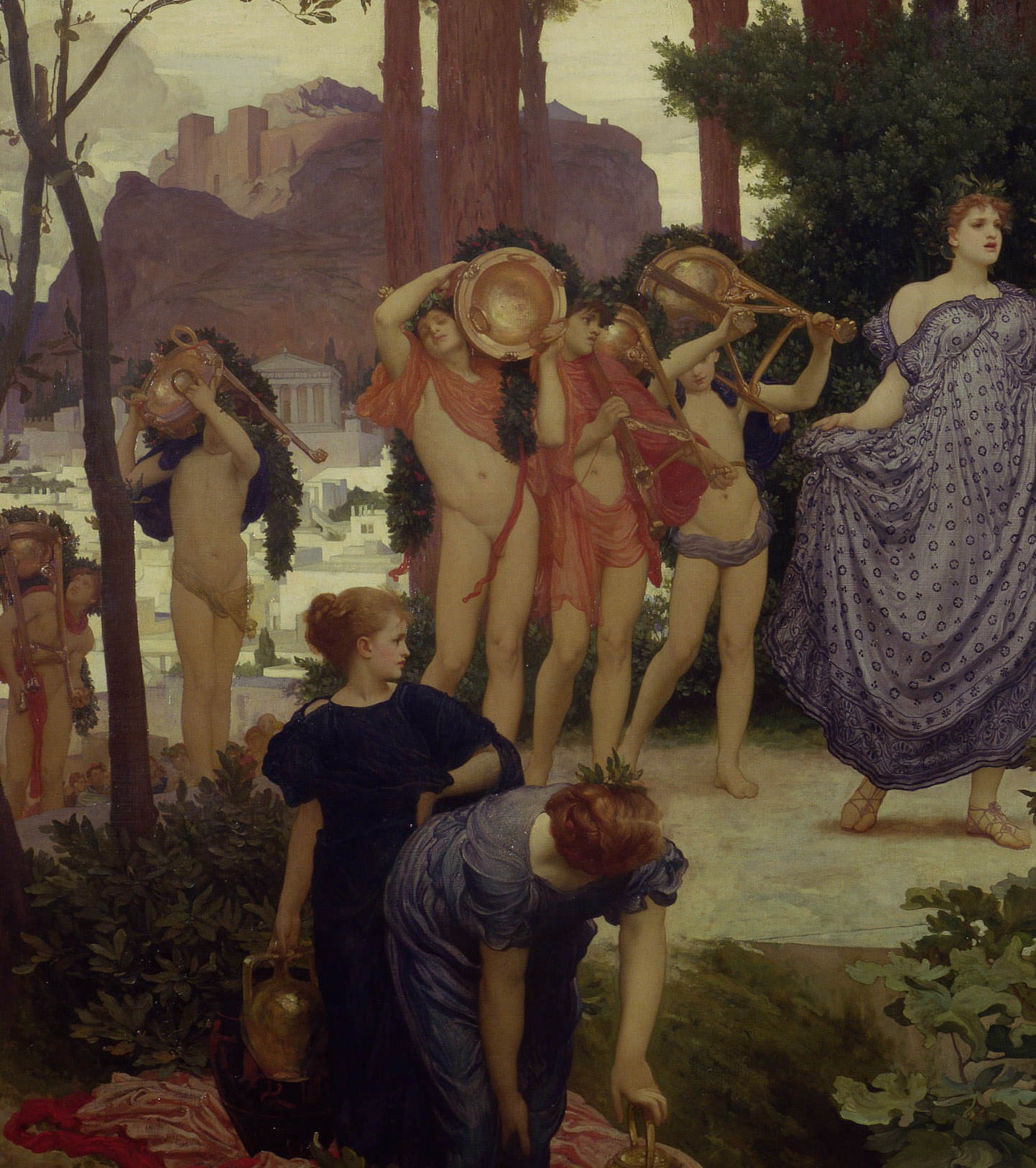
Sketch model for three figures in The Daphnephoria
Three heads at staggered heights
The slight differences in posture leave each silhouette legible, including where the figure in the middle comes forward.
Hands draw the three bodies together
Bent forearms interrupt the long upright forms. The figures have enough room to hold their poses while crossing visually into one another.
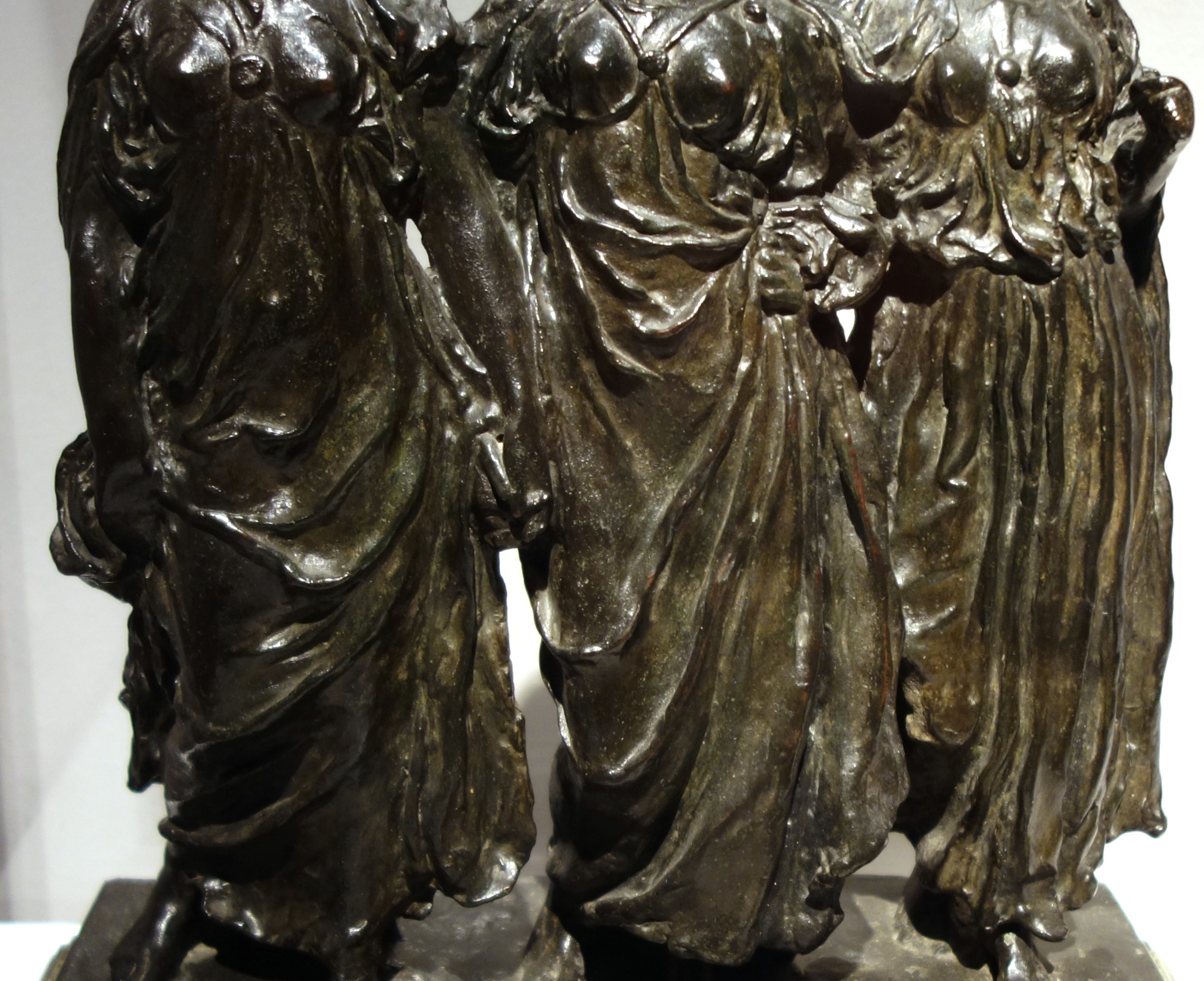
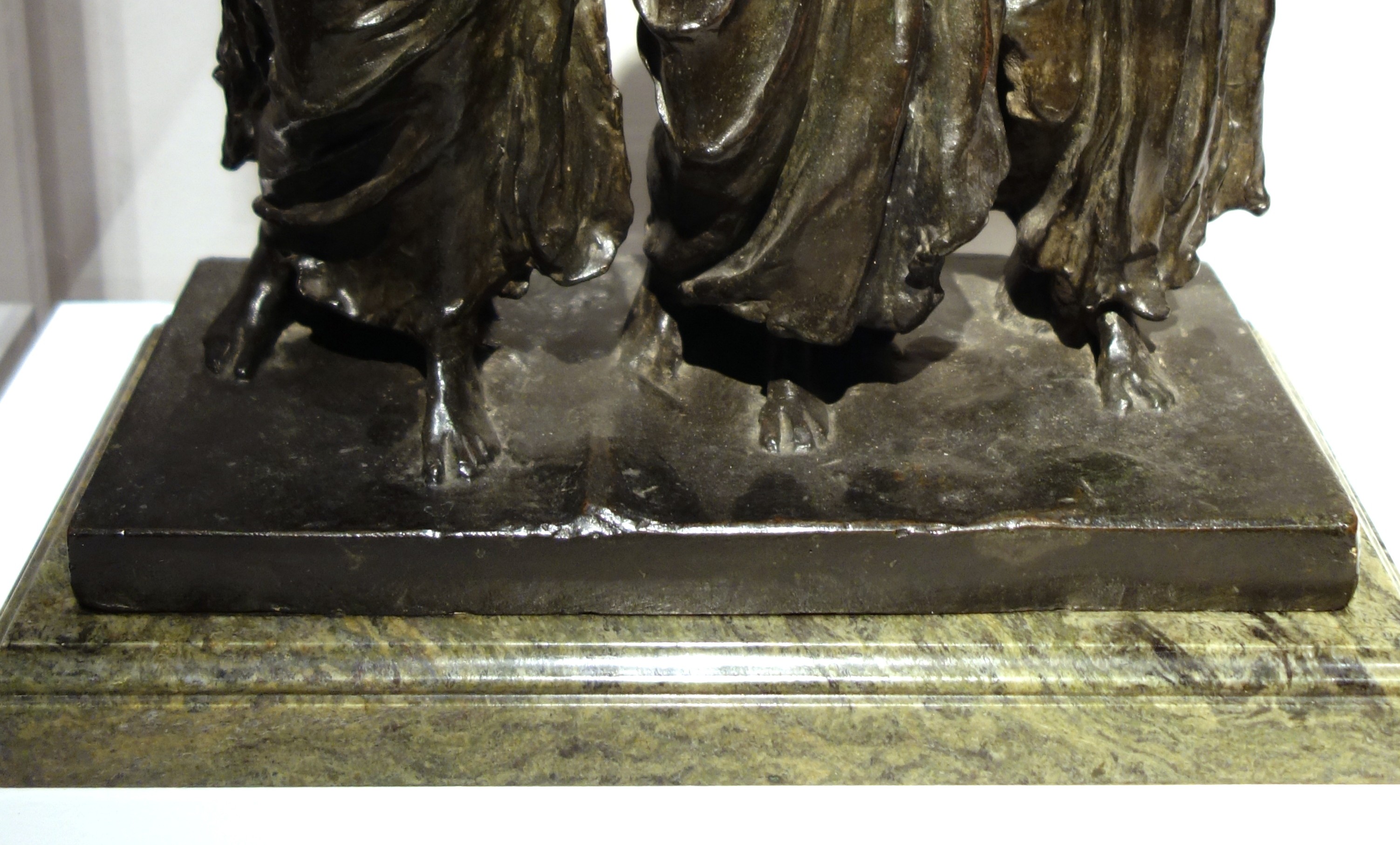
Folds gather above the common base
Deep ridges send reflected light down toward the base. The three sets of feet establish separate places for the small figures to stand.
From a line of figures to a procession
The great width recalls a sculpted frieze. The Dahesh Museum has proposed the Panathenaic procession carved on the Parthenon as a likely model for the format. Its attraction for a painter of a procession is easy to see. Draped figures repeat along a shallow band, yet each person can turn or gesture within it. Leighton gives the band an oblique course across the terrace. The front figures gain space around them as they round the turn, and behind the choirmaster the younger singers gather in a close row in front of taller girls. The long paving joints, the sparse leaves on the stones and the overlapping bodies all help us follow the same route at different distances. In Leighton’s earlier Cimabue’s Celebrated Madonna, a painting is carried through Florence and the Madonna travels high above the crowd. Here the sun-topped pole is equally easy to pick out, while the dense canopy keeps the eye down among the moving figures. [1] [7] [9] [10]
Two ancient vessels offer comparisons for the music and the objects carried in the painting. A fragment from an Attic vessel at the Cleveland Museum of Art, made around 520 BCE, shows Apollo with a lyre. The remains of a horse suggest a chariot procession, possibly for the wedding of Peleus and Thetis. The Met’s Panathenaic prize amphora, made around 530 BCE, belongs to a different Athenian festival, where jars filled with olive oil were awarded as prizes. The fragment preserves the ancient association between Apollo and the lyre. In Leighton’s scene a human musician carries the instrument, and the god is present in the image of the sun. The Athenian vessel provides a comparison for the tripod as an object with a specific ceremonial role. [11] [12]
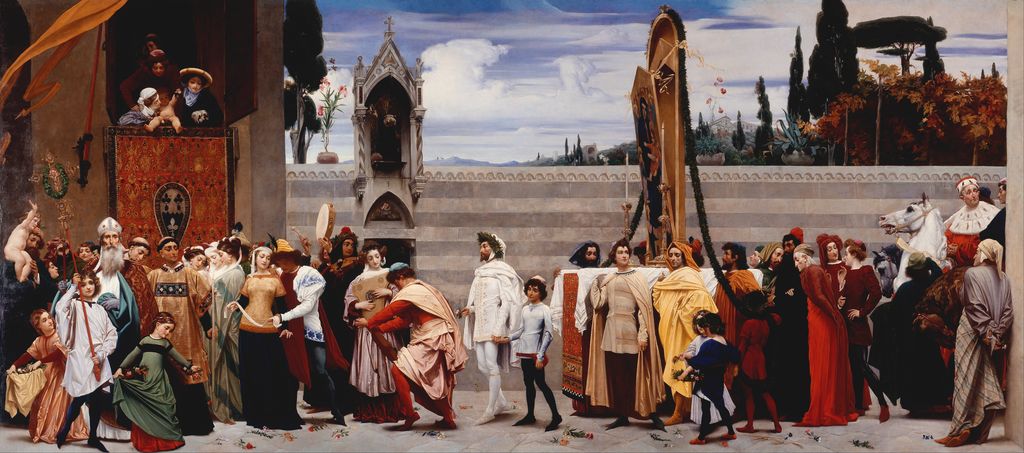
Frederic Leighton, Cimabue’s Celebrated Madonna, 1853–55. Royal Collection, on loan to the National Gallery. Image source. Public domain. Resized without changing the composition.
Working out the crowd
The Lady Lever collection also holds a painted sketch from around 1875 (LL 3116), only sixty centimetres across. Its width in relation to its height is close to that of the large canvas. The sketch already sets the bright paving against a bank of figures and trees. It also includes a dark blue-green figure at the very right. In the finished canvas that figure is gone, and the young standard-bearer stands out at the head of the procession with open sky behind him. In the Dahesh Museum’s separate study (2012.10), Leighton used charcoal and pencil with white heightening on blue paper. The bright marks along the folds and limbs give the figures a solidity closer to relief sculpture. He could also work at the scale of a single relationship. In a chalk study catalogued by Hilary Morgan, a woman and child sit together for the group at the far right. They have no ceremonial duty. Their attention gives the two leaders a visible audience inside the picture. [9] [13] [14]
Leighton could turn one of his small figure models in his hands to see how a pose would look from different angles. The art historian David Getsy connects this practice with the problem Leighton faced on the terrace. The choirmaster, for instance, has to stand believably on the pavement with his back towards us and still show his singers the movement of his raised hand. A sculptural sketch let Leighton work out the turn of the shoulders and the place of the bent arm before committing to a view on canvas. The bronze study for three singers shown at the Academy’s memorial exhibition in 1897 belongs to two moments in the work’s history. Leighton modelled the figures in the 1870s, and the bronze was cast after his death. The studio practice also helped lead to a sculpture in its own right, An Athlete Wrestling with a Python, first shown as a full-size bronze in 1877. A bronze reduction in Rome bears the date 1877. The Italian national catalogue proposes 1902–11 for the casting, drawing on the publisher’s history and the date of the state purchase. [6] [7] [15] [16]
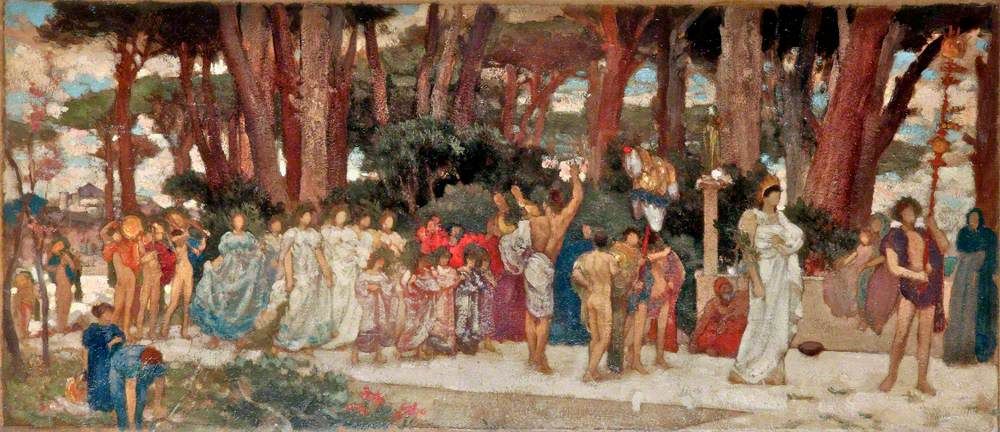
Frederic Leighton, oil sketch for The Daphnephoria, c. 1875. Lady Lever Art Gallery. Image source. Public domain. Resized proportionally.
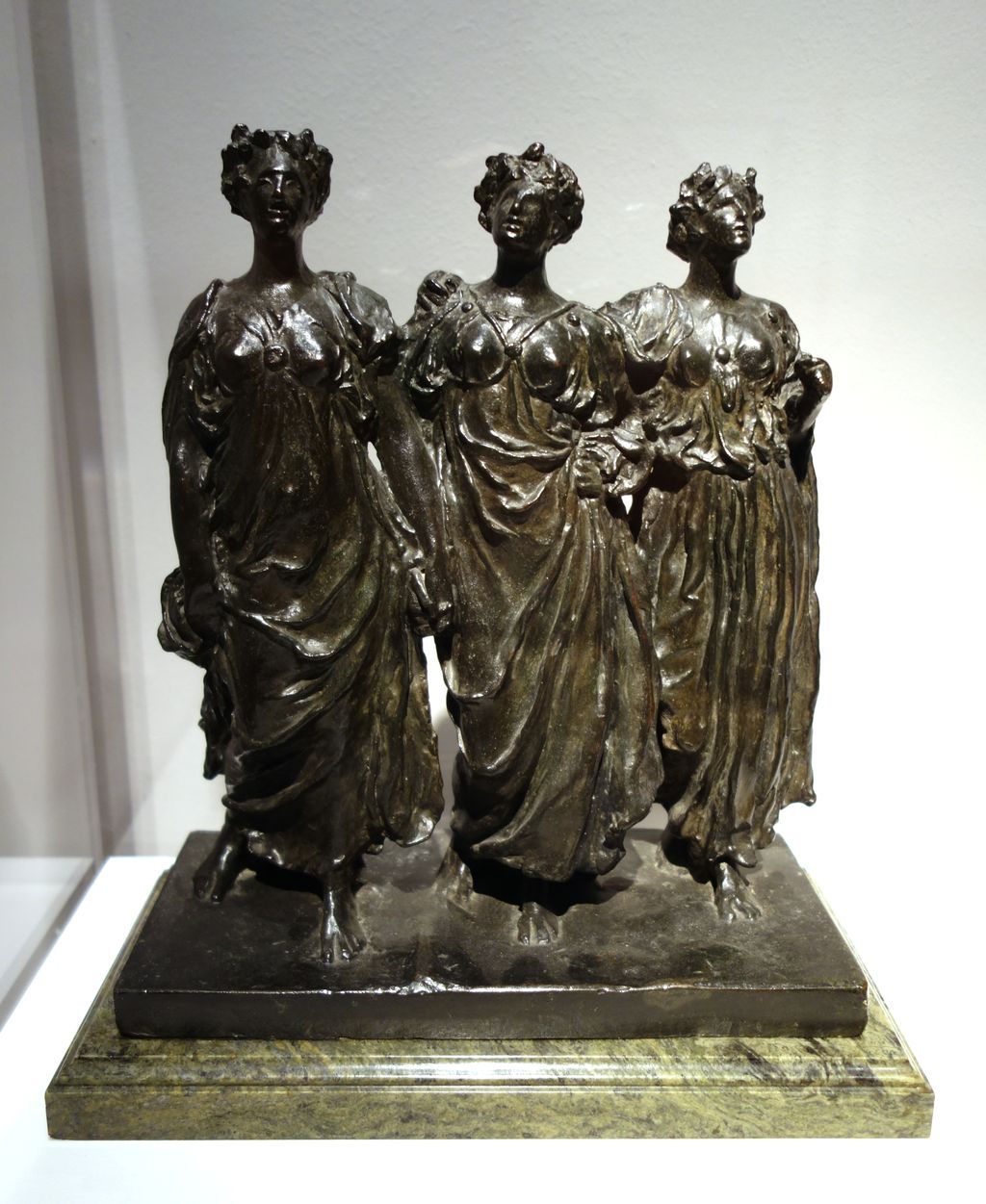
Frederic Leighton, sketch model for three figures in The Daphnephoria, c. 1876, cast c. 1896. Royal Academy of Arts. Image source. Public domain. Resized proportionally.
From a country house to Port Sunlight
Leighton painted the canvas for his friend and patron James Stewart Hodgson. It hung at Lythe Hill, Hodgson’s country house near Haslemere in Surrey. At the 1876 Academy show, the Art Journal praised the precision of the drawing and modelling, while The Graphic, reviewing both the painting and Leighton’s portrait of Richard Burton, admired the procession’s decorative grace but preferred the force of the portrait. In 1893, after the Barings crisis, Hodgson sold the painting. The collector George McCulloch lent it to the 1897 memorial exhibition, and it returned to the Academy for the exhibition of his collection in 1909. It came up for sale again in 1913 and entered William Hesketh Lever’s collection. The Lady Lever Art Gallery identifies it as its largest painting. Standing before it today, you can take in the sun standard from across the hall and discover the attentive child, the individual leaves and the open mouths of the singers as you approach. [1] [3] [6] [15] [17] [18] [19]
Browse Frederic Leighton’s artworks
Explore paintings, drawings, sculptures and prints, with separate rows for identified preparatory works, reproductions and casts.
| Name | Date | Medium |
|---|---|---|
| A Girl Feeding Peacocks | Exhibited 1863 | Painting Catalogue. |
| A Recognition from ‘Romola’, engraved by Swain (Tate N04054) | published 1862 | Print Catalogue. |
| A Roman Lady | 1859 | Painting Catalogue. |
| Abram and the Angel (Tate A00733) | published 1881 | Print Catalogue. |
| Acme and Septimius | Exhibited 1868 | Painting Catalogue. |
| An Athlete Wrestling with a Python (Tate exhibition bronze) | 1877 | Sculpture Catalogue. |
| And the Sea Gave Up the Dead Which Were in It (Tate N01511) | 1891–92 | Painting Catalogue. |
| Andromache in Captivity (photogravure after Leighton) | 1889 | Print Catalogue. |
| Athlete Wrestling with a Python (Anglesey Abbey cast) | model 1877; cast 1905 | Sculpture Catalogue. |
| Athlete Wrestling with a Python (Hood reduced cast) | 1877 (inscribed model date) | Sculpture Catalogue. |
| Athlete Wrestling with a Python (Saint Louis reduced cast) | 1877 (museum date) | Sculpture Catalogue. |
| Cain and Abel (Tate A00731) | published 1881 | Print Catalogue. |
| Captive Andromache | 1888 | Painting Catalogue. |
| Cimabue's Celebrated Madonna | 1853–55 | Painting Catalogue. |
| Cimon and Iphigenia, with Many Smaller Subjects (Tate T09061) | date not known | Drawing Catalogue. |
| Crenaia, the Nymph of the Dargle | Exhibited 1880 | Painting Catalogue. |
| Cymon and Iphigenia | 1884 | Painting Catalogue. |
| Daedalus and Icarus | 1869 | Painting Catalogue. |
| Dante in Exile | 1864 | Painting Catalogue. |
| Death of the First Born (Tate A00737) | published 1881 | Print Catalogue. |
| Electra at the Tomb of Agamemnon | c. 1869 | Painting Catalogue. |
| Eliezer and Rebekah (Tate A00735) | published 1881 | Print Catalogue. |
| Elijah in the Wilderness | 1877–78 | Painting Catalogue. |
| Fanny Kemble: A Study for ‘Jezebel and Ahab’ (Tate T08208) | c.1862 | Drawing Catalogue. |
| Figure Studies | Date not recorded | Drawing Catalogue. |
| Flaming June | 1895 | Painting Catalogue. |
| Gulnihal | Exhibited 1886 | Painting Catalogue. |
| Helios and Rhodes (Tate N03015) | date not known | Painting Catalogue. |
| Hercules Wrestling with Death for the Body of Alcestis | c. 1869–71 | Painting Catalogue. |
| Jonathan's Token to David | c. 1868 | Painting Catalogue. |
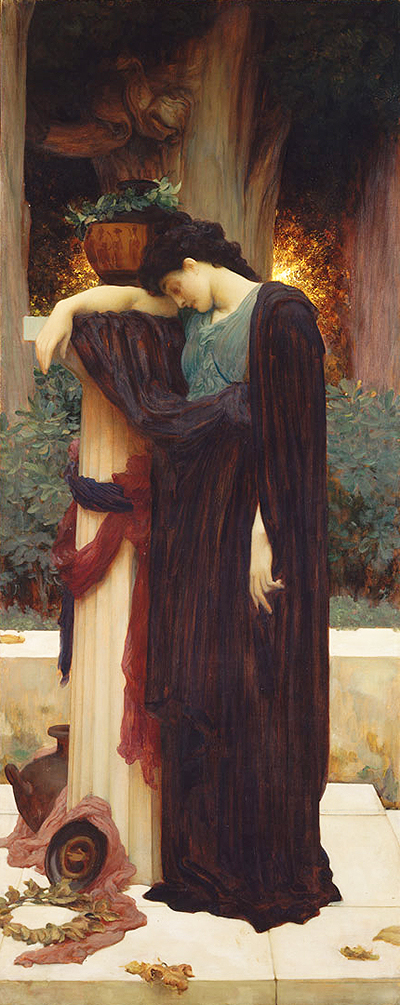
| Lachrymae | 1894–95 | Painting Catalogue. |
| Lieder ohne Worte | Exhibited 1861 | Painting Catalogue. |
| Light of the Harem | Exhibited 1880 | Painting Catalogue. |
| Moses Views the Promised Land (Tate A00736) | published 1881 | Print Catalogue. |
| Mrs James Guthrie | 1865 | Painting Catalogue. |
| Mrs John Hanson Walker (Tate N04731) | 1867 | Painting Catalogue. |
| Music Lesson | 1877 | Painting Catalogue. |
| Needless Alarms (Met cast) | modelled 1886; cast nineteenth century | Sculpture Catalogue. |
| Needless Alarms (Tate N05120) | 1886 | Sculpture Catalogue. |
| Pavonia | c. 1859 | Painting Catalogue. |
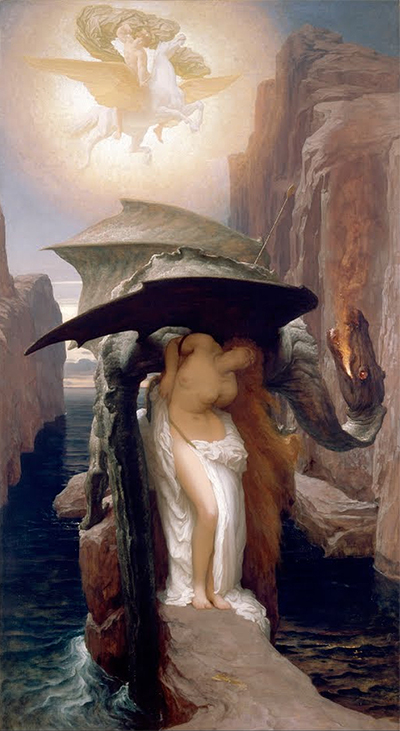
| Perseus and Andromeda | 1891 | Painting Catalogue. |
| Portrait of May Sartoris | c. 1860 | Painting Catalogue. |
| Preparing for a Festa, Florence (Tate T09062) | date not known | Drawing Catalogue. |
| Puerta de los Vientos, near Ronda, Spain (Tate N04006) | c.1886–9 | Painting Catalogue. |
| Samson and the Lions (Tate A00732) | published 1881 | Print Catalogue. |
| Samson at the Mill (Tate A00734) | published 1881 | Print Catalogue. |
| Samson Carrying the Gate (Tate A00738) | published 1881 | Print Catalogue. |
| Sketch for ‘An Athlete Wrestling with a Python’ (Tate N01761) | c.1877 | Sculpture Catalogue. |
| Sketches for Cimon and Iphigenia (Tate T09060) | date not known | Drawing Catalogue. |
| Study for The Return of Persephone (Demeter) | c. 1890–91 | Drawing Catalogue. |
| Study for The Return of Persephone (Persephone) | c. 1890–91 | Drawing Catalogue. |
| Study for ‘Needless Alarms’ (Tate N02945) | 1886 | Sculpture Catalogue. |
| Study for ‘The Discovery of Juliet Apparently Lifeless’ (Tate N01806) | c.1858 | Painting Catalogue. |
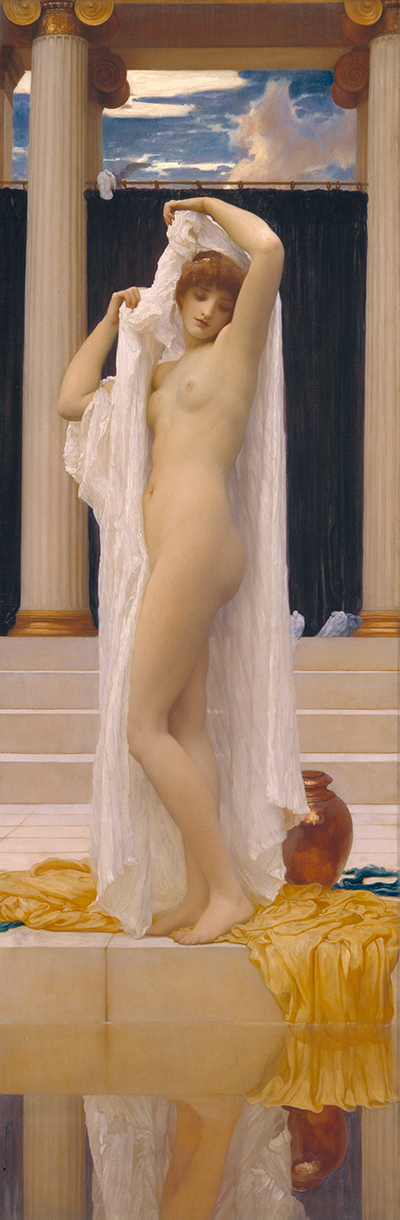
| The Bath of Psyche | Exhibited 1890 | Painting Catalogue. |
| The Daphnephoria | 1874–76 | Painting Catalogue. |
| The Death of Brunelleschi | 1852 | Painting Catalogue. |
| The Fisherman and the Siren | Exhibited 1858 | Painting Catalogue. |
| The Painter's Honeymoon | c. 1864 | Painting Catalogue. |
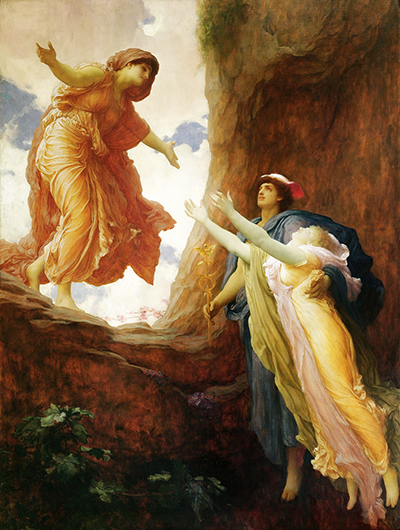
| The Return of Persephone | 1891 | Painting Leeds painting identified in the Met study record. |
| The Return of Persephone (preparatory oil) | c. 1890–91 | Painting Catalogue. |
| The Sluggard (Anglesey Abbey cast) | probably 1890–about 1906 | Sculpture Catalogue. |
| The Sluggard (Met cast) | modelled 1886; cast possibly before 1896 | Sculpture Catalogue. |
| The Sluggard (Museum Wales) | 1882–85 (museum date) | Sculpture Catalogue. |
| The Sluggard (Tate N01752) | 1885 | Sculpture Catalogue. |
| The Spies Escape (Tate A00730) | published 1881 | Print Catalogue. |
| Various Subjects (Tate T09063) | date not known | Drawing Catalogue. |
| View in Capri | Possibly 1859 | Painting Catalogue. |
| Wedded | 1882 | Painting Catalogue. |
| Winding the Skein | c. 1878 | Painting Catalogue. |
Discussion
Look again at the images and ideas explored in The Daphnephoria. These editorial prompts invite your observations.
Reader Insights
Which gap in the crowd helps you read the procession most clearly?
What is easier to see in the final painting after you compare the small oil sketch?
Join the Conversation
Share a detail, comparison or question about The Daphnephoria below.
References
- Mary Roberts, “The Resistant Materiality of Frederic Leighton’s Arab Hall”, British Art Studies 9 (2018), fig. 29 and note 28. View source.
- Algernon Graves, The Royal Academy of Arts: A Complete Dictionary of Contributors and Their Work, vol. 5, entry for Frederic Leighton, 1876, no. 241. View source.
- National Museums Liverpool, Lady Lever Art Gallery Welcome Guide, p. 9, Main Hall. View source.
- Photios, Biblioteca, vol. 2, codex 239, 321a–b, pp. 730–33, Greek text with Italian translation. See also Jane Ellen Harrison, Themis, pp. 437–39, English translation of the festival passage. See also Alexey V. Garadja, Russian translation and commentary, Platonic Investigations 16.1 (2022), codex 239, 321a–b. View source 1. View source 2. View source 3.
- Pausanias, Description of Greece, 9.10.4, on the priesthood and the tripods. View source.
- Royal Academy of Arts, Exhibition of Works by the Old Masters ... and a Collection of the Works of the Late Lord Leighton of Stretton, winter exhibition, 1897, nos. 81 and 312. View source.
- David J. Getsy, Body Doubles: Sculpture in Britain, 1877–1905, Yale University Press, 2004, chapter 1, especially figs. 3–7. View source.
- Enrico Emanuele Prodi, “Text as Paratext: Pindar, Sappho, and Alexandrian Editions”, Greek, Roman, and Byzantine Studies 57 (2017), pp. 569–70, Pindar fr. 94b. View source.
- Dahesh Museum of Art, Study for Daphnephoria, before 1876, 2012.10. View source.
- National Gallery, Cimabue’s Celebrated Madonna, Royal Collection loan L275. View source.
- Cleveland Museum of Art, Fragment from Black-Figure Neck-Amphora of Panathenaic Shape (Storage Vessel): Apollo with Lyre, c. 520 BCE, 1915.533.f. View source.
- Metropolitan Museum of Art, Terracotta Panathenaic prize amphora, c. 530 BCE, 14.130.12. View source.
- National Museums Liverpool via Art UK, The Daphnephoria (sketch), c. 1875, LL 3116, with the collection photograph. View source 1. View source 2.
- Hilary Morgan and Peter Nahum, Study of a Woman and Child for the Painting The Daphnephoria, Burne-Jones, the Pre-Raphaelites, and Their Century, 1989, cat. 103. View source.
- Ernest Rhys, Frederic Lord Leighton: An Illustrated Record of His Life and Work, chapters IV, VIII and XI. View source.
- Ministero della Cultura, Atleta che lotta con un pitone, historic notes and inscriptions, inventory 958. View source.
- Sotheby’s, The Hodgson Bequest, 2021, entry for A Sketch for Music, lot 57. View source.
- Royal Academy of Arts, Exhibition of Modern Works in Painting and Sculpture Forming the Collection of the Late George McCulloch, winter exhibition, 1909, no. 100. View source.
- Barrymore Laurence Scherer, “Masterpieces on the Mersey”, The Magazine Antiques, 26 June 2024, fig. 16 and provenance. See also The Times, 24 May 1913, report of the McCulloch sale. View source 1. View source 2.