 by Tom Gurney
Tom Gurney BSc (Hons) is an art history expert with over 20 years experience
Published on June 19, 2020 / Updated on November 29, 2026
Email: tomgurney1@gmail.com / Phone: +44 7429 011000
And the Sea Gave Up the Dead Which Were in It: Introduction
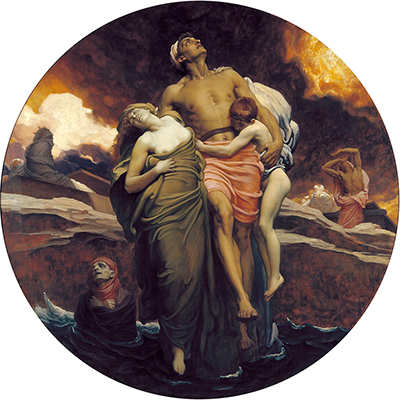
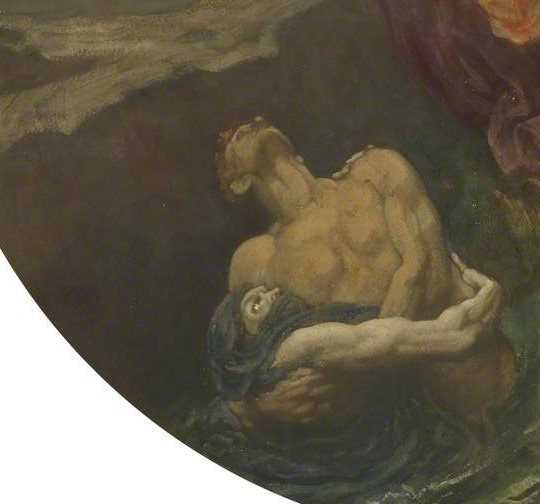
A man rises from dark water with two bodies in his arms. He looks into the storm overhead while a woman’s head falls back against his shoulder and a child curls around his waist. Frederic Leighton painted this family at the moment the sea releases its dead. The finished work, an oil on canvas 228.6 cm across, was exhibited at the Royal Academy in 1892. It belongs to Tate, where its accession number is N01511. Leighton first conceived the composition for a mosaic at St Paul’s Cathedral and returned to it years later at Henry Tate’s invitation. [1] [2]
At a Glance
- CommissionHenry Tate, 1891
- MediumOil on canvas
- CollectionTate, N01511
- First Academy exhibition1892, no. 115
This work across Frederic Leighton’s career
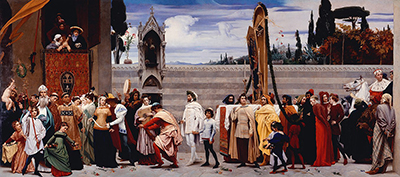
Cimabue’s Celebrated Madonna
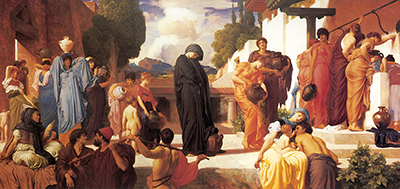
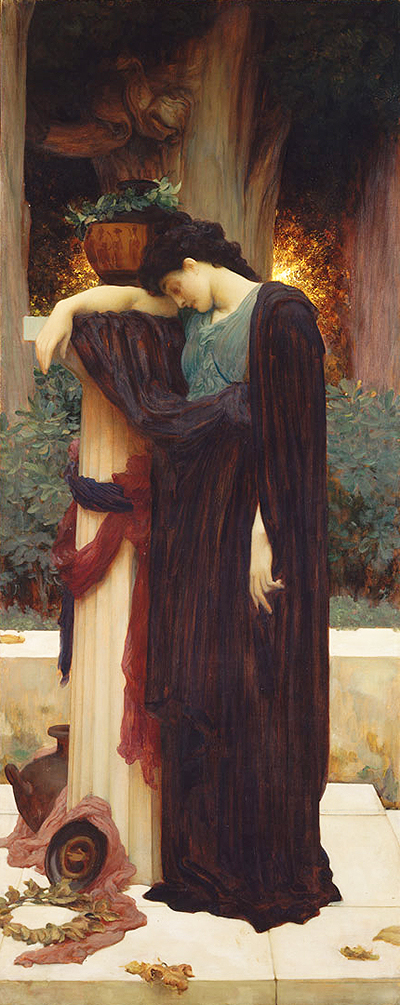
1853–55Lachrymae
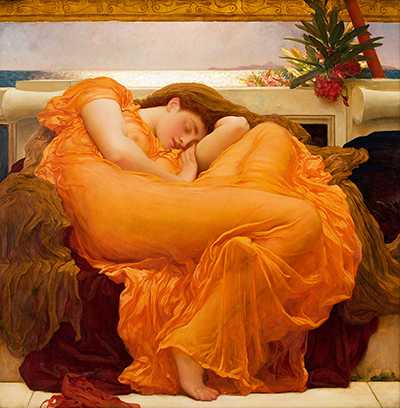
1894–95Flaming June
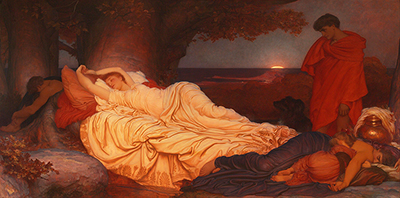
c. 1895Contents
- The dead rise from the sea
- From St Paul’s Cathedral to the Royal Academy
- What the studies reveal
- Other visions of resurrection
- Annotated details
The dead rise from the sea
The title comes from Revelation 20:13 in the King James Bible. The passage describes the dead assembling before a great white throne. Books are opened and each person is judged according to their deeds. The sea, death and hell all surrender the dead they hold. Leighton chose the moment of release. The towering man looks towards a point outside the picture, leaving viewers to imagine what he sees and what judgment awaits the people around him. [1] [3]
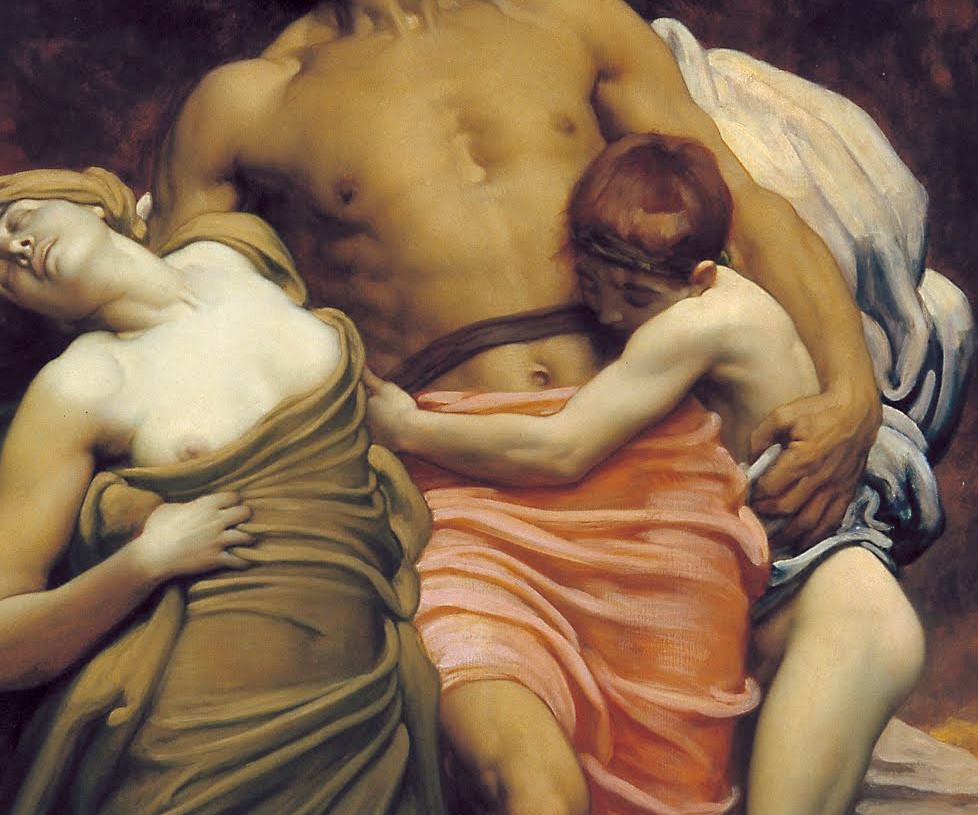
The middle of the canvas is warmest where life appears strongest. The man’s shoulders and chest catch the light. The woman’s face and breast have a pale, cooler cast, and she rests her weight in his bent arm. The child’s bent arm closes around the man, while the warmer flesh and salmon-coloured folds beside him lead the eye down across the dangling legs. Tate reads these differences as successive stages of resurrection. Edward T. Cook’s early Tate handbook likewise saw fear and hope in the man’s upward gaze, and an approaching return to life in the child’s warmer colouring. [2] [4]
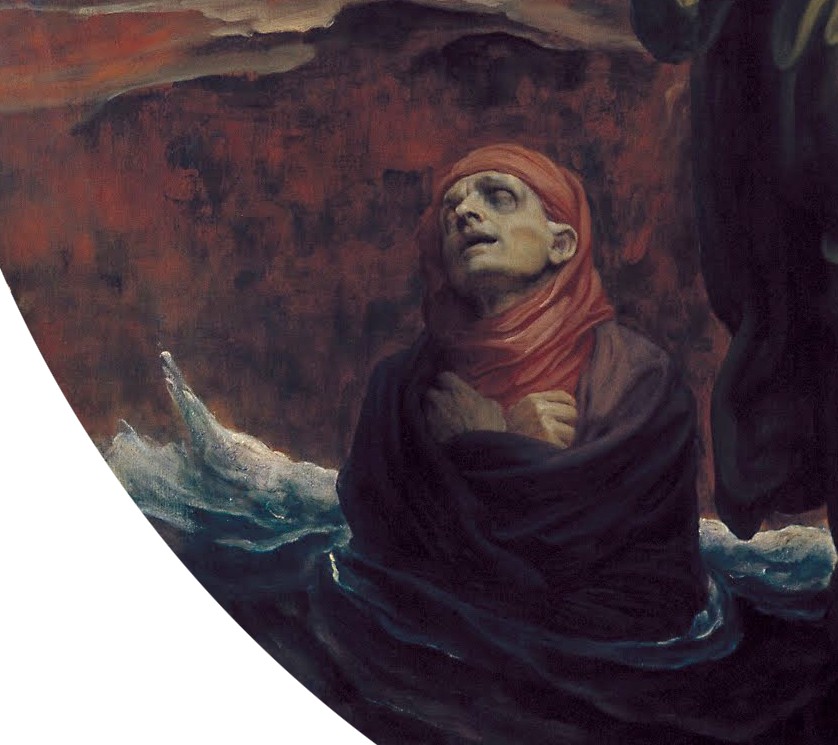
Look first at the painted circle from a distance. The family reads as a single vertical group, tall enough to reach from the breakers to the blackest cloud. Pale bands behind it cut diagonally across the field, and small rising figures at either side make the sea seem to extend far beyond those three bodies. Closer in, the surfaces become stranger. Wet-looking folds cling to the woman and stretch almost to the water. A sliver of bare foot breaks that long fall of fabric. Near the lower left a shrouded figure lifts a wan face above the waves. Leighton gives that figure enough definition to make its emergence legible, then lets the surrounding darkness take over. [1] [2] [4]
Art historian Keren Rosa Hammerschlag reads the garments in terms of shrouds, bandages and decaying flesh. Her interpretation draws attention to something easily missed in the central group. The outlines of the man’s shoulders are crisp, while the material around the others clings, bunches and slips into shadow. The painting gives a particularly clear shape to a body capable of action. Bodies just beginning to stir are harder to distinguish from the fabric and water that have held them. [1] [5]
From St Paul’s Cathedral to the Royal Academy
The design began as part of a proposed series of eight mosaics from the Apocalypse for the spaces beneath the dome of St Paul’s Cathedral. Leighton and Edward Poynter were asked to develop subjects for a scheme following earlier plans by Alfred Stevens. The cathedral retains Leighton’s large painted cartoon, or preparatory design, dated 1878 by the University of York’s St Paul’s research project. Leighton exhibited the design at the Royal Academy in 1882, and it was tried in position at the cathedral in 1884. According to Christie’s account of the project, the dean objected to Leighton’s treatment of the subject. The scheme was abandoned in 1885. The round shape in the Tate canvas preserves a decision made for that architectural setting. [6] [7]
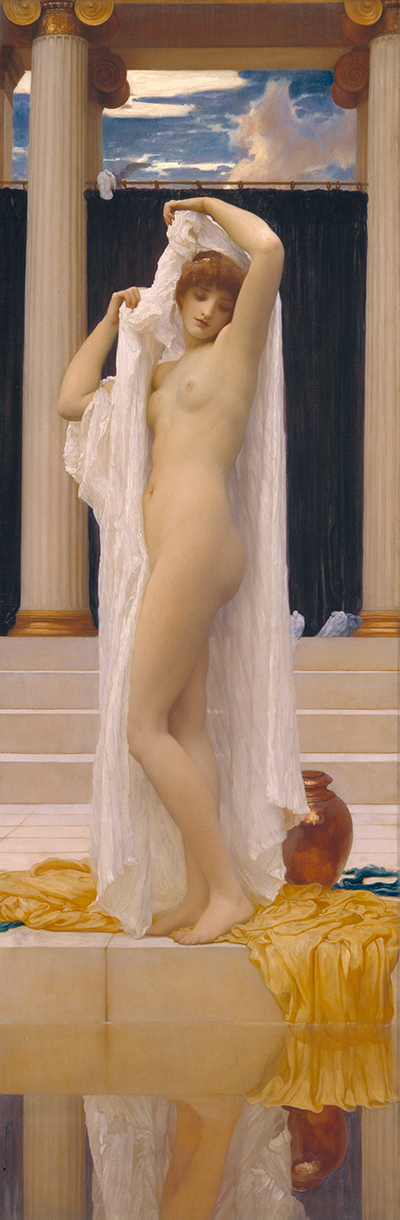
In 1891 Henry Tate commissioned Leighton to return to the subject for his planned gallery of British art. The Birmingham collection’s early catalogue explains that Leighton already had the graceful Bath of Psyche and the bronze Athlete Struggling with a Python represented in the Chantrey collection. The cathedral design offered a different kind of work for the national collection, and Leighton regarded it as among his strongest. Although smaller than the cathedral design, the new painting still measured two and a quarter metres across. The distance between the central group and the surrounding figures allows their gestures to read at that scale. [1] [6] [7] [8]
The completed canvas appeared as no. 115 at the Royal Academy’s 1892 summer exhibition at Burlington House. Leighton also showed The Garden of the Hesperides that year. Its apple tree and resting figures fill a circle with shapes that spread and settle around the centre. In And the Sea, the upward reach of a single body sets the direction for the whole circle. The two works show how differently Leighton could use the same format in pictures that visitors saw in the same exhibition. [1] [9] [10]
Sir Henry Tate presented the painting in 1894. An early illustrated catalogue of the National Gallery of British Art lists it as no. 1511 and identifies it as a Tate gift. The National Gallery’s archive uses NG1511 among the numbers assigned to the group of pictures associated with his offer. The Royal Academy also listed the finished canvas as no. 108 in its posthumous display of Leighton’s work in 1897, alongside related studies with their own catalogue numbers. By 1921 the Anderson photographic catalogue listed a reproduction of the Tate painting under the French title Et la mer rendit ses morts. [1] [11] [12] [13] [14]
What the studies reveal
Several drawings survive from this long project. A sheet of black and white chalk on buff paper, catalogued by Christie’s, studies figures for the cathedral design. The Leighton House collection holds a separate male figure study in black and white chalk on brown paper. Its accents of light along the raised chest, throat and neck show how a few marks on toned paper could make the strain of an upward gaze visible. The 1897 exhibition catalogue records chalk studies separately from the painting, including a study of heads. Emilie Barrington, Leighton’s early biographer, also reproduced a drawing of the whole composition. Together the records show how Leighton worked at the scale of a single gesture and of the complete design. [7] [13] [15] [16]
An oil sketch at Tullie in Carlisle, about 80 cm across, shows how much Leighton changed the composition. In the sketch, a figure behind the man lifts fabric in a loop above his head. Broad strokes carry the sky diagonally across the circle, and in the lower left a second pair of bodies rises from the water. The Tate version darkens the sky around the man’s head and makes the child’s bent arm easy to follow. The secondary group in the lower left gives way to a much smaller shrouded figure. There is also a separate oil study in Birmingham Museums Trust’s collection. Birmingham’s early catalogue identifies its study as preparatory work for the larger 1892 painting. Leighton House has its own colour sketch for the design. The repeated title belongs to several stages of work, from small trials of colour to the canvas exhibited at the Academy. [1] [8] [17] [18]
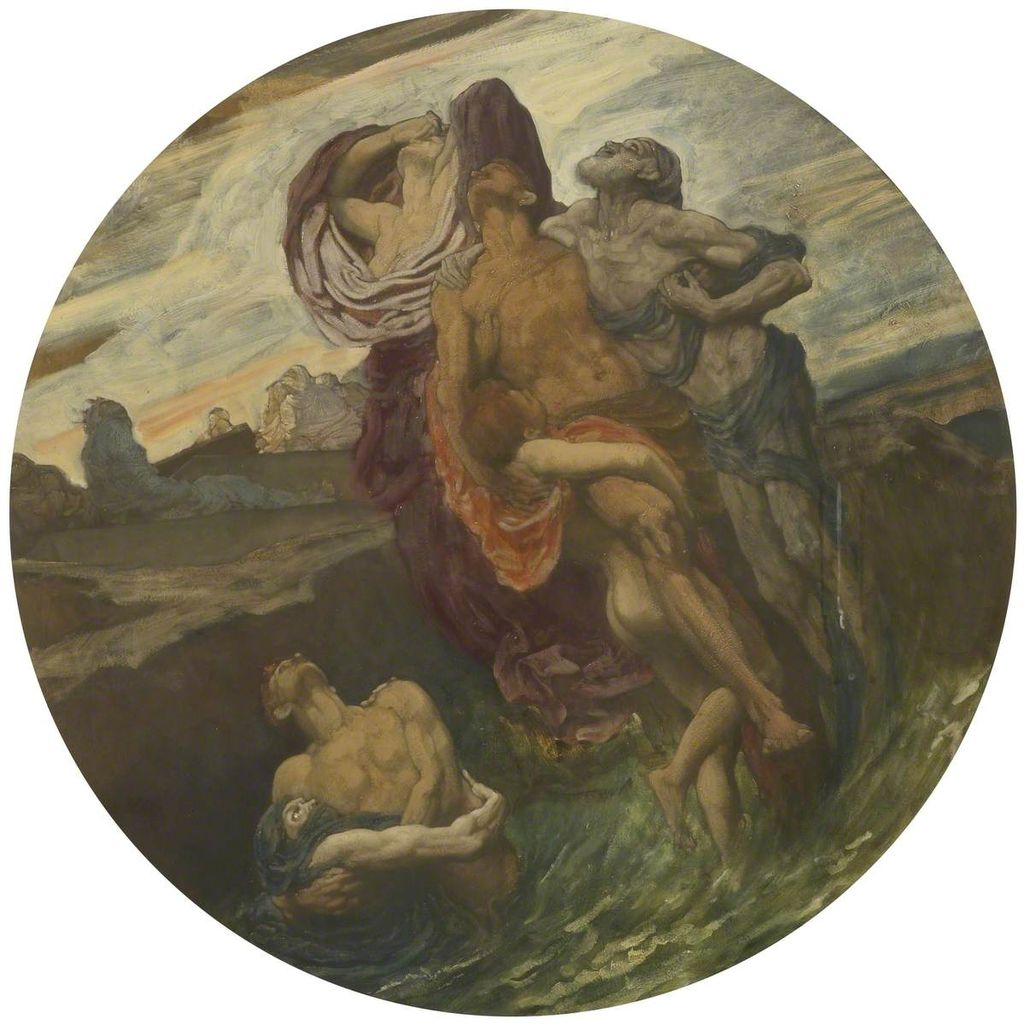
Frederic Leighton, study for And the Sea Gave Up the Dead Which Were in It. Tullie. Image source. Public domain. Resized without changing the composition.
Annotated Details from And the Sea Gave Up the Dead Which Were in It
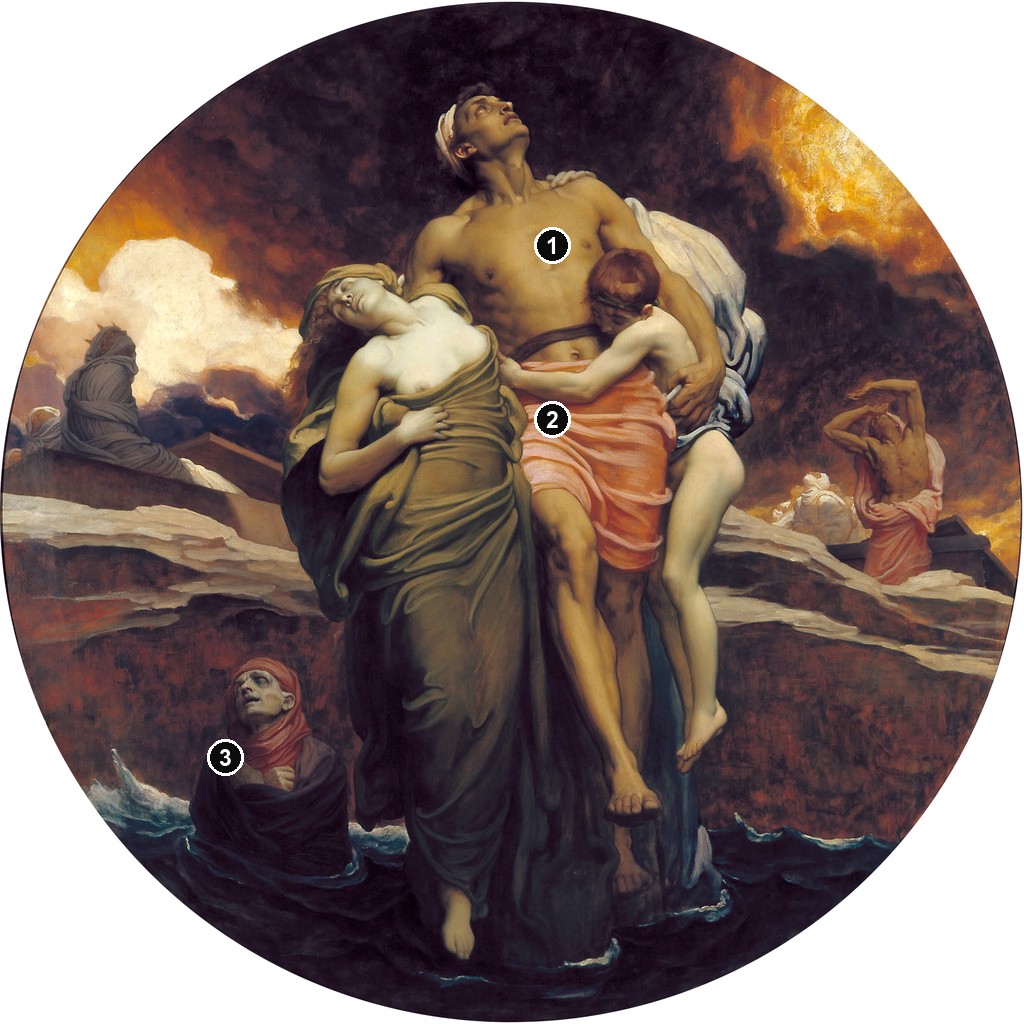
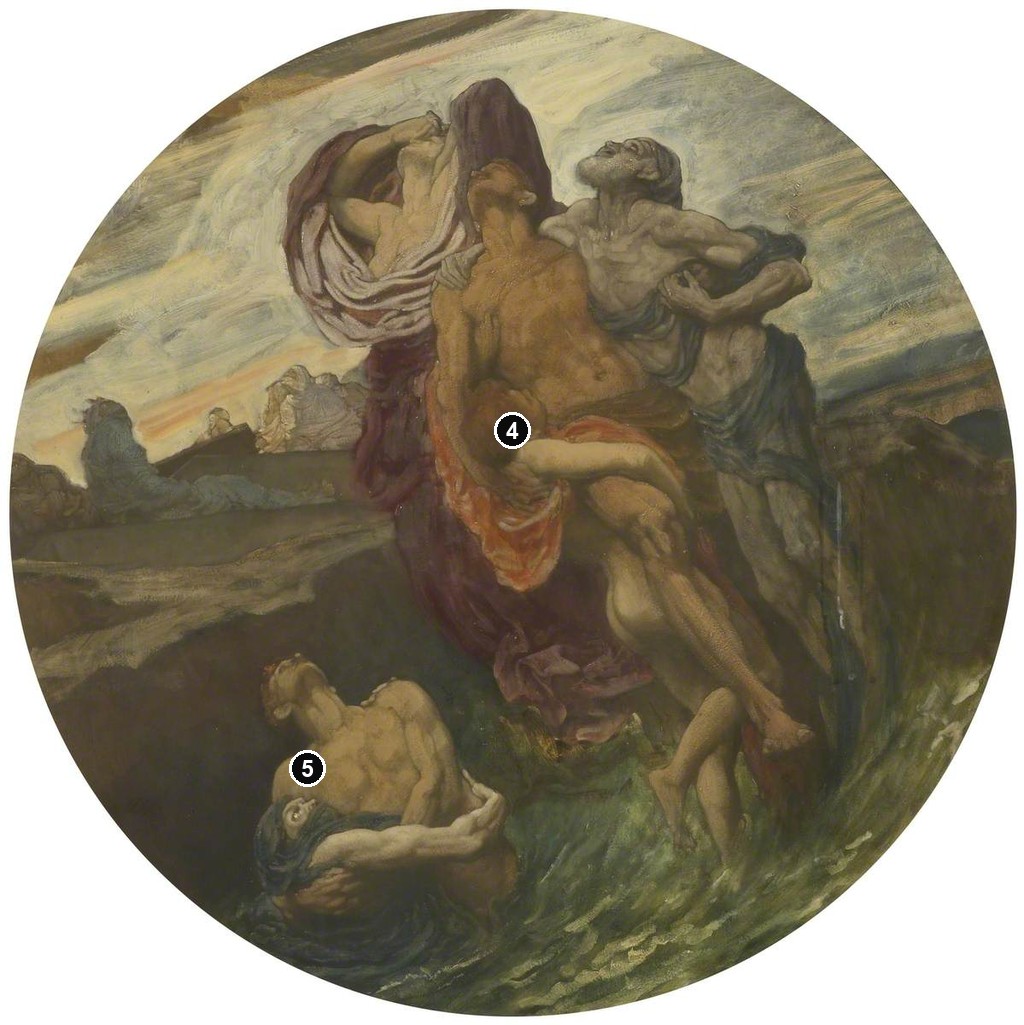
The numbered points identify visible features discussed in this article. Return from each detail to the numbered overview. Each caption identifies the work shown.
And the Sea Gave Up the Dead Which Were in It
Frederic Leighton, And the Sea Gave Up the Dead Which Were in It, exhibited 1892. Tate. Image source. Public domain. Resized without changing the composition.
The Tullie oil study
Frederic Leighton, study for And the Sea Gave Up the Dead Which Were in It. Tullie. Image source. Public domain. Resized without changing the composition.
Details from AND THE SEA GAVE UP THE DEAD WHICH WERE IN IT
Compare the cropped details with the source images above. Notice how their colours, shapes and positions contribute to the larger compositions.
And the Sea Gave Up the Dead Which Were in It
The man turns into the light
The central figure takes the weight of the others as his head turns upwards. Light across his chest separates him from the storm behind.
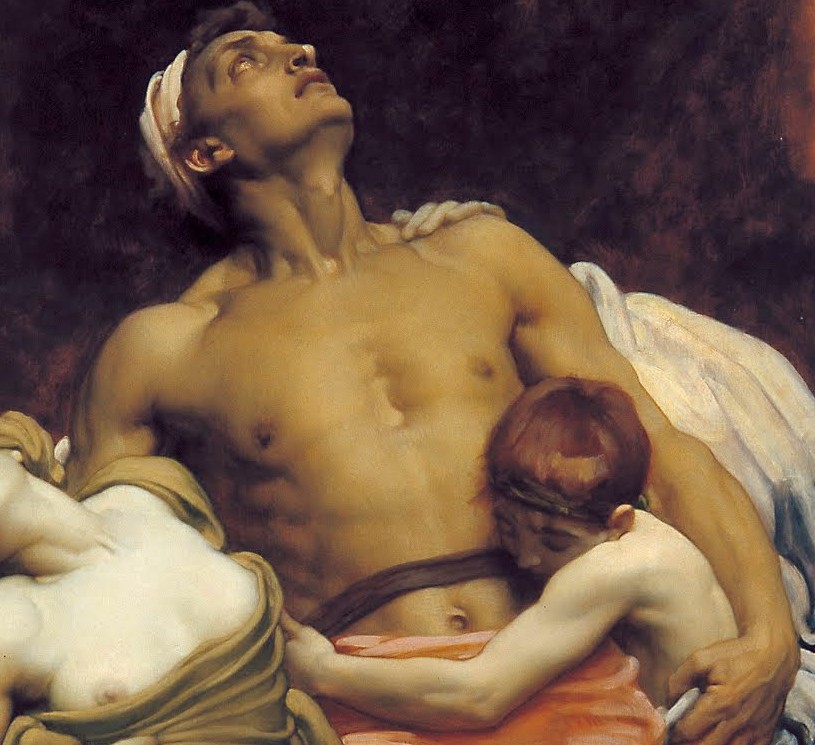
The arms of the child
The child clings across the group. The pink cloth and the slope of the arms join the smaller body to the others.
A figure still in the water
At the edge, a figure’s head rises out of dark waves. The water hides much of the body and holds our attention at a much lower level.
The Tullie oil study
Steeply rising forms
The bodies tilt and intertwine against a pale sky. The sketch makes the direction of their movement clear with comparatively few divisions of colour.
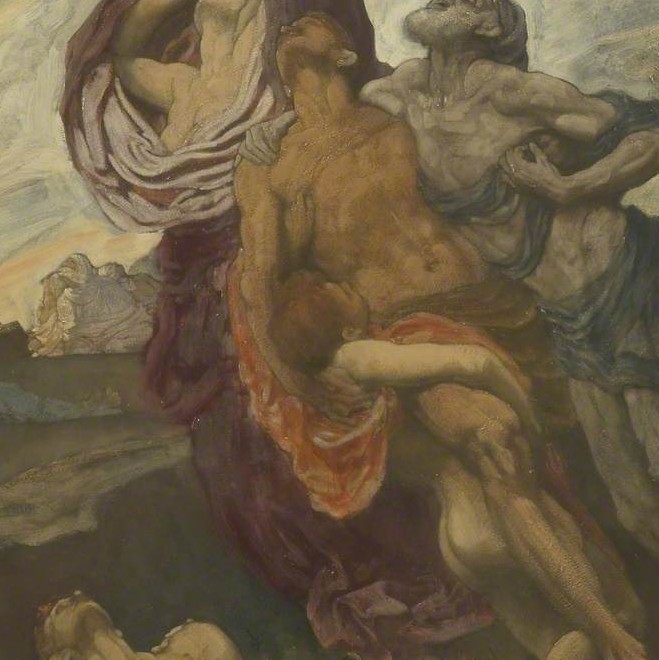
Bodies low in the waves
The figure in the lower part of the study is pale against the surrounding paint. Its relation to the larger group changes in the exhibited version.
Other visions of resurrection
Tate suggests that Michelangelo’s Last Judgment may have inspired Leighton. On the Sistine Chapel altar wall, trumpeting angels wake the dead, the risen recover their bodies on one side, and the struggle over the damned unfolds on the other. Christ presides over the whole fresco. Leighton compresses the action to the space around a few wet figures and gives its upward movement to the father’s raised chin and eyes. A fifteenth-century Last Judgment in a Book of Hours leaf at the Cleveland Museum of Art uses yet another arrangement. Small figures rise from the earth below a visibly enthroned Christ. Both comparisons help locate the moment Leighton chose in the much larger story of judgment. [2] [19] [20]
Duccio’s Raising of Lazarus shows Christ calling one man from his tomb, an episode from John that anticipates Christ’s own Resurrection. George Frederic Watts’s Victorian Court of Death treats death as an enthroned allegorical figure. Leighton’s own Elisha Raising the Son of the Shunamite Woman offers a closer comparison in the way an adult bends towards a child, with light drawing attention to the vulnerable body. In the Tate painting, the child can already hold on, but the woman beside him still hangs slack. The closeness of the family makes it possible to see several moments of awakening at once. [1] [15] [21] [22]
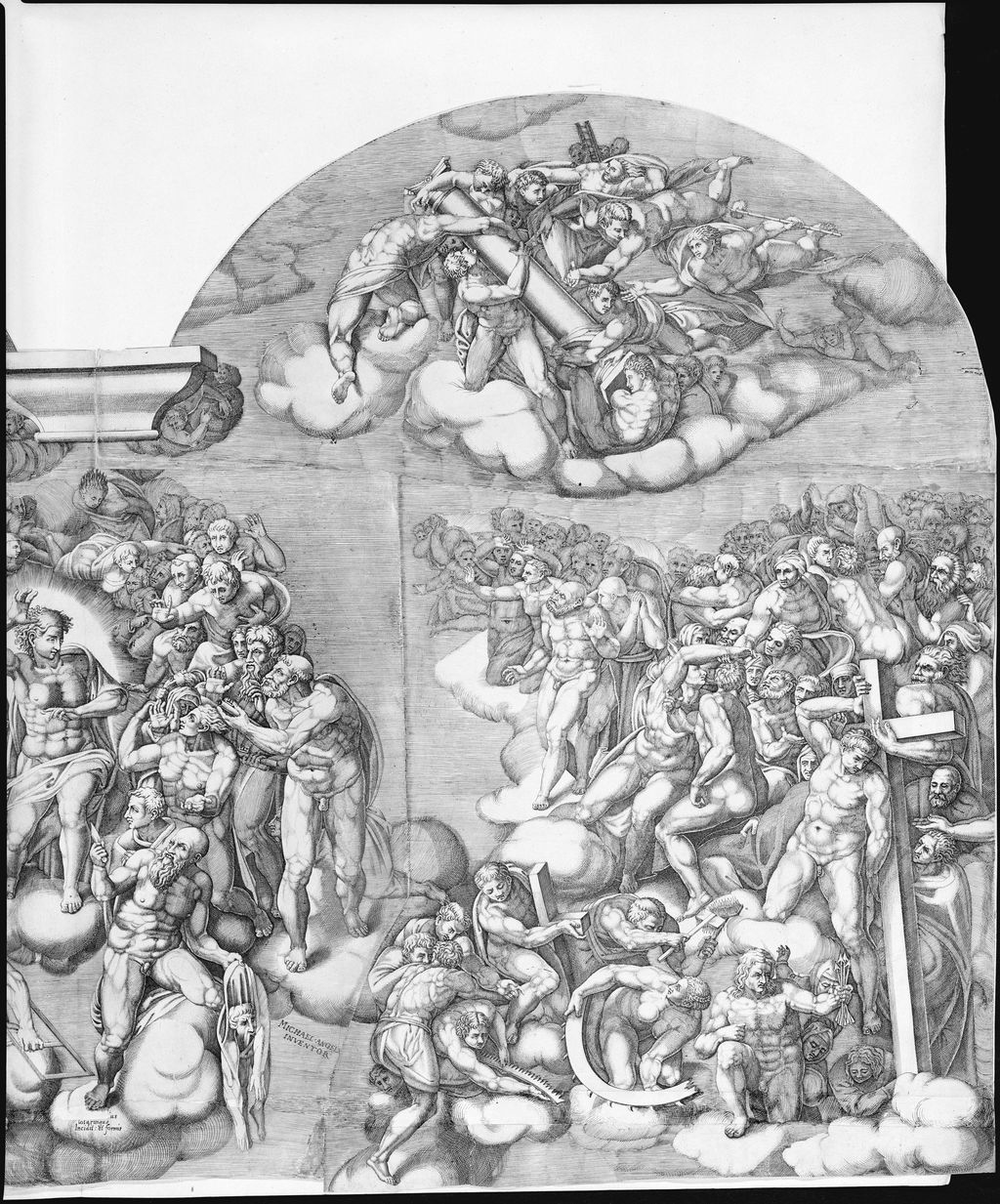
One section of The Last Judgment, 1562, engraved by Nicolas Beatrizet after Michelangelo. The Metropolitan Museum of Art. Image source. CC0 / Public domain. Resized without changing the composition.
Browse Frederic Leighton’s artworks
Explore paintings, drawings, sculptures and prints, with separate rows for identified preparatory works, reproductions and casts.
| Name | Date | Medium |
|---|---|---|
| A Girl Feeding Peacocks | Exhibited 1863 | Painting Catalogue. |
| A Recognition from ‘Romola’, engraved by Swain (Tate N04054) | published 1862 | Print Catalogue. |
| A Roman Lady | 1859 | Painting Catalogue. |
| Abram and the Angel (Tate A00733) | published 1881 | Print Catalogue. |
| Acme and Septimius | Exhibited 1868 | Painting Catalogue. |
| An Athlete Wrestling with a Python (Tate exhibition bronze) | 1877 | Sculpture Catalogue. |
| And the Sea Gave Up the Dead Which Were in It (Tate N01511) | 1891–92 | Painting Catalogue. |
| Andromache in Captivity (photogravure after Leighton) | 1889 | Print Catalogue. |
| Athlete Wrestling with a Python (Anglesey Abbey cast) | model 1877; cast 1905 | Sculpture Catalogue. |
| Athlete Wrestling with a Python (Hood reduced cast) | 1877 (inscribed model date) | Sculpture Catalogue. |
| Athlete Wrestling with a Python (Saint Louis reduced cast) | 1877 (museum date) | Sculpture Catalogue. |
| Cain and Abel (Tate A00731) | published 1881 | Print Catalogue. |
| Captive Andromache | 1888 | Painting Catalogue. |
| Cimabue's Celebrated Madonna | 1853–55 | Painting Catalogue. |
| Cimon and Iphigenia, with Many Smaller Subjects (Tate T09061) | date not known | Drawing Catalogue. |
| Crenaia, the Nymph of the Dargle | Exhibited 1880 | Painting Catalogue. |
| Cymon and Iphigenia | 1884 | Painting Catalogue. |
| Daedalus and Icarus | 1869 | Painting Catalogue. |
| Dante in Exile | 1864 | Painting Catalogue. |
| Death of the First Born (Tate A00737) | published 1881 | Print Catalogue. |
| Electra at the Tomb of Agamemnon | c. 1869 | Painting Catalogue. |
| Eliezer and Rebekah (Tate A00735) | published 1881 | Print Catalogue. |
| Elijah in the Wilderness | 1877–78 | Painting Catalogue. |
| Fanny Kemble: A Study for ‘Jezebel and Ahab’ (Tate T08208) | c.1862 | Drawing Catalogue. |
| Figure Studies | Date not recorded | Drawing Catalogue. |
| Flaming June | 1895 | Painting Catalogue. |
| Gulnihal | Exhibited 1886 | Painting Catalogue. |
| Helios and Rhodes (Tate N03015) | date not known | Painting Catalogue. |
| Hercules Wrestling with Death for the Body of Alcestis | c. 1869–71 | Painting Catalogue. |
| Jonathan's Token to David | c. 1868 | Painting Catalogue. |
| Lachrymae | 1894–95 | Painting Catalogue. |
| Lieder ohne Worte | Exhibited 1861 | Painting Catalogue. |
| Light of the Harem | Exhibited 1880 | Painting Catalogue. |
| Moses Views the Promised Land (Tate A00736) | published 1881 | Print Catalogue. |
| Mrs James Guthrie | 1865 | Painting Catalogue. |
| Mrs John Hanson Walker (Tate N04731) | 1867 | Painting Catalogue. |
| Music Lesson | 1877 | Painting Catalogue. |
| Needless Alarms (Met cast) | modelled 1886; cast nineteenth century | Sculpture Catalogue. |
| Needless Alarms (Tate N05120) | 1886 | Sculpture Catalogue. |
| Pavonia | c. 1859 | Painting Catalogue. |
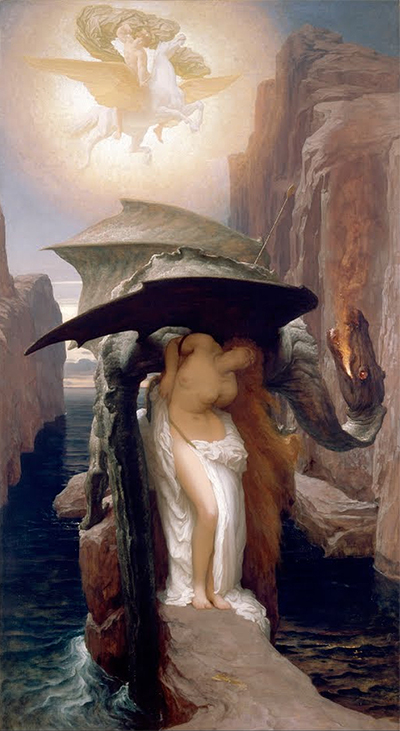
| Perseus and Andromeda | 1891 | Painting Catalogue. |
| Portrait of May Sartoris | c. 1860 | Painting Catalogue. |
| Preparing for a Festa, Florence (Tate T09062) | date not known | Drawing Catalogue. |
| Puerta de los Vientos, near Ronda, Spain (Tate N04006) | c.1886–9 | Painting Catalogue. |
| Samson and the Lions (Tate A00732) | published 1881 | Print Catalogue. |
| Samson at the Mill (Tate A00734) | published 1881 | Print Catalogue. |
| Samson Carrying the Gate (Tate A00738) | published 1881 | Print Catalogue. |
| Sketch for ‘An Athlete Wrestling with a Python’ (Tate N01761) | c.1877 | Sculpture Catalogue. |
| Sketches for Cimon and Iphigenia (Tate T09060) | date not known | Drawing Catalogue. |
| Study for The Return of Persephone (Demeter) | c. 1890–91 | Drawing Catalogue. |
| Study for The Return of Persephone (Persephone) | c. 1890–91 | Drawing Catalogue. |
| Study for ‘Needless Alarms’ (Tate N02945) | 1886 | Sculpture Catalogue. |
| Study for ‘The Discovery of Juliet Apparently Lifeless’ (Tate N01806) | c.1858 | Painting Catalogue. |
| The Bath of Psyche | Exhibited 1890 | Painting Catalogue. |
| The Daphnephoria | 1874–76 | Painting Catalogue. |
| The Death of Brunelleschi | 1852 | Painting Catalogue. |
| The Fisherman and the Siren | Exhibited 1858 | Painting Catalogue. |
| The Painter's Honeymoon | c. 1864 | Painting Catalogue. |
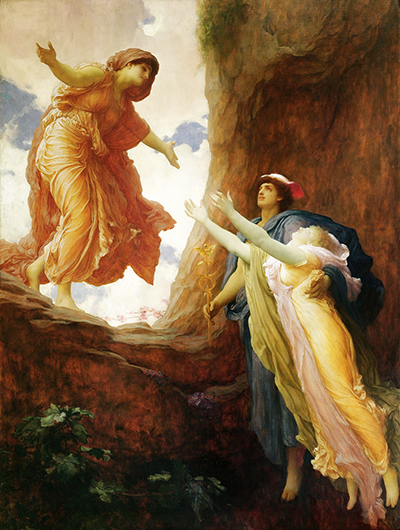
| The Return of Persephone | 1891 | Painting Leeds painting identified in the Met study record. |
| The Return of Persephone (preparatory oil) | c. 1890–91 | Painting Catalogue. |
| The Sluggard (Anglesey Abbey cast) | probably 1890–about 1906 | Sculpture Catalogue. |
| The Sluggard (Met cast) | modelled 1886; cast possibly before 1896 | Sculpture Catalogue. |
| The Sluggard (Museum Wales) | 1882–85 (museum date) | Sculpture Catalogue. |
| The Sluggard (Tate N01752) | 1885 | Sculpture Catalogue. |
| The Spies Escape (Tate A00730) | published 1881 | Print Catalogue. |
| Various Subjects (Tate T09063) | date not known | Drawing Catalogue. |
| View in Capri | Possibly 1859 | Painting Catalogue. |
| Wedded | 1882 | Painting Catalogue. |
| Winding the Skein | c. 1878 | Painting Catalogue. |
Discussion
Look again at the images and ideas explored in And the Sea Gave Up the Dead Which Were in It. These editorial prompts invite your observations.
Reader Insights
What does the circular format do to the rising movement of the figures?
Which changes from the oil study bring the viewer closer to the action?
Join the Conversation
Share a detail, comparison or question about And the Sea Gave Up the Dead Which Were in It below.
References
- Tate, collection record for And the Sea Gave Up the Dead Which Were in It, N01511. View source.
- Tate Britain via Google Arts & Culture, collection interpretation and object details. View source.
- Revelation 20:11–15, King James Version. View source.
- Edward T. Cook, A Popular Handbook to the Tate Gallery, entry no. 1511. View source.
- Keren Rosa Hammerschlag, Frederic Leighton: Death, Mortality, Resurrection, introduction. View source.
- University of York, Pantheons: Sculpture at St Paul’s Cathedral, Leighton monument research, part 4. View source.
- Christie’s, Study for ‘And the Sea gave up the Dead which were in it’, lot 2067834. View source.
- Birmingham Museum and Art Gallery, Illustrated Catalogue, entry no. 156. View source.
- Algernon Graves, The Royal Academy of Arts, vol. V, p. 33, 1892 entries 115 and 204. View source.
- National Museums Liverpool, Myths and Legends, notes on The Garden of the Hesperides. View source.
- The National Gallery of British Art (The Tate Gallery): Illustrated Catalogue, p. 62, entry no. 1511. View source.
- National Gallery Archive, NG7/116/7, Letters from the Earl of Carlisle respecting Mr Tate’s offer. View source.
- Royal Academy of Arts, 1897 winter exhibition catalogue, entries 108, 155, 257 and 277. View source.
- Anderson photographic catalogue, 1921 supplement, p. 22, no. 18386, digitised by the Kunsthistorisches Institut in Florenz. View source.
- Victorian Paintings from London’s Royal Academy, exhibition catalogue, p. 16, figs. 2–3. View source.
- Emilie Barrington, The Life, Letters and Work of Frederic Leighton, vol. II, plate 46. View source.
- Tullie House Museum and Art Gallery via Art UK, collection photograph and data for And the Sea Gave up its Dead (study), 1971.85.1, mirrored by Wikimedia Commons. View source.
- Leighton House Museum via Art UK, Colour Sketch for “And the sea gave up the dead that were in it”, collection image and caption mirrored by Wikimedia Commons. View source.
- Vatican Museums, Michelangelo’s Last Judgement. View source.
- Cleveland Museum of Art, Leaf from a Book of Hours: The Last Judgment, 1999.130. View source.
- Kimbell Art Museum, Duccio’s The Raising of Lazarus, APx 1975.01. View source.
- Watts Gallery, George Frederic Watts’s Court of Death. View source.