 by Tom Gurney
Tom Gurney BSc (Hons) is an art history expert with over 20 years experience
Published on June 19, 2020 / Updated on November 29, 2026
Email: tomgurney1@gmail.com / Phone: +44 7429 011000
Daedalus and Icarus: Introduction
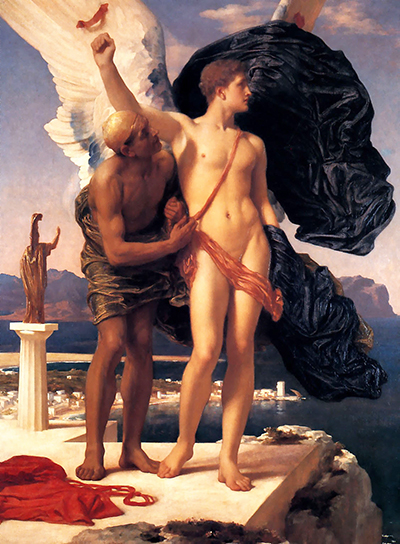
Icarus already has one arm in the air, but both his feet are on the stone. His father, Daedalus, bends close to adjust the wings that will carry them over the sea. A pale wing rises to the left and a length of dark blue cloth swells behind Icarus on the right. Between them, a slender red strap crosses his chest. The Faringdon Collection at Buscot Park catalogues Frederic Leighton’s oil painting as Daedalus and Icarus. The same canvas also appears under the reversed title Icarus and Daedalus. It was exhibited at the Royal Academy in 1869 as no. 469. [1] [2]
At a Glance
- Date1869
- MediumOil on canvas
- CollectionThe Faringdon Collection, Buscot Park, no. 80
- Royal AcademyExhibited in 1869 as no. 469
This work across Frederic Leighton’s career
Cimabue’s Celebrated Madonna
1853–55Lachrymae
1894–95Flaming June
c. 1895Contents
- The moment before flight
- The story in Ovid
- The oil sketch and the dark blue cloth
- A Cretan story with a Rhodian view
- How the Victorian audience saw Icarus
- The same myth at different moments
- Annotated details
The moment before flight
Daedalus’s lowered head draws the eye to what he is doing with his hands. One grasps the red fastening near his son’s waist. Icarus looks away over his shoulder, beyond anything we can see. His torso faces us and his right arm reaches up toward the feathers. Daedalus’s body, inclined toward his son, is lit in warm browns. Icarus’s upright figure catches the light across his chest, belly and legs. Their feet are close together, but their attention has already begun to part. [1] [3]
The wings are easy to mistake at first for part of Icarus’s silhouette. The raised fist and the strap give away the work needed to make them stay in place. Along the bottom of the canvas, a red cloth lies in folds across the stone. Its colour picks up the fastening and the narrow fabric drawn across Icarus’s hips, leading the eye back to the points where Daedalus can still make adjustments. The sea is compacted into a band so far below that we look down at the shoreline even as Icarus invites us to look up. The painter lets us feel both directions before the boy takes either of them. [1] [3]
Annotated Details from Daedalus and Icarus
The numbered points identify visible features discussed in this article. Return from each detail to the numbered overview. Frederic Leighton, Daedalus and Icarus, 1869. The Faringdon Collection, Buscot Park. Image source. Public domain. Resized without changing the composition.
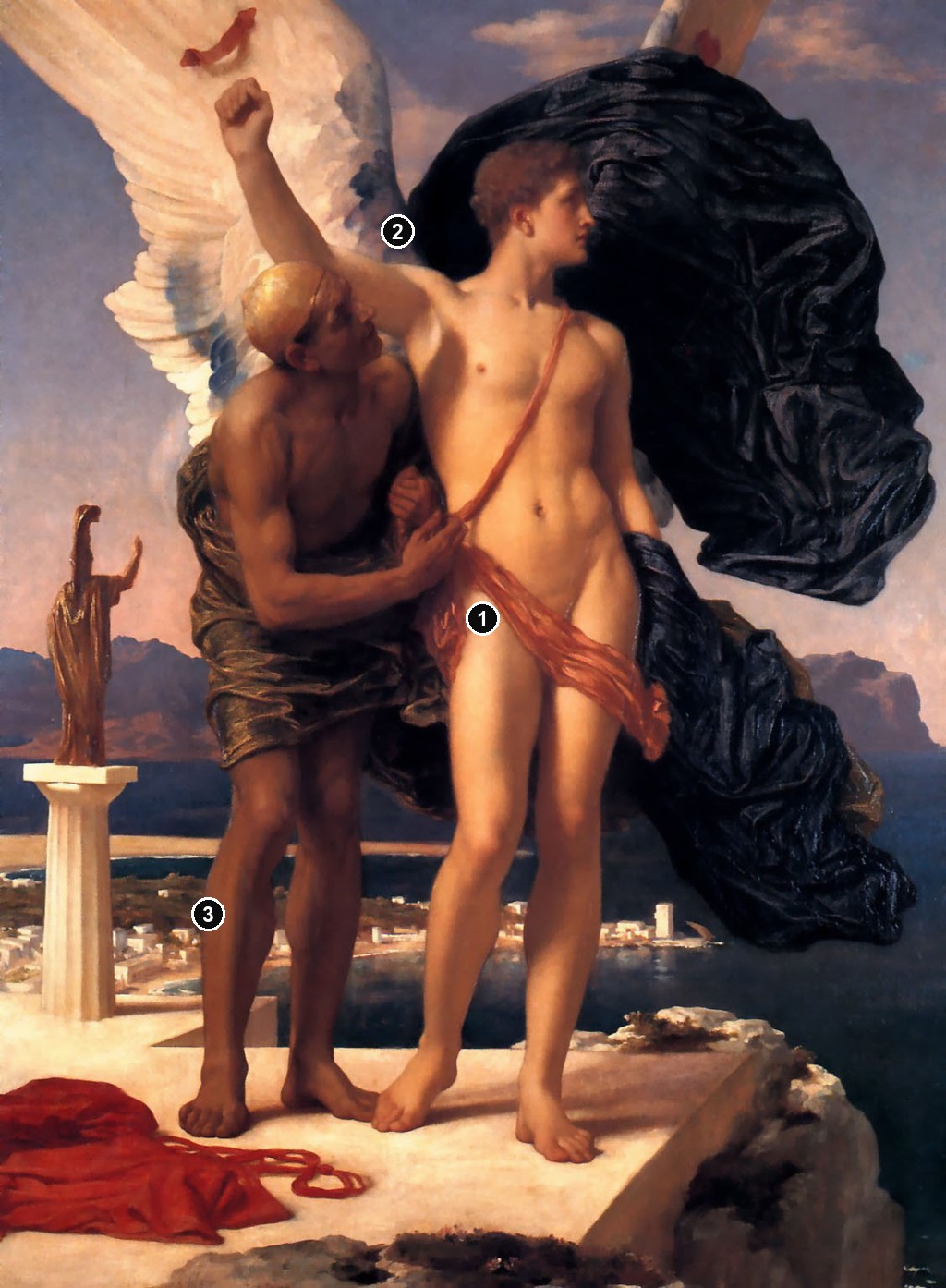
Details from DAEDALUS AND ICARUS
Compare the cropped details with the source images above. Notice how their colours, shapes and positions contribute to the larger compositions.
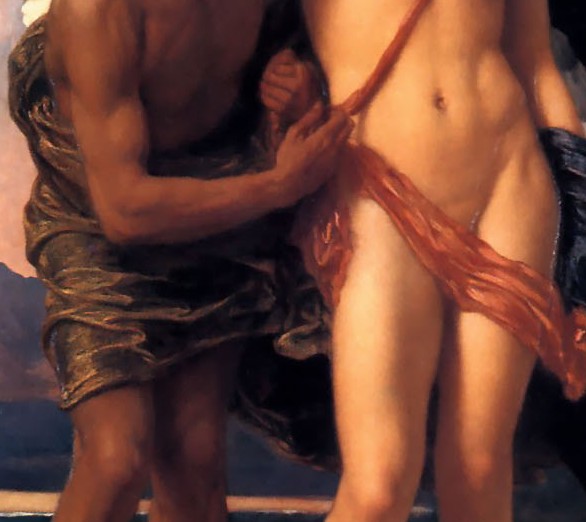
Daedalus at the strap
The father bends towards the young man and brings his hands to the fastening. Their attention lies in two different directions.
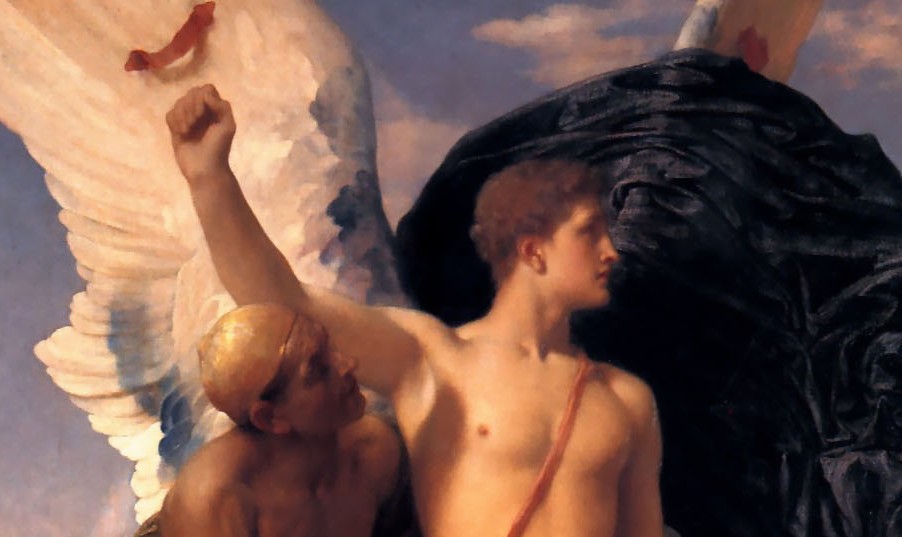
Feathers and dark cloth
A bright bank of feathers rises above the father. The dark blue cloth behind Icarus pulls the eye to the other side of the canvas.
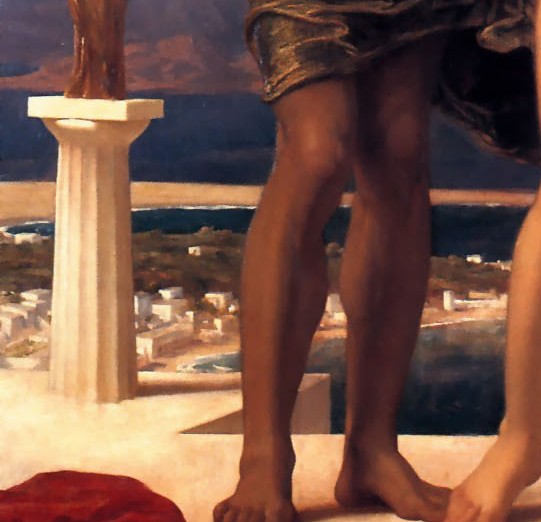
The coast below the platform
The low coast is visible past the column and below the platform. The strip of water foreshadows Icarus’s fall.
The story in Ovid
The Faringdon catalogue follows the scholars Leonée and Richard Ormond in suggesting Ovid’s Metamorphoses as Leighton’s literary source. In Book VIII, Daedalus has built the Labyrinth for King Minos. When Daedalus seeks a way out of Crete, he reasons that Minos can control the land and sea but has no command of the air. He grades the feathers from short to long, binds them with thread and wax, and bends them to imitate birds’ wings. Icarus plays with the loose feathers and presses the wax with his thumb, unaware that his amusement could undo his father’s work. The Greek mythographic account attributed to Apollodorus supplies a more specific cause for their confinement, putting father and son in the Labyrinth after Theseus’s escape. [1] [4] [5]
Ovid gives Daedalus two dangers to warn against. The water will weigh down the feathers if Icarus flies too low, and the sun will melt the wax if he flies too high. The father’s hands tremble as he equips his son. Once airborne, Icarus leaves his guide and climbs. By the time he reaches out with bare arms, he has nothing with which to hold himself up. Daedalus calls for him, sees the feathers in the water and buries his son on the island that takes his name. Knowing how closely the practical details of the invention are tied to its failure gives Leighton’s small red fastening particular weight. The father’s care and the son’s delight can be seen together at the very instant when the wings still promise a way to safety. [1] [4]
The oil sketch and the dark blue cloth
A small preparatory oil sketch at Leighton House shows how early the broad arrangement was in place. On its roughly brushed surface, the pale wing and the dark mass of the cloth already spread out on either side of the pair. The two warm figures stand on a light platform, with the little column at the far left. Leighton could judge the distribution of the principal colours in this form before he rendered individual feathers, picked out the red strap or gave the distant shore its succession of pale buildings. In the finished picture, details as fine as the edge of the strap still depend on the large blocks of light and dark that the sketch establishes. [1] [6]
The Leighton House exhibition catalogue Folded also reproduces a composition study in black and white chalk on blue paper, dated about 1868. In the same catalogue, curator Daniel Robbins describes the finished picture’s billowing fabric as a nearly closed loop. He relates such effects to Leighton’s wider practice of studying cloth independently of the body, sometimes supporting its folds or arranging fabric on a horizontal surface before painting it upright. The dark cloth behind Icarus occupies almost as much space as a wing. Precisely edged folds make it look heavy enough to hold its form, even though the length curling behind his arm seems to have been caught in a sudden gust. The suspended cloth makes the air perceptible before the figures enter it. [7]
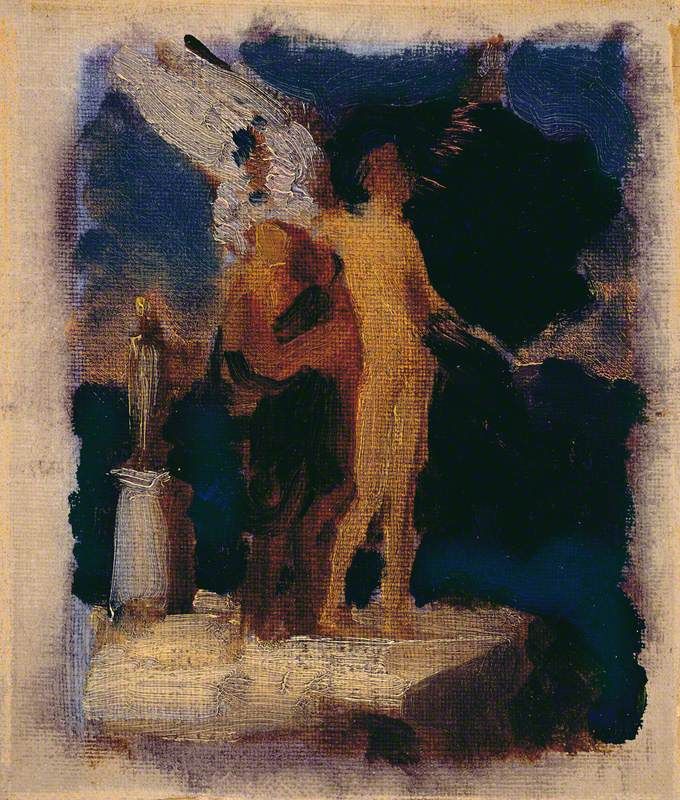
Frederic Leighton, colour sketch for Daedalus and Icarus, c. 1869. Leighton House. Image source. Public domain. Resized without changing the composition.
A Cretan story with a Rhodian view
Leighton had travelled to Lindos on Rhodes in 1867. The Faringdon Collection traces the background to studies from that journey, and Pola Durajska identifies the view with the acropolis at Lindos. Look to the left of Daedalus, past the column and the small statue Durajska identifies as Athena. The light catches a line of buildings at the edge of the bay, beyond which the coast recedes into blue. The painted platform ends abruptly at the lower right, where the rough stone of the promontory is visible. Those changes in level give the mythical scene a recognisable Mediterranean setting and make the height from which the two will launch feel immediate. [1] [8] [9]
Leighton showed Helios and Rhodos at the Academy in the same year. Durajska associates both pictures with his Rhodes studies. Sunlight in Daedalus and Icarus picks out the youth’s torso and the ridges in the feathers with a clarity that comes close to sculpture. That brightness has an ominous part in Icarus’s story, while in the companion exhibit the sun appears in person as Helios. [8] [10]
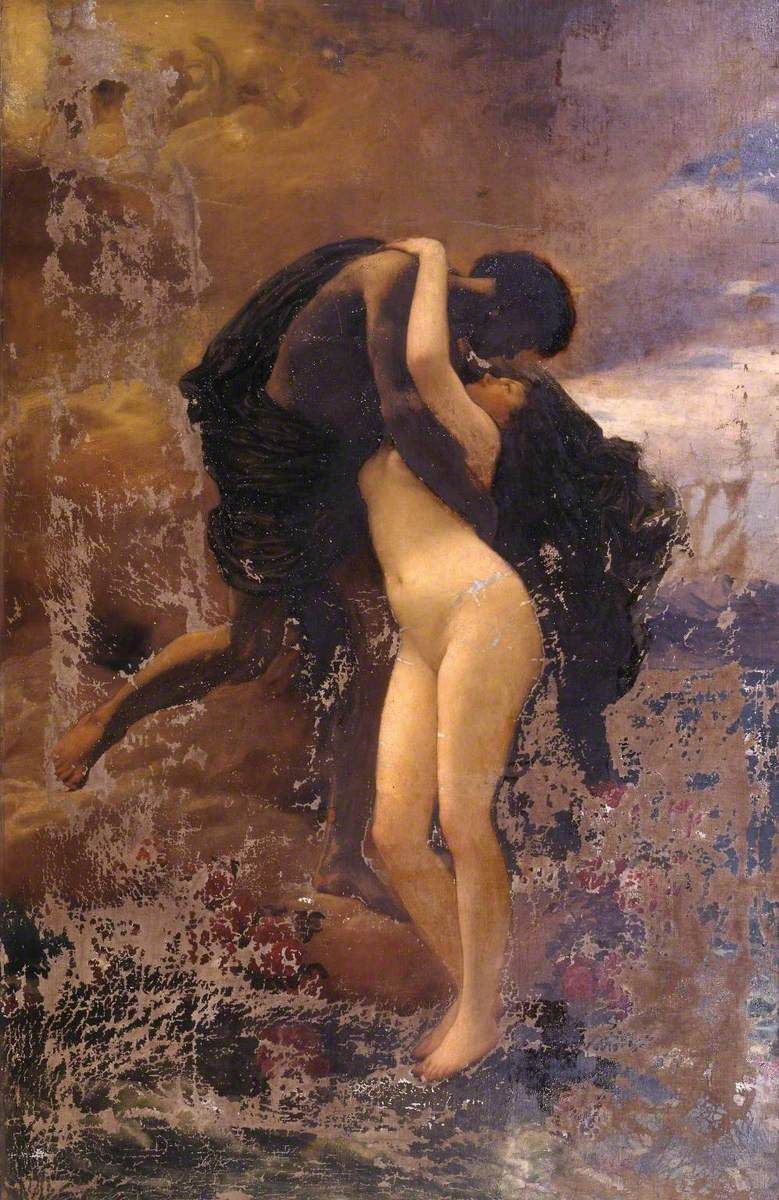
Frederic Leighton, Helios and Rhodos, exhibited 1869. Tate. Image source. Public domain. Resized without changing the composition.
How the Victorian audience saw Icarus
Leighton had been elected a full Royal Academician in 1868, the year before the painting went on view. Electra at the Tomb of Agamemnon and Helios and Rhodos were among his other exhibits. In its review of 15 May 1869, The Times found the contrast between the two skin tones conventional and complained that the shaping of Icarus’s chest looked feminine. The criticism gives a sense of how closely a Victorian reviewer inspected a painted male body for the expected signs of masculinity. Liz Prettejohn places the canvas among the early public explorations of the male nude by British painters newly engaged with classical form. Tate Britain later included it in Queer British Art 1861–1967 in 2017, where the old review helped put the reception of that figure back in view. [1] [10] [11] [12] [13]
The Faringdon Collection records the painting with Thomas Eustace Smith of Gosforth Hall by 1873. Alexander Henderson acquired it by private sale in 1887 and lent it to the Royal Academy’s 1897 memorial exhibition, where it was catalogued as no. 69. It also reached readers in reproductions, including a photogravure in Emilie Barrington’s 1906 biography, credited there to Henderson’s permission. After his death, Gavin, second Baron Faringdon, bought the picture at the Sotheby’s sale of 13 June 1934, where it was lot 117. It was subsequently shown in the travelling Victorian High Renaissance exhibition and in the Academy’s 1996 Leighton retrospective. [1] [11] [14]
The same myth at different moments
The Metropolitan Museum of Art’s marble relief shows an older, seated Daedalus working on the wing that the young Icarus steadies with one hand. Antonio Canova’s marble group at the Museo Correr puts the father and son face to face, joined across the space between them by a thread. Both works reward a look at the exchange of labour between parent and child. Leighton gives the standing pair a common task too, then turns Icarus’s face away so that his eyes and his father’s hands tell different parts of the story. [1] [15] [16]
In the Cleveland Museum of Art’s drawing after Giulio Romano, the figures are already in the air, and Icarus is falling below his father. A print in the Rijksmuseum published in a series from Ovid gathers several moments into one scene, including the fall at the right and the father burying his son at the left. The difference lies in how long the viewer is allowed to stay with the preparation. Leighton gives all the space to a single action, with the height and sunlight suggesting where it will lead. [1] [17] [18]
In 1882 Leighton commissioned a bronze from Alfred Gilbert and left the subject up to the younger sculptor. Gilbert chose Icarus, showing him alone. The bronze now in Amgueddfa Cymru was recognised at the Royal Academy in 1884 and, according to the museum, Gilbert regarded it as a kind of self-portrait. Leighton’s painting spreads our attention between the youth eager to fly and the father who has worked out how to make it possible. The narrow space between Daedalus’s hands and Icarus’s turned face is where that shared undertaking begins to come apart. [1] [19]
Browse Frederic Leighton’s artworks
Explore paintings, drawings, sculptures and prints, with separate rows for identified preparatory works, reproductions and casts.
| Name | Date | Medium |
|---|---|---|
| A Girl Feeding Peacocks | Exhibited 1863 | Painting Catalogue. |
| A Recognition from ‘Romola’, engraved by Swain (Tate N04054) | published 1862 | Print Catalogue. |
| A Roman Lady | 1859 | Painting Catalogue. |
| Abram and the Angel (Tate A00733) | published 1881 | Print Catalogue. |
| Acme and Septimius | Exhibited 1868 | Painting Catalogue. |
| An Athlete Wrestling with a Python (Tate exhibition bronze) | 1877 | Sculpture Catalogue. |
| And the Sea Gave Up the Dead Which Were in It (Tate N01511) | 1891–92 | Painting Catalogue. |
| Andromache in Captivity (photogravure after Leighton) | 1889 | Print Catalogue. |
| Athlete Wrestling with a Python (Anglesey Abbey cast) | model 1877; cast 1905 | Sculpture Catalogue. |
| Athlete Wrestling with a Python (Hood reduced cast) | 1877 (inscribed model date) | Sculpture Catalogue. |
| Athlete Wrestling with a Python (Saint Louis reduced cast) | 1877 (museum date) | Sculpture Catalogue. |
| Cain and Abel (Tate A00731) | published 1881 | Print Catalogue. |
| Captive Andromache | 1888 | Painting Catalogue. |
| Cimabue's Celebrated Madonna | 1853–55 | Painting Catalogue. |
| Cimon and Iphigenia, with Many Smaller Subjects (Tate T09061) | date not known | Drawing Catalogue. |
| Crenaia, the Nymph of the Dargle | Exhibited 1880 | Painting Catalogue. |
| Cymon and Iphigenia | 1884 | Painting Catalogue. |
| Daedalus and Icarus | 1869 | Painting Catalogue. |
| Dante in Exile | 1864 | Painting Catalogue. |
| Death of the First Born (Tate A00737) | published 1881 | Print Catalogue. |
| Electra at the Tomb of Agamemnon | c. 1869 | Painting Catalogue. |
| Eliezer and Rebekah (Tate A00735) | published 1881 | Print Catalogue. |
| Elijah in the Wilderness | 1877–78 | Painting Catalogue. |
| Fanny Kemble: A Study for ‘Jezebel and Ahab’ (Tate T08208) | c.1862 | Drawing Catalogue. |
| Figure Studies | Date not recorded | Drawing Catalogue. |
| Flaming June | 1895 | Painting Catalogue. |
| Gulnihal | Exhibited 1886 | Painting Catalogue. |
| Helios and Rhodes (Tate N03015) | date not known | Painting Catalogue. |
| Hercules Wrestling with Death for the Body of Alcestis | c. 1869–71 | Painting Catalogue. |
| Jonathan's Token to David | c. 1868 | Painting Catalogue. |
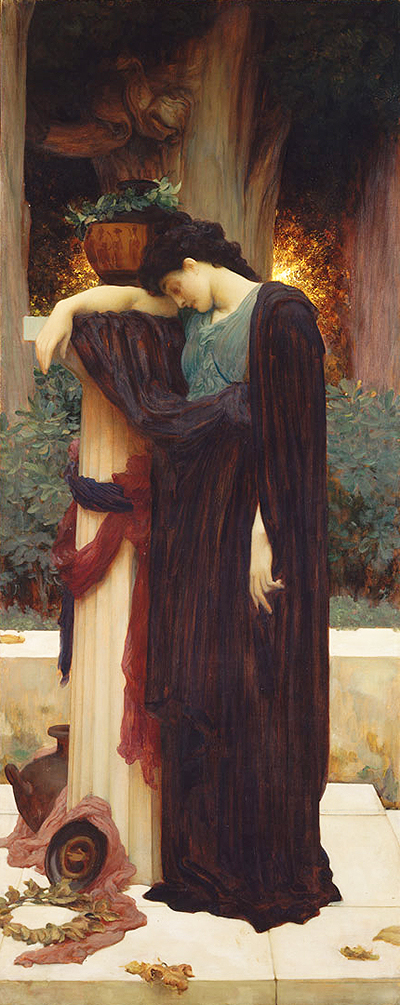
| Lachrymae | 1894–95 | Painting Catalogue. |
| Lieder ohne Worte | Exhibited 1861 | Painting Catalogue. |
| Light of the Harem | Exhibited 1880 | Painting Catalogue. |
| Moses Views the Promised Land (Tate A00736) | published 1881 | Print Catalogue. |
| Mrs James Guthrie | 1865 | Painting Catalogue. |
| Mrs John Hanson Walker (Tate N04731) | 1867 | Painting Catalogue. |
| Music Lesson | 1877 | Painting Catalogue. |
| Needless Alarms (Met cast) | modelled 1886; cast nineteenth century | Sculpture Catalogue. |
| Needless Alarms (Tate N05120) | 1886 | Sculpture Catalogue. |
| Pavonia | c. 1859 | Painting Catalogue. |
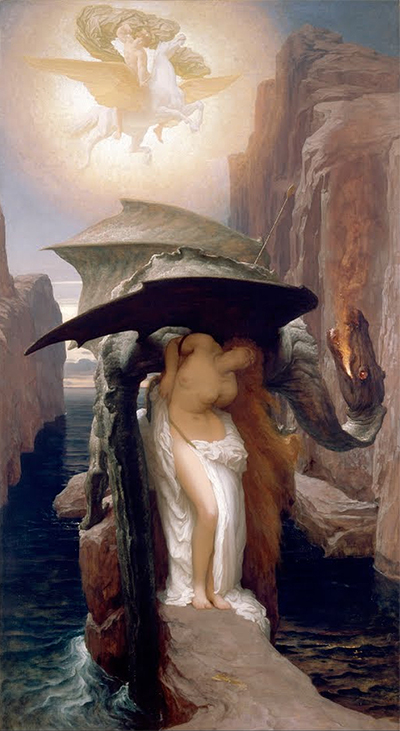
| Perseus and Andromeda | 1891 | Painting Catalogue. |
| Portrait of May Sartoris | c. 1860 | Painting Catalogue. |
| Preparing for a Festa, Florence (Tate T09062) | date not known | Drawing Catalogue. |
| Puerta de los Vientos, near Ronda, Spain (Tate N04006) | c.1886–9 | Painting Catalogue. |
| Samson and the Lions (Tate A00732) | published 1881 | Print Catalogue. |
| Samson at the Mill (Tate A00734) | published 1881 | Print Catalogue. |
| Samson Carrying the Gate (Tate A00738) | published 1881 | Print Catalogue. |
| Sketch for ‘An Athlete Wrestling with a Python’ (Tate N01761) | c.1877 | Sculpture Catalogue. |
| Sketches for Cimon and Iphigenia (Tate T09060) | date not known | Drawing Catalogue. |
| Study for The Return of Persephone (Demeter) | c. 1890–91 | Drawing Catalogue. |
| Study for The Return of Persephone (Persephone) | c. 1890–91 | Drawing Catalogue. |
| Study for ‘Needless Alarms’ (Tate N02945) | 1886 | Sculpture Catalogue. |
| Study for ‘The Discovery of Juliet Apparently Lifeless’ (Tate N01806) | c.1858 | Painting Catalogue. |
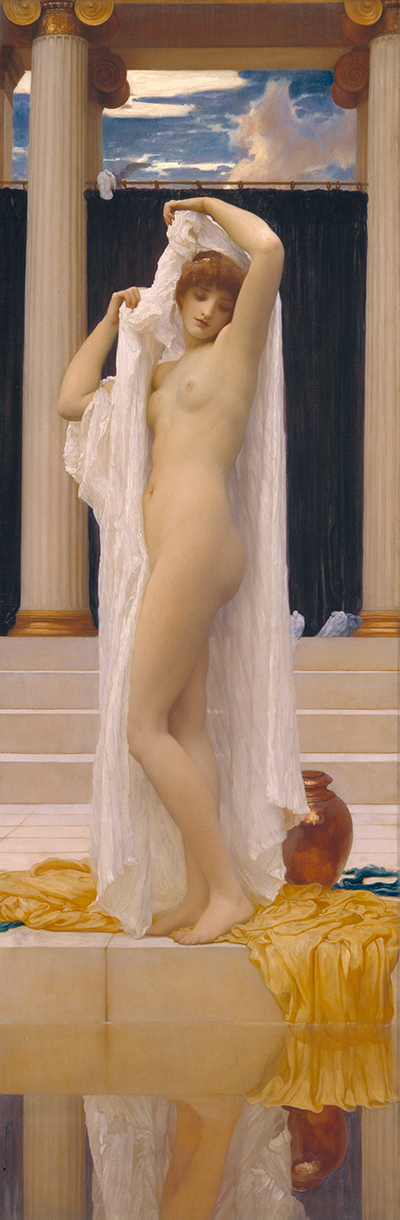
| The Bath of Psyche | Exhibited 1890 | Painting Catalogue. |
| The Daphnephoria | 1874–76 | Painting Catalogue. |
| The Death of Brunelleschi | 1852 | Painting Catalogue. |
| The Fisherman and the Siren | Exhibited 1858 | Painting Catalogue. |
| The Painter's Honeymoon | c. 1864 | Painting Catalogue. |
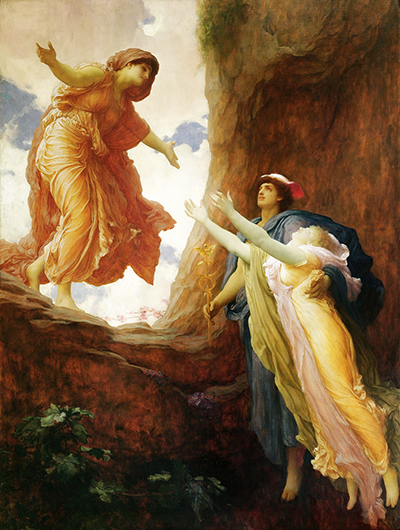
| The Return of Persephone | 1891 | Painting Leeds painting identified in the Met study record. |
| The Return of Persephone (preparatory oil) | c. 1890–91 | Painting Catalogue. |
| The Sluggard (Anglesey Abbey cast) | probably 1890–about 1906 | Sculpture Catalogue. |
| The Sluggard (Met cast) | modelled 1886; cast possibly before 1896 | Sculpture Catalogue. |
| The Sluggard (Museum Wales) | 1882–85 (museum date) | Sculpture Catalogue. |
| The Sluggard (Tate N01752) | 1885 | Sculpture Catalogue. |
| The Spies Escape (Tate A00730) | published 1881 | Print Catalogue. |
| Various Subjects (Tate T09063) | date not known | Drawing Catalogue. |
| View in Capri | Possibly 1859 | Painting Catalogue. |
| Wedded | 1882 | Painting Catalogue. |
| Winding the Skein | c. 1878 | Painting Catalogue. |
Discussion
Look again at the images and ideas explored in Daedalus and Icarus. These editorial prompts invite your observations.
Reader Insights
What can we tell about the relationship between father and son before either leaves the ground?
How does the sunlit view shape our sense of a flight that has not yet begun?
Join the Conversation
Share a detail, comparison or question about Daedalus and Icarus below.
References
- Faringdon Collection, Daedalus and Icarus, catalogue no. 80. View source.
- Marcello Barbanera, The Envy of Daedalus, fig. 1, captioned Icarus and Daedalus, 1869. View source.
- The Warburg Institute, Daedalus binding the wings to Icarus’s arms, iconographic record for the Buscot Park painting. View source.
- Ovid, Metamorphoses, Book VIII, lines 152–235, translated by A. S. Kline. View source.
- Pseudo-Apollodorus, Epitome, 1.12–13, translated by James George Frazer. View source.
- Leighton House, Colour Sketch for ‘Daedalus and Icarus’, collection photograph. View source.
- Daniel Robbins, “Blowing in the Wind: Leighton and Drapery,” and illustration of the composition study in Folded, Leighton House. View source.
- Pola Durajska, Nature, Science, and Myth in the Landscape Art of Frederic Leighton, University of York, 2021, vol. I, discussion of fig. 151. View source.
- Leighton House, “Leighton’s Travels,” including the 1867 eastern Mediterranean itinerary. View source.
- The Magazine of Art, “Our Living Artists—Frederick Leighton, R.A.,” vol. I, p. 59, listing the 1869 exhibits. View source.
- Royal Academy of Arts, Exhibition of Works by the Late Lord Leighton of Stretton, winter 1897, pp. 5–6 and no. 69. View source.
- Laurence Shafe, Darwin and Beauty: 1859–1882, University of Bristol, 2012, vol. I, discussion and citation of The Times, 15 May 1869, p. 12. View source.
- Liz Prettejohn, “The Future of Winckelmann’s Classical Form: Walter Pater and Frederic Leighton,” Journal of Latin Cosmopolitanism and European Literatures 6, 2021, p. 43. View source.
- Emilie Barrington, The Life, Letters and Work of Frederic Leighton, vol. I, 1906, illustration 36. View source.
- The Metropolitan Museum of Art, Relief of Daedalus and Icarus, 1972.118.115. View source.
- Museo Correr, La Collezione Canoviana, room III, Antonio Canova’s Dedalo e Icaro. View source.
- Cleveland Museum of Art, Copy after Giulio Romano’s Fall of Icarus, 1992.90. View source.
- Rijksmuseum, Daedalus en Icarus, RP-P-2015-10-212. View source.
- Amgueddfa Cymru – Museum Wales, Alfred Gilbert’s Icarus, NMW A 116. View source.