 by Tom Gurney
Tom Gurney BSc (Hons) is an art history expert with over 20 years experience
Published on June 19, 2020 / Updated on November 29, 2026
Email: tomgurney1@gmail.com / Phone: +44 7429 011000
Wedded: Introduction
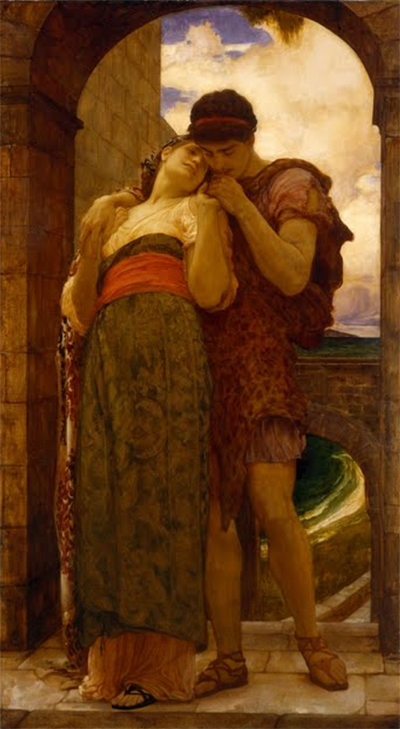
The groom bends to kiss the bride’s hand. She lets her head fall back against him and curls her other hand around the arm he has laid across her shoulders. The embrace takes up nearly the entire opening of a stone arch. Beyond them there is bright sky, and through a second arch, low on the right, a pale curve of ground catches the light. Frederic Leighton painted Wedded in oil on canvas in 1882. The Art Gallery of New South Wales bought the painting that year. It measures 145.4 by 81.3 centimetres and is in the gallery’s Sydney collection (accession 784). [1]
At a Glance
- Painted1882
- MediumOil on canvas, later mounted on hardboard
- CollectionArt Gallery of New South Wales, 784
- Royal AcademyExhibited in 1882
This work across Frederic Leighton’s career
Cimabue’s Celebrated Madonna
1853–55Lachrymae
1894–95Flaming June
c. 1895Contents
- The embrace beneath the arch
- From Taormina to the studio
- From the Royal Academy to Sydney
- What the surface records
- Annotated details
The embrace beneath the arch
Their faces almost meet, but the clearest point of contact is the knot of fingers just below them. His bent forearm makes a diagonal from his sleeve to her hand. Her arm rises almost vertically to meet it. To the left, his hand hangs over her shoulder, while the fingers she raises towards it nearly disappear against his forearm. Those points of contact distribute the weight of the pose. Below the entwined arms, the groom plants his feet wide apart. The tip of one of the bride’s sandals emerges under her hem, close to his nearer foot. [1]
Leighton gives each figure a sweep of colour that makes this closeness legible. The bride’s green overdress falls in a broad, almost unbroken plane, with a darker pattern that takes time to emerge. The orange-red sash runs across it in tight, shallow folds, tracing the turn of her body as she leans. Her cream sleeve catches the light in small wrinkles near the shoulder. Beside it, the groom’s reddish brown mantle breaks into a mottled pattern and ends high enough to expose his legs. A red band across his hair echoes the sash lower down. The costumes give the pair distinct outlines and carry the eye back and forth between them. [1]
The arch above them is dark enough to read as a frame within the painting. Its curve leads down to stone uprights close to each edge. The joints in the paving and the wall on the left lead into depth. A narrow strip of distance beside the groom keeps the opening from feeling closed. Light clouds pick out the contours of both heads, and a patch of blue just under the arch brings cool colour into the warm masonry. Leighton gives the figures the scale of a public monument, while drawing the viewer’s attention to the small space between their hands. [1]
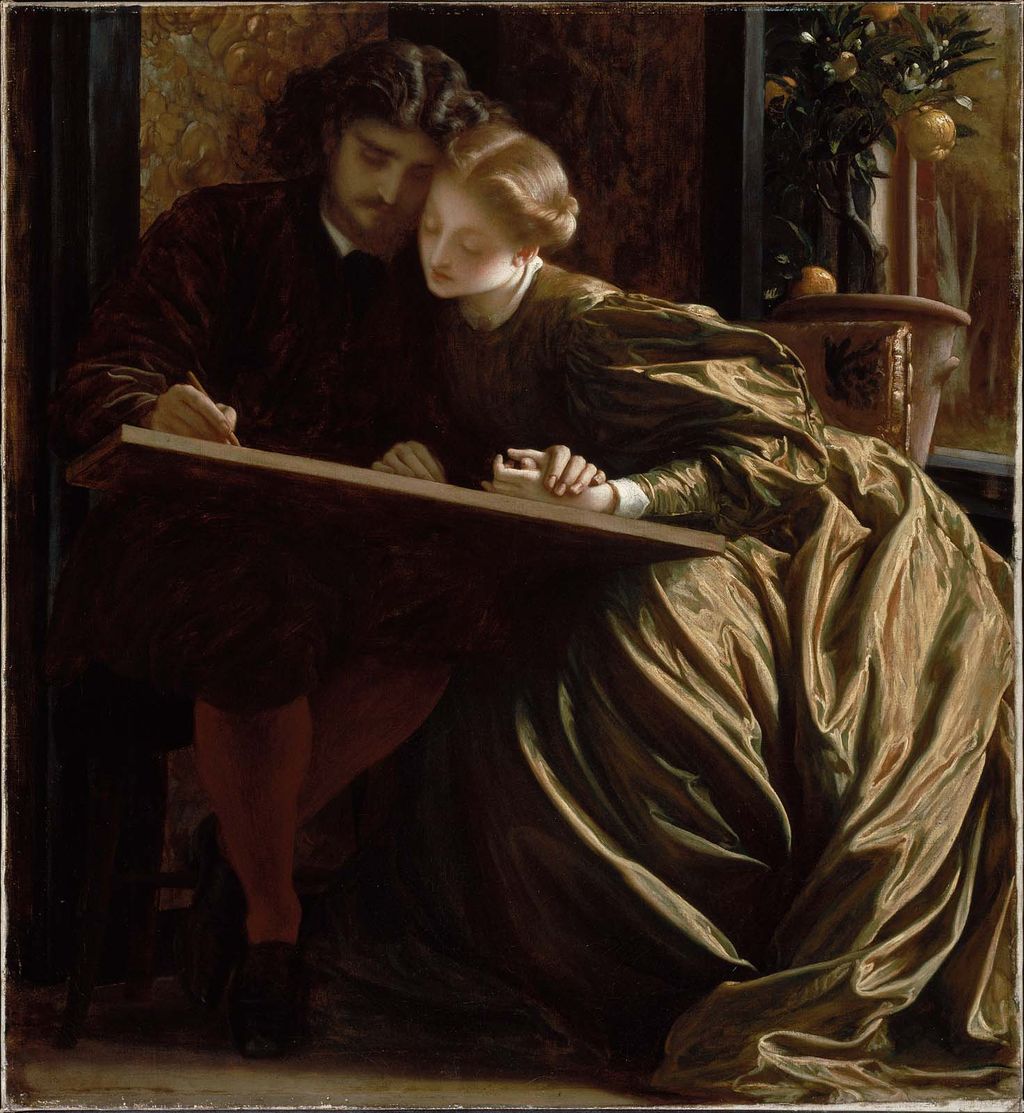
Frederic Leighton, The Painter’s Honeymoon, c. 1864. Museum of Fine Arts, Boston. Image source. Public domain. Resized proportionally.
Annotated Details from Wedded
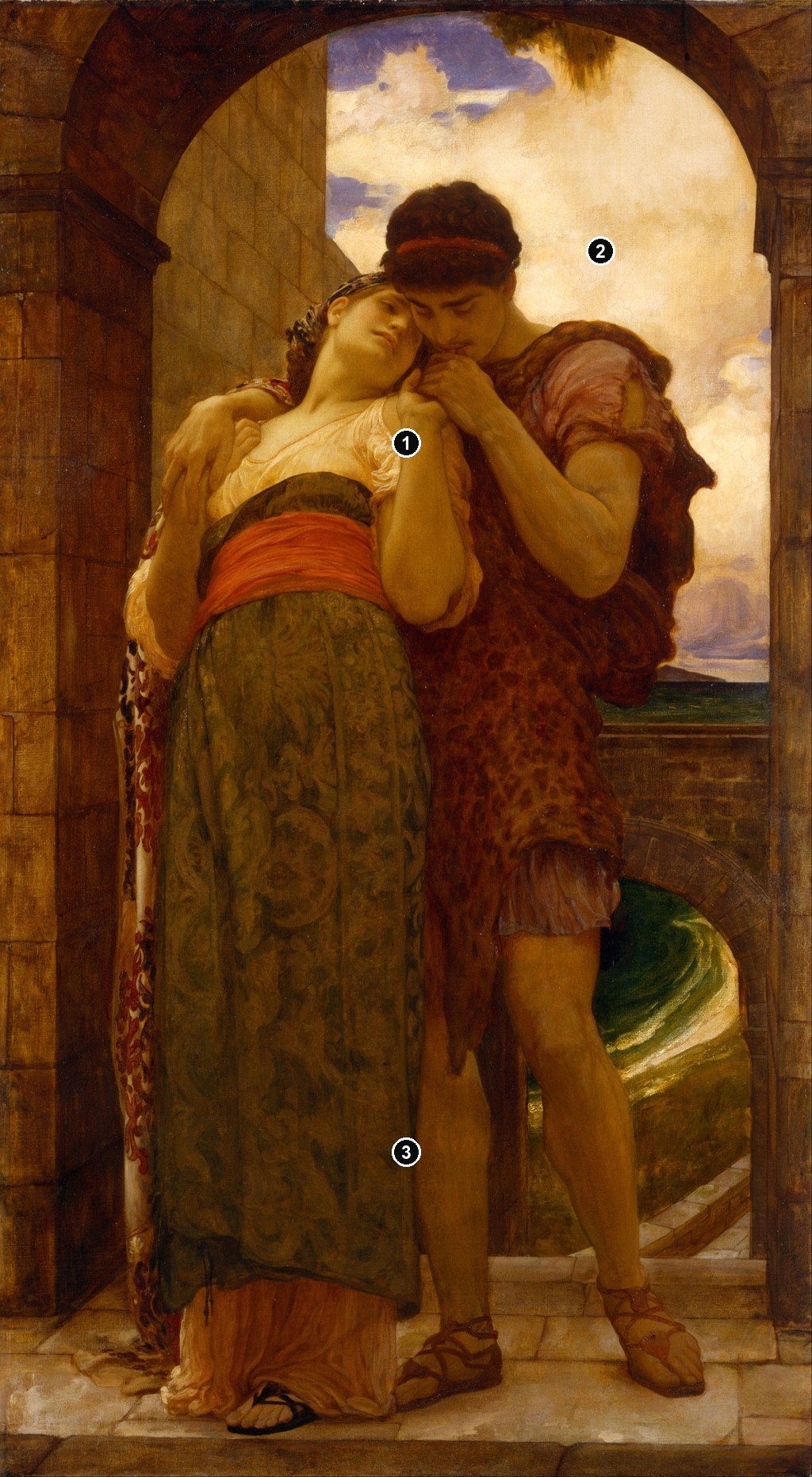
The numbered points identify visible features discussed in this article. Return from each detail to the numbered overview. Frederic Leighton, Wedded, 1882. Art Gallery of New South Wales. Image source. Public domain. Resized proportionally.
Details from WEDDED
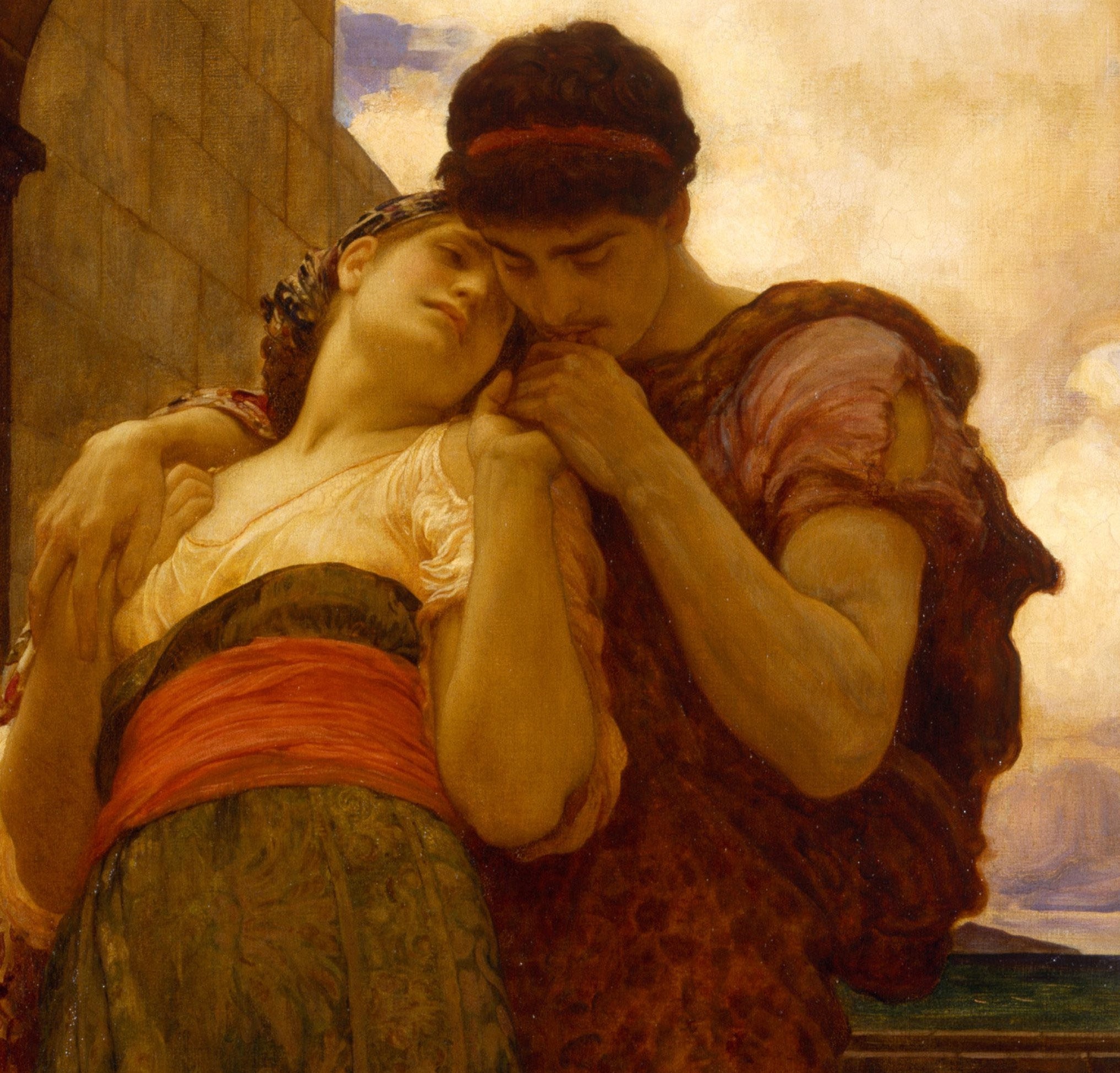
Compare the cropped details with the source images above. Notice how their colours, shapes and positions contribute to the larger compositions.
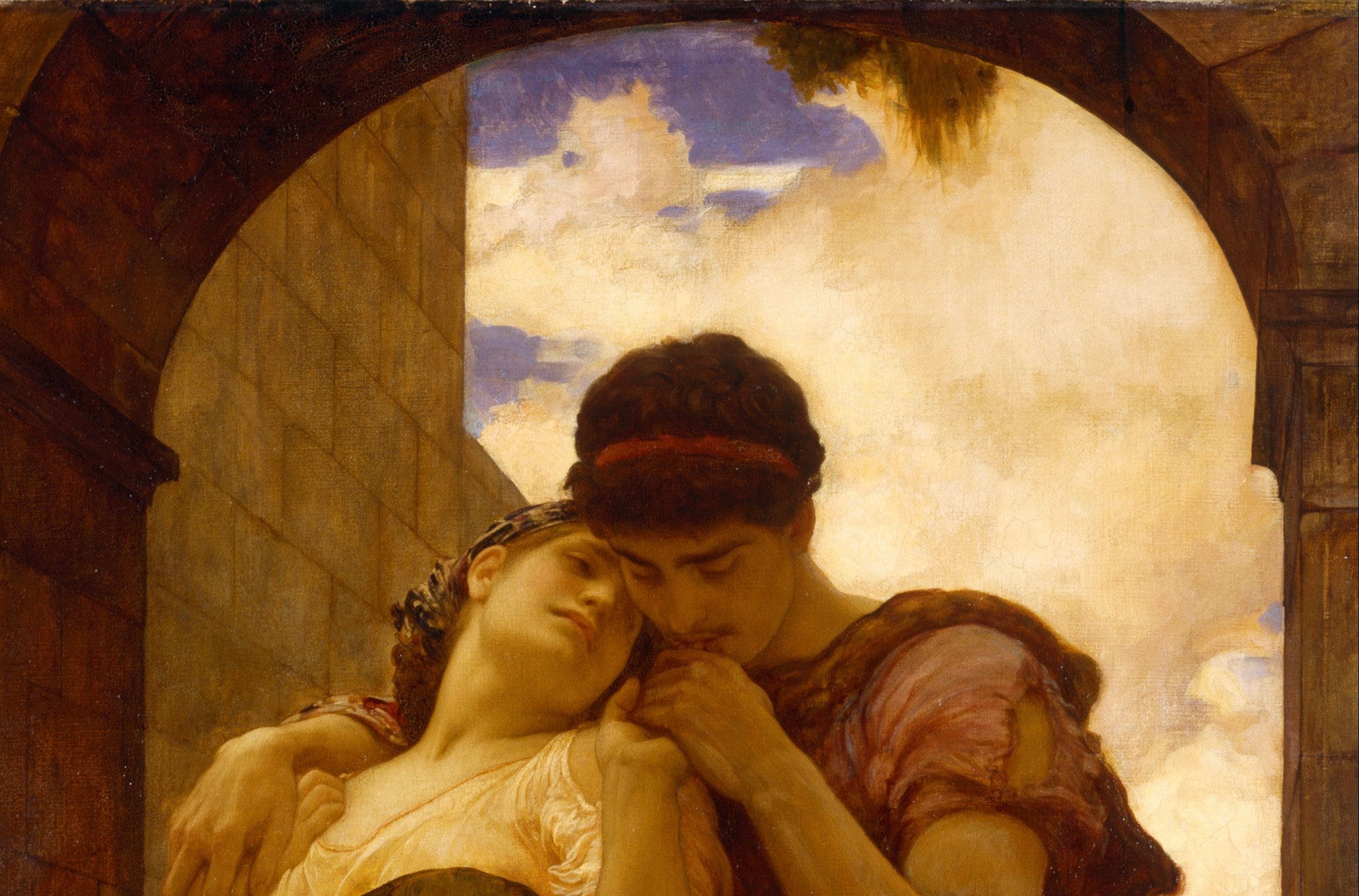
The two heads and joined hands
Their heads incline until the profiles meet. The drawn-up hands carry the meeting down into the centre of the figure group.
A burst of sky through the arch
The lit sky surrounds the figures' heads and shoulders. The curve of the masonry gives that light a clear boundary.
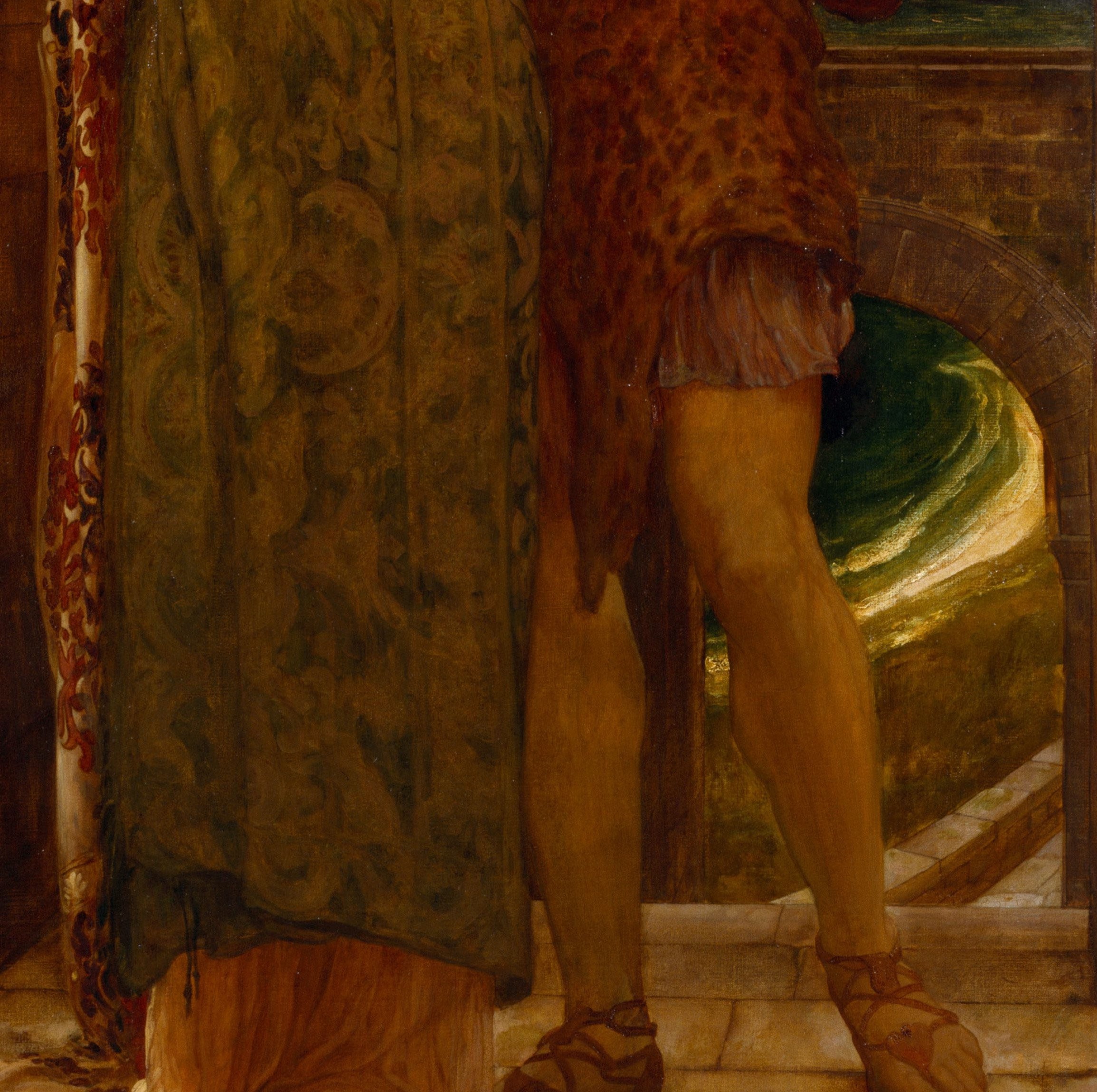
The separate weight of their bodies
Their lower limbs give the standing couple two distinct supports. Patterned cloth and stone are set against the open air at the edge of the wall.
From Taormina to the studio
The Sydney gallery identifies the setting as the ancient theatre at Taormina in Sicily. The site has Greek origins, although the archaeological park dates the visible remains principally to Roman rebuilding. Art historian Pola Durajska traces the painted setting to Leighton’s separate studies of Taormina and dates the studies tentatively to around 1875. Her catalogue records a small oil on panel at Leighton House that supplied part of the setting. There is a good comparison in Sydney’s own collection. John MacWhirter’s 1890 painting of the same theatre opens the view onto Mount Etna. Leighton keeps the landscape to one side and makes the masonry itself bear on the subject. Its deep shade gives the couple a place to pause while the open sky suggests how close they still are to the world outside. The Museo de Arte de Ponce has drawn attention to how close the real and imagined Mediterranean could come in Leighton’s work. Here the study of a recognisable site gives the invented scene its intimacy. [1] [2] [3] [4] [5]
The Colour Sketch for ‘Wedded’ at Leighton House is a small oil on canvas, about 24 centimetres high, that tests the whole composition. The dark arch and blue opening are already set out in a few broad strokes. The people are almost entirely masses of colour. Green falls from the bride’s waist and a rust-coloured stroke indicates one of the groom’s legs. Even the little opening beside his knees is legible as two patches of contrasting colour. In the finished canvas Leighton retains those broad divisions and gives the folds, hands and faces individual contours. The sketch makes it easier to see how much of the picture was settled at the level of colour and silhouette. [1] [6]
A sheet described in the British Museum’s early drawings catalogue puts the emphasis elsewhere. It gives the two figures at the top of the stair and sets a separate nude study of the bride to one side. The two versions on the same paper let Leighton work out how her body tilts and how that tilt reads in the combined pose. A much smaller drawing in pencil and chalk, catalogued at auction as a study of a hand for Wedded, has also been associated with the painting. The accounts of the bride’s face are more tentative. The Sydney gallery suggests that Leighton drew on studies of a Greek girl he encountered in Damascus. The gallery leaves the suggested model unnamed. [1] [7] [8]
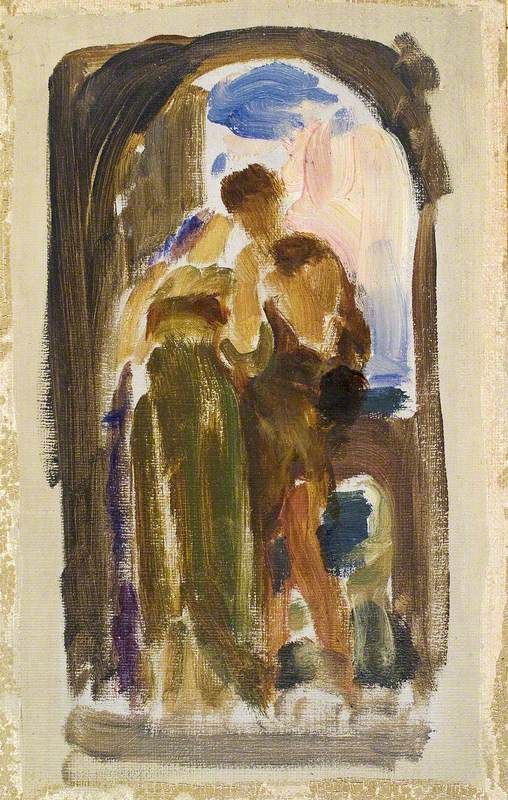
Frederic Leighton, Colour Sketch for Wedded, 1882. Leighton House. Image source. Public domain. Resized proportionally.
From the Royal Academy to Sydney
At the Royal Academy exhibition of 1882 the painting was number 71. Henry Blackburn singled out its colour in his guide to the first gallery. A reviewer in The Spectator found “a touch of genuine feeling” in the way the groom bent to his wife’s hand. A bystander quoted in the same review saw less warmth in the bride’s response. Emilie Barrington remembered standing before the painting with Robert Browning in Leighton’s studio. In her account, published in 1906, the poet told her that he found a quality of poetry in Leighton’s work that he found nowhere else. [9] [10] [11]
The painting was bought in London, possibly through the Academy, according to the Sydney gallery. A letter Leighton wrote from Rome on 24 October 1882, catalogued by historian Hugh Hudson, reports that the canvas had already been sent to Australia and mentions the Fine Art Society’s forthcoming photogravure. Three years later Leighton wrote to the gallery trustee Eliezer Levi Montefiore to confirm that the unsigned painting was his. The gallery’s dating to 1882 comes with that contemporary trail of exhibition, purchase and correspondence. [1] [9] [12]
Blackburn later recalled that Wedded had to leave England soon after the exhibition closed. A conventional engraving would have taken too long, so the painting was sent to Goupil to be reproduced by photogravure, a process that began with a photograph of the original. This gave the composition a life of its own. In a photograph taken in Napier, New Zealand, around 1887, a framed impression hangs in William and Lydia Williams’s home. The Fine Art Society also commissioned Giovanni Battista Amendola to model the couple in three dimensions. In versions of his Wedded, the pair stands on a circular base that takes the place of the theatre and the steps. The removal of the architecture leaves the bend of the heads, the lengths of drapery and the ways the arms support one another to carry the image. [13] [14] [15] [16] [17]
When the Russian traveller Sofia Vitkovskaya visited Sydney in 1896, she described Wedded as a celebrated painting in the gallery. She saw pain in the bride’s expression, where the London reviewer had seen languid grace. Her account, published posthumously, records a visitor’s response to a scene in which even the slightest movement of the bride’s head could change how the embrace was read. [18] [19]
What the surface records
By 1899 the canvas was already the subject of a dispute over cracks in its paint. Alfred Murch described thin glazes breaking into small patches and blamed the use of varnish in the painting medium. He proposed an oil treatment. The trustee and artist Julian Ashton objected and called on Bernard Hall, director of the National Gallery of Victoria. Hall’s intervention helped halt Murch’s treatment of the painting. A photograph taken in December 1899 preserves a detail of the damaged paint before treatment. The conservators Paula Dredge and Alan Lloyd describe the dispute alongside the gallery’s attempts to improve conditions in its rooms. The photograph establishes what the damage looked like, while the correspondence shows how much its cause was disputed. [20]
In 1957 William Boustead removed a loose lining canvas and attached the original canvas to hardboard. He recorded a handwritten note on the lining that mentioned amber varnish, oil of spike, a white priming rubbed in with brown and white, and a pale blue wash on the flesh. Dredge and Lloyd argue that the note probably came from Leighton because it closely matches his worksheet at the Royal Academy. The blue wash is a particularly telling detail to have on record for a picture whose skin tones look so warm at first glance. The gallery’s medium line records both stages of the work’s history. Leighton’s canvas, with the paint layers built up over that ground, now has a rigid backing added in Sydney. [1] [20]
Browse Frederic Leighton’s artworks
Explore paintings, drawings, sculptures and prints, with separate rows for identified preparatory works, reproductions and casts.
| Name | Date | Medium |
|---|---|---|
| A Girl Feeding Peacocks | Exhibited 1863 | Painting Catalogue. |
| A Recognition from ‘Romola’, engraved by Swain (Tate N04054) | published 1862 | Print Catalogue. |
| A Roman Lady | 1859 | Painting Catalogue. |
| Abram and the Angel (Tate A00733) | published 1881 | Print Catalogue. |
| Acme and Septimius | Exhibited 1868 | Painting Catalogue. |
| An Athlete Wrestling with a Python (Tate exhibition bronze) | 1877 | Sculpture Catalogue. |
| And the Sea Gave Up the Dead Which Were in It (Tate N01511) | 1891–92 | Painting Catalogue. |
| Andromache in Captivity (photogravure after Leighton) | 1889 | Print Catalogue. |
| Athlete Wrestling with a Python (Anglesey Abbey cast) | model 1877; cast 1905 | Sculpture Catalogue. |
| Athlete Wrestling with a Python (Hood reduced cast) | 1877 (inscribed model date) | Sculpture Catalogue. |
| Athlete Wrestling with a Python (Saint Louis reduced cast) | 1877 (museum date) | Sculpture Catalogue. |
| Cain and Abel (Tate A00731) | published 1881 | Print Catalogue. |
| Captive Andromache | 1888 | Painting Catalogue. |
| Cimabue's Celebrated Madonna | 1853–55 | Painting Catalogue. |
| Cimon and Iphigenia, with Many Smaller Subjects (Tate T09061) | date not known | Drawing Catalogue. |
| Crenaia, the Nymph of the Dargle | Exhibited 1880 | Painting Catalogue. |
| Cymon and Iphigenia | 1884 | Painting Catalogue. |
| Daedalus and Icarus | 1869 | Painting Catalogue. |
| Dante in Exile | 1864 | Painting Catalogue. |
| Death of the First Born (Tate A00737) | published 1881 | Print Catalogue. |
| Electra at the Tomb of Agamemnon | c. 1869 | Painting Catalogue. |
| Eliezer and Rebekah (Tate A00735) | published 1881 | Print Catalogue. |
| Elijah in the Wilderness | 1877–78 | Painting Catalogue. |
| Fanny Kemble: A Study for ‘Jezebel and Ahab’ (Tate T08208) | c.1862 | Drawing Catalogue. |
| Figure Studies | Date not recorded | Drawing Catalogue. |
| Flaming June | 1895 | Painting Catalogue. |
| Gulnihal | Exhibited 1886 | Painting Catalogue. |
| Helios and Rhodes (Tate N03015) | date not known | Painting Catalogue. |
| Hercules Wrestling with Death for the Body of Alcestis | c. 1869–71 | Painting Catalogue. |
| Jonathan's Token to David | c. 1868 | Painting Catalogue. |
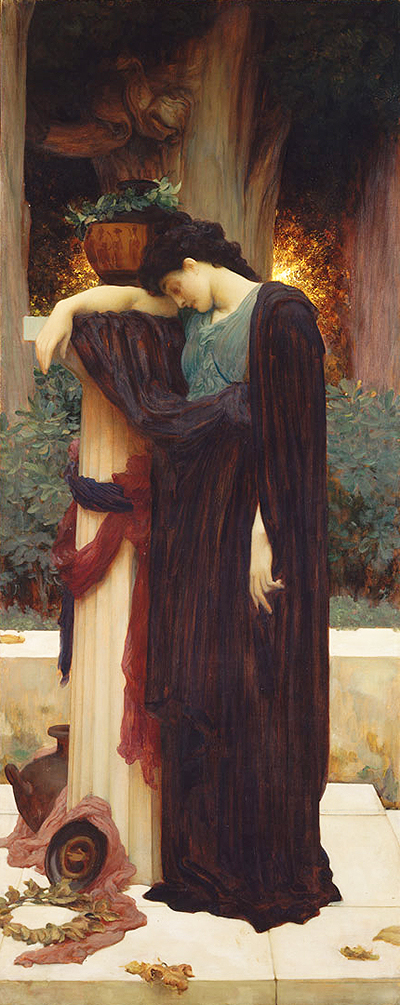
| Lachrymae | 1894–95 | Painting Catalogue. |
| Lieder ohne Worte | Exhibited 1861 | Painting Catalogue. |
| Light of the Harem | Exhibited 1880 | Painting Catalogue. |
| Moses Views the Promised Land (Tate A00736) | published 1881 | Print Catalogue. |
| Mrs James Guthrie | 1865 | Painting Catalogue. |
| Mrs John Hanson Walker (Tate N04731) | 1867 | Painting Catalogue. |
| Music Lesson | 1877 | Painting Catalogue. |
| Needless Alarms (Met cast) | modelled 1886; cast nineteenth century | Sculpture Catalogue. |
| Needless Alarms (Tate N05120) | 1886 | Sculpture Catalogue. |
| Pavonia | c. 1859 | Painting Catalogue. |
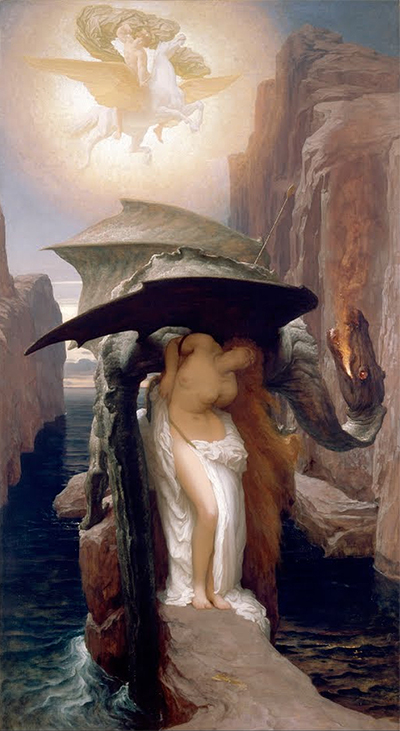
| Perseus and Andromeda | 1891 | Painting Catalogue. |
| Portrait of May Sartoris | c. 1860 | Painting Catalogue. |
| Preparing for a Festa, Florence (Tate T09062) | date not known | Drawing Catalogue. |
| Puerta de los Vientos, near Ronda, Spain (Tate N04006) | c.1886–9 | Painting Catalogue. |
| Samson and the Lions (Tate A00732) | published 1881 | Print Catalogue. |
| Samson at the Mill (Tate A00734) | published 1881 | Print Catalogue. |
| Samson Carrying the Gate (Tate A00738) | published 1881 | Print Catalogue. |
| Sketch for ‘An Athlete Wrestling with a Python’ (Tate N01761) | c.1877 | Sculpture Catalogue. |
| Sketches for Cimon and Iphigenia (Tate T09060) | date not known | Drawing Catalogue. |
| Study for The Return of Persephone (Demeter) | c. 1890–91 | Drawing Catalogue. |
| Study for The Return of Persephone (Persephone) | c. 1890–91 | Drawing Catalogue. |
| Study for ‘Needless Alarms’ (Tate N02945) | 1886 | Sculpture Catalogue. |
| Study for ‘The Discovery of Juliet Apparently Lifeless’ (Tate N01806) | c.1858 | Painting Catalogue. |
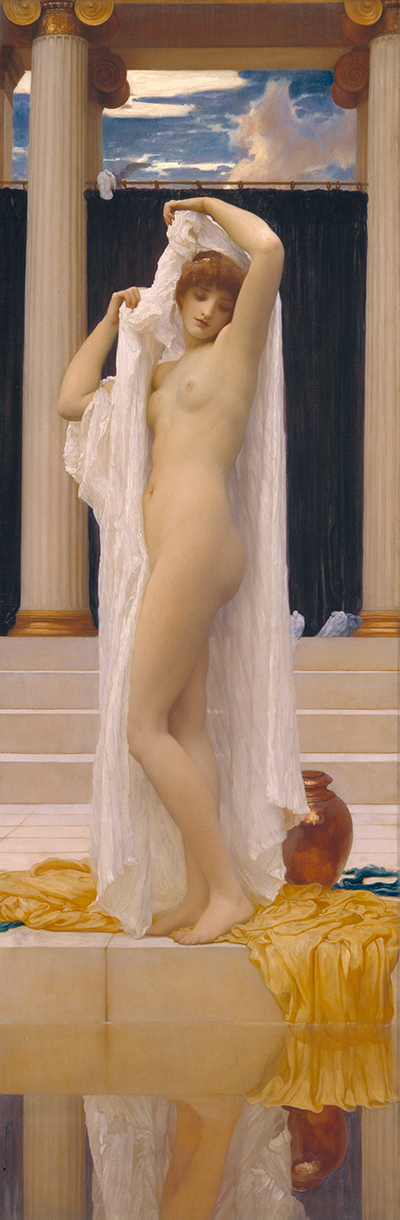
| The Bath of Psyche | Exhibited 1890 | Painting Catalogue. |
| The Daphnephoria | 1874–76 | Painting Catalogue. |
| The Death of Brunelleschi | 1852 | Painting Catalogue. |
| The Fisherman and the Siren | Exhibited 1858 | Painting Catalogue. |
| The Painter's Honeymoon | c. 1864 | Painting Catalogue. |
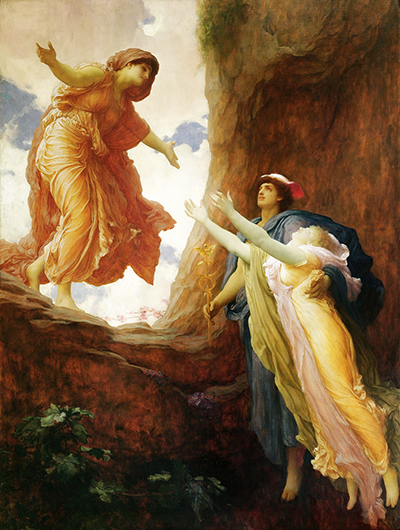
| The Return of Persephone | 1891 | Painting Leeds painting identified in the Met study record. |
| The Return of Persephone (preparatory oil) | c. 1890–91 | Painting Catalogue. |
| The Sluggard (Anglesey Abbey cast) | probably 1890–about 1906 | Sculpture Catalogue. |
| The Sluggard (Met cast) | modelled 1886; cast possibly before 1896 | Sculpture Catalogue. |
| The Sluggard (Museum Wales) | 1882–85 (museum date) | Sculpture Catalogue. |
| The Sluggard (Tate N01752) | 1885 | Sculpture Catalogue. |
| The Spies Escape (Tate A00730) | published 1881 | Print Catalogue. |
| Various Subjects (Tate T09063) | date not known | Drawing Catalogue. |
| View in Capri | Possibly 1859 | Painting Catalogue. |
| Wedded | 1882 | Painting Catalogue. |
| Winding the Skein | c. 1878 | Painting Catalogue. |
Discussion
Look again at the images and ideas explored in Wedded. These editorial prompts invite your observations.
Reader Insights
How does the stone arch and its framed sky make you look at the couple?
Which details shift most between the colour sketch and the finished painting?
Join the Conversation
Share a detail, comparison or question about Wedded below.
References
- Art Gallery of New South Wales, Wedded, 1882, collection record presented on Google Arts & Culture. View source.
- Parco archeologico di Naxos e Taormina, Teatro antico di Taormina, the theatre’s Greek and Roman building phases. View source.
- Pola Durajska, Nature, Science, and Myth in the Landscape Art of Frederic Leighton, University of York, 2021, vol. I, Taormina discussion, and vol. II, catalogue nos. 109–110. View source.
- Art Gallery of New South Wales, John MacWhirter, Mount Etna from the Greek Theatre, Taormina, Sicily, 1890, collection record presented on Google Arts & Culture. View source.
- Museo de Arte de Ponce, Frederick Leighton y el mediterráneo eterno, exhibition overview. View source.
- Leighton House, Colour Sketch for ‘Wedded’, c. 1882, LH0369, collection image supplied to Art UK and reproduced on Wikimedia Commons. View source.
- British Museum, Catalogue of Drawings by British Artists and Artists of Foreign Origin Working in Great Britain, vol. III, Leighton no. 15, Studies for ‘Wedded’. View source.
- Heritage Auctions, Study of a hand for ‘Wedded’, c. 1882, 9 June 2023, lot 69080. View source.
- Henry Blackburn, ed., Academy Notes, 1882, first gallery and no. 71. View source.
- The Spectator, Royal Academy review, 20 May 1882, remarks on no. 71. View source.
- Emilie Barrington, The Life, Letters and Work of Frederic Leighton, vol. II, 1906, introduction, note 6. View source.
- Hugh Hudson, “A Jewish Philanthropist in Colonial Australia,” Australian Jewish Historical Society Journal, vol. 20, part 3, 2011, entries 60 and 110. View source.
- Henry Blackburn, The Art of Illustration, 2nd ed., 1896, pp. 7–8, the Goupil photogravure. View source.
- Alexander Turnbull Library, Interior of William and Lydia William’s house in Napier, with framed pictures, c. 1887, reference 1/1-025655-G. View source.
- Francesco Parisi, “Una confraternita preraffaellita in Italia,” in Preraffaelliti. Rinascimento moderno, Museo Civico San Domenico, 2024, note 10. View source.
- Alba Irollo, “Ambitions esthétiques et goût bourgeois dans le cercle de Alma-Tadema et de Leighton,” Musée Rodin conference abstract, 2013, Amendola’s silvered bronze. View source.
- Christie’s, Giovanni Battista Amendola, Wedded, painted plaster, 1885, object record and inscription. View source.
- Sofia Vitkovskaya, Krugom zemli: Putevye vospominaniia, 1915, Sydney account reprinted in I. N. Vasilieva-Yuzhina, ed., Avstraliia v russkom vospriiatii, 1807–2007, 2007, p. 124. View source.
- Elena Govor, “Iz avstraliiskikh vpechatlenii Sofii Vitkovskoi,” on Vitkovskaya’s 1896 Sydney visit. View source.
- Paula Dredge and Alan Lloyd, “The Sub-Committee and the Restorer,” in Paintings Conservation in Australia from the Nineteenth Century to the Present, AICCM, 2008, pp. 27–28 and 36–37, figures 3–4. View source.