 by Tom Gurney
Tom Gurney BSc (Hons) is an art history expert with over 20 years experience
Published on June 19, 2020 / Updated on November 29, 2026
Email: tomgurney1@gmail.com / Phone: +44 7429 011000
Flaming June: Introduction
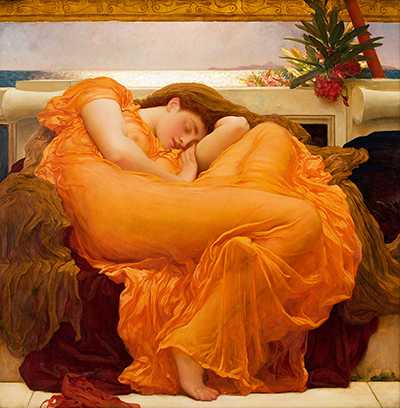
In Frederic Leighton’s Flaming June, a sleeping woman folds herself into the shallow space between the edge of a bench and a glittering sea. Her orange dress gathers the light around her even though an awning hangs overhead. Leighton painted this nearly four-foot-square canvas in 1895, in oils, during the last year of his working life. It belongs to the Museo de Arte de Ponce in Puerto Rico, where it is recorded as accession 63.0406 and measures 119.1 by 119.1 centimetres. [1]
At a Glance
- Painted1895
- ExhibitedRoyal Academy, 1895, no. 195
- MediumOil on canvas
- CollectionMuseo de Arte de Ponce, 63.0406
This work across Frederic Leighton’s career
Contents
- A circle inside a square
- Drawings before colour
- The art of looking at sleep
- The Royal Academy in 1895
- From London to Ponce
- Annotated details
A circle inside a square
Start at the woman’s face. Her head has sunk into the crook of one arm, and what little we see of her cheek glows pink. Follow the bent arm towards the raised knee and then the long slope of the nearer thigh. The foot brings the eye down almost to the base of the painting. The orange fabric gathers there and curves back beneath her, making it easy to return to the face. The eye can keep following that circuit even while the woman remains asleep. Alison Hokanson, writing for the Metropolitan Museum of Art, draws attention to the interplay between this spiral and the edges of the bench, which repeat the straight sides of the canvas. The pose feels at once tightly contained and restless. [2]
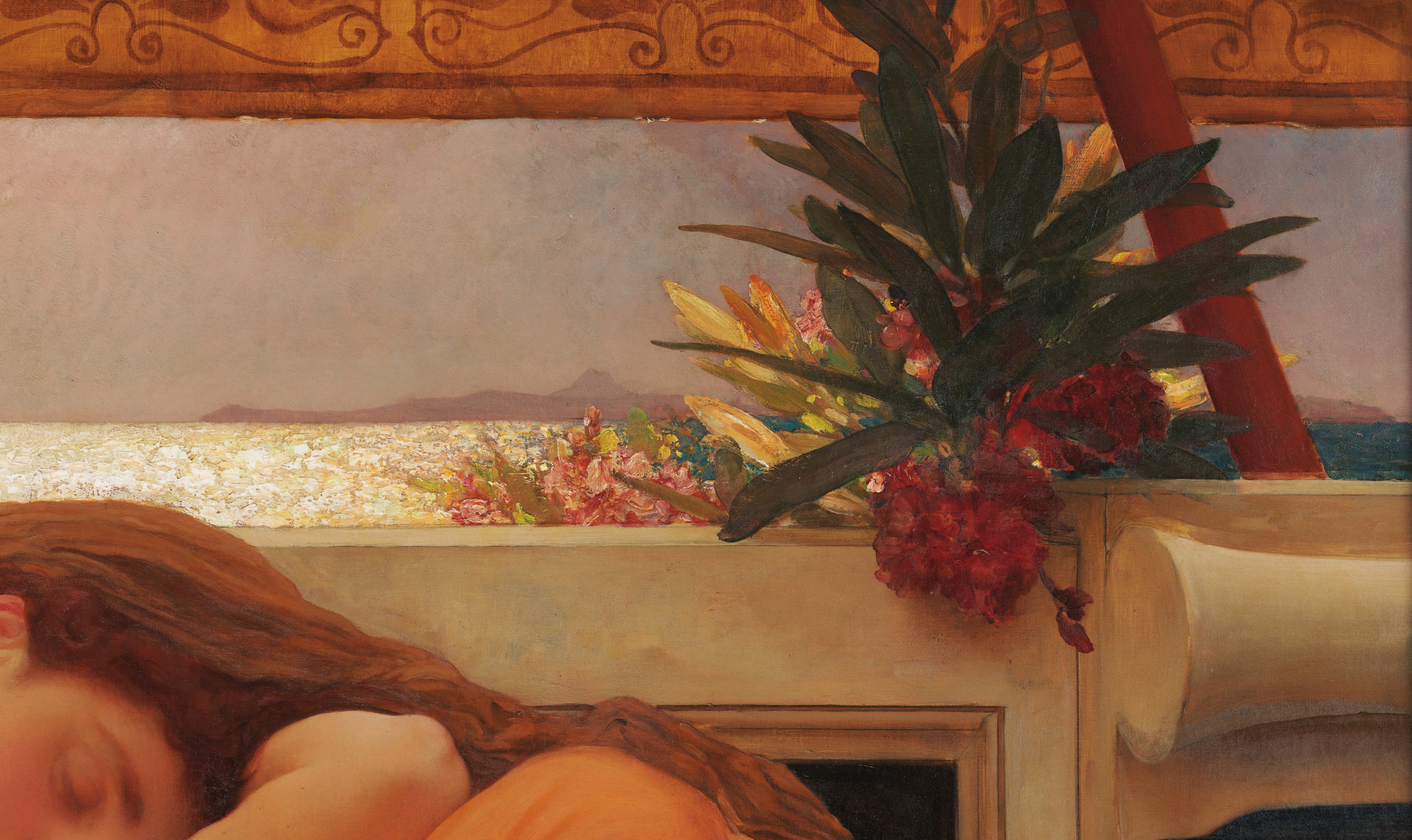
The dress is a translucent red-orange, with stronger bands of colour where the folds bunch together. The deeper crimson and olive fabrics spread on the bench help give the orange its intensity. Susan Grace Galassi and the Frick’s exhibition team describe the painted dress as chiffon and point out the contrast in handling across the canvas. On the face and through parts of the garment, the marks are so finely blended that a change in colour can suggest both the fold and the skin underneath it. On the water, thicker touches of paint catch the light. The glitter seen at a distance is made out of more conspicuous brushmarks than the much closer figure. Ernest Rhys, who wrote about the work within a few years of its exhibition, singled out the broad treatment of the sea as unusual for Leighton. [3] [4]
The bench, ledge and awning hold the image together horizontally. The corners have very different weights. There is relatively open water at the upper left, a small rush of pink flowers at the upper right, dark fabric to one side of the figure and cascading orange below. The narrow strip of sea makes the air beyond the ledge feel open, and the flushed face and saturated dress bring the sense of heat into the shaded foreground. The figure takes up most of the canvas, but the painting needs that little distance behind her. [1] [2] [3]
Annotated Details from Flaming June
The numbered points identify visible features discussed in this article. Return from each detail to the numbered overview. Frederic Leighton, Flaming June, exhibited 1895. Museo de Arte de Ponce. Image source. Public domain. Resized without changing the composition.
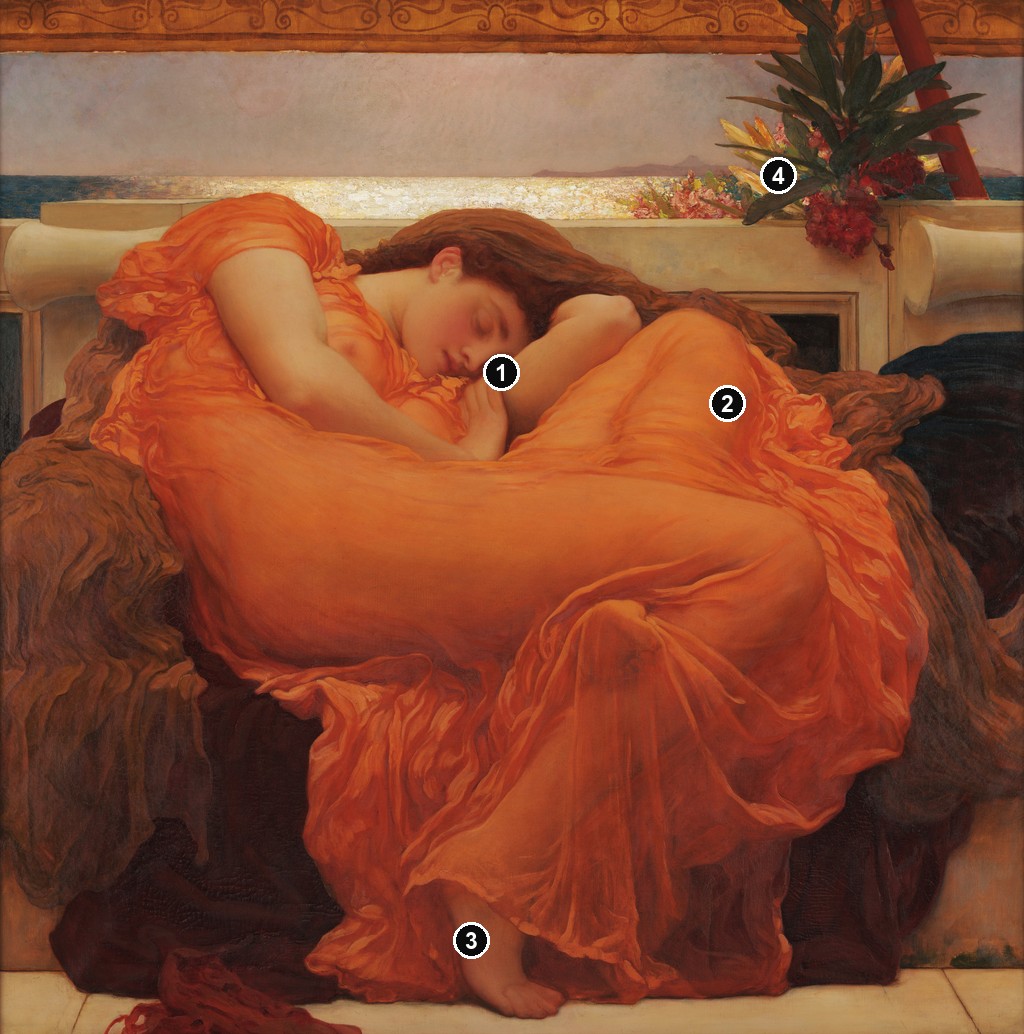
Details from FLAMING JUNE
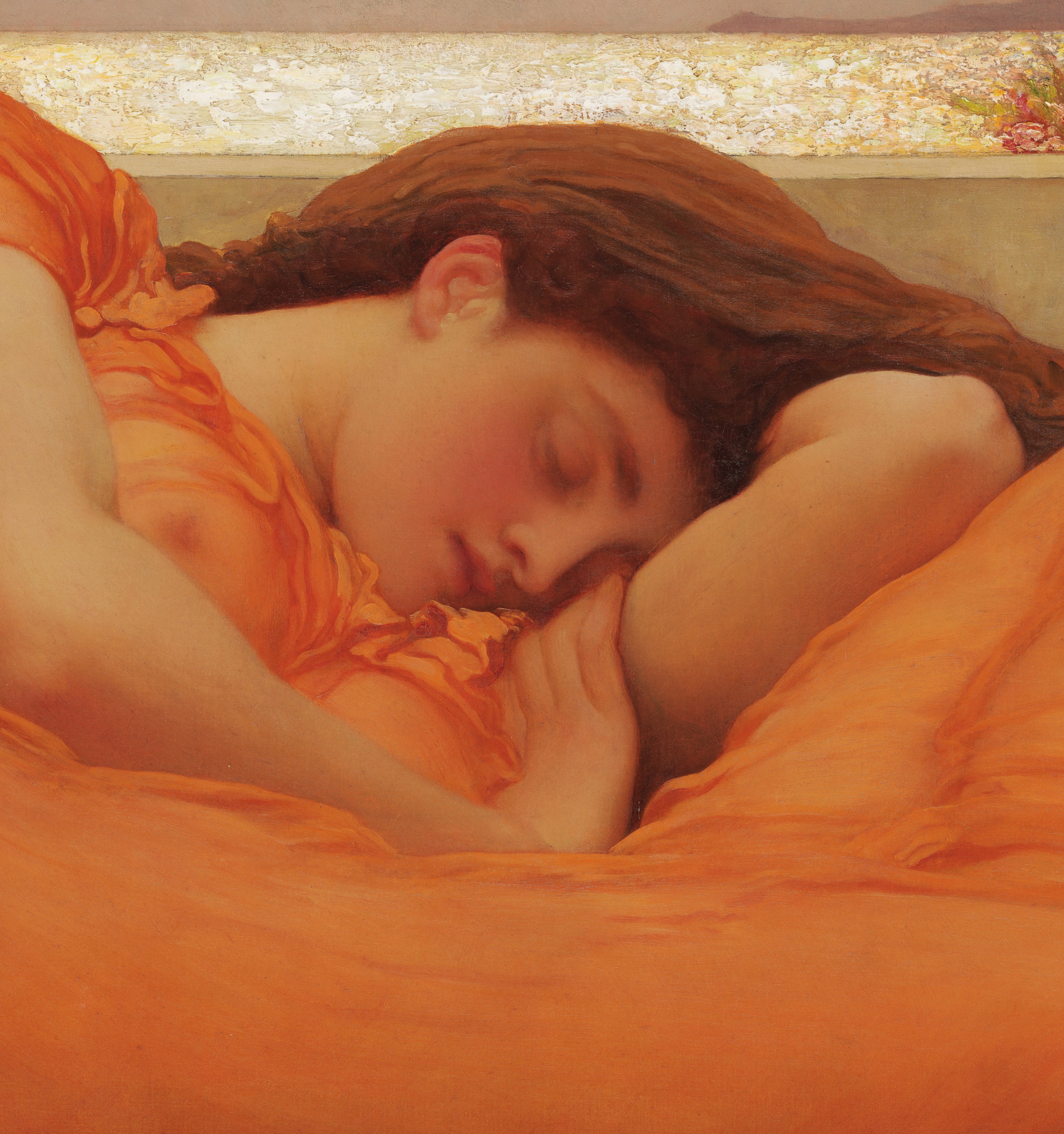
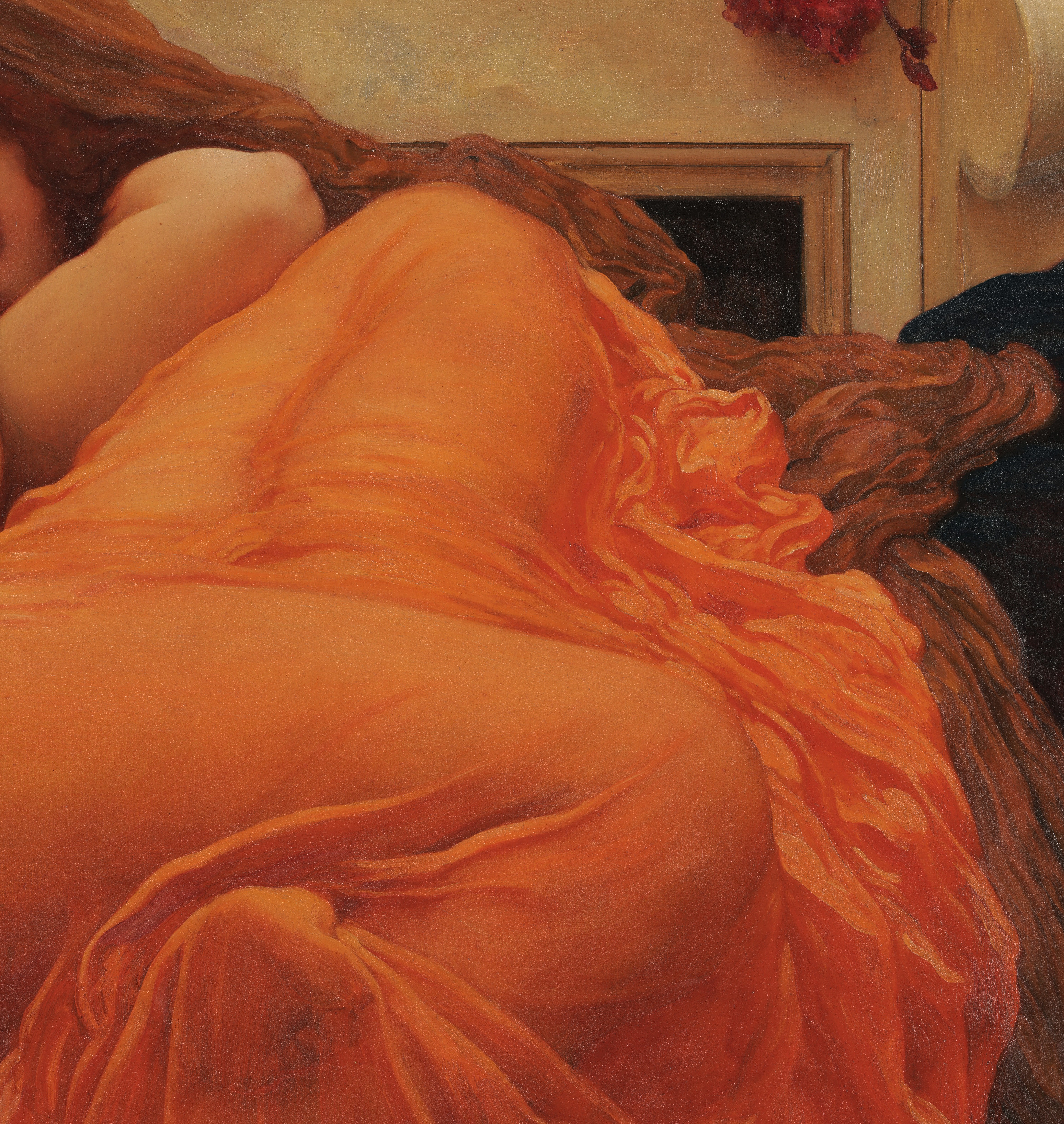
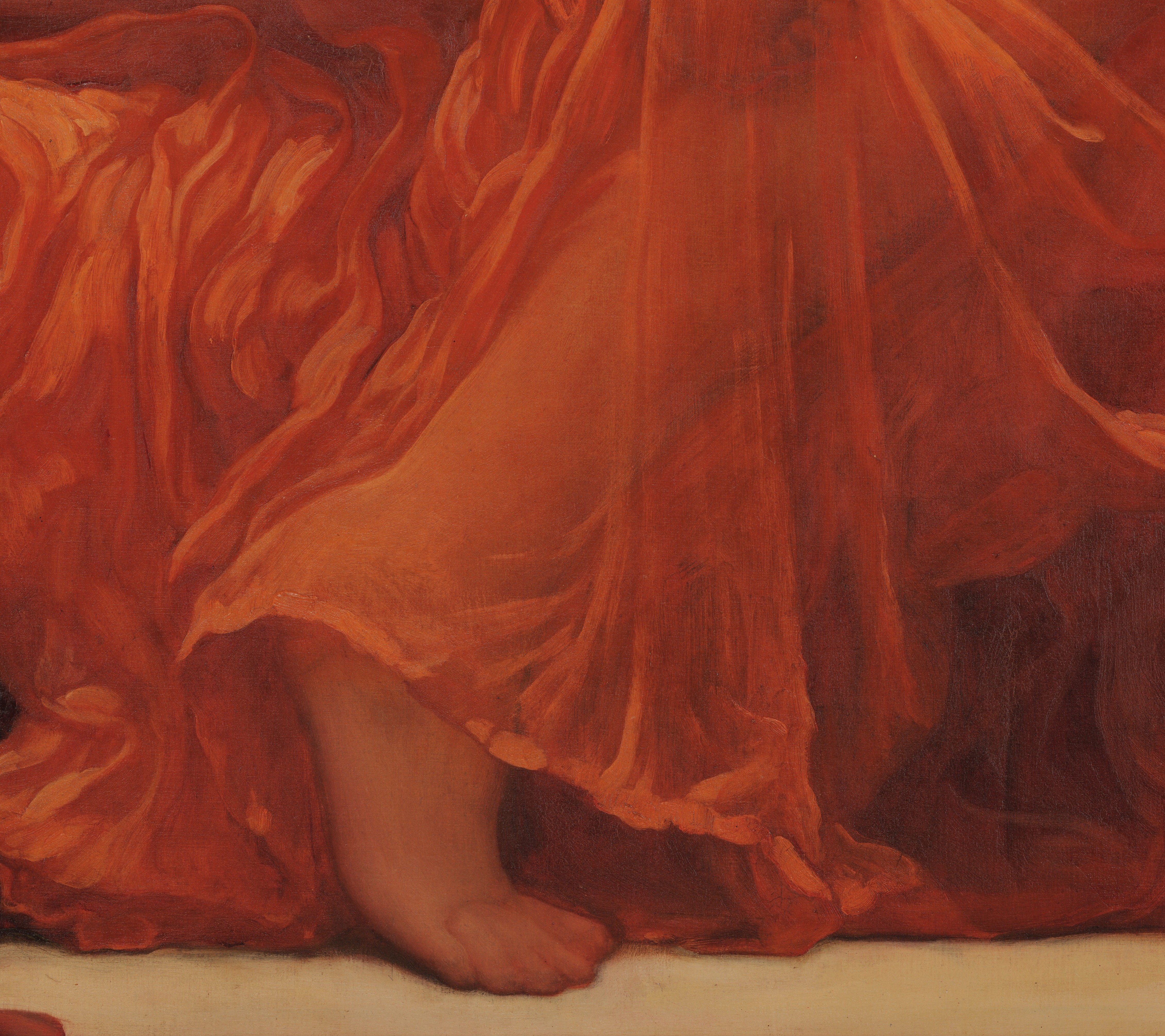
Compare the cropped details with the source images above. Notice how their colours, shapes and positions contribute to the larger compositions.
A face sheltered by an arm
The sleeping face presses into the narrow angle formed by the two arms. Loose hair broadens that dark enclosure without breaking the curl of the pose.
Orange cloth across the bent knee
The orange passes from sharp lines in the lifted folds into a broad quieter field. Layers of cloth remain distinct along the turn of the knee.
The hem and the foot
The narrow bright hem hangs in front of the shin. A bare foot against the floor brings the floating curves of the dress down to the lowest edge.
The flowers and the bright water
Leaves cross the pale boundary of the terrace. Behind them, short highlights carry the thin band of water across the top of the painting.
Drawings before colour
Leighton said that the composition began with a tired model’s chance posture. Leighton House has also identified a remarkably similar curl in a relief motif on the marble plinth of his Summer Slumber of 1894. The two accounts make room for different moments in the painting’s formation. A pose could catch the painter’s attention in the studio and offer a way to develop a shape he had already explored. On a sheet of three chalk studies catalogued by Christie’s, he tests small changes in the position of the legs. Hokanson notes how far Leighton lengthened the nearer thigh in the finished work to sustain the curve. The pose feels convincing because the pressure of the head, folds and foot are so carefully described. [2] [5] [6]
At least ten drawings survive, five of them at Leighton House. The Museo de Arte de Ponce owns a separate, 14.3-centimetre-square study in chalk and charcoal on paper. The Royal Academy’s Squared-up tracing for Flaming June records another stage of design. A grid makes it possible to keep the position of an elbow or a bend in the silhouette in proportion when transferring a design to a larger surface. The drawings let Leighton settle the problem of fitting the woman into a square before he committed to the colour that makes the final painting so immediately recognisable. [3] [5] [7] [8]
Leighton House dates the small oil Colour Sketch for Flaming June to about 1895. It is just eleven centimetres square. The Frick exhibited it alongside the finished picture in 2015, when the sketch was still in private hands. The British government accepted it from Sir David Verey under the Cultural Gifts Scheme and allocated it to Leighton House in 2023. The study already has the vivid orange figure and thick, bright strokes on the sea. A small island interrupts the horizon and the edge of the awning dips in scallops. In the final picture the island has gone and the canopy edge runs straight. The changes give the eye fewer little contours to follow outside the swirls of the dress. [3] [5]
Dorothy Dene and Mary Lloyd, both of whom worked with Leighton, are possible models. The Ponce exhibition text associates the figure with Dene, and the Christie’s catalogue sees a possible likeness in the sheet of three poses. Leighton House and the Met keep the identification open. That caution matters because a face in a study, a model recalled by an artist and the finished figure are three different kinds of evidence. The Met allows that both women may have posed during the work’s development. [2] [5] [6] [9]
Films about Flaming June
Leighton House follows the painting’s history and looks closely at the small colour sketch.
Flaming June The Making of an Icon
How the painting became familiar to viewers far beyond its first Royal Academy exhibition.
Watch on YouTube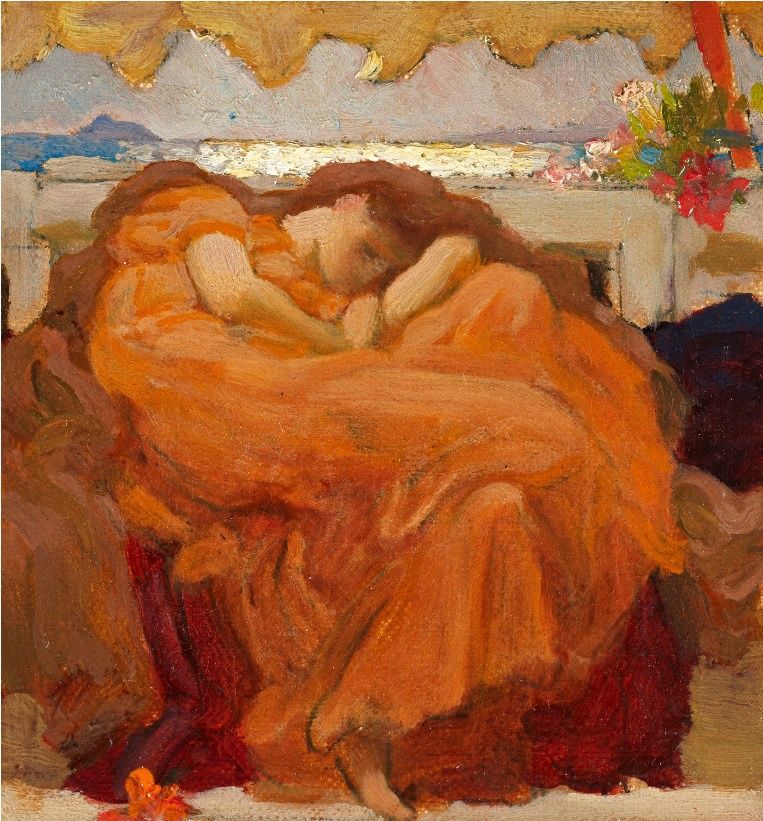
Frederic Leighton, Colour Sketch for Flaming June, about 1895. Leighton House. Image source. Public domain. Resized proportionally.
The art of looking at sleep
The Frick and the Met recall Michelangelo’s Night when discussing the sleeper. On the tomb of Giuliano de’ Medici in Florence’s New Sacristy, the marble figure’s lowered head and raised knee pull the body into an elaborate bend. On the tomb she has a named role, as part of an ensemble marking the passage of time. Leighton gives his painted sleeper a comparable concentration of folded limbs, viewed from the side as if she were a relief. Around her he sets warm fabric, a hot sky and a spray of oleander. The comparison gives a sense of how a sculptural pose could survive in a very different atmosphere, and how much of the painting’s mood belongs to its colour. The Frick also sees a resemblance to the folded legs in Michelangelo’s design for Leda and the Swan. [2] [3] [10]
For the Musée d’Orsay, Leighton’s circle in Holland Park helped shape a Victorian Aestheticism in which harmonies of colour could carry as much interest as a subject. Flaming June gives the eye so much to follow that its simple subject can hold attention without an episode from myth or history. The Museo de Arte de Ponce has asked whether the woman might evoke the month of June or the sun itself. Its exhibition Frederic Leighton and the Eternal Mediterranean set this imagined shore alongside the small landscapes Leighton made on his travels. The art historian Pola Durajska connects one of those oils, Bay Scene, to the shimmer of the finished canvas, reading the heat as a way to understand the sleeper’s languor. A landscape study could furnish a particular effect of sunlight for a painting whose terrace has no certain geographical address. [2] [9] [11] [12]
The oleander brings a different association to the scene. The flower suits the season and lends the wall a note of crimson, but its toxicity led Ponce curator Pablo Pérez d’Ors to consider how its beauty might carry a suggestion of danger. Keren Hammerschlag has explored the proximity of sleep and death in Leighton’s pictures of women, including Cymon and Iphigenia and The Garden of the Hesperides. Those readings make room for an uneasiness the pose already contains. The woman’s limbs grip the space around her while her eyes remain closed, and the cloth clings so closely that her shape appears to pass into the folds. [2] [3] [13]
The Royal Academy in 1895
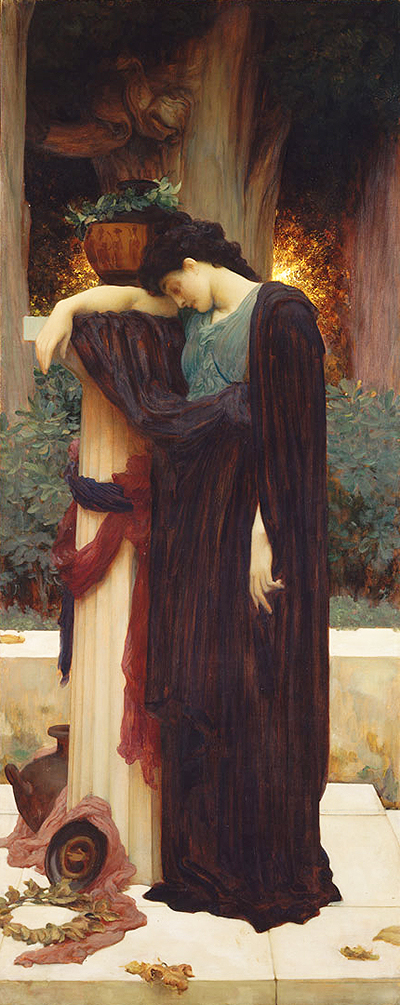
The painting was shown in Leighton’s Kensington studio on Show Sunday, 7 April 1895. It then appeared as number 195 at the Royal Academy, where he was president. The exhibition catalogue records six of his works. Alongside Flaming June were Lachrymae, ’Twixt Hope and Fear, The Maid with the Golden Hair, Listener and a work listed simply as A Study. Rhys later described the last as a study of an auburn-haired girl’s head. Leighton was too ill to attend the exhibition opening and died the following January. [3] [4] [5] [14]
As the art historian Elizabeth Prettejohn observes, the critics of 1895 noticed the range of orange tones, but the standing mourner and Doric column of Lachrymae commanded particular respect. The catalogue places both works in Gallery III. Imagine moving from the upright mourner, in dark drapery beside an upright stone, to the woman who has folded into a bright circle. Each depends on a single figure to hold the canvas, yet the association of the pose with its surroundings takes the viewer in a different direction. [14] [15]
William Luson Thomas, owner of The Graphic, bought Flaming June, and the paper issued a colour reproduction for Christmas 1896. The painting subsequently passed into private ownership, was lent to Oxford’s Ashmolean Museum in 1915 and appeared again at Leighton House for the centenary of the artist’s birth in 1930. The reproduction and the loans gave it a life beyond the Academy. The surviving photograph of Leighton’s studio also preserves the appearance of its original architectural frame, with tall supports and a decorated top enclosing this shallow painted terrace. [4] [5] [16]
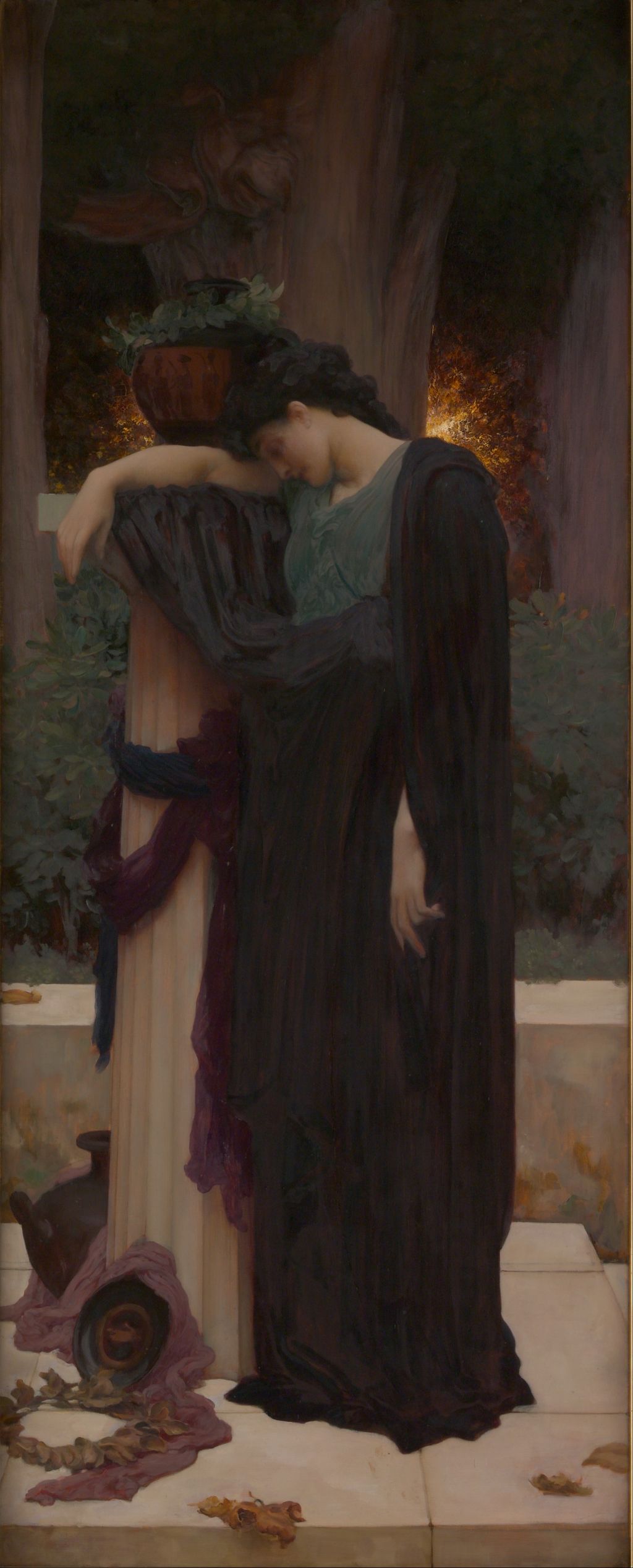
Frederic Leighton, Lachrymae, 1894–95. The Metropolitan Museum of Art, Catharine Lorillard Wolfe Collection, Wolfe Fund, 1896. Image source. CC0 / Public domain. Resized without changing the composition.
From London to Ponce
The painting’s whereabouts between 1930 and its reappearance on the London market in 1962 are uncertain. By the time it returned to the market, the original frame had been separated from it. In 1963 Luis A. Ferré bought the painting from the dealer Jeremy Maas for £2,000. Ferré’s purchase made the painting part of Puerto Rico’s museum history at a time when many British and American curators had turned their attention away from late Victorian academic art. [2] [5]
The gilded tabernacle frame seen in modern exhibition photographs was made in 1996 by Arnold Wiggins & Sons. Its makers used archive material and casts taken from surviving frames associated with Leighton to recover the architectural character of the original. The fluted pilasters and patterned frieze make sense of the painted ledge and awning as parts of a space that the frame opens onto. Its gold also changes the way the orange reads, giving the warmest tones in the picture another colour to play against. [2] [16]
As the Frick’s Spanish-language exhibition account relates, Ferré and the museum’s first director, René Taylor, were building a collection in which Victorian painting would have a substantial place. Ponce’s loans have put Flaming June in company with very different pictures. In 2009 the Gemeentemuseum in The Hague, now Kunstmuseum Den Haag, exhibited it with Edward Burne-Jones’s paintings of sleeping figures. In 2015 the Frick set it among Whistler’s portraits, where visitors could compare the distinct ways two painters made colour and the fall of a garment carry a picture. [3] [17] [18]
The painting’s afterlife has extended beyond museums. Vogue drew on the orange dress and the folded pose for its 2013 cover shoot with Jessica Chastain. In 2026 the Puerto Rican dance company Andanza included Flaming June in Obra Viva, a collaboration with the museum. Natalia Fajardo choreographed and performed the piece, with music by Luis Amed Irizarry. A figure whose stillness once reached readers as a colour print became the starting point for a work in movement. [19] [20]
Browse Frederic Leighton’s artworks
Explore paintings, drawings, sculptures and prints, with separate rows for identified preparatory works, reproductions and casts.
| Name | Date | Medium |
|---|---|---|
| A Girl Feeding Peacocks | Exhibited 1863 | Painting Catalogue. |
| A Recognition from ‘Romola’, engraved by Swain (Tate N04054) | published 1862 | Print Catalogue. |
| A Roman Lady | 1859 | Painting Catalogue. |
| Abram and the Angel (Tate A00733) | published 1881 | Print Catalogue. |
| Acme and Septimius | Exhibited 1868 | Painting Catalogue. |
| An Athlete Wrestling with a Python (Tate exhibition bronze) | 1877 | Sculpture Catalogue. |
| And the Sea Gave Up the Dead Which Were in It (Tate N01511) | 1891–92 | Painting Catalogue. |
| Andromache in Captivity (photogravure after Leighton) | 1889 | Print Catalogue. |
| Athlete Wrestling with a Python (Anglesey Abbey cast) | model 1877; cast 1905 | Sculpture Catalogue. |
| Athlete Wrestling with a Python (Hood reduced cast) | 1877 (inscribed model date) | Sculpture Catalogue. |
| Athlete Wrestling with a Python (Saint Louis reduced cast) | 1877 (museum date) | Sculpture Catalogue. |
| Cain and Abel (Tate A00731) | published 1881 | Print Catalogue. |
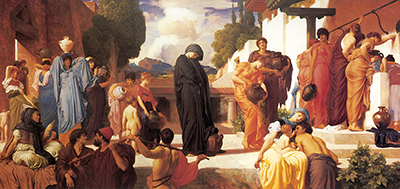
| Captive Andromache | 1888 | Painting Catalogue. |
| Cimabue's Celebrated Madonna | 1853–55 | Painting Catalogue. |
| Cimon and Iphigenia, with Many Smaller Subjects (Tate T09061) | date not known | Drawing Catalogue. |
| Crenaia, the Nymph of the Dargle | Exhibited 1880 | Painting Catalogue. |
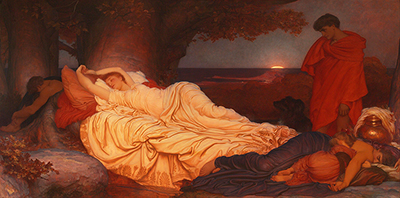
| Cymon and Iphigenia | 1884 | Painting Catalogue. |
| Daedalus and Icarus | 1869 | Painting Catalogue. |
| Dante in Exile | 1864 | Painting Catalogue. |
| Death of the First Born (Tate A00737) | published 1881 | Print Catalogue. |
| Electra at the Tomb of Agamemnon | c. 1869 | Painting Catalogue. |
| Eliezer and Rebekah (Tate A00735) | published 1881 | Print Catalogue. |
| Elijah in the Wilderness | 1877–78 | Painting Catalogue. |
| Fanny Kemble: A Study for ‘Jezebel and Ahab’ (Tate T08208) | c.1862 | Drawing Catalogue. |
| Figure Studies | Date not recorded | Drawing Catalogue. |
| Flaming June | 1895 | Painting Catalogue. |
| Gulnihal | Exhibited 1886 | Painting Catalogue. |
| Helios and Rhodes (Tate N03015) | date not known | Painting Catalogue. |
| Hercules Wrestling with Death for the Body of Alcestis | c. 1869–71 | Painting Catalogue. |
| Jonathan's Token to David | c. 1868 | Painting Catalogue. |
| Lachrymae | 1894–95 | Painting Catalogue. |
| Lieder ohne Worte | Exhibited 1861 | Painting Catalogue. |
| Light of the Harem | Exhibited 1880 | Painting Catalogue. |
| Moses Views the Promised Land (Tate A00736) | published 1881 | Print Catalogue. |
| Mrs James Guthrie | 1865 | Painting Catalogue. |
| Mrs John Hanson Walker (Tate N04731) | 1867 | Painting Catalogue. |
| Music Lesson | 1877 | Painting Catalogue. |
| Needless Alarms (Met cast) | modelled 1886; cast nineteenth century | Sculpture Catalogue. |
| Needless Alarms (Tate N05120) | 1886 | Sculpture Catalogue. |
| Pavonia | c. 1859 | Painting Catalogue. |
| Perseus and Andromeda | 1891 | Painting Catalogue. |
| Portrait of May Sartoris | c. 1860 | Painting Catalogue. |
| Preparing for a Festa, Florence (Tate T09062) | date not known | Drawing Catalogue. |
| Puerta de los Vientos, near Ronda, Spain (Tate N04006) | c.1886–9 | Painting Catalogue. |
| Samson and the Lions (Tate A00732) | published 1881 | Print Catalogue. |
| Samson at the Mill (Tate A00734) | published 1881 | Print Catalogue. |
| Samson Carrying the Gate (Tate A00738) | published 1881 | Print Catalogue. |
| Sketch for ‘An Athlete Wrestling with a Python’ (Tate N01761) | c.1877 | Sculpture Catalogue. |
| Sketches for Cimon and Iphigenia (Tate T09060) | date not known | Drawing Catalogue. |
| Study for The Return of Persephone (Demeter) | c. 1890–91 | Drawing Catalogue. |
| Study for The Return of Persephone (Persephone) | c. 1890–91 | Drawing Catalogue. |
| Study for ‘Needless Alarms’ (Tate N02945) | 1886 | Sculpture Catalogue. |
| Study for ‘The Discovery of Juliet Apparently Lifeless’ (Tate N01806) | c.1858 | Painting Catalogue. |
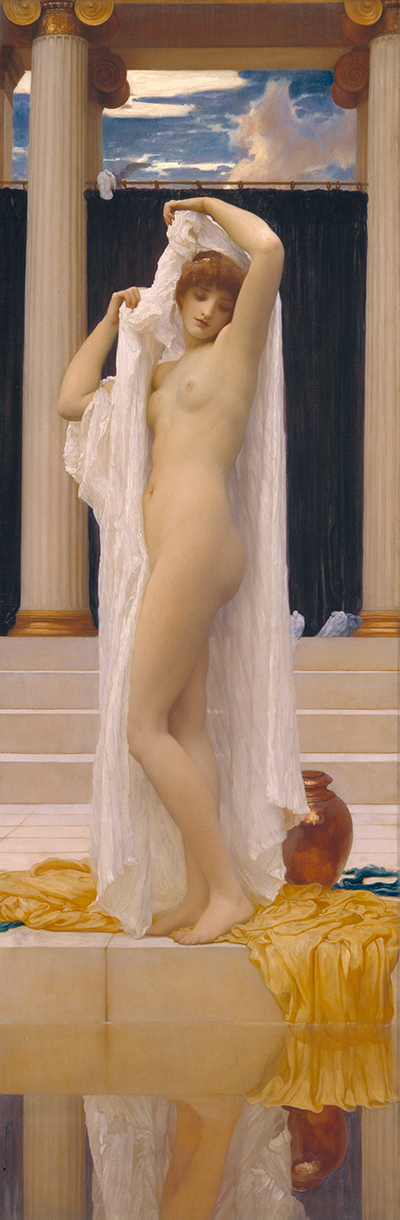
| The Bath of Psyche | Exhibited 1890 | Painting Catalogue. |
| The Daphnephoria | 1874–76 | Painting Catalogue. |
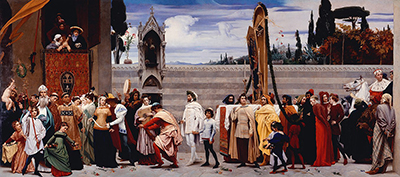
| The Death of Brunelleschi | 1852 | Painting Catalogue. |
| The Fisherman and the Siren | Exhibited 1858 | Painting Catalogue. |
| The Painter's Honeymoon | c. 1864 | Painting Catalogue. |
| The Return of Persephone | 1891 | Painting Leeds painting identified in the Met study record. |
| The Return of Persephone (preparatory oil) | c. 1890–91 | Painting Catalogue. |
| The Sluggard (Anglesey Abbey cast) | probably 1890–about 1906 | Sculpture Catalogue. |
| The Sluggard (Met cast) | modelled 1886; cast possibly before 1896 | Sculpture Catalogue. |
| The Sluggard (Museum Wales) | 1882–85 (museum date) | Sculpture Catalogue. |
| The Sluggard (Tate N01752) | 1885 | Sculpture Catalogue. |
| The Spies Escape (Tate A00730) | published 1881 | Print Catalogue. |
| Various Subjects (Tate T09063) | date not known | Drawing Catalogue. |
| View in Capri | Possibly 1859 | Painting Catalogue. |
| Wedded | 1882 | Painting Catalogue. |
| Winding the Skein | c. 1878 | Painting Catalogue. |
Discussion
Look again at the images and ideas explored in Flaming June. These editorial prompts invite your observations.
Reader Insights
Which fold most clearly shows how the sleeping body is curled?
What differences are easiest to see between the finished canvas and the small colour sketch?
Join the Conversation
Share a detail, comparison or question about Flaming June below.
References
- Museo de Arte de Ponce, Flaming June, accession 63.0406. View source.
- Alison Hokanson, The Metropolitan Museum of Art, The Fascination of Flaming June, 2023. View source.
- The Frick Collection, Leighton’s Iconic Painting Flaming June on View in New York City for the First Time in More Than Thirty-Five Years, exhibition release, revised 16 June 2015. View source.
- Ernest Rhys, Frederic Lord Leighton: An Illustrated Record of His Life and Work, chapter VI and Appendix I. View source.
- Leighton House, Frederic Leighton’s Flaming June: The Making of an Icon. View source.
- Christie’s, Three Studies for ‘Flaming June’, lot 6153993. View source.
- Museo de Arte de Ponce, Study for Flaming June. View source.
- Royal Academy of Arts, Squared-up Tracing for Flaming June. View source.
- Museo de Arte de Ponce, Frederick Leighton y el mediterráneo eterno. View source.
- Ministero della Cultura, Catalogo Generale dei Beni Culturali, Michelangelo, Notte. View source.
- Musée d’Orsay, Beauté, morale et volupté dans l’Angleterre d’Oscar Wilde, exhibition dossier, 2011–12. View source.
- Pola Durajska, Nature, Science, and Myth in the Landscape Art of Frederic Leighton, doctoral thesis, vol. I, University of York, p. 199. View source.
- Keren Hammerschlag, “The Deathly Sleep of Frederic Leighton’s Painted Women,” Women: A Cultural Review, 23(2), 2012, pp. 201–215. View source.
- Royal Academy of Arts, The Exhibition of the Royal Academy of Arts. The One Hundred and Twenty-Seventh, 1895, nos. 139, 159, 182, 195, 654 and 665. View source.
- Elizabeth Prettejohn, “1895: Frederic Leighton’s Last Academy,” Paul Mellon Centre for Studies in British Art, 2018. View source.
- Arnold Wiggins & Sons, Flaming June, account of the 1996 frame reconstruction. View source.
- The Frick Collection and Museo de Arte de Ponce, Flaming June (sol ardiente de junio), Spanish exhibition release, “Una obra maestra redescubierta.”. View source.
- Kunstmuseum Den Haag, De schone slaapster, exhibition archive, 2009. View source.
- Vogue, Where to Find the Eight Masterworks That Inspired Jessica Chastain’s Vogue Cover Shoot, 2013. View source.
- Andanza, Obra Viva, Flaming June entry under Collaborative Projects 2026. View source.