 by Tom Gurney
Tom Gurney BSc (Hons) is an art history expert with over 20 years experience
Published on June 19, 2020 / Updated on November 29, 2026
Email: tomgurney1@gmail.com / Phone: +44 7429 011000
Acme and Septimius: Introduction
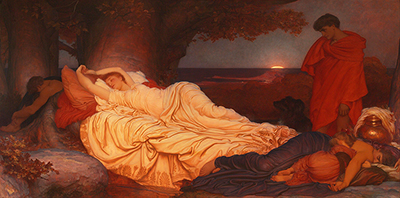
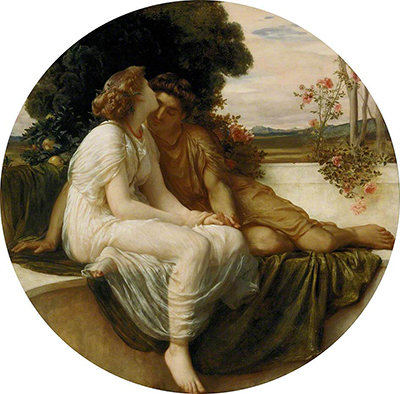
Acme turns her head towards Septimius, whose eyelids are lowered. Their faces almost merge in the shade of a tree. Below them, their hands meet over the white cloth across Acme’s lap. Frederic Leighton took the lovers from a poem by Catullus and exhibited the picture at the Royal Academy in 1868. The circular oil on canvas, 99 centimetres across, is in the Ashmolean Museum in Oxford. The picture keeps us close enough to see a fingertip resting on a knuckle, although beyond the lovers there is still room for a whole landscape. [1] [2] [3]
At a Glance
- ExhibitedRoyal Academy, 1868, no. 449
- SubjectCatullus, poem 45
- MediumOil on canvas
- CollectionAshmolean Museum, WA1978.7
This work across Frederic Leighton’s career
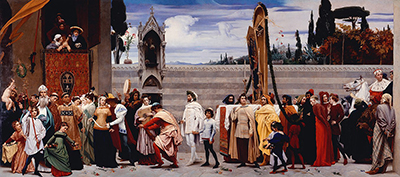
Cimabue’s Celebrated Madonna
1853–55Acme and Septimius (current article)
Exhibited 1868 [1]Lachrymae
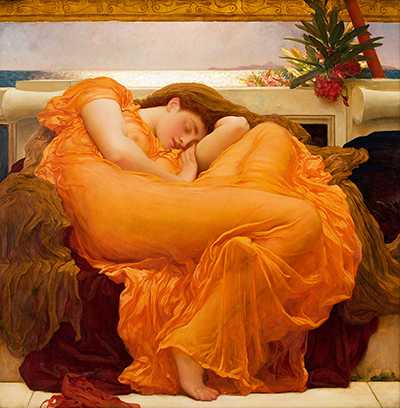
1894–95Flaming June
c. 1895Contents
- How the lovers fit inside the circle
- Catullus and the kiss in the catalogue
- What the Academy critics saw
- The painting after 1868
- Annotated details
How the lovers fit inside the circle
Acme sits across the bench with one leg folded under the other. Her bare foot drops to the lower rim. Septimius takes up the space behind her and to the right, with his knees bent and his feet close to the edge. One of his hands braces him on the seat to the left. Follow that arm towards the shoulder and you reach the two inclining heads, just where the dark leaves make it easiest to read their profiles. From there the line of his other arm carries the eye down to their hands. The composition uses almost the full diameter of the circle, yet the gestures keep redirecting attention to the small space the lovers share. [1] [2]
The different kinds of cloth help us work out how the figures are seated. Thin folds spiral round Acme’s upper arm. Lower down, the white fabric clings to the bent knee and falls in looser folds over the edge of the bench. Septimius wears a warmer garment that catches the light in bands along his shoulder and thigh. Beneath them, deep green cloth bunches under his legs and hangs in heavy folds. You can judge the weight of the figures by what they press down and what falls away. Against these folds the marble bench gives the eye a straight edge to follow. Beyond it, low hills and a strip of open sky counter the concentration of dark foliage immediately behind their heads. [1] [2]
The Ashmolean draws attention to the orange trees and to the rose as a traditional emblem of love. The flowers do compositional work too. Their pink and red run from the cluster beside Septimius’s shoulder to the open sky and down against the white stone. Over on the left, two oranges catch the light where the foliage meets the dark drapery. These smaller points of colour reward a slower look around the rim. Acme’s pale shoulder and the cloth on her lap still hold the centre of attention, while the garden seems to go on quietly around them. [1] [2]
The museum also relates the round shape and arrangement to Raphael’s Madonnas. Raphael’s Madonna della seggiola in Florence gives a sense of how a painter can fit an embrace within a circle. Mary’s inclination towards the child brings their faces close, while the bend of her arm holds the group together. In Leighton’s picture the bodies extend much farther apart and the hands join them across the lap. A Renaissance painting of a mother holding her child helps us see how the arrangement of shoulders, arms and heads can convey affection in a very different scene. [3] [4]
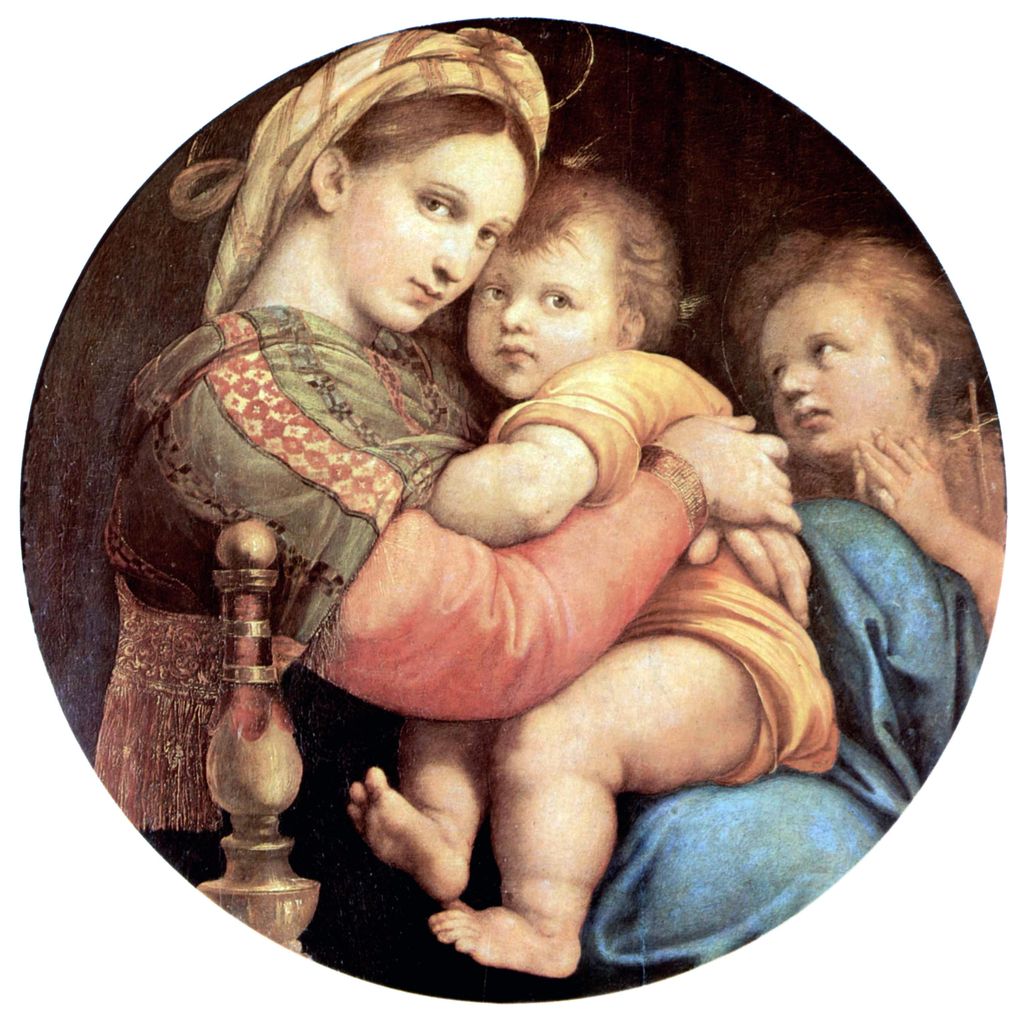
Raphael, Madonna della seggiola. Galleria Palatina, Palazzo Pitti, Florence. Image source. Public domain. Resized proportionally.
Annotated Details from Acme and Septimius
The numbered points identify visible features discussed in this article. Return from each detail to the numbered overview. Frederic Leighton, Acme and Septimius, exhibited in 1868. Ashmolean Museum. Image source. Public domain. Resized proportionally.
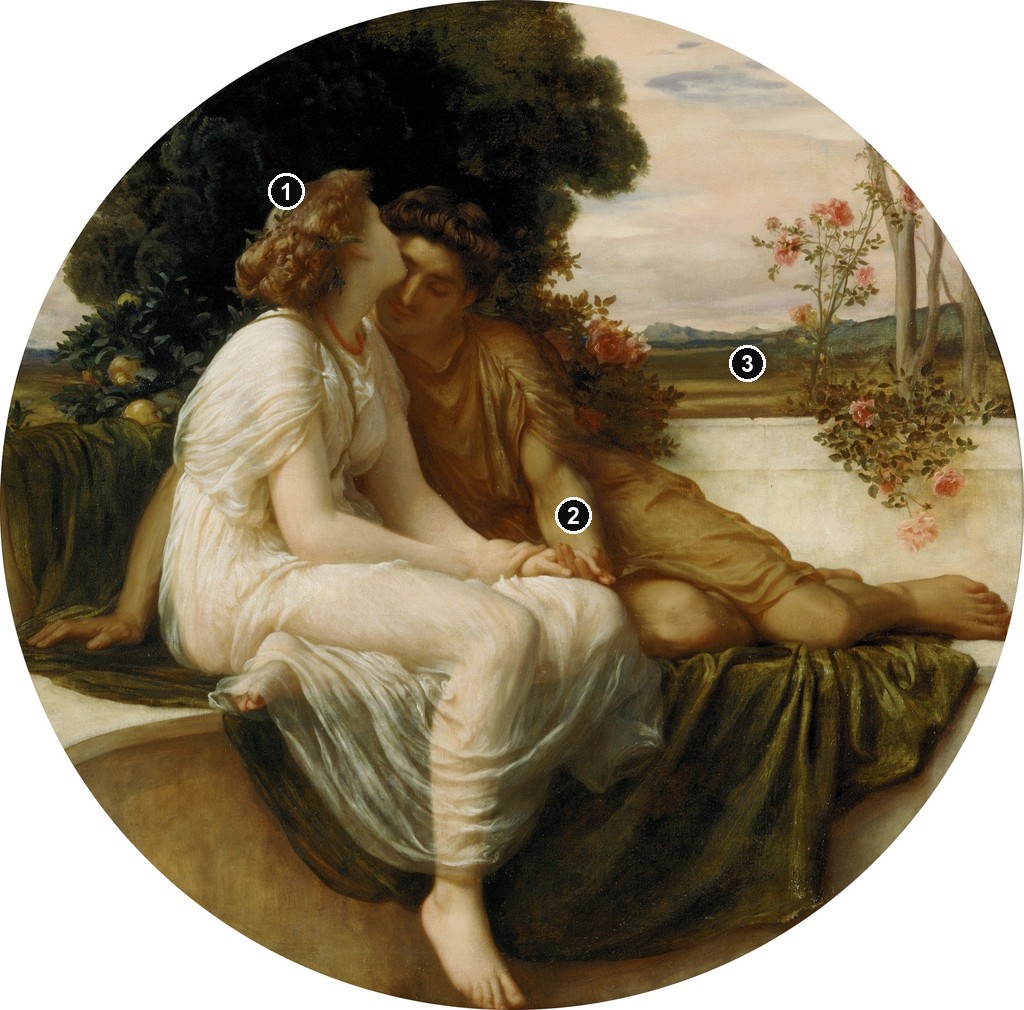
Details from ACME AND SEPTIMIUS
Compare the cropped details with the source images above. Notice how their colours, shapes and positions contribute to the larger compositions.
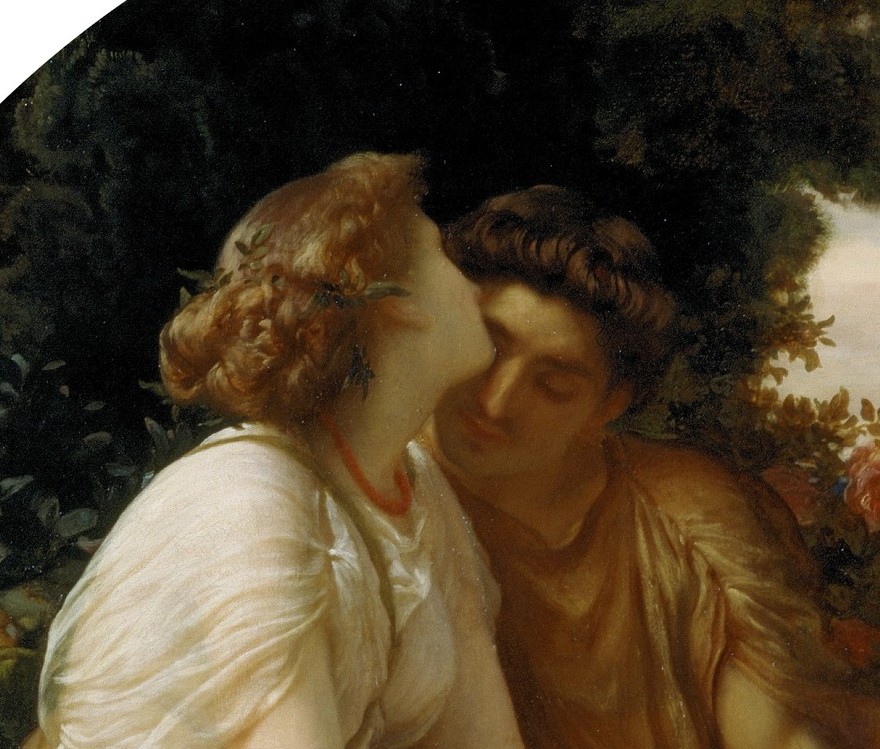
Two faces meet in shadow
The dark foliage behind the lovers gives the curve of Acme’s cheek and the tilt of Septimius’s head space to register.
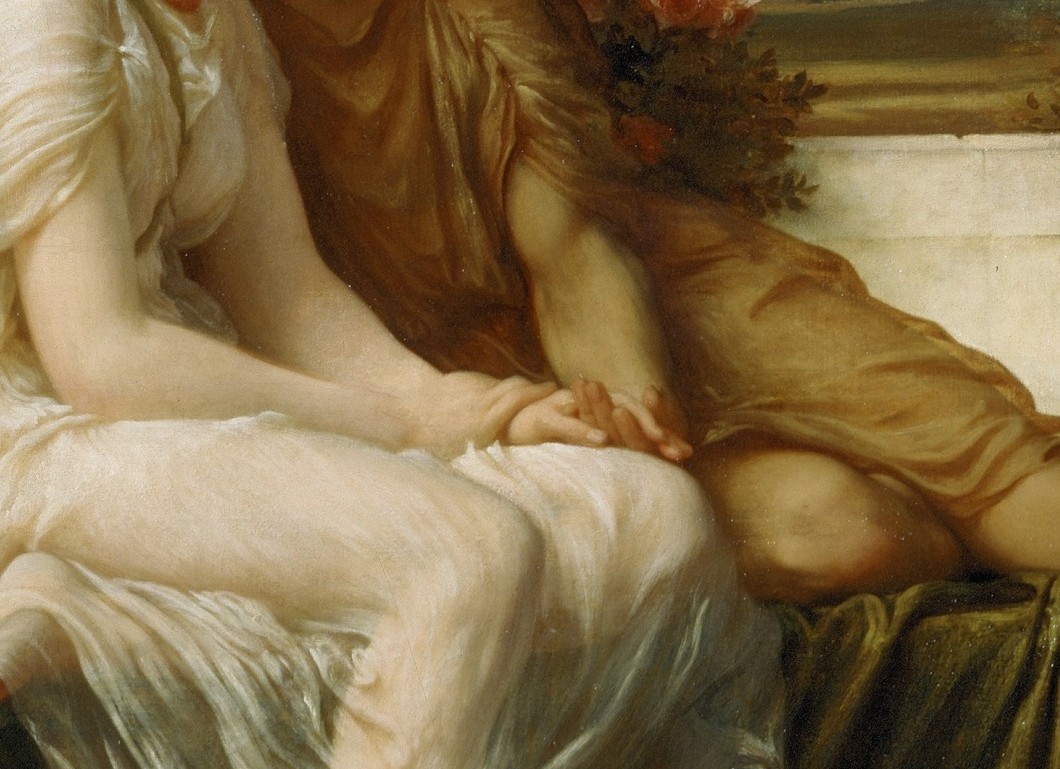
The touch above the white folds
Warm shadows pick out their fingers above the bright cloth. The arm leads down from the two faces to this second point of contact.
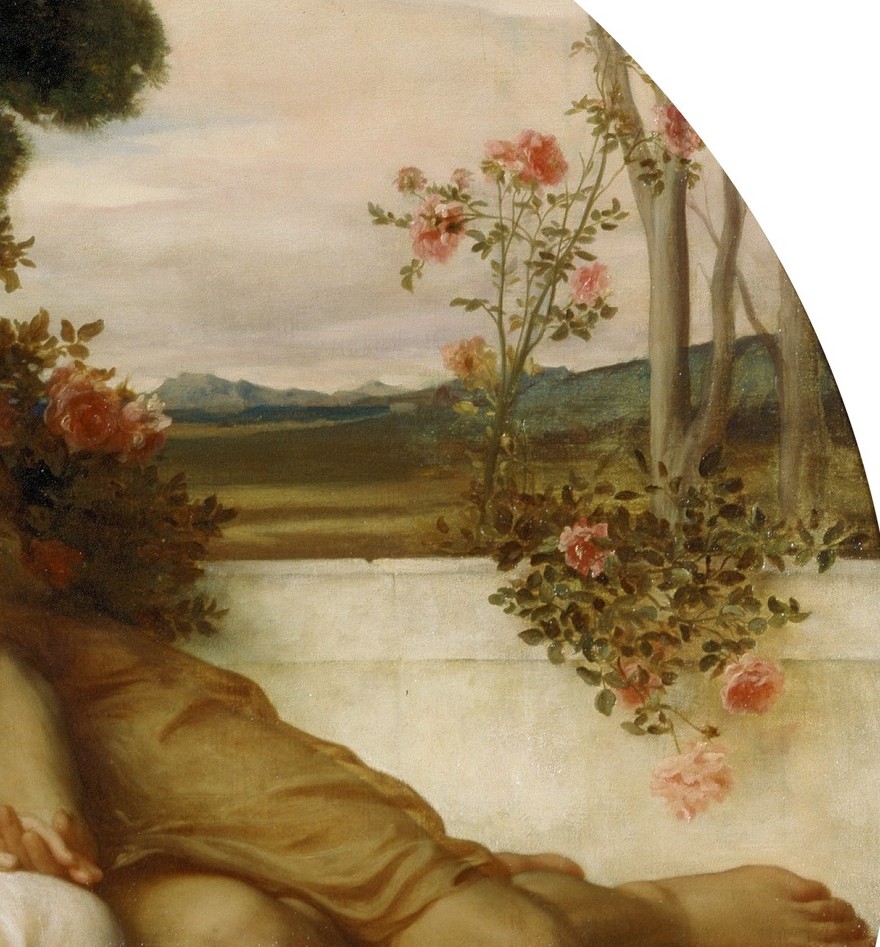
The garden opens to the distance
The roses lead towards the marble edge and open sky. The empty space beyond the figures offsets the dense foliage behind them.
Catullus and the kiss in the catalogue
In Catullus’s poem 45, Septimius begins by holding Acme and making a lavish vow. If he ever loves her less than a lover possibly could, he says, let him meet a lion alone in Libya or scorching India. The god Love sneezes in approval. Acme bends back her head and kisses Septimius’s eyes, then says that the fire in her bones burns more keenly than his. Love sneezes again. By the end, Septimius would choose Acme over Syria and Britain, while her desires are centred entirely on him. The vast distances of the oath and the final comparison make the few inches between their faces feel all the more intimate. [5]
The Academy hung Leighton’s painting in the West Room as no. 449. Under its title the catalogue printed four lines from Theodore Martin’s English verse, ending with Acme’s kiss “Intoxicating him with bliss”. The intoxication works differently in the Latin. Catullus describes the eyes she kisses as already drunk with love. A German rendering by Eduard Mörike, published before the exhibition, also gives Septimius intoxicated eyes at the moment of the kiss. With Martin’s rhyme between “kiss” and “bliss”, the feeling comes as the effect of her touch. Those were the lines the Academy visitor could carry from the catalogue to the canvas. [5] [6] [7]
The excerpt stops before Acme’s speech. In the poem she gets to say what the kiss means, and the repeated sneeze gives her declaration the same approval as his. The French translator Charles Héguin de Guerle has Love applaud each vow. Leighton lets us see Acme initiate the kiss and Septimius incline his face towards her. His hand rests over hers, leaving the lightest of touches to register a response. [1] [5] [6] [8]
What the Academy critics saw
William Michael Rossetti and Algernon Charles Swinburne reviewed the 1868 exhibition in a pamphlet. Rossetti admired how tightly Leighton arranged the figures, although he thought Acme’s drawn-up knee projected too far sideways. Swinburne questioned the drawing of a leg and an arm. He also distinguished between the painting’s fidelity to Martin’s verse and its fidelity to Catullus. To make the point, he borrowed the poem’s own joke and wondered whether Love would have sneezed approval of the painted lovers in either direction. [9]
The two critics help explain why Leighton’s selection from the poem matters. Martin’s stanza can be understood from a single glance at two faces. Swinburne evidently wanted some of the character of the surrounding poem as well. The danger of the lion, the Acme’s claim to feel a fiercer love and the peculiar sneeze all give the poet ways to smile at the very devotion he describes. Leighton gives the lovers the composure of a group that can hold its place on a gallery wall. Looking at Acme’s raised knee, as Rossetti did, makes it possible to see both the apparent ease of the embrace and how much work the pose does to fill the circle. [1] [5] [6] [9]
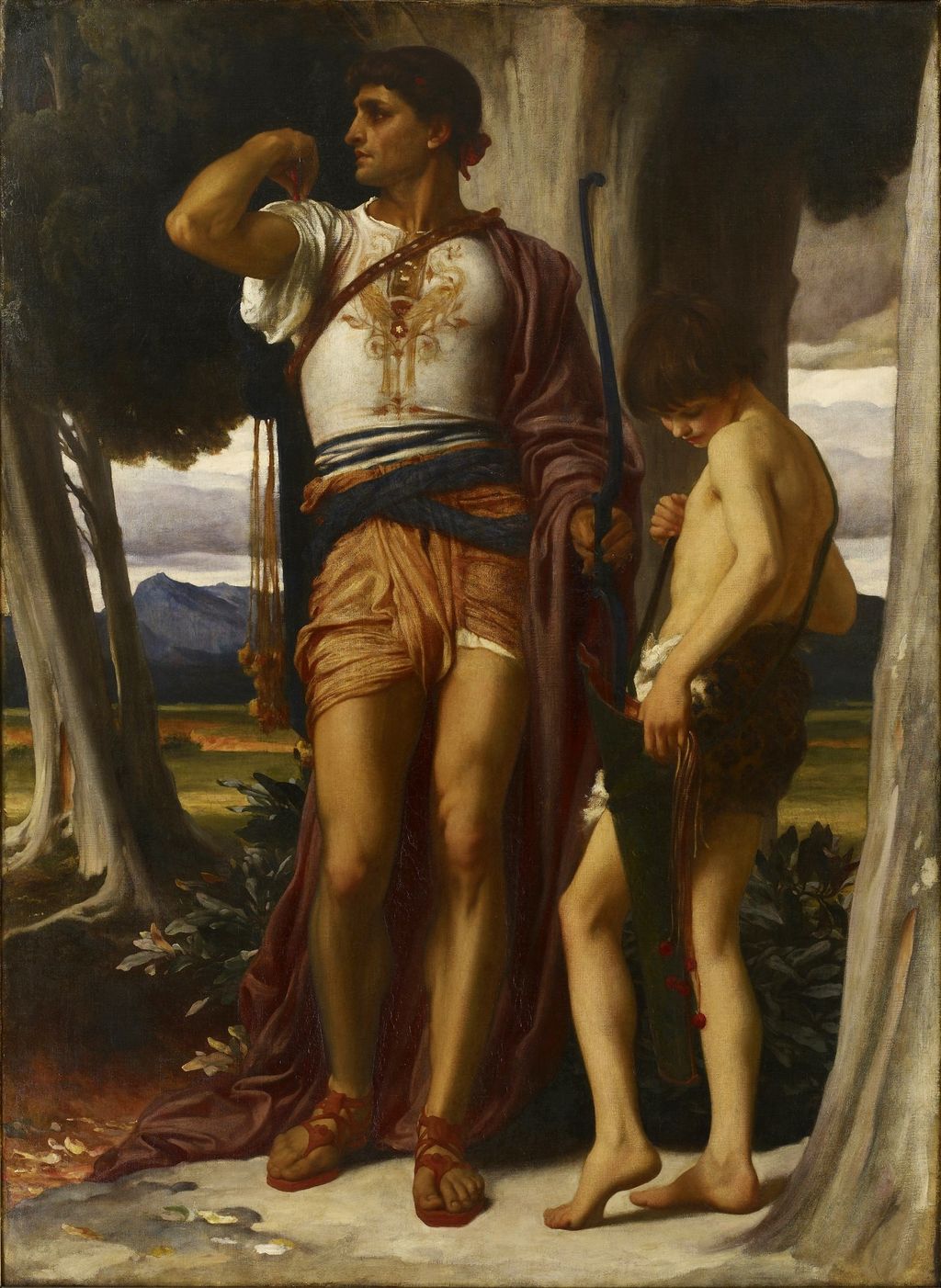
Frederic Leighton, Jonathan’s Token to David, c. 1868. Minneapolis Institute of Art. Image source. Public domain. Resized proportionally.
The painting after 1868
The painting returned to the Royal Academy for the memorial exhibition that ran from 4 January to 13 March 1897. Mrs. Newall lent it as no. 171, and the catalogue repeated Martin’s lines beside its description of the marble seat. A separate entry records a chalk sheet lent by James Knowles with studies for this painting and another Leighton work, Whispers. The exhibition gave visitors a chance to see both the finished canvas and some of the drawing that preceded it. Ernest Rhys, writing at the end of the century, regarded the picture as a love song in paint and recalled it as possibly the most popular painting in that exhibition. [10] [11]
In 2010 the checklist for I Preraffaelliti e il sogno italiano, a joint exhibition by the Ravenna art museum and the Ashmolean, placed Acme and Septimius among works Leighton made in or drew from Italy, alongside views of Capri and Rome. That grouping makes the lower horizon and orange trees worth another look. Unlike the views of particular places on the checklist, the landscape in this painting has been arranged so that its distances open up beside a pair of figures whose story comes from verse. [1] [12]
Browse Frederic Leighton’s artworks
Explore paintings, drawings, sculptures and prints, with separate rows for identified preparatory works, reproductions and casts.
| Name | Date | Medium |
|---|---|---|
| A Girl Feeding Peacocks | Exhibited 1863 | Painting Catalogue. |
| A Recognition from ‘Romola’, engraved by Swain (Tate N04054) | published 1862 | Print Catalogue. |
| A Roman Lady | 1859 | Painting Catalogue. |
| Abram and the Angel (Tate A00733) | published 1881 | Print Catalogue. |
| Acme and Septimius | Exhibited 1868 | Painting Catalogue. |
| An Athlete Wrestling with a Python (Tate exhibition bronze) | 1877 | Sculpture Catalogue. |
| And the Sea Gave Up the Dead Which Were in It (Tate N01511) | 1891–92 | Painting Catalogue. |
| Andromache in Captivity (photogravure after Leighton) | 1889 | Print Catalogue. |
| Athlete Wrestling with a Python (Anglesey Abbey cast) | model 1877; cast 1905 | Sculpture Catalogue. |
| Athlete Wrestling with a Python (Hood reduced cast) | 1877 (inscribed model date) | Sculpture Catalogue. |
| Athlete Wrestling with a Python (Saint Louis reduced cast) | 1877 (museum date) | Sculpture Catalogue. |
| Cain and Abel (Tate A00731) | published 1881 | Print Catalogue. |
| Captive Andromache | 1888 | Painting Catalogue. |
| Cimabue's Celebrated Madonna | 1853–55 | Painting Catalogue. |
| Cimon and Iphigenia, with Many Smaller Subjects (Tate T09061) | date not known | Drawing Catalogue. |
| Crenaia, the Nymph of the Dargle | Exhibited 1880 | Painting Catalogue. |
| Cymon and Iphigenia | 1884 | Painting Catalogue. |
| Daedalus and Icarus | 1869 | Painting Catalogue. |
| Dante in Exile | 1864 | Painting Catalogue. |
| Death of the First Born (Tate A00737) | published 1881 | Print Catalogue. |
| Electra at the Tomb of Agamemnon | c. 1869 | Painting Catalogue. |
| Eliezer and Rebekah (Tate A00735) | published 1881 | Print Catalogue. |
| Elijah in the Wilderness | 1877–78 | Painting Catalogue. |
| Fanny Kemble: A Study for ‘Jezebel and Ahab’ (Tate T08208) | c.1862 | Drawing Catalogue. |
| Figure Studies | Date not recorded | Drawing Catalogue. |
| Flaming June | 1895 | Painting Catalogue. |
| Gulnihal | Exhibited 1886 | Painting Catalogue. |
| Helios and Rhodes (Tate N03015) | date not known | Painting Catalogue. |
| Hercules Wrestling with Death for the Body of Alcestis | c. 1869–71 | Painting Catalogue. |
| Jonathan's Token to David | c. 1868 | Painting Catalogue. |
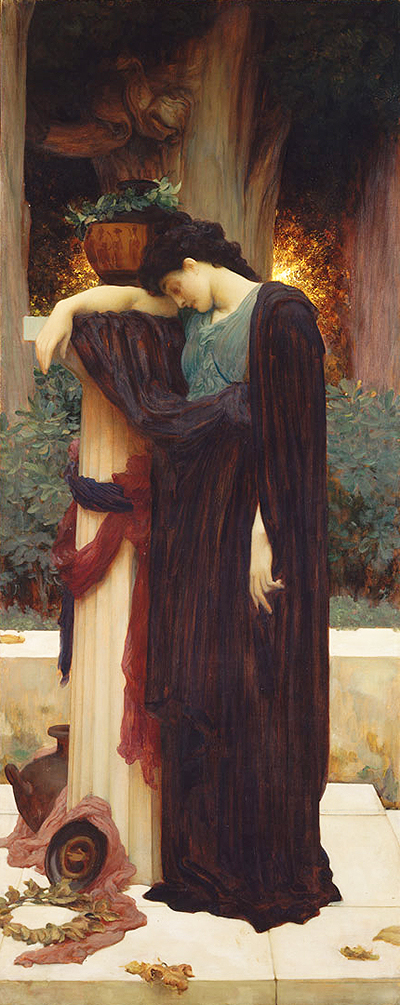
| Lachrymae | 1894–95 | Painting Catalogue. |
| Lieder ohne Worte | Exhibited 1861 | Painting Catalogue. |
| Light of the Harem | Exhibited 1880 | Painting Catalogue. |
| Moses Views the Promised Land (Tate A00736) | published 1881 | Print Catalogue. |
| Mrs James Guthrie | 1865 | Painting Catalogue. |
| Mrs John Hanson Walker (Tate N04731) | 1867 | Painting Catalogue. |
| Music Lesson | 1877 | Painting Catalogue. |
| Needless Alarms (Met cast) | modelled 1886; cast nineteenth century | Sculpture Catalogue. |
| Needless Alarms (Tate N05120) | 1886 | Sculpture Catalogue. |
| Pavonia | c. 1859 | Painting Catalogue. |
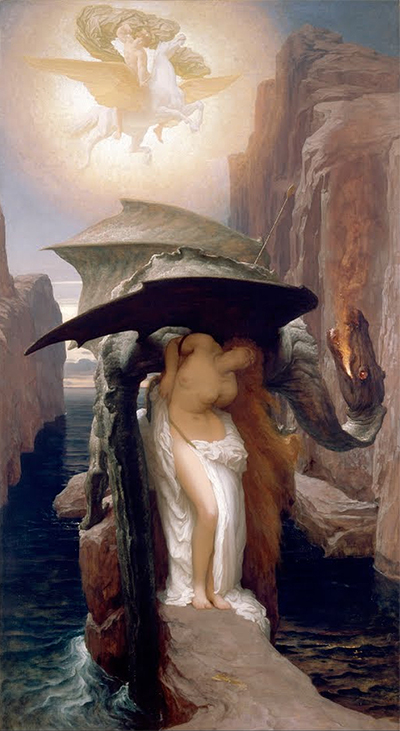
| Perseus and Andromeda | 1891 | Painting Catalogue. |
| Portrait of May Sartoris | c. 1860 | Painting Catalogue. |
| Preparing for a Festa, Florence (Tate T09062) | date not known | Drawing Catalogue. |
| Puerta de los Vientos, near Ronda, Spain (Tate N04006) | c.1886–9 | Painting Catalogue. |
| Samson and the Lions (Tate A00732) | published 1881 | Print Catalogue. |
| Samson at the Mill (Tate A00734) | published 1881 | Print Catalogue. |
| Samson Carrying the Gate (Tate A00738) | published 1881 | Print Catalogue. |
| Sketch for ‘An Athlete Wrestling with a Python’ (Tate N01761) | c.1877 | Sculpture Catalogue. |
| Sketches for Cimon and Iphigenia (Tate T09060) | date not known | Drawing Catalogue. |
| Study for The Return of Persephone (Demeter) | c. 1890–91 | Drawing Catalogue. |
| Study for The Return of Persephone (Persephone) | c. 1890–91 | Drawing Catalogue. |
| Study for ‘Needless Alarms’ (Tate N02945) | 1886 | Sculpture Catalogue. |
| Study for ‘The Discovery of Juliet Apparently Lifeless’ (Tate N01806) | c.1858 | Painting Catalogue. |
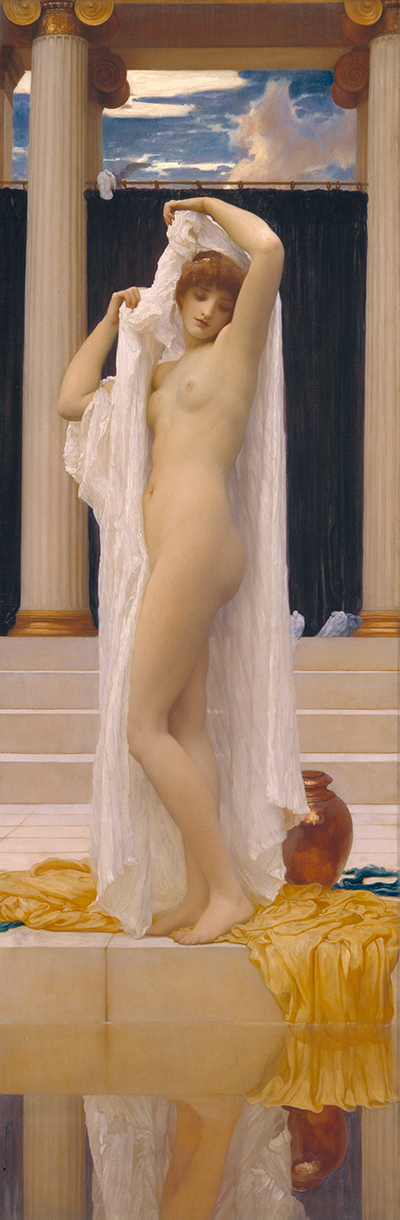
| The Bath of Psyche | Exhibited 1890 | Painting Catalogue. |
| The Daphnephoria | 1874–76 | Painting Catalogue. |
| The Death of Brunelleschi | 1852 | Painting Catalogue. |
| The Fisherman and the Siren | Exhibited 1858 | Painting Catalogue. |
| The Painter's Honeymoon | c. 1864 | Painting Catalogue. |
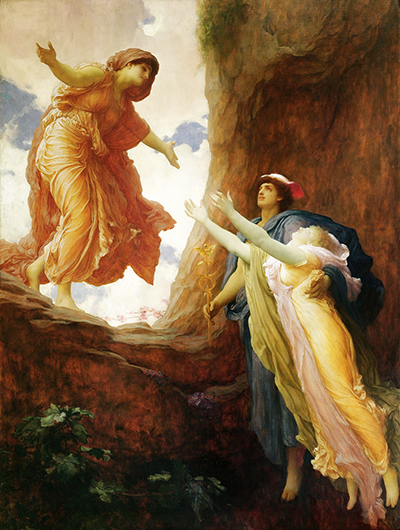
| The Return of Persephone | 1891 | Painting Leeds painting identified in the Met study record. |
| The Return of Persephone (preparatory oil) | c. 1890–91 | Painting Catalogue. |
| The Sluggard (Anglesey Abbey cast) | probably 1890–about 1906 | Sculpture Catalogue. |
| The Sluggard (Met cast) | modelled 1886; cast possibly before 1896 | Sculpture Catalogue. |
| The Sluggard (Museum Wales) | 1882–85 (museum date) | Sculpture Catalogue. |
| The Sluggard (Tate N01752) | 1885 | Sculpture Catalogue. |
| The Spies Escape (Tate A00730) | published 1881 | Print Catalogue. |
| Various Subjects (Tate T09063) | date not known | Drawing Catalogue. |
| View in Capri | Possibly 1859 | Painting Catalogue. |
| Wedded | 1882 | Painting Catalogue. |
| Winding the Skein | c. 1878 | Painting Catalogue. |
Discussion
Look again at the images and ideas explored in Acme and Septimius. These editorial prompts invite your observations.
Reader Insights
Which shapes carry your attention from the lovers’ faces towards their hands?
What changes when you read the two vows in the poem and return to the painting?
Join the Conversation
Share a detail, comparison or question about Acme and Septimius below.
References
- Ashmolean Museum. Love, Friendship & Romance. Collection feature, Acme and Septimius, WA1978.7, with image, subject and 1868 exhibition. View source.
- Ashmolean Museum and Heritage Images. Acme and Septimius, exhibited 1868. Image and object metadata, WA1978.7, dimensions 99 × 99 cm. View source.
- Ashmolean Prints. Acme and Septimius. Museum print catalogue, WA1978.7, with oil-on-canvas medium and comparison with Raphael’s Madonnas. View source.
- Gallerie degli Uffizi. Madonna col bambino e San Giovannino, detta Madonna della seggiola. Italian collection entry on Raphael’s design and the embrace. View source.
- Catullus. Carmina, 45. Latin text and glosses, Dickinson College Commentaries, lines 1–26. View source.
- Royal Academy of Arts. The Exhibition of the Royal Academy, 1868. West Room, p. 25, no. 449, with Theodore Martin’s translation. Scan from the Paul Mellon Centre’s Royal Academy Summer Exhibition Chronicle. View source.
- Mörike, Eduard, trans. “Akme und Septimius”. Gedichte, 2nd ed., Stuttgart and Tübingen, 1848, pp. 132–33. Historical German translation digitised by e-rara. View source.
- Héguin de Guerle, Charles, trans. “Acmé et Septimius”. Poésies de Catulle, Paris, 1837, pp. 67–69. Historical French translation. View source.
- Rossetti, William Michael, and Algernon Charles Swinburne. Notes on the Royal Academy Exhibition, 1868. London, 1868. Rossetti’s entry for no. 449 and Swinburne’s discussion of Leighton, p. 33. View source.
- Royal Academy of Arts. Exhibition of Works by the Late Lord Leighton of Stretton. Winter Exhibition, 1897, title page, no. 171 on p. 36 and no. 300 on p. 50. View source.
- Rhys, Ernest. Frederic Lord Leighton: An Illustrated Record of His Life and Work. Chapter IV, pp. 25–26, on the work and its reception. View source.
- Museo d’Arte della Città di Ravenna and Ashmolean Museum. I Preraffaelliti e il sogno italiano. 2010 exhibition checklist, p. 12, entry for Acme e Settimio. View source.