 by Tom Gurney
Tom Gurney BSc (Hons) is an art history expert with over 20 years experience
Published on June 19, 2020 / Updated on November 29, 2026
Email: tomgurney1@gmail.com / Phone: +44 7429 011000
Portrait of May Sartoris: Introduction
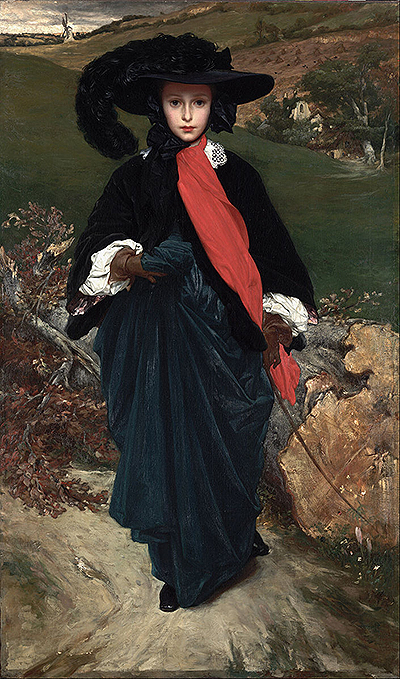
May Sartoris lifts the hem of her riding skirt as she comes towards us along a pale country path. A scarlet scarf crosses her dark jacket, and an ostrich feather curls down from the brim of her hat. Behind her, a fallen tree lies across the slope. Frederic Leighton painted this full-length likeness around 1860, when Mary Theodosia Sartoris, known as May, was about fifteen. The oil on canvas measures 152.1 by 90.2 centimetres and belongs to the Kimbell Art Museum in Fort Worth, Texas. [1] [2]
At a Glance
- DateAbout 1860
- MediumOil on canvas
- CollectionKimbell Art Museum, ACF 1964.03
- SitterMary Theodosia Sartoris
This work across Frederic Leighton’s career
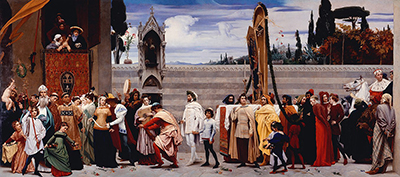
Cimabue’s Celebrated Madonna
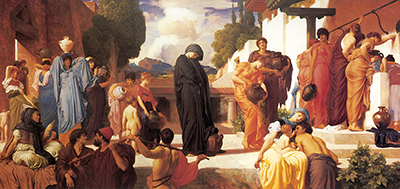
1853–55Lachrymae
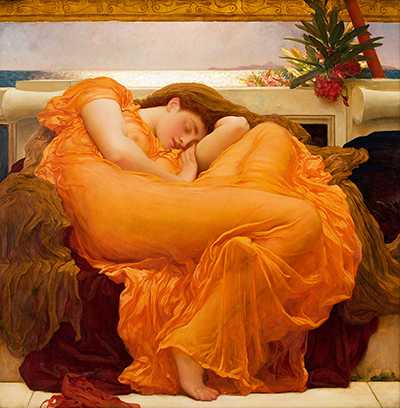
1894–95Flaming June
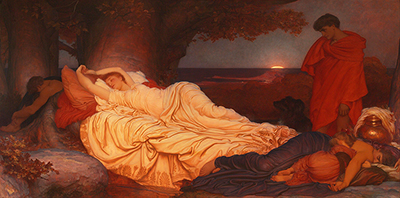
c. 1895Contents
- May and the Sartoris circle
- A riding habit in motion
- How Leighton made Hampshire his own
- The later portraits and the painting’s journey
- Annotated details
May and the Sartoris circle
Leighton met May’s mother, the opera singer Adelaide Kemble Sartoris, in Rome in 1853. The actress Sarah Siddons was Adelaide’s aunt, and Adelaide herself was celebrated for singing the title role in Bellini’s Norma. La Fenice in Venice records her singing the part in December 1838, and an 1841 lithograph shows her in costume. [2] [3] By the time Leighton knew her, she had married Edward Sartoris and was bringing writers, musicians and artists together at her home. Robert and Elizabeth Barrett Browning were among her friends. Writing home from Rome in February 1855, Leighton told his mother he spent every evening with the Sartorises. In a letter to his sister he describes singing tenor at Adelaide’s musical evenings and mentions painting both her and May while they were in Rome. May was still a child then, several years younger than she is in the Hampshire portrait. [2] [4]
May appears in the surviving correspondence of that circle in a lighter mood than the one we might read into the portrait. In 1856 Elizabeth Barrett Browning sent Georgina Cowper a set of verses by her son Penini, including a birthday poem for May. The young poet makes a pun on her name by likening her to a flower whose thorns are the jokes she tells to make everyone laugh. The poem gives us a glimpse of May among people who knew her, several years before the Kimbell likeness was painted. She went on to act and sing as an amateur. The feather and scarf have a theatrical flourish, but the moment Leighton paints is quiet. May holds our gaze with her mouth closed and her gloved hands occupied. [1] [2] [5]
Leighton returned to London in 1859, and the Sartorises rented Westbury House in Hampshire from 1859 to 1863. The museum’s approximate date puts the picture near the beginning of that tenancy. The family’s friendship with the painter makes sense of the unusual intimacy of a portrait on this scale. The Kimbell considers Edward and Adelaide its probable first owners. May eventually inherited it herself. [1] [6] [7]
A riding habit in motion
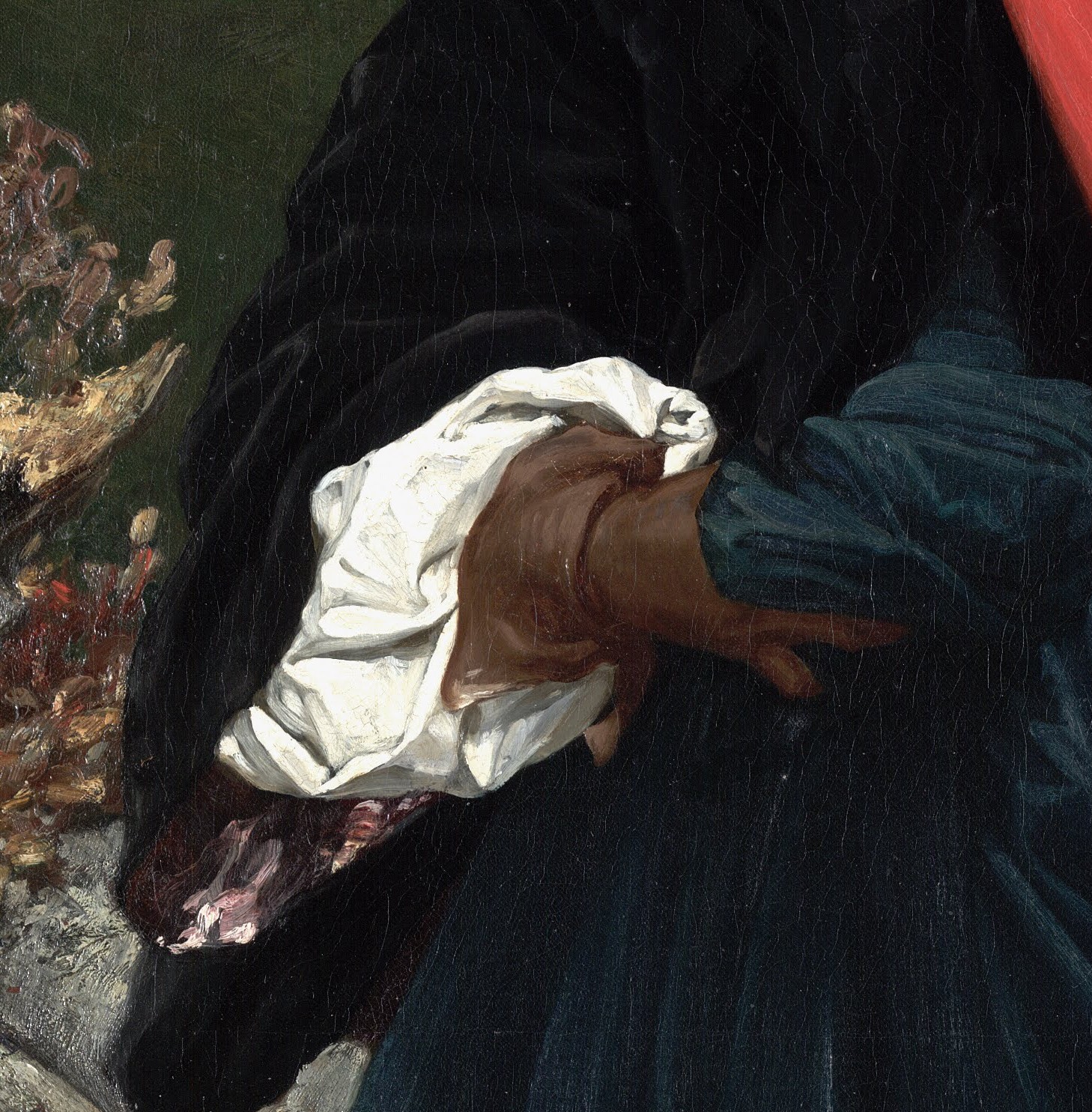
May’s face sits within a broad mass of black. Her feather curves down on one side, while the ribbon that ties the hat makes a dark bow below her chin. White lace at her collar and pale fabric at the ends of her flaring sleeves break up the jacket. At the waist, one gloved hand pulls the dark blue skirt into a bundle of folds. Her other hand holds a slender riding crop angled towards the ground. Lifting the skirt lets the toe of a shoe appear on the path and makes the weight of the fabric apparent. With no horse in sight, Leighton makes the small practical gestures of walking in a riding habit carry the pose. [1] [2] [8]
The Kimbell compares her outfit with a riding fashion plate from Les Modes Parisiennes of 1857. The plate shows that the full skirt and broad sleeves were already in fashion. In the painting those layers also sharpen the difference in scale between the young sitter’s face and the clothes enveloping her. The scarf leads down from her neck, passes through the broad shape of her jacket, then emerges again near her hand. It seems to move with her. After the bright red draws the eye across the figure, the pale collar brings it back up to her face and the small interval between her eyes and the brim. [1] [2]
The full-length figure on an outdoor path had recent precedents in British portraiture. The landscape historian Pola Durajska follows Paul Barlow in comparing May with Francis Grant’s 1857 portrait of his daughter Daisy, painted shortly before Daisy’s marriage. Both women come forward in dark outdoor clothes enlivened by red, and both stand above conspicuously loose strokes along the path. Grant sets his daughter against snow. Leighton draws on the slopes and buildings of Hampshire, giving May’s likeness a setting with a particular connection to her family. [9] [10]
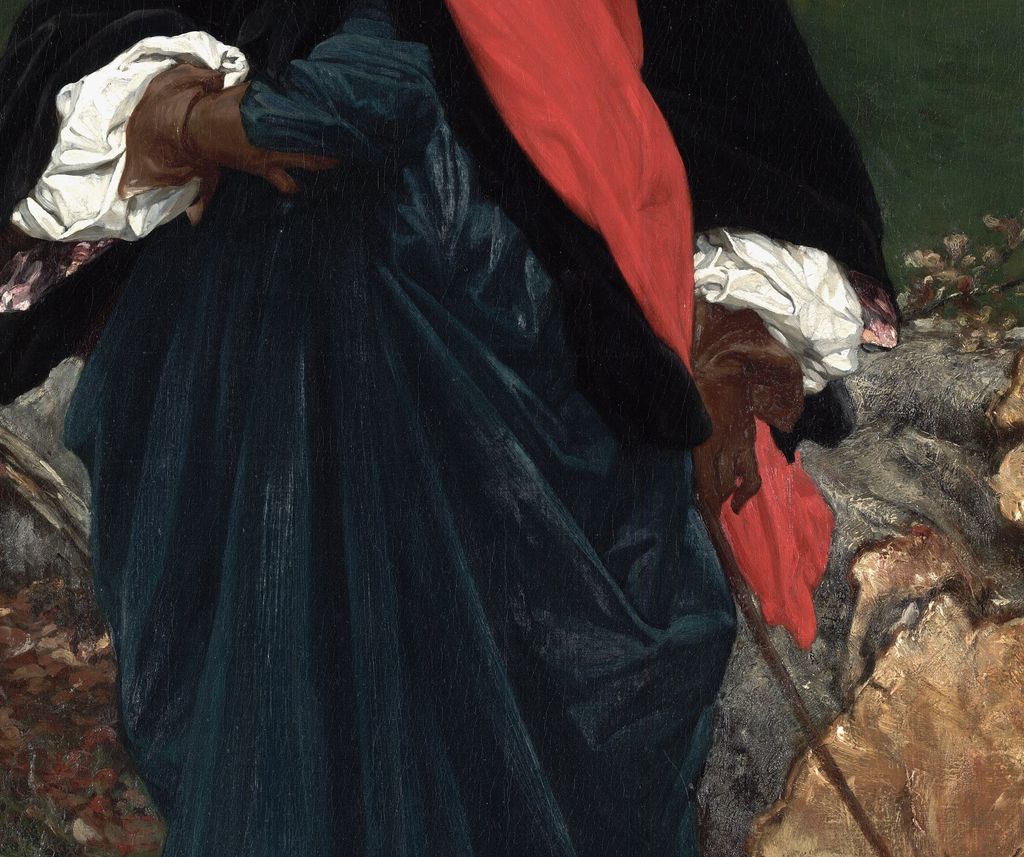
Detail of Portrait of May Sartoris showing the jacket, glove, gathered fabric and riding crop. Image source. Public domain. Detail cropped from the painting’s high-resolution source.
Annotated Details from Portrait of May Sartoris
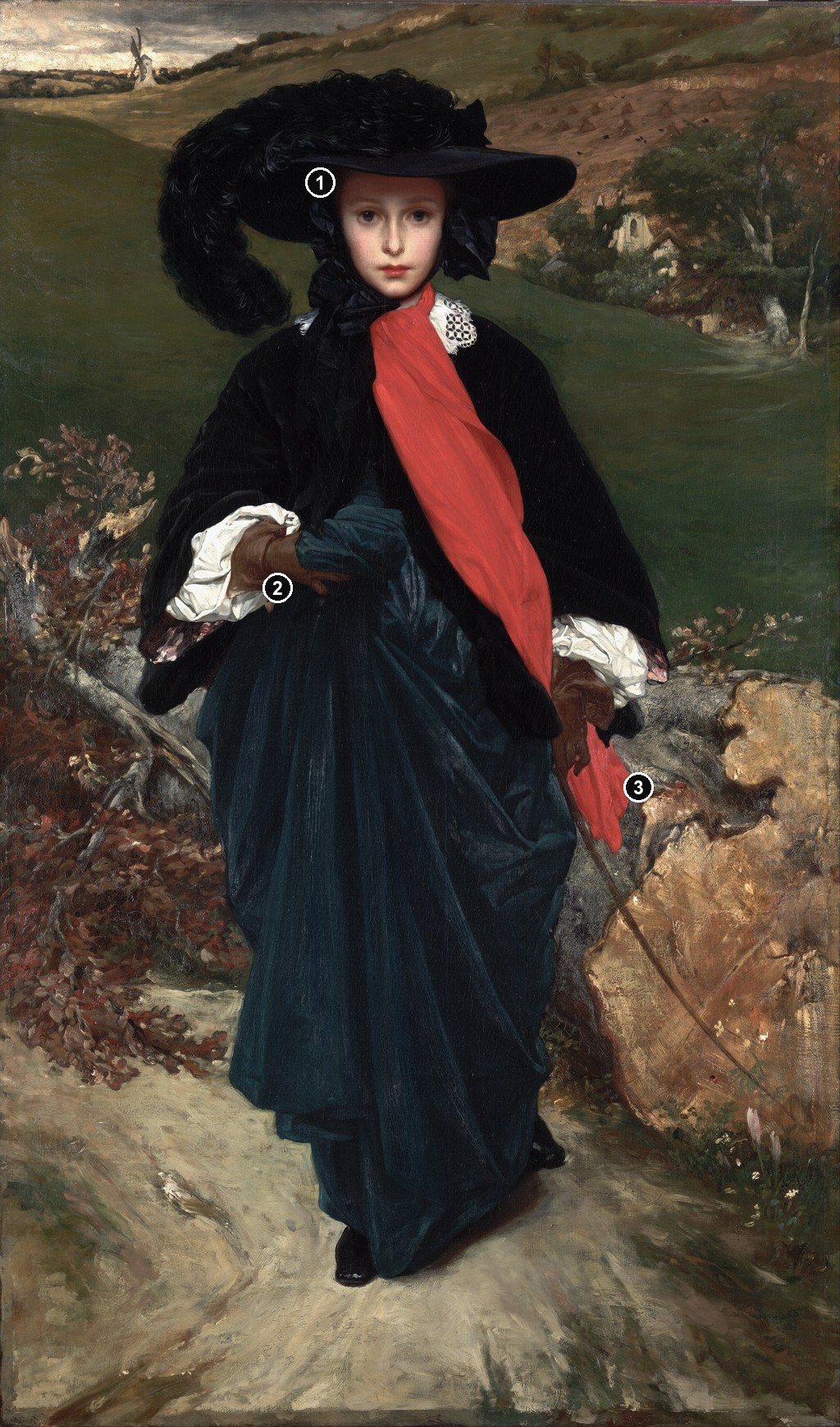
The numbered points identify visible features discussed in this article. Return from each detail to the numbered overview. Frederic Leighton, Portrait of May Sartoris, c. 1860. Kimbell Art Museum. Image source. Public domain. Resized without changing the composition.
Details from PORTRAIT OF MAY SARTORIS
Compare the cropped details with the source images above. Notice how their colours, shapes and positions contribute to the larger compositions.
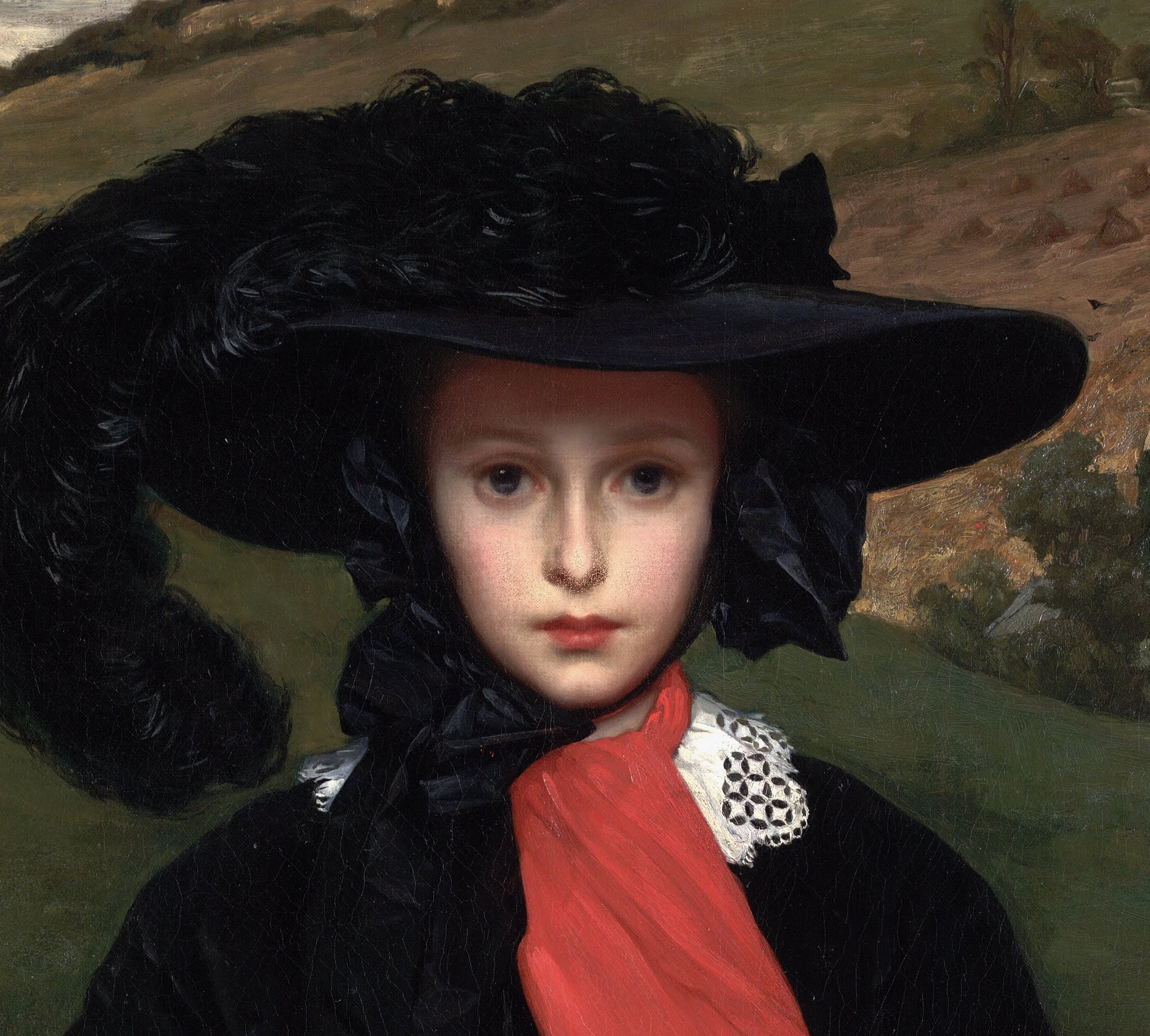
Hat brim and the sitter’s gaze
The dark brim frames her face. The broad feather curves down on the left, and the white collar brings the eye back towards her chin.
The skirt gathered in a glove
May bunches the dark blue fabric at her hip. Narrow shifts in colour and short folds give the skirt a sense of weight.
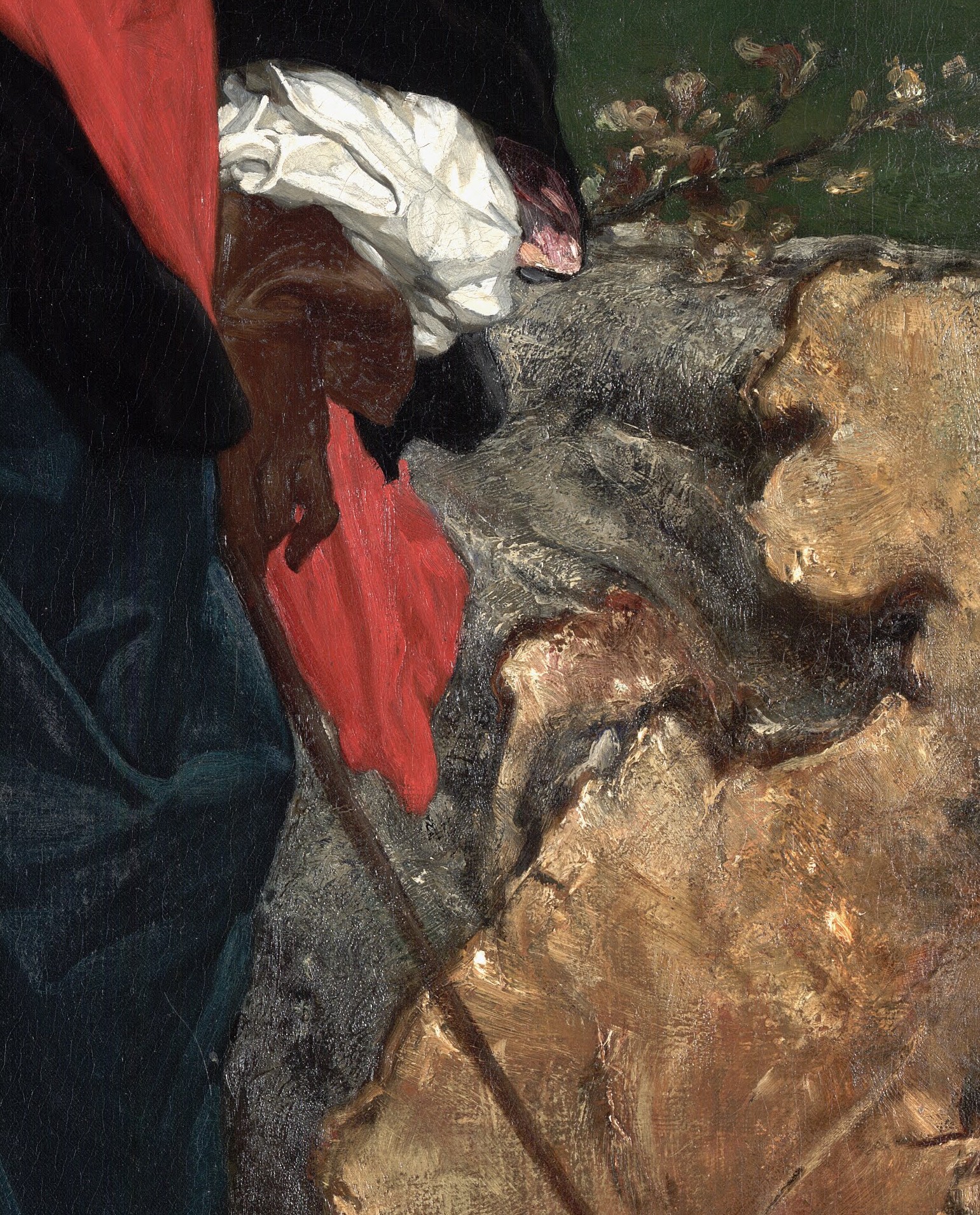
The riding crop and fallen tree
The slender crop runs down past a rough branch. The strip of red scarf and the pale cuff stand out against the brown and grey of the bank.
How Leighton made Hampshire his own
A tiny windmill interrupts the skyline at the upper left. Across the canvas, a smaller building among the trees appears to have a church tower. Malcolm Warner, then a curator at the Kimbell, asked the East Meon History Group whether the two buildings might identify a viewpoint. The group proposed Marland’s Mill near West Meon as the model for the windmill and suggested the former West Meon church as a possible source for the tower. Marland’s Mill could not be seen from Westbury House, and the researchers could find no view that brought the two buildings together as Leighton painted them. Warner concluded that the surrounding countryside probably supplied the elements of the setting. [7] [9]
Leighton knew the area well enough to sketch it. In a letter recorded in Emilie Barrington’s edition of his correspondence, he tells of a request from Adelaide’s sister Fanny Kemble for a small sketch of Westbury. Durajska found no surviving oil study that can be securely matched to the portrait’s background. It remains plausible that Leighton observed individual motifs outdoors and arranged them together as he developed the canvas. Durajska also points to his contact with French landscape painters in Paris, and to Warner’s comparison of the landscape with the work of the Barbizon school. The muted greens of the slope and the light catching the rough ground give ordinary features of the terrain real presence even in a scene whose topography has been rearranged. [7] [9] [11]
The fallen trunk serves the composition as much as it sets the mood. Its diagonal cuts across the ground behind May and breaks the descent from the distant slope to the path at her feet. Christopher Newall, as cited by Durajska, reads it as a way of managing that change in depth. Leonée Ormond’s reading, also discussed by Durajska, draws attention to fallen wood and the autumnal light as reminders of mortality. Warner connects the elegiac mood with Adelaide’s outlook and with the way Victorian painters pictured the passing of childhood. The weathered trunk and May’s upright figure make a striking pair. Her raised hem and the forward edge of her shoe keep us aware of the step she seems about to take. [1] [9] [12]
The later portraits and the painting’s journey
May married Henry Evans Gordon in 1871. Leighton painted her again around that time in a small head-and-shoulders portrait in which she wears a veil against a dark ground. The timing suggests a connection with the wedding, though the occasion is uncertain. This was the canvas shown at the Tretyakov Gallery in Moscow in 2008 under the title Mrs Evans Gordon. In 1875 Leighton exhibited a later likeness at the Royal Academy. It is now at Leighton House in London and shows May seated in a deep red dress with a dog on a table beside her. Where the red in the earlier work flashes across the landscape, here it fills much of the canvas. [1] [2] [13] [14] [15]
In 1897, a year after Leighton’s death, Henry Evans Gordon lent both the full-length portrait and the seated likeness to the Royal Academy’s winter exhibition. The catalogue identifies the earlier work by the riding habit, feathered hat and red scarf, and labels May by both her maiden and married names. His own portrait by Leighton appears immediately before May’s full-length likeness in the catalogue. The three entries show how closely the painter’s career and this family’s history were intertwined. [15]
The full-length painting passed down through the family to Mrs M. Turner of London. It is recorded with Newhouse Galleries in New York in 1962, and the Kimbell Art Foundation acquired it in 1964. The acquisition also had a personal connection for Kay Kimbell. He had long wanted a picture that might give him some of the pleasure he took in seeing Thomas Lawrence’s Pinkie, the 1794 likeness of Sarah Goodin Barrett Moulton at the Huntington. Decades later the Leighton featured in The Kimbell at 40, the museum’s 2012 exhibition tracing its formation through key acquisitions. A painting probably made for people who would have recognised May on sight became one of the works through which an American museum told its own history. [1] [2] [16]
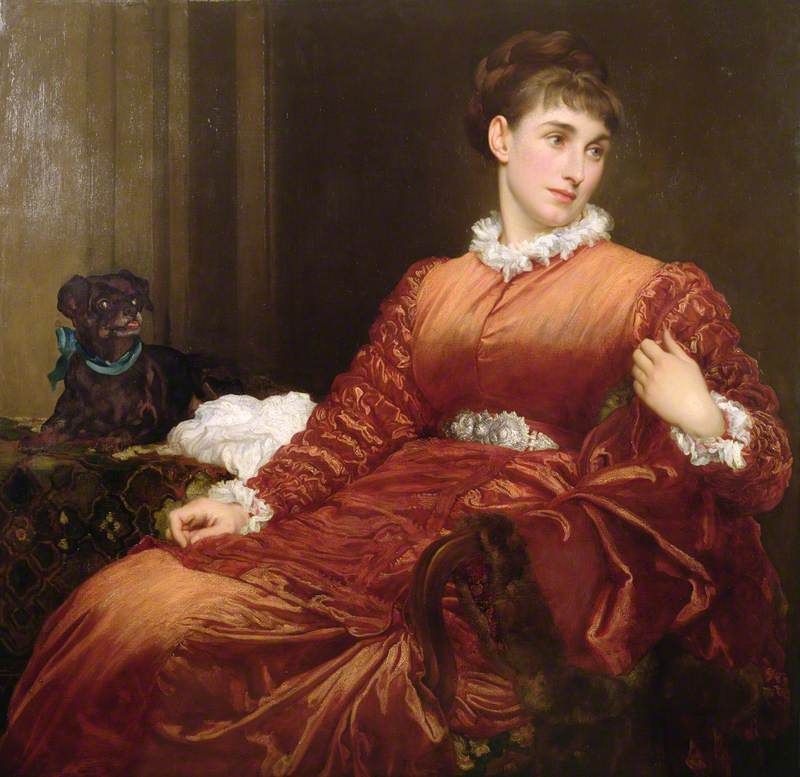
Frederic Leighton, Mrs. Henry Evans Gordon, née May Sartoris, 1875. Leighton House. Image source. Public domain. Resized without changing the composition.
Browse Frederic Leighton’s artworks
Explore paintings, drawings, sculptures and prints, with separate rows for identified preparatory works, reproductions and casts.
| Name | Date | Medium |
|---|---|---|
| A Girl Feeding Peacocks | Exhibited 1863 | Painting Catalogue. |
| A Recognition from ‘Romola’, engraved by Swain (Tate N04054) | published 1862 | Print Catalogue. |
| A Roman Lady | 1859 | Painting Catalogue. |
| Abram and the Angel (Tate A00733) | published 1881 | Print Catalogue. |
| Acme and Septimius | Exhibited 1868 | Painting Catalogue. |
| An Athlete Wrestling with a Python (Tate exhibition bronze) | 1877 | Sculpture Catalogue. |
| And the Sea Gave Up the Dead Which Were in It (Tate N01511) | 1891–92 | Painting Catalogue. |
| Andromache in Captivity (photogravure after Leighton) | 1889 | Print Catalogue. |
| Athlete Wrestling with a Python (Anglesey Abbey cast) | model 1877; cast 1905 | Sculpture Catalogue. |
| Athlete Wrestling with a Python (Hood reduced cast) | 1877 (inscribed model date) | Sculpture Catalogue. |
| Athlete Wrestling with a Python (Saint Louis reduced cast) | 1877 (museum date) | Sculpture Catalogue. |
| Cain and Abel (Tate A00731) | published 1881 | Print Catalogue. |
| Captive Andromache | 1888 | Painting Catalogue. |
| Cimabue's Celebrated Madonna | 1853–55 | Painting Catalogue. |
| Cimon and Iphigenia, with Many Smaller Subjects (Tate T09061) | date not known | Drawing Catalogue. |
| Crenaia, the Nymph of the Dargle | Exhibited 1880 | Painting Catalogue. |
| Cymon and Iphigenia | 1884 | Painting Catalogue. |
| Daedalus and Icarus | 1869 | Painting Catalogue. |
| Dante in Exile | 1864 | Painting Catalogue. |
| Death of the First Born (Tate A00737) | published 1881 | Print Catalogue. |
| Electra at the Tomb of Agamemnon | c. 1869 | Painting Catalogue. |
| Eliezer and Rebekah (Tate A00735) | published 1881 | Print Catalogue. |
| Elijah in the Wilderness | 1877–78 | Painting Catalogue. |
| Fanny Kemble: A Study for ‘Jezebel and Ahab’ (Tate T08208) | c.1862 | Drawing Catalogue. |
| Figure Studies | Date not recorded | Drawing Catalogue. |
| Flaming June | 1895 | Painting Catalogue. |
| Gulnihal | Exhibited 1886 | Painting Catalogue. |
| Helios and Rhodes (Tate N03015) | date not known | Painting Catalogue. |
| Hercules Wrestling with Death for the Body of Alcestis | c. 1869–71 | Painting Catalogue. |
| Jonathan's Token to David | c. 1868 | Painting Catalogue. |
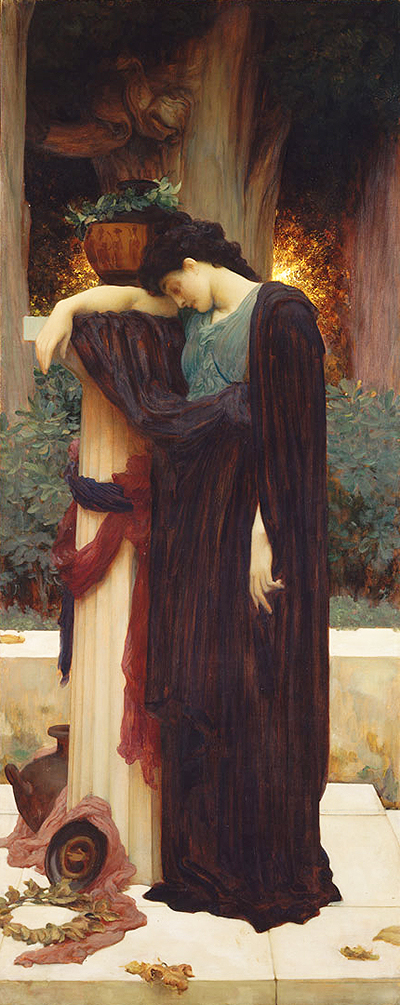
| Lachrymae | 1894–95 | Painting Catalogue. |
| Lieder ohne Worte | Exhibited 1861 | Painting Catalogue. |
| Light of the Harem | Exhibited 1880 | Painting Catalogue. |
| Moses Views the Promised Land (Tate A00736) | published 1881 | Print Catalogue. |
| Mrs James Guthrie | 1865 | Painting Catalogue. |
| Mrs John Hanson Walker (Tate N04731) | 1867 | Painting Catalogue. |
| Music Lesson | 1877 | Painting Catalogue. |
| Needless Alarms (Met cast) | modelled 1886; cast nineteenth century | Sculpture Catalogue. |
| Needless Alarms (Tate N05120) | 1886 | Sculpture Catalogue. |
| Pavonia | c. 1859 | Painting Catalogue. |
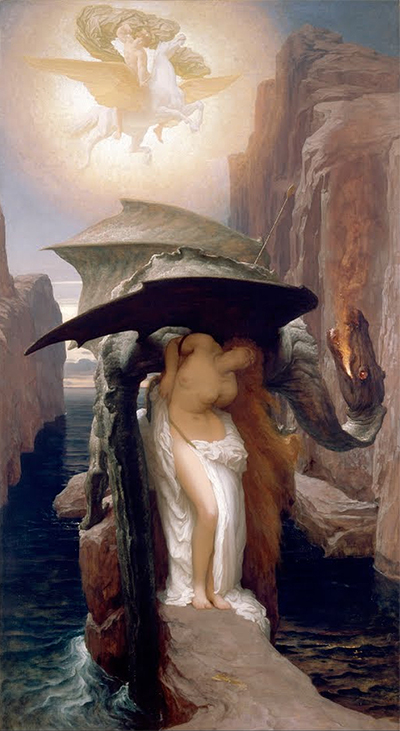
| Perseus and Andromeda | 1891 | Painting Catalogue. |
| Portrait of May Sartoris | c. 1860 | Painting Catalogue. |
| Preparing for a Festa, Florence (Tate T09062) | date not known | Drawing Catalogue. |
| Puerta de los Vientos, near Ronda, Spain (Tate N04006) | c.1886–9 | Painting Catalogue. |
| Samson and the Lions (Tate A00732) | published 1881 | Print Catalogue. |
| Samson at the Mill (Tate A00734) | published 1881 | Print Catalogue. |
| Samson Carrying the Gate (Tate A00738) | published 1881 | Print Catalogue. |
| Sketch for ‘An Athlete Wrestling with a Python’ (Tate N01761) | c.1877 | Sculpture Catalogue. |
| Sketches for Cimon and Iphigenia (Tate T09060) | date not known | Drawing Catalogue. |
| Study for The Return of Persephone (Demeter) | c. 1890–91 | Drawing Catalogue. |
| Study for The Return of Persephone (Persephone) | c. 1890–91 | Drawing Catalogue. |
| Study for ‘Needless Alarms’ (Tate N02945) | 1886 | Sculpture Catalogue. |
| Study for ‘The Discovery of Juliet Apparently Lifeless’ (Tate N01806) | c.1858 | Painting Catalogue. |
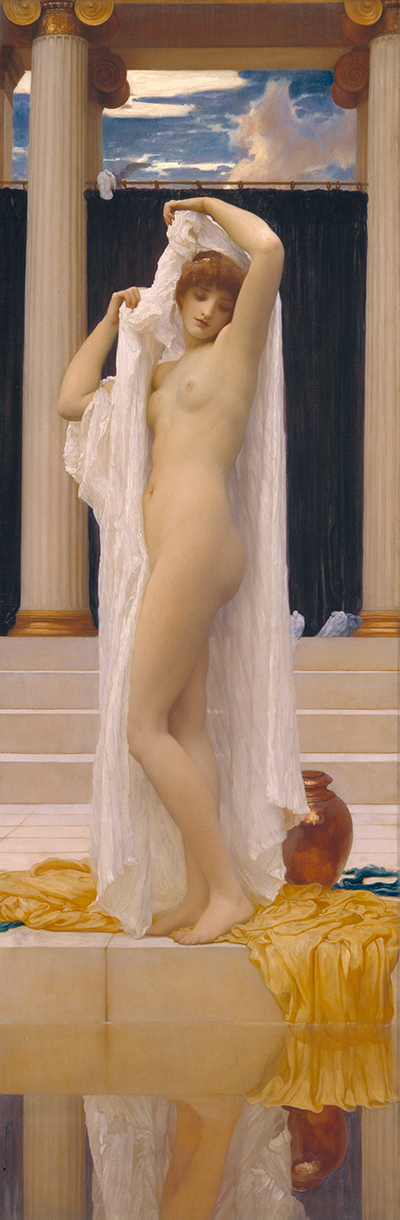
| The Bath of Psyche | Exhibited 1890 | Painting Catalogue. |
| The Daphnephoria | 1874–76 | Painting Catalogue. |
| The Death of Brunelleschi | 1852 | Painting Catalogue. |
| The Fisherman and the Siren | Exhibited 1858 | Painting Catalogue. |
| The Painter's Honeymoon | c. 1864 | Painting Catalogue. |
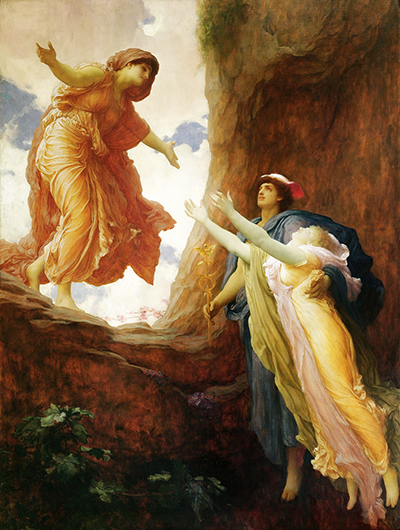
| The Return of Persephone | 1891 | Painting Leeds painting identified in the Met study record. |
| The Return of Persephone (preparatory oil) | c. 1890–91 | Painting Catalogue. |
| The Sluggard (Anglesey Abbey cast) | probably 1890–about 1906 | Sculpture Catalogue. |
| The Sluggard (Met cast) | modelled 1886; cast possibly before 1896 | Sculpture Catalogue. |
| The Sluggard (Museum Wales) | 1882–85 (museum date) | Sculpture Catalogue. |
| The Sluggard (Tate N01752) | 1885 | Sculpture Catalogue. |
| The Spies Escape (Tate A00730) | published 1881 | Print Catalogue. |
| Various Subjects (Tate T09063) | date not known | Drawing Catalogue. |
| View in Capri | Possibly 1859 | Painting Catalogue. |
| Wedded | 1882 | Painting Catalogue. |
| Winding the Skein | c. 1878 | Painting Catalogue. |
Discussion
Look again at the images and ideas explored in Portrait of May Sartoris. These editorial prompts invite your observations.
Reader Insights
What makes the riding habit look heavy and in motion?
Which details locate the portrait in a real place, and where does the evidence for a precise viewpoint run out?
Join the Conversation
Share a detail, comparison or question about Portrait of May Sartoris below.
References
- Kimbell Art Museum. Portrait of May Sartoris, c. 1860. Collection record ACF 1964.03, object details and provenance. View source.
- Kimbell Art Museum. Portrait of May Sartoris. 50th anniversary collection feature, including the 1857 riding-habit fashion plate and c. 1871 likeness. View source.
- Teatro La Fenice. Norma al Teatro La Fenice. Historical archive, p. 67, cast for 12 December 1838. View source.
- Barrington, Emilie, ed. The Life, Letters and Work of Frederic Leighton, vol. I. 1906. Chapter II, Rome correspondence, including his letter to his mother of 19 February 1855 and the letter to his sister Augusta printed after the letter of 2 March. View source.
- Barrett Browning, Elizabeth. Letter to Georgina Cowper, August 1856. The Brownings’ Correspondence, letter 3828, with the enclosures of Penini’s poems. Manuscript at the Armstrong Browning Library. View source.
- National Portrait Gallery, London. Frederic Leighton, Baron Leighton. Biographical chronology. View source.
- East Meon History Group. Find the Lady. Account by participants in the investigation of the painted setting, with Malcolm Warner’s response. View source.
- Kimbell Art Museum. Educator Resource. 2024. Portrait of May Sartoris entry, costume description. View source.
- Durajska, Pola. Nature, Science, and Myth in the Landscape Art of Frederic Leighton, vol. I. University of York doctoral thesis, 2021, pp. 43–46 and associated notes. View source.
- National Galleries of Scotland. Francis Grant, Anne Emily Sophia Grant (known as ‘Daisy’ Grant), Mrs William Markham. Collection record NG 2783. View source.
- Barrington, Emilie, ed. The Life, Letters and Work of Frederic Leighton, vol. II. 1906. Chapter I, Leighton's correspondence about Westbury and Fanny Kemble. View source.
- Kimbell Art Museum. Friendship and Loss in the Victorian Portrait: May Sartoris by Frederic Leighton. Museum synopsis of Malcolm Warner’s 2009 study. View source.
- Christie’s. Portrait of May Sartoris, Mrs Henry Evans Gordon. Lot 164, 12 December 2019. Catalogue entry distinguishing the three oils and identifying the 1875 exhibit. View source.
- The Tretyakov Gallery Magazine. ПРЕРАФАЭЛИТЫ в Государственной Третьяковской галерее [The Pre-Raphaelites at the State Tretyakov Gallery]. No. 2 (19), 2008. Exhibition account and entry for the c. 1870 Mrs Evans Gordon. View source.
- Royal Academy of Arts. Exhibition of Works by the Late Lord Leighton of Stretton. Winter Exhibition, 1897. Catalogue nos. 42, 43 and 189. View source.
- Kimbell Art Museum. The Kimbell at 40: An Evolving Masterpiece. Exhibition record, 7 October to 30 December 2012. View source.