 by Tom Gurney
Tom Gurney BSc (Hons) is an art history expert with over 20 years experience
Published on June 19, 2020 / Updated on November 29, 2026
Email: tomgurney1@gmail.com / Phone: +44 7429 011000
The Painter’s Honeymoon: Introduction
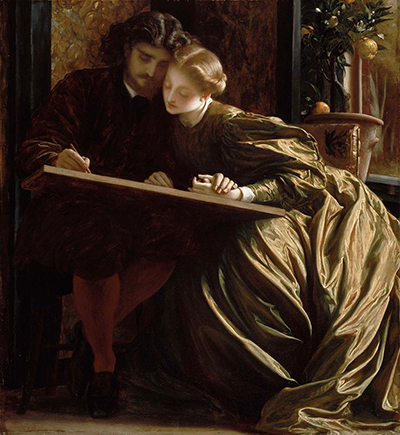
A painter bends over a drawing board with a woman pressed close to his shoulder. His right hand is at work near one end of the board. Farther along it, their hands meet. Both look down, their faces so close that the edge of her hair touches his temple. Frederic Leighton made this scene of a newly married couple about 1864. The oil on canvas measures 83.8 × 76.8 centimetres and belongs to the Museum of Fine Arts, Boston, which catalogues it as Painter’s Honeymoon, accession 1981.258. [1]
At a Glance
- PaintedAbout 1864
- MediumOil on canvas
- ExhibitedRoyal Academy, 1866
- CollectionMuseum of Fine Arts, Boston, 1981.258
This work across Frederic Leighton’s career
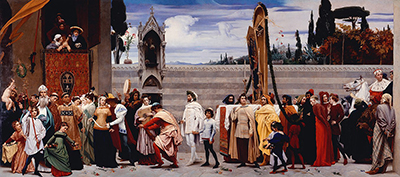
Cimabue’s Celebrated Madonna
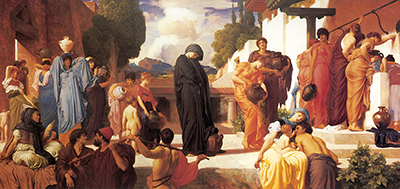
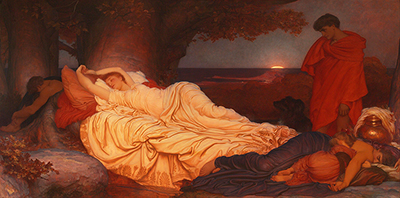
1853–55Lachrymae
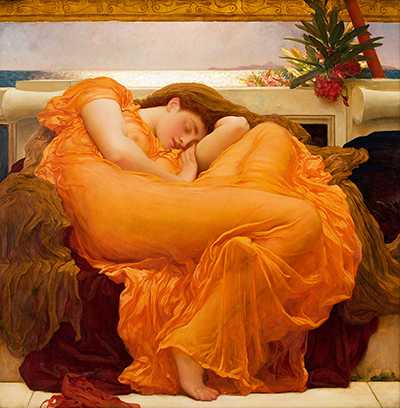
1894–95Flaming June
c. 1895Contents
- The space they share
- A scene from Leighton’s own time?
- Drawing and music
- From a private sale to the exhibition room
- Annotated details
The space they share
The drawing board slopes across the composition, just below the level of the couple’s elbows. Its pale rim picks out a steady line against shadow. At the left, the painter’s working hand hovers just beyond the edge. Toward the middle is another cluster of fingers, two hands in contact, with a white cuff marking the woman’s wrist. The slight separation between these two gestures is enough to make both legible. He can keep drawing and stay in touch with her. She can follow what he is doing from almost the same angle as he sees it. Above the board, their brows and eyes follow the same downward line. [1]
Leighton sets us low enough that the board’s dark underside takes up more room than its working surface. We can see the drawing implement against the illuminated edge, but the design taking shape under it is hidden. Our attention falls where the light is most revealing, on the pressure of the fingers and the tilts of the heads. The man’s dark hair falls forward over a face already in shadow. A much finer line of light follows the woman’s centre part and the roll of hair above her ear. Her lowered eyelids and closed mouth suggest that this involvement is quiet. Whatever the man is putting on the board, there is enough time for her to watch him do it. [1]
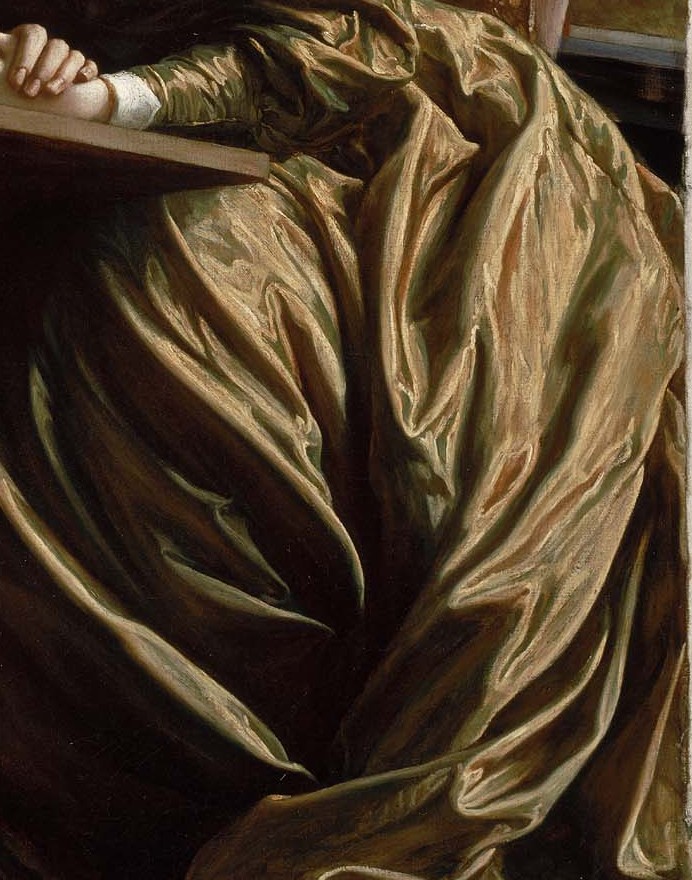
To the right, the light becomes sharper. It breaks into bronze and gold along the folds of the woman’s green dress and catches the round fruit among the leaves above her shoulder. A glazed-looking pot stands behind her beside the opening. There is very little view beyond it. The verticals of the opening and the darker strip at the left edge keep the eye within the interior, while the wide skirt sweeps down toward the lower right corner. On the opposite side, a reddish stocking and the edge of the man’s shoe emerge from the shadow under the board. Leighton lets the man’s dark clothes blend into the room and gives the dress sharp ridges of light so that the woman’s movement toward him carries across nearly the whole canvas. [1]
Annotated Details from The Painter’s Honeymoon
The numbered points identify visible features discussed in this article. Return from each detail to the numbered overview. Frederic Leighton, The Painter’s Honeymoon, c. 1864. Museum of Fine Arts, Boston. Image source. Public domain. Resized proportionally.
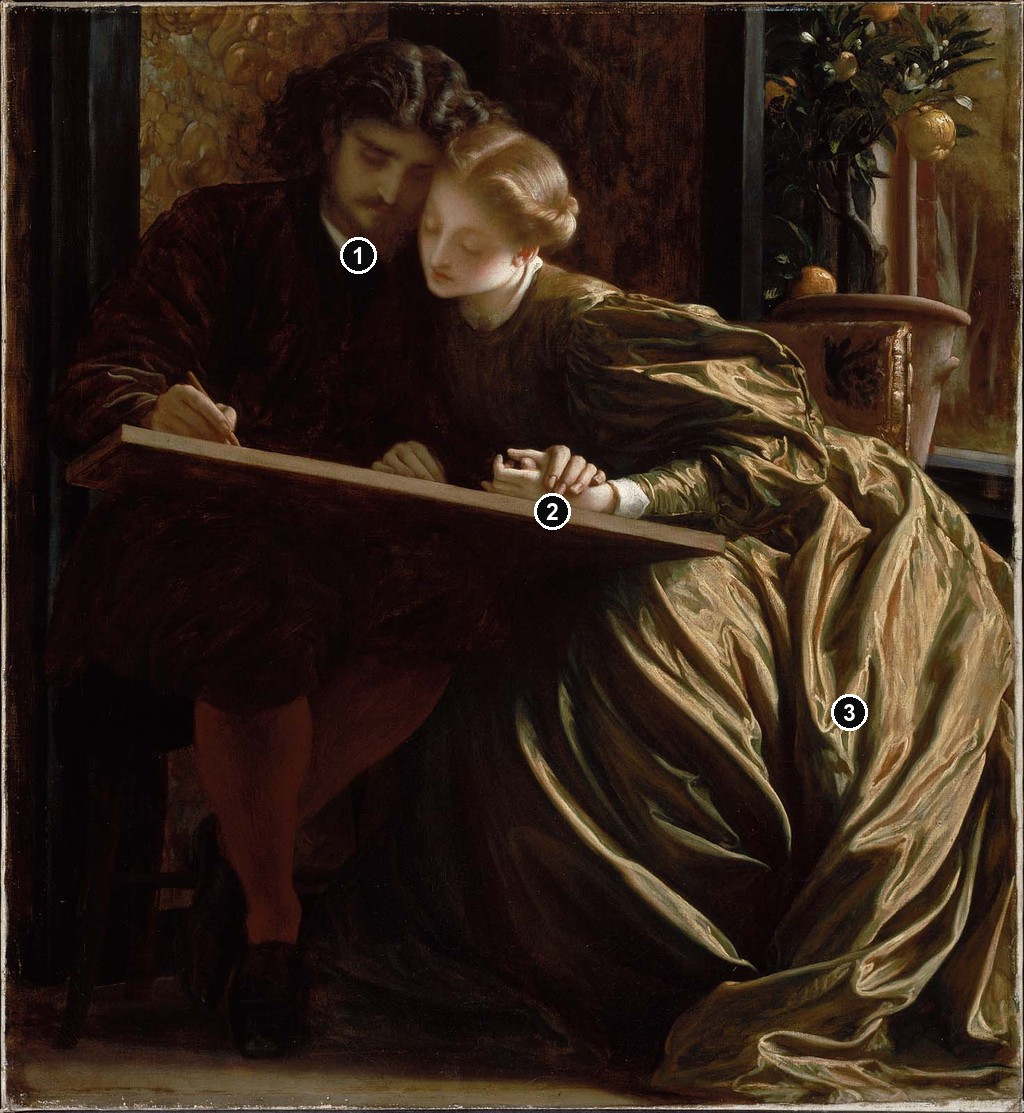
Details from THE PAINTER’S HONEYMOON
Compare the cropped details with the source images above. Notice how their colours, shapes and positions contribute to the larger compositions.
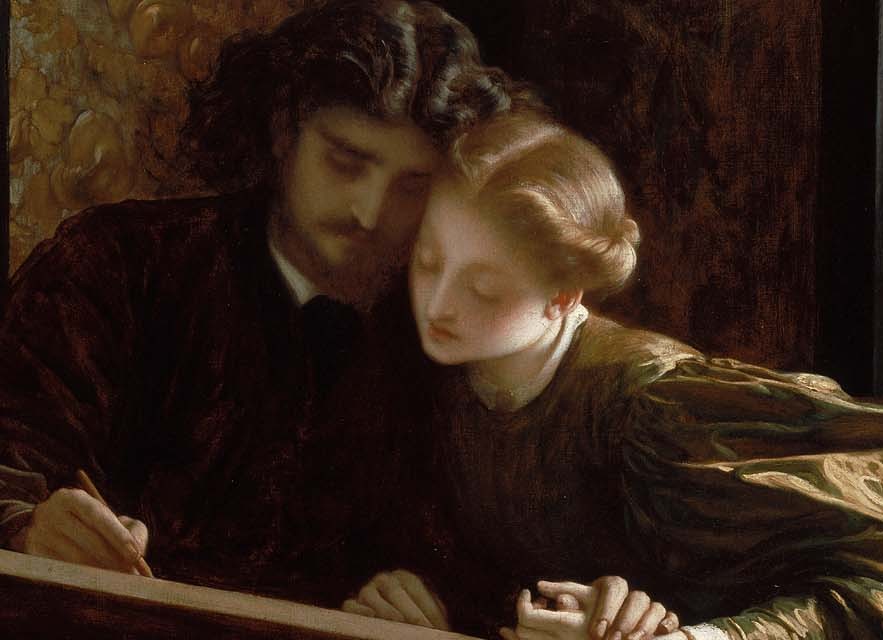
Two faces lean together
The two heads move towards one another in a small lighted space. Their attitudes also lead the eye down towards the board.
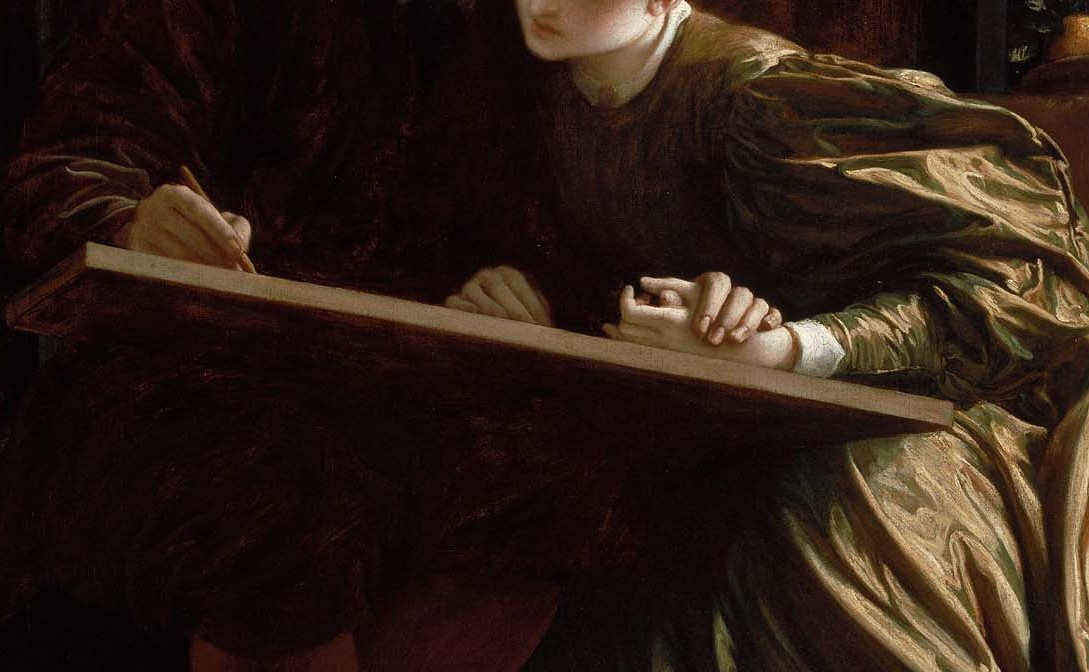
Working across the drawing board
The board crosses both figures and touches their sleeves. A hand works near one end while the other figure leans in from the right.
Light on the folded dress
Lines of reflected light follow the folds and are strongest where the fabric turns towards the right. The brightest silk sits close to the darkest area of the seated group.
A scene from Leighton’s own time?
An early study, discussed in Christie’s catalogue essay for Golden Hours, showed the couple in Renaissance costume. The essay describes the Boston painting as a scene of contemporary love. The distinction matters because the finished work still invites a historical reading. The man’s conspicuous stockings and the subdued gold and bronze of the room can make it feel remote. The woman’s round neckline, long sleeves and full skirt would have been familiar to an audience in the 1860s. A surviving summer dress bodice of about 1864 at London Museum shares the high, round neck and long sleeves, though its printed muslin has a different character from the glossy fabric Leighton paints. Contemporary menswear, as the French Ministry of Culture’s fashion guide notes, had a tendency toward stiff collars and dark, sober clothes. Even where the painter’s costume is hard to place, the small triangle of light at his throat works against the darkness in much the same way a white collar does. A seated figure and deeply shadowed clothes yield only a partial view of either costume. [1] [2] [3] [4]
Clothes can suggest a period without identifying the people who wore them in the studio. Christie’s proposes that the painter and the pianist in Golden Hours were based on the same professional model from London’s Italian community. The essay connects him with the figure of Christ in Leighton’s Lyndhurst mural and a head study in oils at Leighton House. That comparison makes sense of a face recurring in several settings, from a sacred commission to the company of a young woman at a piano or a drawing board. A name for the man remains unconfirmed, and the resemblance proposed across those works pertains to one figure. The closeness of the couple belongs to the picture. [2]
Drawing and music
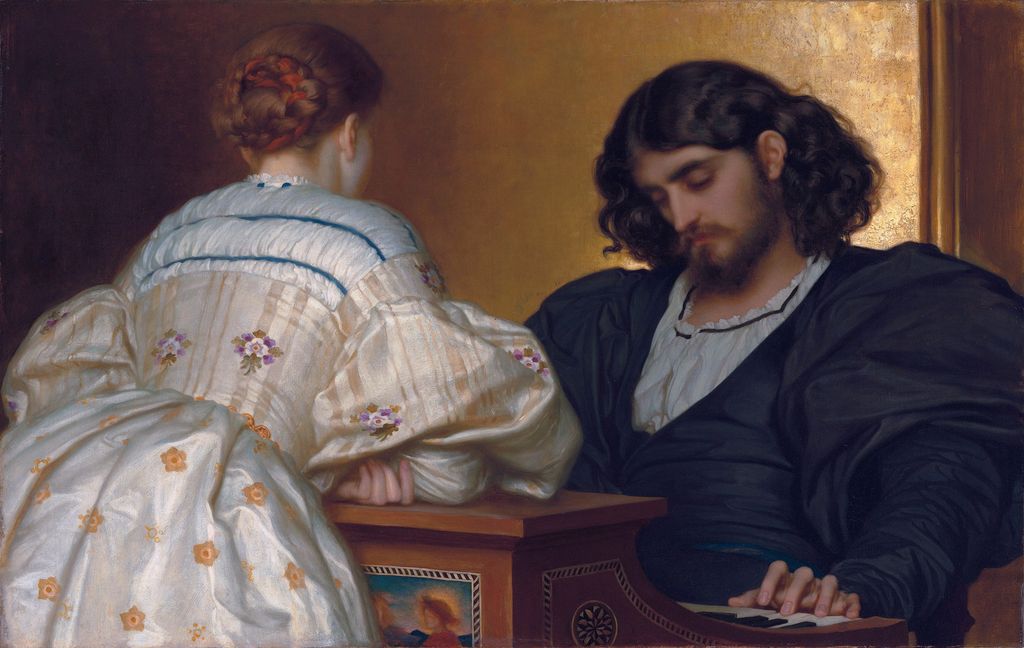
Leighton exhibited Golden Hours in 1864. There, a woman leans over an upright piano with her back to the viewer, while a young man lowers his eyes to the keys. The instrument separates their bodies and gives the listener something to lean on. In The Painter’s Honeymoon the board rests in front of both figures, leaving them free to touch. There is also a difference in what the beholder can imagine. In the music scene one can picture the sound reaching the listener even without seeing her face. In the Boston picture the woman can see what the painter is making, while we, just across the board, have to read the minute changes in attention on their faces and hands. Art historian Marte E. Stinis links the paintings through their attention to private domestic activity. Their similar arrangements let Leighton explore what two people can share when one is absorbed in making something. [1] [2] [5]
Frederic Leighton, Golden Hours, 1864. Image source. Public domain. Resized proportionally.
From a private sale to the exhibition room
In a letter dated 1864 and later printed by Mrs. Russell Barrington, Leighton reports that a Cornhill dealer named Moreby had bought the Honeymoon. In another letter, to his mother, he wonders whether the dealer Ernest Gambart will have it engraved. His wording leaves the engraving in prospect. The sale puts the painting in a dealer’s hands before its recorded Royal Academy appearance in 1866. The reason for that interval remains uncertain. The 1866 catalogue gives the Honeymoon no. 4 in the East Room and lists his portrait of Mrs. James Guthrie three numbers later. In the Middle Room visitors found his large procession of a Syracusan bride, prompted by a passage in Theocritus. The two brides would have offered visitors strikingly different scenes of marriage. In the procession the action is public and there are numerous participants. In the Honeymoon almost everything we know about the marriage comes from the title and the inclination of two heads over a board. [6] [7]
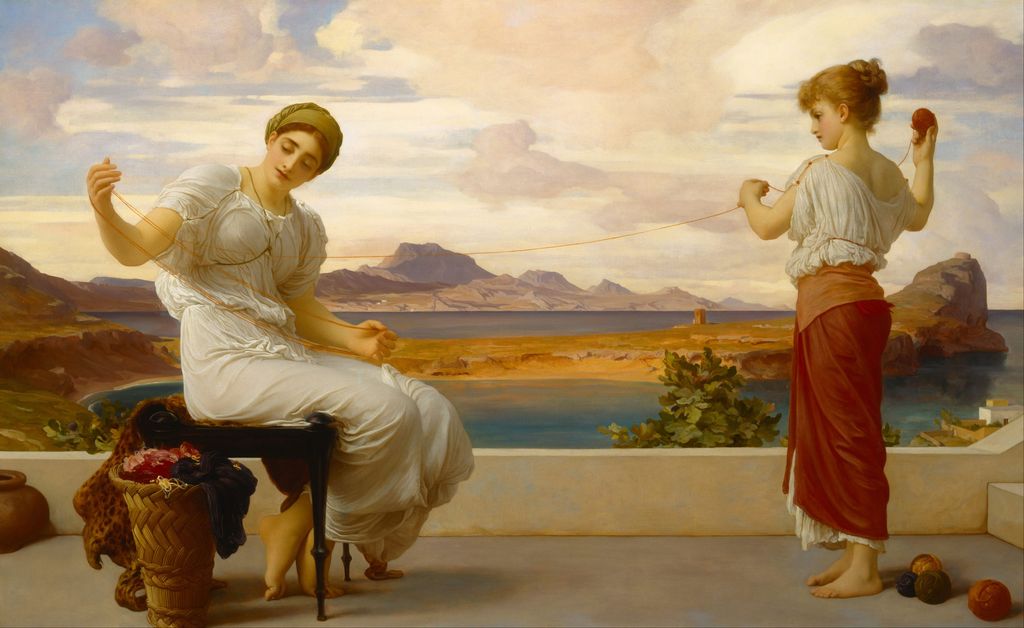
Ernest Rhys also lists the oil at the Grosvenor Gallery’s winter exhibition in 1880, in company with Winding the Skein and its sketch, views of Venice and Florence, and studies of heads, flowers and drapery. A separate chalk study for the Honeymoon, about five inches high, was lent by J. Hanson Walker to the Royal Academy’s memorial exhibition in 1897. There it appeared in a group of three small studies for three different paintings. The Academy catalogue identifies the study’s subject and medium, and the auction essay describes an early version in Renaissance dress. The records leave open whether the references are to the same sheet. The Boston canvas allows us to see what Leighton settled on at full scale. Its two points of contact, the hands and the place where the heads come together, take up very little of the painted surface. Across the room the green dress first catches the eye. Up close, attention passes from the smallest movement of the working hand to the hand that stays still. [1] [2] [8] [9]
Frederic Leighton, Winding the Skein, c. 1878. Art Gallery of New South Wales. Image source. Public domain. Resized without changing the composition.
Browse Frederic Leighton’s artworks
Explore paintings, drawings, sculptures and prints, with separate rows for identified preparatory works, reproductions and casts.
| Name | Date | Medium |
|---|---|---|
| A Girl Feeding Peacocks | Exhibited 1863 | Painting Catalogue. |
| A Recognition from ‘Romola’, engraved by Swain (Tate N04054) | published 1862 | Print Catalogue. |
| A Roman Lady | 1859 | Painting Catalogue. |
| Abram and the Angel (Tate A00733) | published 1881 | Print Catalogue. |
| Acme and Septimius | Exhibited 1868 | Painting Catalogue. |
| An Athlete Wrestling with a Python (Tate exhibition bronze) | 1877 | Sculpture Catalogue. |
| And the Sea Gave Up the Dead Which Were in It (Tate N01511) | 1891–92 | Painting Catalogue. |
| Andromache in Captivity (photogravure after Leighton) | 1889 | Print Catalogue. |
| Athlete Wrestling with a Python (Anglesey Abbey cast) | model 1877; cast 1905 | Sculpture Catalogue. |
| Athlete Wrestling with a Python (Hood reduced cast) | 1877 (inscribed model date) | Sculpture Catalogue. |
| Athlete Wrestling with a Python (Saint Louis reduced cast) | 1877 (museum date) | Sculpture Catalogue. |
| Cain and Abel (Tate A00731) | published 1881 | Print Catalogue. |
| Captive Andromache | 1888 | Painting Catalogue. |
| Cimabue's Celebrated Madonna | 1853–55 | Painting Catalogue. |
| Cimon and Iphigenia, with Many Smaller Subjects (Tate T09061) | date not known | Drawing Catalogue. |
| Crenaia, the Nymph of the Dargle | Exhibited 1880 | Painting Catalogue. |
| Cymon and Iphigenia | 1884 | Painting Catalogue. |
| Daedalus and Icarus | 1869 | Painting Catalogue. |
| Dante in Exile | 1864 | Painting Catalogue. |
| Death of the First Born (Tate A00737) | published 1881 | Print Catalogue. |
| Electra at the Tomb of Agamemnon | c. 1869 | Painting Catalogue. |
| Eliezer and Rebekah (Tate A00735) | published 1881 | Print Catalogue. |
| Elijah in the Wilderness | 1877–78 | Painting Catalogue. |
| Fanny Kemble: A Study for ‘Jezebel and Ahab’ (Tate T08208) | c.1862 | Drawing Catalogue. |
| Figure Studies | Date not recorded | Drawing Catalogue. |
| Flaming June | 1895 | Painting Catalogue. |
| Gulnihal | Exhibited 1886 | Painting Catalogue. |
| Helios and Rhodes (Tate N03015) | date not known | Painting Catalogue. |
| Hercules Wrestling with Death for the Body of Alcestis | c. 1869–71 | Painting Catalogue. |
| Jonathan's Token to David | c. 1868 | Painting Catalogue. |
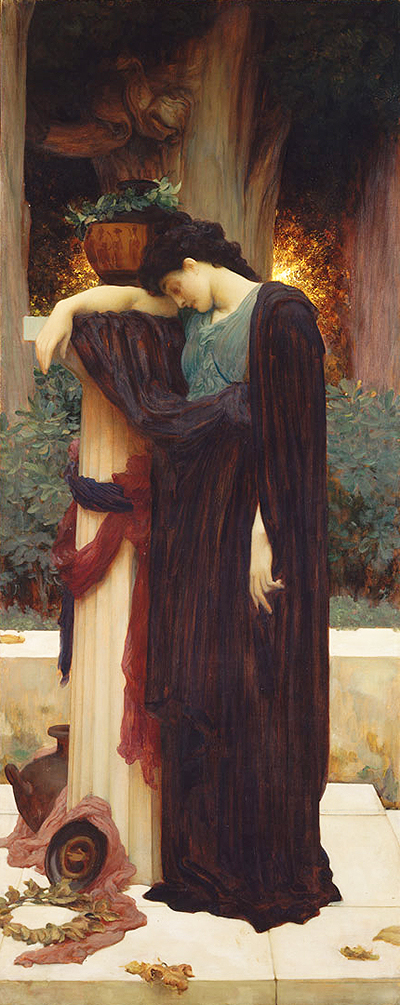
| Lachrymae | 1894–95 | Painting Catalogue. |
| Lieder ohne Worte | Exhibited 1861 | Painting Catalogue. |
| Light of the Harem | Exhibited 1880 | Painting Catalogue. |
| Moses Views the Promised Land (Tate A00736) | published 1881 | Print Catalogue. |
| Mrs James Guthrie | 1865 | Painting Catalogue. |
| Mrs John Hanson Walker (Tate N04731) | 1867 | Painting Catalogue. |
| Music Lesson | 1877 | Painting Catalogue. |
| Needless Alarms (Met cast) | modelled 1886; cast nineteenth century | Sculpture Catalogue. |
| Needless Alarms (Tate N05120) | 1886 | Sculpture Catalogue. |
| Pavonia | c. 1859 | Painting Catalogue. |
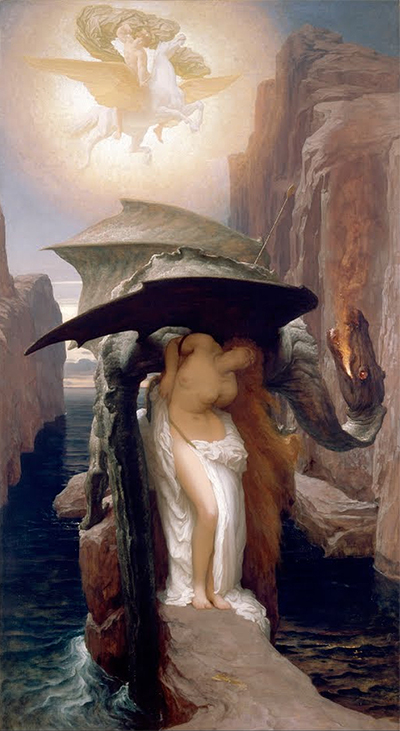
| Perseus and Andromeda | 1891 | Painting Catalogue. |
| Portrait of May Sartoris | c. 1860 | Painting Catalogue. |
| Preparing for a Festa, Florence (Tate T09062) | date not known | Drawing Catalogue. |
| Puerta de los Vientos, near Ronda, Spain (Tate N04006) | c.1886–9 | Painting Catalogue. |
| Samson and the Lions (Tate A00732) | published 1881 | Print Catalogue. |
| Samson at the Mill (Tate A00734) | published 1881 | Print Catalogue. |
| Samson Carrying the Gate (Tate A00738) | published 1881 | Print Catalogue. |
| Sketch for ‘An Athlete Wrestling with a Python’ (Tate N01761) | c.1877 | Sculpture Catalogue. |
| Sketches for Cimon and Iphigenia (Tate T09060) | date not known | Drawing Catalogue. |
| Study for The Return of Persephone (Demeter) | c. 1890–91 | Drawing Catalogue. |
| Study for The Return of Persephone (Persephone) | c. 1890–91 | Drawing Catalogue. |
| Study for ‘Needless Alarms’ (Tate N02945) | 1886 | Sculpture Catalogue. |
| Study for ‘The Discovery of Juliet Apparently Lifeless’ (Tate N01806) | c.1858 | Painting Catalogue. |
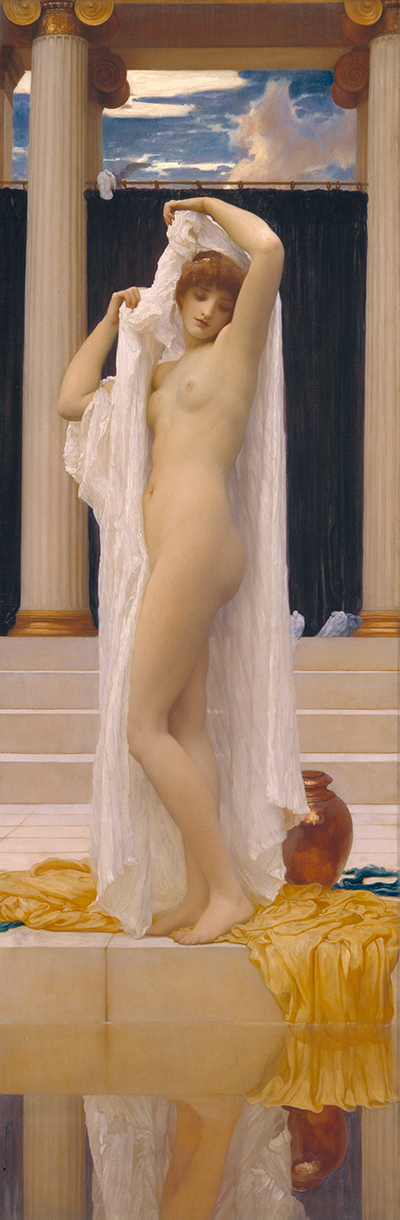
| The Bath of Psyche | Exhibited 1890 | Painting Catalogue. |
| The Daphnephoria | 1874–76 | Painting Catalogue. |
| The Death of Brunelleschi | 1852 | Painting Catalogue. |
| The Fisherman and the Siren | Exhibited 1858 | Painting Catalogue. |
| The Painter's Honeymoon | c. 1864 | Painting Catalogue. |
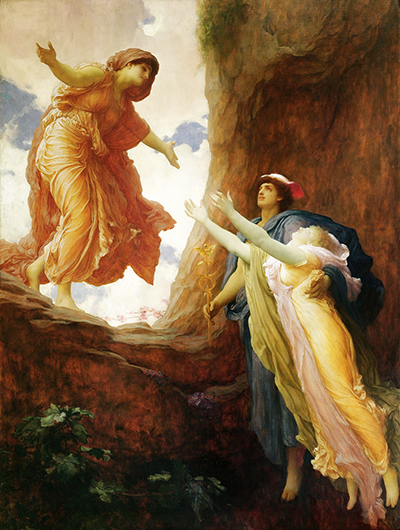
| The Return of Persephone | 1891 | Painting Leeds painting identified in the Met study record. |
| The Return of Persephone (preparatory oil) | c. 1890–91 | Painting Catalogue. |
| The Sluggard (Anglesey Abbey cast) | probably 1890–about 1906 | Sculpture Catalogue. |
| The Sluggard (Met cast) | modelled 1886; cast possibly before 1896 | Sculpture Catalogue. |
| The Sluggard (Museum Wales) | 1882–85 (museum date) | Sculpture Catalogue. |
| The Sluggard (Tate N01752) | 1885 | Sculpture Catalogue. |
| The Spies Escape (Tate A00730) | published 1881 | Print Catalogue. |
| Various Subjects (Tate T09063) | date not known | Drawing Catalogue. |
| View in Capri | Possibly 1859 | Painting Catalogue. |
| Wedded | 1882 | Painting Catalogue. |
| Winding the Skein | c. 1878 | Painting Catalogue. |
Discussion
Look again at the images and ideas explored in The Painter’s Honeymoon. These editorial prompts invite your observations.
Reader Insights
How do the two sets of hands change the way you read the drawing lesson?
What connects the pose in this painting to Leighton’s related pictures of shared creative work?
Join the Conversation
Share a detail, comparison or question about The Painter’s Honeymoon below.
References
- Museum of Fine Arts, Boston, Painter’s Honeymoon, accession 1981.258, museum-contributed AMICA record and image. View source.
- Christie’s, Golden Hours, lot 6011493, catalogue essay and fig. 6, prepared with help from Richard and Leonée Ormond. View source.
- London Museum, Bodice, dress bodice, c. 1864, accession 46.33/10a. View source.
- French Ministry of Culture, Repères mode, section “Entre 1860 et 1869”. View source.
- Marte E. Stinis, Music as Aesthetic Paradigm: Frederic Leighton, Albert Moore, and James McNeill Whistler, University of York, 2021, vol. I, p. 119, and vol. II, fig. 25. View source.
- Mrs. Russell Barrington, The Life, Letters and Work of Frederic Leighton, vol. II (1906), pp. 114–115, 122–123. View source.
- Royal Academy of Arts, The Exhibition of the Royal Academy of Arts, The Ninety-Eighth, 1866, nos. 4 and 7 (East Room) and no. 292 (Middle Room). View source.
- Ernest Rhys, Frederic Lord Leighton: An Illustrated Record of His Life and Work, Appendix I, entries for the Royal Academy in 1866 and the Grosvenor Gallery in 1880. View source.
- Royal Academy of Arts, Exhibition of Works by the Late Lord Leighton of Stretton, Winter Exhibition, 1897, no. 248. View source.