 by Tom Gurney
Tom Gurney BSc (Hons) is an art history expert with over 20 years experience
Published on June 19, 2020 / Updated on November 29, 2026
Email: tomgurney1@gmail.com / Phone: +44 7429 011000
Lachrymae: Introduction
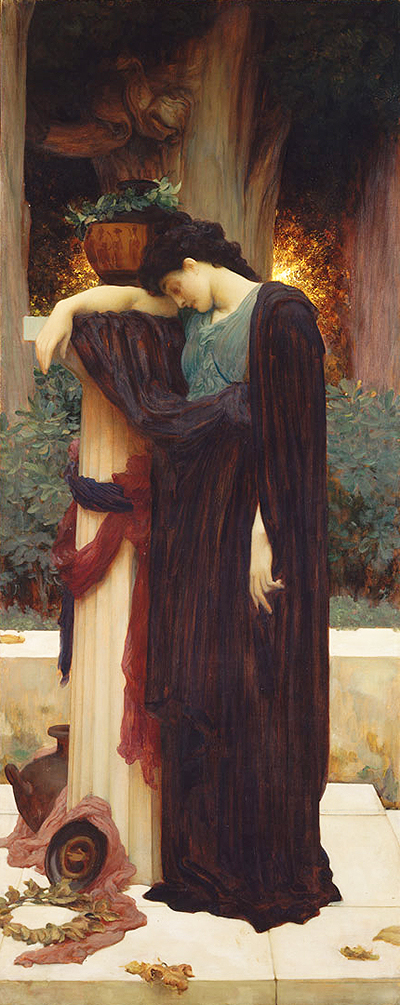
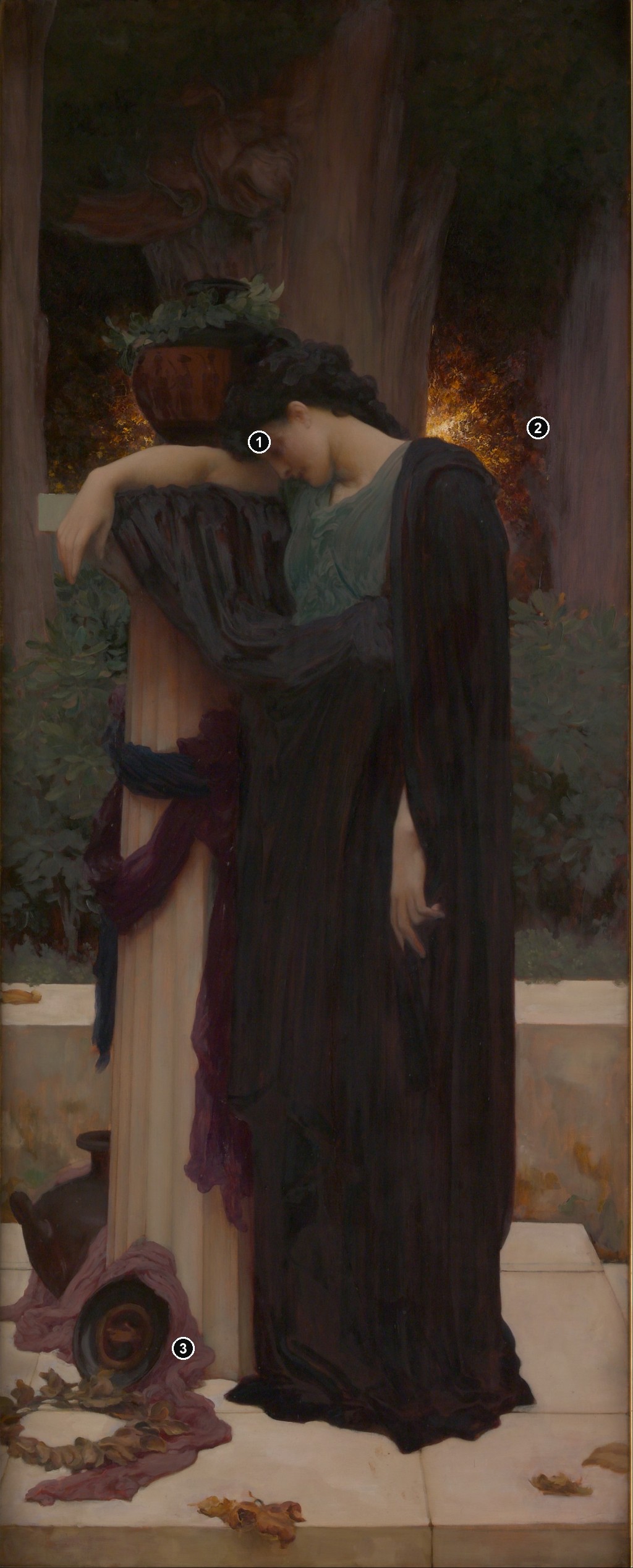
A woman bows her head over an arm resting on a stone column. The long folds of her dark robe reach almost to the ground, where a wreath lies among scattered leaves. Behind her, a sudden flare of light breaks through the trees. Frederic Leighton called the painting Lachrymae, from the Latin for “tears.” The oil on canvas dates from 1894–95, measures 157.5 × 62.9 cm and belongs to the Metropolitan Museum of Art in New York, where it is catalogued as 96.28. [1]
At a Glance
- Painted1894–95
- MediumOil on canvas
- CollectionThe Metropolitan Museum of Art, 96.28
- TitleLatin for tears
This work across Frederic Leighton’s career
Cimabue’s Celebrated Madonna
1853–55Lachrymae (current article)
1894–95 [1]Flaming June
c. 1895Contents
- The figure, the monument and the frame
- Greek vessels and a Victorian stage
- In Leighton’s studio
- At the Royal Academy in 1895
- From London to New York
- Annotated details
The figure, the monument and the frame
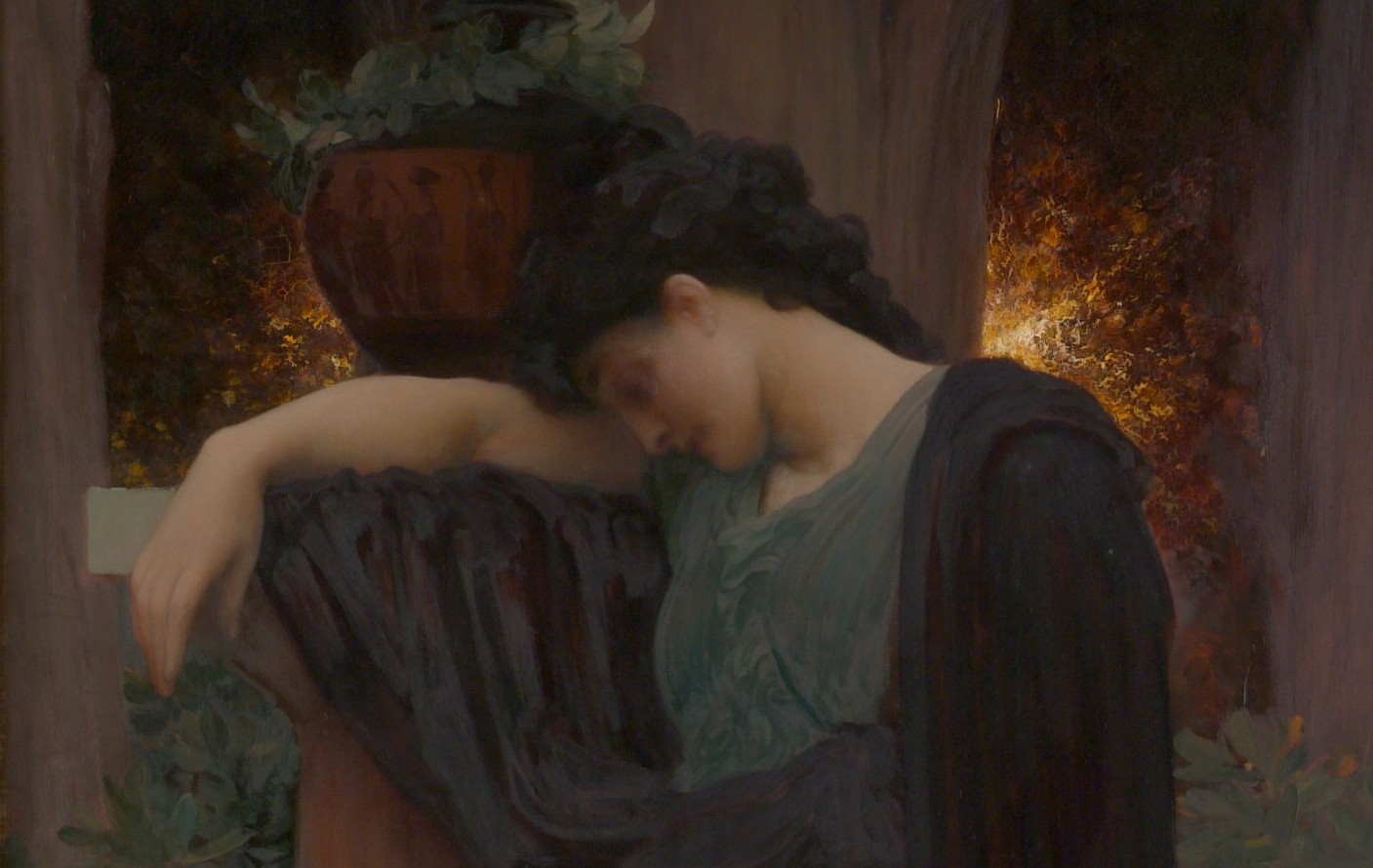
At two and a half times as tall as it is wide, the painting leaves little room to look around the mourner. Her hanging arm, the grooves in the Doric column and the dark trunk behind her all lead the eye downwards. The lighter sleeve and the bend of her supporting arm briefly interrupt that descent. Look below the capital and the dark cloth draped over the stone appears to meet the fabric wrapped around the shaft. Art historian Ciarán Rua O’Neill reads that overlap as a way of binding the woman visually to the column. The pose seems to depend on the architecture around it. [1] [2]
Leighton designed the frame, extending those emphatic verticals into the space around the canvas. The narrow opening between its upright sides has the proportions of a doorway. The straight edges hold the scene close, while the folds and ribbons break up the corresponding lines within the picture. Through that opening we see enough of the stonework to recognise a memorial, and enough of the landscape to see the last strip of brightness behind the figure. [1] [3]
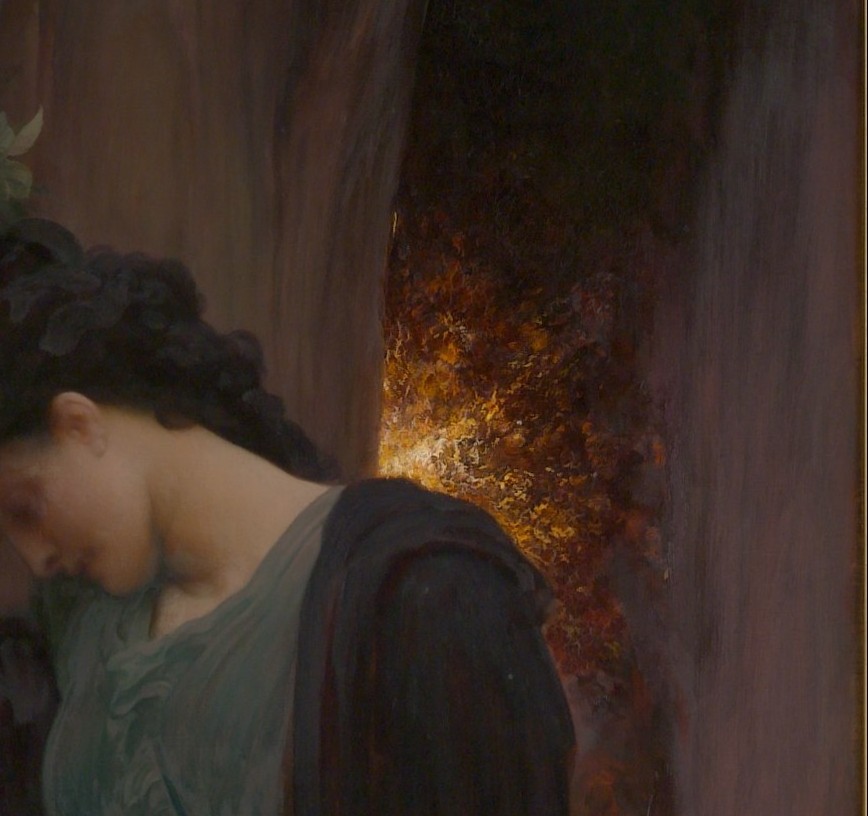
The wreath around the vessel above the column has a counterpart on the ground. The lower wreath has wilted, and the scattered leaves catch against the pale stone. The cypress, which the Met associates with mourning and immortality, holds its dark mass behind the figure as the light fades. The museum allows two readings for the bright area, a funeral fire or a sunset. The thick gold paint catches the eye partly because the stone and drapery nearby are painted so smoothly. Met essayist Jason Rosenfeld reads the light as sunset and connects the smooth finish of the rest of the picture to Leighton’s continental academic training. The burst of light shows how freely the artist could change his handling at a point of emphasis. [1] [4] [5]
Annotated Details from Lachrymae
The numbered points identify visible features discussed in this article. Return from each detail to the numbered overview. Frederic Leighton, Lachrymae, 1894–95. The Metropolitan Museum of Art, Catharine Lorillard Wolfe Collection, Wolfe Fund, 1896. Image source. CC0 / Public domain. Resized without changing the composition.
Details from LACHRYMAE
Compare the cropped details with the source images above. Notice how their colours, shapes and positions contribute to the larger compositions.
The mourner leans against the column
Her forearm lies across the top of the monument. The bowed head and curved arm cross the upright edges of the canvas and column.
Light behind the tree
Warm light emerges beyond the dark vertical trunk and breaks into smaller touches near the figure. The source of that light stays outside the picture.
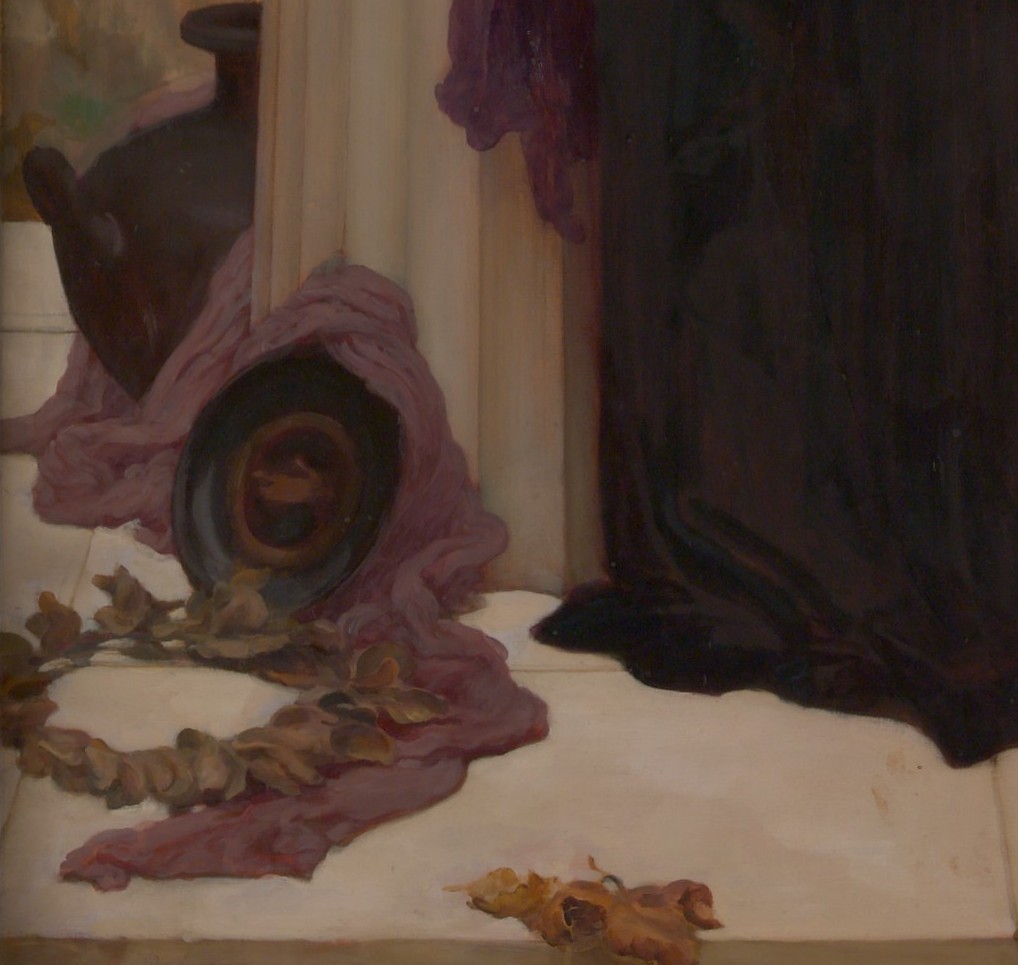
The overturned cup
The cup rests on its side near the base of the monument. The folds, wreath and surrounding stones keep the eye low after the long descent down the dress.
Greek vessels and a Victorian stage
The pottery rewards a close look. Ian Jenkins identifies the wreath-covered vessel on top of the column as a hydria, a form of water jar. It bears a fountain-house scene, which Leighton also used in At the Fountain. At the foot of the monument, a shallow drinking cup, or kylix, lies tipped on its side. The small figure in its round interior is Hermes. Dietrich von Bothmer identified the model for that design as a cup now in the Louvre, and the French Institut national d’histoire de l’art records it as G 471, an Attic red-figure cup with Hermes carrying his herald’s staff. Jenkins also identifies a second type of water jar partly hidden beyond the base. The vessels read as masses of dark colour from a distance, but at close range the tipped cup offers a tiny picture within the larger one. [6] [7]
Jenkins also sees a possible debt to ancient pictures of mourning. Figures gathered at graves appear on fifth-century BCE Attic pottery and fourth-century BCE South Italian vases. The motif is characteristic of Attic white-ground lekythoi, which held oil for offerings at tombs. The resemblance extends to the organisation of the scene, with a monument at the centre of attention and the living figures gathered around it. In Leighton's version a single woman and a few objects carry the whole scene. [6]
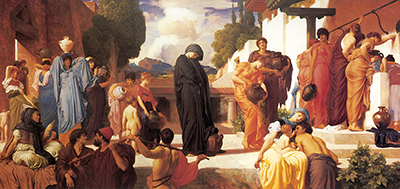
A nearer parallel may lie in the theatre. Leighton helped design scenery and tableaux for productions of G. C. Warr’s adaptations of Greek literature in London in 1886. In the illustrated souvenir Echoes of Hellas, Walter Crane showed Electra and her companions gathered around Agamemnon’s grave monument, drawing on the staged scene. Jenkins suggests that Leighton may have remembered the tableau or Crane’s illustration when he painted Lachrymae. Compare the artist’s own earlier Electra at the Tomb of Agamemnon, in which Electra lifts her arms in an explicit gesture of lament. In Lachrymae the lowered head and resting weight tell us how the woman grieves. Her relationship to the dead is left open. [6]
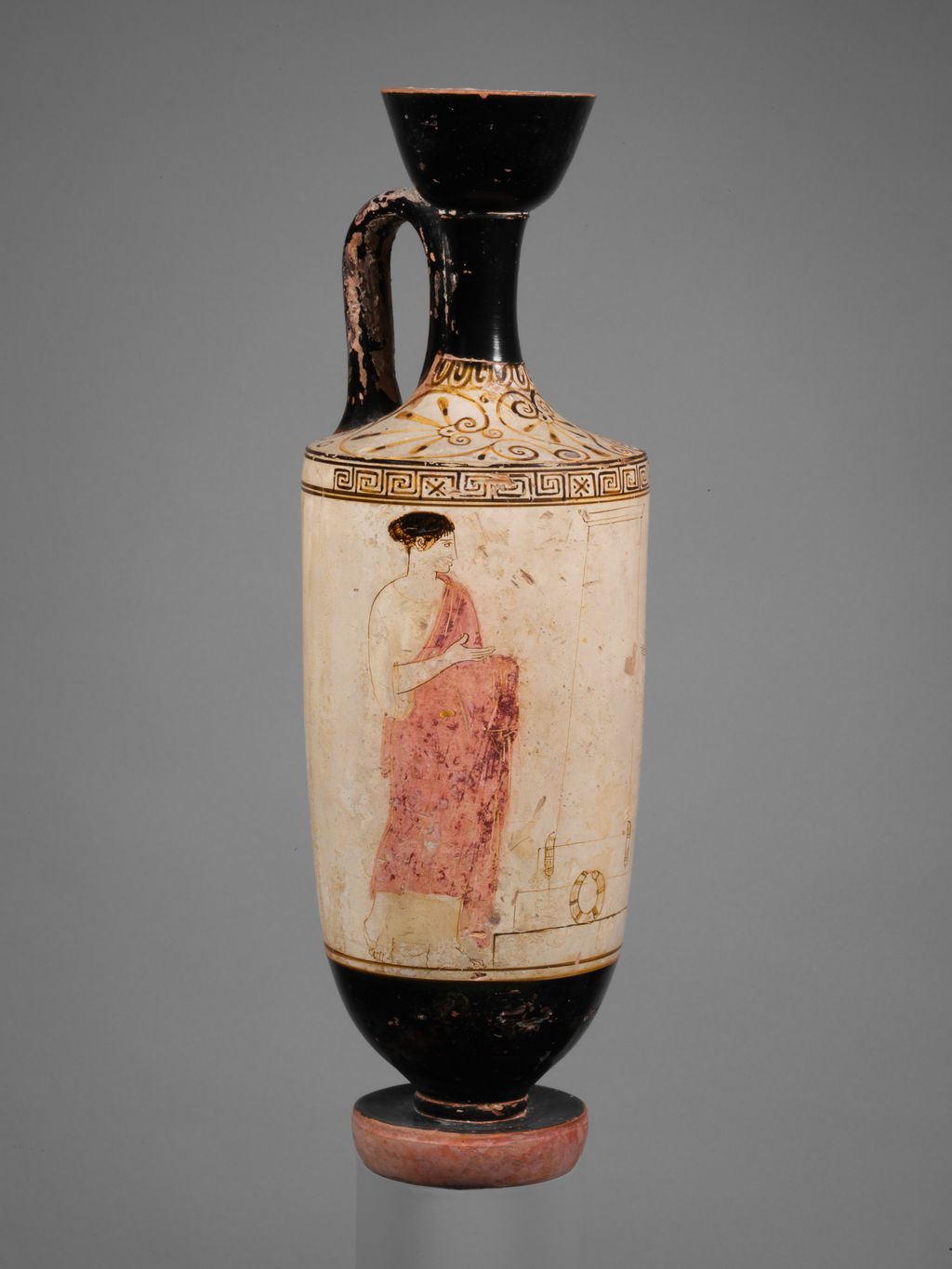
Attic white-ground lekythos attributed to the Thanatos Painter, c. 430 BCE. The Metropolitan Museum of Art, bequest of Walter C. Baker, 1971. This example shows the Greek funerary subject described above. Image source. CC0 / Public domain. Resized without changing the composition.
In Leighton’s studio
Leighton worked out the mourner's head separately. His biographer Emilie Barrington reproduced a study from the Leighton House collection in 1906. Another head study, made in charcoal and white chalk with pencil, passed from Leighton’s sisters to the Fine Art Society in 1896. The society lent chalk studies for the painting to the Royal Academy’s winter exhibition of 1897, and Sotheby’s has proposed that its sheet was among them. Leighton House associates the painting with Mary Lloyd, who also posed for the seated figure in his 1895 painting ’Twixt Hope and Fear. [8] [9] [10] [11]
The background drew on a much longer stock of observations. Barrington records that Leighton reused a brown watercolour study he had signed in Florence in 1854. She also identifies the same study in a separate design worked up in pencil and white. Nearly four decades after Leighton made the study, the tree-filled setting gave him a new use for that earlier observation. Here the dark tree hides most of the light, and that concealment determines how we see the foreground figure. [1] [8]
At the Royal Academy in 1895
Lachrymae was number 182 at the Royal Academy’s 1895 summer exhibition at Burlington House. Henry Blackburn’s illustrated exhibition guide drew attention to the colour within the dark figure, describing a pale blue-green garment beneath her black outer robe and violet and purple bands on the pillar. Ernest Rhys likewise noticed black and blue-green drapery in his account of the six works Leighton sent that year. These descriptions recover nuances easy to miss in a small reproduction, especially where cloth and shadow almost merge. [4] [5] [12] [13]
In The Academy, critic Claude Phillips singled out the choice of vessel. He wondered whether a painted earthenware vase of the fifth century BCE would have stood on a marble half-column, and whether Leighton meant it to be a marble urn decorated like pottery. Phillips preferred Leighton’s reading figure, The Maid with the Golden Hair, for the ease of its pose. The question about the urn points to a distinction that matters in Leighton’s other classical paintings, too. As Jenkins shows, the artist drew freely on Greek shapes and decoration, often combining features from different objects. Here the prominent vessel needs to be legible both as pottery and as an urn that identifies the column as a grave marker. [6] [14]
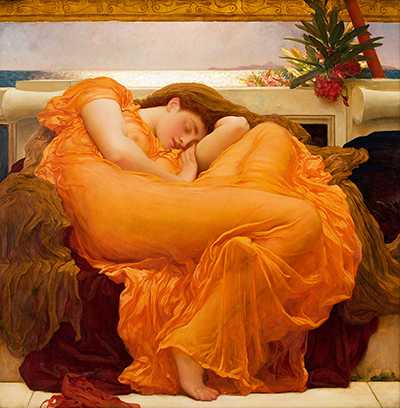
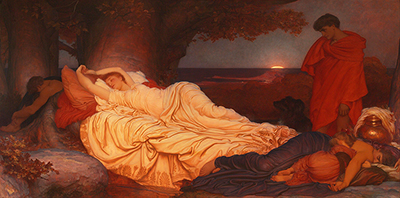
Flaming June, exhibited as number 195, presented another kind of stillness to visitors that year. The sleeper fits into a square, folded into a circle of orange fabric against a shining sea. In Lachrymae the body stays on its feet, pitched slightly towards stone, and the warm light is largely hidden. Art historian Elizabeth Prettejohn observes that many 1895 critics gave greater weight to the classicism of Lachrymae, even as they recognised the striking orange of Flaming June. Light is equally active in Leighton’s last painting, Clytie, whose protagonist throws back her head and stretches towards the sun. The bowed head in Lachrymae gives the dwindling brightness a different force. The light comes into view over the shoulder of a woman whose eyes are on the ground. [8] [12] [15] [16] [17]
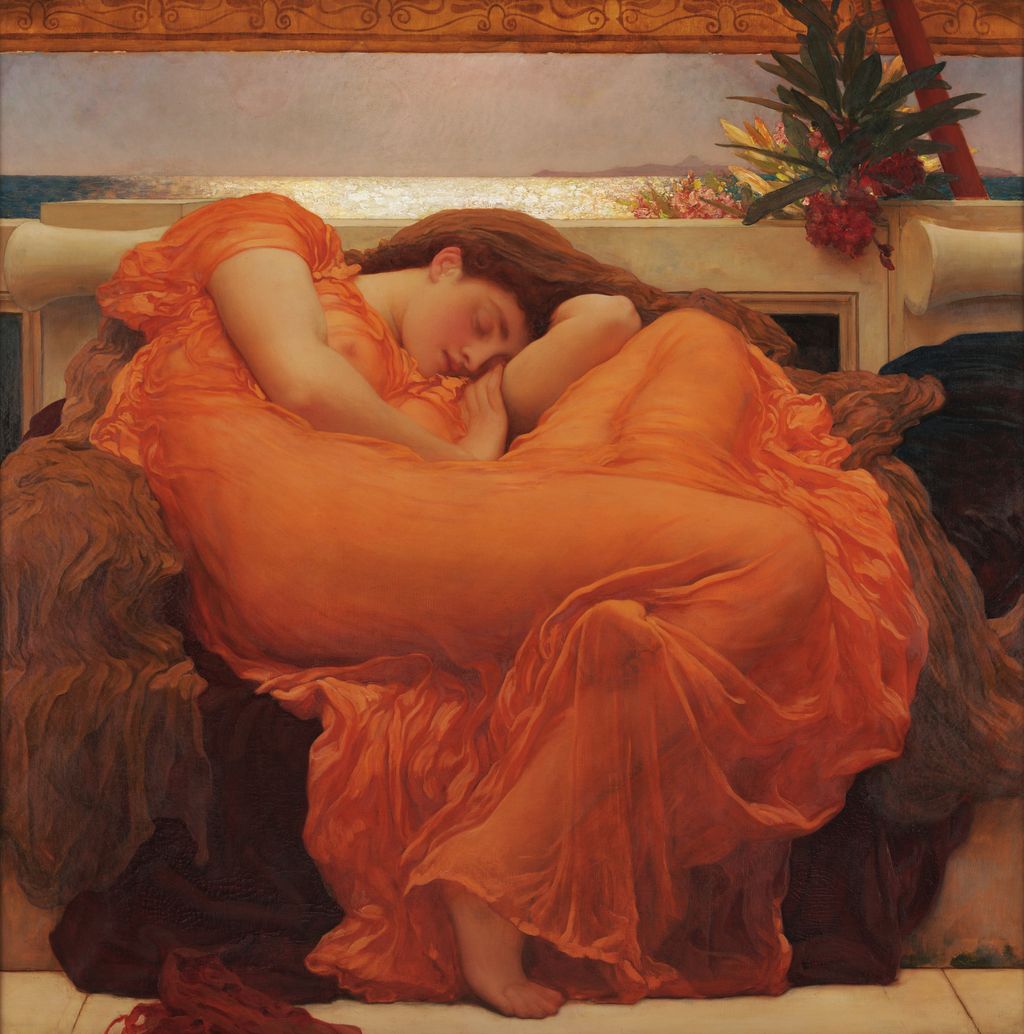
Frederic Leighton, Flaming June, exhibited 1895. Museo de Arte de Ponce. Image source. Public domain. Resized without changing the composition.
From London to New York
The Met’s early catalogue records that the museum bought Lachrymae from Arthur Tooth & Son on 6 April 1896, using income from the Catharine Lorillard Wolfe Endowment Fund. The purchase came less than a year after the painting's Academy exhibition. Wolfe had died in 1887. Her bequest included both the paintings she had collected and a fund for their care and for new acquisitions. Her original bequest already included Lucia, a small head study in oil by Leighton. The fund allowed the museum to add one of his last exhibition pictures. [1] [4] [18] [19]
When the Museo de Arte de Ponce lent Flaming June to the Met for an installation that ran from 2022 to 2024, the museum hung the two oils side by side. The paintings had first been shown together in Leighton’s studio in 1895. The Met described its installation as their first display directly beside one another. That arrangement made the comparison unusually immediate. From the broad sweep of orange in Flaming June, the eye had only a short distance to travel to find the thin streak of gold in Lachrymae. [20] [21]
Browse Frederic Leighton’s artworks
Explore paintings, drawings, sculptures and prints, with separate rows for identified preparatory works, reproductions and casts.
| Name | Date | Medium |
|---|---|---|
| A Girl Feeding Peacocks | Exhibited 1863 | Painting Catalogue. |
| A Recognition from ‘Romola’, engraved by Swain (Tate N04054) | published 1862 | Print Catalogue. |
| A Roman Lady | 1859 | Painting Catalogue. |
| Abram and the Angel (Tate A00733) | published 1881 | Print Catalogue. |
| Acme and Septimius | Exhibited 1868 | Painting Catalogue. |
| An Athlete Wrestling with a Python (Tate exhibition bronze) | 1877 | Sculpture Catalogue. |
| And the Sea Gave Up the Dead Which Were in It (Tate N01511) | 1891–92 | Painting Catalogue. |
| Andromache in Captivity (photogravure after Leighton) | 1889 | Print Catalogue. |
| Athlete Wrestling with a Python (Anglesey Abbey cast) | model 1877; cast 1905 | Sculpture Catalogue. |
| Athlete Wrestling with a Python (Hood reduced cast) | 1877 (inscribed model date) | Sculpture Catalogue. |
| Athlete Wrestling with a Python (Saint Louis reduced cast) | 1877 (museum date) | Sculpture Catalogue. |
| Cain and Abel (Tate A00731) | published 1881 | Print Catalogue. |
| Captive Andromache | 1888 | Painting Catalogue. |
| Cimabue's Celebrated Madonna | 1853–55 | Painting Catalogue. |
| Cimon and Iphigenia, with Many Smaller Subjects (Tate T09061) | date not known | Drawing Catalogue. |
| Crenaia, the Nymph of the Dargle | Exhibited 1880 | Painting Catalogue. |
| Cymon and Iphigenia | 1884 | Painting Catalogue. |
| Daedalus and Icarus | 1869 | Painting Catalogue. |
| Dante in Exile | 1864 | Painting Catalogue. |
| Death of the First Born (Tate A00737) | published 1881 | Print Catalogue. |
| Electra at the Tomb of Agamemnon | c. 1869 | Painting Catalogue. |
| Eliezer and Rebekah (Tate A00735) | published 1881 | Print Catalogue. |
| Elijah in the Wilderness | 1877–78 | Painting Catalogue. |
| Fanny Kemble: A Study for ‘Jezebel and Ahab’ (Tate T08208) | c.1862 | Drawing Catalogue. |
| Figure Studies | Date not recorded | Drawing Catalogue. |
| Flaming June | 1895 | Painting Catalogue. |
| Gulnihal | Exhibited 1886 | Painting Catalogue. |
| Helios and Rhodes (Tate N03015) | date not known | Painting Catalogue. |
| Hercules Wrestling with Death for the Body of Alcestis | c. 1869–71 | Painting Catalogue. |
| Jonathan's Token to David | c. 1868 | Painting Catalogue. |
| Lachrymae | 1894–95 | Painting Catalogue. |
| Lieder ohne Worte | Exhibited 1861 | Painting Catalogue. |
| Light of the Harem | Exhibited 1880 | Painting Catalogue. |
| Moses Views the Promised Land (Tate A00736) | published 1881 | Print Catalogue. |
| Mrs James Guthrie | 1865 | Painting Catalogue. |
| Mrs John Hanson Walker (Tate N04731) | 1867 | Painting Catalogue. |
| Music Lesson | 1877 | Painting Catalogue. |
| Needless Alarms (Met cast) | modelled 1886; cast nineteenth century | Sculpture Catalogue. |
| Needless Alarms (Tate N05120) | 1886 | Sculpture Catalogue. |
| Pavonia | c. 1859 | Painting Catalogue. |
| Perseus and Andromeda | 1891 | Painting Catalogue. |
| Portrait of May Sartoris | c. 1860 | Painting Catalogue. |
| Preparing for a Festa, Florence (Tate T09062) | date not known | Drawing Catalogue. |
| Puerta de los Vientos, near Ronda, Spain (Tate N04006) | c.1886–9 | Painting Catalogue. |
| Samson and the Lions (Tate A00732) | published 1881 | Print Catalogue. |
| Samson at the Mill (Tate A00734) | published 1881 | Print Catalogue. |
| Samson Carrying the Gate (Tate A00738) | published 1881 | Print Catalogue. |
| Sketch for ‘An Athlete Wrestling with a Python’ (Tate N01761) | c.1877 | Sculpture Catalogue. |
| Sketches for Cimon and Iphigenia (Tate T09060) | date not known | Drawing Catalogue. |
| Study for The Return of Persephone (Demeter) | c. 1890–91 | Drawing Catalogue. |
| Study for The Return of Persephone (Persephone) | c. 1890–91 | Drawing Catalogue. |
| Study for ‘Needless Alarms’ (Tate N02945) | 1886 | Sculpture Catalogue. |
| Study for ‘The Discovery of Juliet Apparently Lifeless’ (Tate N01806) | c.1858 | Painting Catalogue. |
| The Bath of Psyche | Exhibited 1890 | Painting Catalogue. |
| The Daphnephoria | 1874–76 | Painting Catalogue. |
| The Death of Brunelleschi | 1852 | Painting Catalogue. |
| The Fisherman and the Siren | Exhibited 1858 | Painting Catalogue. |
| The Painter's Honeymoon | c. 1864 | Painting Catalogue. |
| The Return of Persephone | 1891 | Painting Leeds painting identified in the Met study record. |
| The Return of Persephone (preparatory oil) | c. 1890–91 | Painting Catalogue. |
| The Sluggard (Anglesey Abbey cast) | probably 1890–about 1906 | Sculpture Catalogue. |
| The Sluggard (Met cast) | modelled 1886; cast possibly before 1896 | Sculpture Catalogue. |
| The Sluggard (Museum Wales) | 1882–85 (museum date) | Sculpture Catalogue. |
| The Sluggard (Tate N01752) | 1885 | Sculpture Catalogue. |
| The Spies Escape (Tate A00730) | published 1881 | Print Catalogue. |
| Various Subjects (Tate T09063) | date not known | Drawing Catalogue. |
| View in Capri | Possibly 1859 | Painting Catalogue. |
| Wedded | 1882 | Painting Catalogue. |
| Winding the Skein | c. 1878 | Painting Catalogue. |
Discussion
Look again at the images and ideas explored in Lachrymae. These editorial prompts invite your observations.
Reader Insights
Which small detail makes the scale of the woman’s grief feel most immediate?
How does the narrow canvas change the way you look at the column and trees?
Join the Conversation
Share a detail, comparison or question about Lachrymae below.
References
- The Metropolitan Museum of Art, Lachrymae, object 96.28. View source.
- Ciarán Rua O’Neill, Bearing the Impossible: The Caryatid in Britain, 1790–1914, University of York doctoral thesis, 2018, chapter 4, pp. 183–84 and figs. 4.13–16. View source.
- The Frame Blog, Olympian frames: Frederic, Lord Leighton, section on aedicular frames. View source.
- The Metropolitan Museum of Art, Catalogue of the Paintings in the Metropolitan Museum of Art, no. 340, pp. 100–101. View source.
- Jason Rosenfeld, The Salon and the Royal Academy in the Nineteenth Century, The Metropolitan Museum of Art, 2004. View source.
- Ian Jenkins, “Frederic Lord Leighton and Greek Vases,” The Burlington Magazine, vol. 125, no. 967, 1983, especially p. 601 and note 14. View source.
- Institut national d’histoire de l’art, Coupe attique à figures rouges, Louvre G 471 (in French). View source.
- Emilie Russell Barrington, The Life, Letters and Work of Frederic Leighton, vol. 2, 1906, plate 76 and appendix on the Leighton House sketches. View source.
- Royal Academy of Arts, 1897 winter exhibition catalogue, no. 219, p. 42. View source.
- Sotheby’s, Study for Lachrymae, London, 14 July 2016, lot 2. View source.
- Leighton House, The Women Who Made Us, section on Mary Lloyd. View source.
- Henry Blackburn, ed., Academy Notes, 1895, nos. 182 and 195. View source.
- Ernest Rhys, Frederic Lord Leighton: An Illustrated Record of His Life and Work, chapter V, “Year by Year—1878 to 1896,” and appendix I. View source.
- Claude Phillips, “The Royal Academy,” The Academy, vol. 47, no. 1203, 25 May 1895, p. 449. View source.
- Elizabeth Prettejohn, 1895: Frederic Leighton’s Last Academy, Royal Academy Summer Exhibition Chronicle. View source.
- Museo de Arte de Ponce, Flaming June, object 63.0406. View source.
- Leighton House, Frederic Leighton’s Flaming June: The Making of an Icon, “Model and muse”. View source.
- Deborah Vincelli, (Re)Discover Early Met Collection Catalogues at Watson Library, The Metropolitan Museum of Art, 2020. View source.
- The Metropolitan Museum of Art, Lucia, object 87.15.79. View source.
- The Metropolitan Museum of Art, Victorian Masterpieces from the Museo de Arte de Ponce, Puerto Rico, exhibition overview. View source.
- The Metropolitan Museum of Art, Última oportunidad para ver cinco obras maestras victorianas del Museo de Arte de Ponce, 9 January 2024 (in Spanish). View source.