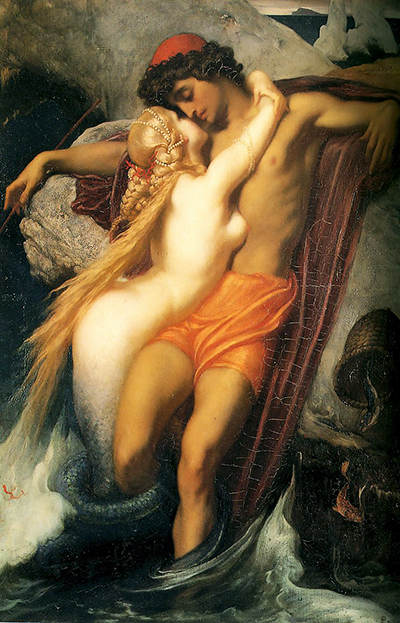
 by Tom Gurney
Tom Gurney BSc (Hons) is an art history expert with over 20 years experience
Published on June 19, 2020 / Updated on November 29, 2026
Email: tomgurney1@gmail.com / Phone: +44 7429 011000
Frederic Leighton Biography: Introduction
By December 1859, Frederic Leighton had taken a studio in Bayswater. Writing to Edward von Steinle, his old teacher in Frankfurt, he considered the prospect of spending his first English winter since early childhood. He had worried about the climate, but London fog had done less to dampen his spirits than he had expected. Getting established was a more practical problem. The studio was narrow and dark compared with his rooms in Paris and Rome, and he was paying five shillings each time a model sat for him. Four years earlier Queen Victoria had bought his first Royal Academy exhibit. His letters show what it took to turn that success into a working life in London. [1] [2]
Leighton would go on to preside over the Royal Academy for seventeen years. The position gave him a public standing that few British artists had enjoyed, even as the work he did in the studio ranged further from what the 1855 exhibition might have led viewers to expect. Alongside grand processions came pictures of musicians, solitary figures absorbed in thought, and a life-size bronze of a man struggling to free himself from a snake. His artistic education, the friends and patrons he met abroad, and the demands of representing British art all help explain the breadth of that career. [3] [4] [5]
At a Glance
- BirthScarborough, 3 December 1830
- Major debutRoyal Academy exhibition of 1855
- London baseSettled in 1859
- DeathLondon, 25 January 1896
Frederic Leighton in context
Royal Academy exhibitions
1855–96 [3]London’s Aesthetic Movement
c. 1860–1900 [39]Leighton’s Academy presidency
1878–96 [3]Frederic Leighton
1830–96 [3]Giovanni Costa
1826–1903 [40]George Aitchison
1825–1910 [24]Contents
- Continental training and Rome, 1830–1859
- Establishing himself in London, 1859–1878
- Academy presidency and the mature studio, 1878–1893
- Final years and reputation, 1893 onward
Continental training and Rome, 1830–1859
Frederic Leighton was born in Scarborough on 3 December 1830. His father was a doctor, and his grandfather had made the family fortune as a physician at the Russian imperial court in St Petersburg. When Leighton was eleven, the family moved abroad for his mother's health. Frequent changes of scene gave him an early education in languages and in European art. They also put a practical choice before his parents. Looking back in 1879, Leighton recalled that they had given him opportunities to learn to draw while expecting a high standard of achievement if he meant to make a profession of it. His father's financial support gave him room to pursue that ambition. [3] [6]
He attended the academy in Florence in the winter of 1845–46 before continuing his training in Frankfurt. At the Städelsches Kunstinstitut he studied with Steinle, who took up the professorship of history painting in 1850. Steinle had worked among the Nazarenes in Rome, a circle that looked to early Italian and German painting for models of Christian art. His own work placed a high value on the expressive power of line and the preparation of large compositions through drawings. A decade later Leighton still asked Steinle for the frankest criticism he could give. In January 1860 he told his teacher that, however strongly he felt the appeal of colour, he had resolved to master drawing first. [1] [6] [7] [8]
Rome offered a different education. In 1853 Leighton met Adelaide Sartoris, the former opera singer whose hospitality brought him into a circle of artists, writers and collectors. He became close to Adelaide and her husband Edward and met figures such as Henry Greville and the poet Robert Browning through their circle. Giovanni Costa, the Roman painter who later recalled how much the Sartorises had meant to Leighton, became a friend for the rest of his life. Adelaide's friendship continued across Leighton's years in Rome and Paris and after he returned to England. It brought companionship as well as access to people who could help an ambitious young painter find an audience. [9] [10] [11]
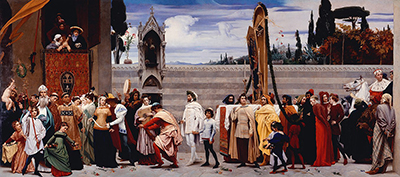
The scale of that ambition was evident in Cimabue's Celebrated Madonna, painted between 1853 and 1855. Across a canvas more than five metres wide, Leighton marshalled clergy, children and musicians around a Madonna borne through Florence. He took the story from Giorgio Vasari, whose account identified the elder painter leading the procession as Cimabue. The panel itself, now in the Uffizi, was commissioned from Duccio in 1285. Leighton's subject was the story still told in his day, in which an artist and his work could command the attention of an entire city. On 3 May 1855, following a visit to the Royal Academy show, Queen Victoria recorded in her diary that Prince Albert's enthusiasm had persuaded her to buy the picture. [2] [12]
Leighton spent much of the next few years based in Paris. The exuberance of the Florentine procession proved difficult to follow. The Triumph of Music, sent to the Academy in 1856, treated Orpheus's descent to the underworld, and critics took issue with such choices as giving the ancient musician a violin. The patrons and friends of the early years did practical work behind the scenes. In an April letter printed by Barrington among the correspondence concerning the 1856 exhibition, Greville told Leighton that he and Adelaide had gone to the dealer Colnaghi to see whether a painting of Romeo and Juliet could be brought to the attention of the royal household. Greville's letter describes a bid to repeat the success of Cimabue with a different painting. Meanwhile, in Paris Leighton and the French sculptor Henry de Triqueti both benefited from the patronage of the British ambassador, Henry Wellesley. Leighton gave Triqueti two drawings when the sculptor's daughter Blanche married in 1858. One was a study for The Triumph of Music, a work whose fortunes in the exhibition room reveal only part of its place in his life. [9] [13] [14] [15]
An encounter with the next generation of the royal family followed. Leighton returned to Rome in autumn 1858, and the young Prince of Wales visited his studio during a tour of the city. Anna Risi, known as La Nanna, sat to Leighton repeatedly during this period. In Nanna (Pavonia) he painted her looking down, with pearls in her dark hair and peacock feathers behind her. The work is signed and dated 1859. The Royal Collection records that George de Monbrison bought it from Leighton and that the Prince acquired it from de Monbrison that year. The picture passed into royal hands through an intermediary, some four years after Victoria's purchase at the Academy. The future Edward VII also acquired a second, similarly sized picture, Bianca, painted in 1862. [1] [16] [17]
Before settling in London, Leighton spent several weeks on Capri in 1859. He made oil studies in the open air, exploring how the same terrain took on different shapes and colours with the changing light. In his December letter to Steinle he paired his account of the island with his excitement at seeing the Temple of Neptune at Paestum. He was fascinated by what a particular place did to the eye, whether he stood in front of an ancient building or looked across a rocky headland. That habit of looking travelled with him. In Scotland that same year, when rain made long sessions outdoors impractical, he stored impressions of light and weather and made brief oil sketches from memory at Dunkeld. [1] [18] [19]
Four stages of Frederic Leighton’s career
These periods group related developments; painting, travel and local work overlap across their boundaries.
Learning in continental Europe
Born in Scarborough, Leighton trained in several European cities. His work in Frankfurt with Edward von Steinle preceded his first independent period in Rome.[3]
A Florentine procession on a monumental scale
Leighton’s Royal Academy debut in 1855 brought royal patronage. He made the procession into a wide, densely populated demonstration of what a history painting could do.[2]
From London pictures to sculpture in the round
Leighton became a full Academician in 1868. His exhibited sculpture of an athlete and a python gave his study of the figure a new medium in 1877.[26]
An Academy president whose art kept changing
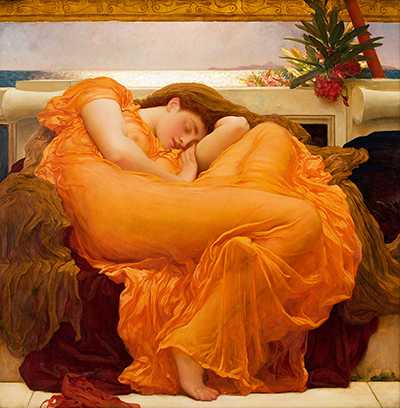
Leighton was elected president in 1878. His last Academy season during his lifetime brought the concentrated designs of Flaming June and Lachrymae before the same audience.[33]
Establishing himself in London, 1859–1878
Leighton returned to London in 1859 and was working at 2 Orme Square by the time he wrote to Steinle in December that he was permanently established in England. He continued to travel, but London became the place from which he sent work to exhibitions, kept up with patrons and saw his pictures together. Around 1860 he painted Adelaide's daughter, May Sartoris. Her hands rest at her waist and her eyes are turned away, with fields, a windmill and a church behind her. The country setting has been tentatively associated with the family's home in Hampshire. Leighton would paint her again in later years, after her marriage in 1871. [1] [3] [10]
His early London work broadened the kinds of subjects an Academy audience might associate with him. In Lieder ohne Worte, exhibited in 1861, the German title means “Songs Without Words.” It invites the viewer to attend to the figure, the setting and their arrangement as one might attend to a musical phrase. Art historian Marte Stinis has traced how Leighton, Albert Moore and James McNeill Whistler drew on music in thinking about the organisation and effects of painting. Leighton's own familiarity with performance gave him a personal route into the question. He sang, kept a piano in his studio and later held concerts there. His friendship with Sartoris connected the music of the salon with the choices he made as a painter. [3] [11] [14]
He also drew for illustrated periodicals. Readers of the Cornhill Magazine encountered his designs for George Eliot's Romola as the novel was serialised in 1862–63. Wood engravers including Joseph Swain and W. J. Linton translated his compositions for publication. In the design for the deathbed scene in chapter ten, for example, downcast figures and candlelight carry the drama in a small image beside the printed text. His knowledge of Renaissance Florence, which had served a five-metre canvas in 1855, found a different outlet in pictures made to be read at close quarters. [2] [20]
London was also a place where Leighton could return favours. In the early 1860s he introduced Costa to British artists including George Frederic Watts and Edward Burne-Jones. Watts had met Leighton in 1855, and the friendship, documented in a substantial surviving correspondence, lasted until Leighton's death. Another circle grew out of the Hogarth Club, where Leighton met the banker James Stuart Hodgson, who joined in 1859. Hodgson collected his work for decades. That enduring relationship would lead to a substantial decorative commission once the banker had a new London house. [21] [22] [23]
Within the Royal Academy, Leighton's standing grew through service as well as through exhibitions. He was elected an Associate on 20 July 1864 and a full Academician on 30 June 1868. From 1869 he taught as a visiting artist in the Life School and School of Painting and served on the Academy Council at various points. In 1866 he moved into his purpose-built studio-house in Holland Park Road, designed by George Aitchison. It gave him the space and light he had missed in Bayswater and a place to receive patrons and friends alongside work in progress. [1] [3] [5] [24]
The London base made it possible to undertake long projects and leave England for months at a time. He toured Spain in 1866, visited Turkey in 1867 and Egypt in 1868, and reached Damascus in 1873. His account of the Nile journey describes evening light moving from orange to violet and indigo, with the banks and hills reflected in the water. He also recorded the practical interruptions to sketching, including the heat that made him ill on a visit to Philae. The detail of such observations has a parallel in the work of Leighton's scientific acquaintances. Art historian Pola Durajska has placed his outdoor painting alongside contemporary investigations of natural light and colour, including those of the physicist John Tyndall. The trips also brought him into contact with Islamic ceramics and textiles. Tiles collected in the eastern Mediterranean, supplemented by purchases made on his behalf, became part of the Arab Hall that he commissioned from Aitchison in 1877. [1] [19] [24] [25]
Two works shown in 1871 give a sense of how much variety Leighton found within classical subjects. In Greek Girls Picking up Pebbles by the Sea, the bending and stooping figures make an ordinary action seem measured and deliberate. Hercules Wrestling with Death for the Body of Alcestis calls for force, with two bodies locked against one another as Hercules tries to wrest Alcestis from Death. By 1877 Leighton had taken a comparable physical problem into sculpture. He worked with the help of Thomas Brock on An Athlete Wrestling with a Python. The body twists against the coils, and a viewer walking around the bronze sees the contest change as different parts of the snake come into view. The work was shown at the Royal Academy that year and entered the national collection through the Chantrey Bequest. [3] [4] [26]
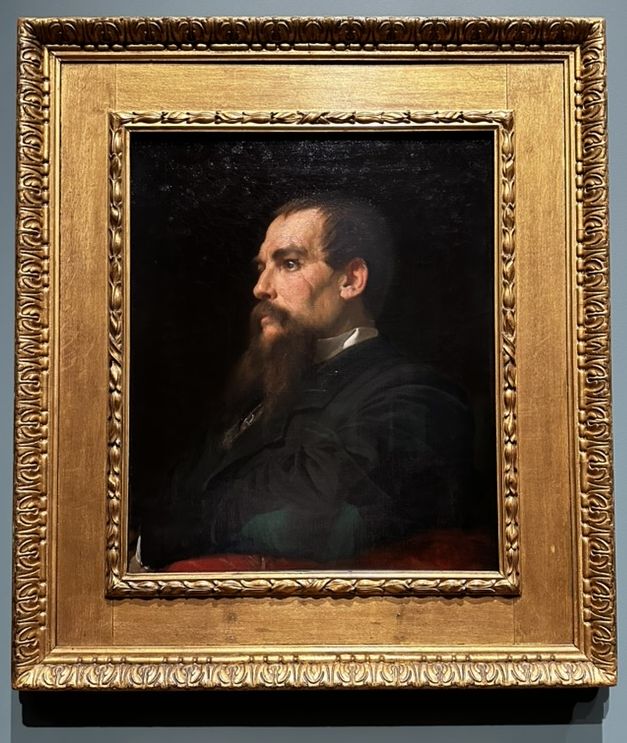
Frederic Leighton’s portrait of Sir Richard Francis Burton, National Portrait Gallery, NPG 1070. My photo from the National Portrait Gallery, London, on 5 November 2026. Image source. Public domain. Gallery photograph cropped to show the framed portrait.
Academy presidency and the mature studio, 1878–1893
The year 1878 brought Leighton two presidencies. At the Paris Exposition Universelle he headed the international jury section for painting and drawing. In a letter to his father he explained that French artists made up half the panel and treated their choice of a foreign chair as a courtesy. Back in London he was elected President of the Royal Academy on 10 December and held the office until his death. He was knighted in 1878, became a baronet in 1886 and sat as a trustee of the National Portrait Gallery by virtue of his Academy post. He also served as lieutenant-colonel of the Artists' Rifle Volunteers from 1876 to 1883. He was still serving in the corps when elected to the Academy presidency. [1] [3] [5]
The paths that had led him to the Academy presidency were beginning to close. Greville had died in 1872 and Sartoris in 1879. Barrington recalled how closely Leighton kept in touch with the surviving friends of his Roman years, even as public duties claimed more of his time. [1] [9]
The presidency had a daily business beyond the crowded annual exhibition. Leighton's correspondence shows him fitting debates about the schools and the use of Chantrey funds into the Academy's timetable. His addresses to students on prize days show another side of the same work. In discussing Spanish painting, for example, he paid close attention to the subjects Velázquez drew from ordinary life and to the changes in his handling of light and atmosphere. He could admire an artist's achievement and ask what obligations to a court had cost him. It was a question with particular relevance to a painter who accepted official duties and still needed long stretches of time in the studio. [1] [27]
Portraits from these years show how Leighton and his friends presented that public role. In his 1880 self-portrait for the Uffizi he wore academic robes and included behind him part of the cast of the Parthenon frieze kept in his studio. The portrait thus connects the outward honours of his position to an object he lived and worked with. Watts, meanwhile, painted his friend several times. The National Portrait Gallery holds an oil portrait from 1881. Studio photographs also made Leighton's face familiar to readers and collectors. The Rijksmuseum preserves late Victorian likenesses issued by London firms including Lock & Whitfield and the London Stereoscopic Company. [21] [28] [29]
Two large commissions show what he was balancing with the institutional work. The South Kensington Museum, now the Victoria and Albert Museum, had invited him to contribute to the decoration of its South Court in 1868. He proposed frescoes and devised a procedure involving drawings, colour trials and help from students transferring the design. The two lunettes, The Arts of Industry as Applied to War and The Arts of Industry as Applied to Peace, were completed in 1880 and 1886 respectively. The paintings carried into a public museum the ambition of the early Florentine procession, enclosing many individual figures and activities within a form set by the building. [30]
For Hodgson's drawing room in Mayfair, Leighton undertook Music and The Dance, each over ten metres wide. Their immediate setting was a private household, and their subject was closer to the paintings that drew on his love of performance. In an undated letter he told Hodgson that the design had reached the canvas but that completing the work in the summer would mean setting everything else aside. The finished friezes were installed by 1885. The appeal of the commission lay in the scope it gave him to work out the pace of many linked figures over a long surface. The difficulty lay in finding uninterrupted time to do it. [23]
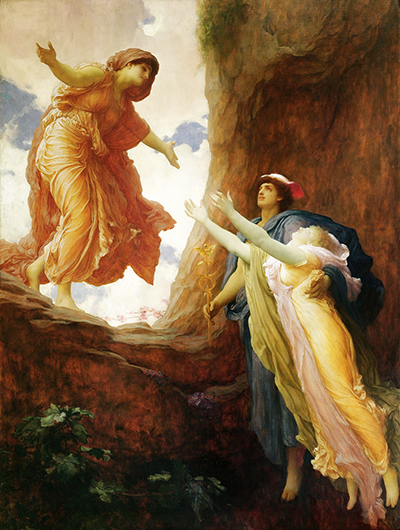
By the early 1890s Leighton was still building paintings through successive studies. For The Return of Persephone he had to coordinate the upward reach of Persephone with the downward reach of her mother, Demeter. Two chalk drawings now at the National Museum of Western Art in Tokyo were formerly listed as unattributed. The studio stamps, inscriptions and correspondence between the poses and the finished canvas in Leeds allowed the museum to connect the sheets to the painting. They preserve some of the small decisions behind the public exhibition picture, right down to the direction of each woman's arms. [31]
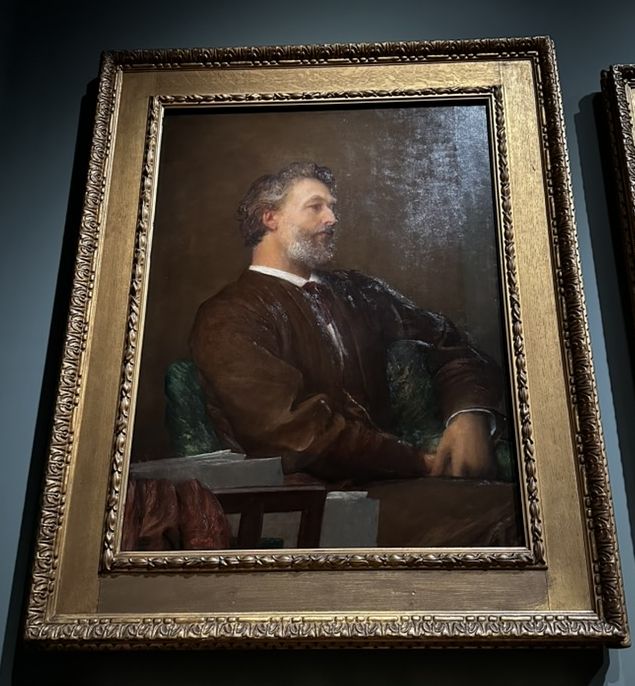
George Frederic Watts’s portrait of Frederic Leighton, 1881, National Portrait Gallery, NPG 1049. My photo from the National Portrait Gallery, London, on 5 November 2026. Image source. Public domain. Gallery photograph cropped to show the framed portrait.
Leighton’s travels on film
Leighton House follows how travel and collecting fed Leighton’s work in London.
Frederic Leighton and his travels | Leighton House
Curators Daniel Robbins and Hannah Lund follow Leighton’s travels and the places he painted.
Watch on YouTubeFinal years and reputation, 1893 onward
In the last years of Leighton's life, Dorothy Dene and Mary Lloyd were among the professional models who helped him develop distinct characters and poses. Dene also pursued an acting career, with performances in New York. She sat for the late Clytie, according to Leighton's neighbour and biographer Emilie Barrington. Leighton House identifies Lloyd with works including Lachrymae and 'Twixt Hope and Fear. The sitter for Flaming June has been identified differently by museums, and the surviving evidence leaves the question open. Leighton never married. His guarded correspondence has left room for speculation about his sexuality and possible fatherhood. The surviving primary evidence leaves both questions unresolved. His collaborations with Dene and Lloyd are better documented, and their work helps explain how his last paintings took shape. [6] [32] [33]
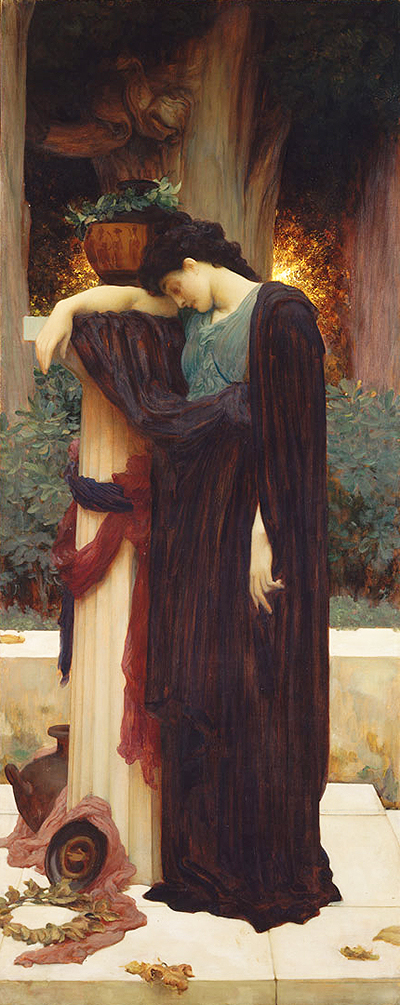
Angina troubled Leighton in his final years, yet he continued to work. At his studio's Show Sunday in April 1895, visitors saw Flaming June before it went to the Royal Academy. At the same exhibition, Lachrymae showed how differently he could use a single female figure. The sleeping woman in Flaming June is folded into a glowing circle of orange fabric, while the mourner in Lachrymae stands beside a memorial, her dark robes contained by a series of severe verticals. In the latter, Leighton carried those lines into the frame he designed. Seeing the works together helps explain the range that late visitors found in the studio. [3] [33] [34]
News of a peerage came at the beginning of 1896. The letters patent creating him Baron Leighton of Stretton were dated 24 January. He died the following day at his home in Kensington. Barrington, recalling the days before the public funeral, described six late pictures gathered around the coffin, with the unfinished Clytie in the centre. She places this display before the coffin was taken to the Royal Academy on 1 February. From Burlington House it was carried through London to St Paul's Cathedral for the funeral on 3 February, with a detachment of the Artists' Volunteers in attendance. When Clytie appeared at that summer's Academy exhibition, critics associated the woman's reach towards the light with Leighton's death. The setting of the picture beside the coffin and the public knowledge of his illness help explain that reading. [1] [3] [27] [35] [36]
Leighton's death set in motion the dispersal of his collection. A committee led by Barrington opened the house as a museum in 1900. Leighton's sisters helped it acquire a collection of around seven hundred of his drawings. The paintings followed paths of their own. Flaming June circulated widely in a colour reproduction issued by The Graphic at Christmas 1896. By the early 1960s the original had resurfaced on the London art market, at a time of limited institutional interest in such pictures. Luis A. Ferré acquired it in 1963 for his Museo de Arte de Ponce in Puerto Rico. Its later loans brought it back to the city where Leighton first showed it, including an exhibition at the Royal Academy in 2024–25. In Puerto Rico, an exhibition at Ponce brought the canvas together with preparatory drawings and small landscapes on loan from Leighton House. Those paintings made during his travels and the drawings from the studio gave visitors a chance to follow the habits of observation and preparation behind a work that had become familiar on its own. [24] [33] [37]
Browse Frederic Leighton’s artworks
Explore paintings, drawings, sculptures and prints, with separate rows for identified preparatory works, reproductions and casts.
| Name | Date | Medium |
|---|---|---|
| A Girl Feeding Peacocks | Exhibited 1863 | Painting Catalogue. |
| A Recognition from ‘Romola’, engraved by Swain (Tate N04054) | published 1862 | Print Catalogue. |
| A Roman Lady | 1859 | Painting Catalogue. |
| Abram and the Angel (Tate A00733) | published 1881 | Print Catalogue. |
| Acme and Septimius | Exhibited 1868 | Painting Catalogue. |
| An Athlete Wrestling with a Python (Tate exhibition bronze) | 1877 | Sculpture Catalogue. |
| And the Sea Gave Up the Dead Which Were in It (Tate N01511) | 1891–92 | Painting Catalogue. |
| Andromache in Captivity (photogravure after Leighton) | 1889 | Print Catalogue. |
| Athlete Wrestling with a Python (Anglesey Abbey cast) | model 1877; cast 1905 | Sculpture Catalogue. |
| Athlete Wrestling with a Python (Hood reduced cast) | 1877 (inscribed model date) | Sculpture Catalogue. |
| Athlete Wrestling with a Python (Saint Louis reduced cast) | 1877 (museum date) | Sculpture Catalogue. |
| Cain and Abel (Tate A00731) | published 1881 | Print Catalogue. |
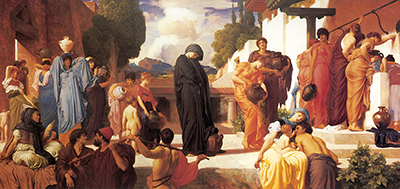
| Captive Andromache | 1888 | Painting Catalogue. |
| Cimabue's Celebrated Madonna | 1853–55 | Painting Catalogue. |
| Cimon and Iphigenia, with Many Smaller Subjects (Tate T09061) | date not known | Drawing Catalogue. |
| Crenaia, the Nymph of the Dargle | Exhibited 1880 | Painting Catalogue. |
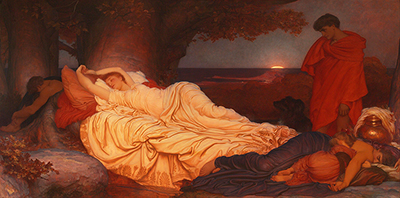
| Cymon and Iphigenia | 1884 | Painting Catalogue. |
| Daedalus and Icarus | 1869 | Painting Catalogue. |
| Dante in Exile | 1864 | Painting Catalogue. |
| Death of the First Born (Tate A00737) | published 1881 | Print Catalogue. |
| Electra at the Tomb of Agamemnon | c. 1869 | Painting Catalogue. |
| Eliezer and Rebekah (Tate A00735) | published 1881 | Print Catalogue. |
| Elijah in the Wilderness | 1877–78 | Painting Catalogue. |
| Fanny Kemble: A Study for ‘Jezebel and Ahab’ (Tate T08208) | c.1862 | Drawing Catalogue. |
| Figure Studies | Date not recorded | Drawing Catalogue. |
| Flaming June | 1895 | Painting Catalogue. |
| Gulnihal | Exhibited 1886 | Painting Catalogue. |
| Helios and Rhodes (Tate N03015) | date not known | Painting Catalogue. |
| Hercules Wrestling with Death for the Body of Alcestis | c. 1869–71 | Painting Catalogue. |
| Jonathan's Token to David | c. 1868 | Painting Catalogue. |
| Lachrymae | 1894–95 | Painting Catalogue. |
| Lieder ohne Worte | Exhibited 1861 | Painting Catalogue. |
| Light of the Harem | Exhibited 1880 | Painting Catalogue. |
| Moses Views the Promised Land (Tate A00736) | published 1881 | Print Catalogue. |
| Mrs James Guthrie | 1865 | Painting Catalogue. |
| Mrs John Hanson Walker (Tate N04731) | 1867 | Painting Catalogue. |
| Music Lesson | 1877 | Painting Catalogue. |
| Needless Alarms (Met cast) | modelled 1886; cast nineteenth century | Sculpture Catalogue. |
| Needless Alarms (Tate N05120) | 1886 | Sculpture Catalogue. |
| Pavonia | c. 1859 | Painting Catalogue. |
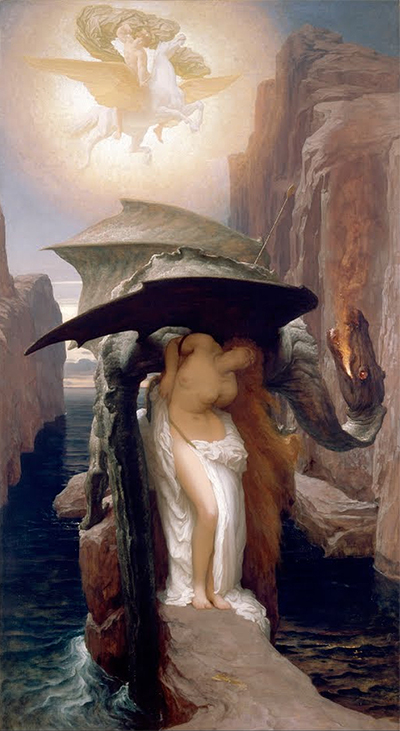
| Perseus and Andromeda | 1891 | Painting Catalogue. |
| Portrait of May Sartoris | c. 1860 | Painting Catalogue. |
| Preparing for a Festa, Florence (Tate T09062) | date not known | Drawing Catalogue. |
| Puerta de los Vientos, near Ronda, Spain (Tate N04006) | c.1886–9 | Painting Catalogue. |
| Samson and the Lions (Tate A00732) | published 1881 | Print Catalogue. |
| Samson at the Mill (Tate A00734) | published 1881 | Print Catalogue. |
| Samson Carrying the Gate (Tate A00738) | published 1881 | Print Catalogue. |
| Sketch for ‘An Athlete Wrestling with a Python’ (Tate N01761) | c.1877 | Sculpture Catalogue. |
| Sketches for Cimon and Iphigenia (Tate T09060) | date not known | Drawing Catalogue. |
| Study for The Return of Persephone (Demeter) | c. 1890–91 | Drawing Catalogue. |
| Study for The Return of Persephone (Persephone) | c. 1890–91 | Drawing Catalogue. |
| Study for ‘Needless Alarms’ (Tate N02945) | 1886 | Sculpture Catalogue. |
| Study for ‘The Discovery of Juliet Apparently Lifeless’ (Tate N01806) | c.1858 | Painting Catalogue. |
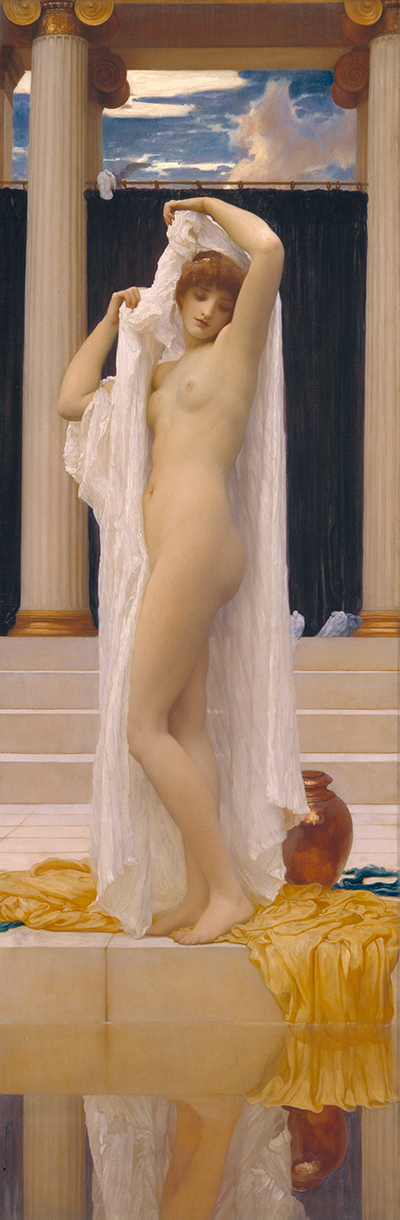
| The Bath of Psyche | Exhibited 1890 | Painting Catalogue. |
| The Daphnephoria | 1874–76 | Painting Catalogue. |
| The Death of Brunelleschi | 1852 | Painting Catalogue. |
| The Fisherman and the Siren | Exhibited 1858 | Painting Catalogue. |
| The Painter's Honeymoon | c. 1864 | Painting Catalogue. |
| The Return of Persephone | 1891 | Painting Leeds painting identified in the Met study record. |
| The Return of Persephone (preparatory oil) | c. 1890–91 | Painting Catalogue. |
| The Sluggard (Anglesey Abbey cast) | probably 1890–about 1906 | Sculpture Catalogue. |
| The Sluggard (Met cast) | modelled 1886; cast possibly before 1896 | Sculpture Catalogue. |
| The Sluggard (Museum Wales) | 1882–85 (museum date) | Sculpture Catalogue. |
| The Sluggard (Tate N01752) | 1885 | Sculpture Catalogue. |
| The Spies Escape (Tate A00730) | published 1881 | Print Catalogue. |
| Various Subjects (Tate T09063) | date not known | Drawing Catalogue. |
| View in Capri | Possibly 1859 | Painting Catalogue. |
| Wedded | 1882 | Painting Catalogue. |
| Winding the Skein | c. 1878 | Painting Catalogue. |
Discussion
Look again at the images and ideas explored in Frederic Leighton Biography. These editorial prompts invite your observations.
Reader Insights
What do Leighton’s letters to Steinle reveal about the practical work of starting over in London?
Which friendship most changed the kind of work Leighton could make or show?
Join the Conversation
Share a detail, comparison or question about Frederic Leighton Biography below.
References
- Emilie Russell Barrington, The Life, Letters and Work of Frederic Baron Leighton of Stretton, vol. II (1906), especially chapters I, III, V and VI. View source.
- National Gallery, Cimabue's Celebrated Madonna, L275, catalogue entry and Queen Victoria's diary entry of 3 May 1855. View source.
- Elizabeth Heath, National Portrait Gallery, Frederic Leighton, Baron Leighton, Later Victorian Portraits Catalogue. View source.
- Tate Britain, An Athlete Wrestling with a Python, collection entry. View source.
- University of Glasgow, Lord Frederic Leighton BART, PRA, HRSA, Mapping the Practice and Profession of Sculpture in Britain and Ireland 1851–1951. View source.
- Leighton House, Frederic Leighton, artist biography. View source.
- Leonée Ormond, Frederic Leighton and the Poets, pp. 223–24 on early education. View source.
- Ekkehard Mai, Steinle, Edward (Eduard) Jakob Ritter von, Neue Deutsche Biographie, vol. 25 (2013). View source.
- Emilie Russell Barrington, The Life, Letters and Work of Frederic Baron Leighton of Stretton, vol. I (1906), pp. 28–29 and 251–53. View source.
- Kimbell Art Museum, Portrait of May Sartoris, collection entry. View source.
- Leighton House, Leighton's Love of Music. View source.
- Daniela Parenti, Gallerie degli Uffizi, Madonna col Bambino in trono e angeli (detta Madonna Rucellai), collection entry. View source.
- Ernest Rhys, Frederic Lord Leighton: An Illustrated Record of His Life and Work, George Bell & Sons, sections on Paris and contemporary critical reception. View source.
- Marte Stinis, Music as Aesthetic Paradigm: Frederic Leighton, Albert Moore, and James McNeill Whistler, University of York doctoral thesis. View source.
- Richard Dagorne, Deux feuilles inédites de Frédéric Leighton offertes à Henry de Triqueti, French abstract, pp. 2–3 of the abstracts for La Revue des musées de France, no. 2016-3. View source.
- Royal Collection Trust, Nanna (Pavonia), RCIN 404570, description and provenance. View source.
- Royal Collection Trust, Conserving Edward VII's Favourite Paintings: Nanna and Bianca, conservation case study. View source.
- National Gallery, View in Capri, L847, catalogue entry. View source.
- Pola Durajska, Nature, Science, and Myth in the Landscape Art of Frederic Leighton, University of York doctoral thesis, abstract and vol. I. View source.
- Metropolitan Museum of Art, Woodcuts from Designs by Various Artists, Collected by Arthur Heseltine, 2012.60.1(1–111), entries 96 and 101. View source.
- National Portrait Gallery, Frederic Leighton, Baron Leighton by George Frederic Watts, NPG 1049, extended catalogue entry. View source.
- Dizionario Biografico degli Italiani, Costa, Giovanni, Treccani, on Costa's visit to London. View source.
- Leighton House, Leighton's Music and The Dance Friezes, the James Stuart Hodgson commission. View source.
- Leighton House, History of Leighton House. View source.
- Leighton House, Q&A: The Arab Hall at Leighton House, interview with Melanie Gibson. View source.
- Leighton House, Recreating Leighton's Athlete Wrestling with a Python. View source.
- Cosmo Monkhouse, Leighton, Frederic, Dictionary of National Biography, supplement (1901). View source.
- National Portrait Gallery, Frederic Leighton, Baron Leighton: All Known Portraits, entry for the Uffizi self-portrait. View source.
- Rijksmuseum, Frederick Leighton, person record and photographic portraits. View source.
- Victoria and Albert Museum, The South Court and Leighton Frescos. View source.
- National Museum of Western Art, Tokyo, Study for ‘The Return of Persephone’, D.2017-0089, Japanese catalogue entry also discussing D.2017-0092. View source.
- Leighton House, The Women Who Made Us, entries on Dorothy Dene and Mary Lloyd. View source.
- Leighton House, Frederic Leighton's Flaming June: The Making of an Icon. View source.
- Metropolitan Museum of Art, Lachrymae, 96.28, collection entry. View source.
- The London Gazette, notice of the letters patent granting the barony, no. 26705, 31 January 1896, p. 587. View source.
- Anne Helmreich, 1896: Leighton's Farewell, The Royal Academy Summer Exhibition: A Chronicle, 1769–2018, on the exhibition reception of Clytie. View source.
- Museo de Arte de Ponce, Frederick Leighton y el mediterráneo eterno, exhibition account. View source.
- Tate, The Bath of Psyche, collection record via Google Arts & Culture. View source.
- Musée d’Orsay, Beauté, morale et volupté dans l’Angleterre d’Oscar Wilde. View source.
- National Gallery, Artistic Exchanges: Corot, Costa, Leighton. View source.