 by Tom Gurney
Tom Gurney BSc (Hons) is an art history expert with over 20 years experience
Published on June 19, 2020 / Updated on November 29, 2026
Email: tomgurney1@gmail.com / Phone: +44 7429 011000
Dante in Exile: Introduction
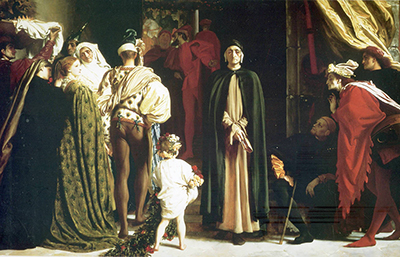
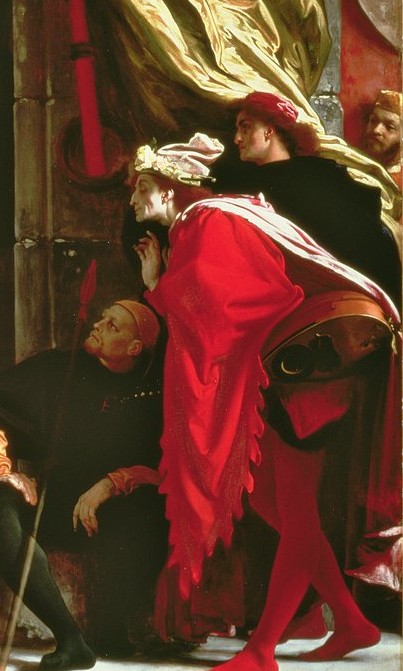
In Frederic Leighton’s Dante in Exile, a poet comes down the stairs of a palace while the people around him prepare for a festival. The man in the middle wears a dark cloak over a plain robe. To his right a jester in scarlet bends towards him, while a garland trails across the floor beside a child. Leighton exhibited the picture at the Royal Academy in 1864, where it hung in the Middle Room as catalogue no. 194. Under the title, visitors found lines from Dante’s Paradiso about how hard it is to go up and down another person’s stairs. [1]
The finished oil on canvas measures 60 by 100 inches, about 152 by 254 centimetres. Leighton uses that width to make room for the court’s preparations on both sides of the poet. Dante has reached the foot of the staircase with a small closed book in his hands. He shares the foreground with the people who watch him, yet the dark opening behind his head and the air around his shoulders give him a space of his own. [2]
At a Glance
- ExhibitedRoyal Academy, 1864, no. 194
- MediumOil on canvas
- SettingThe court of the Scaligeri at Verona
- Current locationUnconfirmed
This work across Frederic Leighton’s career
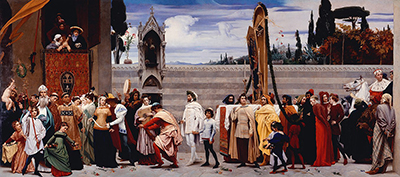
Cimabue’s Celebrated Madonna
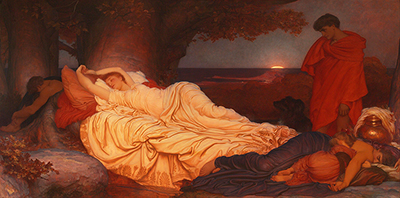
1853–55Lachrymae
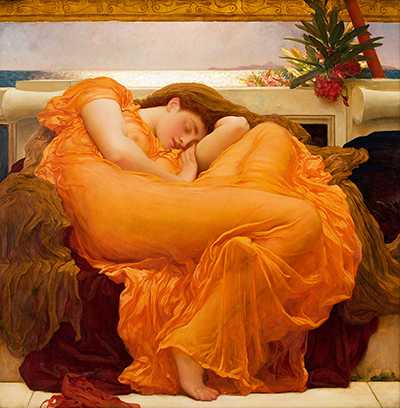
1894–95Flaming June
c. 1895Contents
- Why Dante is on the stairs
- The people around Dante
- Two ways to picture Dante
- The painting’s sale and later history
- Annotated details
Why Dante is on the stairs
Dante belonged to the White Guelf faction in Florence and was banished in 1302 after the Black Guelfs took power. He spent the rest of his life away from the city. Verona was one of the places where he found refuge, and Cangrande della Scala received him there. Ernest Rhys, writing about Leighton in 1896, identifies the setting as Cangrande’s palace in Verona. The exact scene at the stairs comes from the painter’s elaboration of the poem. [3] [4] [5]
In Paradiso, the third part of the Divine Comedy, Dante makes his own exile the subject of a prophecy. The poet was already living away from Florence when he wrote about a journey set before his banishment. In Canto XVII, his ancestor Cacciaguida tells the pilgrim Dante what lies ahead. First comes the loss of everything he loves. Then he will learn the taste of salt in someone else’s bread and how hard it is to descend and climb someone else’s stairs. The difficulty of an ordinary action conveys the effort of living at another person’s pleasure. [6]
Cacciaguida also warns Dante about the company of his fellow exiles, then predicts that he will find generosity among the della Scala family. There is room in the poem for gratitude towards a host and for bitterness about the conditions that make a host necessary. The Academy catalogue quotes Henry Francis Cary’s translation of the lines on bread, stairs and bad company. Leighton gives the stairs a place in the composition and invents the company on either side of them. The jester’s taunt turns years of dependence into a single encounter. Later in the canto, Cacciaguida urges Dante to tell the truth about what he has seen even if his account offends powerful people. The closed book in Leighton’s picture gives that exchange an echo. Dante has little to say to the court, but the person who writes will get to tell the story. [1] [6]
The people around Dante
The jester directs the eye towards Dante by leaning across a strip of open floor. His scarlet clothes draw attention to the gesture, as though his mock courtesy were part of his performance. The seated guard below him looks up from a lower level, and one of the spectators behind him appears to watch more thoughtfully. Across the picture, a woman in green turns her face towards the poet. The spectators have different things to do and different ways of looking. Some seem curious, some amused, and others concerned with the festival. Dante can be the centre of their attention without becoming part of their company. [2] [5]
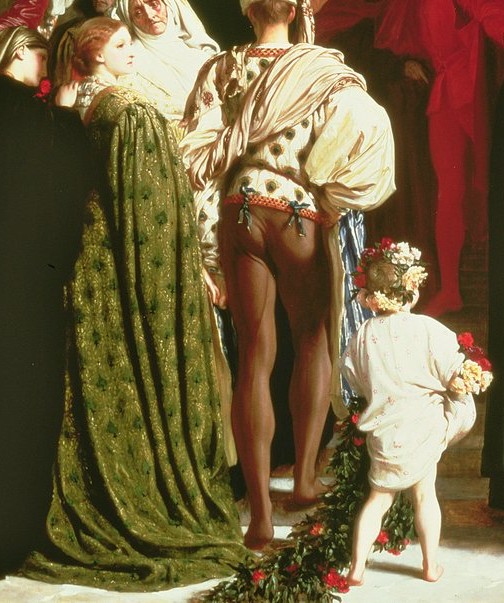
The child in white stands close to Dante and looks straight up at him. A wreath rests on the child’s head, and a garland curves across the flagstones. The flowers lead the eye towards Dante’s feet, where the final step meets the space occupied by the crowd. Beside the child, an elaborately dressed figure seen from behind has a garment dotted with peacock eyes. Near the opposite edge, a stretch of gold fabric catches the light above the jester. The fabrics and decorations give the festival its appeal, which makes the sober vertical folds of Dante’s cloak more conspicuous. [2] [5]
A surviving study offers a glimpse of how Leighton prepared these minor figures. Christie’s catalogued a sheet of black and white chalk on blue paper, measuring 26 by 41 centimetres, with two heads it connects to the finished picture. It links the larger head to a figure in the right foreground and the smaller to the attendant at the far left carrying a tray on his head. Christie’s tentatively describes the load as a peacock pie. The study shows the attention Leighton gave to faces at the edges of the action, where a glance or a tilt of the head could change the mood of the whole group. [7]
Annotated Details from Dante in Exile
The numbered points identify visible features discussed in this article. Return from each detail to the numbered overview. Frederic Leighton, Dante in Exile, 1864. Image source. Public domain. Resized proportionally.
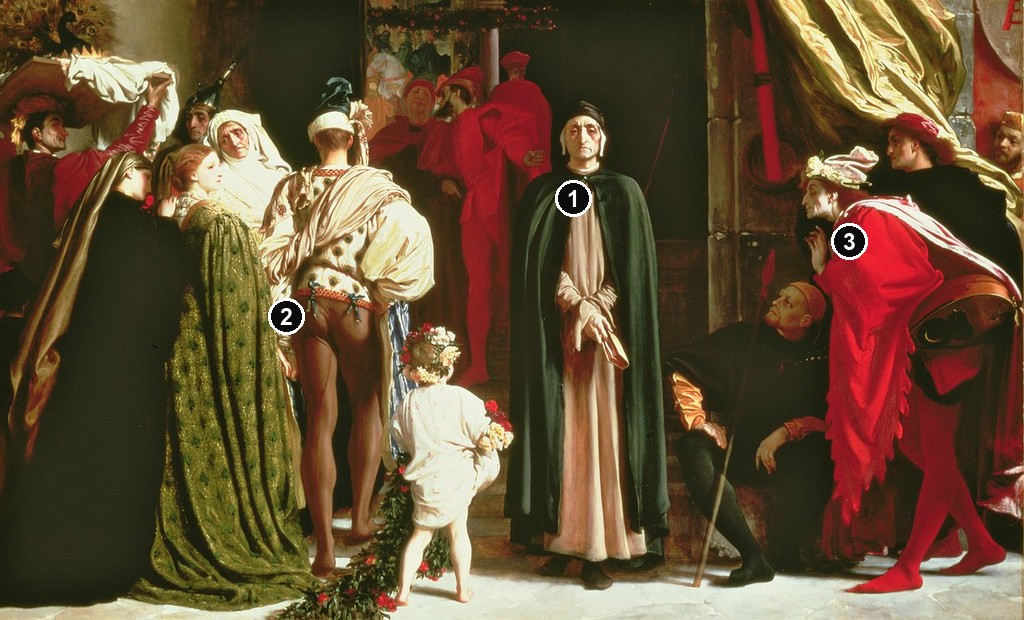
Details from DANTE IN EXILE
Compare the cropped details with the source images above. Notice how their colours, shapes and positions contribute to the larger compositions.
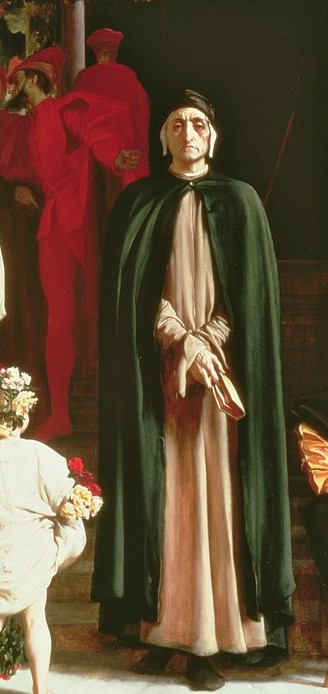
An upright figure in the opening
Dark outer cloth outlines Dante’s height between the court groups. A break in the crowd leaves his still pose and joined hands room to register.
Children and richly dressed company
The lit clothes of the children draw attention towards the opening beside Dante. Dense pattern and diagonal drapery distinguish the figures farther left.
The group in red at the right
A strong passage of red stands clear against the dark interior. Looking along the direction of the nearby profiles shows how closely the other figures sit or stand together.
Two ways to picture Dante
Florence Cathedral offers an earlier image of Dante in Domenico di Michelino’s painting of 1465. There the red-clad poet wears a crown of laurel and holds the Comedy open at its first lines. Rays from the pages reach Florence across the picture. Leighton keeps the familiar sharp features while dressing Dante in subdued colours and closing the book in his hands. The two settings make the difference especially clear. Domenico’s Dante stands beside the city that now celebrates him. Leighton’s has to get through a gathering in somebody else’s house. [2] [8]
Leighton had already painted Dante as a witness to another artist’s reception. In Cimabue’s Celebrated Madonna, exhibited in 1855, the poet watches from the edge while Cimabue and the young Giotto take their places near the centre of a Florentine procession. Art historian Joseph A. Kestner connects the two crowds and the different places Leighton gives his artists within them. In the earlier picture an artwork is an occasion for public celebration. In Verona the preparations have much of the colour and movement of a procession, but the poet at their centre has to pass through without their welcome. [2]
Francis Turner Palgrave admired the picture’s drawing and the small exchanges among the courtiers and servants in his account of the 1864 exhibition. He wished for more life in Dante himself, finding the figure stiff. Compared with the jester’s quick bend or the child’s upturned face, Dante’s body barely yields. His stillness leaves it to the people on either side to show how much the encounter costs him. [9]
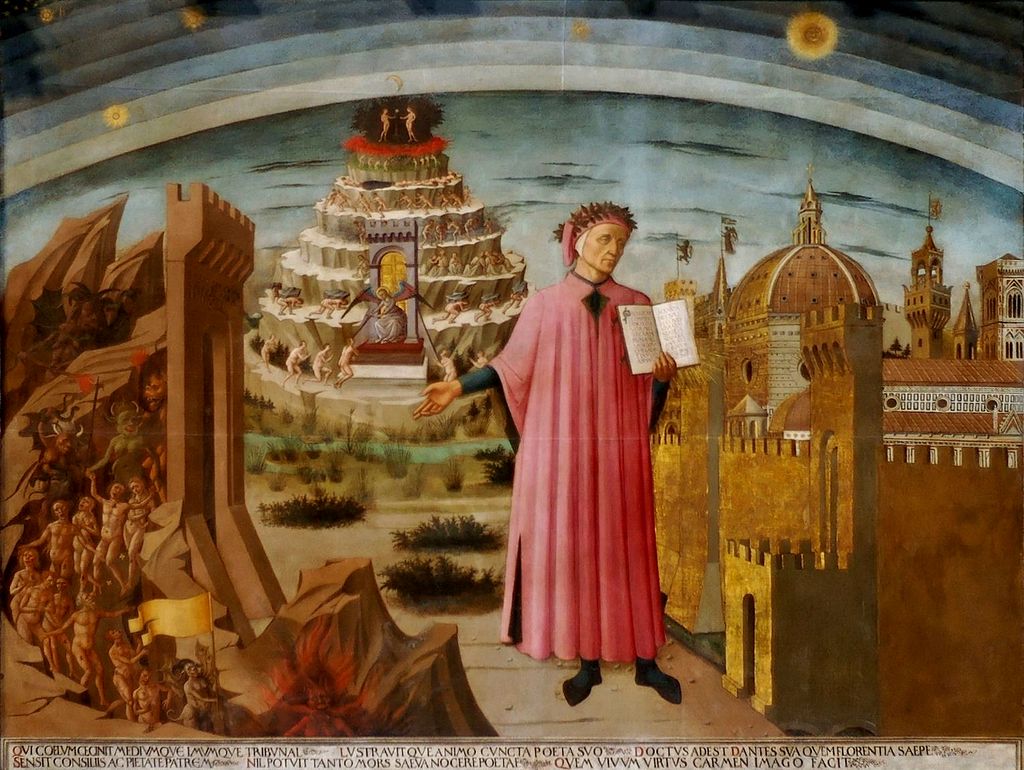
Domenico di Michelino, Dante with Florence and the Realms of the Divine Comedy, 1465. Florence Cathedral. Image source. Public domain. Resized proportionally.
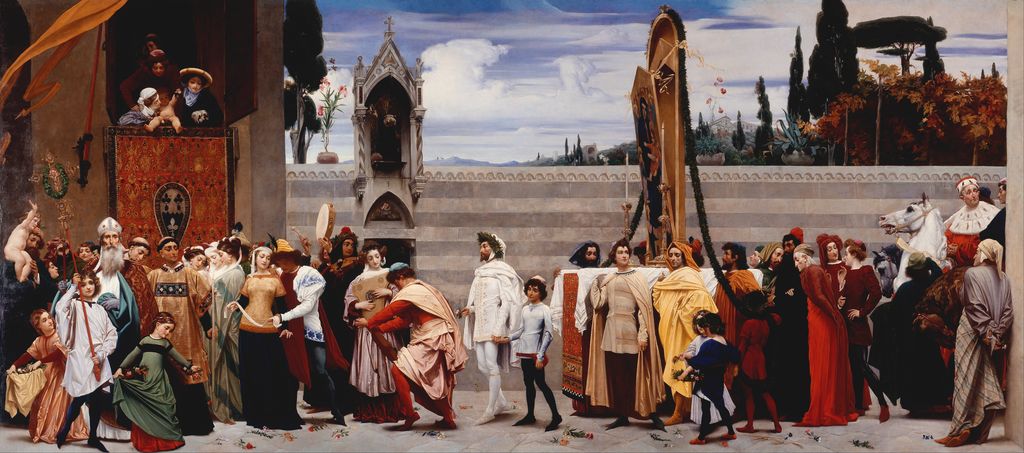
Frederic Leighton, Cimabue’s Celebrated Madonna, 1853–55. Royal Collection, on loan to the National Gallery. Image source. Public domain. Resized without changing the composition.
The painting’s sale and later history
Leighton told his father that the dealer Ernest Gambart paid him £1,050 for Dante in Exile. The dealer’s own portrait, painted by J. P. Knight, was listed four entries after Leighton’s picture in the 1864 catalogue, in the same room. In an account published in 2022, Leighton House curator Daniel Robbins connected that sale and the painter’s election as an Associate of the Royal Academy in 1864 with his confidence to proceed with plans for a studio-house. Leighton acquired a site on Holland Park Road in Kensington and engaged the architect George Aitchison. [10] [1] [11]
By 1890 the canvas was in the collection of Frederick William Cosens. It fetched 580 guineas at the Christie’s sale of his collection on 17 May. Christie’s later recorded the finished painting’s sale at Sotheby’s on 19 June 1990 as lot 27 in its catalogue entry for the separate chalk study. Kestner published a photograph of the canvas in 1993, crediting Sotheby’s and identifying it then as privately held. Robbins identified it with the Andrew Lloyd Webber collection in April 2022. [12] [7] [2] [11]
Browse Frederic Leighton’s artworks
Explore paintings, drawings, sculptures and prints, with separate rows for identified preparatory works, reproductions and casts.
| Name | Date | Medium |
|---|---|---|
| A Girl Feeding Peacocks | Exhibited 1863 | Painting Catalogue. |
| A Recognition from ‘Romola’, engraved by Swain (Tate N04054) | published 1862 | Print Catalogue. |
| A Roman Lady | 1859 | Painting Catalogue. |
| Abram and the Angel (Tate A00733) | published 1881 | Print Catalogue. |
| Acme and Septimius | Exhibited 1868 | Painting Catalogue. |
| An Athlete Wrestling with a Python (Tate exhibition bronze) | 1877 | Sculpture Catalogue. |
| And the Sea Gave Up the Dead Which Were in It (Tate N01511) | 1891–92 | Painting Catalogue. |
| Andromache in Captivity (photogravure after Leighton) | 1889 | Print Catalogue. |
| Athlete Wrestling with a Python (Anglesey Abbey cast) | model 1877; cast 1905 | Sculpture Catalogue. |
| Athlete Wrestling with a Python (Hood reduced cast) | 1877 (inscribed model date) | Sculpture Catalogue. |
| Athlete Wrestling with a Python (Saint Louis reduced cast) | 1877 (museum date) | Sculpture Catalogue. |
| Cain and Abel (Tate A00731) | published 1881 | Print Catalogue. |
| Captive Andromache | 1888 | Painting Catalogue. |
| Cimabue's Celebrated Madonna | 1853–55 | Painting Catalogue. |
| Cimon and Iphigenia, with Many Smaller Subjects (Tate T09061) | date not known | Drawing Catalogue. |
| Crenaia, the Nymph of the Dargle | Exhibited 1880 | Painting Catalogue. |
| Cymon and Iphigenia | 1884 | Painting Catalogue. |
| Daedalus and Icarus | 1869 | Painting Catalogue. |
| Dante in Exile | 1864 | Painting Catalogue. |
| Death of the First Born (Tate A00737) | published 1881 | Print Catalogue. |
| Electra at the Tomb of Agamemnon | c. 1869 | Painting Catalogue. |
| Eliezer and Rebekah (Tate A00735) | published 1881 | Print Catalogue. |
| Elijah in the Wilderness | 1877–78 | Painting Catalogue. |
| Fanny Kemble: A Study for ‘Jezebel and Ahab’ (Tate T08208) | c.1862 | Drawing Catalogue. |
| Figure Studies | Date not recorded | Drawing Catalogue. |
| Flaming June | 1895 | Painting Catalogue. |
| Gulnihal | Exhibited 1886 | Painting Catalogue. |
| Helios and Rhodes (Tate N03015) | date not known | Painting Catalogue. |
| Hercules Wrestling with Death for the Body of Alcestis | c. 1869–71 | Painting Catalogue. |
| Jonathan's Token to David | c. 1868 | Painting Catalogue. |
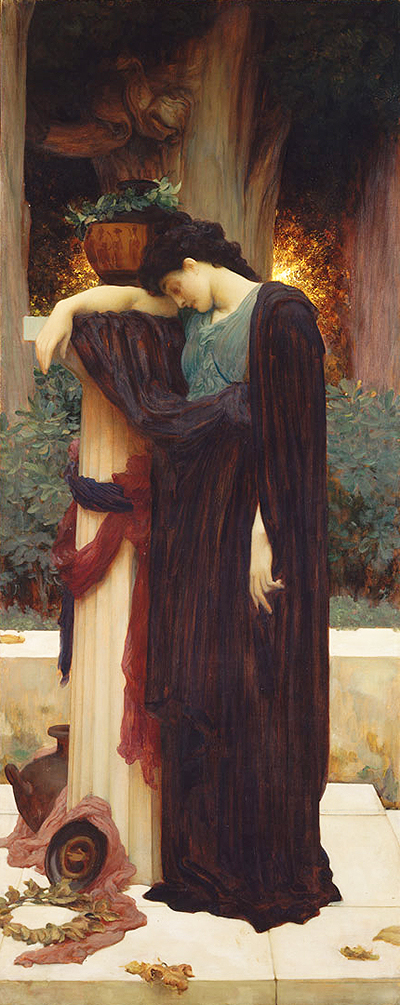
| Lachrymae | 1894–95 | Painting Catalogue. |
| Lieder ohne Worte | Exhibited 1861 | Painting Catalogue. |
| Light of the Harem | Exhibited 1880 | Painting Catalogue. |
| Moses Views the Promised Land (Tate A00736) | published 1881 | Print Catalogue. |
| Mrs James Guthrie | 1865 | Painting Catalogue. |
| Mrs John Hanson Walker (Tate N04731) | 1867 | Painting Catalogue. |
| Music Lesson | 1877 | Painting Catalogue. |
| Needless Alarms (Met cast) | modelled 1886; cast nineteenth century | Sculpture Catalogue. |
| Needless Alarms (Tate N05120) | 1886 | Sculpture Catalogue. |
| Pavonia | c. 1859 | Painting Catalogue. |
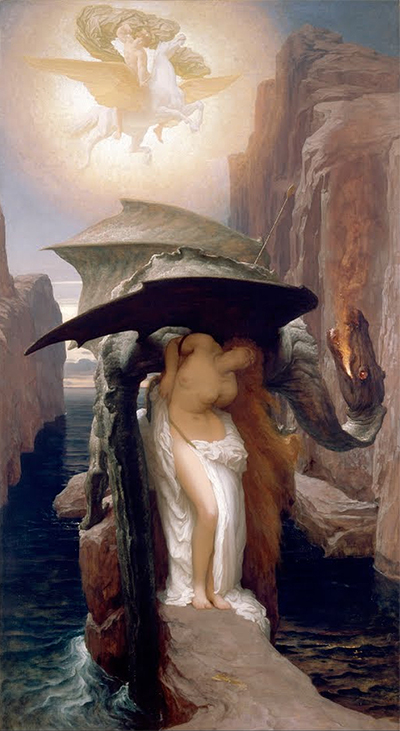
| Perseus and Andromeda | 1891 | Painting Catalogue. |
| Portrait of May Sartoris | c. 1860 | Painting Catalogue. |
| Preparing for a Festa, Florence (Tate T09062) | date not known | Drawing Catalogue. |
| Puerta de los Vientos, near Ronda, Spain (Tate N04006) | c.1886–9 | Painting Catalogue. |
| Samson and the Lions (Tate A00732) | published 1881 | Print Catalogue. |
| Samson at the Mill (Tate A00734) | published 1881 | Print Catalogue. |
| Samson Carrying the Gate (Tate A00738) | published 1881 | Print Catalogue. |
| Sketch for ‘An Athlete Wrestling with a Python’ (Tate N01761) | c.1877 | Sculpture Catalogue. |
| Sketches for Cimon and Iphigenia (Tate T09060) | date not known | Drawing Catalogue. |
| Study for The Return of Persephone (Demeter) | c. 1890–91 | Drawing Catalogue. |
| Study for The Return of Persephone (Persephone) | c. 1890–91 | Drawing Catalogue. |
| Study for ‘Needless Alarms’ (Tate N02945) | 1886 | Sculpture Catalogue. |
| Study for ‘The Discovery of Juliet Apparently Lifeless’ (Tate N01806) | c.1858 | Painting Catalogue. |
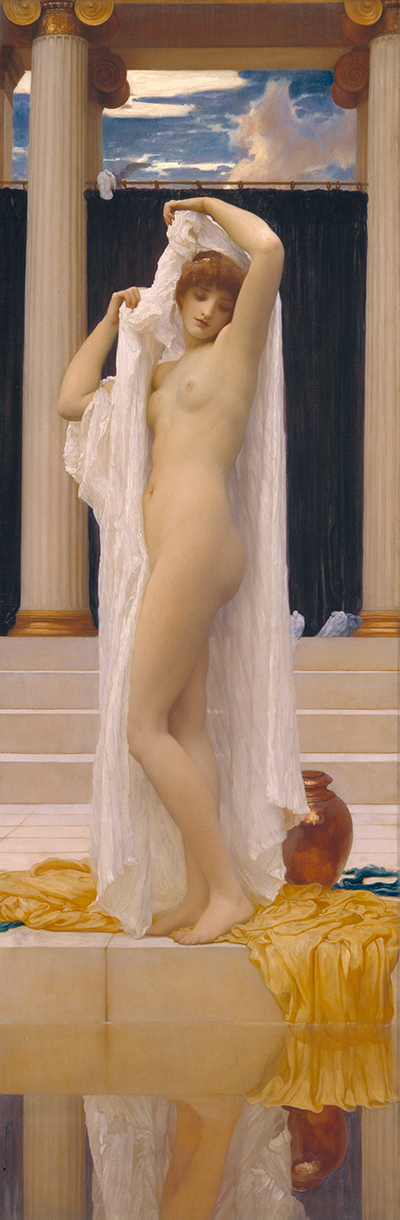
| The Bath of Psyche | Exhibited 1890 | Painting Catalogue. |
| The Daphnephoria | 1874–76 | Painting Catalogue. |
| The Death of Brunelleschi | 1852 | Painting Catalogue. |
| The Fisherman and the Siren | Exhibited 1858 | Painting Catalogue. |
| The Painter's Honeymoon | c. 1864 | Painting Catalogue. |
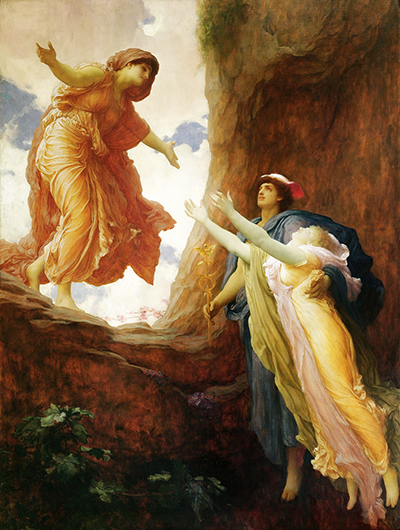
| The Return of Persephone | 1891 | Painting Leeds painting identified in the Met study record. |
| The Return of Persephone (preparatory oil) | c. 1890–91 | Painting Catalogue. |
| The Sluggard (Anglesey Abbey cast) | probably 1890–about 1906 | Sculpture Catalogue. |
| The Sluggard (Met cast) | modelled 1886; cast possibly before 1896 | Sculpture Catalogue. |
| The Sluggard (Museum Wales) | 1882–85 (museum date) | Sculpture Catalogue. |
| The Sluggard (Tate N01752) | 1885 | Sculpture Catalogue. |
| The Spies Escape (Tate A00730) | published 1881 | Print Catalogue. |
| Various Subjects (Tate T09063) | date not known | Drawing Catalogue. |
| View in Capri | Possibly 1859 | Painting Catalogue. |
| Wedded | 1882 | Painting Catalogue. |
| Winding the Skein | c. 1878 | Painting Catalogue. |
Discussion
Look again at the images and ideas explored in Dante in Exile. These editorial prompts invite your observations.
Reader Insights
Which figure shows the strongest reaction to Dante as he passes?
How does the still figure in the centre change the movement of the surrounding groups?
Join the Conversation
Share a detail, comparison or question about Dante in Exile below.
References
- Royal Academy of Arts, The Exhibition of the Royal Academy of Arts, The Ninety-Sixth (1864), p. 12, no. 194, Paul Mellon Centre digitised facsimile View source.
- Joseph A. Kestner, “Constructing the Renaissance: Leighton and Pater”, Journal of Pre-Raphaelite Studies, new series 2, no. 1 (1993), pp. 1–15, especially pp. 3–4, 6–7 and plate 5 View source.
- Bibliothèque nationale de France, “Dante Alighieri”, biographical introduction View source.
- Internet Culturale, “L’ultimo rifugio: Verona e Ravenna”, Dante’s stay with Cangrande della Scala View source.
- Ernest Rhys, Frederic Lord Leighton (1896), chapter III, account of Dante at Verona View source.
- Dante Alighieri, Paradiso, canto XVII, especially lines 46–84 and 106–142, English translation by Henry Wadsworth Longfellow View source.
- Christie’s, Frederic Leighton, Study for ‘Dante in Exile’, lot 1960406, lot essay View source.
- Opera di Santa Maria del Fiore, Domenico di Michelino, Dante, Florence and the Divine Comedy (1465) View source.
- Francis Turner Palgrave, “The Royal Academy of 1864”, Essays on Art (1866), pp. 51–52 View source.
- Frederic Leighton, letter to his father, 1864, in Mrs Russell Barrington, The Life, Letters and Work of Frederic Leighton, vol. II (1906), pp. 114–115 View source.
- Daniel Robbins, “Instant Expert: Lord Leighton’s Palace”, The Arts Society, 23 April 2022 View source.
- W. Roberts, Memorials of Christie’s: A Record of Art Sales from 1766 to 1896, vol. II (1897), p. 149, account of the Cosens sale View source.